Lincoln National Bank (New York, NY)

Episode Information

Episode UID
260801294
Episode Type
Run β†’ Suspension β†’ Reopening
Bank Type
national
Bank ID
26080 national
Charter Number
2608
Start Date
October 24, 1907
Location
New York, New York (40.714, -74.006)

Metadata

Model
gemini-3-flash-preview (chosen from majority vote of a three-model LLM ensemble)
Short Digest
41e722d1fb7078b8

Response Measures

Accommodated withdrawals, Partial suspension, Full suspension

Other: The bank initially accommodated withdrawals during a minor run in October 1907. However, as part of the broader Panic of 1907, New York banks collectively suspended specie payments, issued clearinghouse certificates, and invoked notice clauses for time deposits.

Clearinghouse involved: Yes (loan, examination, or other measures)

Description

The bank experienced minor withdrawals during the Panic of 1907 and was subject to the city-wide suspension of cash payments and use of clearing house certificates.

Events (5)

1. January 4, 1882 Chartered
Source
historical_nic
2. October 24, 1907 Run
Cause
Macro News
Cause Details
Systemic financial panic in New York City (Panic of 1907).
Measures
The bank remained open and reported opening seventy new accounts despite the withdrawals.
Newspaper Excerpt
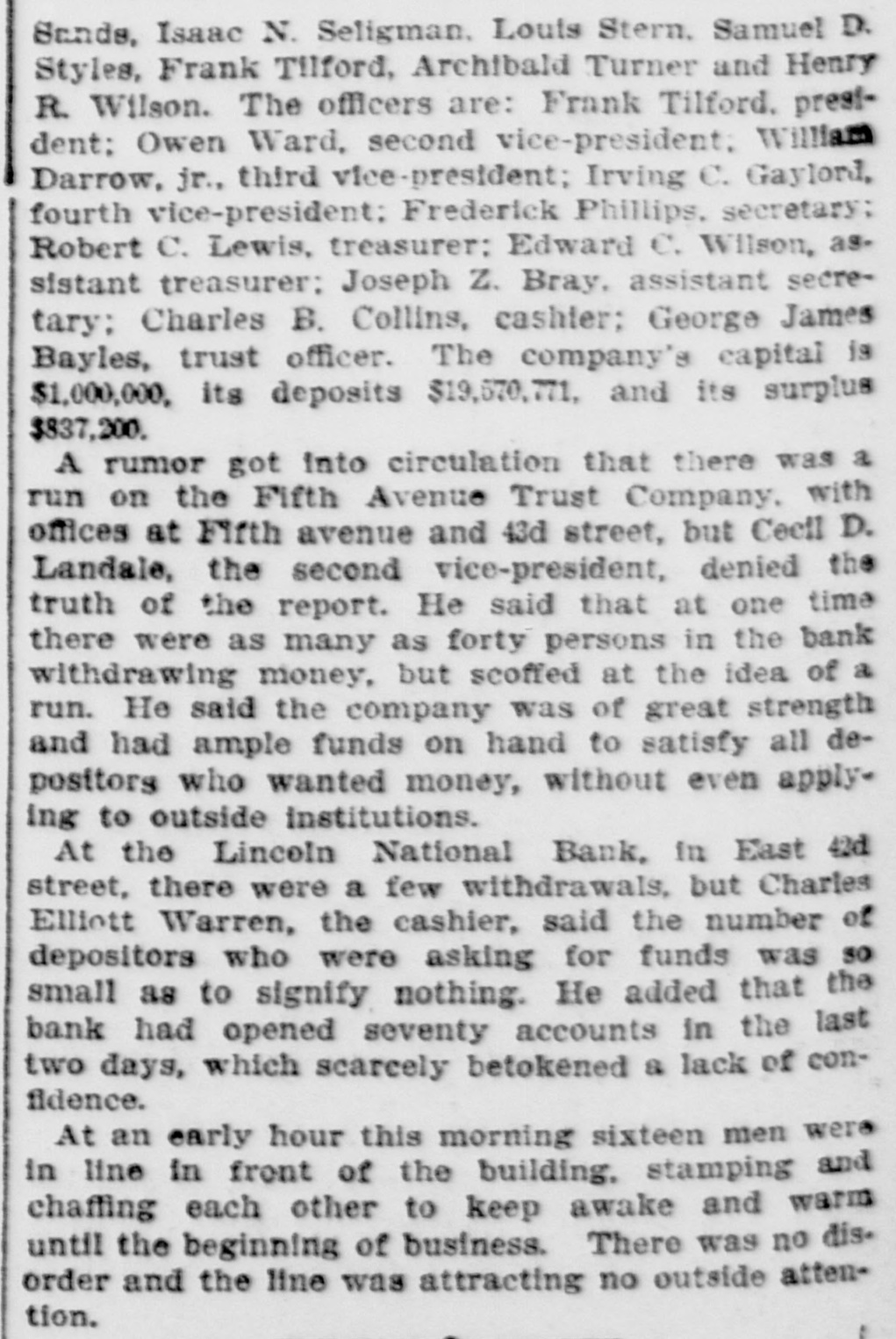
At the Lincoln National Bank, in East 42d street, there were a few withdrawals... sixteen men were in line in front of the building, stamping and chaffing each other to keep awake and warm until the beginning of business.
Source
newspapers
3. October 26, 1907 Suspension
Cause
Macro News
Cause Details
City-wide suspension of cash payments by New York Clearing House banks during the Panic of 1907.
Newspaper Excerpt
Last week New York determined to refuse to pay in money, but to issue in lieu of cash, clearing house certificates.
Source
newspapers
4. January 1, 1908* Reopening
Newspaper Excerpt
it will not be many days until he New York banks will resume the payment of currency and when this is done the panic will be over. ... New York banks have been announcing for some time that specie payments are about to be resumed. (Dec 1907/Feb 1908 context)., date: 1908-01-00
Source
newspapers
5. September 30, 1920 Voluntary Liquidation
Source
historical_nic

Newspaper Articles (13)

Article from New-York Tribune, October 25, 1907

Click image to open full size in new tab

Article Text

Sands, Isaac N. Seligman. Louts Stern. Samuel D. Styles, Frank Tilford, Archibald Turner and Henry R. Wilson. The officers are: Frank Tilford. prestdent: Owen Ward, second vice-president, William Darrow, jr., third vice-president; Irving €. Gaylord, fourth vice-president; Frederick Phillips. secretary: Robert C. Lewis, treasurer; Edward €. Wilson, assistant treasurer; Joseph Z. Bray, assistant secretary; Charles B. Collins, cashier: George James Bayles, trust officer. The company's capital is $1,000,000. its deposits $19,570,771, and its surplus $837,200. A rumor got into circulation that there was a run on the Fifth Avenue Trust Company. with offices at Fifth avenue and 43d street, but Cecil D. Landale, the second vice-president, denied the truth of the report. He said that at one time there were as many as forty persons in the bank withdrawing money, but scoffed at the idea of a run. He said the company was of great strength and had ample funds on hand to satisfy all depositors who wanted money, without even applying to outside institutions. At the Lincoln National Bank, in East 42d street, there were a few withdrawals, but Charles Elliott Warren, the cashier, said the number of depositors who were asking for funds was so small as to signify nothing. He added that the bank had opened seventy accounts in the last two days, which scarcely betokened a lack of confidence. At an early hour this morning sixteen men were in line in front of the building, stamping and chaffing each other to keep awake and warm until the beginning of business. There was no disorder and the line was attracting no outside attention.

Article from The Madison Daily Leader, October 30, 1907

Click image to open full size in new tab

Article Text

SCARE IS SUBSIDING Runs Upon New York Banks Practically Cease. STOCK MARKET UNSTEADY Calling in of Loans Causes a Decline in Prices, Canadian Pacific Leading in the Slump-Worldwide Scramble for Gold. New York, Oct. 30.-The financial situation is without notable developments. and the abating interest indicates that the public has pretty well gotten over its scare. The stock markets is a little unsteady, but without extreme agitation. The announcement at the ImpeS rial bank of Germany a raised its discount rate from 5 1/2 to 6 1/2 per cent in order to protect its gold holdings was not unexpected by bankers here. It is thought quite likely that the Bank of England will follow suit by raising its rate at the regular meeting on Thursday. The scramble for gold is such at all the financial centersLondon, Paris, Berlin and New York -that the metel will go to the highest bidder and under present conditions New York is likely to appear for a time in this role. Her ability to get gold is due not only to the need for it, but to the large credits which are being established by the movement of the crops and other products-notably wheat, cotton, copper, tobacco and meats-and by the sale of American securities. These influences are usually more potent than artificial measures to obtain the yellow metal. It is believed this will be effective to place sufficient gold at the command of the New York market and to maintain credit and cause the resumption of banking operations in the usual manner within a few days. Runs upon the banks here have practically ceased since the banks adopted the policy of paying large depositors in checks. Some transfers of accounts are being made from the smaller to the larger banks, which resulted in adverse balances against the former, but strengthening the ability of the larger institutions to meet pressure and to support the market.


Article from The Newspaper, November 1, 1907

Click image to open full size in new tab

Article Text

THE financial situation in New York, contrary to the general belief did reach west and has OC casioned some inconvenience. The entire trouble hinges on the system of doing business. All western banks use Denver as a depository for surplus funds. Denver in turn sends the money to New York. Their banks utter it on loans to the gamblers on Wall street and as a result when speculation has gone to a certain limit and panic sets in there the strained relations extend with marvelous rapidity west. Last week New York determined to refuse to pay in money, but to issue in lieu of cash, clearing house certificates. This effectually tied up the huge deposits of western banks and they speedily adopted the New York system of refusing to pay out cash in any except small amonuts. This action was taken on the permission of the comptroller of the currency and of the state bank examiner. Of course this seems arbitrary and unfair, but at the same time it effectually stops runs and in some cases protects depositors. It is also only a temporary expedient and we understand will be called off November 5. Paonia has not been effected to any ex tent by the flurry.


Article from Lewiston Evening Teller, November 22, 1907

Click image to open full size in new tab

Article Text

Chicago banks are ready to resume cash business and will do so whenever New York banks consent and co-operate. The magnates who have been asking the people to have confidence can now reciprocate and loosen up the wheels of trade bot' east and west. It was the east that locked the doors on western reserves and started the flurry among western institutions. but in spite of that the west has had no run on its. banks and has only used due precaution In guarding its cash waiting for the east to get over its scare and resume normal business relations. New York can very properly be instructed that the only proper way to resume is to resume.


Article from The Roswell Daily Record, December 3, 1907

Click image to open full size in new tab

Article Text

"The current number of Harper's Weekly contains an editorial 'roast' of the clearing house certificates issued in Las Vegas, New Mexico. In view of the fact that the financial difficulties of the West were wholly due to the suspension of payment by the New York banks, and the issue by these banks of clearing house certificates and other forms of 'Johnsmith' currencyβ€”as it is now calledβ€”it would seem that the Weekly might have found a target for its ammunition nearer home.β€”Socorro Chieftain.


Article from Deseret Evening News, December 3, 1907

Click image to open full size in new tab

Article Text

# RESUMPTION. Horace Greely was wont to say that "the way to resume is to resume." The New York banks have been announcing for some time that specie payments are about to be resumed. It appears that the bankers elsewhere are ready to pay cash as soon as New York decides to keep its promises. It is noted as one peculiar feature of the present panic that some of the New York bankers will become rich because of it. And we doubt not that the most immediate cause of the suspension of cash payment by the banks all over the country was the stoppage of such payments by the banks in New York. As long as the banks of that city continue to withhold payment of their obligations, there seems to be no reason why they might not be purchasing the government bonds and so making a profit out of withholding cash payments to the rest of the country. Such a suggestion is made in many quarters, and the way to negative any such suspicion is for the New York banks to pay their obligations inland in the current money of the realm.


Article from The Montgomery Advertiser, December 17, 1907

Click image to open full size in new tab

Article Text

That government officials feel that the backbone of the panic is broken is evidenced from the fact that postal authorities at Wasnington have sent letters to all postmasters whose offices are depositories either for registry and money order accounts, to prepare to receive checks from the smaller offices. In the letter it is stated that the authorities feel that it will not be many days until he New York banks will resume the payment of currency and when this is done the panic will be over. While this circular letter was sent to all postoffices that are depositories for government accounts, there are but few of them effected by the order. The Montgomery office is not a depository but the instructions are particularly significant throughout the country from the fact that it gives the views to a certain extent of officials in Washington on the money situation. According to these instructions conditions are rapidly becoming better as the postal officials would not say this unless they knew and they are in a position to know the facts if anyone is. The instructions will be welcomed by a great many offices in different parts of the country as the arrangement since October 30 has been very inconvenient. By the action of the banks handling United States accounts it has been necessary in many cases for the smaller offices to send all of their money to the depositories in currency. The government requires that all of its checks be paid in currency and when money became tight the banks refused to take government checks for


Article from The Times Dispatch, February 7, 1908

Click image to open full size in new tab

Article Text

City were increased on the security of stock and bond loans from $281,000,000 to $302,000,000. Three hundred and twelve millions loaned on collateral of Wall Street, and yet they suspended payments to their individual depositors and to their banking correspondents throughout the country. And they did it when they had money in their treasury with which to meet their obliga-tions." ### Kept Cash; Got Premium. Mr. Culberson declared that while New York had so much cash in its banks Southern banks were paying a premium for cash. The Aldrich bill, he declared, would give the banks more power and would foster stock and bond speculation by the banks and still further discriminate against the general public, and in the interest of the bondholding classes. "Against this policy," he added, "I want to enter my earnest and emphatic protest." Senator Hopkins replied briefly to Mr. Culberson. "Every statement made by the Senator," he said, "has been answered by the Secretary of the Treasury in his report." Mr. Culberson said the secretary refused to give the Texas banks deposits they asked for, and Mr. Hopkins replied that he had done the same thing in respect to Chicago banks, as he put the money where he believed the greatest emergency existed. The consideration of Mr. Culberson's resolution was postponed, and it was allowed to lie on the table.


Article from The Roswell Daily Record, November 29, 1909

Click image to open full size in new tab

Article Text

U. S. BANK A FAILURE Washington, Nov. 29.-That the United States has had two unsuccessful experiences at running banks, and should, therefore, act slowly in considering Wall Street's central government bank idea, is being urged by the small bankers of the country, who are avowedly antagonistic to the program of Senator Aldrich. The country bankers are directing attention to the fact that the greatest obstacle in Canada's struggle to develop has been her antiquated systerm of big central banks with branches in every country town, through which all surplus deposits are centralized in the large citires. The Canadian merchant or manufacturer in the outlying town has been unable to secure bank accomodations needed in his business, while idle money from his own town, which a locally owned bank would gladly have loaned him, has been sent to the head offices of the big city bank with a local branch, perhaps to be invested in a far distant place to earn dividends for the stockholders. The year 1791 marked the first bank of the United States. In that year Congress chartered a bank for 20 years. Its methods brought about, 18 years later, the first bank panic in this country. Bribery and corruption in political affairs were the domi nant features of the government's first experience in banking. In 1817 a second United States bank came into existence. Within a short time it had 18 branches. In No. vember, 1818, it was insolvent. Forty Congressmen who held stock in the institution, however, enabled it to continue business. For the following five years there was keen financial distress throughout the country. In 1832 President Jackson vetoed a renewal of the bank's charter, the bank retaliating with coercive measures. I: contracted the money markets and caused great distress. Other banks sprung up. The United States bank continued operations under a charter obtained by bribery from the state of Pennsylvania, reissuing all of its old notes. The crash came in 1837, when 100 New York firms went to the wall in one month. Every bank in the city suspended. Congress was forced to pass an act forbidding the Pennsylvania Bank of the United States from using the notes of the old United States bank. Then the New York banks resumed business. But the reckless operations of the financiers who owned the United States bank brought on disaster. Oct. 19, 1839. it failed, carrying to ruin 343 of the 850 banks in the Union and causing sixty-two to suspend for a time. Its debt to the bank of England alone was $23,000,000, and the failure, coupled with the consequent ren pudiation of indebtedness by several states, destroyed American credit abroad. In spite of the assurance given by Senator Aldrich in his speeches in the west, that politics will play no 1 part in a central government bank, the small bankers are apprehensive [ lest the contrary prevail. They can hardly conceive that it would be in I keeping with the game of politics for any party to set up an institution such as a great government bank without manning it with politicians, as only by taking advantage of such opportunities are great political machines built up. :


Article from New-York Tribune, December 9, 1913

Click image to open full size in new tab

Article Text

# Senator Weeks Enters Lists. Senator O'Gorman said that the New York banks had lent to the country banks more than $410,000,000. Mr. Swanson insisted that the condition was exactly the reverse. Senator Weeks then called attention to the law which required that the New York banks keep 25 per cent of their reserves in their vaults, asserting that they had fallen below this limit when they suspended payments. Senator Root then took a hand in the discussion and elicited from Senator Swanson the admission that the country banks deposited their money with New York reserve agents with the understanding that it was to be loaned on call. "They knew," he said, "when the money was loaned that if there came a sudden demand from all parts of the country they would be subject to the difficulties and embarrassments arising from a defective system." For this reason, Senator Root intimated, there was no occasion whatever to blame the New York bankers for lending the money as they did. Senator O'Gorman quoted from the testimony given by country bankers before the Banking and Currency Committee to show that they had received more aid


Article from The Washington Times, December 9, 1913

Click image to open full size in new tab

Article Text

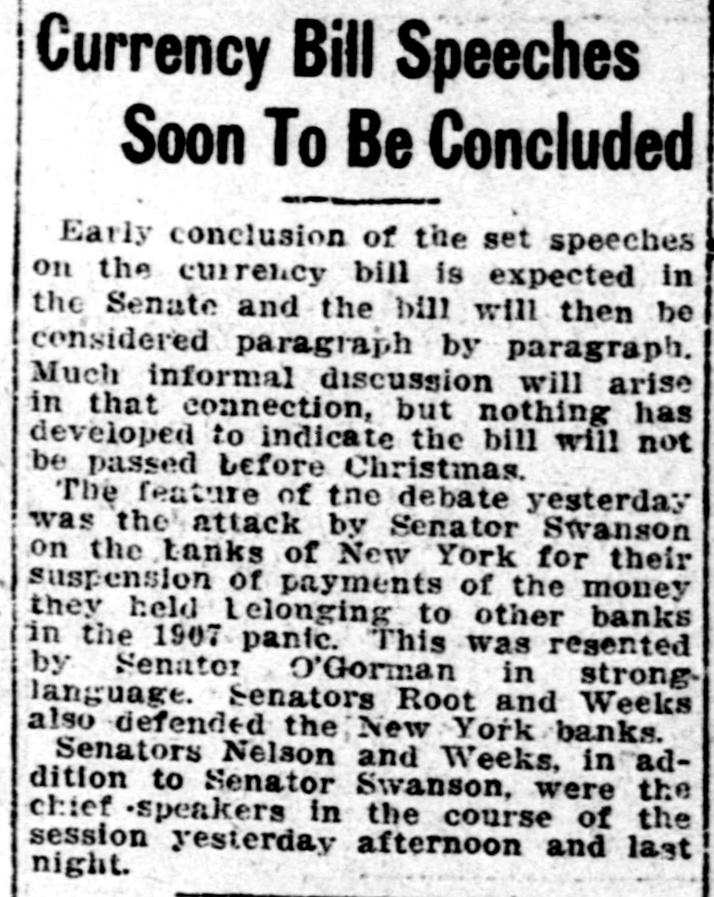
Currency Bill Speeches Soon To Be Concluded Early conclusion of the set speeches on the currency bill is expected in the Senate and the bill will then be considered paragraph by paragraph. Much informal discussion will arise in that connection, but nothing has developed to indicate the bill will not be passed before Christmas. The feature of the debate yesterday was the attack by Senator Swanson on the banks of New York for their suspension of payments of the money they held belonging to other banks in the 1907 panic. This was resented by Senator O'Gorman in strong language. Senators Root and Weeks also defended the New York banks. Senators Nelson and Weeks, in addition to Senator Swanson, were the chief speakers in the course of the session yesterday afternoon and last night.


Article from The Citizen-Republican, August 6, 1914

Click image to open full size in new tab

Article Text

MEASURES TAKEN TO CONSERFE READY CASH This Action Believed Best In Order to Assure Stability of Business. In order to conserve the American supply of gold and to maintain the credit of the national banks of New York, Chicago and Boston Monday decided to suspend the payment of specie and issue clearing house certificates instead. Other cities throughout the country are expected to follow the lead of these big financial centers. Depositors also will be required to give 60 days notice to banks before withdrawing funds on time deposit. The situation is not regarded as grave by any means and reassuring statements have been issued in every quarter. The measures being taken are purely of a precautionary nature.


Article from The Tabor Independent, August 6, 1914

Click image to open full size in new tab

Article Text

MEASURES TAKEN TO CONSERFE READY CASH This Action Believed Best In Order to Assure Stability of Business. In order to conserve the American supply of gold and to maintain the credit of the national banks of New York, Chicago and Boston Monday decided to suspend the payment of specie and issue clearing house certificates instead. Other cities throughout the country are expected to follow the lead of these big financial centers. DeposItors also will be required to give 60 days notice to banks before withdrawing funds on time deposit. The situation is not regarded as grave by any means and reassuring statements have been issued in every quarter. The measures being taken are purely of a precautionary nature.