
2464. Merchants National Bank (Ocala, FL)

Bank Information

Episode Type
Suspension → Closure
Bank Type
national
Bank ID
3815
Charter Number
3815
Start Date
January 1, 1896*
Location
Ocala, Florida (29.187, -82.140)

Metadata

Model
gpt-5-mini
Short Digest
a6a18fe1

Response Measures

None

Description

Articles state the Merchants' National Bank of Ocala failed/suspended in January 1896 and a receiver (G. C. Stapylton) was appointed by the Comptroller of the Currency. Failures were tied to irregular accounts, shortages, and state treasurer Collins' loans/defalcations rather than a depositor run. Classified as suspension leading to permanent closure/receivership.

Events (2)

1. January 1, 1896* Receivership
Newspaper Excerpt
When the bank failed, in January, 1896, G. C. Stapylton was appointed receiver by the .controller of currency
Source
newspapers
2. January 1, 1896* Suspension
Cause
Bank Specific Adverse Info
Cause Details
Bank failure tied to irregular accounts, large shortages, and misapplied/defalcated funds (Treasurer Collins' loans and shortages); insolvency indicated at time of suspension.
Newspaper Excerpt
the date of suspension of the Merchants' National bank of Ocala
Source
newspapers

Newspaper Articles (4)

Article from The Ocala Banner, May 14, 1897

Click image to open full size in new tab

Article Text

Treasurer Collins is carrying as cash three Marion county past due school warrants of $5,000 each. He claims to have loaned the school board of Ma- rion county this sum. The school board, however, claims never to have received the money, or at least only a part, and repudiates a part of the loan, if not the entire amount. Your committee begs leave to state that the foregoing portion of this re- port has reference particularly to the general accounts and funds of the treasurer, and the following portion refers to the accounts, transactions, etc., of Treasurer Collins with the de- funet Merchants' National bank of Ocala and the tax certificate redempt- ion fund. According to the books of Treasurer Collins, and the date of sus- pension of the Merchants' National bank of Ocala that bank was indebted to the state in the sum of $10,927.01. The books of said bank, by a certified copy of Treasurer Collins' account, show that the state waa, indebted to the bank at the date of its suspension in the sum of $1,018 23. Your committee has had copies o the account kept by Treasurer Collin with said bank, and the account o said bank with Treasurer Collins ano the monthly statement of his accounts furnished Treasurer Collins by sai bank, but the said accounts have beer so irregularly and improperly kep and there are so many apparent ficti- tious entries made on the bank books, and irregular entries made on Treas- urer Collins' book, and so many items and vouches of credit missing, and figures juggled in such a manner, that it has been impossible to fully and completely reconcile the account kept by Treasurer with said bank and your committee have had to rely entirely on the amounts which the comptroller certified to us he should have had on hand belonging to the tax certificate redemption fund. Your committee further reports that on October 23, 1896, Treasurer Collins drew a check for $22,000 on the Mer- chants' National Bank of Ocala, in favor of the National Rank of the State of Florida, and sent said check to J. N. C. Stockton as president of the said bank, with instructions to collect the same in cash, and if said Merchants' National bank could not pay the check to accept such credita as could be procured; that said Stock- ton, acting as trustee for Treasurer Collins was compelled to, and did ac- cept securities of the supposed valu- ation of about $65,000. Referring es- pecially to the testimony of W. H. Baker your committee reports that the securities are supposed to be worth about $15,000, und thot said Stockton holds such securities to secure the loan of $15,000 hereinbefore referred to, leaving the item of $22,000 totally unsecured. Your committee would report, as more fully shown by the testimony of C. B. Collins, that as shown by the ac- counts kept by Treasurer with the Merchants' National Bank of Ocala, at the time of its failure, was actually due the state of Florida $32,927.01, sup- posedly for the tax certificate redempt- ion fund deposited therein. The act- ual shortage of said redemption fund is $34,967.01, for which the state has no security, leaving a shortage of $2,- 040 to bersonally accounted for by Treasurer Collins. Your committe further reports that Treasurer Collins claims that the tax certificates redemption fund paid in- to his hands for the quarter ending September 30, 1896, and December 31, 1896, and a balance due for the quarter ending June 30, 1896, aggregating the sum of $34,967, were moneys lost in the defunct Merchants' National bank of Ocala by reason of its failure, but your committee are forced to conclude from Treasurer Collins sworn state- ment, that said tax certificate redemp- tion money was not in the bank at the time of its failure, but other gen- eral funds of the state aggregating in amount $34,967, or greater part there- of, were used and deposited in said bank and the tax certificate redemp- tion fund for the quarters ending as above referred to, were used by Treas- urer Collins to reimburse funds which had been abstracted from the general funds of the state, and deposited in said bank. Your committee also reports that Treasurer Collins received $15,710.96 as the state's proportion of the tax fund for the quarter ending June 30, 1896, and which he claims was held by in cash in the treasurry, until April 6, 1897, and for that reason your com- mittee are unable to say whether these funds are properly disbursed from the tax certificate fund or not. # THE DANGER

Article from The Morning News, January 7, 1899

Click image to open full size in new tab

Article Text

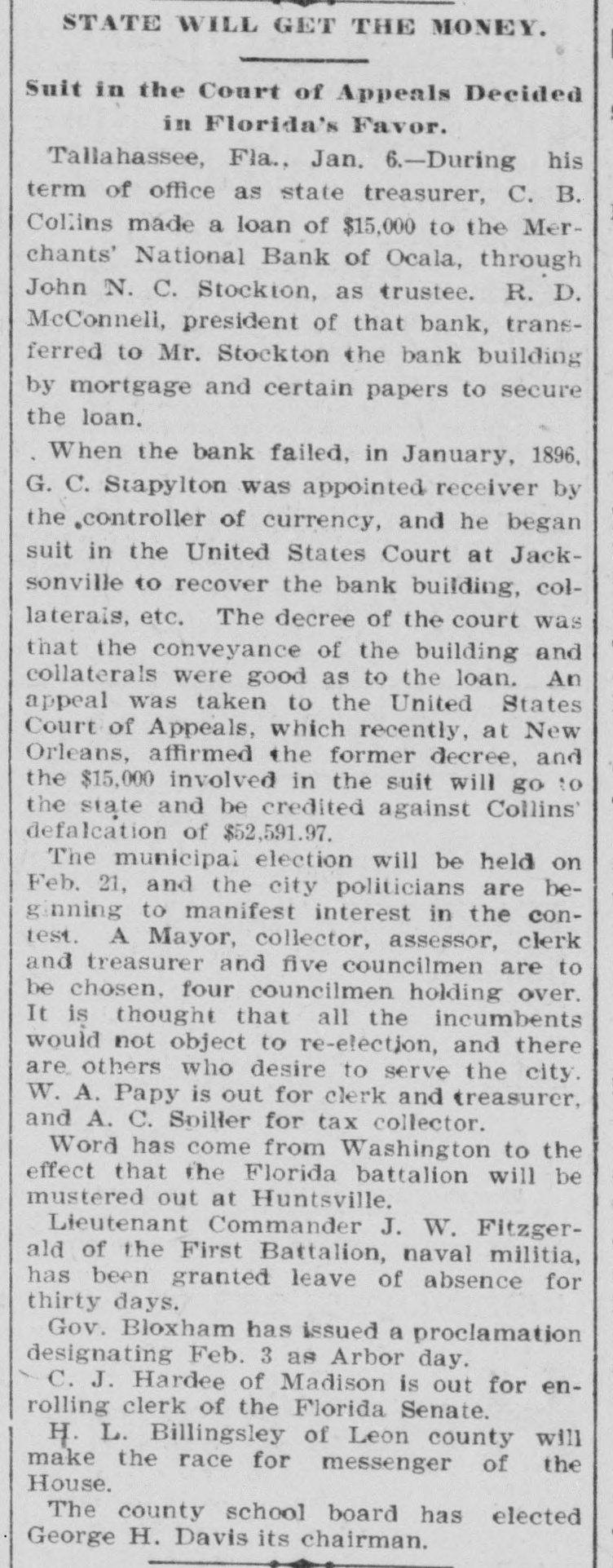
STATE WILL GET THE MONEY. Suit in the Court of Appeals Decided in Florida's Favor. Tallahassee, Fla., Jan. 6.-During his term of office as state treasurer, C. B. Collins made a loan of $15,000 to the Merchants' National Bank of Ocala, through John N. C. Stockton, as trustee. R. D. McConnell, president of that bank, transferred to Mr. Stockton the bank building by mortgage and certain papers to secure the loan. When the bank failed, in January, 1896, G. C. Stapylton was appointed receiver by the .controller of currency, and he began suit in the United States Court at Jacksonville to recover the bank building, collaterais, etc. The decree of the court was that the conveyance of the building and collaterals were good as to the loan. An appeal was taken to the United States Court of Appeals, which recently, at New Orleans, affirmed the former decree, and the $15,000 involved in the suit will go to the state and be credited against Collins' defalcation of $52,591.97. The municipal election will be held on Feb. 21, and the city politicians are beginning to manifest interest in the contest. A Mayor, collector, assessor, clerk and treasurer and five councilmen are to be chosen, four councilmen holding over. It is thought that all the incumbents would not object to re-election, and there are others who desire to serve the city. W. A. Papy is out for clerk and treasurer, and A. C. Soiller for tax collector. Word has come from Washington to the effect that the Florida battalion will be mustered out at Huntsville. Lieutenant Commander J. W. Fitzgerald of the First Battalion, naval militia, has been granted leave of absence for thirty days. Gov. Bloxham has issued a proclamation designating Feb. 3 as Arbor day. C. J. Hardee of Madison is out for enrolling clerk of the Florida Senate. H. L. Billingsley of Leon county will make the race for messenger of the House. The county school board has elected George H. Davis its chairman.


Article from The Ocala Evening Star, January 9, 1899

Click image to open full size in new tab

Article Text

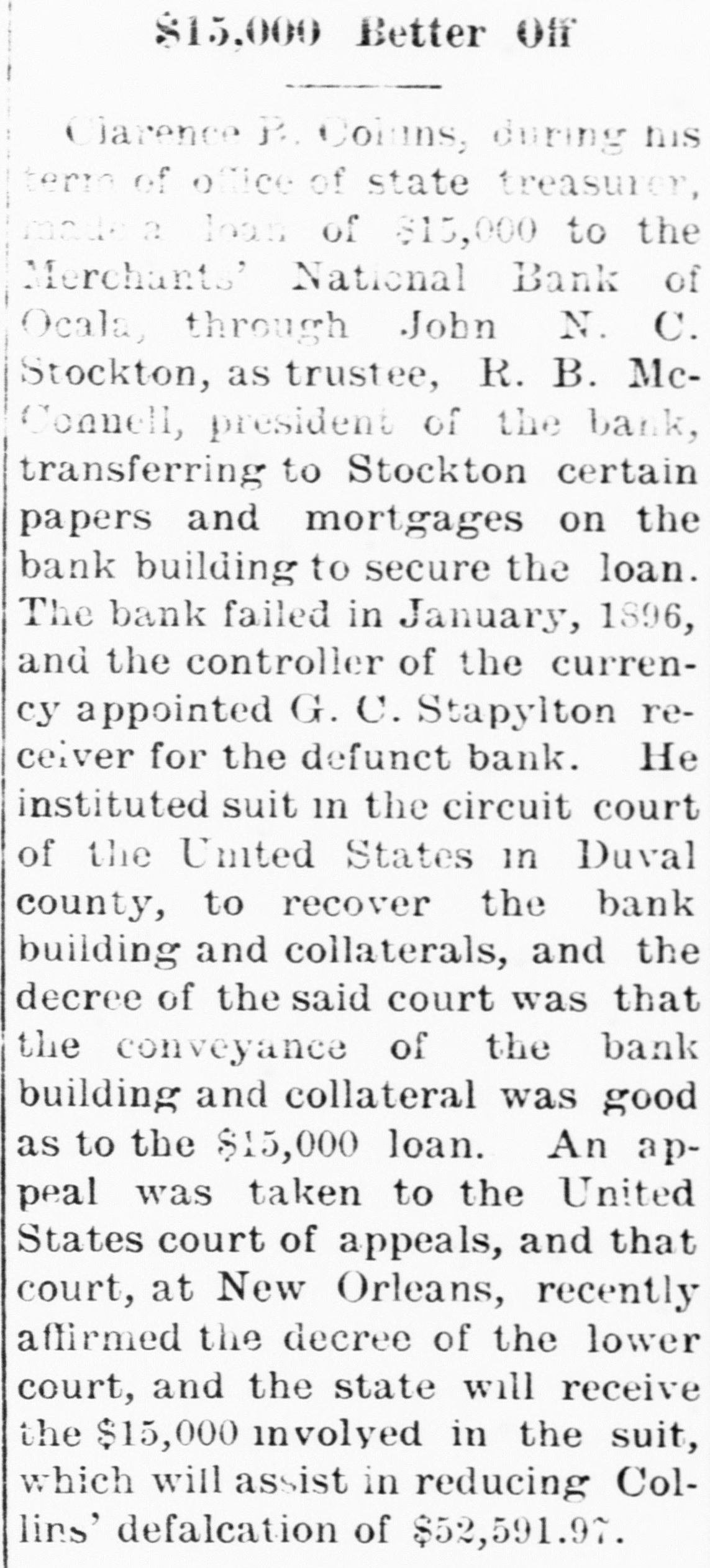
$15,000 Better Off Clarence P. Coluns, during his erro of office of state treasurer, made 2 loan of $15,000 to the Merchants' National Bank of Ocala, through John N. C. Stockton, as trustee, R. B. McConnell, president of the bank, transferring to Stockton certain papers and mortgages on the bank building to secure the loan. The bank failed in January, 1896, and the controller of the currency appointed G. C. Stapylton receiver for the defunct bank. He instituted suit in the circuit court of the United States in Duval county, to recover the bank building and collaterals, and the decree of the said court was that the conveyance of the bank building and collateral was good as to the $15,000 loan. An appeal was taken to the United States court of appeals, and that court, at New Orleans, recently affirmed the decree of the lower court, and the state will receive the $15,000 involved in the suit, which will assist in reducing Collins' defalcation of $52,591.97.


Article from The Ocala Evening Star, December 24, 1921

Click image to open full size in new tab

Article Text

tower on the corner of Fort King and big Osceola, where Ben Condon's formerly the Star office/ now store, stands. The volunteer fire depart- rewas very efficient. I don't member ment ever seeing the fire engine, good tho' I heard of it, for Ocala had water pressure even at that time. The electric light plant was the old it, sheetiron building, or part of of down in the hollow at the crossing It South Main and South Fourth. ad, think, two small engines. The streets were illuminated on dark nights by are lights at long intervals. the I think there were four ares on public square, all of them equal probably to one of the present white way a lamps. They were strung along block apart on the principal streets. the Interiors of buildings were lit by old-style incandescents. Not more than ten per cent of the residences were lit by electricity. There was in not an electric motor nor stove town, and but® few electric fans. The street lights followed the moon-the the is, they were not shining when moon was. The incandescents were cut off in stores and residences at midnight. There never was any current in the daytime, and the luxury of turning on a light on a dark day or as SOOR as the dusk began to gather was unknown. The electric light plant and belonged to a private company, while its rates were reasonable than for then, they were much higher they are now. Ocala had a good water supply, but the it would not meet a fourth of a present demand. The power was couple of old-style engines in a little brick house at the corner of Fourth street and Orange avenue. There the were two or three good wells, and reservoir was on the brick tower at the top of the hill on what is now Camp Heights. A simple plant, but a very reliable one. Few towns in the state had such a powerful water pressure. The water company was economical and its rates were high. very People paid a dollar a month it for one faucet, and additional if was used to supply a garden hose. The people were yet drawing a large supply of their water from surface wells, and typhoid fever was not un1 common. Like the electric light plant, 7 the waterworks belonged to a private e company, Ocala had two banks-the First National, where the Commercial now stands, and the Merchants' National, in the same building now occupied by the Munroe & Chambliss National t The two banks were at war each other, and the '93 Bank. with Merchants' of aided by the panic the freeze of '95, It was a vicFirst National, and National. downed Pyrrhic the tory, and in '96 the Merchants' National also went smash. At that time, Ocala touched rock bottom. Scores left the city and Money was so of the families county. never hundreds Yet scarce nor business so dull. there was very little actual suffering. People` continued to eat and wear clothes, and as there were scores of houses empty nobody had to stay out in the rain. The county had to build a new jail, and the city managed to buy the old t and move its into where they have been ever jail it, building offices since. , fire hall was built, the fire departconcentrated in it, a ment The volunteer with force few paid men and a big to The city and began to aid trie them. light plant bought the improve elechas been improving it ever e Then it bought s and concentrated since. it, works and the the water two on their present location e has been a great deal money utilities There these of opee and some wasted in but the people more n received their money rations, spent than have back in lower rates. w The county has built a new court 1 and two new jails, the latter it in use, at a combined of The federal house now $150,000. government expense n erected a solid and well constructer ed and a cost e has postoffice courthouse, block at that of about $100,000 on a city g was ground up two "busted" banks been The unoccupied have to 1907. t by three, the Munroe and r the Ocala and Either a the Chambliss, replaced Commercial. National of the firstn two does much more business 's the two old put tonamed than both banks If The Munroe & Chambliss y and the Commercial reh the buildings modeled gether. Bank they have bought and the of the dead and made them from gone firms executors handsome National e h and uptodate. The Ocala d has put up a good-looking and subn stantial building of its own. One of the greatest institutions of e the city was not even thought of in 1892. I refer to the Marion County f Hospital, now a large, well-equipped