23147. Exchange Bank (Wheeling, WV)

Bank Information

Episode Type
Run → Suspension → Reopening
Bank Type
state
Start Date
August 5, 1893
Location
Wheeling, West Virginia (40.064, -80.721)

Metadata

Model
gpt-5-mini
Short Digest
edf910a0

Response Measures

Borrowed from banks or large institutions, Capital injected, Full suspension

Other: Assignment to an assignee/receiver (John J. Jones); reorganization and capital subscription to reopen.

Description

Exchange Bank (Wheeling, WV) suspended in early August 1893 because of a drain on cash and general money-market stringency ('scare'); other local banks experienced brief runs as a result of the assignment. The bank was placed in the hands of an assignee (John J. Jones) and reopened about Sept 20, 1893 after reorganization and added capital. Dates taken from contemporaneous newspaper accounts (suspended Aug 5/6, reopened Sept 20).

Events (4)

1. August 5, 1893 Suspension
Cause
Macro News
Cause Details
Steady drain on ready cash and inability to secure additional currency in tight money market; many deposits were in checks/drafts not immediately realizable, and attempts to borrow funds in New York and Chicago failed, forcing suspension/assignment to an assignee (John J. Jones).
Newspaper Excerpt
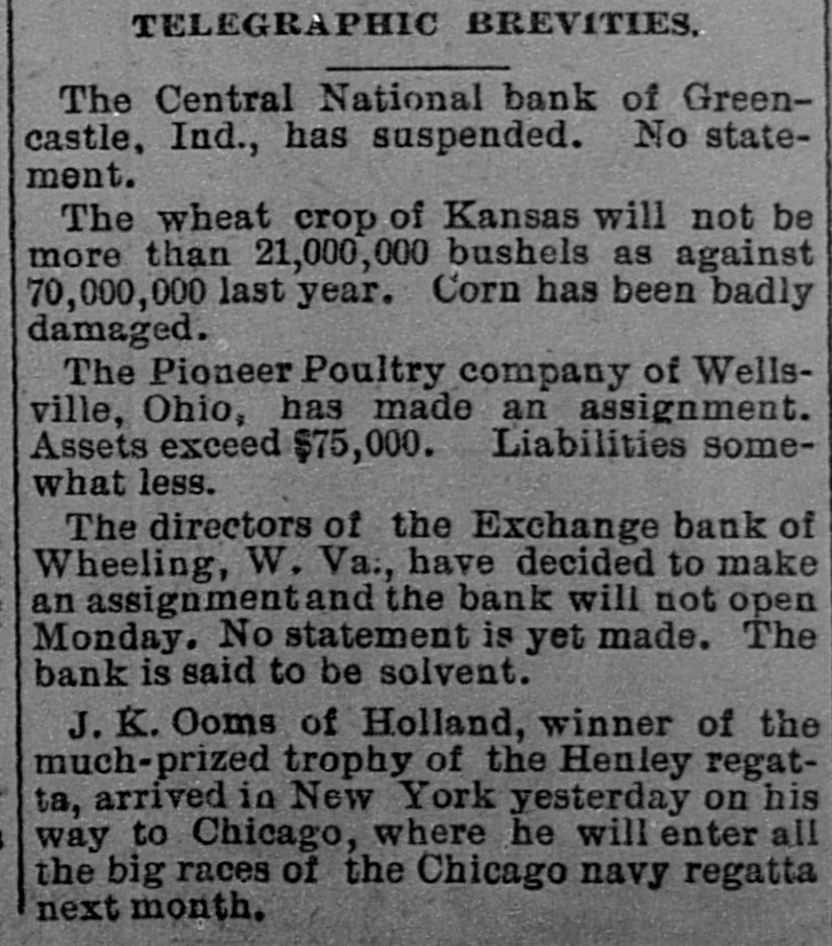
The directors of the Exchange bank of Wheeling, W. Va., have decided to make an assignment and the bank will not open Monday. The bank is said to be solvent.
Source
newspapers
2. August 7, 1893 Other
Newspaper Excerpt
The appointment of Mr. John J. Jones, the cashier, as assignee, was decided on, and a deed of trust to him will be recorded to-day. He will settle up the bank's affairs. Whether it will again open ... has not been discussed by the stockholders.
Source
newspapers
3. August 7, 1893 Run
Cause
Macro News
Cause Details
General national money-market stringency and a 'scare' leading depositors to demand cash; assignment/announcement of Exchange Bank intensified withdrawals at other local banks.
Measures
Large deposits were made in other banks which counteracted withdrawals; public appeals and signatures from local business leaders urging calm.
Newspaper Excerpt
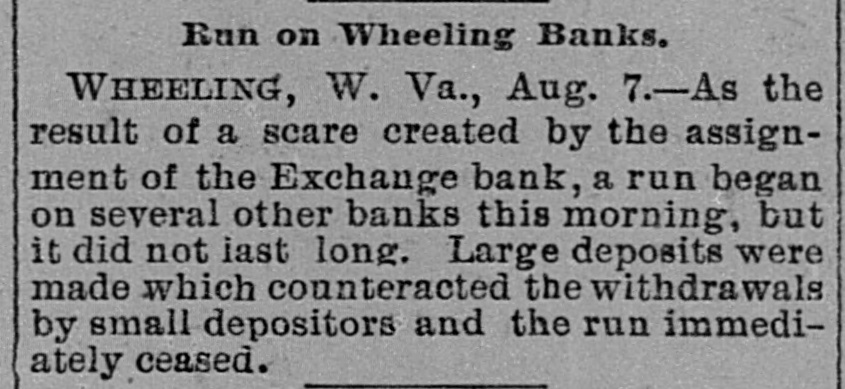
As a result of the scare created by the assignment of the Exchange Bank, a run began on several other banks this morning, but it did not last long.
Source
newspapers
4. September 20, 1893 Reopening
Newspaper Excerpt
The Exchange Bank, the suspension of which early in August almost caused a panic in the city, reopened its doors today. The bank is on a sounder basis than ever, having $100,000 additional stock.
Source
newspapers

Newspaper Articles (23)

Article from Wheeling Sunday Register, August 6, 1893

Click image to open full size in new tab

Article Text

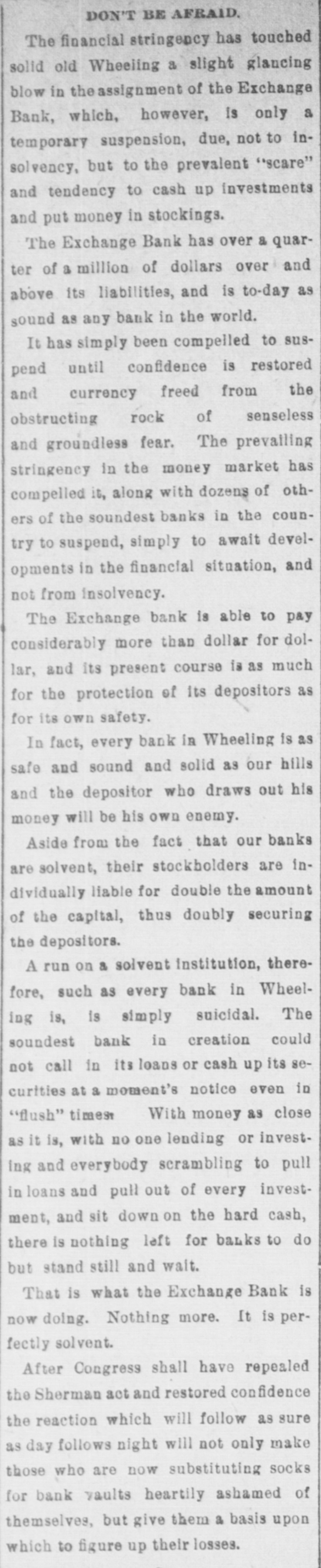
DON'T BE AFRAID. The financial stringency has touched solid old Wheeling a slight glancing blow in theassignment of the Exchange Bank, which, however, is only a temporary suspension, due, not to insolvency, but to the prevalent "scare" and tendency to cash up investments and put money in stockings. The Exchange Bank has over & quarter of a million of dollars over and above its liabilities, and is to-day as sound as any bank in the world. It has simply been compelled to suspend until confidence is restored and currency freed from the obstructing rock of senseless and groundless fear. The prevailing stringency in the money market has compelled it, along with dozens of others of the soundest banks in the country to suspend, simply to await developments in the financial situation, and not from insolvency. The Exchange bank is able to pay considerably more than dollar for dollar, and its present course is as much for the protection of its depositors as for its own safety. In fact, every bank in Wheeling is as safe and sound and solid as our hills and the depositor who draws out his money will be his own enemy. Aside from the fact that our banks are solvent, their stockholders are individually liable for double the amount of the capital, thus doubly securing the depositors. A run on a solvent institution, therefore, such as every bank in Wheeling is, is simply suicidal. The soundest bank in creation could not call in its loans or cash up its securities at a moment's notice even in "flush" times. With money as close as it is, with no one lending or investing and everybody scrambling to pull in loans and pull out of every investment, and sit down on the hard cash, there is nothing left for banks to do but stand still and wait. That is what the Exchange Bank is now doing. Nothing more. It is perfectly solvent. After Congress shall have repealed the Sherman act and restored confidence the reaction which will follow as sure as day follows night will not only make those who are now substituting socks for bank vaults heartily ashamed of themselves, but give them a basis upon which to figure up their losses.


Article from The Salt Lake Herald, August 6, 1893

Click image to open full size in new tab

Article Text

TELEGRAPHIC BREVITIES, The Central National bank of Greencastle, Ind., has suspended. No statement. The wheat crop of Kansas will not be more than 21,000,000 bushels as against 70,000,000 last year. Corn has been badly damaged. The Pioneer Poultry company of Wellsville, Ohio, has made an assignment. Assets exceed $75,000. Liabilities somewhat less. The directors of the Exchange bank of Wheeling, W. Va., have decided to make an assignmentand the bank will not open Monday. No statement is yet made. The bank is said to be solvent. J. K. Ooms of Holland, winner of the much-prized trophy of the Henley regatta, arrived in New York yesterday on his way to Chicago, where he will enter all the big races of the Chicago navy regatta next month.


Article from The Anaconda Standard, August 7, 1893

Click image to open full size in new tab

Article Text

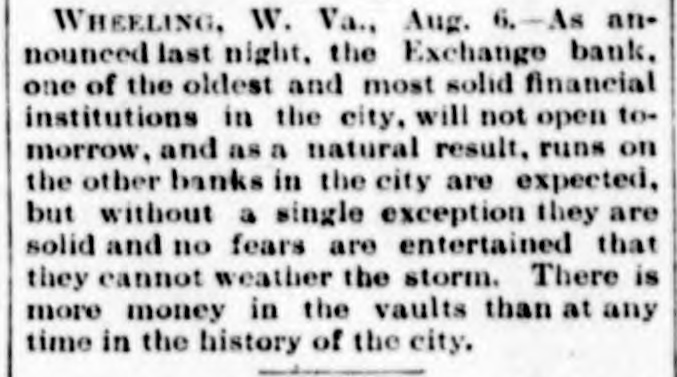
WHEELING, W. Va., Aug. 6. - As announced last night. the Exchange bank. one of the oldest and most solid financial institutions in the city, will not open tomorrow. and as a natural result. runs on the other banks in the city are expected, but without a single exception they are solid and no fears are entertained that they cannot weather the storm. There is more money in the vaults than at any time in the history of the city.


Article from The Herald, August 7, 1893

Click image to open full size in new tab

Article Text

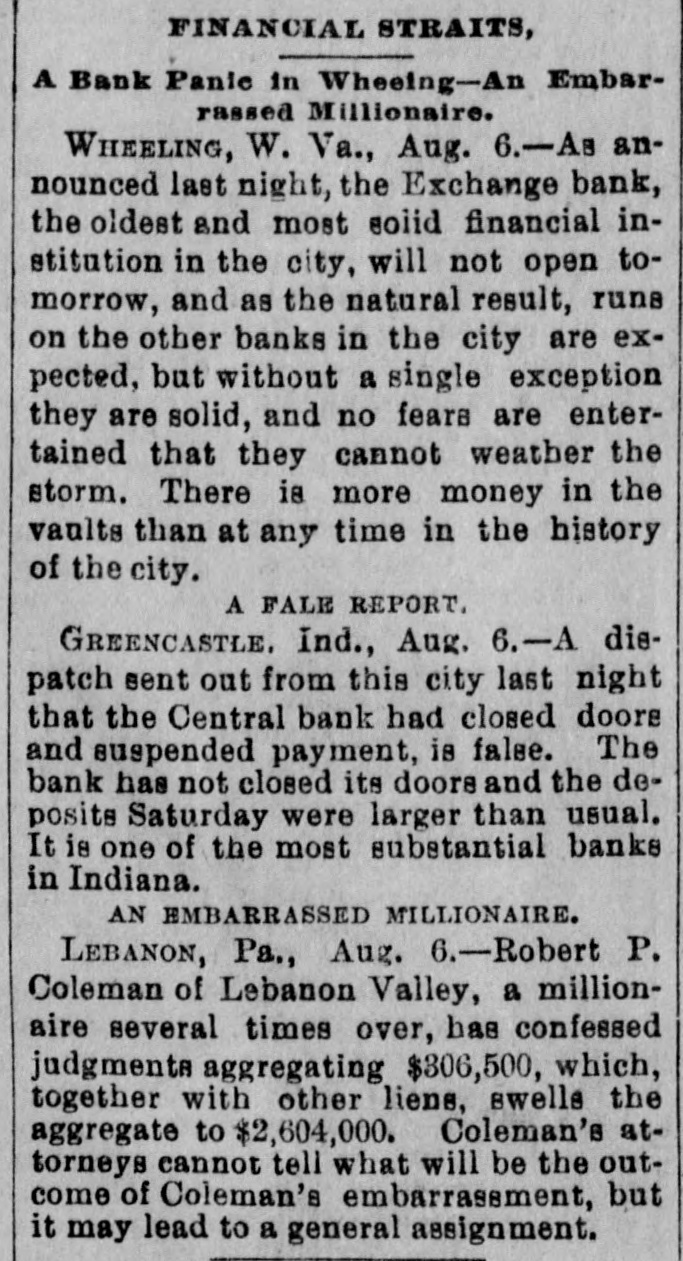
FINANCIAL STRAITS, A Bank Panic in Wheeing-An Embarrassed Millionaire. WHEELING, W. Va., Aug. 6.-As announced last night, the Exchange bank, the oldest and most solid financial institution in the city, will not open tomorrow, and as the natural result, runs on the other banks in the city are expected, but without a single exception they are solid, and no fears are entertained that they cannot weather the storm. There is more money in the vaults than at any time in the history of the city. A FALE REPORT. GREENCASTLE. Ind., Aug. 6.-A diepatch sent out from this city last night that the Central bank had closed doore and suspended payment, is false. The bank has not closed its doors and the deposits Saturday were larger than usual. It is one of the most substantial banks in Indiana. AN EMBARRASSED MILLIONAIRE. LEBANON, Pa., Aug. 6.-Robert P. Coleman of Lebanon Valley, a millionaire several times over, has confessed judgments aggregating $306,500, which, together with other liens, swells the aggregate to $2,604,000. Coleman's attorneys cannot tell what will be the outcome of Coleman's embarrasement, but it may lead to a general assignment.


Article from St. Paul Daily Globe, August 7, 1893

Click image to open full size in new tab

Article Text

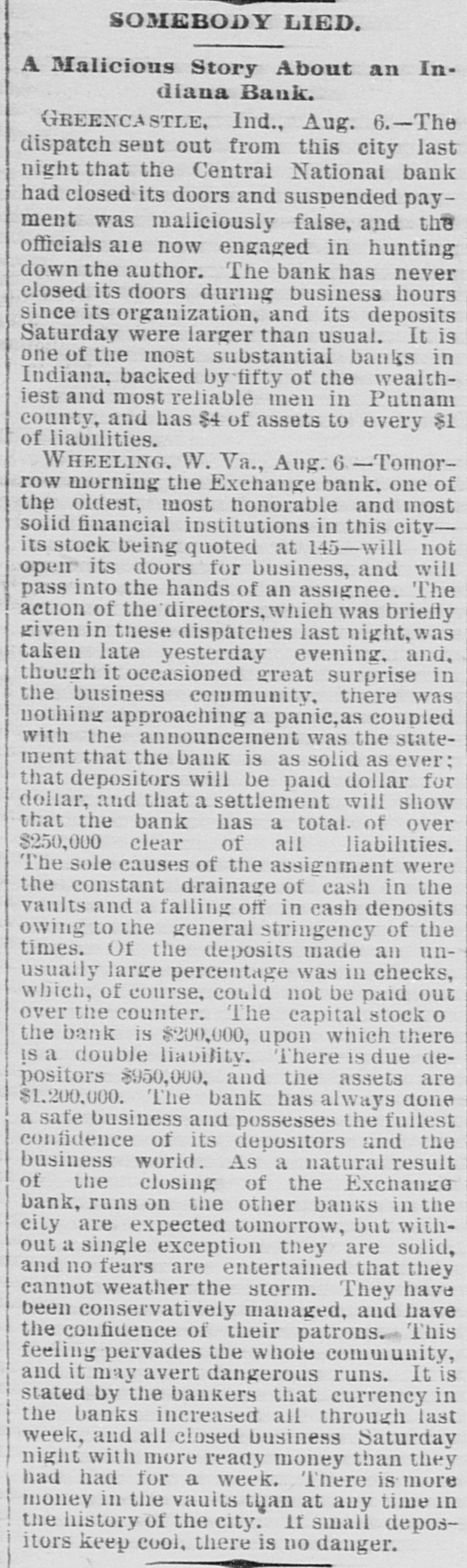
SOMEBODY LIED. A Malicious Story About an Indiana Bank. GREENCASTLE, Ind., Aug. 6.-The dispatch sent out from this city last night that the Central National bank had closed its doors and suspended payment was maliciously false, and the officials are now engaged in hunting down the author. The bank has never closed its doors during business hours since its organization, and its deposits Saturday were larger than usual. It is one of the most substantial banks in Indiana, backed by fifty of the wealthiest and most reliable men in Putnam county, and has $4 of assets to every $1 of liabilities. WHEELING. W. Va., Aug. 6.-Tomorrow morning the Exchange bank. one of the oldest, most honorable and most solid financial institutions in this cityits stock being quoted at 145-will not open its doors for business, and will pass into the hands of an assignee. The action of the directors, which was briefly given in these dispatches last night, was taken late yesterday evening. and, though it occasioned great surprise in the business community, there was nothing approaching a panic,as coupled with the announcement was the statement that the bank is as solid as ever; that depositors will be paid dollar for dollar, and that a settlement will show that the bank has a total. of over $250,000 clear of all liabilities. The sole causes of the assignment were the constant drainage of cash in the vaults and a falling off in cash deposits owing to the general stringency of the times. Of the deposits made an unusually large percentage was in checks, which, of course, could not be paid out over the counter. The capital stock 0 the bank is $200,000, upon which there IS a double liability. There IS due depositors $950,000, and the assets are $1,200,000. The bank has always done a safe business and possesses the fullest confidence of its depositors and the business world. As a natural result of the closing of the Exchange bank, runs on the other banks in the city are expected tomorrow, but without a single exception they are solid, and no fears are entertained that they cannot weather the storm. They have been conservatively managed, and have the confidence of their patrons This feeling pervades the whole community, and it may avert dangerous runs. It is stated by the bankers that currency in the banks increased all through last week, and all closed business Saturday night with more ready money than they had had for a week. There is more money in the vaults than at any time in the history of the city. If small depositors keep cool, there is no danger.


Article from The Wheeling Daily Intelligencer, August 7, 1893

Click image to open full size in new tab

Article Text

THE BANK DOORS SHUT. The Exchange Bank Forced to Suspend Payment BY THE EACK OF READY CURRENCY. It Will Pay Every Dollar of its Liabilities, and all the Other Banks are Solid as the Rocks-A Declaration by Scores of Leading Business Men in Favor of Conservatism and Common Sense.


Article from The Wheeling Daily Intelligencer, August 7, 1893

Click image to open full size in new tab

Article Text

by Scores of Leading Business Men in Favor of Conservatism and Common Sense. Great surprise was occasioned in Wheeling Saturday evening by a report that the Exchange Bank had closed its doors and would not be open for business this morning. It is not too much to say that there was not a concorn in the community whose suspension would have caused greater surprise. At first the story was received with general incredulity, but inquiry showed that it was true. The bank closed when husiness was done on Saturday with the determination not to open again at present. The appointment of Mr. John J. Jones, the cashier, as assignee, was decided on, and a deed of trust to him will be recorded to-day. He will settle up the bank's affairs. Whether it will again open and be operated as a bank, after the present troubles are over, has not been discussed by the stockholders. The trouble has been imminent for several days. It is ascribed by officials of the bank to a steady falling off of deposits, the decrease reaching twenty per cent, with a simultaneous increase of demands upon their resources in ready cash. Recently many deposits have been made in checks and drafts, which are entirely good, but could not be immediately realized on. NO CURRENCY OBTAINABLE. The directors said that a crisis was at hand which only prompt action could avert, and the president, Mr. J. N. Vance, was sent to New York with ample securitiss, all of the most approved gilt-edged character, to secure $100,000. He failed to get the money owing to the stringency of the money market and the enforced conservatism of bankers. He then went to Chicago, but with no better suecess, and he telegraphed that he had failed. The directors were in session until after midnight Friday night, but it was not then finally decided that it would be necessary to close the doors. Indeed, it was not seen to be inevitable until half past one o'clock Saturday vfterneon. The situation was then rendered even more serious by the demand for a cash settlement by a man who had several thousand dollars of claims. The news spread rapidly, and Saturday evening a meeting of representatives of all the banks was held, at which all the expressions were of the most conservative character, and as cheerful a view as possible was taken by all. Every bank in Wheeling is in a sound and healthy condition, and it was plainly seen that there was no occasion for alarm. Each banker expressed his willingness for an immediate and thorough examination by the state or national bank examiner. The Exchange bank has assets to more than cover all its liabilities, leaving its capital and surplus untouched. It was simply unable to realize on these. ITS CONDITION GOOD. Its capital stock is $200,000, held by solid and prosperous men, who, as are all bank stockholders under a special West Virginia statute, are liable for double the par value of all stock held by them. Its real estate at the corner of Main and Twelfth streets, including the bank and the building next adjoining on the north, is worth nearly or quite $100,000. The reserve is $50,000, and other assets foot up to $1,400,000 in all, while the liabilities to be met are only $950,000 or about that. After it was seen Saturday afternoon that it would be necessary to suspend, at least temporarily, about $17,000 of deposits were brought in, but this was left unbroken and not placed to the credit of the depositors. As soon as possible the original sums will be handed back to the owners, just as if it had not been taken to the bank. Of course when money was offered in this way the officials could not without risk of the gravest consequences, refuse it or describe to customers the state of affairs. The only safe and honorable coursewas, therefore, the one which was adopted. It is stated that a working capital of $175,000 was exhausted in the past three weeks by the drain on the cash in the vaults. It is given out that in settling up the affairs of the concern, none of those who owe the bank money will be pushed, and it is evident that only a little time is needed to straighton out affairs and pay every dollar of liability without bank.


Article from Wheeling Register, August 7, 1893

Click image to open full size in new tab

Article Text

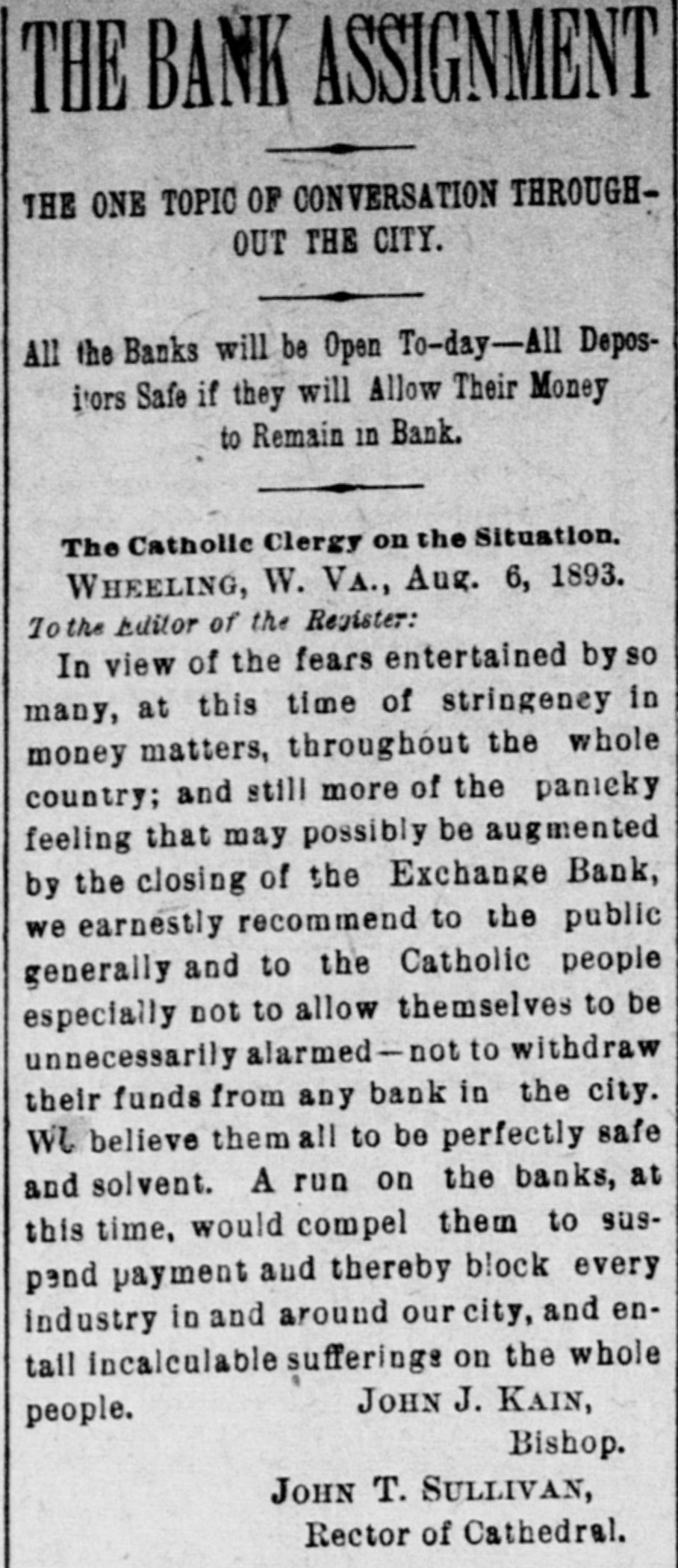
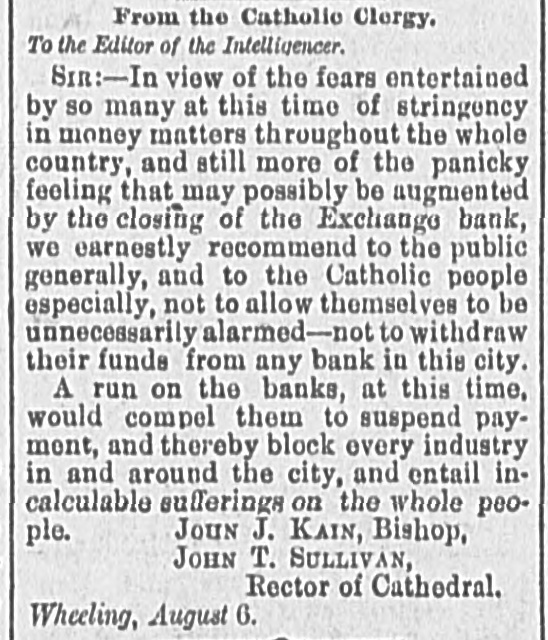
THE BANK ASSIGNMENT THE ONE TOPIC OF CONVERSATION THROUGHOUT THE CITY. All the Banks will be Open To-day-All Depositors Safe if they will Allow Their Money to Remain in Bank. The Catholic Clergy on the Situation. WHEELING, W. Va., Aug. 6, 1893. To the Editor of the Register: In view of the fears entertained by so many, at this time of stringeney in money matters, throughout the whole country; and still more of the panieky feeling that may possibly be augmented by the closing of the Exchange Bank, we earnestly recommend to the public generally and to the Catholic people especially not to allow themselves to be unnecessarily alarmed-not to withdraw their funds from any bank in the city. WL believe them all to be perfectly safe and solvent. A run on the banks, at this time, would compel them to suspend payment and thereby block every industry in and around our city, and entail incalculable sufferings on the whole JOHN J. KAIN, people. Bishop. JOHN T. SULLIVAN, Rector of Cathedral.


Article from Wheeling Register, August 7, 1893

Click image to open full size in new tab

Article Text

The topic of conversation in this city yesterday, almost to the exclusion of everything else, was the assignment of the Exchange Bank Saturday night, and many were the opinions of the effect it would have upon the other financial institutions of the city. The general impression prevails that the situation is very grave, much depending upon the good sense and calm judgment of the citizens of Wheeling. Whether these qualities can be relied upon in the present emergency is an open question, which only today's events will answer. The business men of Wheeling who are familiar with the situation, are not the ones to fear in the present crisis. They may be relied upon to do the only sensible thing,-allow their deposits to remain in the banks. But there are others who fear that there will be a run upon the particular institution in which their money is deposited, with consequent embarrassment to the bank, and they are anxious to secure their money before the doors close,-if such a course on the part of the bank officials may be considered probable in the event of a run. Every bank in the city, with the exception of the Exchange, will open its doors promptly at o'clock, and will be prepared to do business. All will remain open as long as there is no unreasonable demand upon the funds on hand. A REGISTER reporter yesterday made an effort to ascertain the feeling among all classes of citizens relative to the probable action of depositors today. Those who announced their intention to withdraw their deposits were very few, while on the other hand, several men were seen who stated that they will not follow their usual custom of having their checks cashed today, but will simply deposit the checks. Others stated that they will make deposits as soon as convenient after the opening of the bank doors this morning. If there is any cause for fear on the part of the officials of the respective banks, it is that the special interest bearing deposits of people in moderate circumstances will be withdrawn. Accounts of this nature aggregate a considerable sum, but it is thought that reason will prevail and they will be allowed to remain in the bank vaults, where they are much more safe than in any hiding place at home. Nobody doubts that every bank in Wheeling is solvent, and it is to be hoped that depositors will show their good sense by allowing their money to remain in bank rather than to rashly precipitate a panic among the people of the city. Mr. Anton Reymann was among those who were seen by the reporter yesterday. Said Mr. Reymann; "I feel it my duty to inform my friends and the public génerally that I believe every bank in the city to be solvent, and abundantly able to pay its depositors dollar for dollar, unless there is an unreasonable immediate demand. I would advise all citizens to allow their deposits to remain in bank, where they are safer than at home. During the day several papers were circulated among business men and others and were numerously signed. They are published for the benefit of those who regard their deposits as unsafe. Rt. Rev. Bishop Kain and Rev. Mgr. J. T. Sullivan have also written a card, which appears above. Following is the paper circulated yesterday afternoon, with a list of the signatures secured within a few hours: To the Crtizens of W/ King: We business men and Jepositors in the banks of the city, de most earnestly ask for the good name of our fair city, that all depositors refrain from withdrawing their deposits from our banks at this time and that we make our deposits as usual. We feel sure that our banks are all sound and no depositor has cause for any alarm. Let us take pride in the fact that Wheeling has always stood high in the commercial world, and let us do nothing at this time that may cause us regret later. Kraft & Rosenburg. R G Dunn & Co, By W A Wilson, Mgr. Neill and Elli gham, Horkheimer Bros. E Buckman & Co, Geo L Durst, Ewing Bros, BaerSons Grocery Co, Bremer & Mabis, Henry Baer, Pres, Dinger Bros, Kline Bros. AW Emsheimer & Bro, RA McCabe, schwertfeger & Robb, O'Kane & Co, W S Foose, H B Baguley, House & Hermann, Henry Morris, E R Morris, AL Rice & Co, A D Seamon. T Reister, Geo Steifel & Co, Noble Bros, P Welty & Co, S L Jepson, Central Glass Co, N B Scott, Pres. Henry Jacobs, Milt. Hanauer, LaBelle Iron Works, per Cecil Robinson, G Emsheimer,
Article from The Morning Call, August 8, 1893

Click image to open full size in new tab

Article Text

SCARCITY OF MONEY. That Is the Condition That Now Confronts Wall Street. Believed to Be Even More Serious Than the Reputed Evil of the Sherman Law. Special to THE MORNING CALL NEW YORK, Aug. 7.-Aside from the meeting of Congress and its probable action on the silver question, together with the probable effect of that action on business in general and the stock market in particular, the principal subject of discussion to-day was the continued scarcity of all forms of currency, notes and specie. In fact, according to well-imformed bankers, that was in some respects the most serious question of the dav. Money-brokers today were paying as high as 1/2 to 1 per cent for currency and were getting as high as 31/2 for it in big lots. One peculiar feature in connection with this scarcity of cash was that money-brokers were bidding from 1/2 to 5/4 to 1 per cent for gold to arrive, notwithstanding that the rate of foreign exchange did not warrant the importation of gold. Sight sterling was in demand in consequence of the offering of a premium for gold. At the sub-treasury to-day it was said that there was an abundant supply of currency on hand which banks can have in exchange for its equivalent. The Clearinghouse loan committee issued $1,015,000 more loan certificates, making the total amount now outstanding $36,065,000. Gold in the treasury is daily increasing. It stands to-day $102,291,395, or $2,291,395 above the reserve. The net balance in the treasury, however, from the Treasurer's statement issued to-day, shows a decrease, attributed largely to the falling off in customs receipts. The fact that customs receipts are falling off. while it affects the Government revenue from that source, has an opposite bearing upon the general prosperity of the country, as it shows that less money is being expended abroad for imported merchandise. Offers of silver to-day aggregated 565,000 ounces, and of this amount 21,000 ounces were purchased at .726 and the same price tendered for the remainder. CHICAGO, Aug. 7.-The Chicago Iron and Steel Company of East Chicago, Ind., has failed. There is DO statement. The plant was nearly new and cost $250,000. It is claimed the liabilities are less than $100,000. SPRINGFIELD, Mo., Aug. -The Greene County Bank falled this morning: no statement. A run on all the other banks resulted. PHILADELPHIA, Aug. 7.-A receiver was appointed for the Chestnut Hill Iron Ore Company. It is hopelessly insolvent. It was once one of the largest manufacturers of pigiron in Eastern Pennsylvania. CLEVELAND, Ohio, Aug. 7.-The National Vapor Stove Company has made an assignment. The assets are $125,000 and the liabilities $90,000. WHEELING, W. Va., Aug. 7.-As a result of the scare created by the assignment of the Exchange Bank, a run began on several other banks this morning, but it did not last long. Large deposits were made, which counteracted the withdrawals by smaller depositors, and the run inmediately ceased. STURGIS, Mich., Aug. 7.-The directors of the National Bank of Sturgis met today and decided to suspend payment for a short time. The assets will pay the liabillties three to one, and the bank will probably reopen soon. NASHVILLE, Tenn., Aug. 7. - Attilla Cox of Louisville was to-day appointed receiver for the Louisville, Sr. Louis and Texas Railway by United States Judge Lurton upon the application of Post, Martin & Co. of New York.


Article from The Wheeling Daily Intelligencer, August 8, 1893

Click image to open full size in new tab

Article Text

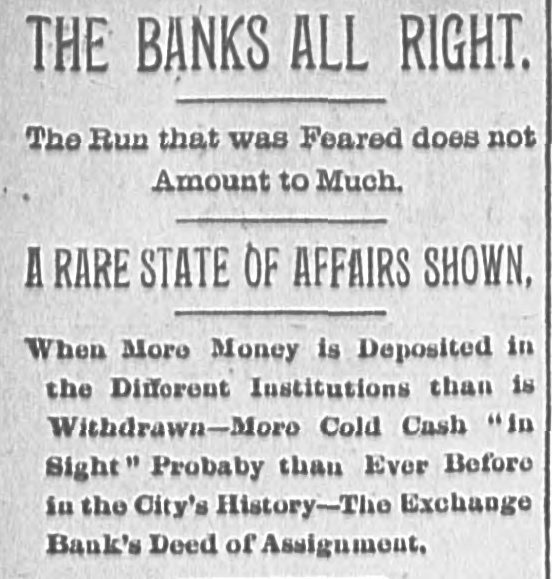
THE BANKS ALL RIGHT. The Run that was Feared does not Amount to Much. A RARE STATE OF AFFAIRS SHOWN, When More Money is Deposited in the Different Institutions than is Withdrawn-Moro Cold Cash "in Sight" Probaby than Ever Before in the City's History-The Exchange Bank's Deed of Assignment,


Article from The Wheeling Daily Intelligencer, August 8, 1893

Click image to open full size in new tab

Article Text

From the Catholic Clergy. To the Editor of the Intelligencer. Sm:-In view of the fears entertained by so many at this time of stringency in money matters throughout the whole country, and still more of the panicky feeling that may possibly be augmented by the closing of the Exchange bank, we earnestly recommend to the public generally, and to the Catholic people especially, not to allow themselves to be unnecessarily alarmed-not to withdraw their funds from any bank in this city. A run on the banks, at this time, would compel them to suspend payment, and thereby block every industry in and around the city, and entail incalculable sufferings on the whole peoJOUN J. KAIN, Bishop, ple. JOHN T. SULLIVAN, Rector of Cathedral. Wheeling, August 6.


Article from The Salt Lake Herald, August 8, 1893

Click image to open full size in new tab

Article Text

Run on Wheeling Banks. WHEELING, W. Va., Aug. 7.-As the result of a scare created by the assignment of the Exchange bank, a run began on several other banks this morning, but it did not last long. Large deposits were made which counteracted the withdrawals by small depositors and the run immediately ceased.


Article from Wheeling Register, August 8, 1893

Click image to open full size in new tab

Article Text

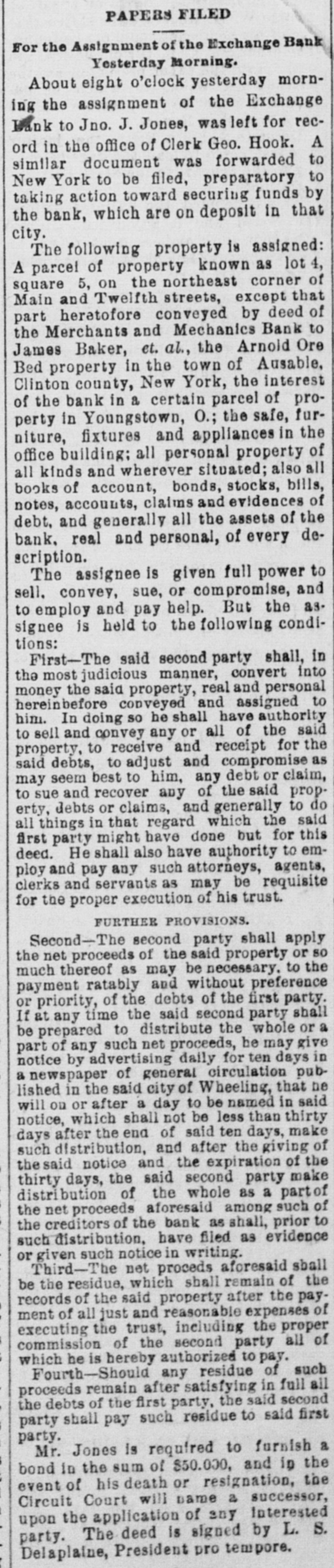
PAPERS FILED For the Assignment of the Exchange Bank Yesterday Morning. About eight o'clock yesterday morning the assignment of the Exchange Bank to Jno. J. Jones, was left for record in the office of Clerk Geo. Hook. A similar document was forwarded to New York to be filed, preparatory to taking action toward securing funds by the bank, which are on deposit in that city. The following property is assigned: A parcel of property known as lot 4, square 5, on the northeast corner of Main and Twelfth streets, except that part heretofore conveyed by deed of the Merchants and Mechanics Bank to James Baker, et. al., the Arnold Ore Bed property in the town of Ausable, Clinton county, New York, the interest of the bank in a certain parcel of property in Youngstown, O.; the safe, furniture, fixtures and appliances in the office building: all personal property of all kinds and wherever situated; also all books of account, bonds, stocks, bills, notes, accounts, claims and evidences of debt, and generally all the assets of the bank. real and personal, of every description. The assignee is given full power to sell. convey, sue, or compromise, and to employ and pay help. But the assignee is held to the following conditions: First-The said second party shall, in the most judicious manner, convert into money the said property, real and personal hereinbefore conveyed and assigned to him. In doing so he shall have authority to sell and convey any or all of the said property, to receive and receipt for the said debts, to adjust and compromise as may seem best to him, any debt or claim, to sue and recover any of the said property, debts or claims, and generally to do all things in that regard which the said first party might have done but for this deed. He shall also have authority to employ and pay any such attorneys, agents, clerks and servants as may be requisite for the proper execution of his trust. FURTHER PROVISIONS. Second-The second party shall apply the net proceeds of the said property or so much thereof as may be necessary. to the payment ratably and without preference or priority, of the debts of the first party. If at any time the said second party shall be prepared to distribute the whole or a part of any such net proceeds, he may give notice by advertising daily for ten days in a newspaper of general circulation published in the said city of Wheeling, that he will on or after a day to be named in said notice, which shall not be less than thirty days after the end of said ten days, make such distribution, and after the giving of thesaid notice and the expiration of the thirty days, the said second party make distribution of the whole as a part of the net proceeds aforesaid among such of the creditors of the bank as shall, prior to such distribution, have filed as evidence or given such notice in writing. Third-The net proceds aforesaid sball be the residue, which shall remain of the records of the said property after the payment of all just and reasonable expenses of executing the trust, including the proper commission of the second party all of which he is hereby authorized to pay. Fourth-Should any residue of such proceeds remain after satisfying in full all the debts of the first party, the said second party shall pay such residue to said first party. Mr. Jones is required to furnish a bond in the sum of $50.000, and in the event of his death or resignation, the Circuit Court will name a successor, upon the application of any interested party. The deed is signed by L. S. Delaplaine, President pro tempore.


Article from Wheeling Register, August 11, 1893

Click image to open full size in new tab

Article Text

THE BUSINESS OUTLOOK SEEMS TO BE GROWING BRIGHTER DAY BY DAY. The Cash Balances in the Banks Increasing. Plans for Reorganizing the Exchange Bank Under Informal Discussion. Yesterday was another encouraging day for local business men. The banks reported an increase in the amount of cash on hand, deposits coming in quite freely, considering the general slackness of trade, and there was a marked growth of the feeling of confidence which has been abroad since the flurry of last Monday morning. Everyone seems inclined to the opinion that no more trouble will be experienced in this city, and that with a continuation of the eminently sound sense which has 80 far controlled local business matters, and with an exercise of a spirit of mutual forbearance in financial and business affairs, made necessary by prevailing conditions, all Wheeling corporations, business houses and individuals will not only come out of the present pinch in good shape, but with an enhanced credit abroad, and a much better feeling for each other at home. There were & number of illustrations, yesterday, of the faith of the public in the banks of the city. One of them OCcurred during the afternoon, when a gentleman who had given notice some time ago of an intention to draw a sum of money, appeared at the bank counter with his notice in his hand. The time had expired, and the cashier had turned to count the cash, when the holder of the notice stopped him and said: "I don't want that money! I merely called in to show the notice to you, and to tell you to tear it up!" The notice was destroyed, and the cash remained in the bank. Another gentleman was absent from the city when the recent trouble OCcurred. He arrived yesterday, and at once went to his bank and deposited all the cash he had, with the remark: "I don't need this money and the bank does. That's the place for it in times like these." This is the proper spirit to manifest, and if everyone would take the same course, and stop hoarding up cash, the financial difficulties would be solved at once, and business would experience a big jump back into its accustomed channels. Another good sign-indeed, a most excellent indication of confidence-is the fact that a number of gentlemen are already informally considering ways and means of effecting a reorganization of the Exchange Bank, with a largely increased capital, and the resumption of business. Several Main street business men have the matter in hand at present. and yesterday they were sounding depositors and others upon the subject, presenting the details of a plan which would bring all the old stockholders and the depositors together in the new corporation, save both deposits and the old stock, and at the same time release a very large amount of money now tied up in the institution. Men who were depositors but not stockholders seemed anxious to take stock under the proposed arrangement, and nearly all spoken to were of the opinion that the thing to do was to get the bank in running order again without the loss of any more time than was absolutely necessary. The Exchange Bank was one of the most useful to business men in the city, its policy having been a most liberal one, and asa result of this it has a host of warm friends, who will strain every nerve to set it upon its feet again. From the tenor of conversations among business men yesterdav, It is likely that the project of restoring the institution to a new career of usefulness will not be allowed to drop, but & meeting of stockholders and depositors may be looked for at an early date. The only business embarrassment announced yesterday was a small one, it being the failure of Philip E. Schenk, who has been doing business in wall paper, etc., at 2135 Main street. Mr. Schenk made an assignment to V. W. Berry, bnt his assets are said to exceed his liabilities. There is quite a demand for money, one broker yesterday having six applications for loans of large amounts and others reported a like enquiry. This money, in most cases, was to be used for improvements of property, development of business. etc. and looked upon 9.8


Article from Martinsburg Herald, August 12, 1893

Click image to open full size in new tab

Article Text

Bank Failure in Wheeling-The Duty of the Hour. The first bank failure in the history of Wheeling occurred last Saturday evening when the Exchange Bank, the oldest and largest banking institution in West Virginia, closed its doors. Hon. John J. Jones, cashier, was appointed receiver. The bank has a capital stock of $500,000 and deposits of nearly $2,000,000. A steady drain on its ready money has been in progress three months, and, being unable to go further, suspended. All claims will be paid in full. The affair created a tremendous sensation, and fully aroused the citizens of Wheeling, causing them to band together for mutual protection. An address was issued to business men and depositors to refrain from withdrawing deposits and to continue to transact business as usual. It is hoped the address will be heeded and that Wheeling banks and business houses may retain their reputation as solid institutions.


Article from The Wheeling Daily Intelligencer, August 14, 1893

Click image to open full size in new tab

Article Text

Wheeling Banks all Right. Keyser Echo. Wheeling certainly has a good many level headed people. The manner in which the business men of that city are standing by their banks is certainly worthy of all credit. The business men of Wheeling not only intend to keep themselves from being panic struck, but they do not mean that anybody else shall wreck their sound banks by getting up a scare. There is no danger that anybody will lose a cent by the suspension of the Exchange Bank, and the bank will probably resume in a short time. We haven't any money in it, more's the pity. If we had we would not lose a wink of sleep for fear of losing it.


Article from Evening Star, August 25, 1893

Click image to open full size in new tab

Article Text

DISTRICT GOVERNMENT. Orders Issued. The Commissioners have approved the following orders of the engineer department: That order be issued to the Rock Creek Railway Company to plank crossings of said road with Grant Chapel and Pierce's Mill roads, the planks to be flushed with the top of rails, for full width of roadway and to be placed both between tracks and rails. That Fred Fritz be employed to rejoint curb upon 2d street northeast between C and F streets, at 5 cents per lineal foot. That P. A. Tobin be authorized to rejoin the curb upon Brightwood avenue at 5 cents per lineal foot and redress front of said curb, when ordered, at 8 cents per lineal foot. That sewer be constructed on south side of E street northwest to serve the north frontage of lot 3, square south 104, under the permit system at an estimated cost of $104. That the sewer in block 3, Trinidad, from the alley to the center of M street northeast be constructed under the appropriation for suburban sewers, 1894, instead of under the compulsory permit system as heretofore ordered. Estimated cost 8520. That about 709 new lamp posts be painted, and that all the lamps in the District of Columbia be numbered. Estimated cost, $450. That licenses as plumbers and gas fitters be issued to Wm. R. Bonis, Brill and Hayden and John Carmody upon signing of proper bonds. Brightwood Avenue. The widening of Brightwood avenue has finally been determined upon by the Commissioners. In a letter today to Mr. John A. Prescott, whose name headed a protest from property owners along the avenue against the proposed widening, the Commissioners state that their action is in accordance with an opinion of the attorney for the district and based upon lines laid down by surveyor Forsyth. They state also That in their opinion it will increase the value of all the property upon that highway. Notes. John E. Fears has been appointed a private of class one of the police force. Private Q. B. Lyga, a private of class one, has been promoted to class two, and E. R. Coon has been appointed a irivate of class one. The appointments will take effect on the first proximo. The chairman of the committee on lighting the park, of the Public Welfare Association of Takoma Park, has whitten to the Commissioners inquiring the cost of street lighting by oil. At a crossing between Lexington and West Alexandria, Ohio, on the Cincinnati, Jackson and Mackinac railroad, Mrs. William Hapner and her daughter, aged seventeen, were struck by a train and instantly killed. Rev. Dr. Howard, who was arrested in Chicago August 4 on the charge of using the mails for fraudulent purposes and immediately afterward escaped from an officer, is again in custody, having been arrested at Jackson, Tenn. Arthur Watson is under arrest at Asheville, N. C., and will be held until the Covington (Ky.) authorities can get him. Wat. son murdered his sweetheart, Amanda Caine, near Independence, Ky., September 1892. because she refused to elope with him The Exchange Bank of Wheeling, W. Va. which suspended three weeks ago owing to the stringency in the money market, will resume operations about the 15th of September.


Article from Daily Kennebec Journal, August 26, 1893

Click image to open full size in new tab

Article Text

On Its Feet Again. WHEELING, Aug. 25. - The Exchange bank of this city. which suspended three weeks ago, will resume operations Sept. 15


Article from The Wheeling Daily Intelligencer, August 31, 1893

Click image to open full size in new tab

Article Text

Two committees have been at work this week, one representing the directors and the other the stockholders of the Exchange Bank, who carefully went over every detail of the assets of the bank and of its liabilities. They found affairs in much better shape than those not already familiar with the bank had supposed, and it was decided to recommend that the bank resume business as soon as practicable. To-day a canvas will be commenced for additional subscriptions to the capital stock, the desire being to increase the capital by $100,000, but the resumption of business does not depend in any degree upon the success of this canvass. In going over the assets all doubtful securities were rigidly scaled to the low. est notch, and yet it was found that the assets far exceeded all liabilities, including the capital stock. The committee found that the bank was in condition to open its doors at once, and could probably pay all demands on it, but in order to make sure depositors had confidence in the institution it was wise to submit to them a proposition, and a paper for their signature, agreeing to accept for their deposits three certificates of deposit, each for one-third of the amount, these to run four, eight and twelve months, respectively, and to bear interest at 3 per cent per annum. This would secure the bank from the results of any possible scare, and enable it to go on with its new business without embarrassment. It would also doubtless be an advantage to the creditors in the long run, as'it would enable them to draw out one-third of their deposits in four months if they desired, while it is scarcely probable that so much can be paid in dividends in that time if the bank remains in the hands of the assignee. Already Wheeling depositors representing about $200,000 of the claims against the bank have signed the agreement referred to, and if the rest do 80 Assignee Jones will re-transier the bank assets to the Exchange Bank corporation and the business will go on as if it had not been interrupted. It can be seen readily that the general acceptance would be to the advantage of the depositors, of the bank and especially of the community at large, which really needs an increase of its present banking facilities.


Article from The Wheeling Daily Intelligencer, September 20, 1893

Click image to open full size in new tab

Article Text

The Exchange Bank Opens To-day. This morning at the usual hour for opening banking business the Exchange bank will re-open its doors after being closed 45 days. It suspended business August 5. and now re-opens with $100 000 additional stock and the brightest prospects for the future. It bids fair to again assume at once that leading position among local financial institutions which it al ways held.


Article from New-York Tribune, September 21, 1893

Click image to open full size in new tab

Article Text

SUSPENDED BANKS RESUMING BUSINESS. Wheeling, W. Va., Sept. 20.-The Exchange Bank, the suspension of which early in August almost caused a panic in the city., reopened its doors today. The bank is on a sounder basis than ever, having $100,000 additional stock. Denver, Col., Sept. 20.-The Rocky Mountain Dime and Dollar Savings Bank opened for business yesterday. This is the first of the four failed savings banks to resume. Deposits amounted to fully five times the withdrawals.


Article from The Star, September 27, 1893

Click image to open full size in new tab

Article Text

Financial and Commercial. The National bank of Ashland, at Ashland, Neb., resumed business in an excellent condition. The Exchange Bank at Wheeting, W.Va., which suspended last month, has reopened under a new organization and largely increased capital. This resumption will release about $900,000 which has been tied up. The Rocky Mountain Dime and Dollar Savings Bank, of Denver, opened for business. This is the first of the four failed savings banks to resume. Deposits amounted to fully five times the withdrawals. The daily statement of the United States treasurer shows for the first time in two weeks t he receipts of the government to be in excess of the expenditures, the figures for the month thus far standing as fotlows: Receipts, $17,272,851; expenditures, $17,062,000, Of the latter amount $8,518,500 was on account of pensions. The gold reserve to. day was $95,684,317. The net balance is now $11,819,278.