Click image to open full size in new tab
Article Text
# Referee in Bankruptcy After
# All Day Hearing Allows
# Racine Bank's Claim.
# BALANCES AND OVERDRAFTS
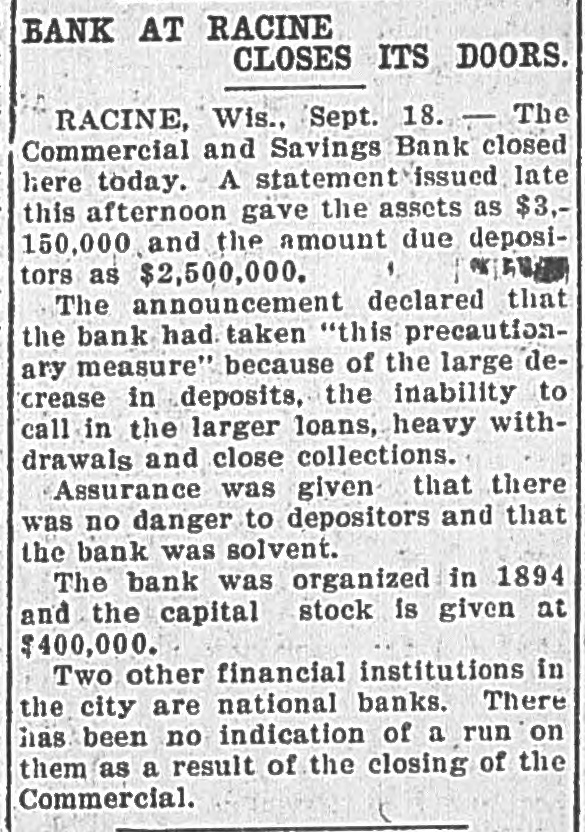
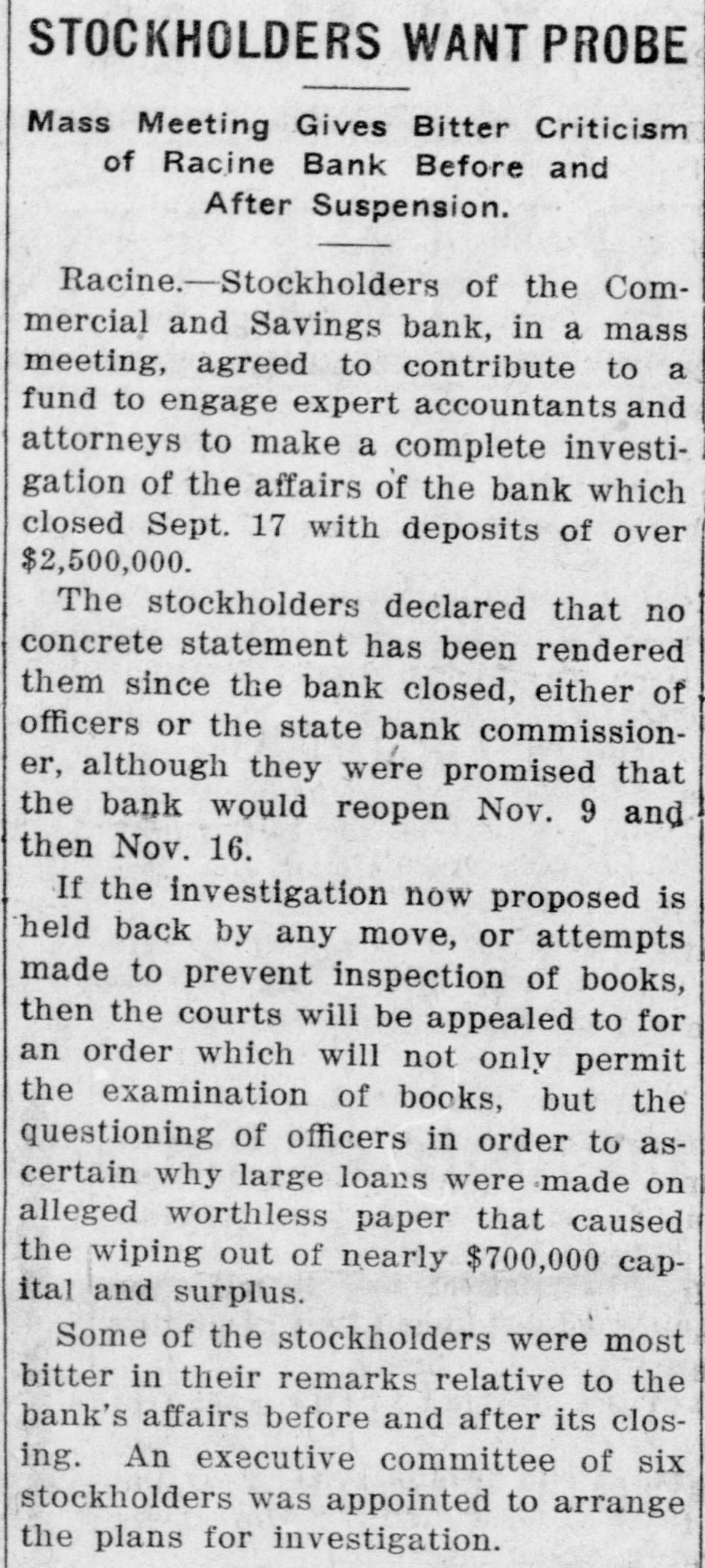
Creditors of the United Refrigerator Company got a bad bump in Racine late Thursday afternoon when after an all day hearing the referee in bankruptcy decided to admit the claims of the Commercial and Savings Bank of Racine, totaling more than $283,000, and the bank will share with the other creditors the meagre assets of the bankrupt. Trustee Rowland strongly contended that the bank had no valid claims and it was asserted that the claims had been settled by the turning over of collectable accounts. Evidence showed that the notes for which the collectable claims had been given as collateral were not covered by the claims made against the bankrupt by the bank officials.
W. H. Doty of Kenosha, bookkeeper for the bankrupt firm, was on the stand the greater part of the day, and through him an attempt was made to show the various transactions which involved loans, and which the records indicate were the largest single factor in causing the bank to suspend.
That the system of book-keeping by the bank at times showed a large discrepancy between the amounts to the credit of the Refrigerator company was one of the features of the examination.
Mr. Doty testified that on September 30, 1914, the books of the bank showed a credit of $544.55 for the Refrigerator company, while the books of the Refrigerator company indicated that all it had was an overdraft on the same day of $183,544.
The explanations of the various discrepancies were vague and the attorneys representing the bank and the trustee for the Kenosha company frequently clashed as to the correctness of statements by the witness. He was not very positive at times, being compelled to ask help from one of his assistants in regard to transactions which he had not personally handled.
Mr. Doty admitted that he was not fully conversant with all the loans. Peter B. Nelson at times made the loans and did not keep his bookkeeper advised of their character.
John B. Simmons, of Simmons and Walker, attorneys for the banking commissioner, entered an objection to statements made from the books of the Refrigerator company saying they merely showed how the books were kept.
C. C. Gittings, attorney for the trustee of the Refrigerator company, retorted that while that might be so, the books of the Commercial and Savings Bank were no criterion of how the bank was conducted.
A statement from the Commercial and Savings Bank on July 31, 1913, showed that the Refrigerator company had a balance of $40,458.80. The books of the company showed on that date it was overdrawn $48,362.42.
Of all the testimony taken, the attorney for the trustee of the Refrigerator company had failed to prove his contention that the Commercial and Savings Bank claim is not valid.
Employes of that company while testifying do not deny that large sums were borrowed from the bank, and not from Charles R. Carpenter, as an individual.