
22796. Mineral Point Bank (Mineral Point, WI)

Bank Information

Episode Type
Run → Suspension → Closure
Bank Type
state
Start Date
*
Location
Mineral Point, Wisconsin (42.860, -90.183)

Metadata

Model
gpt-5-mini
Short Digest
9194ecb3

Response Measures

Full suspension

Other: Cashier suicide mentioned; articles describe bank as 'wrecked' or 'failed' rather than describing depositor run.

Description

Articles state the Mineral Point Bank 'wrecked' / 'failed' and that its failure 'created a panic' and 'caused a suicide' (cashier committed suicide). This indicates a depositor panic/run followed by the bank's failure/suspension and ultimate closure. No reopening is mentioned. OCR corrected 'barfk' to 'bank' in Article 1.

Events (2)

1. * Run
Cause
Bank Specific Adverse Info
Cause Details
Failure of the Mineral Point Bank (unspecified insolvency) provoked a panic among depositors.
Newspaper Excerpt
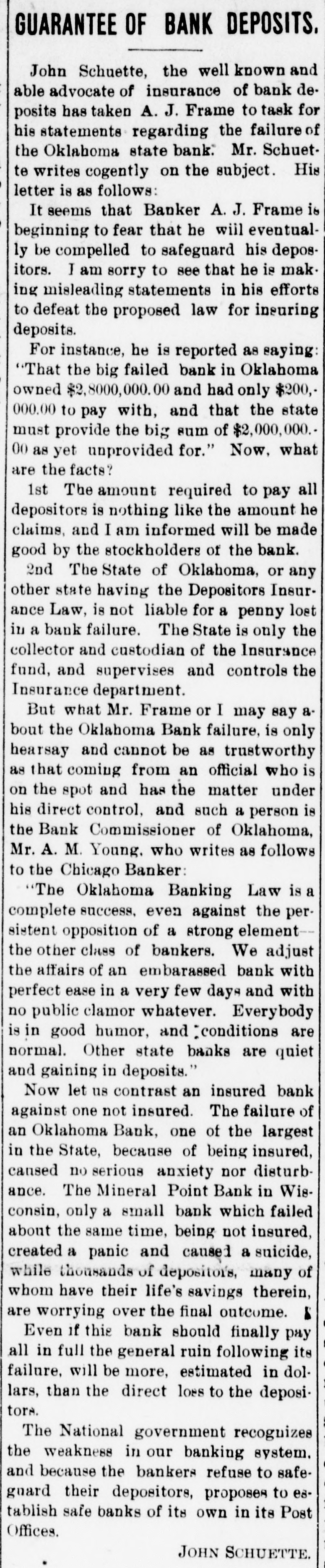
The Mineral Point Bank in Wisconsin, only a small bank which failed about the same time, being not insured, created a panic and caused a suicide,
Source
newspapers
2. * Suspension
Cause
Bank Specific Adverse Info
Cause Details
Bank is described as 'wrecked' / failed; suspension/closure followed the failure.
Newspaper Excerpt
F. E. Hanscome, cashier of the wrecked Mineral Point, Wis., bank, committed suicide
Source
newspapers

Newspaper Articles (2)

Article from Wausau Pilot, October 26, 1909

Click image to open full size in new tab

Article Text

# SUMMARY OF THE MOST IMPORTANT NEWS. Sunday. President Taft reached San Antonio and was welcomed by a big crowd. Mobs in London, Paris, and other European cities and in Havana, Cuba, protested against Ferrer's execution. William I. Buchanan, former minister to Argentina and director of the Pan-American exposition, died in a London street. Governor Shallenberger of Nebraska declared that the federal judges who set aside the bank guaranty law are political puppets. Charles E. Magoon, former provisional governor of Cuba, denied the report that he will be appointed minister to China to succeed C. R. Crane. Monday. President Taft retired to his brother's ranch for four days of rest. Missouri Democrats opened an active campaign to get Folk nominated for President. Daniel D. Davies was ousted as Chicago immigration inspector for padding expense vouchers. Twelve thousand Christians, headed by Gypsy Smith, paraded through the red light district of Chicago. Count Lambert flew thirty-one miles and soared over Paris and the Eiffel tower at a height of 1,300 feet. The report from Madrid was that Premier Maura was near a fall, as Alfonso was angry because he did not have a chance to pardon Ferrer. Gary, Ind., became a city amid bloodshed and riots, following the nomination of ex-Mayor W. C. Crolius of Joliet for office over Thomas E. Knotts. F. E. Hanscome, cashier of the wrecked Mineral Point, Wis., barfk, committed suicide on his parents' grave and his mother-in-law dropped dead on hearing the news. Tuesday. Cesare Lombroso, the noted Italian criminologist, died at Turon. The officials of the American Federation of Labor denounced the "murder" of Prof. Ferrer. The people of Peoria and other Illinois valley towns demand a real deep waterway without politics. An official of Framingham, Mass., declared that the forgeries against that town amount to $325,000. President James McCrea announced the Pennusylvania system probably will begin work soon on a $25,000,000 station in Chicago. Wednesday. Six were drowned in' the wreck of a steamship on upper Lake Erie. Chicago, Peoria and St. Louis Railroad in the federal court at Springfield attacked the 2-cent rate law as unconstitutional. James M. Barrie, novelist and playwright, won a divorce in London after telling of his wife's misconduct with Gilbert Cannon, a young author. A lone bandit who held up the bank of D. M. Erskine & Co. at Highland Park, III., and got $477, committed suicide when run down by a posse of 100 Thursday. President Taft accepted the resignation of Charles R. Crane, minister designate to China. The Hghlaind Park bank robber suicide was identified as Lamar A. Harris, a Los Angeles lawyer. The purchase of the Katy road by Hawley gives the Alton a gulf outlet and strengthens the Rock Island in the Southwest. Barril, companion of Cook on Mount McKinley expedition, said they were no nearer than fourteen miles of mountain's summit. The corner stone of the new Central Masonic Temple in Chicago was laid under the auspices of the Illinois Grand Lodge and in the presence of 2,000 of the order. Friday. King George of Greece may soon abdicate. The Southern storm death list numbered fifty-five. Two Italian children kidnaped in St. Louis were found wandering in Chicago. Rioting was renewed in many European capitals as the result of Ferrer's execution. President Zelaya of Nicaragua declared the points captured by the rebels are unimportant and that the country is loyal. Saturday. A new ruling lets pulp from Canada in free, with some exceptions. Presidents Taft and Diaz met on American and Mexican soil; Diaz gave a state banquet. Willie Boy, Indian outlaw, kined himself on a mountain top with last shot after defying posses for weeks. Police dogs routed a Paris mob demonstrating in sympathy of Ferrer and prevented the wrecking of the Church of the Sacred Heart. Captain Schoubye, skipper of the Danish government's arctie yacht, got the story of the finding of the north pole by Dr. Cook from the two Eskimos who accompanied the explorer on his fical dash. NOTES OF CURRENT EVENTS

Article from The Manitowoc Pilot, October 28, 1909

Click image to open full size in new tab

Article Text

GUARANTEE OF BANK DEPOSITS. John Schuette, the well known and able advocate of insurance of bank deposits has taken A. J. Frame to task for his statements regarding the failure of the Oklahoma state bank: Mr. Schuette writes cogently on the subject. His letter is as follows: It seems that Banker A. J. Frame is beginning to fear that he will eventually be compelled to safeguard his depositors. I am sorry to see that he is mak. ing misleading statements in his efforts to defeat the proposed law for insuring deposits. For instance, he is reported as saying: "That the big failed bank in Oklahoma owned $2,8000,000.00 and had only $200,000.00 to pay with, and that the state must provide the big sum of $2,000,000.00 as yet unprovided for." Now, what are the facts? 1st The amount required to pay all depositors is nothing like the amount he claims, and I am informed will be made good by the stockholders of the bank. 2nd The State of Oklahoma, or any other state having the Depositors Insurance Law, is not liable for a penny lost in a bank failure. The State is only the collector and custodian of the Insurance fund, and supervises and controls the Insurance department. But what Mr. Frame or I may say about the Oklahoma Bank failure, is only hearsay and cannot be as trustworthy as that coming from an official who is on the spot and has the matter under his direct control, and such a person is the Bank Commissioner of Oklahoma, Mr. A. M. Young. who writes as follows to the Chicago Banker: 'The Oklahoma Banking Law is a complete success, even against the persistent opposition of a strong element-the other class of bankers. We adjust the affairs of an embarassed bank with perfect ease in a very few days and with no public clamor whatever. Everybody is in good humor, and "conditions are normal. Other state banks are quiet and gaining in deposits." Now let us contrast an insured bank against one not insured. The failure of an Oklahoma Bank, one of the largest in the State, because of being insured, caused no serious anxiety nor disturbance. The Mineral Point Bank in Wisconsin, only a small bank which failed about the same time, being not insured, created a panic and caused a suicide, while thousands of depositors, many of whom have their life's savings therein, are worrying over the final outcome. & Even if this bank should finally pay all in full the general ruin following its failure, will be more, estimated in dollars, than the direct loes to the depositore. The National government recognizes the weakness in our banking system. and because the bankers refuse to safeguard their depositors, proposes to establish safe banks of its own in its Post Offices. JOHN SCHUETTE.