22779. Wisconsin Marine and Fire Insurance Company Bank (Mitchell Bank) (Milwaukee, WI)

Bank Information

Episode Type
Run → Suspension → Closure
Bank Type
state
Start Date
July 25, 1893
Location
Milwaukee, Wisconsin (43.039, -87.906)

Metadata

Model
gpt-5-mini
Short Digest
9913c831

Response Measures

Full suspension

Other: Receiver appointed (Washington Becker) after board-ordered closure.

Description

The bank closed by order of its board on July 25, 1893 after steady withdrawals/drain amid the broader money-market stringency. A receiver (Washington Becker) was appointed the same day, indicating permanent closure rather than a temporary suspension and reopening. Articles describe heavy withdrawals and crowding, so a run preceded the suspension. Private is used because contemporary reports call it a private copartnership with stockholders individually liable.

Events (3)

1. July 25, 1893 Receivership
Newspaper Excerpt
Judge Johnson appointed Washington Becker receiver of the bank. His bond was fixed at $1,000,000.
Source
newspapers
2. July 25, 1893 Run
Cause
Macro News
Cause Details
Steady withdrawals and a drain on funds driven by the general stringency of the money market and wider banking failures/panic.
Measures
Bank decided not to open for business that morning; directors closed the bank to stem further withdrawals.
Newspaper Excerpt
There was a rush in the direction of the Mitchell building ... considerable money was hastily withdrawn
Source
newspapers
3. July 25, 1893 Suspension
Cause
Macro News
Cause Details
Closed by board due to money-market stringency and inability to meet withdrawals despite assets; decision taken to not open for business that day.
Newspaper Excerpt
By reason of the stringency of the money market, this bank has been closed by order of Board of Directors.
Source
newspapers

Newspaper Articles (5)

Article from The Jersey City News, July 25, 1893

Click image to open full size in new tab

Article Text

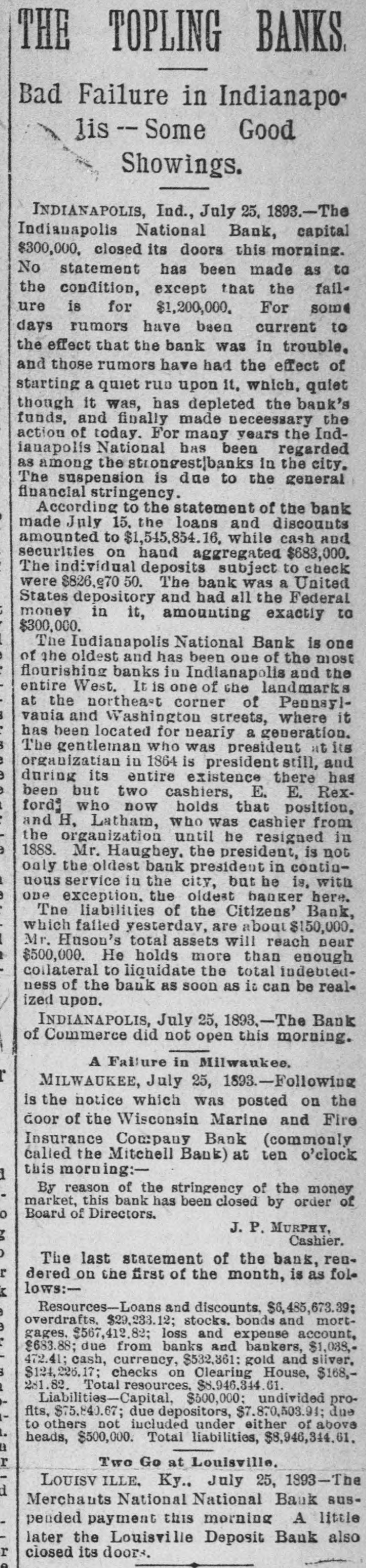
THE TOPLING BANKS Bad Failure in Indianapo lis -- Some Good Showings. INDIANAPOLIS, Ind., July 25. 1893.-The Indianapolis National Bank, capital $300,000. closed its doors this morning. No statement has been made as to the condition, except that the fail ure is for $1,200,000. For some days rumors have been current to the effect that the bank was in trouble. and those rumors have had the effect of starting a quiet run upon 11, which, quiet though it was, has depleted the bank's funds, and finally made neceessary the action of today. For many years the Indiauapolis National has been regarded as among the strongest|banks in the city. The suspension is due to the general financial stringency. According to the statement of the bank made July 15, the loans and discounts amounted to $1,545,854.16, while cash and securities on hand aggregated $683,000. The individual deposits subject to check were $826,e70 The bank was a United States depository and had all the Federal ; money in it, amounting exactly to $300,000. The Indianapolis National Bank is one of the oldest and has been one of the most : flourishing banks in Indianapolis and the entire West. It is one of the landmarks at the northeast corner of Pennsyl3 vania and Washington streets, where it : has been located for nearly a generation. 3 The gentleman who was president at its e organizatian in 1864 is president still, and 9 during its entire existence there has ) been but two cashiers, E. E. Rex1 ford who now holds that position, : and H, Latham, who was cashier from the organization until he resigned in e 1888. Mr. Haughey. the president, is not only the oldest bank president in contin1 uous service in the city, but be is, with 9 one exception. the oldest banker here. The liabilities of the Citizens' Bank, which falled yesterday, are about $150,000. I Mr. Huson's total assets will reach near I $500,000. He holds more than enough collateral to liquidate the total indebtedness of the bank as soon as it can be realized upon. INDIANAPOLIS, July 25, 1893,-The Bank of Commerce did not open this morning. A Failure in Milwaukee. r MILWAUKEE, July 25, 1893.-Following is the notice which was posted on the Goor of the Wisconsin Marine and Fire Insurance Company Bank (commonly called the Mitchell Bank) at ten o'clock this morning:1 By reason of the stringency of the money market, this bank has been closed by order of Board of Directors. o J. P. MURPHY, No Cashier. ) The last statement of the bank, renr dered on the first of the month, is as fol lows:K Resources-Loans and discounts. $6,485,673.39; ) overdrafts, $29,233.12; stocks. bonds and mort9 gages, $567,412.82; loss and expense account, : $683.88; due from banks and bankers, $1,083,472.41; cash, currency, $532,361: gold and silver, 3 $124,226.17; checks on Clearing House, $168,i 231.82. Total resources, $8,946,344.61. Liabilities-Capital, $500,000; undivided profits, $75,840.67; due depositors, $7.870.503.94; due to others not included under either of above 1. heads, $500,000. Total liabilities, $8,946,344.61. a r Two Go at Louisville, LOUISV ILLE, Ky.. July 25, 1893-The d Merchants National National Bank suspended payment this morning A little later the Louisville Deposit Bank also r closed its doors. e
Article from New-York Tribune, July 26, 1893

Click image to open full size in new tab

Article Text

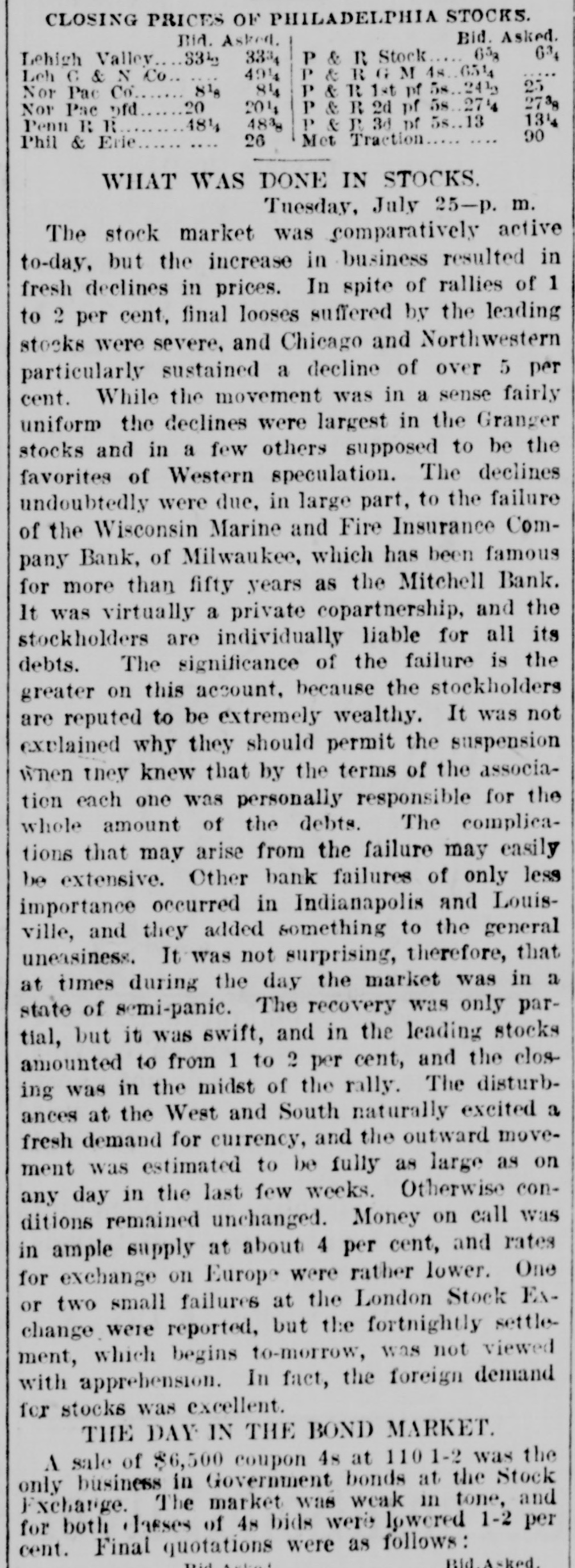
CLOSING PRICES OF PHILADELPHIA STOCKS. Bid. Asked. Bid. Asked. 63, 65g P & R Stock Lehigh Valley 33½ 3334 P & R G M 4s 6514 494 Leh C & N Co 25 84 P & R 1st nf 58 2412 81₈ Nor Pac Co 2738 20 P & R 2d of 58 274 204 Nor Pac ofd 134 P & R 3d of 5s 13 48³₈ Penn R R 48½ 90 Met Traction 26 Phil & Erie WHAT WAS DONE IN STOCKS. Tuesday, July 25-p. m. The stock market was comparatively active to-day, but the increase in business resulted in fresh declines in prices. In spite of rallies of 1 to 2 per cent, final looses suffered by the leading stocks were severe, and Chicago and Northwestern particularly sustained a decline of over 5 per cent. While the movement was in a sense fairly uniform the declines were largest in the Granger stocks and in a few others supposed to be the favorites of Western speculation. The declines undoubtedly were due, in large part, to the failure of the Wisconsin Marine and Fire Insurance Company Bank, of Milwaukee, which has been famous for more than fifty years as the Mitchell Bank. It was virtually a private copartnership, and the stockholders are individually liable for all its debts. The significance of the failure is the greater on this account, because the stockholders are reputed to be extremely wealthy. It was not explained why they should permit the suspension wnen they knew that by the terms of the association each one was personally responsible for the whole amount of the debts. The complications that may arise from the failure may easily be extensive. Other bank failures of only less importance occurred in Indianapolis and Louisville, and they added something to the general uneasiness. It was not surprising, therefore, that at times during the day the market was in a state of semi-panic. The recovery was only partial, but it was swift, and in the leading stocks amounted to from 1 to 2 per cent, and the closing was in the midst of the rally. The disturbances at the West and South naturally excited a fresh demand for currency, and the outward movement was estimated to be fully as large as on any day in the last few weeks. Otherwise conditions remained unchanged. Money on call was in ample supply at about 4 per cent, and rates for exchange on Europe were rather lower. One or two small failures at the London Stock Exchange were reported, but the fortnightly settlement, which begins to-morrow, was not viewed with apprehension. In fact, the foreign demand for stocks was excellent. THE DAY IN THE BOND MARKET. A sale of $6,500 coupon 4s at 110 1-2 was the only business in Government bonds at the Stock Exchange. The market was weak in tone, and for both dasses of 48 bids were lowered 1-2 per cent. Final quotations were as follows: Rid Asked.


Article from The Indianapolis Journal, July 26, 1893

Click image to open full size in new tab

Article Text

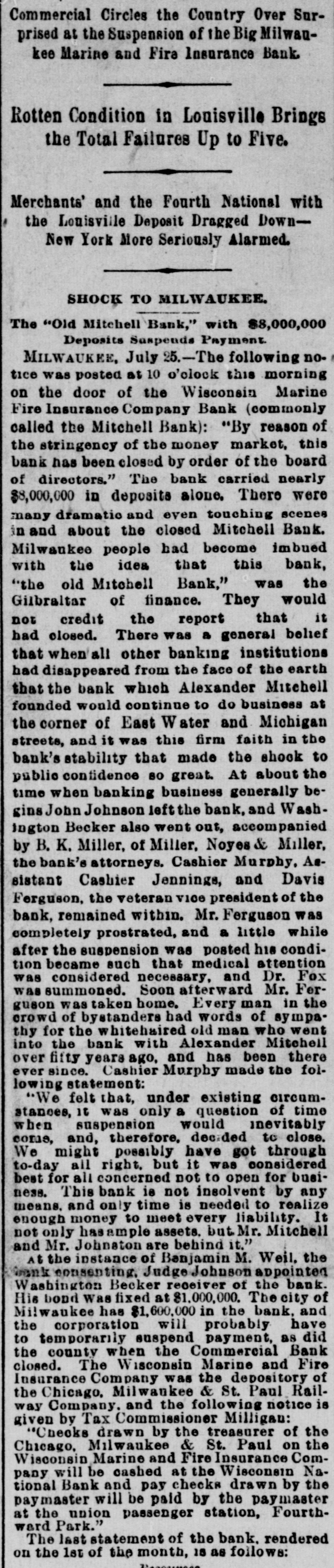
Commercial Circles the Country Over Surprised at the Suspension of the Big Milwaukee Marine and Fira Insurance Bank Rotten Condition in Louisville Brings the Total Failures Up to Five. Merchants' and the Fourth National with the Louisville Deposit Dragged DownNew York More Seriously Alarmed. SHOCK TO MILWAUKEE. The "Old Mitchell Bank," with $8,000,000 Deposits Suspends Payment MILWAUKEE, July 25.-The following notice was posted at 10 o'clock this morning on the door of the Wisconsin Marine Fire Insurance Company Bank (commonly called the Mitchell Bank): "By reason of the stringency of the money market, this bank has been closed by order of the board of directors." The bank carried nearly $8,000,000 in deposits alone. There were many dramatic and even touching scenes in and about the closed Mitchell Bank. Milwaukee people had become imbued with the idea that this bank, "the old Mitchell Bank," was the Gilbraltar of finance. They would not credit the report that it had closed. There was a general belief that when all other banking institutions had disappeared from the face of the earth that the bank which Alexander Mitchell founded would continue to do business at the corner of East Water and Michigan streets, and it was this firm faith in the bank's stability that made the shook to public confidence 80 great. At about the time when banking business generally begins John Johnson left the bank, and Washlogton Becker also went out, accompanied by B. K. Miller, of Miller. Noyes & Miller, the bank's attorneys. Cashier Murphy. Assistant Cashier Jennings, and Davis Ferguson, the veteran V100 president of the bank, remained within. Mr. Ferguson was completely prostrated, and a little while after the suspension was posted his condition became such that medical attention was considered necessary, and Dr. Fox was summoned. Soon afterward Mr. Forguson was taken home. Every man in the crowd of bystanders had words of sympathy for the whitehaired old man who went into the bank with Alexander Mitchell over fifty years ago, and has been there ever since. Cashier Murphy made the following statement: "We felt that, under existing circumstances, it was only a question of time when suspension would inevitably come, and, therefore, decided to close. We might possibly have got through to-day all right. but it was considered best for all concerned not to open for business. This bank is not insolvent by any means. and only time is needed to realize enough money to meet every liability. It not only sample assets. but Mr. Mitchell and Mr. Johnston are behind it." At the instance of Banjamin M. Weil. the Grank consenting, Judge Johnson appointed Washington Becker receiver of the bank. His bond Was fixed at $1,000,000. The city of Milwaukee has $1,600,000 in the bank. and the corporation will probably have to temporarily suspend payment, as did the county when the Commercial Bank closed. The Wisconsin Marine and Fire Insurance Company was the depository of the Chicago. Milwaukee & St. Paul Railway Company. and the following notice is given by Tax Commissioner Milligan: "Checks drawn by the treasurer of the Chicago, Milwaukee & St. Paul on the Wisconsin Marine and Fire Insurance Company will be cashed at the Wisconsin National Bank and pay checks drawn by the paymaster will be paid by the paymaster at the union passenger station, Fourthward Park." The last statement of the bank. rendered on the 1st of the month, 18 as follows:


Article from New-York Tribune, July 26, 1893

Click image to open full size in new tab

Article Text

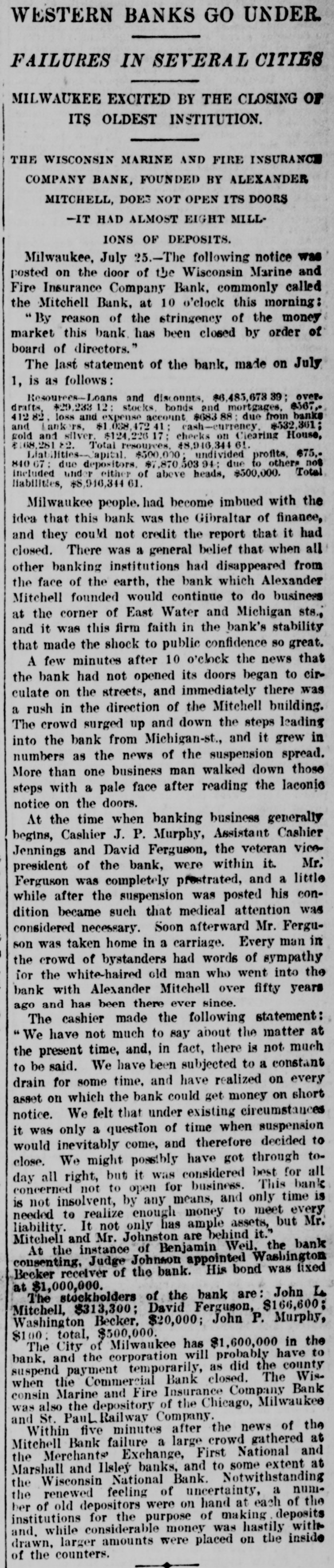
WESTERN BANKS GO UNDER FAILURES IN SEVERAL CITIES MILWAUKEE EXCITED BY THE CLOSING or ITS OLDEST INSTITUTION. THE WISCONSIN MARINE AND FIRE INSURANCE COMPANY BANK, FOUNDED BY ALEXANDER MITCHELL, DOES NOT OPEN ITS DOORS -IT HAD ALMOST EIGHT MILLIONS OF DEPOSITS. Milwaukee, July 25.-The following notice was posted on the door of the Wisconsin Marine and Fire Insurance Company Bank, commonly called the Mitchell Bank, at 10 o'clock this morning: By reason of the stringency of the money market this bank has been closed by order of board of directors." The last statement of the bank, made on July 1, is as follows: Resources-Loans and discounts. $6,485,673.39; over. drafts, *29.233.12 stocks. bonds and mortgages, 8567, 41282 loss and expense : account 868388; due from banks and Lankers, $1,038,472 41 cash-currency, #532,361; gold and silver. $124,226 17 cheeks on Clearing House, $168.281.82. Total resources, 48,946,344 61. Liabilities Capital. $500,000 undivided profits, $75.840 67 : due depositors. $7,870,503.94: due to others not included under either of above heads, $500,000. Total liabilities, $8,946,344 61. Milwaukee people. had become imbued with the idea that this bank was the Gibraltar of finance, and they could not credit the report that it had closed. There was a general belief that when all other banking institutions had disappeared from the face of the earth, the bank which Alexander Mitchell founded would continue to do business at the corner of East Water and Michigan sts., and it was this firm faith in the bank's stability that made the shock to public confidence so great. A few minutes after 10 o'clock the news that the bank had not opened its doors began to circulate on the streets, and immediately there was a rush in the direction of the Mitchell building. The crowd surged up and down the steps leading into the bank from Michigan-st., and it grew in numbers as the news of the suspension spread. More than one business man walked down those steps with a pale face after reading the laconio notice on the doors. At the time when banking business generally begins, Cashier J. P. Murphy, Assistant Cashier Jennings and David Ferguson, the veteran vicepresident of the bank, were within it. Mr. Ferguson was completely prestrated, and a little while after the suspension was posted his condition became such that medical attention was considered necessary. Soon afterward Mr. Ferguson was taken home in a carriage. Every man in the crowd of bystanders had words of sympathy for the white-haired old man who went into the bank with Alexander Mitchell over fifty years ago and has been there ever since. The cashier made the following statement: We have not much to say about the matter at the present time, and, in fact, there is not much to be said. We have been subjected to a constant drain for some time, and have realized on every asset on which the bank could get money on short notice. We felt that under existing circumstances it was only a question of time when suspension would inevitably come, and therefore decided to close. We might possibly have got through today all right, but it was considered best for all concerned not to open for business. This bank is not insolvent, by any means, and only time is needed to realize enough money to meet every liability. It not only has ample assets, but Mr. Mitchell and Mr. Johnston are behind it. At the instance of Benjamin Weil, the bank consenting, Judge Johnson appointed Washington Becker receiver of the bank. His bond was fixed at $1,000,000. The stockholders of the bank are: John L Mitchell, $313,300; David Ferguson, $166,600; Washington Becker, $20,000; John P. Murphy, $100: total, $500,000. The City of Milwaukee has $1,600,000 in the bank. and the corporation will probably have to suspend payment temporarily, as did the county when the Commercial Bank closed. The Wisconsin Marine and Fire Insurance Company Bank s also the depository of the Chicago, Milwaukee and St. auL.Railway Company. Within five minutes after the news of the Mitchell Bank failure a large crowd gathered at the Merchants Exchange, First National and Marshall and Ilsley banks, and to some extent at the Wisconsin National Bank. Notwithstanding the renewed feeling of uncertainty, a number of old depositors were on hand at each of the institutions for the purpose of making deposits and, while considerable money was hastily with drawn, larger amounts were placed on the inside of the counters.


Article from The Democratic Advocate, July 29, 1893

Click image to open full size in new tab

Article Text

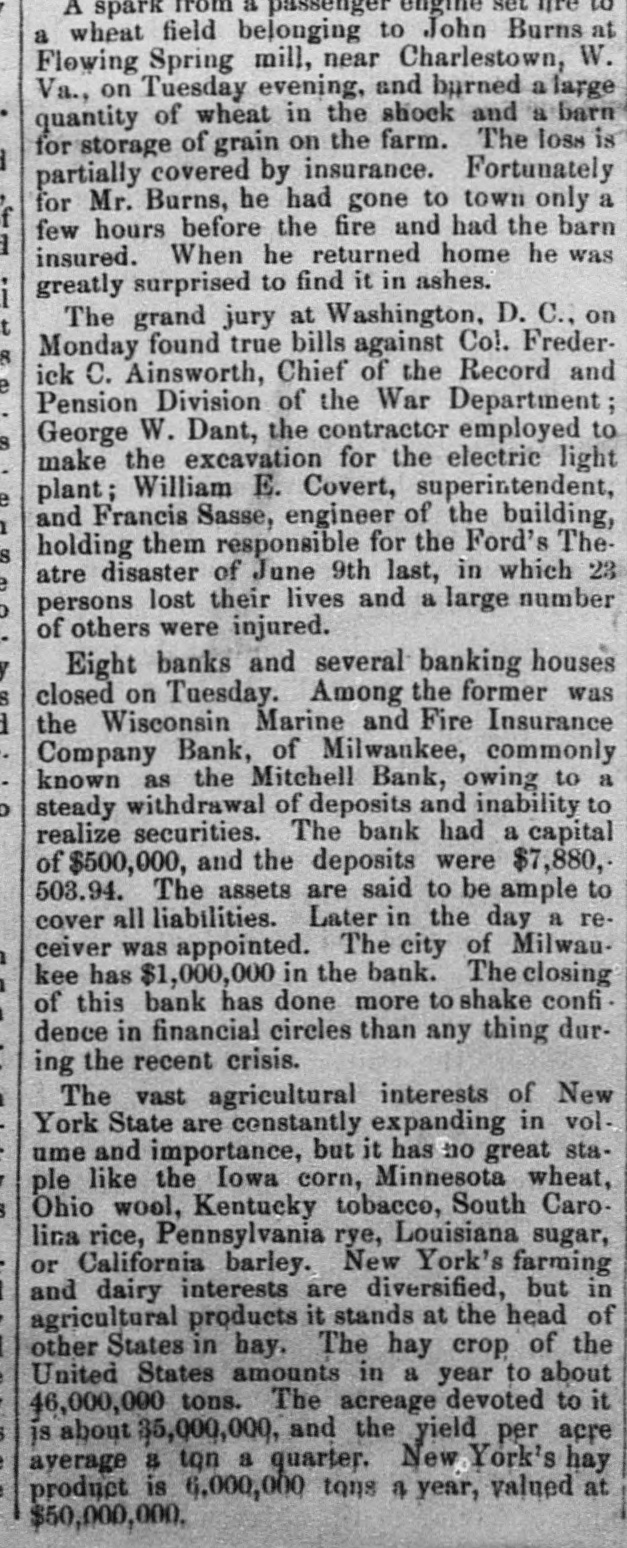
A spark a passenger engine a wheat field belonging to John Burns at Flowing Spring mill, near Charlestown, W. Va., on Tuesday evening, and burned a large quantity of wheat in the shock and a barn for storage of grain on the farm. The loss is partially covered by insurance. Fortunately for Mr. Burns, he had gone to town only a few hours before the fire and had the barn insured. When he returned home he was greatly surprised to find it in ashes. The grand jury at Washington, D. C., on Monday found true bills against Col. Frederoc. ick C. Ainsworth, Chief of the Record and Pension Division of the War Department; George W. Dant, the contractor employed to make the excavation for the electric light plant; William E. Covert, superintendent, and Francis Sasse, engineer of the building, holding them responsible for the Ford's Theatre disaster of June 9th last, in which 23 persons lost their lives and a large number of others were injured. Eight banks and several banking houses closed on Tuesday. Among the former was the Wisconsin Marine and Fire Insurance Company Bank, of Milwankee, commonly known as the Mitchell Bank, owing to a steady withdrawal of deposits and inability to realize securities. The bank had a capital of $500,000, and the deposits were $7,880,503.94. The assets are said to be ample to cover all liabilities. Later in the day a receiver was appointed. The city of Milwaukee has $1,000,000 in the bank. The closing of this bank has done more to shake confidence in financial circles than any thing during the recent crisis. The vast agricultural interests of New York State are constantly expanding in volume and importance, but it has no great staple like the Iowa corn, Minnesota wheat, Ohio wool, Kentucky tobacco, South Carolina rice, Pennsylvania rye, Louisiana sugar, or California barley. New York's farming and dairy interests are diversified, but in agricultural products it stands at the head of other States in hay. The hay crop of the United States amounts in a year to about 46,000,000 tons. The acreage devoted to it is about 35,000,000, and the yield per acre ayerage a ton a quarter. New York's hay product is 6,000,000 tons a year, valued at $50,000,000.