22750. Mitchell bank (Milwaukee, WI)

Bank Information

Episode Type
Suspension → Closure
Bank Type
state
Start Date
July 25, 1893
Location
Milwaukee, Wisconsin (43.039, -87.906)

Metadata

Model
gpt-5-mini
Short Digest
2de408a1

Response Measures

None

Description

The Mitchell bank at Milwaukee suspended on July 25, 1893, a receiver (Washington Becker) was appointed in early August, reopening was proposed in Dec 1893 but depositors refused and the receiver abandoned resumption; the bank proceeded to liquidation/receivership. No explicit article describes a depositor run prompting the suspension — coverage emphasizes closure/suspension and insolvency/receivership. Bank type not clearly indicated in the articles.

Events (4)

1. July 25, 1893 Suspension
Cause
Bank Specific Adverse Info
Cause Details
Bank closed/suspended due to its own failure/insolvency as reported; articles link the Mitchell bank suspension to broader market panic and losses in local business (bank-specific collapse).
Newspaper Excerpt
On the 25th the Mitchell bank at Milwaukee closed its doors.
Source
newspapers
2. August 7, 1893 Receivership
Newspaper Excerpt
Washington Becker, receiver of the Mitchell bank, ... (Aug. 7 dispatch). The plan ... originated in the mind of Washington Becker, receiver of the Mitchell bank, and has been accepted ... .
Source
newspapers
3. December 4, 1893 Other
Newspaper Excerpt
In a circular issued by Washington Becker, receiver of the Mitchell bank, the following terms are proposed: Ten per cent. in cash on demand after the bank opens, 10 per cent. in six months from Jan. 1, 1894, and the balance ... Judge Johnson ... says the Mitchell next [could open].
Source
newspapers
4. December 23, 1893 Other
Newspaper Excerpt
It seems to be settled that the Mitchell bank at Milwaukee will not resume business. The depositors in sufficient numbers refused to agree to the extension of time ... and the receiver has therefore abandoned the project of resuming.
Source
newspapers

Newspaper Articles (21)

Article from Fort Worth Gazette, July 26, 1893

Click image to open full size in new tab

Article Text

A Brewery Fails. MILWAUKEE, Wis., July 25.-The J. Obermann Brewing company has failed. Herman P. Obermann is assignee. His bond is for $500,000. Assets nominally $500,000; liabilities, $294,000. The failure is due to the suspension of the Mitchell bank.


Article from St. Paul Daily Globe, July 26, 1893

Click image to open full size in new tab

Article Text

A SMASHED MARKET. ANOTHER BOTTOM DROPS OUT IN CHICAGO AND NEW YORK. ALL THE BULLS ON THE RUN. Bank Failures in Milwaukee, Indianapolis, Louisville and Other Cities Start the BreakLong Wheat Dumped and Good Stocks Sacrificed. CHICAGO, July 25.-Today made a complete undoing of yesterday's business on 'change. In two hours the big advance of yesterday in all pits was wiped out. Wheat broke 1½c. corn 18/4c, and oats 13/3c from closing prices last night. Bull houses turned around and sold out everything bought on the advance yesterday. The shorts who covered at the sight of bull markets put outfresh lines today, and forced the selling around low figures. The chief cause of the smash this morning was the Mitchell bank suspension at Milwaukee, followed by bank failures in Indianapolis, Louisville and other cities. The showers over the West relieve d the alarm about crops. and the increase in local stocks and liberal receipts all added to the selling. Everything closed at about bottom figures. It was the impression that considerable wheat for Milwaukee parties tradmg in this market, who had their accounts in the Milwaukee bank which closed, ordered their long wheat closed out. Buyers of yesterday turned sellers today, and the effects of the bad crop outlook and war news at Siam were for the moment, at least, lost sight of. The opening was %@%c lower than yester day's closing, and with only slight fluctuations prices further declined until the close, which was comparatively quiet and steady. Liverpool. Berlin and Paris all showed some improvement at the close over yesterday's quotations, but the gloom of expiring banks was too dense to be lifted by any ordinary news. The corn movement was heavy at 821 cars, covering forty-eight hours. The grading gave 411 cars of contract corn. The stocks of contract corn increased 140,000 bu, to a total of 1,03,000 bu. The cash demand was so slow as to bei


Article from The Morning News, July 26, 1893

Click image to open full size in new tab

Article Text

Chicago, July 25.-To-day made complete undoing of yesterday's business on change. In two hours the big advance of yesterday was wiped out. Wheat broke 1%c, corn 1%C, and oats 1%c from the closing prices last night. The chief cause of the smash of the morning was the Mitchell bank suspension at Milwaukee, followed by bank failures in Indianapolis. Louisville and other cities. It was the impression that considerable wheat was sold for Milwaukee parties trading in this market. who had their accounts in the Milwaukee bank which closed. and who ordered their "long wheat closed out. Buyers of yesterday turned sellers to-day, and the effects of the bad crop outlook and war news at Siam were for the moment lost sight of. The opening was %@½c lower than yesterday's closing. and with only slight fluctuations, prices further declined until the close, which was comparatively quiet and steady. The corn movement was heavy, stocks of contract corn increased and cash demand was so slow as to be against the speculative market. Fears of seeing a turn in sentiment pressed selling, and forced the market back. Trade in oats was regulated entirely by other markets. Provisions started with an upturn of 5@10c. but attempts to unload precipitated the break in keeping. with the drop in grain. There was a partial reaction in prices later, but only scant business. The estimated receipts for to-morrow are wheat 87 cars. corn 360. Chicago, July 25.-Casn quotations were as follows: Flour in fair demand: prices practically unchanged: No. 2spring in sack $3 624@3 62%: bakers $2 25. Wheat-No. 2 spring 635/g Corn-No. 2 39%c. Oats-No. 2 21½0, Mess pork $19 75@19 77½. Lard. per 100 pounds, $9 75@9 80. Short rib sides. loose, $8 19@8 35. Dry salted shoulders, boxed, $7 75 @8 00; short clear sides, boxed, $850@8 62½. Whisky $112.


Article from Vermont Phœnix, July 28, 1893

Click image to open full size in new tab

Article Text

Features of the Situation. Wednesday was the worst day which there has been in the New York stock market since the present financial disturbances began. A big decline in stocks set in about noon, and as the day wore on the stock exchange presented a situation very close to a panic. At times the sales of investment stocks proceeded in such volume and with such violence as had never before been witnessed except in the worst days of 1873. Some of the best stocks on the market broke from four points upwards. One extraordinary incident was the sale of 1200 shares of Evansville and Terre Haute, a stock not active on the exchange. They were sold "under the rule" for an embarrassed broker, and although the price was quoted Tuesday at 126 bid, no buyer was found yesterday until the stock was offered at 75, a decline of 56 points in a day, probably unparallelled in the record of the stock exchange. The week has been a bad one for bank failures in the West and Southwest. Milwaukee, Wis., has been the worst sufferer, with four failures, one of them the Mitchell bank, so called, supposed to be impregnable. Two national banks have failed at Louisville, Ky., and one at Indianapolis. Besides these there have been numerous smaller failures, 20 in Kansas alone. Two trust companies and one national bank have suspended at Manchester, N. H. There have been many reports of the shutting down of manufacturing concerns and curtailment |of help. A notable instance is that of the Smith & Sons' carpet mills at Yonkers, N. Y., employing 500 hands, which closed Wednesday night for the first time since 1873. Yesterday there was a decidedly better feeling in the stock market and an upward movement in good securities which seems to stand a fair chance to continue.


Article from The Bessemer Indicator, July 29, 1893

Click image to open full size in new tab

Article Text

THE FINANCIAL SITUATION. On the 25th the Mitchell bank at Milwaukee closed its doors Its deposits amount to nearly $3,000,000, assets $9,000,000. At Indianapolis the Indianapolis National bank and the Bank of Commerce closed their loors. Joint liabilities $2,500,000. Three banks at Louisville, Kentucky, also falled on the 25th. They are the Merchants' National, the Fourth National and the Louisville Deposit bank. None of the failures are considered bad ones. Depositors in the two national banks will be paid in full, and the loss to stockhoMers will not be more than 60 per cent. In either case. The situation on the New York stock exchange on the 26th was critical and a panic was narrowly averted. The news that the Erle railroad had gone into the hands of a receiver was largely responsible for the break in stocks which felt from 1 to 4 points. H. I. Nicholas & Ea. brokers, assigned.


Article from Baxter Springs News, July 29, 1893

Click image to open full size in new tab

Article Text

THE WEST. Gov. MARKHAM, of California, has appointed ex-Gov. George C. Perkins United States senator to succeed Leland Stanford. CHARLES W. DEPAUW, one of the greatest capitalists of Indiana, has assigned. GEN. VANDEVER died at Ventura, Cal., recently. REV. CHARLES W. GALLAGHER, D. D., of Appleton, Wis., has been chosen president of the Wesleyan seminary, at Kent's Hill, Me. For four years he has been president of Lawrence university, at Appleton. A MASS meeting in the cause of silver was held at San Francisdo. A series of resolutions were adopted in which the "secret demonetization of silver" in 1873 is denounced as "a crime which can never be expiated, except in its complete rehabilitation." THE Merchants national bank at Great Falls, Mont., has suspended. FIFTEEN persons, eight of them exfederal officers, have been indicted at Portland, Ore., for smuggling Chinese and opium into the United States. THE second "grand excursion" of the railroads from the Missouri river to the world's fair proved a dismal failure. CALE, a town eighteen miles south of Caddo, I. T., was visited by a tornado. A church and many barns were destroyed. THE Woman's Relief corps of Illinois has decided to establish a home for old soldiers and soldiers' widows at Wilmington, Ill. NON-RESIDENT insurance agents are being prevented from doing business in Illinois by the new insurance law. REPORTS from Fort Gibson show little likelihood of the expulsion of any "intruders" from the Cherokee nation. THE Lane & Bodley Co., of Cincinnati, closed because the workmen refused to accept a reduction of 25 per cent. in wages during the present stringency. THERE was a slight fire in the transportation building at the world's fair the other day. It caused considerable alarm. THE old Mitchell bank at Milwaukee suspended on the 25th. greatly to the surprise of the people for it was considered a "Gibraltar of finance." GRASSHOPPERS have appeared in vast numbers east of Atchison in Missouri, delaying trains. They are of the native variety. Gov. Bones, of Iowa, says he will again accept the democratic nomination, contrary to previous assertions that he would not. THE Obermann Brewing Co., of Milwaukee has assigned. THE Indianapolis national and the Bank of Commerce, both of Indianapolis, Ind., failed on the 25th. COMMISSIONER Sr. CLAIR. of West Virginia. had a fight with gatemen and guards at the world's fair. MRS. LEONARD FRITSCHE was assassinated at an early hour in her home at Burlington. Ia. TWENTY-ONE world's fair excursionists were injured in a wreck on the Pittsburgh & Western railway, at Monroe Falls, O. A PREACHER named Jones, near Bedford. Ia., has been arrested for drawing a pension belonging to another Jones. THE B. & O. road is back of a West Virginia coal syndicate that is trying to crowd all other coke out of the western markets.


Article from The Meeker Herald, August 5, 1893

Click image to open full size in new tab

Article Text

THE FINANCIAL SITUATION, On the 25th the Mitchell bank at Milwaukee closed Its doors. Its deposits amount to nearly $8,000,000, assets $9,000,000. At Indianapolis the Indianapolis National bank and the Bank of Commerce closed their doors. Joint liabilities $2,500,000. Three banks at Louisville, Kentucky, also failed on the 25th. They are the Merchants' National, the Fourth National and the Louisville Deposit bank. None of the failures are considered bad ones. Depositors in the two national banks will be paid in full, and the loss to stockholders will not be more than 60 per cent. in either case. The situation on the New York stock exchange on the 26th was critical and a. panic was narrowly averted. The news that the Erie railroad had gone into the hands of & receiver was largely responsible for the break In stocks which fell from 1 to 4 points. H. I. Nicholas & Co., brokers, assigned. The First National and Montana National banks of Helena, failed to open Thursday morning. A run followed on theother banks of the city. The run was confined principally to the Merchants' National bank, which paid everybody. They are confident that they will be able to stand the run. The two closed banks have ample assets, but cannot realize on them. The Oregon National bank and the Northwest Loan and Trust company of Portland failed to open their doors on the 27th. A notice on the door says: "Owing to withdrawal of deposits and the inability to realize on securities this bank is forced to suspend." The First National of Middleboro, Kentucky, closed on the 27th. Two banks at Sparta, Wisconsin, closed, also a bank at Portage. The Ellensburg, Washington, National bank suspended payment. In consequence of A run upon It the Traders' Deposit bank of Mount Sterling, Indiana, suspended. The following banks failed on the 28th: First National at Great Falls, Montana; German National at Washington, Wisconsin Seymour's Bank at Chippewa Falls, Wisconsin; Chamberlain National at Chamberlain, South Dakota. The publication of the intended action of the New York and Brooklyn savings banks and institutions to put Into practice the law entitling them to sixty days' notice from deithdrawals of money positors of Intended precipitated a run Saturday. Some of the banks paid the amount in full, and thus sought to restore confidence. Others required notice, the time ranging from ten to ninety days, according to the period specified in the by-laws. The Commercial National, Ainsworth National and Portland Savings bank of Portland, Oregon, closed their doors on the 29th. The following banks also closed on that date: Citizens Savings, Akron, Ohio; First National. Kankakee, Illinois; Commercial, Eau Claire, Wisconsin: Barron Brothers, Lusk, Wyoming. The McNeal & Urban Safe and Lock Company, one of the oldest safe firms in the country, have assigned to Howard Douglass of Cincinnati. Assets. $160,000; liabilities unknown. The firm has been unfortunate in several large contracts, but It is claimed that It is solvent. The New York clearing-house committee on the 31st authorized the issue of $2,500,000 more In loan certificates, which brings the total issue outstanding up to $27,975,000. It may be noted that $26,565,000 was the maximum issue of 1878, but this comparison is really less impressive than It seems, for a very considerable part of this year's New York Issues has in practical effect, been provision for Chicago. No banks applied, 50 the dispatches stated, for loan certificates in the city. A secondary result of the local money scareity was an absolute want of bids for sterling bills, exchange rates going on some transactions below the year's previous lowest record. The following banks suspended on the 31st: Springfield Savings, at Springfield, Misssouri; First National, Ashland, Wisconsin: First National, Dalles, Oregon: Bellingham Bay National, Whatcom, Washington. Savings
Article from St. Paul Daily Globe, August 8, 1893

Click image to open full size in new tab

Article Text

# WILL RESIGN. Schlesinger Will Retire and the Creditors Will Take Charge of All His Property. MILWAUKEE, Wis., Aug. 7.-President Ferdinand Schlesinger, of the Chapin Mining company, and the head of the great Schlesinger mining syndicate, will tender his resignation within three days to take effect at once. The company has given its creditors absolute control of its property, which includes a lease of the famous Chapin mine, with the understanding that after all the indebtedness is cleared away the property shall return to the stockholders of the company. It was only after this agreement was made by all parties interested that Mr. Schlesinger, who is practically the Chapin Mining company, consented to being retired. The plan of the creditors to realize on their claims against the company is well arranged on a business basis, which promises to protect the property against utter demoralization and enable all the banks in Milwaukee holding paper of the Chapin Mining company to realize on the basis of 100 cents on the dollar with interest. It originated in the mind of Washington Becker, receiver of the Mitchell bank, and has been accepted by the creditors in every detail as well as by Mr. Schlesinger. In order to make the plan plain, it is necessary to refer to the lease under which Schlesinger operated the mine, and to show its possession by the deposed president. The lease was issued years ago by the Chapins the owners of the mine, to J. J. Hagerman, formerly of Milwaukee, and now a resident of Colorado. Mr. Hagerman made a fortune out of the investment, and afterwards sold the lease to the Van Dykes, or more correctly speaking, the Menomonie Mining company. This corporation worked the mine and made a fabulous fortune out of it. Then Schlesinger saw an opportunity to secure it, so he organized the Chapin company and purchased the lease of the Menomonie company, paying for it $1,400,000. Besides the lease he invested about $800,000 in improving the property so that the Chapin company's investment represents an actual investment of over $2,000,000. The fee owners of the mine, who are the Chapins, by the terms of law are paid an annual rental and a liberal royalty on every ton of ore that is taken out of the mine. This makes them active among the creditors to secure claims, and places them in direct relation to Schlesinger's company as regards its indebtedness. The arrears of royalties due the Chapins amount to about $200,000.


Article from Wood County Reporter, August 24, 1893

Click image to open full size in new tab

Article Text

anking laws. The banking laws atimated, cannot be amended with submitting the amendment to of the people, and as the p never voted on this law it I invalid from this omission. It is not very good news for creo the Marine bank that this indiv ability may possibly lapse. SI be declared that the law is no ective, then under another statut tockholders, in addition to losing tock, would be liable only for mount equal to the amount of sl the capital stock which they hat would mean only $500,000 of private fortunes of Mitchell, Becker and Murphy comb early two-thirds of that sum will to be paid by Mitchell. Mr. has no stock now. Milwaukee, Aug. 17.-Judge Joh morning affirmed the petitio D. McDougall to consolidate suits against the Wisconsin M: Fire Insurance Company ba The effect of this decision will 1 importance to all those inter the collapsed bank. It will pre further suits except the one Benjamin M. Weil VS. the W F. I. Co. bank, and restrains brought from being further It will simplify the law eedings and prevent the extraordi xpense of the thousand and one to be brought by creditor: which would have to come or assets of the bank. But the most important part of ecision outside of the consolidation suits into one, is the fact tha of Alexander Mitchell is cally declared to be an asset of fitchell bank. Judge Johnson the personal liability of th of Alexander Mitchell was I ansferred by a filed declaratio equired by law. If the executo estate, John L. Mitchell, had declaration upon assuming the estate would now be the complications entailed by ispension of the bank. Now estate goes into the recei and if there is enough left creditors are paid the benefici the will of Alexander Mit come in, and after their clai atisfied John L. Mitchell as resid gatee gets what is left. It strengthens the assets of the an enormous degree if the dec made to stand. Judge Johnson stated while delivering his op there was a question as rega Alexander Mitchell estate 1 acluded in the suit of Weil ag Mitchell bank. He though fould bring up the constitutional as to whether the constitution complied with, when it pro all banking acts, which in law providing for such declar liability of stockholders, mus upon by the people. That never been submitted by the The decision makes all the S olders of the bank defendants. M. Bean, the receiver of Johnson estate. The judge that it would not be necessa clude Mrs. Martha Mitchell or the beneficiaries under the wi Mitchell. The proceeding robate by Martha Mitchell he ret enjoin. Judge Johnson's decision partly barized is as follows: "This action having been insti a creditor for the benefit o reditors, who may come in and e their claims, and the petitnoner come in and exhibited his e must be regarded as a co-pla the original plaintiff. The raised by the netition must +


Article from Iowa County Democrat, August 25, 1893

Click image to open full size in new tab

Article Text

to declare the law uncons and of no effect. He said sibly this might be done on ti that the act was an amendme banking laws. The banking intimated, cannot be amended first submitting the amendme vote of the people, and as t) had never voted on this law be invalid from this omissio It is not very good news for of the Marine bank that this i liability may possibly lapse be declared that the law i fective, then under another st stockholders, in addition to los stock, would be liable only amount equal to the amount of the capital stock which t That would mean only $500,0 the private fortunes of Mite guson, Becker and Murphy ( Nearly two-thirds of that su have 10 be paid by Mitchell. ston has no stock now. Milwaukee, Aug. 17. Judge this morning affirmed the p' Aix. D. McDougall to conso the suits against the Wisconsi and Fire Insurance Company The effect of this decision \ vital importance to all those i the collapsed bank. It wil my further suits except the fled Benjamin M. Weil VS. 11 and F. 1. Co. bank, and restra now brought from being furt ecuted It will simplify the reedings and prevent the extr expense of the thousand and liable to be brought by cree of which would have to con the assets of the bank. But the most important pa decision outside of the consol all suits into one, is the fact estate of Alexander Mitchell tieally declared to be an ass Mitchell bank. Judge Johns that the personal liability O tate of Alexander Mitchell " transferred by a filed decla required by law. If the ex the estate, John 1.. Mitchell, such declaration upon assa office the estate would now from the complications entail suspension of the bank. whole estate goes into the hands, and if there is enough the creditors are paid the be under the will of Alexander will come in. and after their satisfied John L. Mitchell as legatee gets what is left. It strengthens the assets of to an enormous degree if the is made to stand. Judge John self stated while delivering hi that there was a question as the Alexander Mitchell esta included in the suit of We the Mitchell bank. He th would bring up the constituti tion as to whether the constit been complied with, when it that all banking acts, whic the law providing for such d of liability of stockholders, voted upon by the people. had never been submitted by ple. The decision makes all t holders of the bank defend Irving M. Bean, the receiv John Johnson estate. The cided that it would not be ne include Mrs. Martha Mitche of the beneficia under +1


Article from Wood County Reporter, September 7, 1893

Click image to open full size in new tab

Article Text

ime on his way to Washington it capacity as a senator was to avoid forced into trials before the same have been taken against John ohnston, that is to say, Mr. Mitchell roposes to stand up to the rack, bût he proposes to have company. Milwaukee, Sept. 2,-In Judge John court this morning, when the mo was reached in reference to the of a preferred creditor by the Attorney B. K. Miller asked the to postpone the hearing for two veeks. He said that within the past few a conference of creditors of the Iitchell bank, representing over $2, 00,000 of deposits had been held, and was resolved to ask the court for an xtension of two weeks in order that attorneys representing them could post themselves in the matter said it was a matter of great con to the rest of the creditors if the of the city was sustained. Judge Johnson extended the time the hearing of the motion by the until one week from today, but he ecided to go on with the hearing of motion by Alex D. McDougall ask for a more definite statement of city funds deposited in the bank. City Attorney Krez opened the arguby reading an affidavit by himas to the amount of the different funds and their character deposin the bank. City Attorney Krez in his affidavit lleges that the total liabilities mount to $6,710,374.04, and the as to $7,000,000, and that the rehas now on hand over $300,000 cash. He says that when the bank $30,000 only was at the disposiof the city treasurer, and that the urrent expenses of the city amount to $100,000 a month, that there is due to owners of property conemned for the Sixteenth street via about $80,000, and to the different ersons for work, labor and materials $177,000 and that in addition to current expenses about $100,000 will be required for each month ntil December, and that the city has eceived about $73,000 by advance pay of taxes and about $70,000 by on notes. The security required of the bank onsists of a bond for $1,500,000 exe by the bank as principal and L. Mitchell, John Johnston and avid Ferguson as sureties. John Johnston and David Ferguson declared insolvent and John L. [itchell is thus personally liable for the debts of the bank to the full of his property, and as senator the United States has claimed and claim his immunity from process a number of years. That in the


Article from St. Paul Daily Globe, September 9, 1893

Click image to open full size in new tab

Article Text

WANTS FIRST MONEY. Milwaukee A After the Defunct Marine Bank. MILWAUKEE, Sept. 8.-A very important matter in the Mitchell bank receivership will be argued extensively before Judge Johnson tomorrow. It is the request of the city attorney to have the city of Milwaukee declared a preferred creditor of the Marine bank on its deposites amounting to $1,600,000. There are any number of lawyers representing creditors of the bank who will oppose the city attorney's motion. All feel that to take out such an immense sum from the bank's assets will make a very serious inroad, and they do not want the city to have so much better a chance than other creditors. If the city be beaten it will probably begin an action against Senator Mitchell, as city attory


Article from River Falls Journal, October 5, 1893

Click image to open full size in new tab

Article Text

Will Pay Every Dollar. George Hiles, the heaviest individual depositor in the Mitchell bank at Milwaukee, was allowed by the receiver to examine the bank's books and draw off a detailed statement of assets and liabilities, and he says that the bank is well able to pay depositors every dollar and that the stockholders will not at the outside lose more than the face value of their stock.


Article from Iowa County Democrat, October 13, 1893

Click image to open full size in new tab

Article Text

Milwaukee, Oct. 9.-Judge Johnson, this morning, decided that the state of Wisconsin, the city of Milwaukee and the city of Columbus were preferred creditors in the Wisconsin Marine and Fire Insurance company bank, and that the county of Milwaukee was a preferred creditor in the Commercial bank. Judge Johnson said nothing about the matter of appointing a co-receiver for the Mitchell bank. It is presumed that he withheld his decision in that matter until be could learn wether resumption was a possibility. He will more than likely render a decision in this matter when he grants an cider for a dividend to preferred creditors. If resumption takes place no co-receiver is needed, of course. It is understood that there is now about $1,000,000 in cash in the Mitchell bank. This would not be enough to pay all the preferred creditors in full and a pro rata payment would be made. This would give the city about $800,000. It is likely the county would get at least $200,000 in the first payment from the Commercial bank.


Article from The Waco Evening News, October 24, 1893

Click image to open full size in new tab

Article Text

# Senator Mitchell In Trouble. Special to the News. WASHINGTON, Oct. 24. There has been more or less comment in senatorial circles over the fact that when Senator John L. Mitchell went west a couple of weeks ago to consult with Milwaukee people who are anxious to resuscitate the Mitcheli bank, he suspended his journey at Chicago, and that the Milwaukee people who wanted to confer with him were compelled to go down there for the purpose. It now develops, however, that had he gone within the legal limits of the Queen City he would have been pounced upon by the sheriff and half a dozen other officials who were waiting to serve him papers in suits growing out of the failure of the bank and other business troubles and relating to suits involving fully a million dollars. As the situation now stands the distinguished senator, who up to a few months ago could scarcely go to any portion of the state without being made the recipient of an ovation, is now practically outlawed from Wisconsin unless he chooses to accept service in suits without number, many of them connected with matters in which his interest is very slight. His friends say that there seems to be a desire to make him a scape-goat, and that while he is willing to pay his share of the bank's indebtedness, even if it leaves him penniless, he thinks that the others interested with him should do their share instead of leaving him to bear the burden alone.


Article from The Kimball Graphic, October 28, 1893

Click image to open full size in new tab

Article Text

MITCHELL A MARTYR. The Senator Being Compelled to Bear the Burdens of Others. WASHINGTON, Oct. 26. - There has been more or less comment in senatorial circles over the fact that when Senator John L. Mitchell went west a couple of weeks ago to consult with Milwaukee people who are anxious to resuscitate the Mitchell bank, he suspended his journey at Chicago, and that the Milwaukee people who wanted to confer with him were compelled to go down there for the purpose. It now develops, however, that he had gone within the legal limits of the Cream City he would have been pounced upon by the sheriff and half a dezen other officials who were waiting to serve him papers in suits growing out of the failure of the bank and other business troubles and relating to suits involving fully a $1,000,000. As the situation now stands the distinguished senator, who up to a few months ago could scarcely go to any portion of the state without being made the recipient of an ovation, is now practically outlawed from Wisconsin unless he chooses to accept service in suits with. out number, many of them connected with matters in which his interest is very slight. His friends say that there seems to be a desire to make him a scapegoat, and that while he is willing to pay his share of the bank's indebtedness, even if it leaves him penniless, he thinks that the others interested with him should do their share instead of leaving him to bear the burden alone.


Article from Eagle River Review, November 2, 1893

Click image to open full size in new tab

Article Text

this week while on his way home from a visit to Chieago and the World's Fair. -The Mitchell bank at Milwaukee will again open its doors, arrangements to that effect having been made between Senator Mitchell, his mother Mrs. Alexander Mitchell and other parties most interested. -Henry Van.Alstien left for Milwaukee yesterday where he will remain until his case with the North Western road is settled. Henry lost a leg about four monts ago, at Port Washington, while working on said road. -It is a nice easy snap, to be editor, foreman, devil and all around man of this office during the absence of the boss, but as our thinker and activity is on the wane we wouldn't care a cuss if the old man would get back again. -Don Oleson. of Mykoff, Minn., ar rived in town last Thursdav. Mr Oleson has rented P. Bogrand's old stand and will open up a photograph gallery in the same. He comes well reccommended and will gaurantee al his work. -By Wits Outwitted was presented by the Wade-Leroyale company at Opera Hall last Saturday evening. It proved very laughable and altogether gave very good satisfaction. The company, although small in numbers, is a strong one. -Fred Hall brought home a fine deer Monday morning. There was some thing about an Indian and three dollars mixed up with the shooting of the deer which we couldn't understand but we suppose Fred can explain it all right. -Cleveland says, that every new appointment he makes stirs up trouble, and it is given out that he will make no new appointments u til after the silver question is settled. It did look as if would be a long, cold and cheerless winter for many of the aspiring Democrats. -The Chicago & Northwestern road is after the branch of the Northern Pacific running from Ashland to Superior, a distance of sixty-five miles. with the Lake Shore and western that road would have a through line to the head of navigation if they secure the Northern Pacific Ashland division. -We are in receipt of Vol. 1 No. 1 of the Cudahy Times, printed at Cudahv, Milwaukee County, Wis. It is an eight page paper edited by Messrs Sheridan and McElroy. It is a newsy paper and will work for theinterests of Cudahy to the best advantage. We welcome it to our exchange table. --McCon nell Bros. shipped their goods to Oshkosh, Tuesday, and left the same day on the south bound train for Oshkosh where they will make their future home. They have made a host of friends during their residence here Who unite with the REVIEW in wishing hem the best of success in their new venture. -Bro. Small, of the Democrat, was around, Tuesday, with blood in his eye. He was looking for a spade with which to exercise his muscle in banking up the office. He secured the desired article and set manfully to work and bossed the job while Bro. Carpenter did the work, and now he is kicking because he has no more offices to bank. -As we have gone to Australia for for our balloting law, why not go to China for our banking law? There has not been a failure in China, and it is quite simple too. The China law pro vides that if a bank fails and cannot pay its depositors within a certain time the banker shall have his head cut off. These simple laws are beautiful be cause of their brevity and effectiveness-


Article from Rock Island Argus, December 4, 1893

Click image to open full size in new tab

Article Text

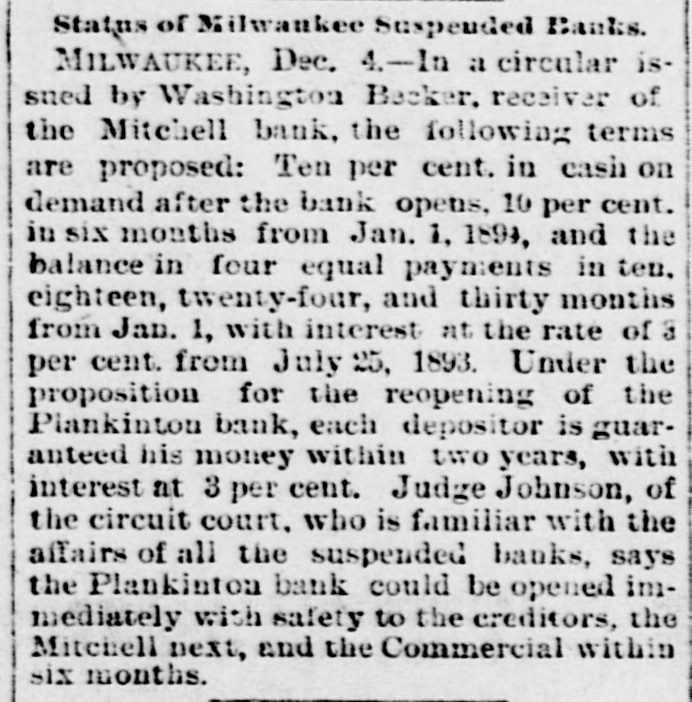
Status of Milwankee Suspended Banks. MILWAUKEE, Dec. 4.-In a circular issued by Washington Backer, receiver of the Mitchell bank, the following terms are proposed: Ten per cent. in cash on demand after the bank opens, 10 per cent. in six months from Jan. i. 1894, and the balance in four equal payments in ten. eighteen, twenty-four, and thirty months from Jan. 1, with interest at the rate of 3 per cent. from July 25. 1893. Under the proposition for the reopening of the Piankinton bank, each depositor is guaranteed his money within two years, with interest at 3 per cent. Judge Johnson, of the circuit court, who is familiar with the affairs of all the suspended banks, says the Plankinton bank could be opened immediately with safety to the creditors, the Mitchell next, and the Commercial within six months.


Article from St. Paul Daily Globe, December 23, 1893

Click image to open full size in new tab

Article Text

IT SEEMS to be settled that the Mitchell bank at Milwaukee will not resume business. The depositors in sufficient numbers refused to agree to the extension of time demanded during which they would permit their deposits to remain, and the receiver has therefore abandoned the project of resuming. The affairs of the institution will be wound up, but, although all depositors will be paid in full, they will have to wait three years for a final settlement.


Article from The Waco Evening News, January 1, 1894

Click image to open full size in new tab

Article Text

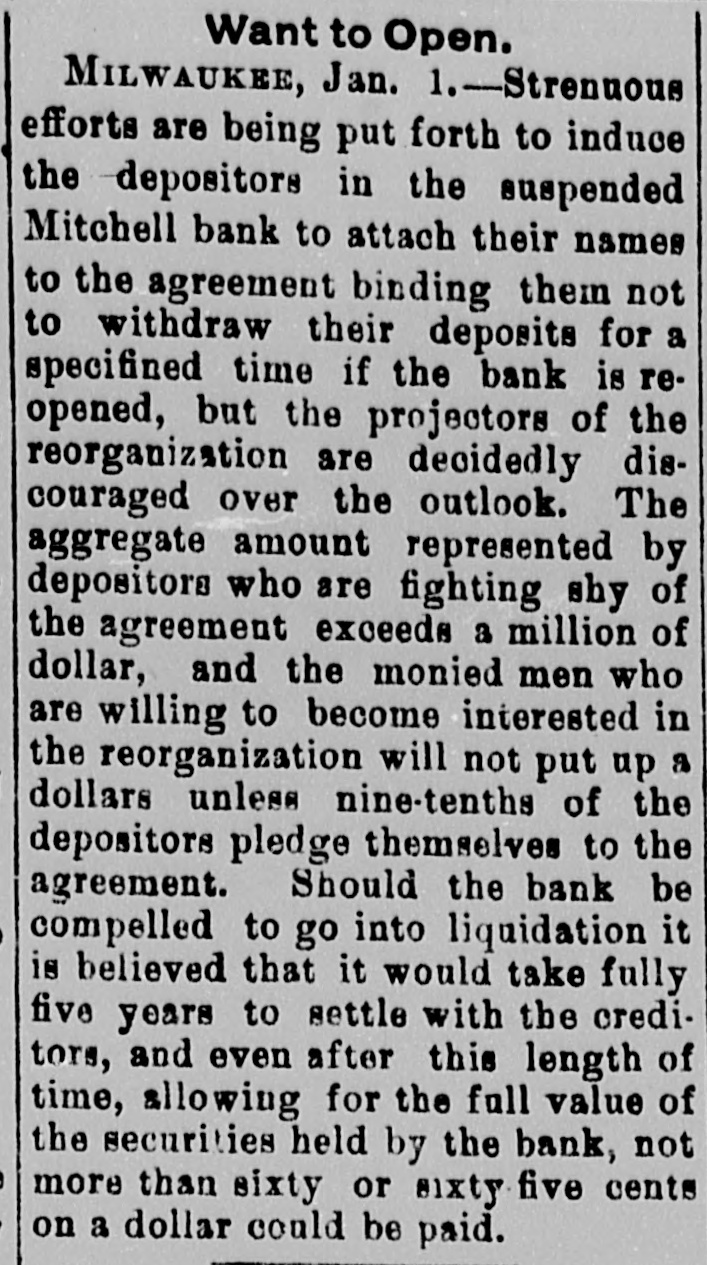
Want to Open. MILWAUKEE, Jan. 1.-Strenuous efforts are being put forth to induce the depositors in the suspended Mitchell bank to attach their names to the agreement binding them not to withdraw their deposits for a specifined time if the bank is reopened, but the projectors of the reorganization are decidedly discouraged over the outlook. The aggregate amount represented by depositors who are fighting shy of the agreement exceeds a million of dollar, and the monied men who are willing to become interested in the reorganization will not put up a dollars unless nine-tenths of the depositors pledge themselves to the agreement. Should the bank be compelled to go into liquidation it is believed that it would take fully five years to settle with the creditors, and even after this length of time, allowing for the full value of the securities held by the bank, not more than sixty or sixty five cents on a dollar could be paid.


Article from River Falls Journal, January 4, 1894

Click image to open full size in new tab

Article Text

Will Not Resume. It seems to be settled that the Mitchell bank at Milwaukee will not resume business. The depositors in sufficient numbers refused to agree to the extension of time demanded during which they' would permit their deposits to remain, and the receiver has therefore abandoned the project of resuming. The affairs of the institution will be wound up, but, although all depositors will be paid in full, they will have to wait three years for a final sottlement