Click image to open full size in new tab
Article Text
THE WEEK IN WALL STREET.
Liquidation at the Stock Exchange was con-
tinued with much force last week. The total
transactions in shares amounted to 2,070,778,
against 1,601,624 in the preceding week, and
987.123 in the corresponding week last year.
While the market, therefore, was fairly active, and
the movements wide and violent, there was an
utter absence of excitement, and at no time was
the market in the state of panic. The downward
movement in prices was most pronounced on Tues-
day, and especially on Wednesday after the an-
nouncements of the receivership of the Erie Rail-
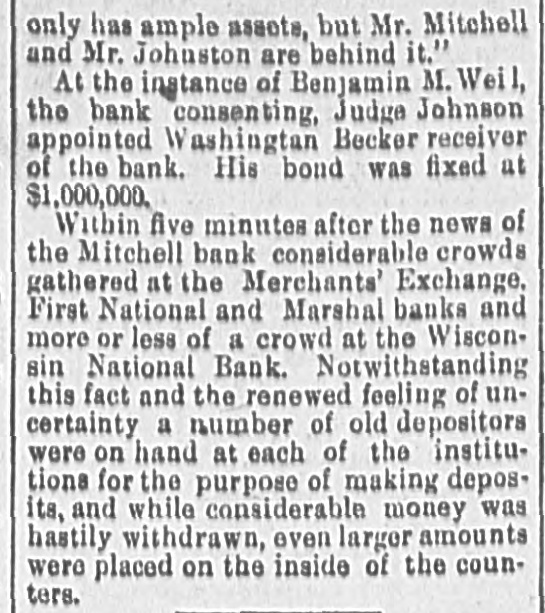
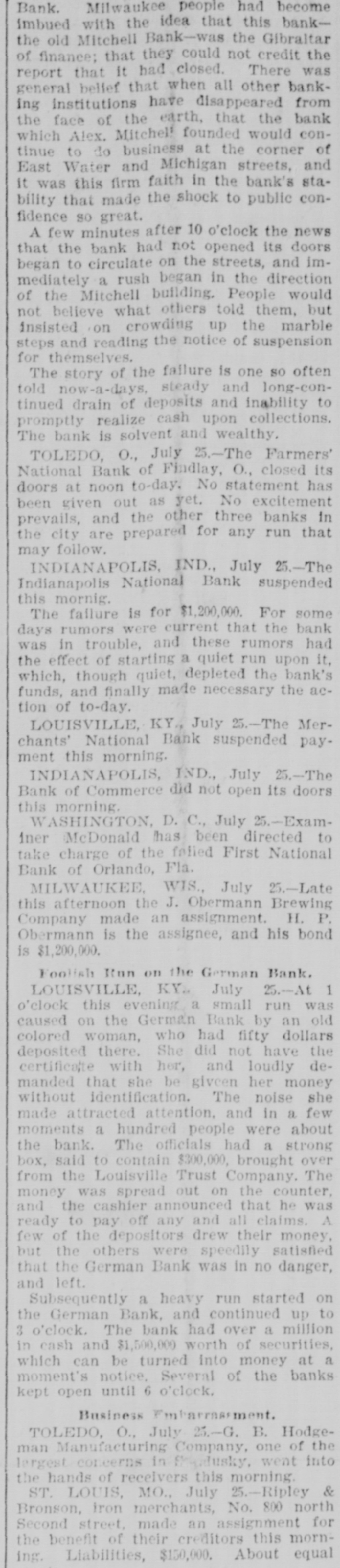
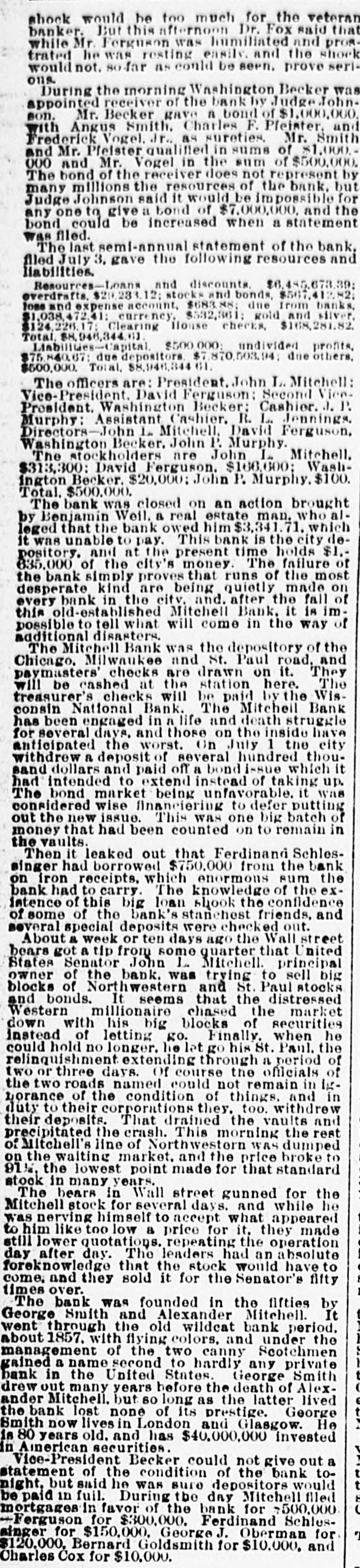
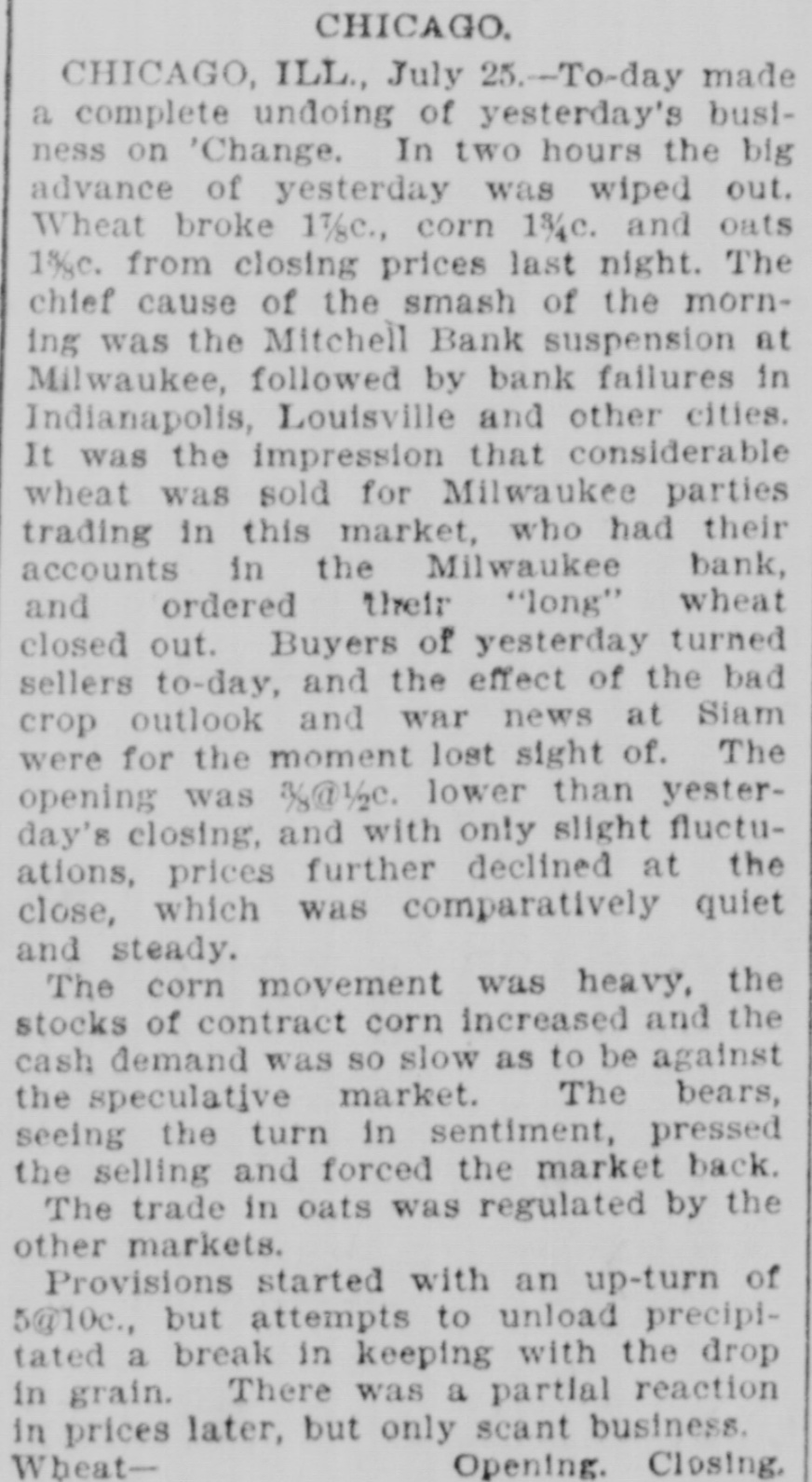
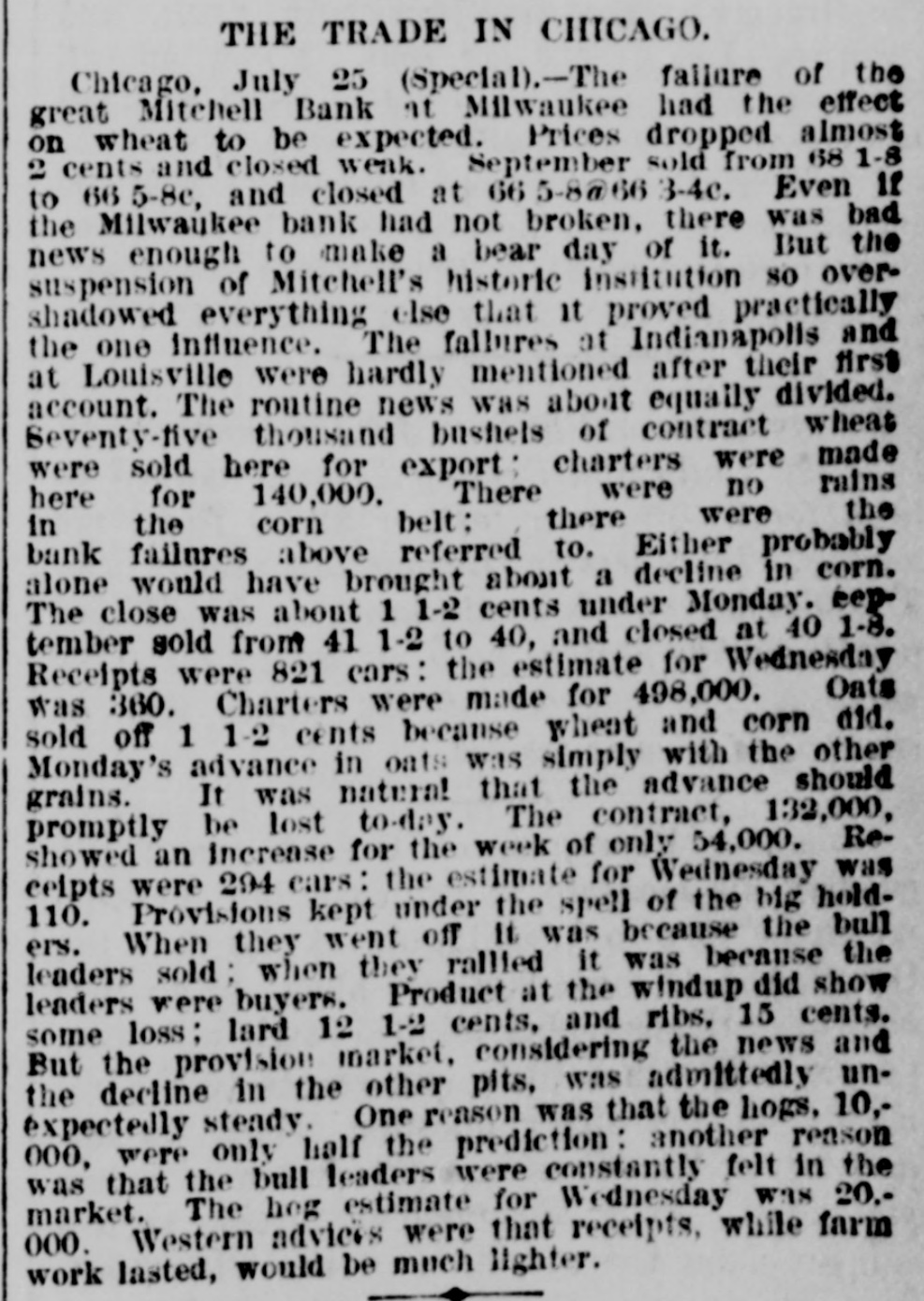
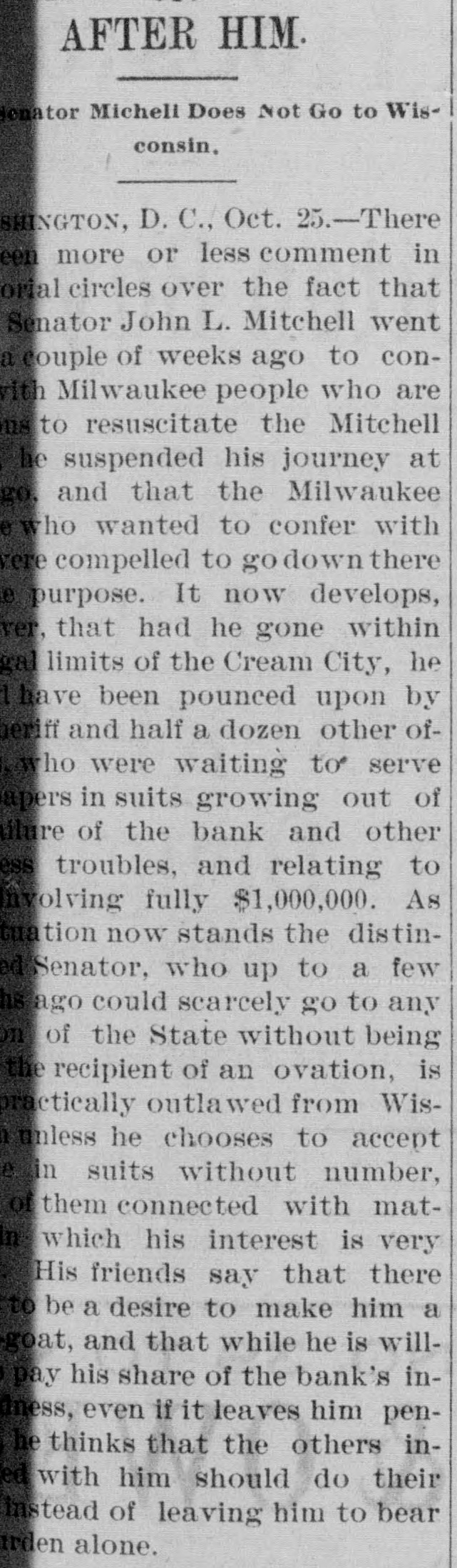
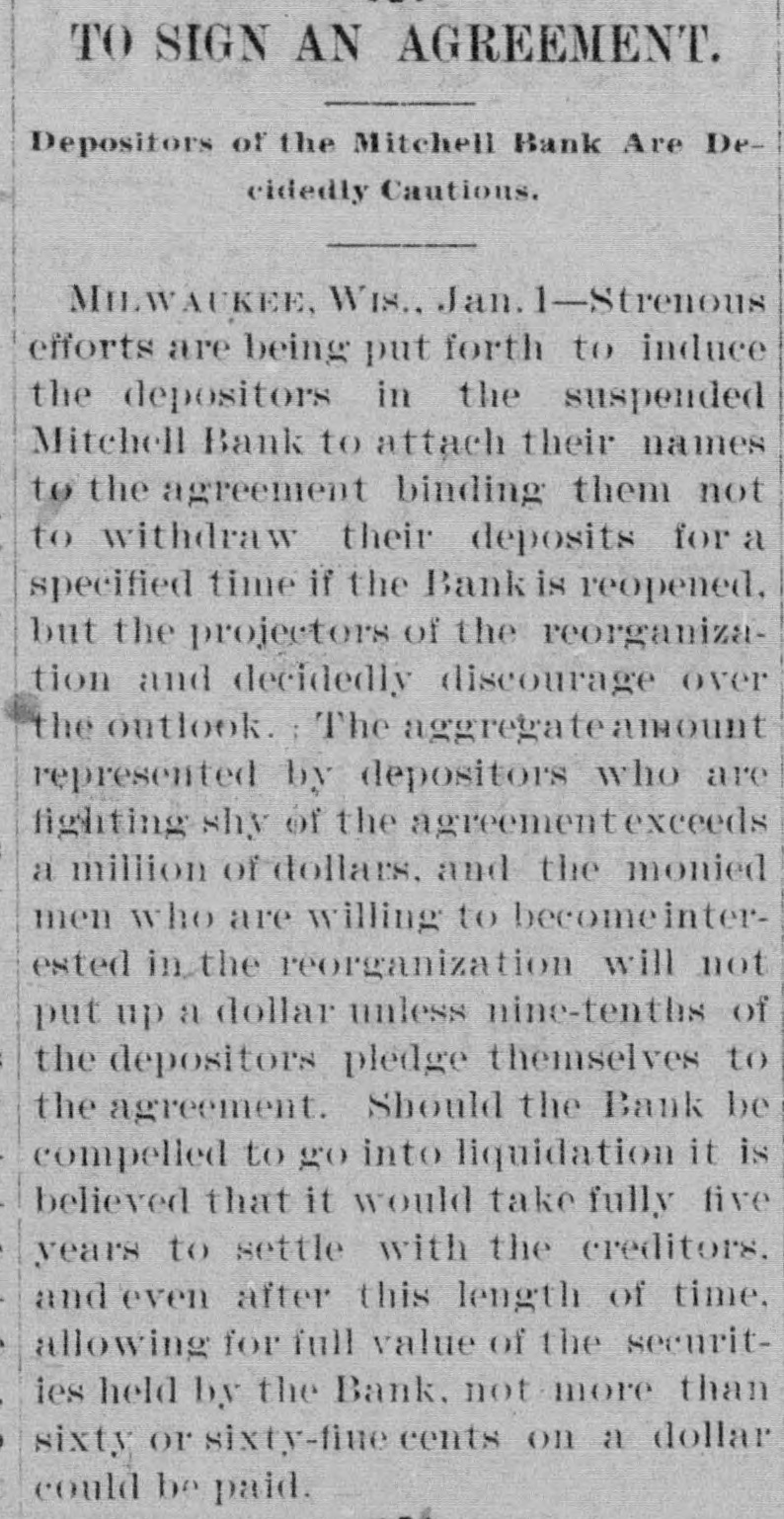
road and the failure of the "Mitchell" Bank in
Milwaukee. From the extreme declines there was
a sharp rally on Thursday, stimulated by the
engagement in London of $1,000,000 gold for
shipment to this country. The gold was obtained
at the Bank of England, and it was promptly
inferred that that venerable institution had loosened
its pursestrings and the return flow had set in.
The buoyancy which was manifest on Thursday
was continued only for a few minutes on Friday
morning, and afterward the course of prices was
again downward. In spite of brief rallies the
closing was weak and unsettled.
The importation of large amounts of gold from
Europe would quickly relieve the financial situa-
tion in this country. At present no other remedy
seems to be attainable. It is the season of the
year when an inflow of gold ought naturally to
be expected. The exports of merchandise, and
especially of food products, are increasing, while
the low prices of grain ought still further to
stimulate the European demand. The first im-
portant engagements of gold, however, have stif-
fened the rate of money in London, and caused
the Bank of England to raise its price for gold
bars to 18 shillings an ounce. If this has resulted
merely from the engagement of $2,000,000 gold,
the chances for large importations of the precious
metal may hardly be considered brilliant. It has
been the traditional policy of the Bank of Eng-
land to check the outflow of gold by advancing
its rate of discount, and that is preceded invaria-
bly by advancing the rate in the open market.
Practically all the gold available for shipment is
held by the bank, and upon its decision must rest
our hopes of obtaining relief through imports of
gold. One prominent banking firm has been try-
ing for nearly two weeks to secure a small amount
of the metal in the open market, and yesterday it
succeeded in securing £50,000. It is well known
that in the open market in London there is no
gold obtainable. Sanguine estimates that the
importations in the next two months may reach
$40,000,000 or $50,000,000 in the circumstance
may hardly be depended on.
The repeal of the Sherman law, or at least of
the clause compelling the monthly purchase of
silver bullion, would afford relief by strength-
ening confidence at home and abroad. The buying
of securities for European account in the last
week has been unusually heavy and at the current
prices this buying would be continued on a still
larger scale, provided doubt about currency
legislation was removed. There is apparently no
absolute certainty that Congress will take prompt
action, but on the contrary there are many in-
dications that in the upper house of Congress
the struggle may be long and bitter. In the
mean time the closing of mines, mills and factories
throw many men out of employment, and the
bank suspensions, which recently have grown more
important, tend to restrict the volume of cur-
rency as well as to injure credit. The volume of
business is narrowed, necessarily, by these oc-
currences, and not only in mercantile trade, but
in the transportation interests, the contraction
becomes daily more severe. The constant issue of
loan certificates by the Clearing House Associations
here and at other points is proof of the gravity
of the financial situation. The demand for cur-
rency from all sections of the country has become
burdensome. There is reason to believe that in
some cities, particularly Philadelphia and Chicago,
the banks are practically hoarding money. A
Chicago bank, which within a few days was re-
ported to be in need of aid, was said to have in
cash about one half the amount of its deposits.
The percentage of reserve held by the Clearing
House banks of this city is barely above 24 per
cent. Even in this condition they have displayed
constantly a praiseworthy desire to accommodate
their correspondents. The action of the savings
banks in enforcing the time clause previous to
the withdrawal of deposits was equally to be com-
mended, although the first announcement, which
was a complete surprise, excited fears that it
might precipitate runs on some of the weaker
institutions. Happily these fears were wholly
groundless.
The sharp contraction of business and credit
will be followed naturally in some cases by the
suspension of dividends, and possibly in others
by a receivership. The last week was remarkable
for the number of unpleasant surprises. That
the Erie Railroad should seek the protection of
the courts was not entirely unexpected, because
it had been known for some time that it had ex-
perienced difficulty in extending its floating in-
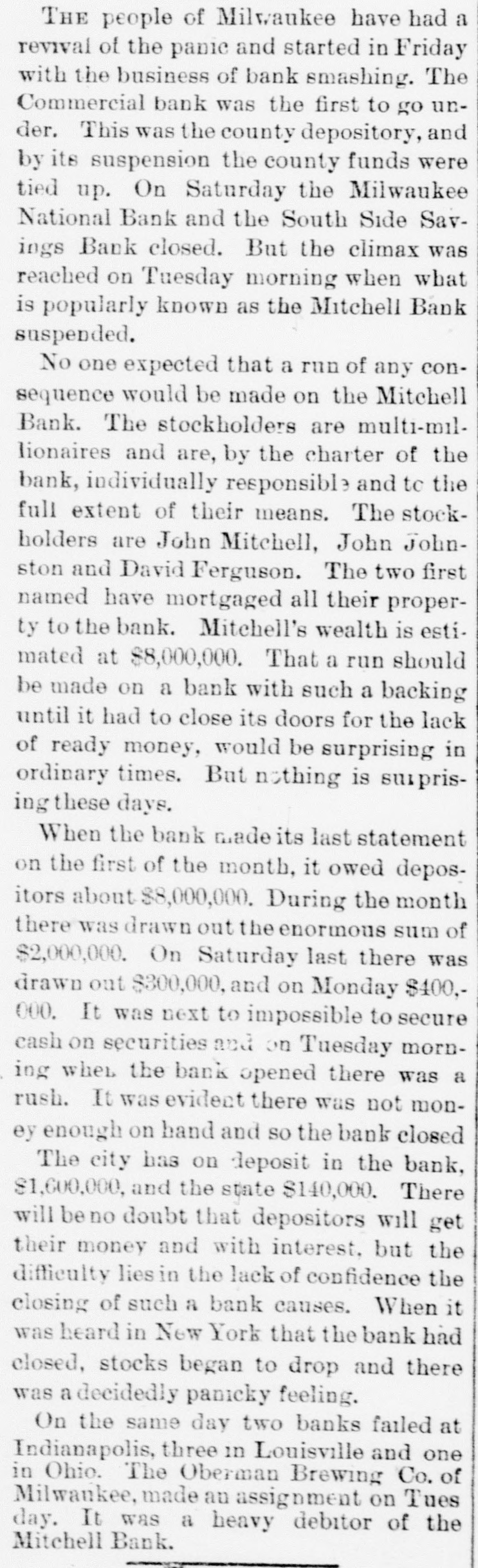
debtedness. The suspension of the "Mitchell"
Bank of Milwaukee caused no little astonishment
even among bank officers. The failure readily ex-
plained the recent heavy selling in this market
of the Granger stocks and bonds. The official
announcement that the General Electric Company
had a floating debt of $4,000,000, and that it was
forced to sell treasury assets in order to meet these
obligations, was a most disagreeable surprise. It
is only two months ago that an officer of the com-
pany stated that the sale of its Edison Electric
Illuminating stock furnished money enough to
meet all its obligations for some time, and it is
within two weeks that the directors declared the
usual quarterly dividend of 2 per cent. It is no
wonder that the price of the stock fell abruptly.
Another surprise still more unpleasant appears to
be threatened in Chicago Gas. A prominent di-
rector of that company said that the earnings in
the fiscal year, after the payment of all charges,
would amount to about $2,000,000, which is
equal to about 8 per cent on the share capital,
but he explained that the company had spent
three-fourths of this amount in new construc-
tion, and that for this reason the directors would
be likely to pass the next dividend. It has been
fashionable lately to calculate the amount realized
on the investment at the present prices of the
leading stocks and bonds. These calculations
would be more valuable and interesting if some
guarantee were afforded by them that the present
rates of dividend and interest payments would be
maintained.
It is worthy of notice that while the market was
active more than one-half of the business was
contributed by six stocks, and that of these only
two were railroad stocks. They were in the order
named: Chicago Gas, which lost 10 per cent:
St. Paul, 2 7-8 per cent: Western Union Tele-
graph, 7 1-8 per cent: General Electric, 11 1-4
per cent: Sugar Refining, 8 per cent, and Chicago,
Burlington and Quincy, 5 5-8 per cent. In the
rest of the list the business was fairly distributed,
but the declines were extremely irregular. One
of the minor incidents was a fall of 46 per cent in
Evansville and Terre Haute. The so-called Goul
shares, excepting Western Union, were not specially
active, but Missouri Pacific lost 7 1-4 and Man-
hattan Railway 10 3-4 per cent. In the last
month Missouri Pacific has declined from 32 1-8
to 18 1-8 and Manhattan from 124 3-4 to 104.
Following is our usual table, giving the number
of shares sold of all stocks, the highest, lowest
and the final prices of the week, together with
the final prices of a week ago, prefixed by the
average prices of July 23, 1892:
WEEKLY RANGE,
RAILWAY STOCKS.