Click image to open full size in new tab
Article Text
# HALE IS IN CHARGE.
HE FURNISHES THE BOND AND IS
NOW A BANKER.
HE GIVES A $185,000 BOND.
All the Affairs of the Bank Assigned to
Him When He Furnishes the Bond.-
He Appears at the Bank Early
This Morning.
(From Tuesday's Daily.)
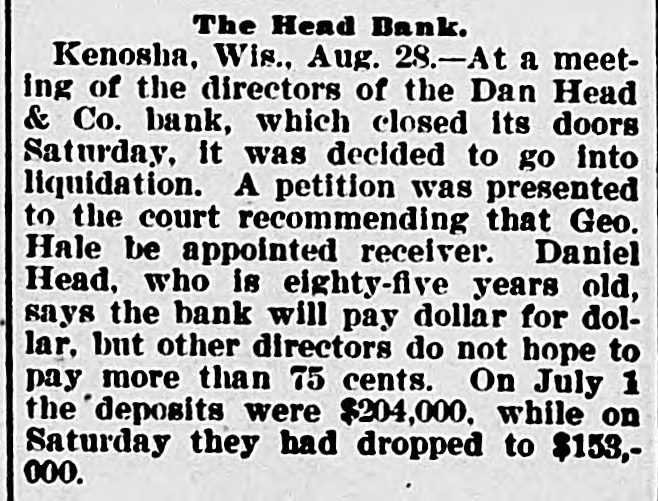
The assignment of the affairs of the
Dan Head & Co. bank was made com-
plete Monday night when George Hale
furnished a bond for $185,000. He ap-
peared at the bank about 8 o'clock this
morning and began at once upon the
books of the concern. He is putting
his full time on the bank's affairs, but,
of course, in so short a time would be
unable to tell much, if anything, about
the condition of things. He had the
keys to the institution and opened up.
He was closely followed by Dr. E. G.
Hazelton, who went in with him. Dan
Lewis, the collector, reached the place
a little ahead of Mr. Hale and busied
himself in arranging matters for the
new assignee. Everything throughout
the day has been quiet about the build-
ing. There was no demonstration
about the place. Depositors feel as
though no better selection could have
been made for an assignee. The entire
business community has implicit con-
fidence in Mr. Hale and that the affairs
of the bank will be carefully handled
there seems not the least doubt. The
feeling is very prevalent that he has a
very large task on hand, but Mr. Hale
is equal to it. He has always been
known as a man of unimpeachable in-
tegrity and of sterling good sense in
business matters.
Hope for the Depositors.
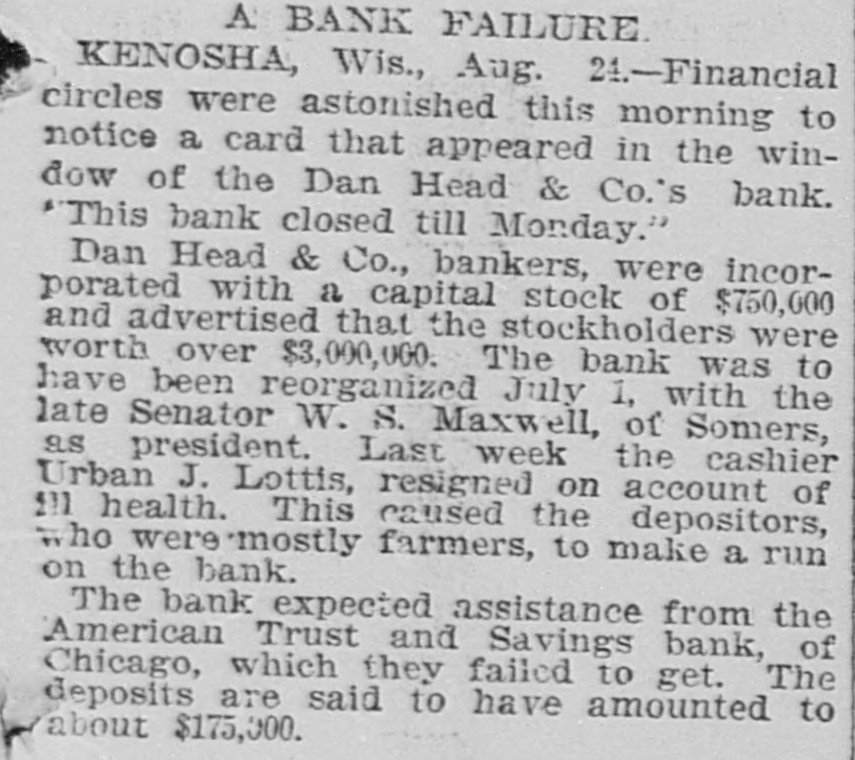
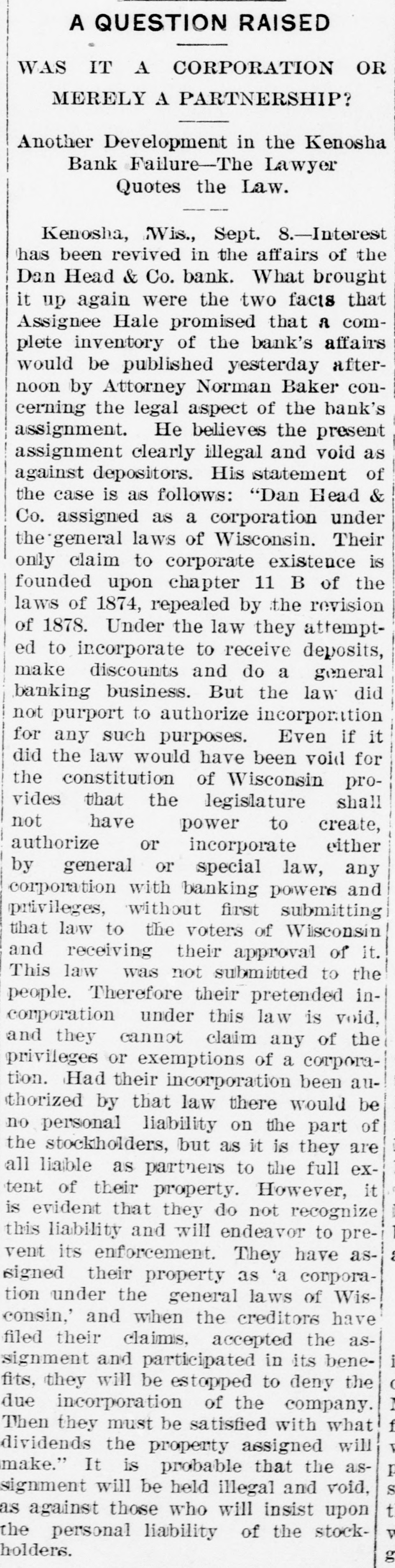
Although it is nearly impossible to
make it absolutely sure that the Dan
Head & Co. was nothing more than
a simple co-partnership, it seems to be
the general impression that such is the
case. If that be true the depositors are
undoubtedly much better off than was
at first supposed. If the company had
been incorporated none of the stock-
holders in the concern would have been
liable for more than just double the
amount of the stock they held in it. On
the contrary, if it was merely a simple
co-partnership every stockholder can
be holden liable to the full extent of his
property. It is believed that several of
the stockholders have property enough
to make good all the deposits in the
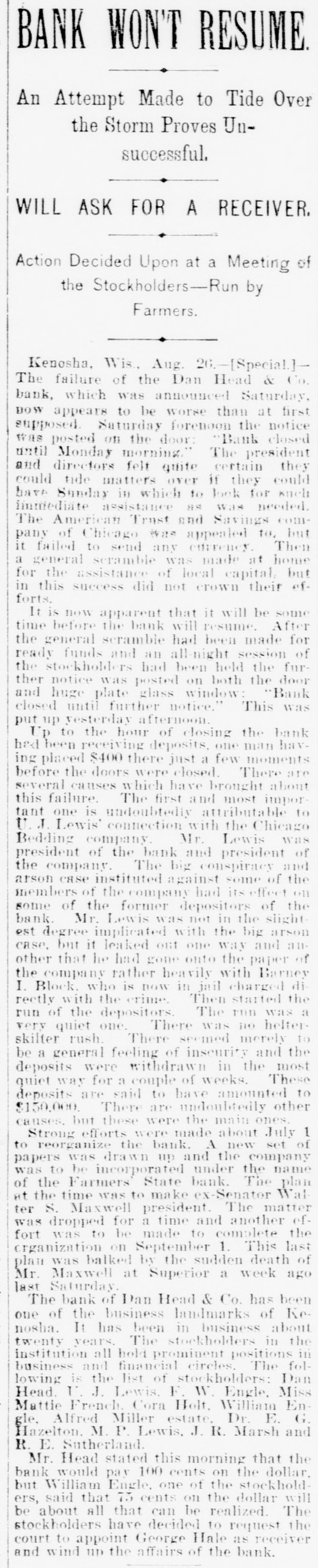
bank. According to the statement of
the bank made July 1, there were a
trifle over $200,000 of the deposits.
The run on the bank reduced this
amount very considerably until it is
thought that not more than $150,000
were left at the time the doors closed.
Dividing this among the eleven stock-
holders would make a heavy payment
for each to make, but, of course, there
are assets in the bank or within reach
which will preclude the necessity of
forcing full payment of all depositors'
claims by them from their individual
holdings.
The Chicago End of the Story.
Cashier James R. Chapman, of the
American Trust and Savings bank, the
Chicago correspondent of Dan Head &
Co., was seen and asked concerning
Mr. Head's bank and the negotiations
for a loan carried on before the failure.
"We have been the Chicago corres-
pondents for Head & Co.," said Mr.
Chapman, "for the last four years and
during the greater part of the time the
firm has kept a good balance on depos-
it with us, though of late it has dwin-
dled somewhat. Previous to four years
ago Head & Co. transacted its Chicago
business through the Merchant's Na-
tional bank. Ten years ago the firm of
Head & Co. did a large business, in
the neighborhood of $400,000 a year, I
should say, but of late it has run down
somewhat. All our business has hith-
erto been transacted with Mr. Lewis,
the cashier, but last Thursday Mr.
Head, who is now only a small stock-
holder, came in aud wanted to borrow
some money to tide his bank over.
They had stopped loaning out money,
he said, and were calling in their loans
as fast as possible. He had with him
some $13,000 worth of personal notes,
on which he wished to borrow $6,500.
We were not satisfied with the securi-
ties and wished Mr. Head to put up
better, as we knew he held them. This
he refused to do and we consequently
declined to advance the cash. At that
time Mr. Head said if the bank could
survive the next fifteen days it was all
right.
"Urban J. Lewis, the cashier and
actual manager of the bank, has been
interested in a number of schemes in
Kenosha and Head & Co. probably
hold some of this paper. How much I
cannot say. The Chicago Bedding
company, of which he was treasurer,
may have hastened the downfall. Soon
after the plant of the bedding com-
pany was destroyed by fire the back-
ers wanted us to advance the money to
rebuild on the insurance as security.
We declined. The failure of Head &
Co., though a surprise to me, will, I
think, prove a pretty bad one. It is
hardly possible the bank will open its
doors for some time. The firm is, I
think, a corporation, and under the