Article Text
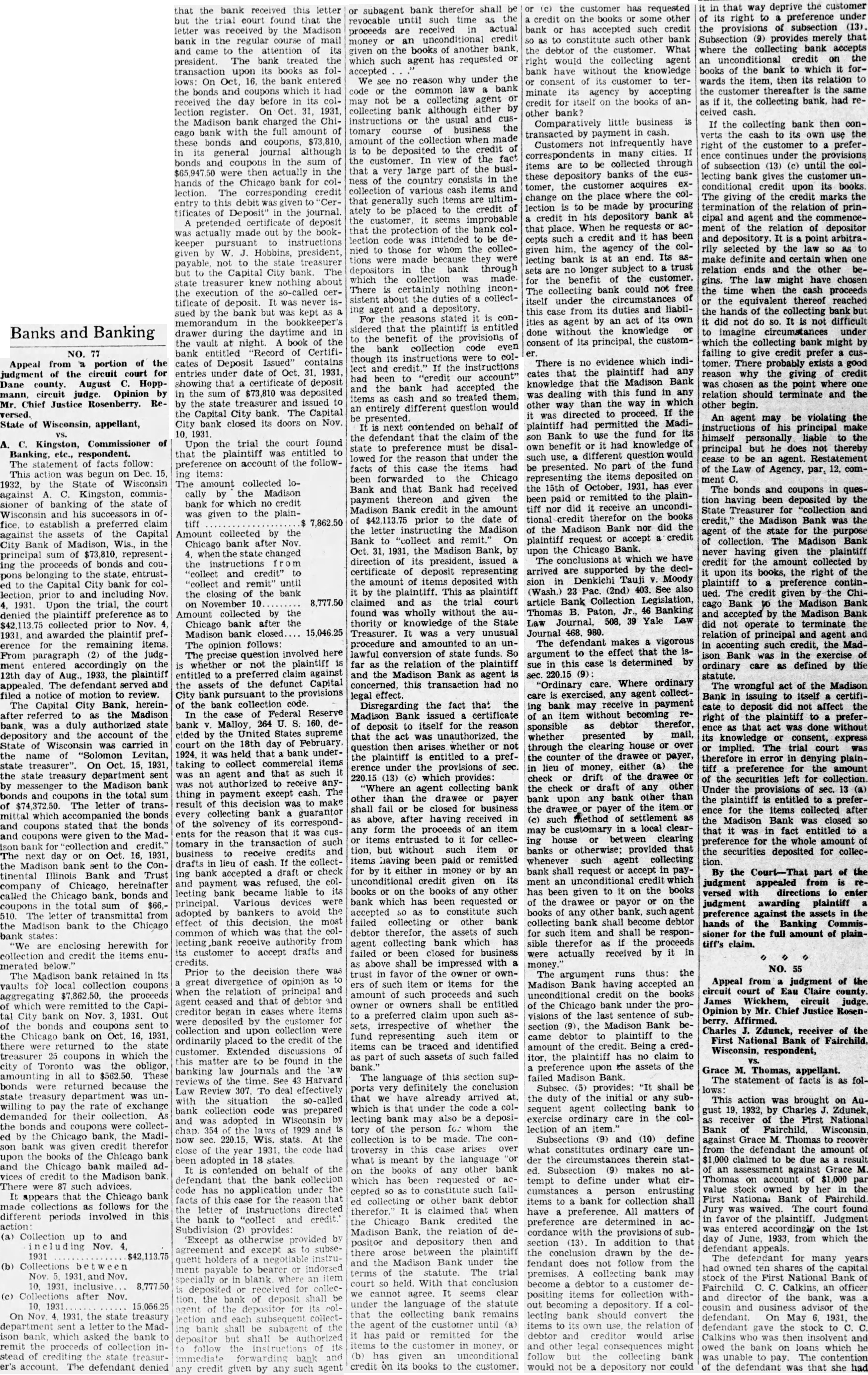
and Banking NO. Appeal from portion of the of the circuit court for judgment Dane county. August C. Hoppmann, circuit judge. Opinion by Mr. Chief Justice Rosenberry. versed. State of Wisconsin, appellant, Kingston, Commissioner of Banking, etc., respondent. The statement of facts follow: This was begun Dec. 15, by the State of Wisconsin Kingston, commisagainst sioner of banking of the state of Wisconsin and his successors in fice. to establish preferred claim against the assets of the Capital City Bank of Madison, Wis., in the principal sum of $73,810. representing the proceeds of bonds and coupons belonging to the state, entrustto the Capital City bank for collection, prior to and including Nov. 1931. Upon the trial, the court denied the plaintiff preference as to collected prior to Nov. 1931, and awarded the plaintif preference for the remaining items. From paragraph (2) of the judgment entered accordingly on the 12th day of Aug., 1933, the plaintiff The defendant served and appealed. filed notice of motion to review. The Capital City Bank, hereinafter referred to as the Madison bank, was duly authorized state depository and the account of the State of Wisconsin was carried in the name of "Solomon Levitan, state treasurer". On Oct. 15, 1931, the state treasury department sent to the Madison bank by messenger bonds and coupons in the total of $74,372.50. The letter of transmittal which the bonds and coupons stated that the bonds and coupons were given to the Madison bank for "collection and The next day or on Oct. 16, 1931, the Madison bank sent to the Continental Illinois Bank and of Chicago, hereinafter company called the Chicago bank, bonds and coupons in the total of $66,510. The letter of transmittal from the Madison bank to the Chicago bank states: are enclosing herewith for collection and credit the items enumerated below.' The Madison bank retained in its vaults for local collection coupons aggregating the proceeds which were remitted to the Capital bank on Nov. 1931. Out City of the bonds and coupons to the Chicago bank on Oct. 16, 1931, there were returned to the state treasurer 25 coupons in which the city of Toronto was the obligor, amounting in all to These bonds were returned because the state treasury department was willing pay the rate of exchange demanded for their collection. the bonds and coupons were collected by the Chicago bank, the Madibank was given credit therefor upon the books of the Chicago bank and the Chicago bank mailed vices of credit to the Madison bank There 87 such advices. It appears that the Chicago bank made collections as follows for the different periods involved in this action: Collection up to and Nov. Collections Nov. inclusive 8,777.50 Collections after Nov. On Nov. the state treasury sent letter to the ison bank, which asked the bank to remit the proceeds of collection stead of the state account. The defendant denied that the bank received this letter but the trial court found that the letter was received by the Madison bank in the regular course of mail and to the attention of its came The bank treated the president. transaction upon its books follows: On Oct, 16, the bank entered the bonds and coupons which had received the day before in its collection register. On Oct. 31, 1931, the Madison bank charged the Chibank with the full amount of cago these bonds and coupons, in general journal although bonds and in the of coupons were then actually in the hands of the Chicago bank for lection. The corresponding credit entry to this debit given tificates of Deposit" in the journal. A pretended certificate of deposit actually made out by the bookkeeper pursuant to instructions given by W. Hobbins, president, payable, not to the state treasurer but to the Capital City bank. The state treasurer knew nothing about the execution of the so-called tificate of deposit. It was never sued by the bank but was kept memorandum in the bookkeeper's drawer the daytime and in during the vault at night. A book of the bank entitled 'Record of Certifiof Issued" contains cates Deposit entries under date of Oct. 31, 1931, that certificate of deposit showing in the of $73,810 was deposited the treasurer and issued to by state the Capital City bank. The Capital City bank closed its doors on Nov. 1931. the trial the court found Upon that the plaintiff was entitled to account of the followpreference on items: The amount collected locally by the Madison bank for which no credit given to the plainwas tiff Amount collected by the Chicago bank after Nov. when the changed the instructions "collect and credit" to "collect and until the closing of the bank November 8,777.50 on Amount collected by the Chicago bank after the Madison bank 15,046.25 The opinion follows: involved here The precise not the plaintiff is whether or entitled to preferred claim against of the defunct Capital the assets bank to the provisions City pursuant of the bank collection code. the of Federal Reserve In case bank Malloy, 264 160, cided by the United States supreme the 18th day of court on held that bank under1924, it was collect commercial items taking to and that as such it was an agent was not to receive anycash. The thing in payment except result of this decision was to make collecting bank every of the solvency of its correspondents for the reason that it was tomary in the transaction of such business to receive credits and cash. If the collectdrafts in lieu of ing bank accepted draft or check and payment was refused. the collecting bank became liable to its Various devices were principal. adopted by bankers to avoid the effect of this decision. the most common of which that the colreceive authority from its customer to accept drafts and credits. Prior to the decision there was great divergence of opinion as to relation of and when the principal agent ceased and that of debtor and creditor began in cases where items were deposited by the customer for collection and upon collection were ordinarily placed to the credit of the customer. Extended discussions of this matter are to be found in the banking law journals and the of the time. See Harvard reviews Law Review To deal effectively with the situation the bank collection code was prepared and was adopted in Wisconsin by chap 354 of the of and now Wis. stats. At the close of the year 1931, the code had been adopted in 18 states. It is contended behalf of the on defendant that the bank collection code has no application under the facts of this case for the that the letter of instructions directed the bank to "collect and credit. Subdivision provides: Except otherwise provided by agreement and except to subseholders of negotiable instrument payable to bearer or specially or in blank. where an item deposited or received for collection, the bank of deposit shall be of the depositor for its collection and each subsequent bank shall be subagent of the but shall authorized depositor follow the of bank and credit given by such agent any any bank therefor shall or subagent such time the revocable until as received in actual proceeds are unconditional credit money or an of another bank, on the books given has requested or which such accepted under the We no reason why see law bank code or the common agent or not be collecting may collecting bank although either by the usual and cusinstructions or business the course of tomary amount of the collection when made to be deposited to the credit of of the fact the customer. In view that very large part of the busiconsists in the ness of the country items and collection of various cash such items are ultimthat generally credit of to placed to the ately the customer, it seems improbable of the bank colthat the protection intended to be delection code nied to those for whom the collections were made because they were in the bank through depositors the collection was made. which There is certainly nothing inconsistent about the duties of collecting agent and depository. For the reasons stated it is conis entitled sidered that the plaintiff to the benefit of the provisions of collection code even the bank instructions were to colthough its lect If the instructions and "credit account" had been to our the and the bank had accepted and treated them, items as cash would an entirely different question be presented. It next contended on behalf of the defendant that the claim of the must be disalstate to preference lowed for the reason that under the facts of this case the items had been forwarded to the Chicago Bank and that Bank had received thereon and given the payment Madison Bank credit in the amount to the date of of prior the letter instructing the Madison Bank to "collect and remit." On Oct. 31, 1931, the Madison Bank, by direction of its president, issued certificate of deposit representing the amount of items deposited with by the plaintiff. This as plaintiff claimed and as the trial court found was wholly without the authority or knowledge of the State Treasurer. It was very unusual procedure and amounted to an unlawful conversion of state funds. So far as the relation of the plaintiff and the Madison Bank as agent concerned, this transaction had no legal effect. Disregarding the fact that the Madison Bank issued certificate of deposit to itself for the reason that the act was unauthorized, the question then arises whether or not the plaintiff is entitled to preference under the provisions of sec. (c) which provides: an agent collecting bank other than the drawee or payer shall fail or be closed for business as above, after having received in form the proceeds of an item any items entrusted to it for cellecor tion, but without such item or items having been paid or remitted for by it either in money or by an unconditional credit given on its books on the books of any other bank which has been requested or accepted SO as to constitute such failed collecting or other bank debtor therefor, the assets of such agent collecting bank which has failed or been closed for business as above shall be impressed with trust in favor of the owner or of such item or items for the amount of such proceeds and such owner or owners shall be entitled to preferred claim upon such assets, irrespective of whether the fund representing such item or items be traced and identified can as part of such assets of such failed bank." The language of this section supports very definitely the conclusion that we have already arrived at, which that under the code collecting bank may also deposiof the whom the tory person collection is to be made. The controversy in this case arises over what meant by the language the books of other bank on any which has been requested or acto constitute such failcepted so as collecting other bank debtor or therefor. It is claimed that when the Chicago Bank credited the Madison Bank, the relation of depositor and depository then and there arose between the plaintiff and the Madison Bank under the of the statute. The trial terms court so held. With that conclusion cannot agree. It seems clear under the language of the statute that the collecting bank remains the agent of the customer until has paid or remitted for the items to the customer in money, or has given an unconditional credit on its books to the customer. or the customer has requested credit on the books or some other bank has accepted such credit or to constitute such other bank so debtor of the customer. What the right would the collecting agent bank have without the knowledge or consent of its customer to terminate its agency by accepting credit for itself on the books of another bank? Comparatively little business payment in cash. transacted by infrequently have Customers not in cities. If correspondents many be collected through items are to banks of the custhese depository acquires exthe customer tomer, where the colon the place change is to be made by procuring lection bank at credit in his depository When he requests or acthat place. and it has been such credit cepts of the colhim, the agency given end. Its bank is at an lecting are no longer subject to trust of the customer. for the benefit could not free collecting bank The circumstances of itself under the duties and liabilthis case from its by an act of its ities as agent the knowledge or done without the customconsent of its principal, evidence which indiThere is no the plaintiff had any cates that the Madison Bank knowledge that with this fund in any was dealing in which than the way other way it was directed to proceed. the the Madiplaintiff had permitted fund for its Bank to use the knowledge of benefit it had or would such different question use, a of the fund No part be presented. representing the items deposited on October, 1931, has ever the 15th of remitted to the plainbeen paid or receive an unconditiff nor did it therefor the books on Bank did the the Madison nor of a credit request or accept plaintiff Chicago Bank. the upon which we have The conclusions at by the deciarrived are supported Tauji Moody sion in Denkichi (2nd) See also 23 Pac. Bank Collection Legislation, article Paton, 46 Banking Thomas B. 508, 39 Yale Law Law Journal, Journal 980. defendant makes a vigorous The effect that the isargument to the is determined by sue in this case Where ordinary "Ordinary care. care is exercised, any agent collectbank receive in payment ing may of item without becoming an debtor therefor, sponsible as by mail, whether presented through the clearing house or over counter of the drawee or payer, the either (a) the in lieu of money, drift of the drawee or check or the check or draft of any other bank other than bank upon any of the item or the drawee or payer such method of settlement as (c) in local clearmay be customary house between clearing ing or otherwise; provided that banks or whenever such agent collecting bank shall request or accept in payment an unconditional credit which to the books has been given on drawee or on the of the or payor books of other bank, such agent any bank shall become debtor collecting for such item and shall be respontherefor as if the proceeds sible actually received by it in The runs thus: the argument Madison Bank having accepted an unconditional credit on the books of the Chicago bank under the provisions of the last sentence of subsection the Madison Bank became debtor to plaintiff to the amount of the credit. Being creditor, the plaintiff has no claim to preference upon the assets of the failed Madison Bank. shall be Subsec. provides: the duty of the initial or any subsequent agent collecting bank to exercise ordinary care in the collection an item." Subsections (9) and define what constitutes ordinary care under the circumstances therein stated. Subsection makes no attempt to define under what circumstances person entrusting items to bank for collection shall have preference. All matters of preference are determined in accordance with the provisions of subsection (13). In addition to that the conclusion drawn by the defendant does not follow from the premises. collecting bank may become debtor to customer depositing items for collection without becoming depository. If collecting bank should convert the items to its own use, the relation of debtor and creditor would arise and other legal consequences might follow but the collecting bank would not be depository could that deprive the customer in way to preference under of its right of subsection (13). the provisions Subsection provides merely that where the collecting bank accepts an unconditional credit on the bank to which it forbooks of the wards the item, then its relation to the customer thereafter is the same as if the collecting bank, had ceived cash. If the collecting bank then converts the cash to its own use the right of the customer to prefercontinues under the provisions of subsection (c) until the collecting bank gives the customer unconditional credit upon its books. The giving of the credit marks the termination of the relation of principal and agent and the commencement of the relation of depositor and depository. It is point arbitrarily selected by the law so as to make definite and certain when one relation ends and the other begins. The law might have chosen the time when the cash proceeds or the equivalent thereof reached the hands of the collecting bank but did not do so. It is not to imagine circumstances under which the collecting bank might by failing to give credit prefer a customer. There probably exists good reason why the giving of credit was chosen as the point where one relation should terminate and the other begin. An agent may be violating the instructions of his principal make himself personally liable to the principal but he does not thereby cease to be an agent. Restatement of the Law of Agency, par. ment The bonds and coupons in question having been deposited by the State Treasurer for "collection and credit," the Madison Bank was the agent of the state for the purpose of collection. The Madison Bank never having given the plaintiff credit for the amount collected by upon its books, the right of the plaintiff to preference continued. The credit given by the Chicago Bank to the Madison Bank and accepted by the Madison Bank did not operate to terminate the relation of principal and agent and in accenting such credit, the Madison Bank was in the exercise of ordinary care as defined by the statute. The wrongful of the Madison Bank in issuing to itself certificate to deposit did not affect the right of the plaintiff to preference as that act was done without its knowledge or consent, express or implied. The trial court was therefore in error in denying plaintiff preference for the amount of the securities left for collection. Under the provisions of sec. the plaintiff is entitled to preference for the items collected after the Madison Bank was closed so that it fact entitled to preference for the whole amount of the securities deposited for collection. By the part of the judgment appealed from is versed with directions to enter judgment awarding plaintiff preference against the assets in the hands of the Banking Commissioner for the full amount of plaintiff's claim. Appeal from judgment of the circuit court of Eau Claire county. James Wickhem, circuit judge. Opinion Chief Justice Rosenberry. Affirmed. Charles Zdunck, receiver of the First National Bank of Fairchild, Wisconsin, respondent, Grace M. Thomas, appellant. The statement of facts as follows: This action was brought on August 1932, by Charles Zdunek, receiver of the First National Bank of Fairchild, Wisconsin, against Grace Thomas to recover from the defendant the amount of claimed to due as result of an assessment against Grace Thomas on account of $1,000 par value stock owned by her in the First National Bank of Fairchild Jury was waived. The court found in favor of the plaintiff. Judgment was entered on the 1st day of June, 1933, from which the defendant appeals. The defendant for many years had owned ten shares of the capital stock of the First National Bank of Fairchild Calkins, an officer and director of the bank, was cousin and business advisor of the defendant. On May 1931, the defendant gave the stock to Calkins who was then insolvent and owed the bank on loans which he unable to The contention of the defendant was that she had