22357. Washington National Bank (Seattle, WA)

Bank Information

Episode Type
Suspension → Closure
Bank Type
national
Bank ID
4059
Charter Number
4059
Start Date
August 30, 1893
Location
Seattle, Washington (47.606, -122.332)

Metadata

Model
gpt-5-mini
Short Digest
d92bdd97

Response Measures

None

Description

Articles report the president turning over the safe to Receiver Stuart Rice following a court decision and comptroller's finding of insolvency (Aug 1893). The bank is listed among suspended banks later (Nov 1894) and a receiver was in possession — indicates suspension leading to permanent closure/receivership. No explicit contemporaneous run is described.

Events (3)

1. August 30, 1893 Receivership
Newspaper Excerpt
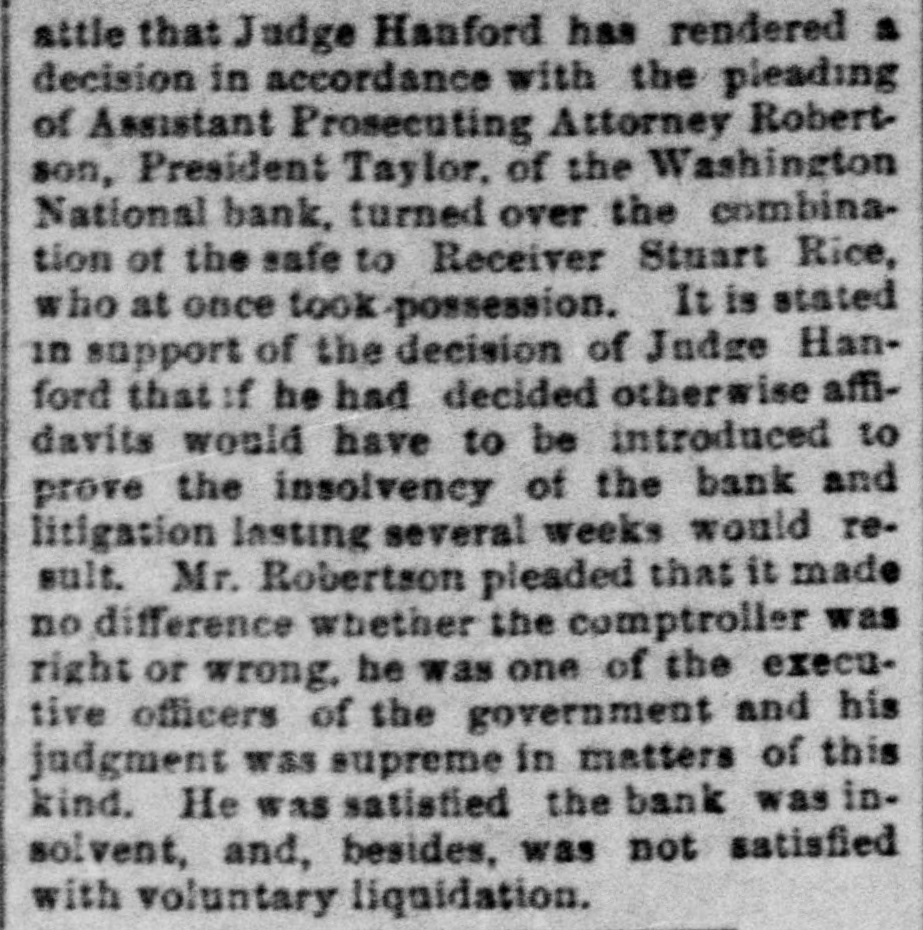
turned over the combination of the safe to Receiver Stuart Rice, who at once took possession. ... he was one of the executive officers of the government and his judgment was supreme in matters of this kind. He was satisfied the bank was insolvent, and, besides, was not satisfied with voluntary liquidation. (Seattle P-I, 1893-08-30).
Source
newspapers
2. August 30, 1893 Suspension
Cause
Bank Specific Adverse Info
Cause Details
Comptroller and court proceedings found the bank insolvent; court decision led to receiver taking possession.
Newspaper Excerpt
President Taylor, of the Washington National bank, turned over the combination of the safe to Receiver Stuart Rice, who at once took possession.
Source
newspapers
3. November 1, 1894* Other
Newspaper Excerpt
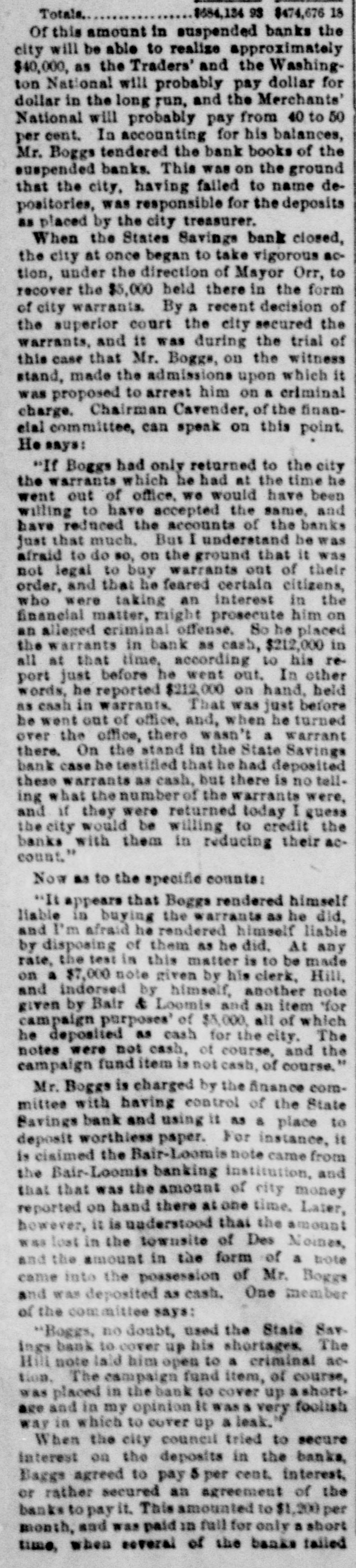
Of this amount in suspended banks the city will be able to realize approximately $40,000, as the Traders' and the Washington National will probably pay dollar for dollar in the long run, and the Merchants' National will probably pay from 40 to 50 per cent. (Seattle P-I, 1894-11-09).
Source
newspapers

Newspaper Articles (3)

Article from The Seattle Post-Intelligencer, August 30, 1893

Click image to open full size in new tab

Article Text

attle that Judge Hanford has rendered a decision in accordance with the pleading of Assistant Prosecuting Attorney Robertson, President Taylor, of the Washington National bank, turned over the combination of the safe to Receiver Stuart Rice, who at once took possession. It is stated in support of the decision of Judge Hanford that if he had decided otherwise affidavits would have to be introduced to prove the insolvency of the bank and litigation Insting several weeks would result. Mr. Robertson pleaded that it made no difference whether the comptroller was right or wrong, he was one of the executive officers of the government and his judgment was supreme in matters of this kind. He was satisfied the bank was insolvent, and, besides, was not satisfied with voluntary liquidation.


Article from The Seattle Post-Intelligencer, June 16, 1894

Click image to open full size in new tab

Article Text

Estate of J. Gardner Kenyon-Answers; filed. Estate of James McSorley-Will; decree admitting will to probate. Estate of Thomas Stevens-Notice of death at asylum. Estate of Josephine Cornell-Order allowing two claims. Estate of May M. Viele-Inventory. CRIMINAL DEPARTMENT-HUMES, J. State vs. Frank H. Minsch-Murder first degree; order to issue subpœnas for defendant's witnesses; signed. Lorinda E. Van Valkenberg vs. Francis 8. Van Valkenberg-Divorce; continued one week at plaintiff's request. Edna West vs. George E. West-Continued one week at plaintiff's request. M. McCarty vs. W. S. Fletcher-Foreclosure of mortgage; findings and judgment for defendant. EQUITY DEPARTMENT-LANGLEY, J. James Welsh vs. D. H. Blackmar et al. -Order allawing plaintiff to file supplemental complaint; signed, George Wist vs, Philip Wist et al.-Order appointing George Wist guardian ad litem of Charles Oswin Wist; signed. Oregon Mortgage Company vs. Sarah Melissa Rice al.-Findings of facts and conclusions of law; signed: exception allowed: decree signed. W. W. Dearborn et al. vs. Washington Savings Bank-Petition for release of mortgaged property; granted; order authorizing sale; signed. Louise C. Freeburn vs. William H. Kent et al.-Motion for default and reference; allowed; order of default and reference; signed. George M. Weigel vs. Cascade Fire and Marine Insurance Company-Order extending time to file statement of facts; signed. N. J. Bartlett vs. W. C. ReichenekerContinued to June 16. Willamette Casket Company vs. Cross Undertaking Company-Order directing sale of effects of defendant corporation as per stipulations; signed. Meyer Lewisve. Western Mill Company -Order for removal to United States cir-' euit court: signed. Nelson W. Parker vs. Rainier Power & Railway Company et al-Order of default of D. T. Denny and John B. Denny; signed; judgment; signed. Samuel Blair vs. Cedar River Coal Company et al.-Order of defaut of Cedar River Coal Company and J. P. Gleason; signed. James R. Robbins vs. Ben E. Snipes et al.-Order of default of Washington National bank, Scandinavian-American bank, Dexter Horton & Co. and I. N. Power, as receiver; signed. Robert Croft V8, Sutcliffe Baxter et al.Motion for default of certain defendants; allowed; order; signed. D. L. Cox vs. Ninth Street Grocery Company-Set for June 22. MacDougall & Southwick Company vs. Bennett-Hull Furniture Company-Bids opened; Bennett's accepted; decree ordered prepared accordingly.


Article from The Seattle Post-Intelligencer, November 9, 1894

Click image to open full size in new tab

Article Text

Totals. $684,134 93 $474,676 18 Of this amount in suspended banks the city will be able to realize approximately $40,000, as the Traders' and the Washington National will probably pay dollar for dollar in the long run, and the Merchants' National will probably pay from 40 to 50 per cent. In accounting for his balances, Mr. Boggs tendered the bank books of the suspended banks. This was on the ground that the city, having failed to name depositories, was responsible for the deposits as placed by the city treasurer. When the States Savings bank closed, the city at once began to take vigorous action, under the direction of Mayor Orr, to recover the $5,000 held there in the form of city warrants. By a recent decision of the superior court the city secured the warrants, and it was during the trial of this case that Mr. Boggs, on the witness stand, made the admissions upon which it was proposed to arrest him on a criminal charge. Chairman Cavender, of the financial committee, can speak on this point. He says: "If Boggs had only returned to the city the warrants which he had at the time he went out of office, we would have been willing to have accepted the same, and have reduced the accounts of the banks just that much, But I understand he was afraid to do so, on the ground that it was not legal to buy warrants out of their order, and that he feared certain citizens, who were taking an interest in the financial matter, might prosecute him on an alleged criminal offense. So he placed the warrants in bank as cash, $212,000 in all at that time, according to his report just before he went out, In other words, he reported $212,000 on hand, held as cash in warrants. That was just before he went out of office, and, when he turned over the office, there wasn't a warrant there. On the stand in the State Savings bank case he testified that he had deposited these warrants as cash, but there is no telling what the number of the warrants were, and if they were returned today I guess the city would be willing to credit the banks with them in reducing their account." Now as to the specific counts: "It appears that Boggs rendered himself liable in buying the warrants as he did, and I'm afraid he rendered himself liable by disposing of them as he did, At any rate, the test in this matter is to be made on a $7,000 note given by his clerk, Hill, and indorsed by himself, another note given by Bair & Loomis and an item for campaign purposes' of $5,000, all of which he deposited as cash for the city. The notes were not cash, of course, and the campaign fund item is not cash, of course." Mr. Boggs is charged by the finance committee with having control of the State Bavings bank and using it as & place to deposit worthless paper. For instance, it is cisimed the Bair-Loomis note came from the Bair-Loomis banking institution, and that that was the amount of city money reported on hand there at one time. Later, however, it is understood that the amount was lost in the townsite of Des Noines, and the amount in the form of a bote came into the possession of Mr. Boggs and was deposited as cash. One member of the committee says: "Boggs, no doubt, used the State SavIngs bank to cover up his shortages. The Hill note laid him open to a criminal action, The campaign fund item, of course, was placed in the bank to cover up ashort. age and in my opinion It was a very foolish way in which to cuver up a leak. When the city council tried to secure interest on the deposits in the banks, Baggs agreed to pay 5 per cent. interest, or rather secured an agreement of the banks to pay it. This amounted to $1,200 per month, and was paid in full for only a short time, when several of the banks failed