22351. State Savings Bank (Seattle, WA)

Bank Information

Episode Type
Suspension → Closure
Bank Type
savings bank
Start Date
October 1, 1894*
Location
Seattle, Washington (47.606, -122.332)

Metadata

Model
gpt-5-mini
Short Digest
c7afd868

Response Measures

None

Description

Articles (Nov 9, 1894 and Jan 12, 1896) describe the State Savings Bank as suspended/closed after City Treasurer Boggs deposited worthless paper and city funds went missing. No article describes a depositor run; receivers are mentioned, indicating permanent closure and receivership.

Events (4)

1. October 1, 1894* Suspension
Cause
Bank Specific Adverse Info
Cause Details
City Treasurer Boggs deposited city warrants, notes and worthless paper in the bank; alleged misuse to cover shortages and cover-ups led to suspension/closure.
Newspaper Excerpt
When the States Savings bank closed, the city at once began to take vigorous action...
Source
newspapers
2. November 9, 1894 Other
Newspaper Excerpt
the trial of the case of the city against the suspended State Savings bank Mr. Boggs made certain admissions which... rendered him liable to criminal prosecution by the city.
Source
newspapers
3. January 12, 1896 Other
Newspaper Excerpt
Mr. Boggs deposited about $400,000 in the banks of the city, which has disappeared... A large part of the money deposited by Boggs was used to bolster up rotten banks... The State Savings bank was the first to go when Boggs delivered his office to Treasurer McCauley in 1894.
Source
newspapers
4. * Receivership
Newspaper Excerpt
Mr. Boggs' notes and overdrafts amounting to $75,000 are now in the possession of the various receivers of these banks.
Source
newspapers

Newspaper Articles (3)

Article from The Seattle Post-Intelligencer, November 9, 1894

Click image to open full size in new tab

Article Text

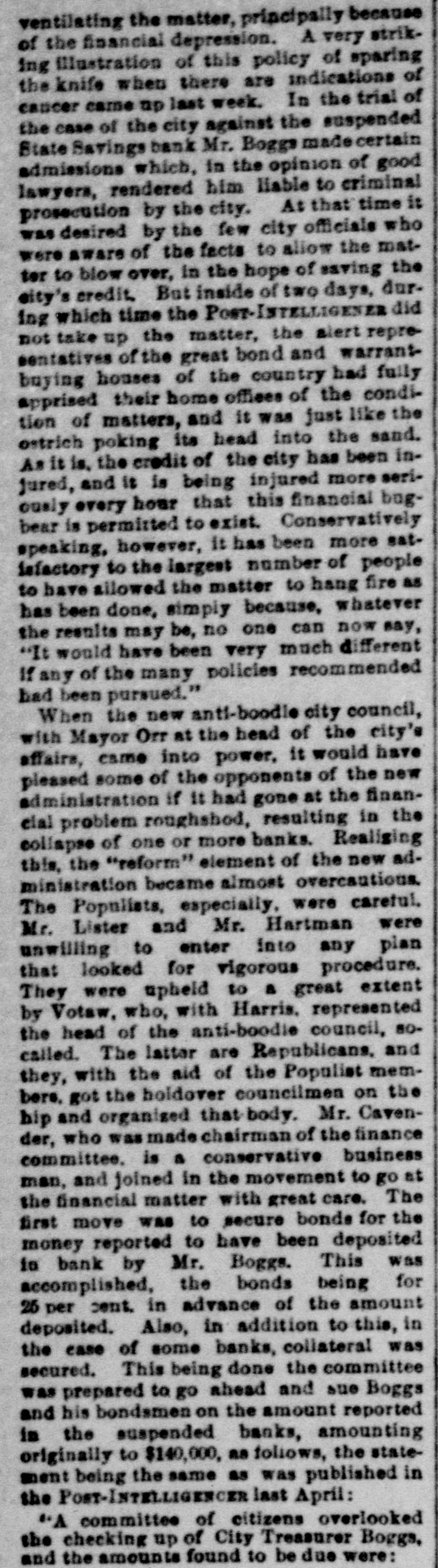
# VENTILATING THE MATTER At that time it ventilating the matter, principally because of the financial depression. A very striking illustration of this policy of sparing the knife when there are indications of cancer came up last week. In the trial of the case of the city against the suspended State Savings bank Mr. Boggs made certain admissions which, in the opinion of good lawyers, rendered him liable to criminal prosecution by the city. was desired by the few city officials who were aware of the facts to allow the matter to blow over, in the hope of saving the city's credit. But inside of two days, during which time the Post-INTELLIGENCER did not take up the matter, the alert representatives of the great bond and warrant-buying houses of the country had fully apprised their home offices of the condition of matters, and it was just like the ostrich poking its head into the sand. As it is, the credit of the city has been injured, and it is being injured more seriously every hour that this financial bugbear is permitted to exist. Conservatively speaking, however, it has been more satisfactory to the largest number of people to have allowed the matter to hang fire as has been done, simply because, whatever the results may be, no one can now say, "It would have been very much different If any of the many policies recommended had been pursued." When the new anti-boodle city council, with Mayor Orr at the head of the city's affairs, came into power, it would have pleased some of the opponents of the new administration if it had gone at the financial problem roughshod, resulting in the collapse of one or more banks. Realizing this, the "reform" element of the new administration became almost overcautious. The Populists, especially, were careful. Mr. Lister and Mr. Hartman were unwilling to enter into any plan that looked for vigorous procedure. They were upheld to a great extent by Votaw, who, with Harris, represented the head of the anti-boodle council, so-called. The latter are Republicans, and they, with the aid of the Populist members, got the holdover councilmen on the hip and organized that body. Mr. Cavender, who was made chairman of the finance committee, is a conservative business man, and joined in the movement to go at the financial matter with great care. The first move was to secure bonds for the money reported to have been deposited in bank by Mr. Boggs. This was accomplished, the bonds being for 25 per cent. in advance of the amount deposited. Also, in addition to this, in the case of some banks, collateral was secured. This being done the committee was prepared to go ahead and sue Boggs and his bondsmen on the amount reported in the suspended banks, amounting originally to $140,000, as follows, the statement being the same as was published in the POST-INTELLIGENCER last April: "A committee of citizens overlooked the checking up of City Treasurer Boggs, and the amounts found to be due were:
Article from The Seattle Post-Intelligencer, November 9, 1894

Click image to open full size in new tab

Article Text

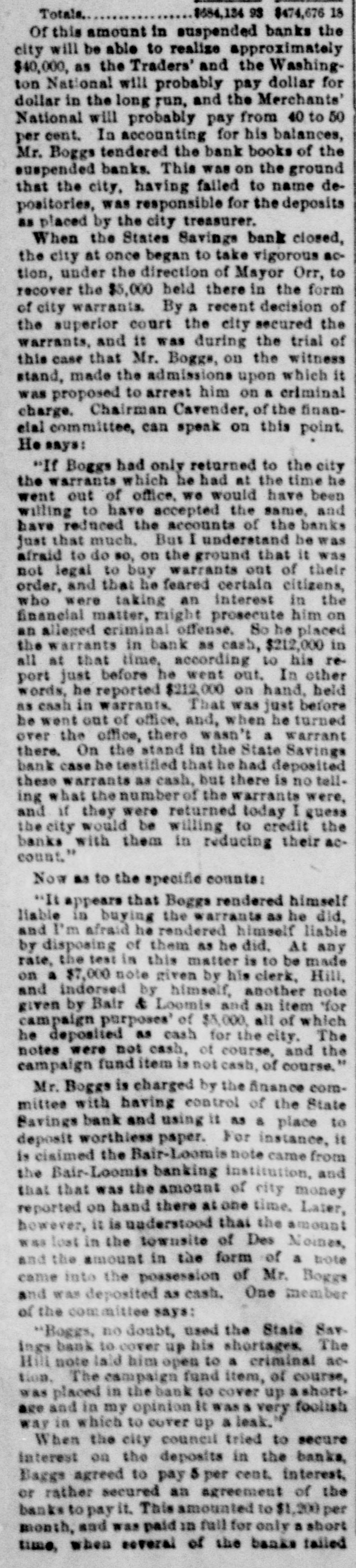
Totals. $684,134 93 $474,676 18 Of this amount in suspended banks the city will be able to realize approximately $40,000, as the Traders' and the Washington National will probably pay dollar for dollar in the long run, and the Merchants' National will probably pay from 40 to 50 per cent. In accounting for his balances, Mr. Boggs tendered the bank books of the suspended banks. This was on the ground that the city, having failed to name depositories, was responsible for the deposits as placed by the city treasurer. When the States Savings bank closed, the city at once began to take vigorous action, under the direction of Mayor Orr, to recover the $5,000 held there in the form of city warrants. By a recent decision of the superior court the city secured the warrants, and it was during the trial of this case that Mr. Boggs, on the witness stand, made the admissions upon which it was proposed to arrest him on a criminal charge. Chairman Cavender, of the financial committee, can speak on this point. He says: "If Boggs had only returned to the city the warrants which he had at the time he went out of office, we would have been willing to have accepted the same, and have reduced the accounts of the banks just that much, But I understand he was afraid to do so, on the ground that it was not legal to buy warrants out of their order, and that he feared certain citizens, who were taking an interest in the financial matter, might prosecute him on an alleged criminal offense. So he placed the warrants in bank as cash, $212,000 in all at that time, according to his report just before he went out, In other words, he reported $212,000 on hand, held as cash in warrants. That was just before he went out of office, and, when he turned over the office, there wasn't a warrant there. On the stand in the State Savings bank case he testified that he had deposited these warrants as cash, but there is no telling what the number of the warrants were, and if they were returned today I guess the city would be willing to credit the banks with them in reducing their account." Now as to the specific counts: "It appears that Boggs rendered himself liable in buying the warrants as he did, and I'm afraid he rendered himself liable by disposing of them as he did, At any rate, the test in this matter is to be made on a $7,000 note given by his clerk, Hill, and indorsed by himself, another note given by Bair & Loomis and an item for campaign purposes' of $5,000, all of which he deposited as cash for the city. The notes were not cash, of course, and the campaign fund item is not cash, of course." Mr. Boggs is charged by the finance committee with having control of the State Bavings bank and using it as & place to deposit worthless paper. For instance, it is cisimed the Bair-Loomis note came from the Bair-Loomis banking institution, and that that was the amount of city money reported on hand there at one time. Later, however, it is understood that the amount was lost in the townsite of Des Noines, and the amount in the form of a bote came into the possession of Mr. Boggs and was deposited as cash. One member of the committee says: "Boggs, no doubt, used the State SavIngs bank to cover up his shortages. The Hill note laid him open to a criminal action, The campaign fund item, of course, was placed in the bank to cover up ashort. age and in my opinion It was a very foolish way in which to cuver up a leak. When the city council tried to secure interest on the deposits in the banks, Baggs agreed to pay 5 per cent. interest, or rather secured an agreement of the banks to pay it. This amounted to $1,200 per month, and was paid in full for only a short time, when several of the banks failed


Article from The Seattle Post-Intelligencer, January 12, 1896

Click image to open full size in new tab

Article Text

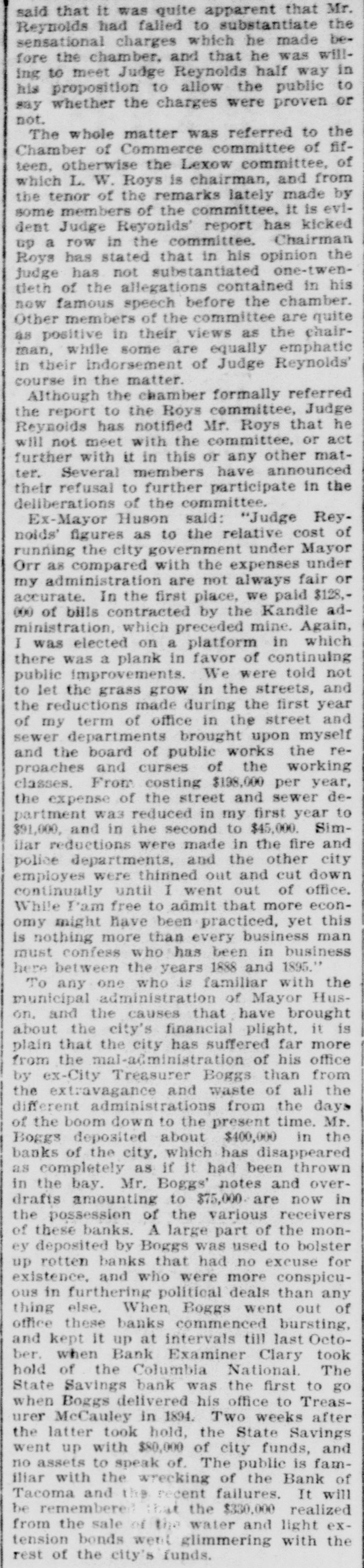
said that it was quite apparent that Mr. Reynolds had falled to substantiate the sensational charges which he made before the chamber, and that he was willing to meet Judge Reynolds half way in his proposition to allow the public to say whether the charges were proven or not. The whole matter was referred to the Chamber of Commerce committee of fifteen, otherwise the Lexow committee, of which L. W. Roys is chairman, and from the tenor of the remarks lately made by some members of the committee, it is evident Judge Reyonids' report has kicked up a row in the committee. Chairman Roys has stated that in his opinion the judge has not substantiated one-twentieth of the allegations contained in his now famous speech before the chamber. Other members of the committee are quite as positive in their views as the chairman, while some are equally emphatic in their indorsement of Judge Reynolds' course in the matter. Although the chamber formally referred the report to the Roys committee, Judge Reynolds has notified Mr. Roys that he will not meet with the committee, or act further with it in this or any other matter. Several members have announced their refusal to further participate in the deliberations of the committee. Ex-Mayor Huson said: "Judge Reynolds' figures as to the relative cost of running the city government under Mayor Orr as compared with the expenses under my administration are not always fair or accurate. In the first place, we paid $128,000 of bills contracted by the Kandle administration, which preceded mine. Again, I was elected on a platform in which there was a plank in favor of continuing public improvements. We were told not to let the grass grow in the streets, and the reductions made during the first year of my term of office in the street and sewer departments brought upon myself and the board of public works the reproaches and curses of the working classes. From costing $198,000 per year, the expense of the street and sewer department was reduced in my first year to $91,000, and in the second to $45,000. Similar reductions were made in the fire and police departments, and the other city employes were thinned out and cut down continually until I went out of office. While T'am free to admit that more economy might have been practiced, yet this is nothing more than every business man must confess who has been in business here between the years 1888 and 1895." To any one who is familiar with the municipal administration of Mayor Huson, and the causes that have brought about the city's financial plight, it is plain that the city has suffered far more from the mal-administration of his office by ex-City Treasurer Boggs than from the extravagance and waste of all the different administrations from the days of the boom down to the present time. Mr. Boggs deposited about $400,000 in the banks of the city, which has disappeared as completely as if it had been thrown in the bay. Mr. Boggs' notes and overdrafts amounting to $75,000 are now in the possession of the various receivers of these banks. A large part of the money deposited by Boggs was used to bolster up rotten banks that had no excuse for existence, and who were more conspicuous in furthering political deals than anything else. When Boggs went out of office these banks commenced bursting, and kept it up at intervals till last October. when Bank Examiner Clary took hold of the Columbia National. The State Savings bank was the first to go when Boggs delivered his office to Treasurer McCauley in 1894. Two weeks after the latter took hold, the State Savings went up with $80,000 of city funds, and no assets to speak of. The public is familiar with the wrecking of the Bank of Tacoma and the recent failures. It will be remembered that the $330,000 realized from the sale of the water and light extension bonds went glimmering with the rest of the city's funds.