Article Text
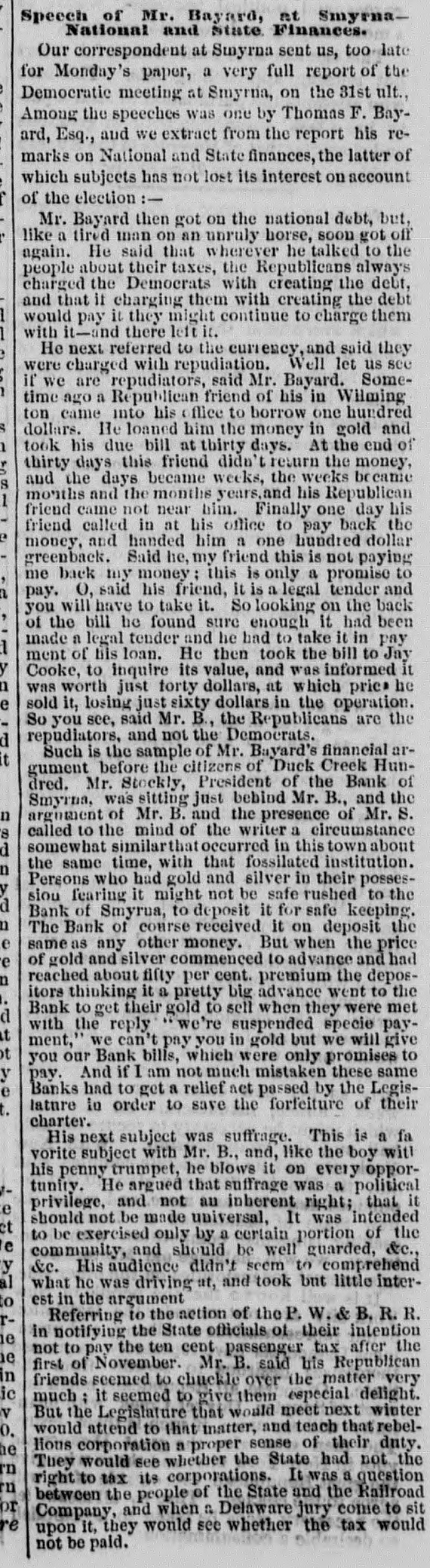
Speech of Mr. Bayard, at SmyrnaNational and state Finances. Our correspondent at Swyrna sent us, too-lat for Monday's paper, a very full report of the Democratic meeting at Smyrna, on the 31st ult., Among the speeches was one by Thomas F. Bayard, Esq., and we extract from the report his remarks on National and State finances, the latter of which subjects has not lost its interest on account of the election :Mr. Bayard then got on the national debt, but, like a tired man on an unruly horse, soon got off again. He said that wherever he talked to the people about their taxes, the Republicans always charged the Democrats with creating the debt, and that it charging them with creating the debt would pay it they might continue to charge them with it-and there left it. He next referred to the currency, and said they were charged with repudiation. Well let us see if we are repudiators, said Mr. Bayard. Sometime ago a Republican friend of his in Wilming ton came into his office to borrow one hundred dollars. He loaned him the money in gold and took his due bill at tbirty days. At the end of thirty days this friend didn't return the money, and the days became weeks, the weeks bc came months and the months years, and his Republican friend came not near him. Finally one day his friend called in at his office to pay back the money, and handed him a one hundred dollar greenback. Said he, my friend this is not paying me back my money; this is only a promise to n pay. o, said his friend, it is a legal tender and you will have to take it. So looking on the back of the bill he found sure enough it had been made a legal tender and he bad to take it in pay ment of his loan. He then took the bill to Jay Cooke, to inquire its value, and was informed it n was worth just torty dollars, at which prica he e sold it, losing just sixty dollars in the operation. So you see, said Mr. B., the Republicans are the repudiators, and not the Democrats. d Such is the sample of Mr. Bayard's financial arit gument before the citizens of Duck Creek Hundred. Mr. Stockly, President of the Bank of Smyrna, was sitting just behind Mr. B., and the n argiment of Mr. B. and the presence of Mr. S. S called to the mind of the writer a circumstance somewhat similarthat occurred in this town about d the same time, with that fossilated institution. n Persons who had gold and silver in their possessiou fearing it might not be safe rushed to the a Bank of Smyrua, to deposit it for safe keeping. n The Bank of course received it on deposit the e same as any other money. But when the price e of gold and silver commenced to advance and had reached about fifty per cent. premium the deposn itors thinking it a pretty big advance went to the Bank to get their gold to sell when they were met d with the reply we're suspended specie payt ment," we can't pay you in gold but we will give t you our Bank bills, which were only promises to y pay. And if I am not much mistaken these same e Banks had to get a relief act passed by the Legislature in order to save the forfeiture of their t. charter. His next subject was suffrage. This is a fa vorite subject with Mr. B., and, like the boy with his penny trumpet, he blows it on every opportunity. He argued that suffrage was a political e privilege, and not au inherent right; that it should not be made universal, It was intended et to be exercised only by a certain portion of the e community, and should be well guarded, &c., y &c. His audience didn't seem to comprehend al what he was driving at, and took but little interto est in the argument rReferring to the action of the P. W. & B. R. R. in notifying the State officials of their intention e not to pay the ten cent passenger tax after the ae first of November. Mr. B. said his Republican in friends seemed to chuckle over the matter very ic much ; it seemed to give them especial delight. V But the Legislature that would meet next winter 0, that matter, and teach that rebela sense he would lions corporation attend to proper State of had their not duty. They would see whether the the rn right to tax its corporations. It was a question rn between the people of the State and the Railroad or Company, and when a Delaware jury come to sit re upon it, they would see whether the tax would not be paid.