20876. Bank of Nashville (Nashville, TN)

Bank Information

Episode Type
Suspension → Closure
Bank Type
state
Start Date
September 7, 1868
Location
Nashville, Tennessee (36.166, -86.784)

Metadata

Model
gpt-5-mini
Short Digest
6e58d015

Response Measures

None

Description

Articles (1868–1871) describe the Bank of Tennessee being placed in receivership, legislative action to wind it up, and later destruction of note plates — indicating a formal suspension and winding up (permanent closure). No article describes a depositor run on this specific bank; causes and actions are state/legislative (receiver, winding up). Dates are taken from publication dates and in‑text references to legislative actions and committee reports.

Events (4)

1. September 7, 1868 Suspension
Cause
Government Action
Cause Details
Bank placed under the supervision of a Receiver and being wound up; legislative and receiver actions to settle and liquidate the bank's affairs are described in multiple articles (receivership and winding up).
Newspaper Excerpt
The business of the Bank of Tennessee is being wound up under the supervision of the Receiver
Source
newspapers
2. November 10, 1868 Receivership
Newspaper Excerpt
He recommends that measures be adopted to wind up the Bank of Tennessee forthwith. ... the six railroads now in the hands of receivers appointed by him on behalf of the State ... he recommends that measures be adopted to wind up the Bank of Tennessee forthwith.
Source
newspapers
3. February 21, 1869 Other
Newspaper Excerpt
House bill to wind up the affairs of the same institution was made the special order for Monday morning. Mr. Singletary submitted a report from the Special Committee on the affairs of the Bank of Tennessee ... recommend placing said bank in the hands and under the control of officers of the State, the Attorney-general to do his utmost to wind up litigation, requested receivers be granted in the Chancery Court of Davidson county ... real estate to be sold, and the books and papers removed to the capitol.
Source
newspapers
4. December 11, 1871 Other
Newspaper Excerpt
The plates from which the notes of the Bank of Tennessee were struck ... were destroyed today in the presence of a joint committee of the Legislature and the Clerk and Master of the Nashville Chancery Court.
Source
newspapers

Newspaper Articles (13)

Article from Nashville Union and Dispatch, March 26, 1868

Click image to open full size in new tab

Article Text

SUIT INSTITUTED IN THE UNITED STATES CIRCUIT COURT.-Mr. William Bayne, of Maryland, and Messrs. Andrew J. Duncan and John W. Judkins, of Tennessee, have instituted a suit in the United States Circuit Court, against the President and Directors of the Farmers' Bank of Virginia, for a considerable amount. The plaintiffs claim that they have in their possession notes of the said bank amounting to some $28,000, and a draft drawn by the Farmers' Bank on the Bank of Nashville for $1266 13, which had been presented and payment refused. The defendants have been notified that the plaintiffs will, on the 16th day of April next, move the court for an injunction to restrain the defendants from disposing of the assets of said bank, in any manner whatever, and ask for the appointment of a receiver by the court.-Richmond Examiner, March 20.


Article from Memphis Daily Appeal, September 7, 1868

Click image to open full size in new tab

Article Text

BANK OF TENNESSEE. 71991881 New Way to Pay Old Debts. The following communication to the Nashville Banner is another of 8 million disreputatable illustrations of Radioalism in Tennessee. It will interest our taxpayers : I am informed that the business of the Bank of Tennessee is being wound up under the supervision of the Receiver in a very unlawful and dishonest manner. I am informed that If a debtor of the bank calls there to ascertain the amount of his note and interest-suppose it is $5000-and he says he will go out and buy the amount in Tennessee bank notes, which he can get for thirty cents on the dollar, the officer in the bank tells him he need not go to that trouble; that he may just pay him the same amount in greenbacks that he will have to pay & broker, and that he can take his note. The consequence is that all the notes of the Bank of Tennessee remain outstanding, and the notes or assets belonging to the bank are shaved off at 70 per cent. discount, and the proceeds pocketed by Browniow's officers in the bank, whilet if the notes in the bank were paid up out of the circuistion of the bank, the outstanding circulation would increase in value as the amount diminished. As it is done now, the outstanding circulation will become worthless. I think this system is wrong and robbery. This statement, I am told, can be proved by application to Mr. Thomas S. Marr, or any other broker in Nashvitle. This same kind of settlement was made with Wm. Spence, two years since. The bank held about one hundred thousand dollars in State bonds that Spence had left as collateral security for loaned money. After the bank tailed, Spence proposed to pay what he owed in the notes of the branch, they being then worth about 40 cents on the dollar. 1 am told that Mr. Watson told Spence that he could pay him $35,000 in greenbacks and take his boad, bich amounted to $40,000, but he said be would compromise with him, as they wanted some greenbacks to pay off the employes of the bank, and the State officers generally. This thing should all be exposed. I am informed that Mr. Watson told a friend nes of his of tbls last transaction. A CITIZEN, Creditor of the Bank.


Article from Memphis Daily Appeal, November 11, 1868

Click image to open full size in new tab

Article Text

NASHVILLE. NASHVILLE, November 10.-Governor Brownlow's message was read in the Senate to-day. After congratulating the country upon the election of Grant and Colfax, and the bountiful harvest which has rewarded the husbandman, he recommends the sale of the six railroads now in the hands of receivers appointed by him on behalf the State, and the proceeds to be applied to the reduction of the State debt. He also recommends that no further aid be given to railroads except those which he mentions, in which the State has large interests, it would lose if aid should be denied them. He recommends that measures be adopted to wind up the Bank of Tennessee forthwith. In regard to the extension of the elective franchise, he suggests that there should be & discrimination exercised concerning those who were in rebellion. They are not all alike culpable for the past, nor untrustworthy for the future; for these who were involuntarily drawn into the service of the rebellion, and since its utter failure have given evidence that they accept the result in good faith, that they are good citizens, quiet and law-abiding-that they have strictly observed their parole; that they will not use political power to proscribe and degrade those whom the war has emancipated and invested with the right of citizens. For disfranchised persons of this description the franchise might safely, and, therefore, wisely be extended. The extension should, however, be applied with suitable guards and checks, that advantage could not be taken of its liberality, to the damage and honor of the State. The other class who still remain bostile to the government, he thinks, should remain disfranchised for an indefinite period. He also recommends an increase of the salaries of Governor and Judiciary, and makes various recommendations relativato insuring the hospital, penitentiary, etc.


Article from Public Ledger, November 11, 1868

Click image to open full size in new tab

Article Text

Tennessee Legislature. NASHVILLE, November 10.-Governor Brownlow's message was read in the Senate to-day. After congratulating the country upon the election of Grant and Colfax, and the bountiful harvest which has rewarded the husbandman, he recommends the sale of the six railroads now in the hands of receivers appois ted by him on behalf of the State, and the proceeds to be applied to the reduction of the State debt. He also recommends that no further aid be given to railroads except those which he mentions, in which the State has large interests, it would lose if aid should be denied them. He recommends that measures be adopted to wind up the Bank of Tennessee forthwith. In regard to the extension of the elective franchise, he suggests that there should be a discrimination exercised concerning those who were in rebellion. They are not all alike culpable for the past, nor untrustworthy for the future; for those who were involuntarily drawn into the service of the rebellion, and since its utter failure have given evidence that they accept the result in good faith, that they are good citizens, quiet and law-abidingthat they have strictly observed their parole; that they will not use political power to proscribe and degrade those whom the war has emancipated and invested with the right of citizens, For disfranchised persons of this description the franchise might safely, and therefore wisely, be extended. The extension should, however, be applied with suitable guards and checks, that advantage could not be taken of its liberality, to the damage and honor of the State. The other class who still remain hostile to the government, he thinks, should remain disfranchised for an indefinite period. He also recommends an increase of the salaries of Governor and Judiciary, and makes various recommendations relative to insuring the hospital, penitentiry, etc. Special to Louisville Courier and Journal.] NASHVILLE, November 9.-The Governor's message will not be read before there is a quorum present. He refers briefly to the suffrage question, recommending the extension of suffrage to that small class of rebels who were involuntarily dragged into the re: bellion, and who have since the war cheerfully supported the Brownlow administration. For the great body of rebels, those who affiliate with the Democratic party, and cannot be induced to believe that the State government is not tyrannical and unjust, the Governor breathes out unlimited vengeance, going so far as to recommend that they should not be enfranchised until the last cent of the national debt be paid, The substance of his remarks on the franchise question amounts simply to this That those who are disposed to identify themselves with the Radical party ought to be enfranchised, while those who are not should never have the ballot extended to them. There is very little to be hoped from the Legislature, as that body, as a whole, has failed to exhibit any signs of liberal ity or magnanimity. In connection with the message, Brownlow has an article over his own signature in the last number of the Knoxville Whig, addressed to the Legislature, bitterly opposing anything like magnanimity to the disfranchised masses, and abounding in the most malignant abuse of the ex-rebels of the State. It is surmised that the extreme bitterness of tone manifested by the Governor arises, in part, from the heavy losses sustained by his party in the recent election in Tennessee and the gain of two Demoadherence to cratic have proof indebtedness mends In intimate, his failed positive Congressmen. the message, sale to to if to not of pay the of the treason the those state Democratic State. the Governor He in interest railroads words, and does rebellion. party on not that recom- which their fail an is The passenger train, which left here this morning, on the Washville and Northwestern railroad, ran off the trank near Johnsonville, killing the conductor and severely wounding two or three


Article from Daily Ohio Statesman, November 11, 1868

Click image to open full size in new tab

Article Text

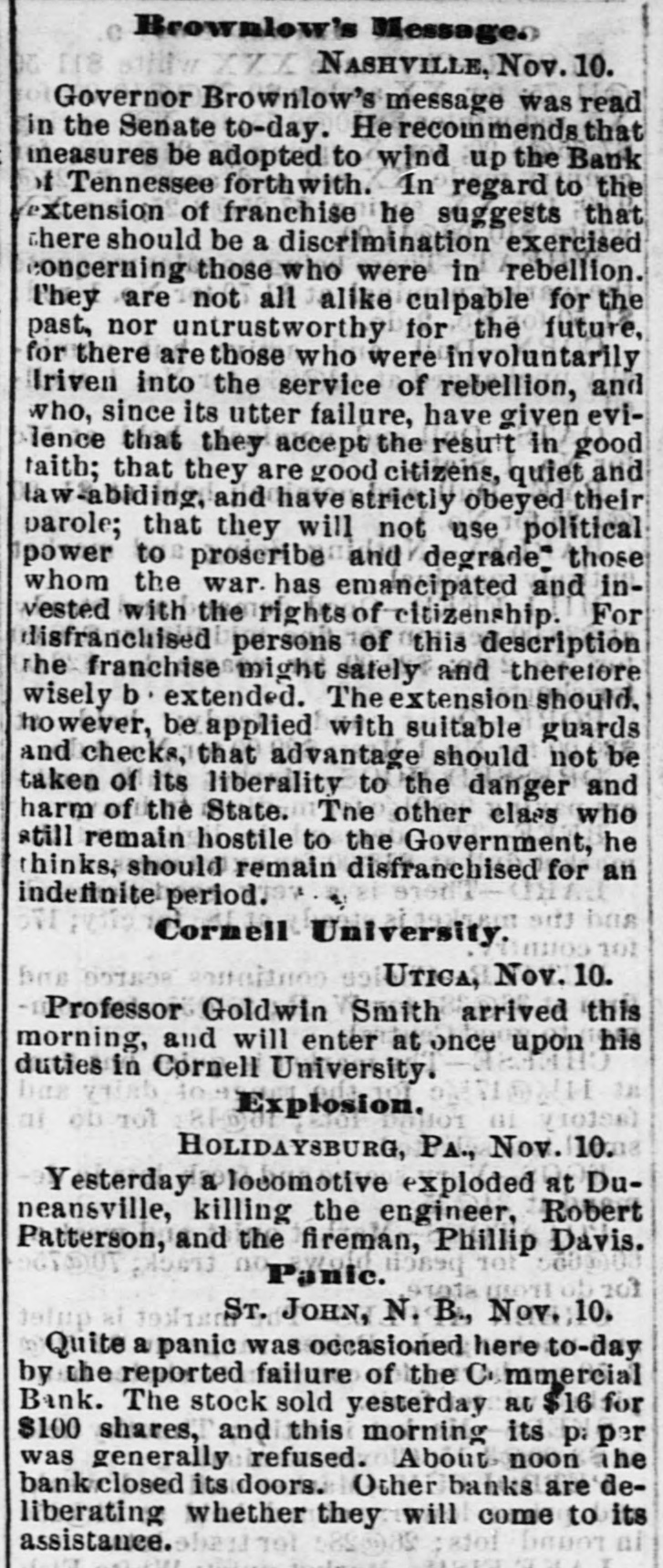
Brownlow's Messages NASHVILLE, Nov. 10. Governor Brownlow's message was read in the Senate to-day. He recommends that measures be adopted to wind up the Bank of Tennessee forthwith. In regard to the xtension of franchise he suggests that there should be a discrimination exercised concerning those who were in rebellion. they are not all alike culpable for the past, nor untrustworthy for the future, for there are those who were involuntarily Iriven into the service of rebellion, and who, since its utter failure, have given evilence that they accept the result in good taith; that they are good citizens, quiet and la abiding, and have strictly obeyed their parole; that they will not use political power to proscribe and degrade" those whom the war. has emancipated and invested with the rights of citizenship. For disfranchised persons of this description the franchise might safely and therefore wisely b extended. The extension should. wever, be applied with suitable guards and checks, that advantage should not be taken of its liberality to the danger and harm of the State. The other class who still remain hostile to the Government, he thinks, should remain disfranchised for an indefinite period. Cornell University. UTICA, Nov. 10. Professor Goldwin Smith arrived this morning, and will enter at once upon his duties in Cornell University. Explosion. HOLIDAYSBURG, PA., Nov. 10. Yesterday a locomotive exploded at Duneansville, killing the engineer, Robert Patterson, and the fireman, Phillip Davis. Panic. ST. JOHN, N. B., Nov. 10. Quite a panic was occasioned here to-day by the reported failure of the C mmercial Bank. The stock sold yesterday at $16 for $100 shares, and this morning its p: per was generally refused. About noon he bankclosed its doors. Other banks are deliberating whether they will come to its assistance.


Article from The New York Herald, November 11, 1868

Click image to open full size in new tab

Article Text

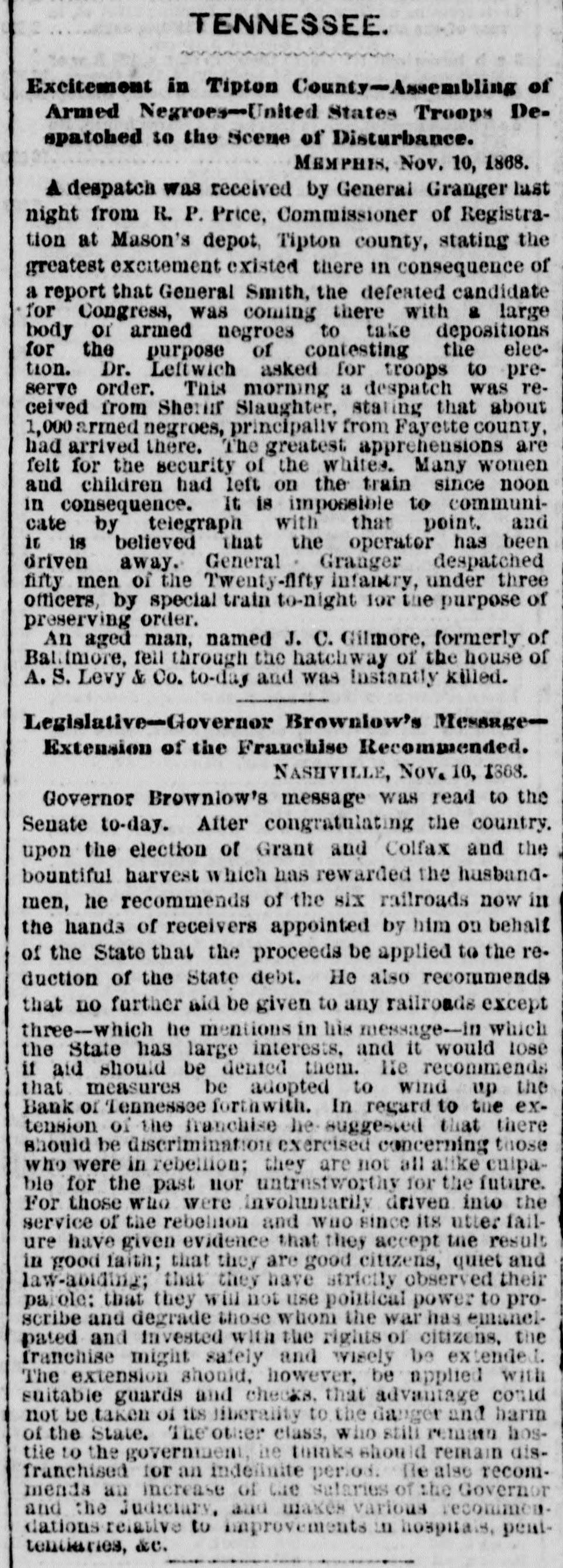
TENNESSEE. Excitement in Tipton County-Assembling of Armed Negroes-United States Troops Despatched to the Scene of Disturbance. MEMPHIS, Nov. 10, 1868. A despatch was received by General Granger last night from R. P. Price, Commissioner of Registration at Mason's depot, Tipton county, stating the greatest excitement existed there in consequence of a report that General Smith, the defeated candidate for Congress, was coming there with a large body or armed negroes to take depositions for the purpose of contesting the election. Dr. Leftwich asked for troops to preserve order. This morning a despatch was received from Sheriff Slaughter, stating that about 1,000 armed negroes, principally from Fayette county, had arrived there. The greatest apprehensions are felt for the security of the whites. Many women and children had left on the train since noon in consequence. It is impossible to communicate by telegraph with that point. and it is believed that the operator has been driven away. General Granger despatched fifty men of the Twenty-fifty infantry, under three officers, by special train to-night for the purpose of preserving order. An aged man, named J. C. Gilmore, formerly of imore, fell through the hatchway of the house of A.S. Levy & Co. to-day and was Instantly killed. Legislative-Governor Brownlow's MessageExtension of the Franchise Recommended. NASHVILLE, Nov. 10, 1868. Governor Brownlow's message was read to the Senate to-day. After congratulating the country. upon the election of Grant and Colfax and the bountiful harvest which has rewarded the husbandmen, he recommends of the six railroads now in the hands of receivers appointed by him on behalf of the State that the proceeds be applied to the reduction of the State debt. He also recommends that no further aid be given to any railroads except three-which he mentions in his message-in which the State has large interests, and it would lose it aid should be denied them. He recommends that measures be adopted to wind up the Bank of Tennessee forthwith. In regard to tue extension of the franchise he suggested that there should be discrimination exercised concerning those who were in rebellion; they are not all alike cuipable for the past nor untrestworthy for the future. For those who were involuntarily driven into the service of the rebelition and who since its utter failure have given evidence that they accept the result in good faith; that they are good citizens, quiet and law-abiding; that they have strictly observed their parole: that they will not use political power to proscribe and degrade those whom the war has emancipated and invested with the rights of citizens, the franchise might safely and wisely be extended. The extension should, however, be applied with suitable guards and checks. that advantage could not be taken of its liberality to the danger and harm of the State. The other class, who still remain hostile to the government, he thinks should remain aisfranchised for an indelinite period. Пе also recommends an increase of the sularies of the Governor and the Judiciary, and шакев various recommen. dations relative to improvements in hospitals, penttentiaries, &c.


Article from The Texas Republican, November 27, 1868

Click image to open full size in new tab

Article Text

# Deferred Dispatches. Washington, Nov. 7. It is asserted that Gen. Grant is unpledged to any party, and uncommitted to any party or policy, and that he is opposed to any extreme measure toward Radicalism. A prominent officer of the army, who was friendly to Gen. Grant's election, and known to be somewhat in bis confidence, remarked lately that the General would call around him, as advisors, only statesmen of known conservative views, and that an ex-member of Congress from Illinois, of the Democratic school, would be the first selection for his Cabinet. The Conservative men in Washington yield gracefully to their overwhelming defeat, confident in the belief that had Grant not been nominated by the Radicals, he would have been by the Democrats, and that his antecedents have all been conservative. Many predict that he will be impeached by the Radicals in less than twelve months from the date of his inauguration. A private letter received here to-day from a well-known Republican Senator states that he has prepared, and will introduce into the Senate when Congress meets, a constitutional amendment providing for universal manhood suffrage in all States. He says it can obtain the requisite two-thirds vote of each House, and can be submitted to the required three-fourths of the State Legislatures which convene next winter. It will be recollected that two Senators favored such an amendment to the constitution of the United States in open debate in the Senate last session. Special to the Cincinnati Enquirer. Washington, Nov. 8. A singular movement has been originated by certain politicians, having in view the casting of the Democratic electoral votes for Grant. It is urged it would influence Grant to a conservative course, to which he is undoubtedly inclined. A circular letter on this subject has been addressed to Mr. Pendleton, Gov. Stevenson and Gen. Preston, of Kentucky, A. H. Stevens, and prominent Democrats of the North. The following is the text of the letter: "WASHINGTON, Nov. 8. General: In my judgment the wisest thing the Democracy could now do would be to throw their entire electoral vote for Gen. Grant, as an indication of the fact that, should he pursue a liberal, generous, and magnanimous course, they will sustain him. It would also have the effect of not leaving him altogether in the hands of the adverse faction, and would doubtless strengthen any purpose he may entertain toward the conservative sentiment of the country. This vote cannot possibly do Seymour any good, and thrown in the manner suggested, would, at least, produce a conciliatory impression. "Very truly yours, etc." Nashville, Nov. 10. Gov. Brownlow's message was read in the senate to-day. After congratulating the country upon the election of Grant and Colfax, and the bountiful harvest which has rewarded the husbandman, he recommends the sale of the six railroads now in the hands of receivers appointed by him on behalf of the State, and the proceeds to be applied to the reduction of the State debt. He also recommends that no further aid be given to railroads, except three, which he mentions, in which the State has large interest: it would lose if aid were denied them. He recommends that measures be adopted to wind up the Bank of Tennessee forthwith. In regard to the extension of the franchise, he suggests that there should be a discrimination exercised concerning those who were in rebellion. They are not all alike culpable for the past, nor untrustworthy for the future. For those who were involuntarily drawn into the service of the rebellion, and since its utter failure have given evidence that they accept the result in the good faith, that they were good citizens, quiet and law bidding, that they have strictly observed thier parole, that they will not use political power to proscribe and degrade those whom the war has emancipated and invested with the rights of citizens for dis-franchised persons of this description the franchised might safely, and therefore, wisely, be extended. The extension should, however, be applied with suitable guards and checks, that advantage could not be taken of its liberties, to the damage and honor of the State. The other class, who still remain hostile to the Government he thinks should remain disfranchised for an indefinite period. He also recommends an increase of salaries of Gov. and Judicary, and makes various reenmmendations relative to insuring hospitals, penitentiary, etc. Washington, Nov. 10. Every little straw is gathered now to show the probable policy of the General after his inauguration. Here are two of them: In the railroad car from Chicago the other day a gentleman said to Grant, "General, I hope when you are in office you will let us have peace in fact as well as in name. To this the General answered, You may be sure I will, sir. I shall make peace, and a solid peace, which will satisfy all good men North, South, East, and West." A brother of Gen. Grant, who lives in Chicago, is re
Article from Nashville Union and American, February 21, 1869

Click image to open full size in new tab

Article Text

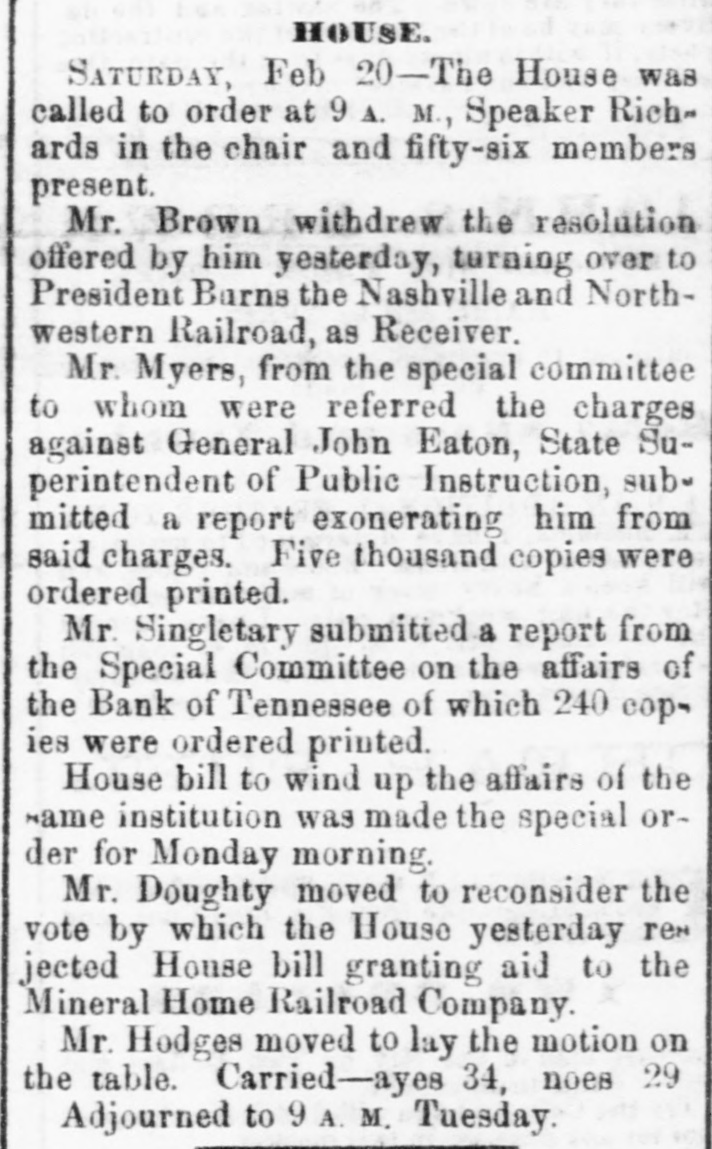
HOUSE. SATURDAY, Feb 20-The House was called to order at 9 A. M., Speaker Richards in the chair and fifty-six members present. Mr. Brown withdrew the resolution offered by him yesterday, turning over to President Burns the Nashville and Northwestern Railroad, as Receiver. Mr. Myers, from the special committee to whom were referred the charges against General John Eaton, State Superintendent of Public Instruction, submitted a report exonerating him from said charges. Five thousand copies were ordered printed. Mr. Singletary submitted a report from the Special Committee on the affairs of the Bank of Tennessee of which 240 copies were ordered printed. House bill to wind up the affairs of the same institution was made the special order for Monday morning. Mr. Doughty moved to reconsider the vote by which the House yesterday ren jected House bill granting aid to the Mineral Home Railroad Company. Mr. Hodges moved to lay the motion on the table. Carried-ayes 34, noes 29 Adjourned to 9 A. M. Tuesday.


Article from Nashville Union and American, February 21, 1869

Click image to open full size in new tab

Article Text

BANK OF TENNESSEE. A Report on its Affairs and Condition -Proposition to Wind it Up. The resolution, under which your committee was appointed, calls for, 1. The amount of cash on hand. 2. Amount of bonds. 3. Amount of accounts. 4. Amount of promissory notes. 5. Amount of bank bills. 6. Amount of Southern currency. 7. Amount of other assets. 8. Annual expense of bank. 9. Value and description of the real estate. 10. The condition of the suits now pending in the courts. 11. The probable conditions of a speedy adjustment and settlement of said bank. 12. Recommendations necessary to pro tect the interest of the State. The House will at once perceive that a full and minute report would require more time than this General Assembly could grant to give the subject that care and scrutiny which it demands. The Bank of Tennessee might well be termed the offspring of the State, and, to the war, its were of the of war guardians commencement previous school this officers fund. civil Up to the th the school fund was regarded as safe in the Bank of Tennessee, and at that time the bank was in a sound and prosperous condition. Previous to the war the available bank were and its of stock, means its 21-100, capital of the liabilities, $4,305,115 exclusive $7,984, 83.100. bank was Nashville south on The mother February removed 16, civil 1862, from and from that time during the war the business of the mother bank and its branches was transacted within the Con. federate lines. It is unnecessary for us to proceed further with a history of the bank during the war, for the special committees ap pointed by previous Legislatures have made reports that show conclusively its conditions during and since the war, and for us to reiterate the words of former committees is, as we deem. unnecessary, and, in accordance with the resolutions under which we were appointed, we submit the following as statements from the bank Cash on hand, $66,914 84. In reference to the bonds, there apto be a the from will to this pears gentleman report seeming House Wiison discrepancy, before (Mr. adjourn- Waters) and ment in reference to that matter, who is intrusted by the committee with that question. $ 537,708 16 Amount of accounts, Amount of promisary notes, 1,369,349 00 1,045,998 73 Amount of bank bills Am't of Southern currency 82,906 87 The annual expenses of the bank and its branches, according to Mr. Watson's statement and report, is $24,420. REAL ESTATE. The property of the Bank of Tenness consists in a ing, street, see at upon Nashville Cherry and is bank estimated build= estiat $75,000. Also two vacant lots, mated at $6,000. One banking-house at Sparta, Tennessee, valued at $35,000. One banking-house at Rogersville, valued at $5,000. One lot in Chattanooga, valued at $1,000. Two hundred and forty acres of land in Hamilton county, valued at $1,000. One banking house at Shelbyville, valued at $5,000. Two thousand acres of land in Arkan sas, value unknown. One house and lot at Mossy Creek, valued at $400. These estimates are made from the books of the bank. to the suits in courts attention is In reference now pending the condition respectfully of of the the to that of country, directed your part Mr. fully Watson's the conditimony which explains tion of said suits. As to the probable and speedy adjustment of said bank, we are of the opinion that it will require years to wind up the same. In consideration of he foregoing, your are of the best or to committee thing policy opinion be that adopted the is some measure the hands bankin very to pass and under placing and the that control said of officers of the State, the utmost to have ed Attorney-generalof the to do his the State all be litigation requestto Receivers of said in the of that Davidson bank, refers granted county-and Chancery and that trustees all Court the real estate to be that the books papers sold, and belonging and said bank and be every thing appertaining to said bank removed from the bank building to the capitol. All of which is respectfully submitted, F. S. SINGLETARY, Chairman.


Article from Memphis Daily Appeal, February 24, 1869

Click image to open full size in new tab

Article Text

THE TENNESSEE BANK. The Report and RecommendaI. tions of the Committee. g In the House, Saturday, Mr. Singletary, from the Special Committee on the Affairs of the Bank of Tennessee, submitted the following report: '8 The resolution under which your comn mittee was appointed calls1. For the amount of cash on hand. ? 2. Amount of bonds. t 3. Amount of accounts. 8 4. Amount of promise ryno'es. 5. Amount of ta k bills. 6. Amount of Southern currency. 7. Amount of other assets. e 8. Annual expense of bank. I 9. Value and description of the real 8 estate. 7 10. The condition of the suits now pending in the courts. 11. The probable condition of a speedy adjustment and settlement of said bank. 12. Recommendation necessary to proteet the interest of the State. The House will at once perceive that full and minute report would require more time than this General Assembly could grant to give the subject that care and scrutiny which it demands. The Bank of Tennessee might well be termed the offepring of the State, and, previous to the war, its officers were the guardians of the school fund. Up the commencement of this civil war this school fund was regarded as safe in the Bank of Tennessee, and at that time the bank was in a sound and prosperous condition. Previous to the war the available means of the bank were $7,984,181 21, and its liabilities, exclusive of its capital stock, $4 305,115 83. The mother bank was removed from Nashville south on February 16, 1862, and from that time during the civil war the business of the mother bank and its branches was transacted within the Confederate lines. It is unnecessary for us to proceed further with a history of the bank during the war, for the special committees appointed by previous Legislatures have made reports that show conclusively its conditions during and since the war, and for us to reiterate the words of former committees is, as we deem, unnecessary, and in accordance with the resolusions under which we were appointed we submit the following asstatements from the bank: Cash on hand, $66,914 85. In reference to the bonds there appears to be a seeming discrepancy, and the gentleman from Wilson (Mr. Waters) will report to this House before adjournment, in reference to that matter, he bete ing intrusted by the committee with that question. te 537,703 16 Amount of accounts re 1,3,9,349.00 Amount of promissory notes m 1,045,993 73 Amount of bank bills 82,906 87 Amount of Southern currency pl The annual expenses of the bank at Nashville, $9,556 46. and for the particuS lar items see Exhibit A. D The annual expenses of the bank and m its branches, according to Mr. Watson's to statement and report, is $24,420. in REAL ESTATE. th The property of the Bank of Tennessee to at Naahville consists in a bank building, to on Cherry street, and is estimated at th $75,000. Also, two vacant lots, estimated at $6000. C One banking house at Sparta, Tenn., valued at $35,000. &1 One banking house at Rogersville, val ued at $5000. One lot in Chattanooga, valued at C $1000. of Two hundred and forty acres of land de in Hamilton county, valued at $1000. One banking house at Shelbyville, valin ued at $5000. w Two thousand acres of land in Arkansas, value unknown. for One house and lot at Mosby Cresk, valued at $400. da These estimates are made from the books of the bank. ter th In reference to the condition of the in suits now in do your attention country, pending the is courts respectfully of the fro directed to that part of Mr. Watson's o testimony which explains fully the condition of said suite. pa the ies of we are of fre As said to bank, probable speedy wind the opinion adjustment that it will require years to up In consideration of the foregoing, your su committee are of the opinion that the at very best thing or policy to be adopted ce is to pass some measure placing said bank in the hands and under the control of officers of the General of reAttorney the State, the State and have that all be the to do his utmost to liti[E: refere to an gation quested Court that bank, of granted receivers in the and Chan- trustees cery of eaid Davidson county-and my that all real estate belonging to said yo bank be sold, and that the books and me papers, and everything appertaining to per said bank, be removed from the back sk building to the Capitol. All of which is respectfully submitted. H F. S.SINGLETARY, Chairman.


Article from Nashville Union and American, February 5, 1870

Click image to open full size in new tab

Article Text

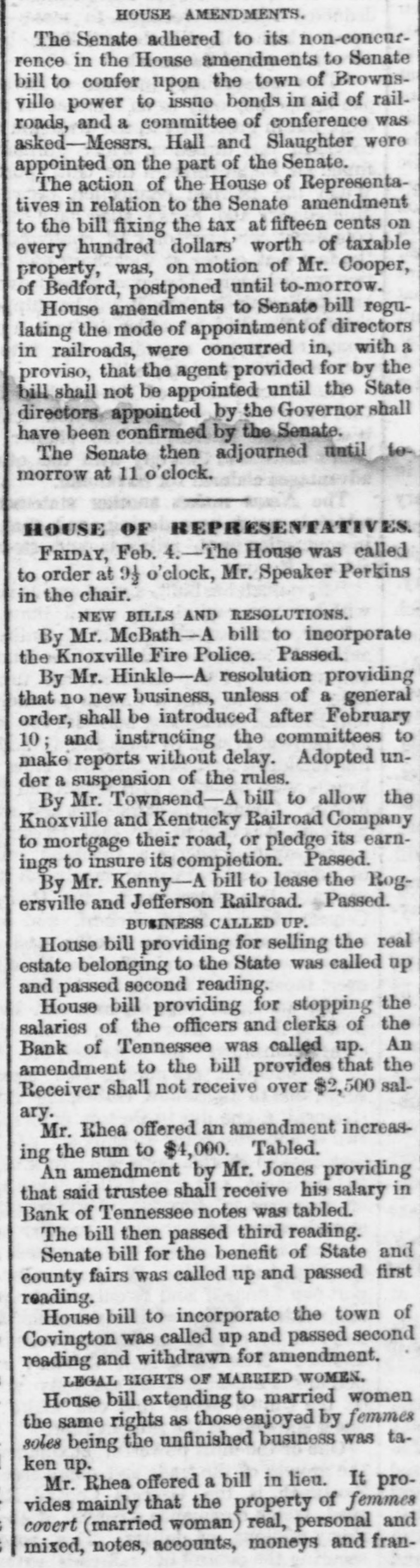
# HOUSE AMENDMENTS. The Senate adhered to its non-concurrence in the House amendments to Senate bill to confer upon the town of Brownsville power to issue bonds in aid of railroads, and a committee of conference was asked-Messrs. Hall and Slaughter were appointed on the part of the Senate. The action of the House of Representatives in relation to the Senate amendment to the bill fixing the tax at fifteen cents on every hundred dollars' worth of taxable property, was, on motion of Mr. Cooper, of Bedford, postponed until to-morrow. House amendments to Senate bill regulating the mode of appointment of directors in railroads, were concurred in, with a proviso, that the agent provided for by the bill shall not be appointed until the State directors appointed by the Governor shall have been confirmed by the Senate. The Senate then adjourned until tomorrow at 11 o'clock. # HOUSE OF REPRESENTATIVES. FRIDAY, Feb. 4. - The House was called to order at 9 o'clock, Mr. Speaker Perkins in the chair. NEW BILLS AND RESOLUTIONS. By Mr. McBath-A bill to incorporate the Knoxville Fire Police. Passed. By Mr. Hinkle-A resolution providing that no new business, unless of a general order, shall be introduced after February 10; and instructing the committees to make reports without delay. Adopted under a suspension of the rules. By Mr. Townsend-A bill to allow the Knoxville and Kentucky Railroad Company to mortgage their road, or pledge its earnings to insure its completion. Passed. By Mr. Kenny-A bill to lease the Rogersville and Jefferson Railroad. Passed. BUSINESS CALLED UP. House bill providing for selling the real estate belonging to the State was called up and passed second reading. House bill providing for stopping the salaries of the officers and clerks of the Bank of Tennessee was called up. An amendment to the bill provides that the Receiver shall not receive over $2,500 salary. Mr. Rhea offered an amendment increasing the sum to $4,000. Tabled. An amendment by Mr. Jones providing that said trustee shall receive his salary in Bank of Tennessee notes was tabled. The bill then passed third reading. Senate bill for the benefit of State and county fairs was called up and passed first reading. House bill to incorporate the town of Covington was called up and passed second reading and withdrawn for amendment. # LEGAL RIGHTS OF MARRIED WOMEN. House bill extending to married women the same rights as those enjoyed by femmes soles being the unfinished business was taken up. Mr. Rhea offered a bill in lieu. It provides mainly that the property of femmes covert (married woman) real, personal and mixed, notes, accounts, moneys and fran-


Article from Memphis Daily Appeal, January 21, 1871

Click image to open full size in new tab

Article Text

NASHVILLE. Reller of Federal and Confederate Soldlers and of School Teachers-Incorporation of Germantown and Raleigh. The Bank of Tennessee and Penitentiary Branches Run late the Ground-The School Fund Fraud - D. F. Jackson, of Memphis. Delinquent Railroads-Rates of Taxation Special to Memphis APPEAL.] SENATE. NASHVILLE, January 20.-Mr. Lut"rell introduced a bill for the relief of Federal and Confederate soldiers in the late war who have been arrested for acts committed during the war, etc. House bills on third reading: For relief of the Secretary of State, allowing him certain fees, etc. Passed. To amend section 4038 of the Code. Passed. For the relief of school teachers authorized by the county trustees to forward their warrants to the State Treasurer, etc. Passed. To authorize Chancery Courts to grant letters of incorporation, and to authorize County Courts to incorporate towns and villages. Passed. House amendment to Senate bill to provide revenue for State were amended and concurred in. Senate bills on third reading To establish the Fifteenth Judicial Circuit, and change the Third, Fifth and Tenth Circuits of the State. Passed. For improvement and extension of Penitentiary: Bill was amended so as to grant $90,000, in old issue of Bank of Tennessee as collateral security, the same to be returned within two years, and to legalize the stockades at Tracy City, and Battle Creek coal mines as branches of the Penitentiary. Bill then referred to Judiciary Committee. To confer criminal jurisdiction on the County Court of Hamilton county, and for other purposes. Passed. HOUSE. In the House, Mr. White, from a special committee in regard to the connection of B. Lanier in the school fund fraud, presented 2 report of exonoration of Mr. Lanier from all connection with said fraud. Mr. Jones offered a resolution appointing a committee to investigate the claim of D.F. Jackson, former jailer of Shelby county. Adopted, and Jones, Casey and Owen appointed on the committee. Mr. Lackey offered a resolution to appoint a committee to burn all the blank notes and bonds of the Bank of Tennessee. Adopted. The following bills were introduced By Mr. Rhea: To authorize the courts to legitimatize persons and alter names. By Mr. Clark: A bill for the benefit of Clerks of County and Circuit Courts. House bills on third reading: To amend an act to establish a Law Court at Nashville by directing the Judge of said Court to hold the Circuit Court of Summer county. Rejected. To amend the revenue laws in regard to taxing notes. Passed. To amend an act for the formation of Etheridge county. Passed. To authorize the Governor to sell the real estate belonging to the State. Passed. To wind up the Bank of Tennessee, Passed. To amend an act to provide for the sale of delinquent railroads by appropriating $2000 for the payment of each attorney employed in the suits, $3000 each to commissioners, and allowing the Clerk and Master the usual office fees, but no commissions for making sales. Passed. To change qualifications of jurors. Passed. To equalize taxation. Rejected. The House concurred in the Senate amendments to the revenue bill. The revenue bill has finally passed both Houses, and now awaits the approval of the Governor, which no doubt it will receive. The first section fixes the tax at sixty cents on one hundred dollars of taxable property. The second section provides for a license tax, to be paid by the merchants to equal their ad valorem tax. The third section repeals the act fixing the tax at forty cents. section that or local of any every The traveling fourth provides agent in the of pay an annual insurance it, shall company, Stateoro privilege tax of twenty-five dollars to the State and ten dollars to each county. The fifth section provides that railroad companies shall pay a tax of six mills on the dollar on net earnings. The sixth section taxes commercial dollars drummers the State fifty representing per parties annum out for of the State and five dollars for each county. The seventh section provides that the act shall take effect from and after its D8888ge


Article from Knoxville Daily Chronicle, December 15, 1871

Click image to open full size in new tab

Article Text

Our Nashville Letter. NASHVILLE, Dec. 11. The plates from which the notes of the Bank of Tennessee were struck, twentythree in number, were destroyed to-day in the presence of a joint committee of the Legislature and the Clerk and Master of the Nashville Chancery Court. The plates seem to be all in good order and were lately received from Philadelphia, where they have been for ten years. They were destroyed by being cast into the furnace at the penitentiary. Senator Staley was Chairman of the Committee that did the work. I am led to believe from investigation that there has not been any notes struck off these plates since the Bank of Tennessee has suspended. I am informed the plates have all the time been in the hands of highly responsible parties. But how many notes unsigned were in the vaults of the Bank of Tennessee and its branches when the bank left this State, I can not state, but I understand these unsigned notes were very numerous. THE TAX BILL. The tax bill has not yet finally got through the two Houses. The House has refused to concur in the Senate amendments, and a Committee of Conference has been appointed. The ad valorem tax is forty cents. Nothing was done for schools. The Senate voted down to-day a House bill exempting manufacturers from taxation for five years, The objection to the bill was that it was unconstitutional. The Senate would have sustained the bill had it not been for this Constitutional difficulty. Thus does the new Constitution damage the material interest of the State. VETOES. Governor Brown has been rather free in the use of the veto power. He vetoed quite a batch of county line bills on Satürday, and thus created quite a flutter among the members. The Senate overruled one of the vetoes and sustained the balance. A great many Democrats have rather cooled in their affection for the Govternor, and his course and policy have been severely criticised in and out of the Legislature. Brown is not quite Democratic enough for the rebels. The old Whig still sticks out in him. "Raising will tell." ADJOURNMENT. The Legislature will adjourn about SatSurday. Members swear they will not stay an hour after their pay stops. I expect the world will continue to turn around Yours. after adjournment.