22104. Woodstock Bank (Woodstock, VT)

Bank Information

Episode Type
Suspension → Reopening
Bank Type
state
Start Date
November 3, 1857
Location
Woodstock, Vermont (43.624, -72.518)

Metadata

Model
gpt-5-mini
Short Digest
cebdd215

Response Measures

None

Description

Articles indicate the Woodstock Bank suspended specie/current-fund redemptions during the Panic of 1857 (more than sixty days) and later resumed business (New-York Daily Tribune, Jan 22, 1858). No explicit depositor run is described in the provided excerpts, so classify as a suspension with reopening due to the resumption note. Dates chosen from article publication dates and context.

Events (3)

1. November 3, 1857 Suspension
Cause
Macro News
Cause Details
Suspension of specie/current-fund redemptions occurred during the Panic of 1857; article notes the bank suspended redemption for more than sixty days during the panic (state-level consequences of widespread financial crisis).
Newspaper Excerpt
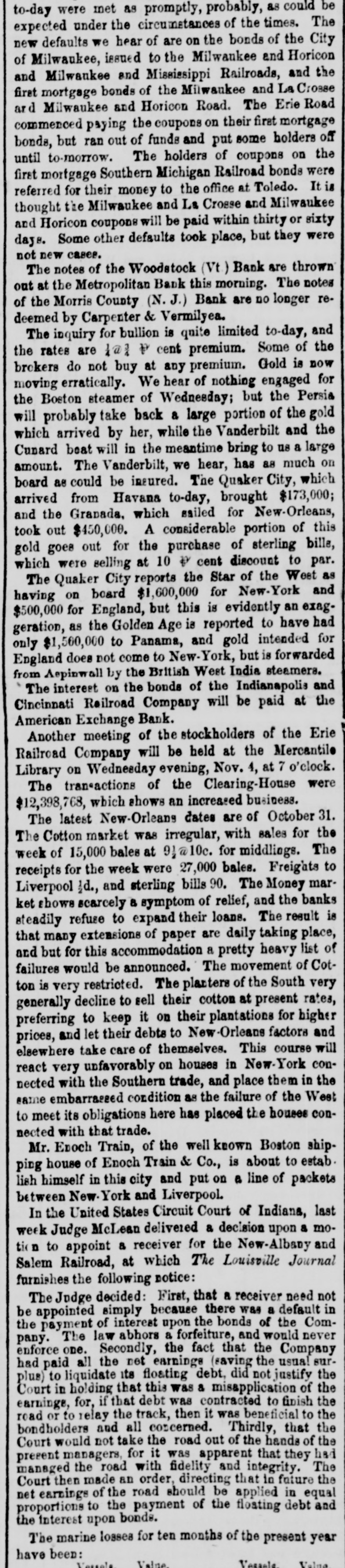
The notes of the Woodstock (Vt.) Bank are thrown out at the Metropolitan Bank this morning.
Source
newspapers
2. January 22, 1858 Reopening
Newspaper Excerpt
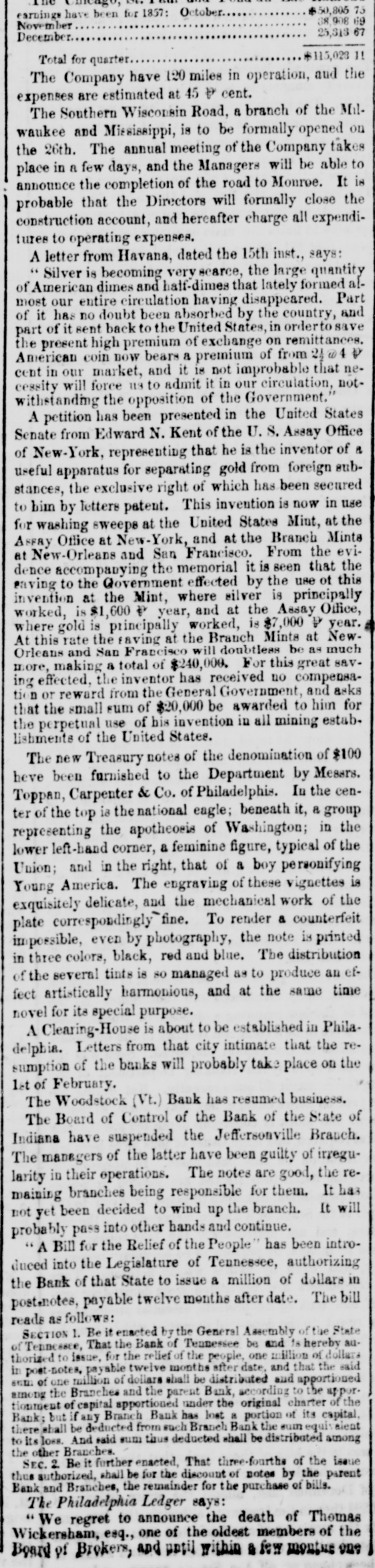
The Woodstock (Vt.) Bank has resumed business.
Source
newspapers
3. November 18, 1858 Other
Newspaper Excerpt
The Missisquoi, Royalton and Woodstock Banks are in the same boat ... suspended the redemption of its bills in specie or current Boston funds, for more than sixty days during the panic of last fall and winter. ... its managers ask to have [the penalty] remitted by the General Assembly.
Source
newspapers

Newspaper Articles (3)

Article from New-York Daily Tribune, November 3, 1857

Click image to open full size in new tab

Article Text

to-day were met as promptly, probably, as could be expected under the circumstances of the times. The new defaults we hear of are on the bonds of the City of Milwaukee, issued to the Milwankee and Horicon and Milwankee and Mississippi Railroads, and the first mortgage bonds of the Milwaukee and La Crosse ard Milwaukee and Horicon Road. The Erie Road commenced paying the coupons on their first mortgage bonds, but ran out of funds and put some holders off until to-morrow. The holders of coupons on the first mortgage Southern Michigan Railroad bonds were referred for their money to the office at Toledo. It is thought the Milwaukee and La Crosse and Milwaukee and Horicon coupons will be paid within thirty or sixty days. Some other defaults took place, but they were not new cases. The notes of the Woodstock (Vt.) Bank are thrown out at the Metropolitan Bank this morning. The notes of the Morris County (N. J.) Bank are no longer redeemed by Carpenter & Vermilyea. The inquiry for bullion is quite limited to-day, and the rates are h@q P cent premium. Some of the brokers do not buy at any premium. Gold is now moving erratically. We hear of nothing engaged for the Boston steamer of Wednesday; but the Persia will probably take back a large portion of the gold which arrived by her, while the Vanderbilt and the Cunard beat will in the meantime bring to us a large amount. The Vanderbilt, we hear, has 88 much on board as could be insured. The Quaker City, which arrived from Havana to-day, brought $173,000; and the Granada, which sailed for New-Orleans, took out $450,000. A considerable portion of this gold goes out for the purchase of sterling bills, which were selling at 10 P cent discount to par. The Quaker City reports the Star of the West as having on board $1,600,000 for New-York and $500,000 for England, but this is evidently an exaggeration, as the Golden Age is reported to have had only $1,500,000 to Panama, and gold intended for England does not come to New-York, but is forwarded from Aspinwall by the British West India steamers. The interest on the bonds of the Indianapolis and Cincinnati Reilroad Company will be paid at the American Exchange Bank. Another meeting of the stockholders of the Erie Railroad Company will be held at the Mercantile Library on Wednesday evening, Nov. 4, at 7 o'clock. The transactions of the Clearing-House were $12,398,768, which shows an increased business. The latest New-Orleans dates are of October 31. The Cotton market was irregular, with sales for the week of 15,000 bales at 9}@10c. for middlings. The receipts for the week were 27,000 bales. Freights to Liverpool 1d., and sterling bills 90. The Money market shows scarcely a symptom of relief, and the banks steadily refuse to expand their loans. The result is that many extensions of paper are daily taking place, and but for this accommodation a pretty heavy list of failures would be announced. The movement of Cotton is very restricted. The planters of the South very generally decline to sell their cotton at present rates, preferring to keep it on their plantations for higher prices, and let their debts to New-Orleans factors and elsewhere take care of themselves. This course will react very unfavorably on houses in New-York connected with the Southern trade, and place them in the same embarrassed condition as the failure of the West to meet its obligations here has placed the houses connected with that trade. Mr. Enoch Train, of the well known Boston shipping house of Enoch Train & Co., is about to estab. lish himself in this city and put on a line of packets between New.York and Liverpool. In the United States Circuit Court of Indiana, last week Judge McLean delivered & decision upon a motic n to appoint a receiver for the New-Albany and Salem Railroad, at which The Louisville Journal furnishes the following notice: The Judge decided: First, that a receiver need not be appointed simply because there was a default in the payment of interest upon the bonds of the Company. The law abhors a forfeiture, and would never enforce one. Secondly, the fact that the Company had paid all the net earnings (saving the usual surplus) to liquidate its floating debt, did not justify the Court in holding that this was a misapplication of the earnings, for, if that debt was contracted to finish the road or to relay the track, then it was beneficial to the bondholders and all concerned. Thirdly, that the Court would not take the road out of the hands of the present managers, for it was apparent that they had managed the road with fidelity and integrity. The Court then made an order, directing that in future the net earnings of the road should be applied in equal proportions to the payment of the floating debt and the interest upon bonds. The marine losses for ten months of the present year have been: Vessels. Value. Value, Vessele,

Article from New-York Daily Tribune, January 22, 1858

Click image to open full size in new tab

Article Text

50,805 75 earnings have been for 1857: October 38,908.69 November 25,318 67 December $115,028 11 Total for quarter The Company have 120 miles in operation, and the expenses are estimated at 45 P cent. The Southern Wisconsin Road, a branch of the Milwaukee and Mississippi, is to be formally opened on the 26th. The annual meeting of the Company takes place in a few days, and the Managers will be able to announce the completion of the road to Monroe. It is probable that the Directors will formally close the construction account, and hereafter charge all expenditures to operating expenses. A letter from Havana, dated the 15th inst., says: Silver is becoming very scarce, the large quantity of American dimes and half-dimes that lately formed almost our entire circulation having disappeared. Part of it has no doubt been absorbed by the country, and part of it sent back to the United States, in ordertosave the present high premium of exchange on remittances. American coin now bears a premium of from 21 w 4 P cent in our market, and it is not improbable that necessity will force us to admit it in our circulation, notwithstanding the opposition of the Government." A petition has been presented in the United States Senate from Edward N. Kent of the U. S. Assay Office of New-York, representing that he is the inventor of a useful apparatus for separating gold from foreign substances, the exclusive right of which has been secured to him by letters patent. This invention is now in use for washing sweeps at the United States Mint, at the Assay Office at New-York, and at the Branch Mints at New-Orleans and San Francisco. From the evidence accompanying the memorial it is seen that the saving to the Government effected by the use of this invention at the Mint, where silver is principally worked, is $1,600 P year, and at the Assay Office, where gold is principally worked, is $7,000 P year. At this rate the saving at the Branch Mints at NewOrleans and San Francisco will doubtless be as much more, making a total of $240,000. For this great saving effected, the inventor has received no compensatie n or reward from the General Government, and asks that the small sum of $20,000 be awarded to him for the perpetual use of his invention in all mining establishments of the United States. The new Treasury notes of the denomination of $100 heve been furnished to the Department by Messrs. Toppan, Carpenter & Co. of Philadelphis. In the center of the top is the national eagle; beneath it, a group representing the apotheosis of Washington; in the lower left-hand corner, a feminine figure, typical of the Union; and in the right, that of a boy personifying Young America. The engraving of these vignettes is exquisitely delicate, and the mechanical work of the plate correspondingly fine. To render a counterfeit impossible, even by photography, the note is printed in three colors, black, red and blue. The distribution of the several tints is so managed as to produce an effect artistically harmonious, and at the same time novel for its special purpose. A Clearing-House is about to be established in Philadelphia. Letters from that city intimate that the resumption of the banks will probably take place on the 1st of February. The Woodstock (Vt.) Bank has resumed business. The Board of Control of the Bank of the State of Indiana have suspended the Jeffersonville Branch. The managers of the latter have been guilty of irregularity in their operations. The notes are good, the remaining branches being responsible for them. It has not yet been decided to wind up the branch. It will probably pass into other hands and continue. A Bill for the Relief of the People" has been introduced into the Legislature of Tennessee, authorizing the Bank of that State to issue a million of dollars in postenotes, payable twelve months after date. The bill reads as follows: SECTION 1. Be it enacted by the General Assembly of the State ofTennessee, That the Bank of Tennessee be and 18 hereby authorized to issue, for the relief of the people, one million of dollars in post-notes, payable twelve months after date, and that the said sem of one million of dollars shall be distributed and apportioned among the Branches and the parent Bank, according to the apportionment of capital apportioned under the original charter of the Bank; but if any Branch Bank has lost a portion of its capital, there shall be deducted from such Branch Bank the sum equiv alent to its loss. And said sum thus deducted shall be distributed among the other Branches. SEC. 2. Be it further enacted, That three-fourths of the issue thus authorized, shall be for the discount of notes by the parent Bank and Branches, the remainder for the purchase of bills. The Philadelphia Ledger says: " We regret to announce the death of Themas Wickersham, esq., one of the oldest members of the Board of Brokers, and until within a few months one


Article from Vermont Phœnix, November 20, 1858

Click image to open full size in new tab

Article Text

THURSDAY, November 18. SCISSORS :-A bill was introduced in the House, last week, by Mr. Bridgman, on request of some outsider, to incorporate the Windham County Distillery Company. Upon the announcement of the title a sensation was plainly discernible. Members opened their eyes as if they could not trust their sight, and listened in almost breathless amazement to the reading of the bill. Among the names of the corporators mentioned in the bill are J. D. Bradley of Brattleboro, Chas. K. Field of Newfane, Erasmus Plimpton of Wardsboro, Charles N. Davenport of Wilmington, and others whose names do not now occur. The aims and objects of the intended corporation, as set forth in the bill, and designed by its instigators are, "for the purpose of prosecuting the business of distillation, in all its branches, and, by means thereof, obtaining pure yeast for domestic uses and unadulterated alcohol for mechanical, chemical and medicinal purposes."The bill was referred to the Committee on Manufactures, a majority of which reported adversely to its passage, and, on Tuesday, the bill was refused a third reading by a vote of three to one. From the unanimity with which the bill was strangled one would infer that the Legislature believed that these applicants were already running emptyings sufficiently. The Senate have passed a bill appropriating a sum not exceeding $1000, for the completion of the "Ethan Allen" monument at Burlington, or, in other words, towards defraying the expenses of completing the statue of old Ethan that your gifted young townsman proposes to chisel. I see no reason why the bill will not pass the House. Last week a Joint Committee was appointed ascertain the earliest day practicable for an adjournment. That Committee reported, a day or two since, that in their opinion the General Assembly could not complete the business before them sooner than Friday, the 26th inst. A joint resolution was introduced at that time, directing the President of the Senate, and Speaker of the House, to adjourn their respective Houses, on the morning of the 26th inst., without day. This resolution has passed the House and is now on the table of the Senate. The House have adopted a resolution limiting the introduction of bills, except such as are reported by Committees, than that come from the Senate to-day. The bill in amendment of the Charter of the Vermont and Canada Railroad Company, came up and was disposed of in the House yesterday. Its merits had been so thoroughly discussed in the Senate, the report of the Committee on Roads was so able and lucid, and the subject matter generally had been so much thought of and talked of, that there was no attempt at a discussion in the House. Every member was probably as well prepared to vote when the bill was put on its passage as they would have been after a week's discussion. The bill passed by the decisive vote of 167 yeas to 40 nays. I believe every member of the House from Windham County voted in its favor. The bill for the relief the St. Albans Bank having once been refused a third reading, was brought again before the House by a re-consideration, and re-committed to the Committee on Banks. The Bank, it will be remembered, suspended the redemption of its bills in specie or current Boston funds, for more than sixty days during HELL the panic of last fall and winter. For that reason it incurred a penalty of $3000, which penalty its managers ask to have remitted by the General Assembly. The Missisquoi, Royalton and Woodstock Banks are in the same boat, and of course the friends of all these ba ks are united in the work of seeking a remission, and the bill for the relief of the St. Albans Bank, now before the House, is the test question. Its consideration is set down for Friday next, and present indications seem to favor the belief that the application will be successful. The proclamation is already printed, so you and the readers may be making suitable preparations for the due observance on Thursday, the 2nd C. proximo.