
22065. St Albans Bank (St Albans, VT)

Bank Information

Episode Type
Suspension → Reopening
Bank Type
state
Start Date
September 1, 1857*
Location
St Albans, Vermont (44.811, -73.083)

Metadata

Model
gpt-5-mini
Short Digest
68ddd21b

Response Measures

None

Description

The bank suspended redemption of its bills (suspended specie payments/redemption in Boston) during the Panic of 1857 and later resumed redeeming by early January 1858. No discrete depositor run is described in the articles; the action is described as a suspension of redemption during the panic and subsequent resumption. The bank appears to have sought legislative relief from a fine incurred for failure to redeem; articles indicate temporary suspension (more than sixty days) in autumn/winter 1857 and redemption resumed by Jan 2, 1858. OCR errors corrected where obvious (e.g., 'St. Alban's' and dates inferred from publication dates).

Events (2)

1. September 1, 1857* Suspension
Cause
Macro News
Cause Details
Temporary suspension of specie payments/redemption during the national financial panic of 1857 (panic caused banks to suspend and bills to become uncurrent).
Newspaper Excerpt
the bank suspended the redemption of its bills in specie or current Boston funds, for more than sixty days during ... the panic of last fall and winter.
Source
newspapers
2. January 2, 1858 Reopening
Newspaper Excerpt
The Messenger says that the St. Albans Bank is now redeeming its bills in Boston : and that during the panic it redeemed them at its counter.
Source
newspapers

Newspaper Articles (5)

Article from Vermont Phœnix, October 31, 1857

Click image to open full size in new tab

Article Text

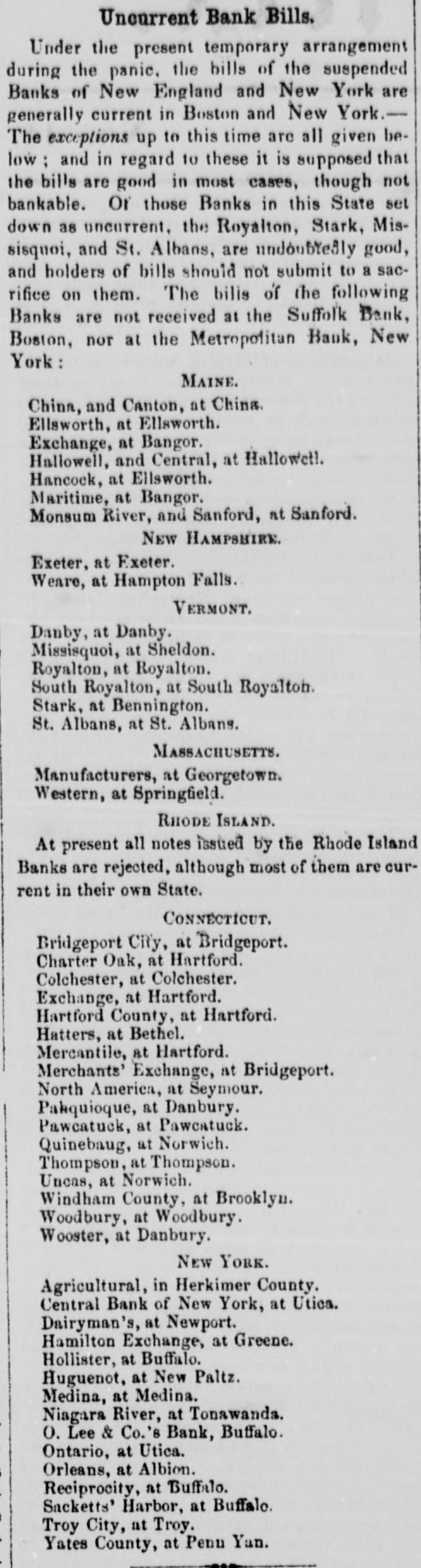
Uncurrent Bank Bills. Under the present temporary arrangement during the panic, the bills of the suspended Banks of New England and New York are generally current in Boston and New York.The exceptions up to this time are all given below ; and in regard to these it is supposed that the bills are good in most cases, though not bankable. Or those Banks in this State set down as uncurrent, the Royalton, Stark, Missisquoi, and St. Albans, are undoubtedly good, and holders of bills should not submit to a sacrifice on them. The bilis of the following Banks are not received at the Suffolk Bank, Boston, nor at the Metropolitan Bank, New York : MAINE. China, and Canton, at China. Ellsworth, at Ellsworth. Exchange, at Bangor. Hallowell, and Central, at Hallowell. Hancock, at Ellsworth. Maritime, at Bangor. Monsum River, and Sanford, at Sanford. NEW HAMPSHIRE. Exeter, at Exeter. Weare, at Hampton Falls. VERMONT. Danby, at Danby. Missisquoi, at Sheldon. Royalton, at Royalton. South Royalton, at South Royalton. Stark, at Bennington. St. Albans, at St. Albans. MASSACHUSETTS. Manufacturers, at Georgetown. Western, at Springfield. RHODE ISLAND. At present all notes issued by the Rhode Island Banks are rejected, although most of them are current in their own State. CONNECTICUT. Bridgeport City, at Bridgeport. Charter Oak, at Hartford. Colchester, at Colchester. Exchange, at Hartford. Hartford County, at Hartford. Hatters, at Bethel. Mercantile, at Hartford. Merchants' Exchange, at Bridgeport. North America, at Seymour. Palaquioque, at Danbury. Pawcatuck, at Pawcatuck. Quinebaug, at Norwich. Thompson, at Thompson. Uncas, at Norwich. Windham County, at Brooklyn. Woodbury, at Woodbury. Wooster, at Danbury. NEW YORK. Agricultural, in Herkimer County. Central Bank of New York, at Utica. Dairyman's, at Newport. Hamilton Exchange, at Greene. Hollister, at Buffalo. Huguenot, at New Paltz. Medina, at Medina. Niagara River, at Tonawanda. O. Lee & Co.'s Bank, Buffalo. Ontario, at Utica. Orleans, at Albion. Reciprocity, at Buffalo. Sacketts' Harbor, at Buffalo. Troy City, at Troy. Yates County, at Penn Yan.


Article from Vermont Phœnix, January 2, 1858

Click image to open full size in new tab

Article Text

News, Notes, and Varieties. At the annual meeting of the Vermont and Canada Railroad in Montpelier on Tuesday, Wm. Parsons, Wm. T. Parrott, Geo. M. Brow n and Sidney Homer of Roston, and Joseph Clark, Henry M. Bates and Asa O. Aldis, of Vermont, were chosen directors. The report of the directors, which was debated, but not accepted. states that the indebtedness of the rond is $11,904. The amount invested in wood and shop stock is $100,142 54. and that we have now arrived at the long hoped for period when the debts are disposed of and a quick capital provided, so essential for the proper operation of the road." The Messenger says that the St. Albans Bank is now redeeming its bills in Boston : and that during the panie it redeemed them at its counter. This course pursued by the bank is extending its line of discounts and at the same time refusing, during the suspension of specie payments, it is claimed was of advantage to the business interests of that section. Mr. Aaron Brownof Sheffield was killed the 15th ult., by falling from the scaffold of a barn and breaking his neck. He was about fifty years of age, and leaves a wife and several children. Mr. Amos Cook of Glover broke his leg on the 15th ult., by the falling of a log he had been chopping. The Postmaster General has appointed Ansel L Tyler to the Charlemont, Mass., Post office. a place worth about $200. Mr Tyler is a Republican. hat a pity Charlemont is not in the balliwick of the Argus. A man named Noble Shaw went fishing in North permanent residence. his absence was not noticed. On the 21st two men from Greenwich who went fishing at the same place, found n hat in the Ice and a string of fish. Upon further search Shaw's body was found in ten feet of water. A man calling himself George Williams, but whose real name is George H. Brown, belonging in Boston was arrested at Manchester, N.H., on Friday evening, charged with possing counterfeit bills on the John Hancock Bank of Springfield, and the South Reading Bank. He was committed for trial. W. H. Emerson, a merchant at Newport, C. W., was robbed of $14.0 0 in bank bills. while traveling on the New York Central Railroad, on Thursday last. The money was in & satchel, which he placed the seat by his side and covered it with his shawl. He got out at a depot for refreshments, and when he returned the money was gone. So far as returns are received, the state constitution is accepted in Oregon by 3828 majority : slavery is prohibited by 5,000 majority : and free negroes excluded by 4'829 majority. The vote for the constituton is about two to one, against slavery four to one, and against free negroes nine to one. It is understood that the Rhode Island banks will resume the redemption of their bills at the Suffolk bank, Boston, on or about the 11th of January It stated that the calcium light on board the new Collins steamship Adrintic, was so distinctly visible at a distance of fifteen or twenty miles from Sandy Hook, at an early hour on Monday morning last, ns to cause the impression that there was a fire at sea. The official canvass of the Minnesota election has been completed. The entire democratic ticket is elected. Messrs. Rice and Shields, democr ts, have been elected U. S. senators. Hon. Amos Tuck of Exeter, and Lyndon A. Marsh, Esq., of Woodstock, have been elected Trustees of Dartmouth College. An impertinent Editor in Alabama wants to know when we "intend to pay the debt of nature.' We are inclined to think that when nature gets her dues from him it will be by an exce Louisville Journal. Francis W. Pickens of South Carolina, has been a nominated to the Senate for the mission of St. Petersburg. and not Mr. Buchanan of Maryland, as rumored. Col. Seymour of Connecticut it thus seems to go home, nolens, volens. Among the decorations of St. James (Episcopal) church at Greenfield, on Christmas Eve, was a large and beautiful "Star in the East" set some forty feet above the pulpit and lighted by a fluid lamp. In the midst of Rev. Mr. Flint's sermon the took fire, the evergreens blazing up in a very startling manner.Seeing that the star could not be immediately reac h. ed, and unwilling to lose his congregation, Mr. Flint continued his discourse, when, suddenly, the burning mass gave way and fell upon the reverend gentleman the fluid lamp striking him on the back, and scatter ing the blazing fluid in all directions. Fortunately the fire was extinguished before it had done any dam age, and Mr. Flint was unhurt. His escape is remark able. A bill to punish professional gamblers by whipping has passed the house of the South Carolina legislature It provides that in addition to the punishment already provided by law, that the guilty party shall receive not to exceed thirty-nine lashes. The papers do no state whether stock gamblers are included in the ben eficent provisions of this bill. The American majority in the Kentucky Senate has receeded from its refusal to go into joint ballot and al low the democrats to elect a U. S. senator, and the convention of the two Houses will be held next week Tuesday. The democrats have 21 majority on join ballot, and have nominated ex-Gov Lazarus W. Pow a ell of Henderson. Nicholas Longworth, the great Cincinnati wine grow er, celebrated his golden wedding at Cincinnati, or g Christmas eve. The bride and bridesmaid were boti present and entered the parlor arm in arm ns they has a half century before. Three children, twelve grand


Article from Burlington Free Press, November 5, 1858

Click image to open full size in new tab

Article Text

where the House had not confined themselves strictly to the technical question of law. The motion to recommit pending, on motion of Mr. Kellog, the House adjourned. FRIDAYY, October 29. SENATE. Mr. Everts called up Senate Bill for the surrender of fugitives from service, and it was made a special order for Tuesday next at 11 o'clock A. M. Correction. In the Senate Reports of yesterday morning it appears that Mr. Chittenden moved a recommitment of bill for the relief of the St. Al- bans Banks, to committee on Banks. It should have read, Mr. French of Windsor. Mr. Chitten- den opposed the bill on the ground of establishing a dangerous precedent, and it was so reported, but by mistake at the office it appeared otherwise. Leave was granted to the committee on Roads to sit during the afternoon session. Mr. Stark moved to reconsider the vote indefi- nitely postponing Senate bill relating to witnesses, and the motion was agreed to. On motion of Mr. Chittenden, the bill was made the special order for to-morrow morning. Reports. By Mr. Chittenden, for committee on Judiciary, adverse to Senate bill extending the ju- risdiction of the constables, and the third reading was refused. By Mr. Stark, for Judiciary com- mittee, in favor of House bill to avoid delays in suits at law; ordered to a third reading. Public bill referred. Making further appropria- tion for the Ethan Allen Monument; to committee on Finance. HOUSE. On motion of Mr. Deane, the committee on Roads had leave to sit during the sessions of the House. The Senate came in and the joint assembly elect ed Wm. G. Shaw. Esq., of Burlington, Reporter of the decisions of the Supreme Court. Reports. By Committee on Agriculture, bill to incorporate Connecticut Valley Fair Ground Co., and it was ordered to 3d reading. Also, bill for the encouragement of agriculture, exempting one yoke of oxen and certain farming tools from at- tachment. On motion of Mr. Hebard, the House went into committee of the whole on this bill; and the chair was assigned to Mr. Hebard. Mr. Olmstead moved to exempt one horse for every machanic; and Mr. Slayton moved to amend this proposition by adding one horse for each mechanic and lawyer, but the the chai ruled the last out of order at this time. Mesers Webber and Billings of Mt. Holly, favored the bill as reported, and on motion of Mr. Kellogg, the committee rose. Reports. By committee on Claims, bill to pay Geo. P. Marsh and John N. Pomeroy, for services in the supervision of the erection of the monument to Ethan Allen, in Burlington. Mr. Bridgman stated the facts in the caso, and Mr. Randall, of Roxbury, moved to dismiss; lost. And on motion of Mr. Hebard, the bill was laid on the table. By committee on Banks, bill for the relief of the St. Alban's Bank, (remitting the fine for temporary non-redemption of its bills in Boston and New York.) This bill was supported by Messrs. Ran- dall of Roxbury, Hebara and Deane, opposed by Messrs. Linsley of Rutiand, Rounds and Olmstead. This bill presents the simple question whether the alternative of paying a tax, instead of redeem- ing the bills of the bank as provided by Statute, shall be enforced in cases of exigency like that of last autumn. The House determined to enforce the Statute, by refusing the third reading of the bill. SATURDAY, October 30. SENATE. Mr. Gleed called up Senate Bill, re lating to witnesses. He thought the main objection to the bill was the fear of witnesses committing the crime of perjury; and in that he must disagree with other Senators. The argument that many a rogue would get clear by coolness, and innocent men suffer through em- barrassment, was one of the strongest presented by the Senator from Windsor. His experience was dif- ferent from this theory. Witnesses testifying un- der embarrassment, generally have their train of circumstances so connected that the embarrassment has a favorable effect upon the jury, and he be lieved that no criminal could go upon the stand, who was quilty, and have his story so well connect- ed, as to deceive a court and jury. By adopting the views a iverse to this bill we must exclude every witness on the stand, for all are liable to the crime of perjury. He thought the criminal code of the State was clearing itself of barbarism and approaching a plain system. The bill before the Senate proposed a further advance in the same di- rection. The change giving both parties the pri- vilege of testifying in civil cases had produced a most salutary effect. So it has been in our legis- lation, first to last, and this progression to im- provement is desirable. The law allowing the complainant to testify and excluding the respondent je a ludicrous one. By our law, as it now stands, a man of established character, for truth, can tes- tify in the case of another party, but when he himself is interested and is the best witness in the case, our statute excludes his testimony. Per- sons who have been confined in a Penitentiary for a criminal offence are allowed to testify against others, but where a man is arraigned on trial for a supposed crime, though of the best moral char- acter, by the present law, he must be excluded from vindicating his innocence. He was in fa- vor of this bill on the score of justice, and believ ed the time was not far distant when the change would be effected. Mr. Davis said that this bill with the amend- ment, provided that the respondent might testi y and be subjected to the usual cross examination: but he questioned the law, that will compel a witness to criminate himself. At that point the witness would claim his constitutional right and it was very strange that the State should allow the criminal to tell his own story, when he can fall at any moment upon his constitutional right and re- fuse any cross examination affecting his guilt- Such being the case with this bill, he was strongly opposed to it. Too often we should find men of previous good character go upon the stand, urged on by great excitement or personal interest, and commit the crime of perjury. He would not hold out such a temptation. The motion to indefinitely postpone was car- ried by 19 to 11. Reports. By Mr. Butier for committee on roads, bill to amend the charter of the Vermont and Canada railroad company, with amendment, substituting a new bill.) Mr. Buttler in explanation said that this char- ter expired to-morrow, and the committee offered the amendment, to extend the charter to the 5th of Nov. 1858, that further legislation might be had. The amendment was adopted and the bill passed. This bill was concurred in by the House in the afternoon. TUESDAY, Nov. 2. Senate Bill for the relief of the St. Albans Bank, being the special order, was taken up, the pending motion being to reconsider the vote by which the third reading was refused. Mr. Bartholoinew said he was one who voted against the bill and had not yet seen anything to change his vote upon it, but he was for a recom mitment, understanding that further facts would be presented, having a favorable bearing upon the bill. Mr. Chittenden called from the chairman of the bank committee a statement of facts. Mr. Smith said he had heard a statement in cir- culation that the bank had bought up its own cir- culation at a di count, which, if true, would have a serious effect upon the bill. He denied the charge, and was desirous of annearing, that the Senate might have a detailed statement of the condition of the bank at the time it was thrown out, and to present all the facts before the Senate before its final action. Mr. Chittenden did not desire to hear any fur- ther statement to correct the report that the Bank had bought up its bills at a discount. No Sens- tor, upon the denial of the report by the chair- man of the committee, could desire any further examination. Upon the bank committee is an officer of the St. Alban's Bank, and the friends of the bill had had an opportunity of making a full showing of facts. If the object to re-commait is to produce further facts which will have a tendency to clear up this case, and not to connect it with other matters, he would vote to reconsider; but until something was presented to that point he could not vote to recommit. The question wheth- er or not the bank did buy up its bills has no- thing indeed to do with the present question. All the precedents are one way on this matter, and there was not a case which had been presented but which had been granted; but none of these precedents apply to the Bank of St. Albans. When the Legislaiure interfered in these cases, the South Royalton Bank was in the hands of a Re- ceiver, and the Stark Bank and Bank of Castleton had impaired their capital by losses, so that a necessity existed, requiring it to be made up by the shareholders. Now the St. Albans' Bank does not ask a release upon grounds of insolvency, but while it is in a sound condition. Is it equitable, is it just that this bank should be so favored? This bank asks that a

Article from Vermont Phœnix, November 20, 1858

Click image to open full size in new tab

Article Text

THURSDAY, November 18. SCISSORS :-A bill was introduced in the House, last week, by Mr. Bridgman, on request of some outsider, to incorporate the Windham County Distillery Company. Upon the announcement of the title a sensation was plainly discernible. Members opened their eyes as if they could not trust their sight, and listened in almost breathless amazement to the reading of the bill. Among the names of the corporators mentioned in the bill are J. D. Bradley of Brattleboro, Chas. K. Field of Newfane, Erasmus Plimpton of Wardsboro, Charles N. Davenport of Wilmington, and others whose names do not now occur. The aims and objects of the intended corporation, as set forth in the bill, and designed by its instigators are, "for the purpose of prosecuting the business of distillation, in all its branches, and, by means thereof, obtaining pure yeast for domestic uses and unadulterated alcohol for mechanical, chemical and medicinal purposes."The bill was referred to the Committee on Manufactures, a majority of which reported adversely to its passage, and, on Tuesday, the bill was refused a third reading by a vote of three to one. From the unanimity with which the bill was strangled one would infer that the Legislature believed that these applicants were already running emptyings sufficiently. The Senate have passed a bill appropriating a sum not exceeding $1000, for the completion of the "Ethan Allen" monument at Burlington, or, in other words, towards defraying the expenses of completing the statue of old Ethan that your gifted young townsman proposes to chisel. I see no reason why the bill will not pass the House. Last week a Joint Committee was appointed ascertain the earliest day practicable for an adjournment. That Committee reported, a day or two since, that in their opinion the General Assembly could not complete the business before them sooner than Friday, the 26th inst. A joint resolution was introduced at that time, directing the President of the Senate, and Speaker of the House, to adjourn their respective Houses, on the morning of the 26th inst., without day. This resolution has passed the House and is now on the table of the Senate. The House have adopted a resolution limiting the introduction of bills, except such as are reported by Committees, than that come from the Senate to-day. The bill in amendment of the Charter of the Vermont and Canada Railroad Company, came up and was disposed of in the House yesterday. Its merits had been so thoroughly discussed in the Senate, the report of the Committee on Roads was so able and lucid, and the subject matter generally had been so much thought of and talked of, that there was no attempt at a discussion in the House. Every member was probably as well prepared to vote when the bill was put on its passage as they would have been after a week's discussion. The bill passed by the decisive vote of 167 yeas to 40 nays. I believe every member of the House from Windham County voted in its favor. The bill for the relief the St. Albans Bank having once been refused a third reading, was brought again before the House by a re-consideration, and re-committed to the Committee on Banks. The Bank, it will be remembered, suspended the redemption of its bills in specie or current Boston funds, for more than sixty days during HELL the panic of last fall and winter. For that reason it incurred a penalty of $3000, which penalty its managers ask to have remitted by the General Assembly. The Missisquoi, Royalton and Woodstock Banks are in the same boat, and of course the friends of all these ba ks are united in the work of seeking a remission, and the bill for the relief of the St. Albans Bank, now before the House, is the test question. Its consideration is set down for Friday next, and present indications seem to favor the belief that the application will be successful. The proclamation is already printed, so you and the readers may be making suitable preparations for the due observance on Thursday, the 2nd C. proximo.


Article from Burlington Free Press, November 18, 1859

Click image to open full size in new tab

Article Text

I noticed an evident difference in the temper of the members here, as compared with last year.The leading speakers in the Houseare mostly different. The topics that call forth debate are mostly different. And the same topic, on the docket last year, and coming up again this, is treated in a different manner, excites a different interest-is met or sustained by different arguments, and not unfrequently the same man is found on a different side of the same This may be a fancy of mine, but yet, as a looker on, SO it seems. Let me notice a few things wherein this change seems to have taken place Election day last year was a day of forms, and military display. The Governor was escorted to the House-an election sermon was preachedthen the Governor was esported back again, and the soldiers performed evolutions, and went through with drills before the officers of the State. This year, there wasnothing of this. But in its place was a crowd of noisy peddlers hawking their wares, and chief interest of each one who had come to "election," seemed to be to make some sharp bargain for himself. Last year there seemed to be an eagerness to increase and foster the Militia of the State. This year, on the election of a Brigadier-General for the volunteer Militia, the Joint Assembly came within an ace of carrying a practical joke into an accomplished fact, by which the whole system of our Military would have been knocked on the head-and also a gross insult would have been offered to the men who have generously and patriotically enlisted in this voluntary service. The election of a man with no Militarv tastes or capacities, and who is radically and heartily opposed to all warlike preparations, was only defeated because a few men, who would gladly abolish the whole system, seeing that this was a very awkward and ungenerous way to do it, voted with the friends of the military system. It was attempted last year to defeat the el:c_ tion of the two oldest men on the bench of the Supreme Court, but the attempt did not succeed. It was opposed by the staid conservative virtue of the Assembly, by those who wanted a permanent judiciary and were satisfied when they knew that the bench was by tried men of ability and incorruptible integrity. This year the same effort was made, but under a different plan, and urged by different reasons. Conservative virtue that opposed last year, was induced to take the lead this, and what failed largely then, is easily accomplished now-that is, the part undertaken, the remainder may be in the programme for next year. An appropriation of $1000 was asked last year for a statue of Ethan Allen, by Mead, to be set on his monument. It was violently opposed, and lost. This year an appropriation of $2000 for the same, to be set in the State House, was easily obtained. Last year no measure was pressed with more persev erance and pertinacity, nor with more speaking and feeling than the circus bill. This year it was introduced without vote, entertained without interest, came to a vote without one word of support, was rejected without more than a dozen feeble yeas, and with a round volume of nays. Last year the St. Albans Bank asked to be relieved from the tax to the State which it had incurred by failing to redeem its bills in Boston during the financial panic of 1857 The request was met by earnest, strong, and excited opposition. It was said that several other banks were in a similar position, and would claim the same favor should it be shown to the St. Albans Bank. Also that other banks had maintained their deposits in Boston only by incurring a large extra expense-and these would be entitled to ask relief for their extra expense when they did redeem in Boston, just as much as the other to ask relief from the lawful tax imposed because it did not redeem in Boston. Eash bad suffered greatly in the panic-and about equally-but in different ways, both perhaps without fault. But shall the Legislature iscriminate? shall it relieve one, or both, or neither Last year it said neither; and the relief to the St. Albans bank was lost by the decisive vote of 63 for and 139 against-more than two to one. This year the Missisco Bank has asked relief from the same tax, incurred in just the same way and at the same time. The bill has passed along without debate, till, on its final passage, a


