22047. National Bank (Rutland, VT)

Bank Information

Episode Type
Suspension → Closure
Bank Type
national
Bank ID
1450
Charter Number
1450
Start Date
January 1, 1900*
Location
Rutland, Vermont (43.611, -72.973)

Metadata

Model
gpt-5-mini
Short Digest
4b3744e2

Response Measures

None

Description

Articles report large misapplication of funds (~$100,000), conviction of the cashier, and reference to a receiver for the bank. No articles mention a depositor run or a temporary suspension/reopening; the bank was effectively ruined and a receiver was appointed, consistent with a suspension leading to closure/receivership.

Events (4)

1. July 17, 1865 Chartered
Source
historical_nic
2. January 13, 1885 Voluntary Liquidation
Source
historical_nic
3. January 1, 1900* Other
Newspaper Excerpt
was convicted last year of the misapplication of $100,000 of the funds of the bank and sentenced to seven years in the house of correction.
Source
newspapers
4. * Receivership
Newspaper Excerpt
He never profited a dollar by the transactions, and what little he had saved from his annual salary of $1,500 was promptly turned over to the receiver.
Source
newspapers

Newspaper Articles (4)

Article from Evening Journal, June 26, 1901

Click image to open full size in new tab

Article Text

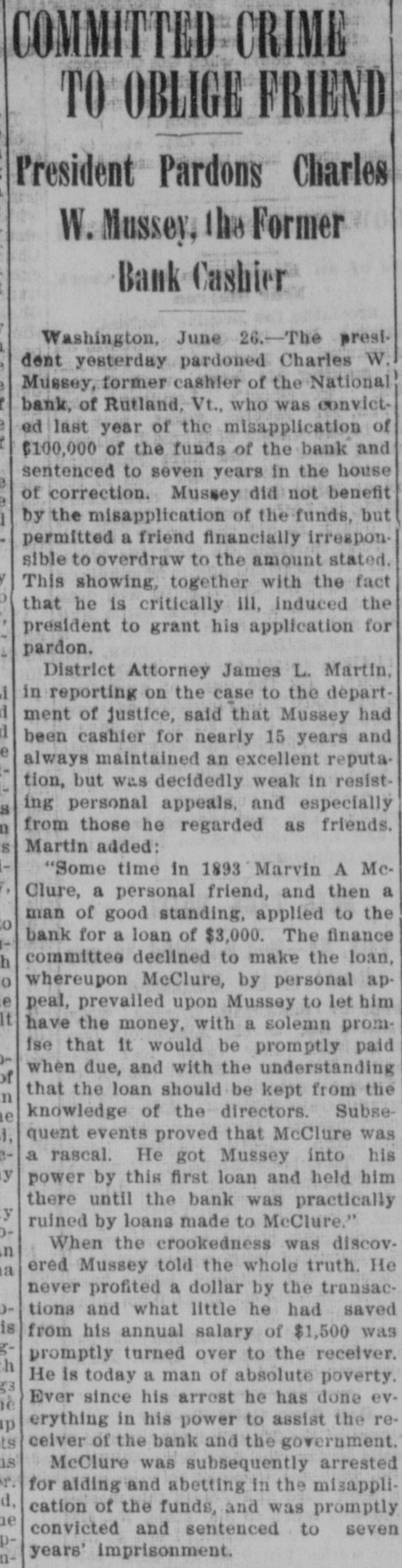
# COMMITTED CRIME # TO OBLIGE FRIEND # President Pardons Charles # W. Mussey, The Former # Bank Cashier Washington, June 26. -The president yesterday pardoned Charles W. Mussey, former cashier of the National bank, of Rutland, Vt., who was convicted last year of the misapplication of $100,000 of the funds of the bank and sentenced to seven years in the house of correction. Mussey did not benefit by the misapplication of the funds, but permitted a friend financially irresponsible to overdraw to the amount stated. This showing, together with the fact that he is critically ill, induced the president to grant his application for pardon. District Attorney James L. Martin, in reporting on the case to the department of justice, said that Mussey had been cashier for nearly 15 years and always maintained an excellent reputation, but was decidedly weak in resisting personal appeals, and especially from those he regarded as friends. Martin added: "Some time in 1893 Marvin A McClure, a personal friend, and then a man of good standing, applied to the bank for a loan of $3,000. The finance committee declined to make the loan, whereupon McClure, by personal appeal, prevailed upon Mussey to let him have the money, with a solemn promise that it would be promptly paid when due, and with the understanding that the loan should be kept from the knowledge of the directors. Subsequent events proved that McClure was a rascal. He got Mussey into his power by this first loan and held him there until the bank was practically ruined by loans made to McClure." When the crookedness was discovered Mussey told the whole truth. He never profited a dollar by the transactions and what little he had saved from his annual salary of $1,500 was promptly turned over to the receiver. He is today a man of absolute poverty. Ever since his arrest he has done everything in his power to assist the receiver of the bank and the government. McClure was subsequently arrested for aiding and abetting in the misapplication of the funds, and was promptly convicted and sentenced to seven years' imprisonment.


Article from Richmond Planet, June 29, 1901

Click image to open full size in new tab

Article Text

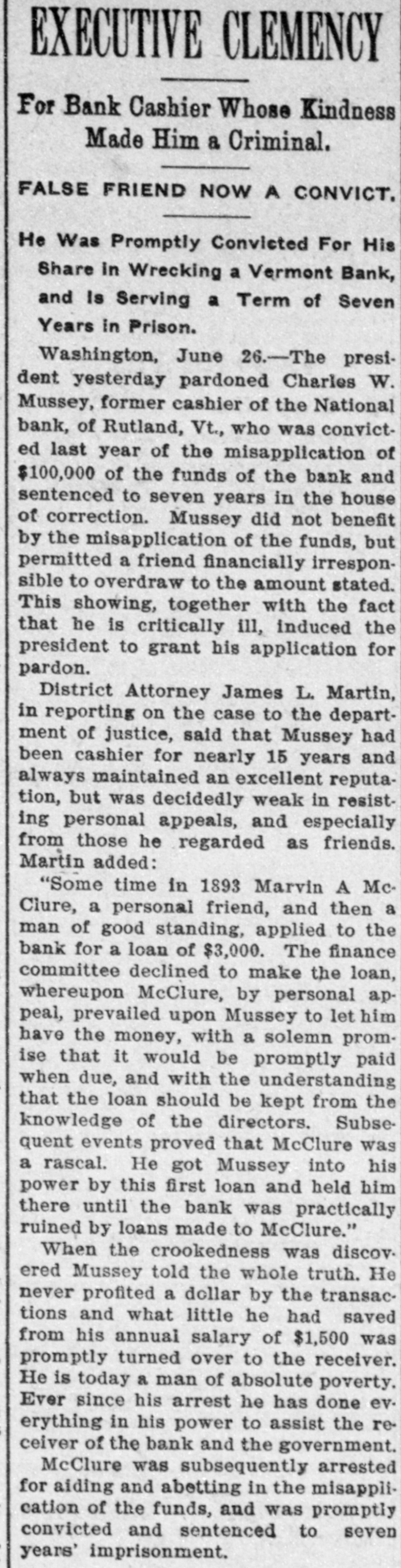
# EXECUTIVE CLEMENCY For Bank Cashier Whose Kindness Made Him a Criminal. FALSE FRIEND NOW A CONVICT. He Was Promptly Convicted For His Share in Wrecking a Vermont Bank, and Is Serving a Term of Seven Years in Prison. Washington, June 26.—The president yesterday pardoned Charles W. Mussey, former cashier of the National bank, of Rutland, Vt., who was convicted last year of the misapplication of $100,000 of the funds of the bank and sentenced to seven years in the house of correction. Mussey did not benefit by the misapplication of the funds, but permitted a friend financially irresponsible to overdraw to the amount stated. This showing, together with the fact that he is critically ill, induced the president to grant his application for pardon. District Attorney James L. Martin, in reporting on the case to the department of justice, said that Mussey had been cashier for nearly 15 years and always maintained an excellent reputation, but was decidedly weak in resisting personal appeals, and especially from those he regarded as friends. Martin added: "Some time in 1893 Marvin A McClure, a personal friend, and then a man of good standing, applied to the bank for a loan of $3,000. The finance committee declined to make the loan, whereupon McClure, by personal appeal, prevailed upon Mussey to let him have the money, with a solemn promise that it would be promptly paid when due, and with the understanding that the loan should be kept from the knowledge of the directors. Subsequent events proved that McClure was a rascal. He got Mussey into his power by this first loan and held him there until the bank was practically ruined by loans made to McClure." When the crookedness was discovered Mussey told the whole truth. He never profited a dollar by the transactions and what little he had saved from his annual salary of $1,500 was promptly turned over to the receiver. He is today a man of absolute poverty. Ever since his arrest he has done everything in his power to assist the receiver of the bank and the government. McClure was subsequently arrested for aiding and abetting in the misapplication of the funds, and was promptly convicted and sentenced to seven years' imprisonment.


Article from St. Johnsbury Caledonian, July 3, 1901

Click image to open full size in new tab

Article Text

VERMONT NEWS. # Ex-Cashier Mussey Pardoned. President McKinley on June 25, par- doned Charles M. Mussey, ex-cashier of the National bank of Rutland, who was convicted last year of the misapplication of $100,000 of the funds of the bank and sentenced to seven years in the house of correction. Application for Mussey's pardon, on the ground of critical ill- health, was made on the 21st and also a fled statement by T. W. Moloney, a special assistant United States attorney engaged for the purpose of assisting in the prosecution of Marvin A. McClure, who it was alleged was the sole bene- ficiary of the funds of the bank which were misapplied, and also affidavits of several physicians testifying to the im- paired health of the petitioner; also a letter from Rev. George W. Phillips, pas- tor of the Congregational church of Rut- land saying that Mussey, up to the time of his detection, had borne a good name. District Attorney James L. Martin, in reporting on the case to the department of justice, said that Mussey had been cashier for nearly 15 years and had al- ways maintained an excellent reputa- tion, but was decidedly weak in resisting personal appeals, especially from those be regarded as friends. Martin added: "Some time in 1893, Marvin A. McClure, a personal friend and then a man of good standing, applied to the bank for a loan of $3000 whereupon McClure, by per- sonal appeal, prevailed upon Mussey to let him have the money, with a solemn promise that it would be promptly paid when due and with the understanding that the loan should be kept from the knowledge of the directors. Subsequent events proved that McClure got Mussey in his power by the first loan, and held him there until the bank was practically ruined by loans made to McClure. When the crookedness was discovered, Mus- sey's manhood asserted itself, and he told the whole truth. He never profited a dollar by the transactions, and what little he had saved from his annual salary of $1500 was promptly turned over to the receiver. He is today a man of absolute poverty. Ever since his arrest he has done everything in his power to assist the receiver of the bank and the government. McClure was sub- sequently arrested for aiding and abet- ting in the misapplication of the funds, and after a sharp trial was promptly convicted and sentenced to seven years' imprisonment. In this trial Mussey ren- dered invaluable services. The district attorney says he has no doubt whatever that Mussey has suffered sufficient pun- ishment. The attorney-general, in passing on the application for pardon, made the following endorsement: "The petition- er has served more than a year of a seven-year sentence for a violation of the national banking laws. The district at- torneys recommend his immediate pardon for the reason that they believe, from the facts developed since his sentence, that he is sufficiently punished and further imprisonment will endanger his life. # A Vermonter in Chicago. Hon. Alson S. Sherman of Chicago has just celebrated his 80th birthday anni- versary at bis palatial home near that city, where surrounded by their children, grandchildren, great-grandchildren he received a large number of leading citi- zens and members of the Methodist church of which he is one of the pillars. Mr. Sherman way born in Barre, and was the grandson of the man who gave Barre its name, after deciding the ques- tion by a fisticuff bout with one of the early settlers. He was born on West hill on the farm now occupied by Frank Nichols and was the man who built the granite work on the second state house at Montpelier. He went to Chicago in 1836, and was elected mayor of that city in 1844. He was the seventh may- or of the great metropolis, and is the oldest man living who filled the executive seat in the windy city. He was once chief of the fire department, and it was he who brought out the noted fire chief, Dennis Swenie. # A Long Lumber Slide. The new slide extending up the moun- tains a distance of some four miles erect- ed by the Battenkill Lumber company of Manchester Depot, is completed and ready for use. In it pulp wood is to be run down the mountain to cars which will stand on a side track leading to it, just put in by the Rutland railroad com- pany. The slide is 24 inches deep, 26 inches wide, and is made out of four- inch spruce plank. There is much inter- est taken in the enterprise, as the slide will lead directly to a car, and it is ex- pected that 25 cars will be loaded every working day. The company now has about 75 men on the mountain cutting pulp wood. John K. Smith of Brattleboro, a man over 80 years old, was overcome by the heat Thursday and died in about three hours. # State Sons of Veterans. The nineteenth annual encampment of the Sons of Veterans of Vermont was held at Essex Junction Thursday and these officers were elected: Commander, C. J. Smith of Huntington; senior vice- commander, Jessie Walker of Walcott; junior vice-commander, G. A. Uttery of Manchester: division committee, E. E. Perry, of Barre, Homer Wood, Cam- bridge, J. C. Shedd, of Stowe; delegate- at-large, to the encampment at Provi- dence, R. I. in September, J. B. Ripley, of Lyndonville; delegate, F. E. Terrill, of Jericho, delegates to choose their own al- ternates. During the year the member- ship has fallen from 680 to 511. The an- nual meeting of the state Ladies' Aid society was held at the same time and place. This order has eight societies and the membership has increased from 129 to 134 during the year. # To Welcome Boston's Visitors. A meeting was held at Montpelier Thursday to arrange for the reception of the Vermont Association of Boston, and

Article from The Colored American, July 6, 1901

Click image to open full size in new tab

Article Text

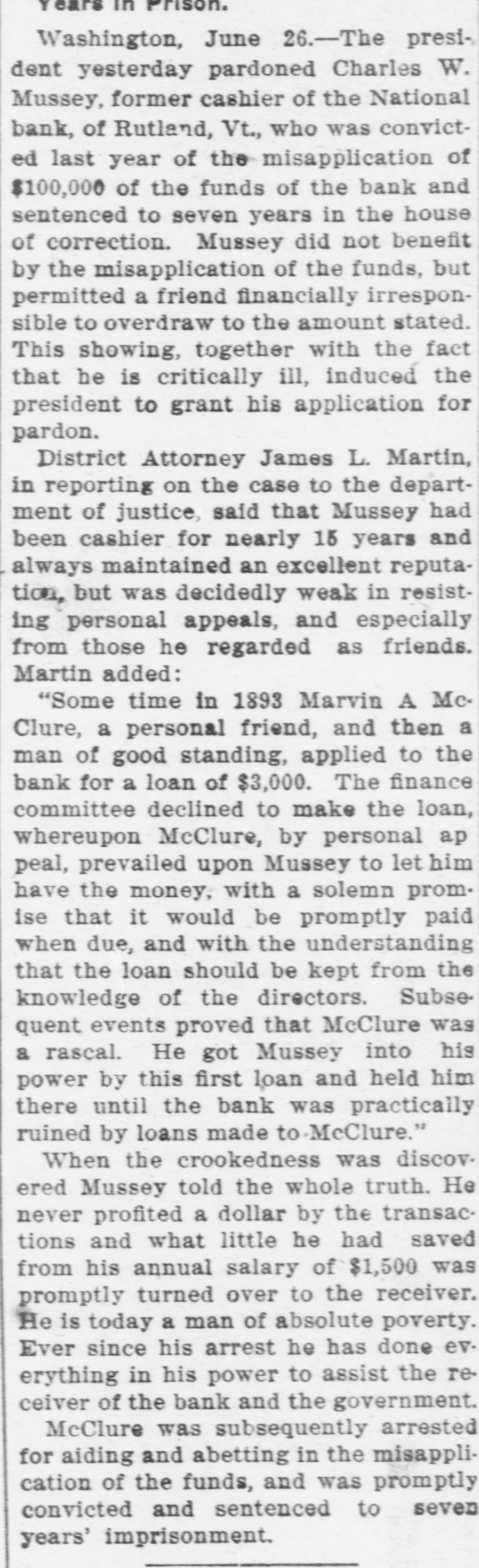
Years in Prison. Washington, June 26.-The president yesterday pardoned Charles W. Mussey, former cashier of the National bank, of Rutland, Vt., who was convicted last year of the misapplication of $100,000 of the funds of the bank and sentenced to seven years in the house of correction. Mussey did not benefit by the misapplication of the funds, but permitted a friend financially irresponsible to overdraw to the amount stated. This showing, together with the fact that he is critically ill, induced the president to grant his application for pardon. District Attorney James L. Martin, in reporting on the case to the department of justice, said that Mussey had been cashier for nearly 15 years and always maintained an excellent reputation, but was decidedly weak in resisting personal appeals, and especially from those he regarded as friends. Martin added: "Some time in 1893 Marvin A Mc. Clure, a personal friend, and then a man of good standing, applied to the bank for a loan of $3,000. The finance committee declined to make the loan, whereupon McClure, by personal ap peal, prevailed upon Mussey to let him have the money, with a solemn promise that it would be promptly paid when due, and with the understanding that the loan should be kept from the knowledge of the directors. Subsequent events proved that McClure was a rascal. He got Mussey into his power by this first loan and held him there until the bank was practically ruined by loans made to-McClure." When the crookedness was discovered Mussey told the whole truth. He never profited a dollar by the transactions and what little he had saved from his annual salary of $1,500 was promptly turned over to the receiver. He is today a man of absolute poverty. Ever since his arrest he has done everything in his power to assist the receiver of the bank and the government. McClure was subsequently arrested for aiding and abetting in the misapplication of the funds, and was promptly convicted and sentenced to seven years' imprisonment.