Article Text
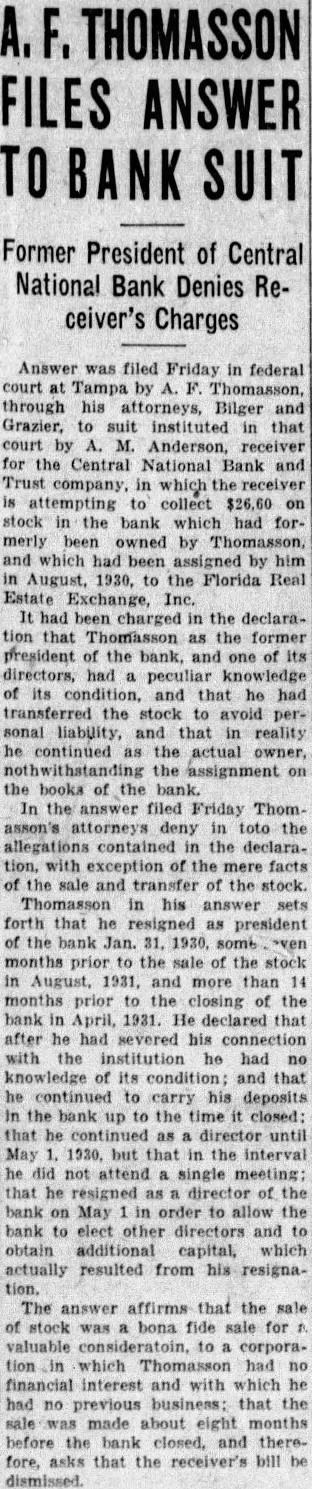
THOMASSON FILES ANSWER TO BANK SUIT Former President of Central National Bank Denies Receiver's Charges Answer was filed Friday in federal court at Tampa by A. F. Thomasson, through his attorneys, Bilger and Grazier, to suit instituted in that court by A. M. Anderson, receiver for the Central National Bank and Trust company. in which the receiver is attempting to collect $26.60 on stock in the bank which had formerly been owned by Thomasson, and which had been assigned by him August, 1930, to the Florida Real Estate Exchange, Inc. It had been charged in the declaration that Thomasson as the former president of the bank, and one of its directors, had a peculiar knowledge of its condition, and that he had transferred the stock to avoid personal liability, and that in reality he continued as the actual owner, nothwithstanding the assignment on the books of the bank. In the answer filed Friday Thomasson's attorneys deny in toto the allegations contained in the declaration, with exception of the mere facts of the sale and transfer of the stock. Thomasson in his answer sets forth that he resigned as president of the bank Jan. 31. 1930. somb en months prior to the sale of the stock in August, 1931, and more than 14 months prior to the closing of the bank in April, 1931. He declared that after he had severed his connection with the institution he had no knowledge of its condition; and that he continued to carry his deposits in the bank up to the time it closed: that he continued as director until May 1. 1930. but that in the interval he did not attend single meeting: that he resigned as director of the bank on May in order to allow the bank to elect other directors and to obtain additional capital, which actually resulted from his resignation. The answer affirms that the sale of stock was a bona fide sale for valuable to a corporation in which Thomasson had no financial interest and with which he had no previous business: that the sale was made about eight months before the bank closed, and therefore, asks that the receiver's bill be dismissed.