Click image to open full size in new tab
Article Text
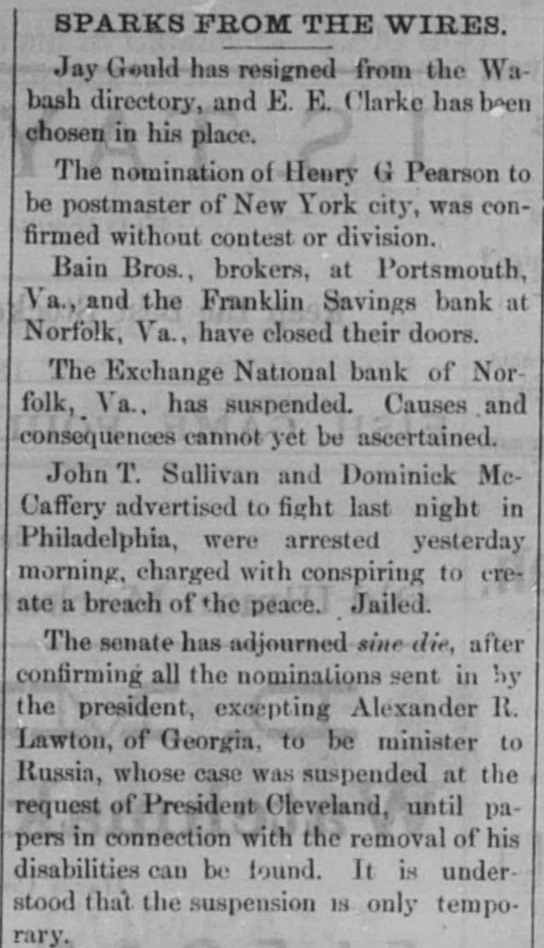
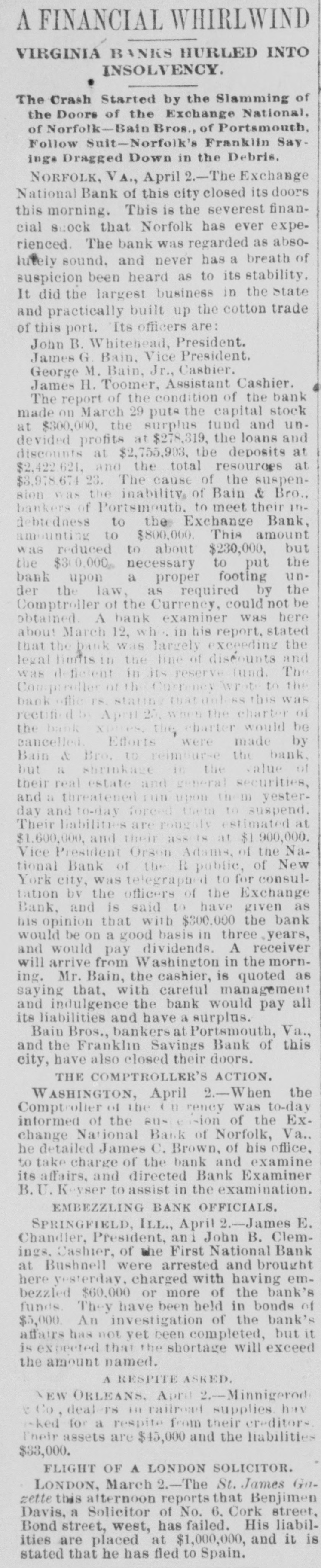
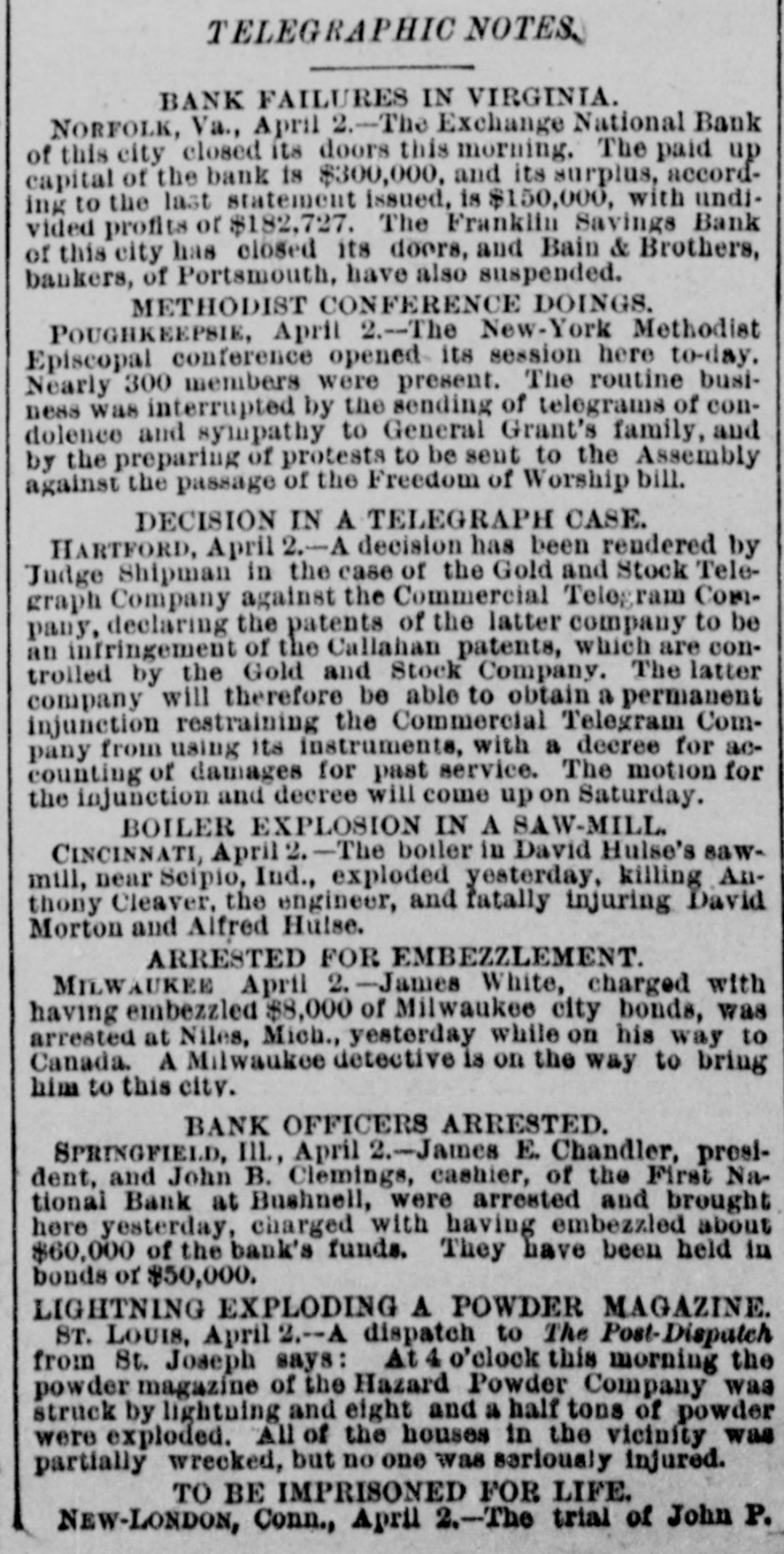
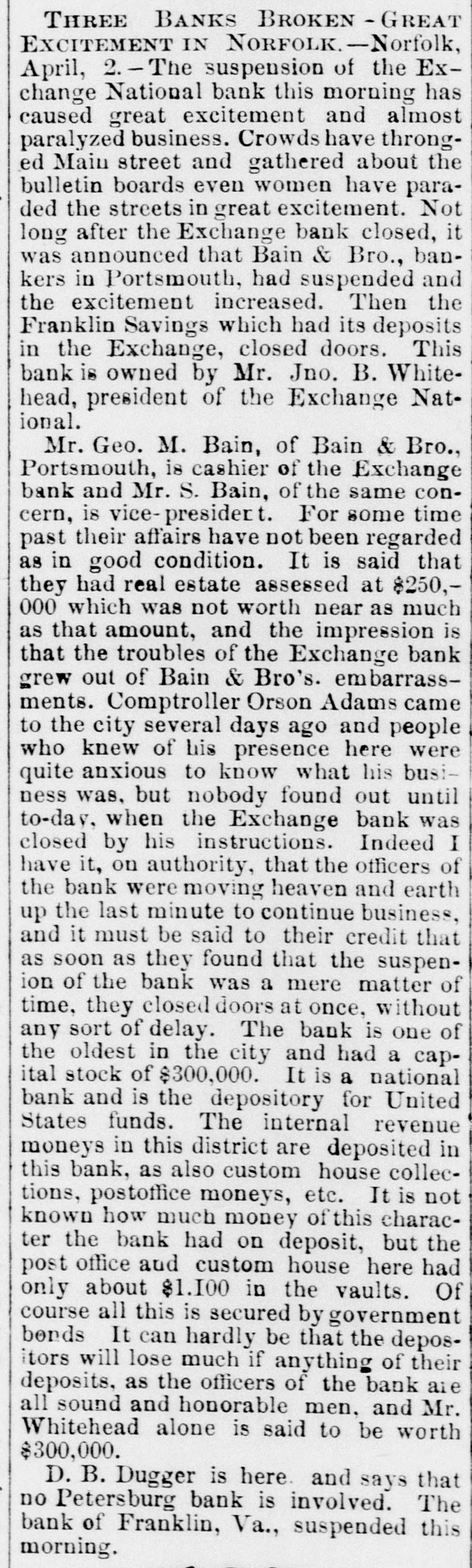
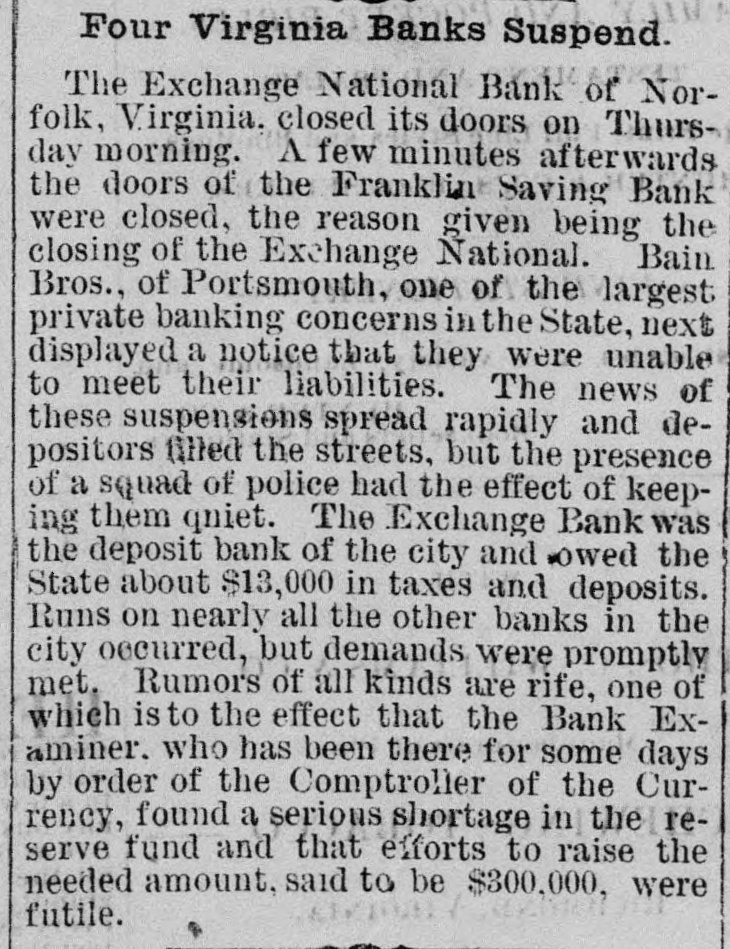
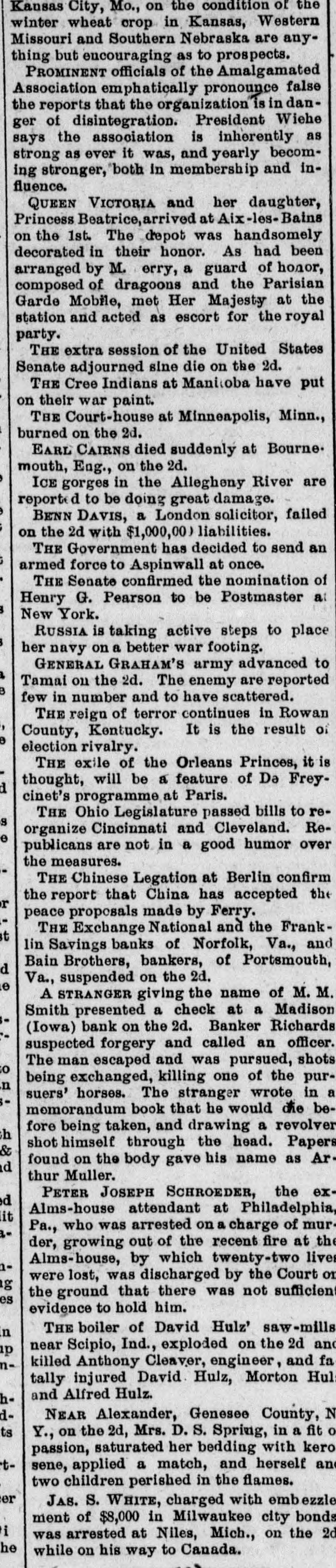
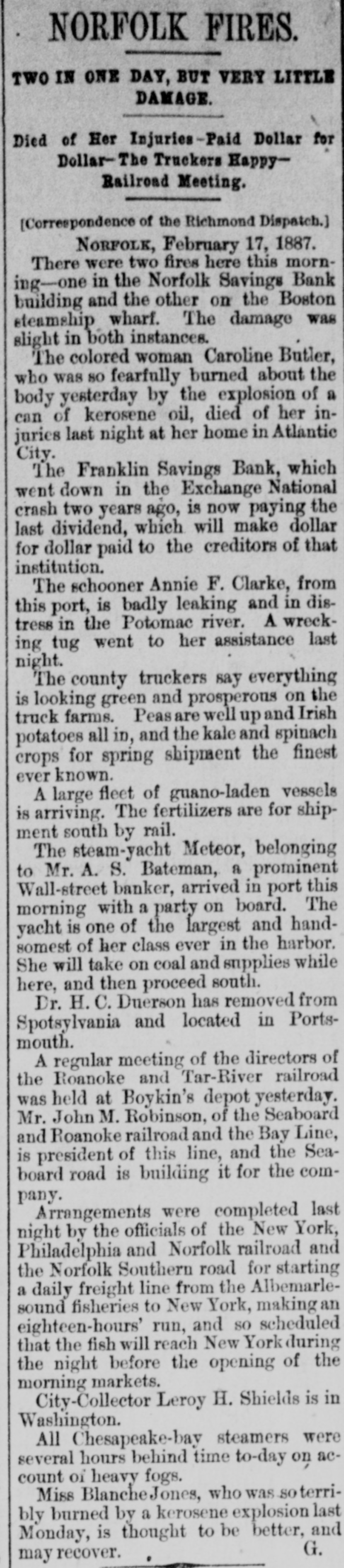
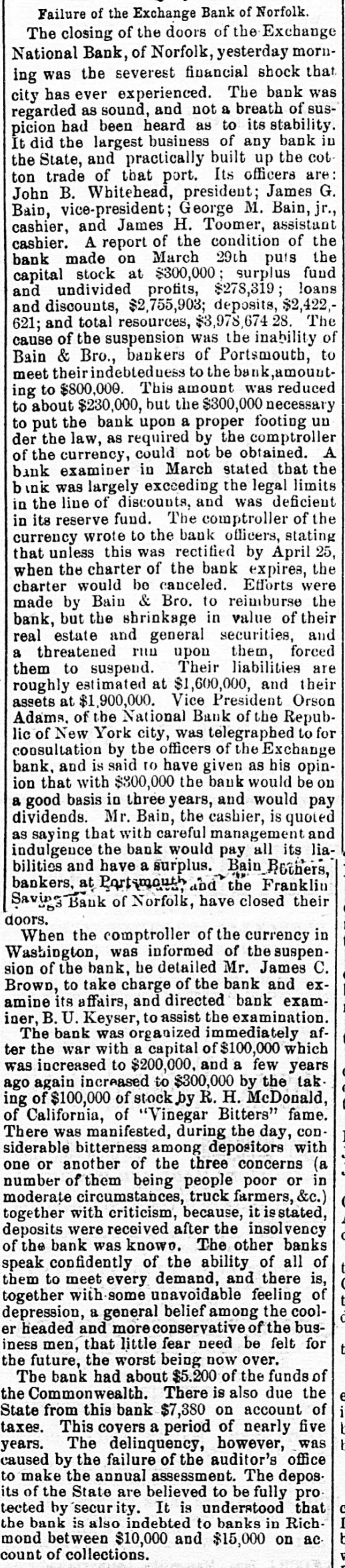
Failure of the Exchange Bank of Norfolk. The closing of the doors of the Exchange National Bank, of Norfolk, yesterday morning was the severest financial shock that city has ever experienced. The bank was regarded as sound, and not a breath of suspicion had been heard as to its stability. It did the largest business of any bank in the State, and practically built up the cotton trade of that port. Its officers are: John B. Whitehead, president; James G. Bain, vice-president; George M. Bain, jr., cashier, and James H. Toomer, assistant cashier. A report of the condition of the bank made on March 29th puts the capital stock at $300,000; surplus fund and undivided profits, $278,319; loans and discounts, $2,755,903; deposits, $2,422,621; and total resources, $3,978,674.28. The cause of the suspension was the inability of Bain & Bro., bankers of Portsmouth, to meet their indebteduess to the bank,amounting to $800,000. This amount was reduced to about $230,000, but the $300,000 necessary to put the bank upon a proper footing un der the law, as required by the comptroller of the currency, could not be obtained. A bank examiner in March stated that the b ink was largely exceeding the legal limits in the line of discounts, and was deficient in its reserve fund. The comptroller of the currency wrote to the bank officers, stating that unless this was rectified by April 25, when the charter of the bank expires, the charter would be canceled. Efforts were made by Bain & Bro. to reimburse the bank, but the shrinkage in value of their real estate and general securities, and a threatened run upon them, forced them to suspend. Their liabilities are roughly estimated at $1,600,000, and their assets at $1,900,000. Vice President Orson Adams. of the National Bank of the Republic of New York city, was telegraphed to for consultation by the officers of the Exchange bank, and is said to have given as his opinion that with $300,000 the bank would be on a good basis in three years, and would pay dividends. Mr. Bain, the cashier, is quoted as saying that with careful management and indulgence the bank would pay all its liabilities and have a surplus. Bain Bothers, bankers, at Partsmouth and the Franklin Saving Bank of Norfolk, have closed their doors. When the comptroller of the currency in Washington, was informed of the suspension of the bank, he detailed Mr. James C. Brown, to take charge of the bank and examine its affairs, and directed bank examiner, B. U. Keyser, to assist the examination. The bank was organized immediately after the war with a capital of $100,000 which was increased to $200,000, and a few years ago again increased to $300,000 by the tak. ing of $100,000 of stock by R. H. McDonald, of California, of "Vinegar Bitters" fame. There was manifested, during the day, considerable bitterness among depositors with one or another of the three concerns (a number of them being people poor or in moderate circumstances, truck farmers, &c.) together with criticism, because, it isstated, deposits were received after the insolvency of the bank was knowo. The other banks speak confidently of the ability of all of them to meet every demand, and there is, together with-some unavoidable feeling of depression, a general belief among the cooler headed and more conservative of the business men, that little fear need be felt for t the future, the worst being now over. The bank had about $5.200 of the funds of the Commonwealth. There is also due the e State from this bank $7,380 on account of i taxes. This covers a period of nearly five t b years. The delinquency, however, was caused by the failure of the auditor's office to make the annual assessment. The depos. its of the State are believed to be fully proo tected by secur ity. It is understood that I the bank is also indebted to banks in Richb mond between $10,000 and $15,000 on ac count of collections.