Click image to open full size in new tab
Article Text
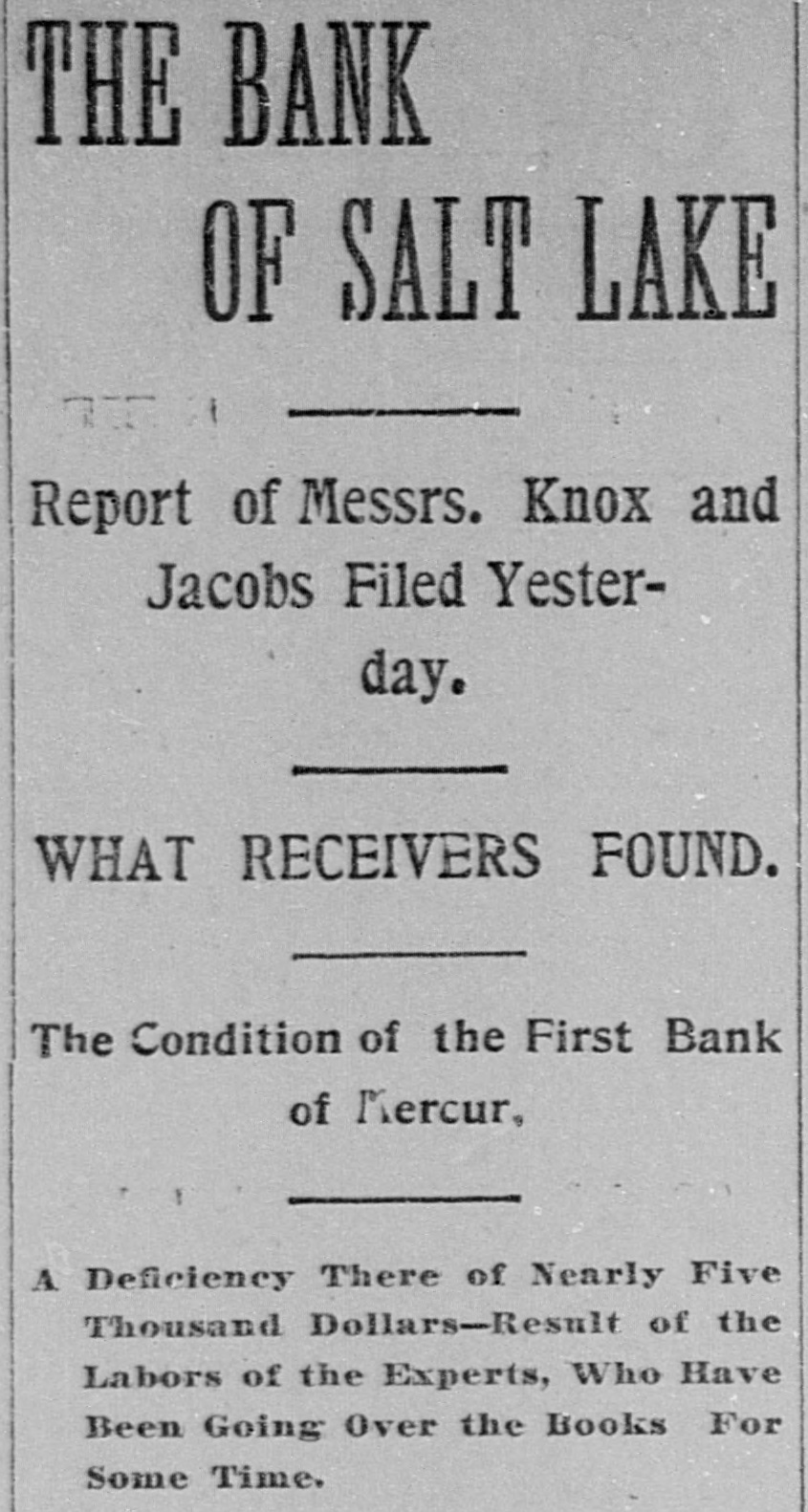
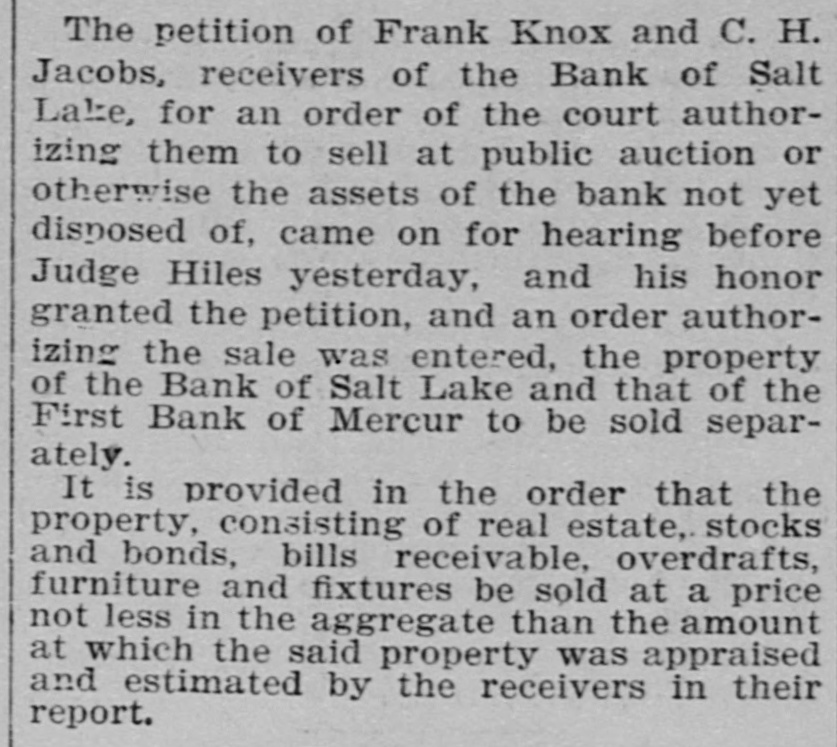
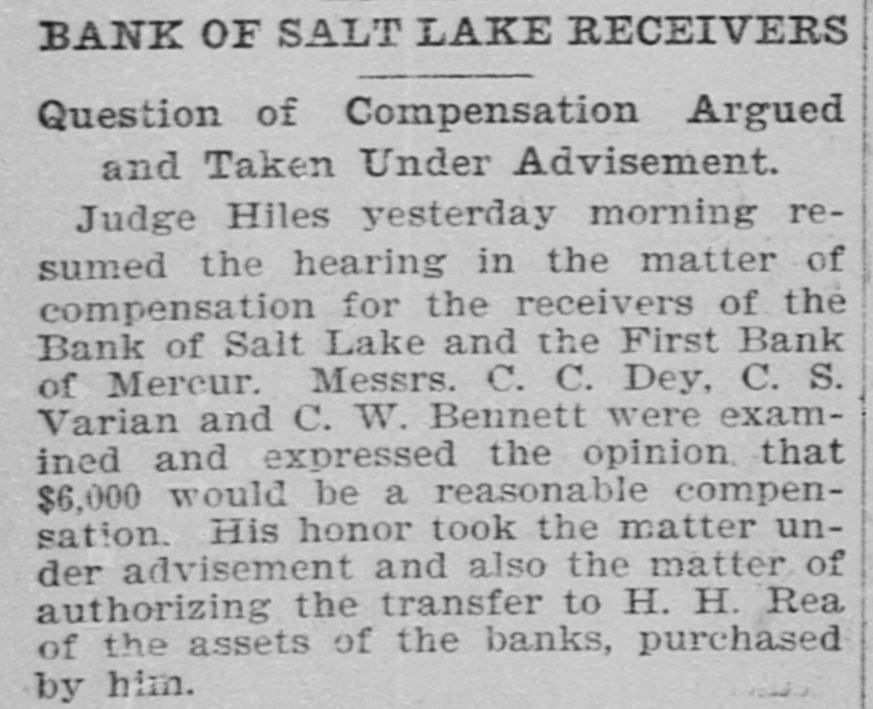
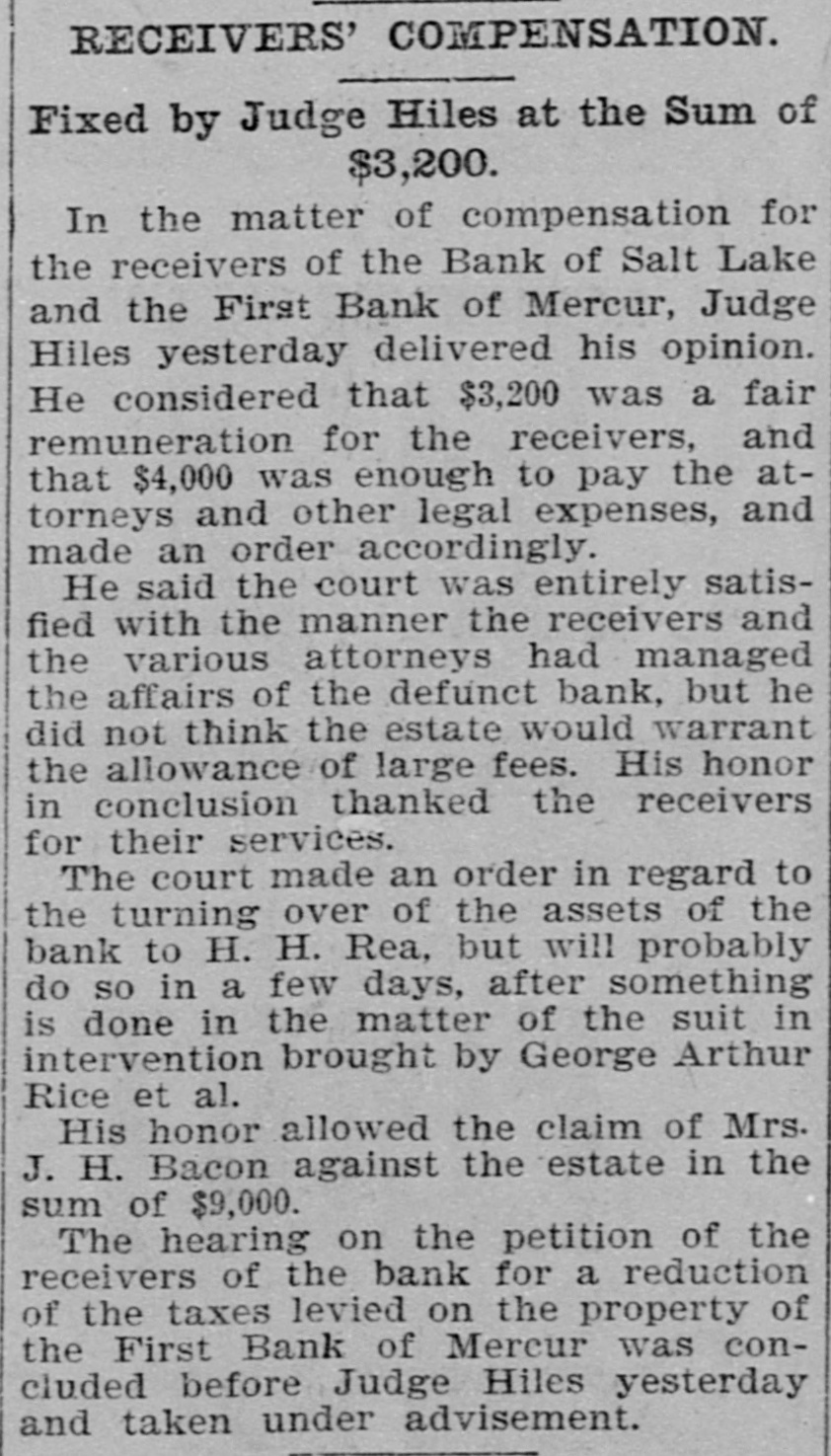
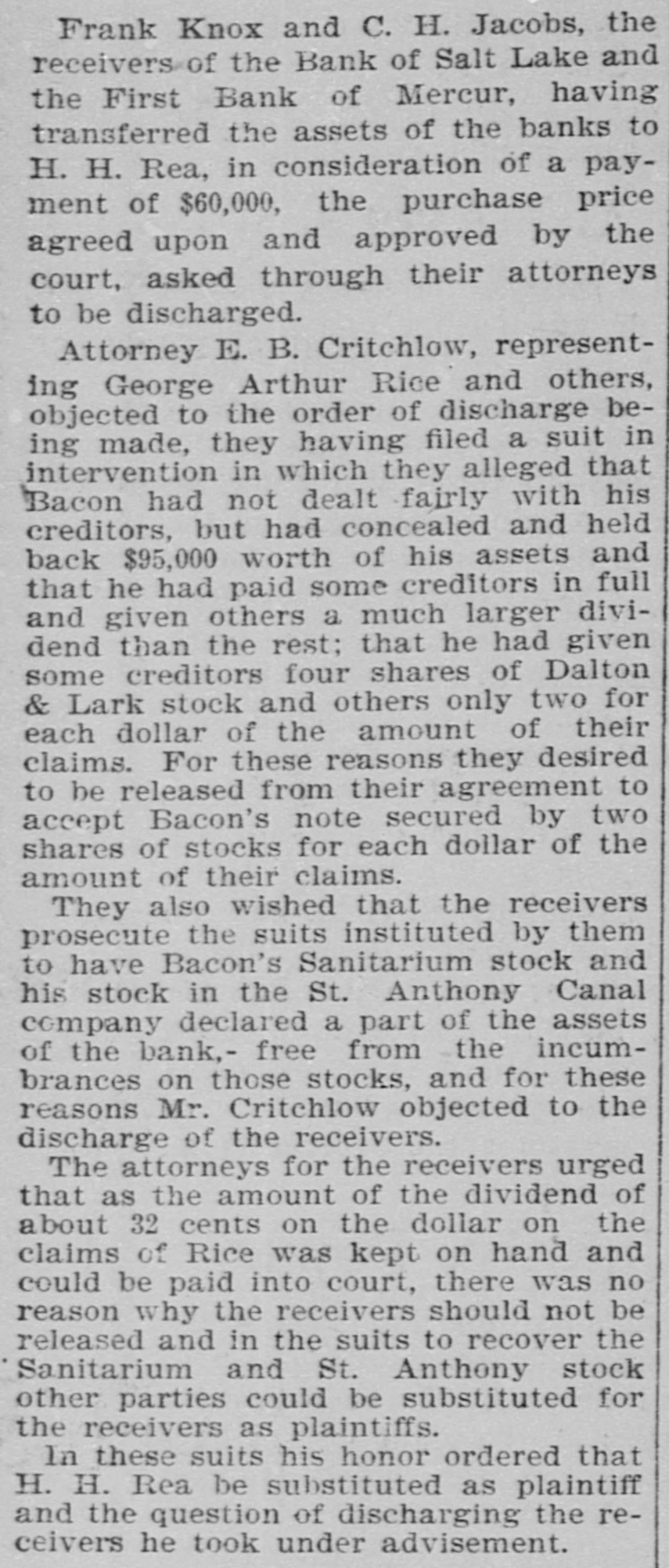
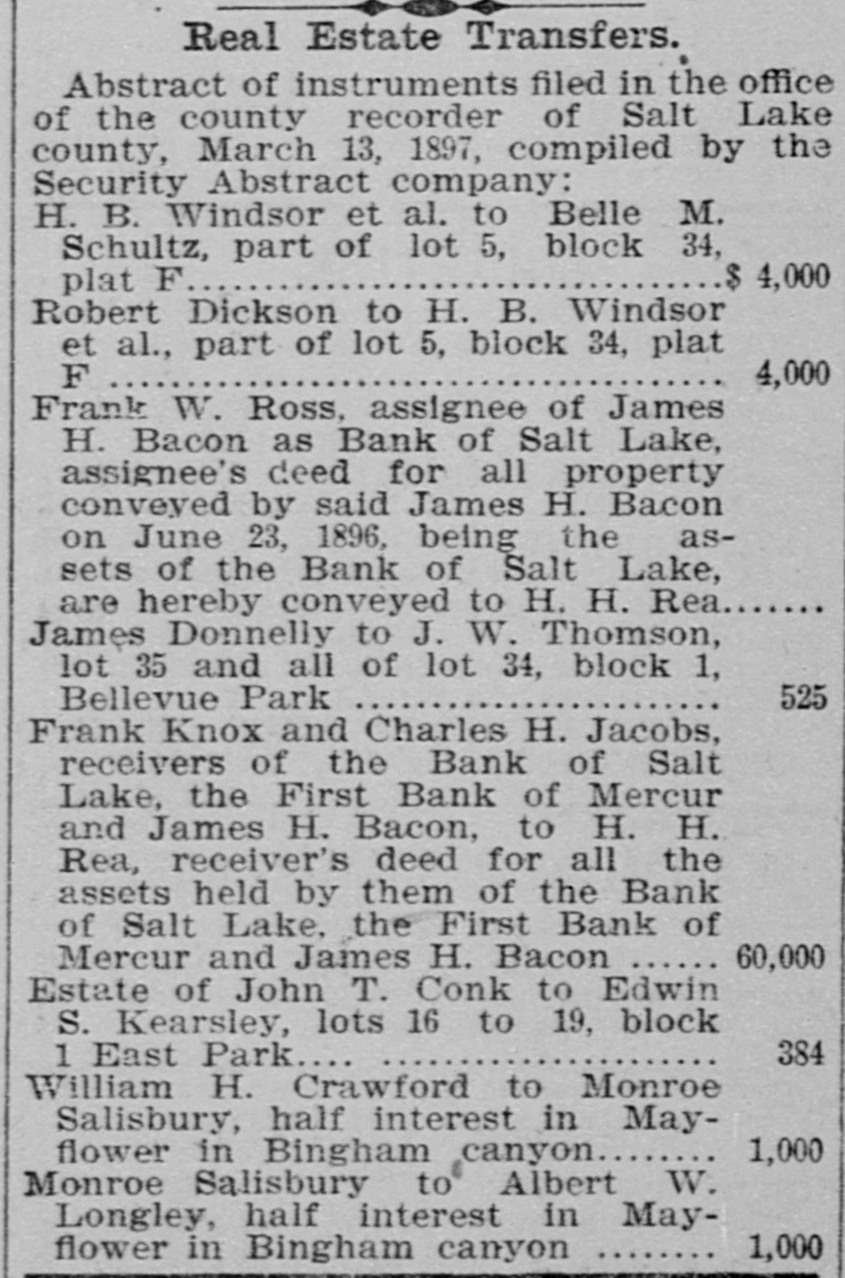
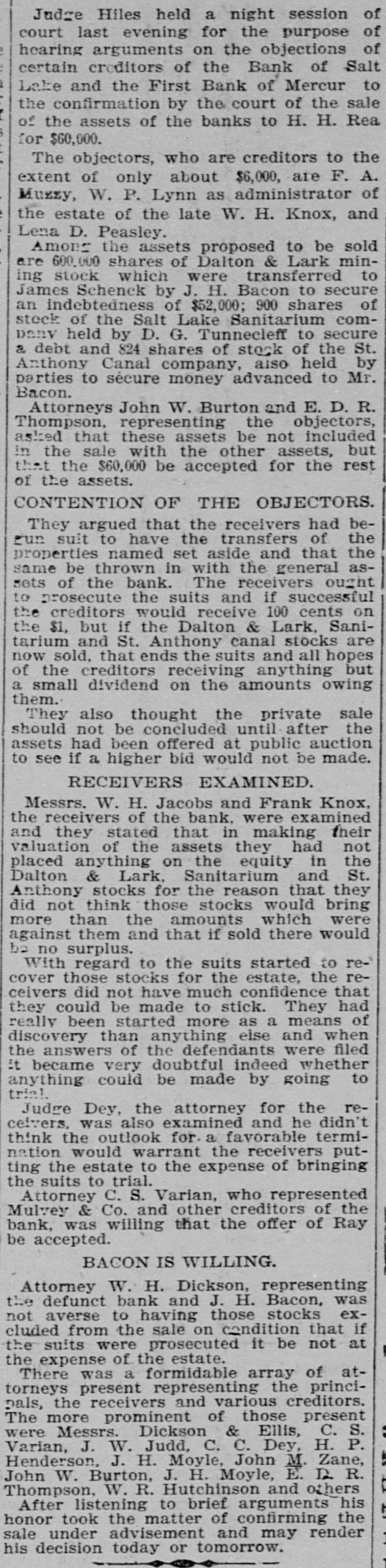
Judge Hiles held a night session of court last evening for the purpose of hearing arguments on the objections of certain creditors of the Bank of Salt Late and the First Bank of Mercur to the confirmation by the court of the sale of the assets of the banks to H. H. Rea for $60,000. The objectors, who are creditors to the extent of only about $6,000, are F. A. Muzzy, W. P. Lynn as administrator of the estate of the late W. H. Knox, and Lena D. Peasley. Amons the assets proposed to be sold are 600.000 shares of Dalton & Lark mining stock which were transferred to James Schenck by J. H. Bacon to secure an indebtedness of $52,000; 900 shares of stock of the Salt Lake Sanitarium comDany held by D. G. Tunnecleff to secure a debt and 824 shares of stock of the St. Anthony Canal company, also held by parties to sécure money advanced to Mr. Bacon. Attorneys John W. Burton and E. D. R. Thompson, representing the objectors, asked that these assets be not included in the sale with the other assets, but that the $60,000 be accepted for the rest of the assets. CONTENTION OF THE OBJECTORS. They argued that the receivers had begun suit to have the transfers of the properties named set aside and that the same be thrown in with the general assets of the bank. The receivers ought to prosecute the suits and if successful the creditors would receive 100 cents on the $1, but if the Dalton & Lark, Sanitarium and St. Anthony canal stocks are now sold, that ends the suits and all hopes of the creditors receiving anything but a small dividend on the amounts owing them. They also thought the private sale should not be concluded until after the assets had been offered at public auction to see if a higher bid would not be made. RECEIVERS EXAMINED. Messrs. W. H. Jacobs and Frank Knox, the receivers of the bank, were examined and they stated that in making their valuation of the assets they had not placed anything on the equity in the Dalton & Lark, Sanitarium and St. Anthony stocks for the reason that they did not think those stocks would bring more than the amounts which were against them and that if sold there would be no surplus. With regard to the suits started to recover those stocks for the estate, the receivers did not have much confidence that they could be made to stick. They had really been started more as a means of discovery than anything else and when the answers of the defendants were filed it became very doubtful indeed whether anything could be made by going to trial. Judge Dey, the attorney for the receivers, was also examined and he didn't think the outlook for. a favorable termination would warrant the receivers putting the estate to the expense of bringing the suits to trial. Attorney C. S. Varian, who represented Mulvey & Co. and other creditors of the bank, was willing that the offer of Ray be accepted. BACON IS WILLING. Attorney W. H. Dickson, representing the defunct bank and J. H. Bacon, was not averse to having those stocks excluded from the sale on condition that if the suits were prosecuted it be not at I the expense of the estate. There was a formidable array of attorneys present representing the principals, the receivers and various creditors. The more prominent of those present were Messrs. Dickson & Ellis, C. S. .. Varian, J. W. Judd, C. C. Dey, H. P. w Henderson, J. H. Moyle, John M. Zane, John W. Burton, J. H. Moyle, E. In R. t Thompson, W. R. Hutchinson and others After listening to brief arguments his b honor took the matter of confirming the sale under advisement and may render 1 his decision today or tomorrow.