6455. German Bank (Louisville, KY)

Bank Information

Episode Type
Run Only
Bank Type
state
Start Date
July 25, 1893
Location
Louisville, Kentucky (38.254, -85.759)

Metadata

Model
gpt-5-mini
Short Digest
b9c75b151bf30b22

Response Measures

None

Description

Multiple contemporaneous newspapers (dated July 25–26, 1893) report a run on the German Bank of Louisville that began about 1:00–1:15 PM after an incident in which a woman demanded $50 without identification. Officials displayed a strong box of cash and offered to pay all claims; the run continued until about 3 PM but the bank did not suspend (other Louisville banks did). OCR variances in cash/securities amounts across articles noted (reports of $500k–$1,000,000 cash and $150k–$1,500,000 securities). No evidence of suspension, receivership, or reopening for the German Bank in these articles.

Events (1)

1. July 25, 1893 Run
Cause
Rumor Or Misinformation
Cause Details
A commotion started when a depositor (an elderly Black woman) loudly demanded $50 without identification; her disturbance attracted a crowd and triggered withdrawals. The disturbance appears to have sparked wider depositor nervousness and a subsequent heavy run.
Measures
Strong box with cash (~$300,000) brought from Louisville Trust Co. and money spread on the counter; cashier publicly announced readiness to pay all claims.
Newspaper Excerpt
At 1 o'clock this afternoon a small run was caused on the German Bank by an old colored woman who had $50 deposited there...the bank officials had a strong box, said to contain $300,000, brought over from the Louisville Trust Company...Subsequently a heavy run started on the German Bank, and continued up to 3 o'clock.
Source
newspapers

Newspaper Articles (7)

Article from The Indianapolis Journal, July 26, 1893

Click image to open full size in new tab

Article Text

The Deposit Bank was not a member of the clearing house. It was organized just before the Baring failure and naturally its career has been a stormy one. It determined to have business; went for it, and in a little while it secured a handsome deposit. Cashier Obligschlager said to a reporter that the bank was abundantly able to meet its liabilities if it could realize on its assets, and he assures the depositors that they will lose nothing. President Davis, of the Fourth National, was seen just after the closing of the doors. "All the information we have to give out at this time," he said, "is that no one will lose a mili by our suspension." President Lindenberger, of the Merchants' National, said: "The bank is abundantly solvent and there 18 no sort of doubt that the depositors will be paid in full. It is my judg. ment, from a calm view of the prospect as now presented, that the stockholders will receive the face value of their shares," The Merchants' National Bank, of Louis ville, was organized as a national bank on July 5, 1874, succeeding the Merchants' Bank of Kentucky, which had been operating under a charter from the State since Sept. 1, 1860. The Fourth National was organized in 1883. Shortly after the assign. ment of his bank President Moses Sch wartz filed an individual assignment in the county clerk's office to the same assignee, the Germania Safety Vault and Trust Company. All his personal assets are given over into the hands of the assignee. A heavy run started on the German Bank this afternoon and continued up to 3 o'clock. The bank has over a half-million in cash and $150,000 worth of securities which can be turned into money at a moment's notice. Several of the banks kept open until 6 o'clock. No meeting of the clearing house has been called to consider the situation. The Sweetwood Distillery Company also made an assignment by its president, Moses Schwartz. at 12:45 o'clock this afternoon to the Germania Safety Vault and Trust ComDany. Mr. Sch wartz could not say what the liabilities amounted to, and felt too bad to talk about the matter. Jake Schwartz, the liquor dealer. announced to-day that he had suspended. He owes $70,000. three-quartere of which. he says, is secured. and with time he claims he can pay off the rest and ha 70 something for himself. He is a brother of Moses Schwartz, president of the assigned Louisville Deposit Bank.
Article from The Times, July 26, 1893

Click image to open full size in new tab

Article Text

Bank. Milwaukee people had become imbued with the idea that this bankthe old Mitchell Bank-was the Gibraltar of finance; that they could not credit the report that it had closed. There was general bellef that when all other banking institutions have disappeared from the face of the earth, that the bank which Alex. Mitchel! founded would continue to do business at the corner of East Water and Michigan streets, and it was this firm faith in the bank's stability that made the shock to public confidence so great. A few minutes after 10 o'clock the news that the bank had not opened its doors began to circulate on the streets, and immediately a rush began in the direction of the Mitchell building. People would not believe what others told them, but insisted on crowding up the marble steps and reading the notice of suspension for themselves. The story of the failure is one so often told now-a-days, steady and long-continued drain of deposits and inability to promptly realize cash upon collections. The bank is solvent and wealthy. TOLEDO, O., July 25.-The Farmers' National Bank of Findlay, O., closed its doors at noon to-day. No statement has been given out as yet. No excitement prevails, and the other three banks in the city are prepared for any run that may follow. INDIANAPOLIS, IND., July 25.-The Indianapolis National Bank suspended this mornig. The failure is for $1,200,000. For some days rumors were current that the bank was in trouble, and these rumors had the effect of starting a quiet run upon it, which, though quiet, depleted the bank's funds, and finally made necessary the action of to-day. LOUISVILLE, KY, July 25.-The Merchants' National Bank suspended payment this morning. INDIANAPOLIS, IND., July 25.-The Bank of Commerce did not open its doors this morning. WASHINGTON D. C., July 25.-Examiner McDonald has been directed to take charge of the falled First National Bank of Orlando, Fla. MILWAUKEE, WIS., July 25.-Late this afternoon the J. Obermann Brewing Company made an assignment. H. P. Obermann is the assignee, and his bond is $1,200,000. Foolish Itnn on the German Bank. LOUISVILLE, KY July 25.-At 1 o'clock this evening a small run was caused on the German Bank by an old colored woman, who had fifty dollars deposited there. She did not have the certificate with her, and loudly demanded that she be giveen her money without identification. The noise she made attracted attention. and in a few moments a hundred people were about the bank. The officials had a strong box, said to contain $300,000, brought over from the Louisville Trust Company. The money was spread out on the counter, and the cashier announced that he was ready to pay off any and all claims. A few of the depositors drew their money, but the others were speedily satisfied that the German Bank was in no danger, and left. Subsequently a heavy run started on the German Bank, and continued up to 3 o'clock. The bank had over a million in cash and $1,500,000 worth of securities, which can be turned into money at a moment's notice, Several of the banks kept open until 6 o'clock. Business Emparrasement. TOLEDO, O., July 25.-G. B. Hodgeman Manufacturing Company, one of the largest concerns in Produsky, went into the hands of receivers this morning. ST. LOUIS, MO., July 25.-Ripley & Bronson, iron merchants, No. 800 north Second street, made an assignment for the benefit of their creditors this morning. Liabilities, $150,000. About equal


Article from Richmond Dispatch, July 26, 1893

Click image to open full size in new tab

Article Text

Warm Wirelets. The little practice-ship Bancroft was finally accepted yesterday by the naval authorities. Examiner McDonald has been directed to take charge of the failed First National Bank, Orlando, Fla. The business portion of Hollow Rock, Tenn. was destroyed by fire Tuesday night. Loss, $40,009, with insurance small. A. J. Beall, a letter-carrier, was arrested in Washington yesterday for rifling the mails, having been caught through a decoy letter. Four explosions shattered the Ablon dynamite factory in Bonfleur. near Havre, France, yesterday. Nine men were killed and twenty severely wounded. France, Italy. Switzerland, Belgium, and Greece have agreed to exclude the twoand-a-half-franc silver piece from the international circulation of the Latin Union. Maggie Taylor. Lulu Johnson, Marian Smith, and Nellie Patrick, all young women, were drowned near Patrick's Landing, on the Wicomico river, Md., yes. terday by the capsizing of a sail-boat. The steamer Oceanic at San Francisco brings news from Honolulu of the appointment of William D. Alexander as a special commissioner to Washington to assist in the negotiations for annexation. There was a run on the German Bank, Louisville, Ky., yesterday afternoon. The bank has over halt a million dollars in cash and $1,500,000 worth of securities which can be turned into money at a moment's notice. The opinion prevails in official circles at Honolulu that after receiving Minister Blount's report President Cieveland will resubmit President Harrison's treaty of annexation, or some modification thereof to the Senate. The court of inquiry which has been in session at the Brooklyn navy-yard investi. gating the collision between the United States ship Monongahela and a Norwegian bark in the harbor of Madeira has exone. rated Commander Lyons, late captain of the war-ship. Secretary Herbert, of the Navy Depart. ment, arrived at the Kittery navy-yard, Portsmouth, N. H., yesterday, in the dispatch-boat Dolphin, and after being introduced to the officers of the yard and the United States vessels at the yard made an inspection of the yard. The New York World of to-day says: The Erie Railroad Company has gone into the hands of receivers. Judge Lacombe, of the United States Circuit Court, named John King and J. G. McCullough. They gave $500,000 bonds, with D. O. Millsand J. L. Welch, of Philadelphia, as sureties. As a result of counter-offers the Federal Treasury Department purchased Tuesday 107,500 ounces of silver at .6900 cents per ounce, including the 50.000 ounces announced in Tuesday's dispatches. The price of silver in London vesterday showed a slight advance over Tuesday's prieg. The race for th Steward's Cup at Good. wood vesterday was won by Mr. Henry Milnor's 2-year-old chestnut filly Medora, by Bendor. out of Ageneta, M. E. Blanc's 3-year-sld chestnut colt Marly, by Energy, out of Modest Martha, being second, and Mr. F. Hobson's 6-year-old bay horse Que. bec. by Canadian, out of Vesper, third. Bank managers at Hamilton. Out., re. port that a large amount of money has been received from American citizens during the part few days to be deposited in banks there, a deposit of $45,000 having been received yesterday from a woman living in Buffalo, N. Y., who had withdrawn the amount from a bank in that city.


Article from The Morning News, July 26, 1893

Click image to open full size in new tab

Article Text

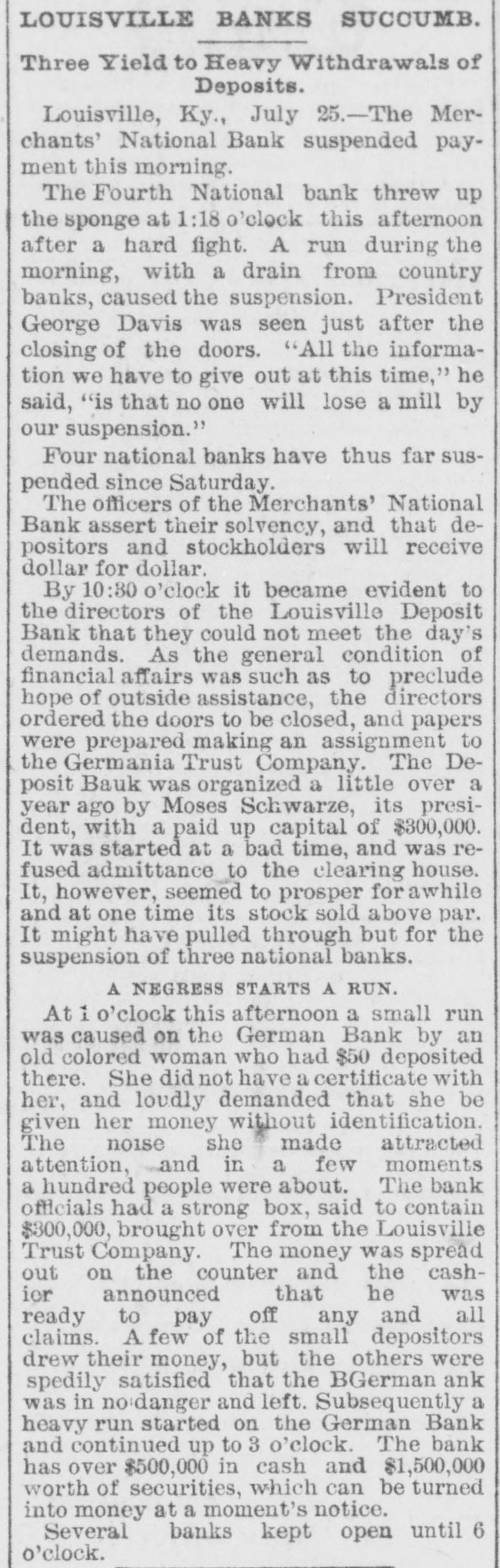
LOUISVILLE BANKS SUCCUMB. Three Yield to Heavy Withdrawals of Deposits. Louisville, Ky., July 25.-The Merchants' National Bank suspended payment this morning. The Fourth National bank threw up the sponge at 1:18 o'clock this afternoon after a hard fight. A run during the morning, with a drain from country banks, caused the suspension. President George Davis was seen just after the closing of the doors. "All the information we have to give out at this time," he said, "is that no one will lose a mill by our suspension." Four national banks have thus far suspended since Saturday. The officers of the Merchants' National Bank assert their solvency, and that depositors and stockholders will receive dollar for dollar. By 10:30 o'clock it became evident to the directors of the Louisville Deposit Bank that they could not meet the day's demands. As the general condition of financial affairs was such as to preclude hope of outside assistance, the directors ordered the doors to be closed, and papers were prepared making an assignment to the Germania Trust Company. The Deposit Bauk was organized a little over a year ago by Moses Schwarze, its president, with a paid up capital of $300,000. It was started at a bad time, and was refused admittance to the clearing house. It, however, seemed to prosper for awhile and at one time its stock sold above par. It might have pulled through but for the suspension of three national banks. A NEGRESS STARTS A RUN. At 1 o'clock this afternoon a small run was caused on the German Bank by an old colored woman who had $50 deposited there. She did not have a certificate with her, and lovdly demanded that she be given her money without identification. The noise she made attracted attention, and in a few moments a hundred people were about. The bank officials had a strong box, said to contain $300,000, brought over from the Louisville Trust Company. The money was spread out on the counter and the cashior announced that he was ready to pay off any and all claims. A few of the small depositors drew their money, but the others were spedily satisfied that the BGerman ank was in no:danger and left. Subsequently a heavy run started on the German Bank and continued up to 3 o'clock. The bank has over $500,000 in cash and $1,500,000 worth of securities, which can be turned into money at a moment's notice. Several banks kept open until 6 o'clock.


Article from Richmond Dispatch, July 27, 1893

Click image to open full size in new tab

Article Text

# The Safety Fund and "Runs." It is the want of confidence in the banks that causes the "runs' upon them. Nothing else. Under the existing national-banking system no note-hoider ever engages in a "run" on a national bank. He never even looks into his pocket-book to see whether he has a note on a broken bank or not. The government stands at the back of every bank note and inspires confidence amongst all classes and conditions of men. It was a want of confidence in the safety of deposits that broke we might say nearly every bank which has failed during the prevailing monetary troubles. Read the story of one bank. On Tuesday the Indianapolis Bank of Commerce did not open its doors, Why not? Read: "For some days rumors were current that the bank was in trouble and these rumors had the effect of starting a quiet run upon it, which, though quiet, depleted the bank's funds and finally made necssary the suspension spoken ot." There was nothing in the world the matter with the Indianapolis Bank of Commerce. It had lent its deposits to its customers for sixty or ninety days and of course could not deliver them" on demand." It was confidence that was lacking; or, in other words, it was a safety fund, or a redemption fund, or government backing that the bank needed. That bank has lost by this suspension more than it would have had to pay as a guarantee fund in twenty years. Now, read what the Controller of the Currency says: "The five banks which have been permitted to resume were forced to suspend because of runs. All were in a healthy condition and well managed." "I am convinced that had notice of runs been given the banks would have been able to meet the demands. The trouble grew out of a scare. The banks were unprepared for the sudden assault and suspended to protect themselves. Many banks have been caught up in this way, and as soon as confidence is restored they will be prepared to reopen. The banks are sound and should be supported. If the public continues its confidence in institutions which have been ably and conservatively managed for years there will be fewer failures." Yes, "confidence" is what is needed. How is it to be secured? We answer by establishing "a safety fund" to give to depositors the confidence, which note-holders already possess. The best banks and the worst bauks are in the same boat. The bad ones are go managed as to destroy public confidence in them; and the moment the people lose confidence in the bad banks and seek in vain to withdraw their deposits from them, the depositors in the best banks begin to suspect the solvency of these banks, and then begins a "ran." "The devil take the hindmost," is the motto of the wild, reckless, uninformed depositors. There is no more sense nor reason in a crowd of angry depositors trying in vain to get their deposits out of a bank than there is in a mob of any other sort collected for any other purpose. There is no use in arguing with the economical, would-be thrifty sons of toil, or with their wives, sisters, daughters, or mothers. We cannot believe that any bank would be so blind to its own interests as to be willing to risk facing at any time a mob of angry depositors rather than to pay annually the small sum of money necessary for each bank to pay in order to make a howling mob of depositors an unknown thing in the future. The telegraph tells us of a run on Tuesday upon the German Bank of Louisville; also that American citizens are depositing in Canadian banks. Also, that two Indianapolis banks suspended. Also, a Milwaukee bank. Also, other western banks. And why? Because the people lacked confidence in the banks, and did not know what to do in order to get back the money they had deposited in these now suspended banks.


Article from The Indiana State Sentinel, August 2, 1893

Click image to open full size in new tab

Article Text

claims. A few of the small depositors drew their money, but the others were speedily satisfied that the German bank was not in danger and left without drawing their money. Lieut. Jacobs then escorted the box back to the vault of the Louisville trust company, and the run resulted in about $500 being withdrawn. Subsequently a heavy run started on the German bank and continued up to 3 o'clock. The bank has over $500,000 in cash, and $150,000 worth of securities, which can be turned into money at a moment's notice. Several of the banks kept open until 6 o'clock. No meeting of the clearing house has been called to consider the situation.


Article from The Indiana State Sentinel, August 2, 1893

Click image to open full size in new tab

Article Text

THREE FAIL AT LOUISVILLE. Merchants' National, Louisville Deposit and Fourth National. LOUISVILLE, July 25.-This will prove a memorable day in the financial history of Louisville. At 10 o'clock this morning the Merchants' national bank posted a notice of suspension, and half an hour later the failure of the Louisville deposit bank was announced. By this time half a dozen banks in the city were being run by depositors, mostly small ones. They all stood the pressure except one, the Fourth national, which closed its doors in the Board of Trade building at 10 o'clock. At that hour the excitement was running high, and every one of a half dozen banks was crowded with depositors, who were in line awaiting their turn with the paying teller. The first failure of the present crisis was that of the Kentucky national bank Saturday. Then came the Louisville city national Monday, after the intervention of a Sunday holiday, and the Merchants' national, the Louisville deposit and the Fourth national today The failure of the Merchants' national was caused by the withdrawals of country banks and country depositors. The Louisville deposit was the only bank in the city not a member of the Clearing house association and in its time of need none of the other banks would give it any assistance whatever The suspension of the Fourth national was a result of the panic. There has been a steady pulling out of deposits. This changed into a run after the suspension of the Kentucky national last Saturday, and the run continued Monday and Tuesday and until all the funds were exhausted today. None of the failures are considered bad ones. Depositors in the two national banks will be paid in full, and the loss to stockholders will not be more than 60 per cent. in either case. The Merchants' national bank is capitalized at $500,000, and J. H. Lindenberger is president. The Fourth national has a capital of $300,000, a surplus of $35,000. George Davis is president. The Louisville deposit bank has a capital of $300,000 and a surplus of $16,128. Moses Schwartz is president. The Deposit bank was not a member of the clearing house. It was organized just before the Baring failure, and naturally its career has been a stormy one. It determined to have business; went for it, and in a little while it secured a handsome deposit. Cashier Ohligschlager said to a Post reporter that the bank was abundantly able to meet its liabilities if it could realize on its assets, and he assures the depositors that they will lose nothing. The Banks Solvent. President Davis of the Fourth national was seen just after the closing of the doors. "All the information we have to give out at this time." he said, "is that no one will lose a mill by our suspension." President Lindenberger of the Merchants' national said: "The bank is abundantly solvent, and there is no sort of doubt that the depositors will be paid in full. It is my judgment, from a calm view of the prospect as now presented. that the stockholders will receive the face value of their shares. Had the bank gone on without having to close the realization would have been greater, but even with the disadvantages under which we are now laboring I do not think they will lose anything." The Merchants' national bank of Louisville was organized as a national bank on July 5, 1874, succeeding the Merchants' bank of Kentucky, which had been operating under a charter from the state since Sept. 1, 1860. The Fourth national was organized in 1883. Shortly after the assignment of his bank. President Moses Schwartz filed an individual assignment in the county clerk's office to the same assignee, the Germania safety vault and trust company. All his personal assets are given over into the hands of the assignee. The Sweetwood distillery company also made an assignment by its president, Moses Schwartz, at 12:45 o'clock this afternoon, to the Germania safety vault and trust company. Mr. Schwartz could not say what the liabilities amounted to, and felt too bad to talk about the matter. Jake Schwartz, the liquor dealer, announced today that he had suspended. He owes $70,000, three-fourths of which he says is secured, and with time he claims he can pay off the rest and have something for himself. Lately he did business at Third and Main. He is a brother of Moses Schwartz, president of the assigned Louisville deposit bank. At 1:15 o'clock this afternoon a small run was caused on the German bank by an old colored woman, who had $50 deposited there. She did not have the certificate with her and demanded that she be given her money without identification. The noise she made attracted attention, and in a few moments a hundred people were about. The bank officials sent for Police Lieut. Jacobs and had a strong box, said to contain $300,000, brought over from the Louisville trust company. The money was spread out on the counter and the cashier announced that he was ready to pay off any and all