Bank of Olin (Olin, IA)

Episode Information

Episode UID
2124621691260
Episode Type
Suspension โ†’ Closure
Bank Type
private
Bank ID
212462169 hash
Start Date
December 14, 1904
Location
Olin, Iowa (41.998, -91.142)

Metadata

Model
gpt-5-mini (chosen from majority vote of a three-model LLM ensemble)
Short Digest
8391a9fcf54a8099

Response Measures

None

Description

Owner E. E. Snyder later indicted for fraudulent banking and embezzlement; bank made an assignment in Dec 1904.

Events (2)

1. December 14, 1904 Receivership
Newspaper Excerpt
The crash came in December, 1904, when Snyder...closed up the bank, making an assignment in favor of L. M. Carpenter; receiver has been able to realize only about $30,000.
Source
newspapers
2. December 14, 1904 Suspension
Cause
Bank Specific Adverse Info
Cause Details
Bank made an assignment due to bad loans, speculation, and alleged fraudulent handling of funds.
Newspaper Excerpt
The Bank of Olin, owned by E. E. Snyder, assigned today.
Source
newspapers

Newspaper Articles (4)

Article from The Cairo Bulletin, December 15, 1904

Click image to open full size in new tab

Article Text

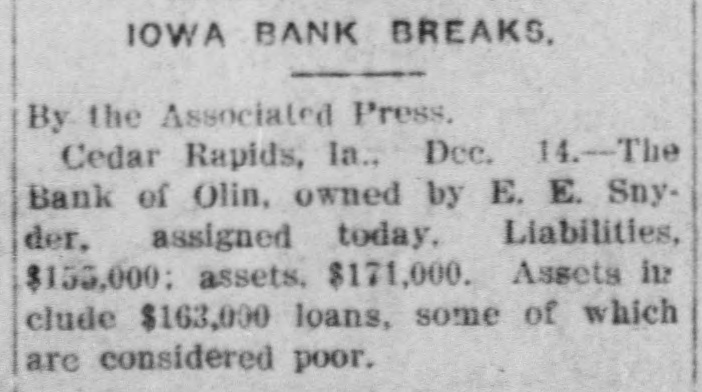
IOWA BANK BREAKS. By the Associated Press, Cedar Rapids, la., Dec. 14.--The Bank of Olin, owned by E. E. Snyder, assigned today. Liabilities, $155,000; assets, $171,000. Assets in clude $163,000 loans, some of which are considered poor.

Article from Vilas County News, December 19, 1904

Click image to open full size in new tab

Article Text

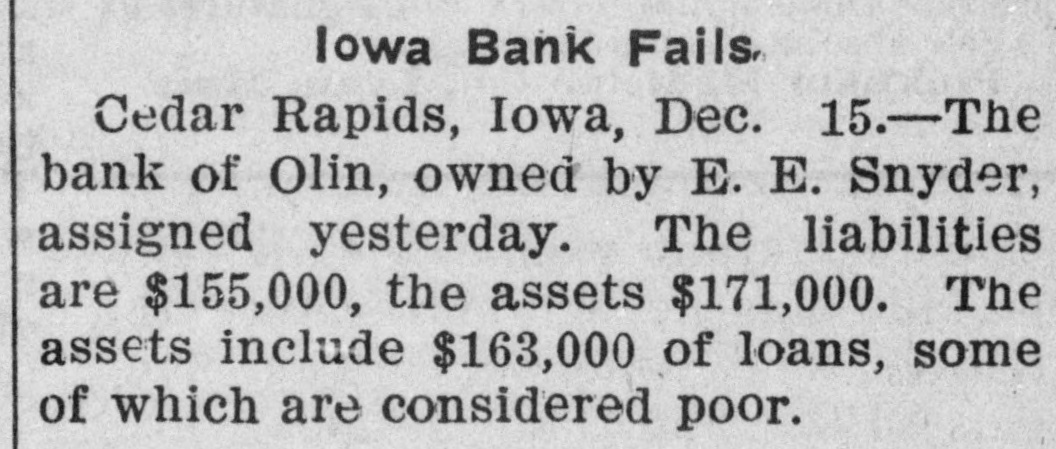
Iowa Bank Fails Cedar Rapids, Iowa, Dec. 15.-The bank of Olin, owned by E. E. Snyder, assigned yesterday. The liabilities are $155,000, the assets $171,000. The assets include $163,000 of loans, some of which are considered poor.

Article from Ottumwa Tri-Weekly Courier, June 3, 1905

Click image to open full size in new tab

Article Text

account of age. He is a rich man. Mt. Ayr - Citizens' bank. Failed on account of bad management and bad loans, but not to farmers. Sigourney - Sigourney Savings bank. The cashier took $47,000 and used it in speculation on the board of trade, and when the discovery was made, shot himself. The bank paid out. Holstein - F. H. McCutcheon & Co.'s bank, Speculations on the board of trade. Corning - Corning State Savings bank. The proprietor of the bank used the funds as his own and when the discovery was made killed himself. Pella - People's Savings bank. Suspended but in settlement paid out. Coin - Bank of Coin. Broke up on account of bad loans, Banker speculated on board of trade. Garden Grove - Farmers' bank. Speculation on Chicago board of trade. Maquoketa - Exchange bank. Broken up on account of dishonesty, shiftlessness and extravagance. Pleasanton - Royal Richardson & Co.'s bank. Broken up on account of speculation. Dixon - Bank of Dixon. Broken up on account of embezzlement by the banker and his son. New Liberty - New Liberty Savings bank, Broken up by loaning money to a theatrical syndicate in Chicago and by speculation and extravagance on the port of the manager. Imogene - Citizens' bank. This bank did not fail; cashier skipped and his father put up shortage and bank flourishes. Birmingham - E. H. Skinner & Co.'s bank. Failed from bad management. Banker now under nine indictments. Olin - Bank of Olin. Broken up by speculation. Buck Grove - H. S. Green's bank. Banker skipped with the money. Dow City - H. S. Green's bank. Failed on account of speculation, and banker skipped. Waverly - German-American Loan and Trust Co. Failed, but paid out. Curlew - Bank of Curlew. Did not fail; moved to another town. Gaza - Bank of Gaza, Did not fail; sold out and moved away. Little Sioux - Little Sioux bank. Failed on account of speculation; president was a farmer and feeder and speculator; finally paid out. Tiffin - Corn Exchange bank. Did not fail; was the private bank and incorporated under the name of Tiffin Savings bank. Emerson - Farmers' bank. This bank never failed. It was consolidated with another bank under name of Emerson state bank. Sheldon - Sheldon state bank. This bank failed on account of politics and bad business methods. Ireton - Bank of Ireton. Failed because it had no capital; manager was a cranky man, and lost money in a brick plant. Ireton - F. M. McKeever's bank. There was no such bank. The bank referred to was the Bank of Ireton. Germania - State bank. This was one of the W. E. Brown banks and was loaded with northern and Canadian lands, hence its failure. Colfax - Bank of Colfax. This bank failed on account of speculations on the board of trade; the cashier suicided. Royal - Bank of Royal. This is one of the W. E. Brown banks and failed on account of speculations on the board of trade. New Providence - O. E. Miller & Sons' bank. This firm kept a store; had small capital; for various reasons lost public confidence and failed. Linn Grove - H. W. Main's bank. This was one of W. E. Brown's banks and failed on account of the speculation upon the part of Brown; Main suicided. Grinnell - National bank. Failed on account of misuse of funds by the Spencer family, extending over a period of years; Spencer and son were drowned, either by accident or intention. Storm Lake - National bank. This was W. E. Brown's bank and failed on account of Brown's speculations; Brown is under indictment. Le Mars - National bank. This bank failed about the year 1900, and the cashier was convicted of embezzlement. The bank failed for want of public confidence and on account of bucketshop speculations by cashier. In some cases it will be seen that the banks were not failures, but were incorporated with others. But in spite of the fact that the story is entirely wrong it is allowed to go out over the country and exert an influence dangerous to Iowa and her real estate interests. The fact is that loans to farmers in Iowa are sought after by country bankers and are valued by them. There is a great deal of legitimate and truthful ground upon which to fight the beef trust without damaging the reputation of the Iowa farmer. According to the magazine article, Senator L. W. Lewis of Page county is quoted as authority for the statements made by Mr. Russell. The Des Moines Capital wrote to Mr. Lewis and received the following in reply: "I am of the opinion that the Iowa bank failures are due to down-right rascality, outside speculation and over-loans.


Article from The Minneapolis Journal, October 6, 1905

Click image to open full size in new tab

Article Text

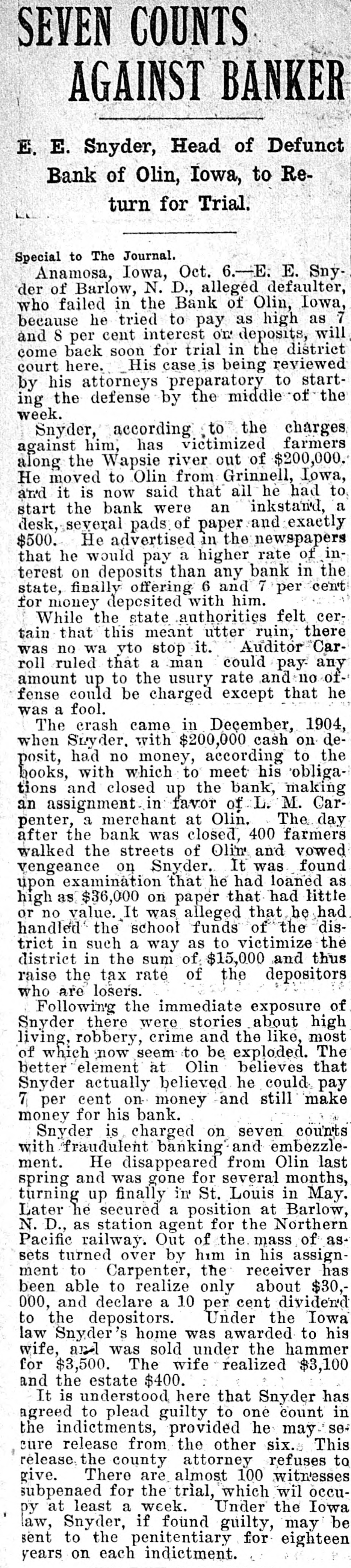
SEVEN COUNTS AGAINST BANKER E. E. Snyder, Head of Defunct Bank of Olin, Iowa, to Return for Trial. Special to The Journal. Anamosa, Iowa, Oct. 6.-E. E. Snyder of Barlow, N. D., alleged defaulter, who failed in the Bank of Olin, Iowa, because he tried to pay as high as 7 and 8 per cent interest on deposits, will come back soon for trial in the district court here. His case is being reviewed by his attorneys preparatory to starting the defense by the middle of the week. Snyder, according to the charges against him, has victimized farmers along the Wapsie river out of $200,000. He moved to Olin from Grinnell, Iowa, and it is now said that all he had to start the bank were an inkstand, a desk, several pads of paper and exactly $500. He advertised in the newspapers that he would pay a higher rate of interest on deposits than any bank in the state, finally offering 6 and 7 per cent for money deposited with him. While the state authorities felt certain that this meant utter ruin, there was no wa yto stop it. Auditor Carroll ruled that a man could pay any amount up to the usury rate and no of fense could be charged except that he was a fool. The crash came in December, 1904, when Suyder. with $200,000 cash on deposit, had no money, according to the books, with which to meet his obligations and closed up the bank, making an assignment in favor of L. M. Carpenter, a merchant at Olin. The day after the bank was closed, 400 farmers walked the streets of Olin and vowed vengeance on Snyder. It was found upon examination that he had loaned as high as $36,000 on paper that had little or no value. It was alleged that he had handled the school funds of the district in such a way as to victimize the district in the sum of $15,000 and thus raise the tax rate of the depositors who are losers. Following the immediate exposure of Snyder there were stories about high living, robbery, crime and the like, most of which now seem to be exploded. The better element at Olin believes that Snyder actually believed he could pay 7 per cent on- money and still make money for his bank. Snyder is charged on seven counts with fraudulent banking and embezzlement. He disappeared from Olin last spring and was gone for several months, turning up finally in St. Louis in May. Later hรฉ secured a position at Barlow, . D., as station agent for the Northern Pacific railway. Out of the mass of assets turned over by him in his assignment to Carpenter, the receiver has been able to realize only about $30,000, and declare a 10 per cent dividend to Iowa the the depositors. Under law Snyder's home was awarded to his wife, and was sold under the hammer for $3,500. The wife realized $3,100 and the estate $400. It is understood here that Snyder has agreed to plead guilty to one count in the indictments, provided he may. secure release from the other six. This release, the county attorney refuses to give. There are almost 100 witnesses subpenaed for the trial, which wil occupy at least a week. Under the Iowa law, Snyder, if found guilty, may be sent to the penitentiary for eighteen years on each indictment.