Click image to open full size in new tab
Article Text
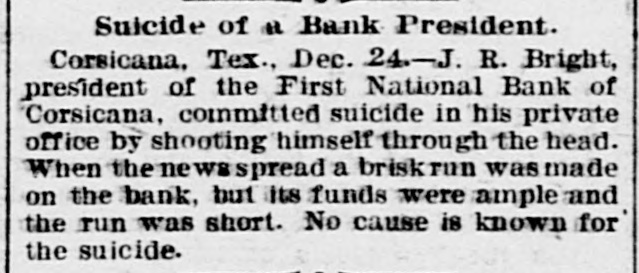
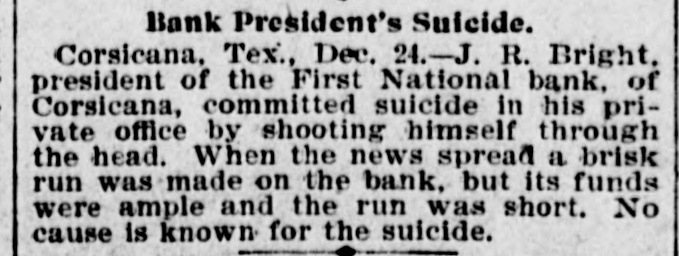
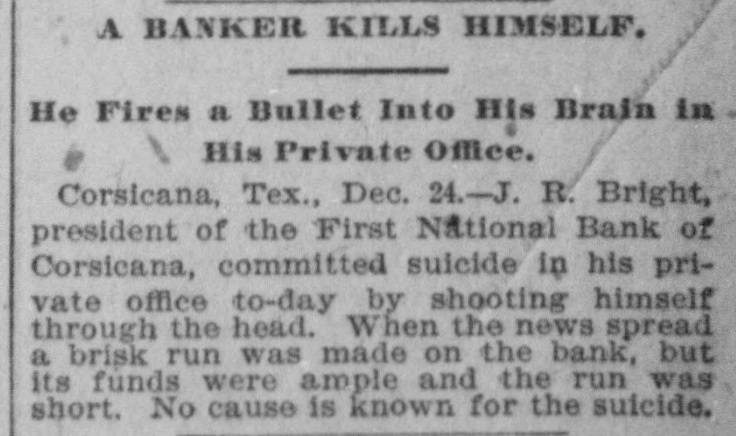
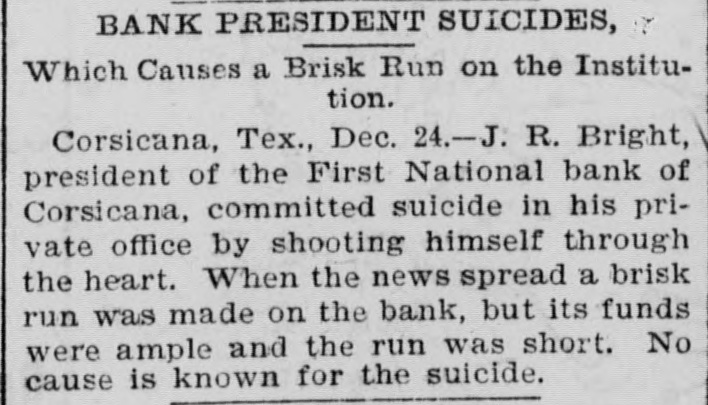
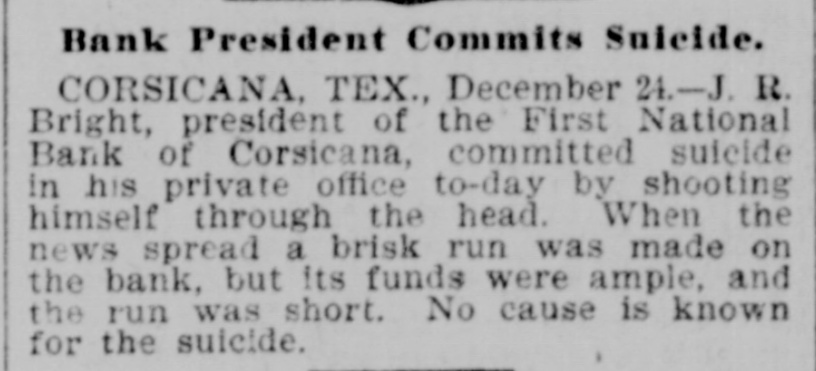
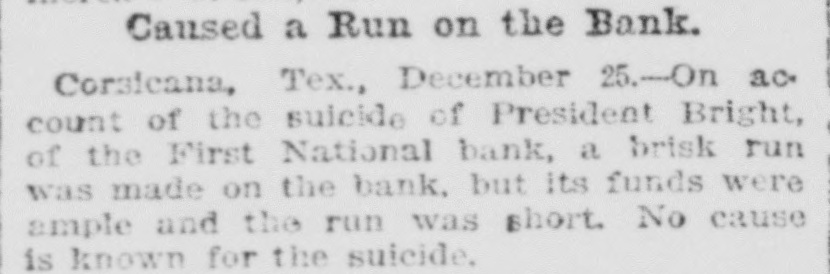
Domestic. Zacharias Wilkinson, seventy-two years old, a wool sorter of Bordentown, N. J., was attacked three weeks ago with hiccoughs, from which he suffered very badly until he died from exhaustion. J. R. Bright, President of the First National Bank of Corsicana, Texas, committed suicide in his private office by shooting himself in the head. A brisk run was made on the bank. No cause is known for the suicide. A locomotive pitched into the Ashley River through a trestle about two miles from Charleston, S.C. Engineer George Baxter and Brakeman Clarence Turner were killed. The wife of ex-Comptroller Edward Wemple died at Fultonville, N. Y., from injuries received in a fall. She was about fifty years old. Some of the street-car men in Philadelphia went on strike again, and there was considerable rioting, but the trouble was temporarily settled. Henry J. Newton, a prominent spiritualist and retired millionaire. was run over and instantly killed by a cable car in New York City. The New England Society celebrated its ninetieth birthday with a banquet in New York City. George W. Kipp,'a farmer, of Rhinebeck, N. Y.. who said he loved a village girl who would not return his affection, committed suicide by shooting himself through the heart. He was a young man of means. He left no explanation, except that he died for love. The Memphis Cotton Exchange began a movement looking to a reduction in the cotton acreage the coming season. P. J. Kerrigan, Member of the New York Assembly from the new Seventeenth District, New York City. died in the Pulaski House, in Savannab, Ga. His death was a very sudden one, and was due to dropsy. The jury in the case of Dr. James A. Hearne, on trial at Bowling Green, Mo., for the murder of AmosStillwell, returned a verdict of not guilty. The case against Mrs. Hearne. charged with being an accomplice, was dismissed. An investigation committee reported to the State Prison Commission that the condition of the New York City prisons is reprehensible, and recommends that the Tombs and Penitentiary on Blackwell's Island be torn down. Georgiana A. Curley, of Boston, killed herself because her desire to take the veil was opposed by her family. R. A. Ford, a lineman, was killed while mending a cable on a pole in Hartford, Conn. Seventy-five hundred volts passed through his body, making death instantaneous. There was a head-on collision between two passenger trains on the Reading railroad at Frankford, a suburb of Philadelphia. by which George Anderson. aged sixteen, and Daniel Hart, aged seventy, were killed. Postmaster A. B. Payne, in Longview, Ala., was shot and killed ina foul manner by Jasper Nabers, a young man and a relative of Payne's wife. The trolley-car strikers in Philadelphia called Eugene V. Debs and ex-President McBride, of the American Federation of Labor. to their aid. Justice Gaynor decided that Patrick Gleason was elected Mayor of Long Island City. The New York and Montreal Express collided with a freight engine near Tupper Lake, N. Y., killing both engineers and fatally injuring two other trainmen. Excessive sorrow and shock over the tragic death of a favorite child friend caused the death of Mrs. Henry McAdams, at her home in Elizabeth, N. J. Unprecedented rains in Missouri and Illinois caused disastrous floods in those States. The jury in the trial of Lloyd Montgomery, the eighteen-year-old boy, for the murder of his father and mother and Daniel McKeercher, Brownsville, N. Y., returned a verdict of guilty of murder in the first degree. Charles B. Atwood, the well known architect, died at his home in Buena Park, a suburb of Chicago, of a complication of diseases, brought on by overwork during the World's Fair. New York City will have to pay $1,500,000, its part of the State tax for the care of the insane, the suit to evade such payment having been decided against the city by the New York Court of Appeals. N The power of the Government wasbrought to bear on the street car strike in Philadelphia, Penn., owing to the fart that nets of violence by the strikers interfered with the running of cars carrying United States mail. The New York Court of Appeals sustained the General Term of the Supreme Court, which granted Erastus Wiman anew trial on the charge of forgery.