Central National Bank (Boston, MA)

Episode Information

Episode UID
210301235
Episode Type
Run โ†’ Suspension โ†’ Closure
Bank Type
national
Bank ID
21030 national
Charter Number
2103
Start Date
November 13, 1902
Location
Boston, Massachusetts (42.358, -71.060)

Metadata

Model
gpt-5-mini (chosen from majority vote of a three-model LLM ensemble)
Short Digest
f9f568e1d09f2eb9

Response Measures

Accommodated withdrawals, Capital injected, Full suspension, Books examined

Clearinghouse involved: Yes (loan, examination, or other measures)

Receivership Details

Depositor recovery rate
100.0%
Date receivership started
1902-11-13
Date receivership terminated
1906-10-20
OCC cause of failure
Excessive lending
Share of assets assessed as good
68.8%
Share of assets assessed as doubtful
24.6%
Share of assets assessed as worthless
6.6%

Events (6)

1. April 30, 1873 Chartered
Source
historical_nic
2. November 13, 1902 Receivership
Source
historical_nic
3. November 13, 1902 Run
Cause
Bank Specific Adverse Info
Cause Details
Large withdrawals followed rejection of asset liquidation by Eliot National and disclosure of impaired assets/losses.
Measures
Several banks aided depositors; National Shawmut offered to advance 50% of depositors' balances.
Newspaper Excerpt
Wednesday sales of the Central's stock dropped $15 from par and yesterday depositors withdrew something like $2,000,000.
Source
newspapers
4. November 14, 1902 Receivership
Newspaper Excerpt
the controller of the currency having ordered the bank examiner to close its doors and take charge of its business; Examiner Neal appointed temporary receiver
Source
newspapers
5. November 14, 1902 Suspension
Cause
Government Action
Cause Details
Ordered closed by the Acting Comptroller of the Currency and placed in charge of an examiner/temporary receiver.
Newspaper Excerpt
Closed by order of the controller of the currency.
Source
newspapers
6. November 25, 1902 Receivership
Newspaper Excerpt
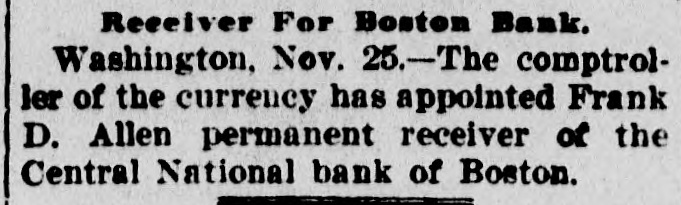
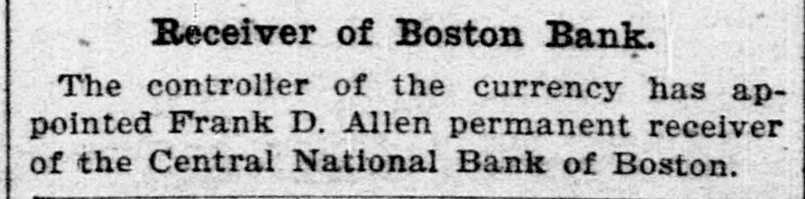
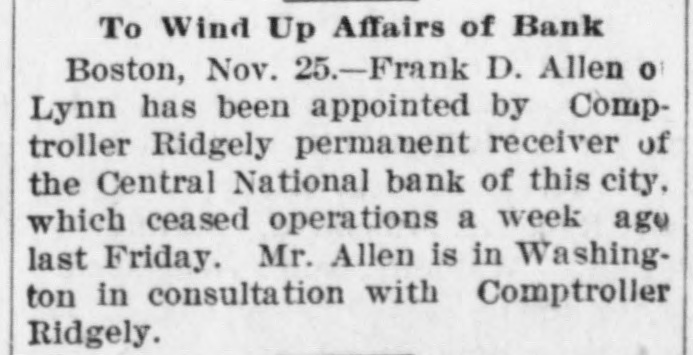
The comptroller of the currency has appointed Frank D. Allen permanent receiver of the Central National bank of Boston.
Source
newspapers

Newspaper Articles (21)

Article from Spirit of the Age, November 8, 1902

Click image to open full size in new tab

Article Text

TUESDAY, Nov. 4, 1902. William T. Nelson of New York commits suicide; act caused by worry over friend's arrest. Coal arbitrators visit mines in the Hazleton region. "Jim Crow" car law goes into operation in New Orleans. Treasurer Roberts' annual report shows greatest cash balance in history of the country. Colombian government will renew negotiation of a canal treaty. Little Haverhill girl, supposed to have been abducted, claims to have been lost in Lawrence. Body of Ernest C. Mansfield, the Harvard student, found in Charles river. Alaskan natives dying by thousands from measles. Directors of Central national bank of Boston vote to wind up its business. S. T. Coy, a prominent paper manufacturer of Bellows' Falls, dead. Five hundred silversmiths go on strike in New York. Laura Biggar gives herself up to authorities at Freehold, N.J. Lebaudy brothers' new airship makes successful trial trip near Moisson, France. Dismissal of Grand Duke Paul Alexandrovitch from Russian army due to his marriage to Baroness Pistolkoff. Pennsylvania railroad promises 90minute runs between New York and Philadelphia. Wife of a New York real estate man, who is suing for divorce, charged with stealing husband's papers. Eleven Cuban children, destined for a Buddhist school in California, detained by immigration authorities in New York. Crown Prince of Siam arrives at Niagara Falls. Joseph Cloud was arrested at Brunswick, Me., charged with assaulting Mrs. John Griffin. He confessed. The aldermen of Fall River last night gave the Dartmouth and Westport Street Railway company the right to carry freight. Henry Brittin was held in $500 in Lewiston charged with the larceny of three barrels of whiskey and one barrel of brandy. While lighting the gas in a store window in Lowell the clothing of Miss Helen Priestly caught fire and she was probably fatally burned. The city council of Portland has passed a resolution favoring an abolishment of the lower branch and an increase of aldermen to three from each ward. The wholesale grocery firms of Chicago will have none of George B. Hanford's $500,000,000 grocery trust, for the formation of which a convention is called to meet in Detroit. John Hannan, the millionaire shoe manufacturer of New York, had a narrow escape from drowning at Narragansett Pier. As he was boarding a sailboat at the south pier dock he slipped and fell into the water. Although he was rescued at once, Mr. Hannan was speechless when taken aboard the boat. A 16-year-old hunter, David Fuller, was shot and instantly killed at Asqwith, Me., by Arthur Bagley. who fired into a clump of alders which were being shaken as if by a moving animal. Mark Fuller, his son, David, and Arthur Bagley of Henderson were hunting together. The stock of . O. Toby's store was extensively damaged by fire at Machiasport, Me. It was believed Mr. Toby sought death by burning with his property. Mr. Toby's store books were found outside the building, wrapped up and covered with his overcoat. Nothing else had been removed. He was not seen after leaving his home.
Article from Evening Star, November 14, 1902

Click image to open full size in new tab

Article Text

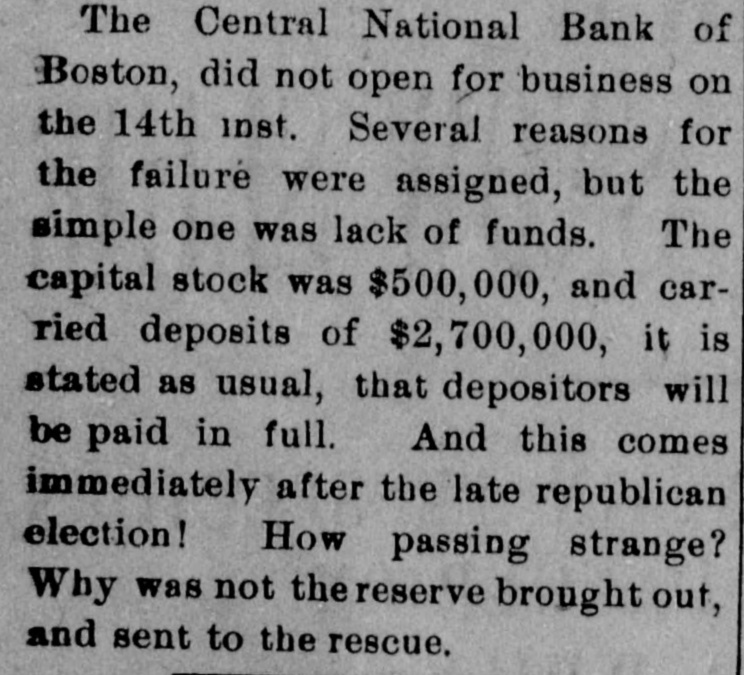
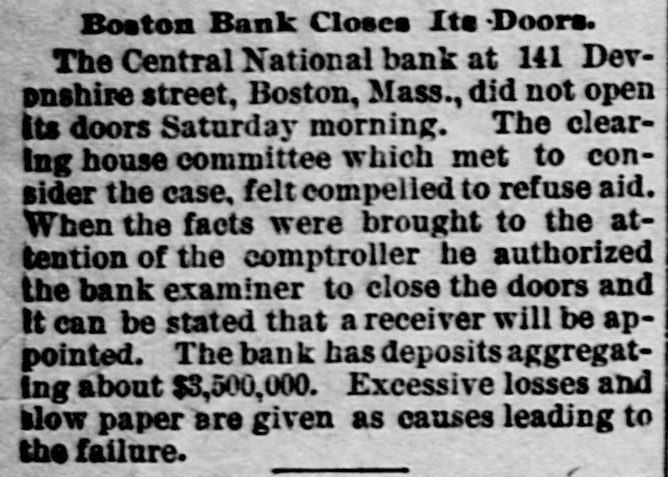
BOSTON BANK BROKEN Currency Controller Closes Central National. DUE TO EXCESS LOANS INVOLVED IN RAILROAD FAILURE 20 YEARS AGO. Never Fully Recovered-Believed That $2,700,000 Deposits Can Be Paid Without Assessment. BOSTON, November 14.-The Central National Bank of this city did not open for business today, the controller of the currency having ordered the bank examiner to close its doors and take charge of its business. The closing of the bank is said to be due to excess loans and a lack of quick assets. An appeal for aid was made to the Boston Clearing House Association, but the committee did not deem it advisable to assist the bank. Deposits of $2,700,000. The bank is among the smaller institutions of the city. It was organized in 1873, with a capital of $500,000. Its deposits aggregate $2,700,000, and it is believed that this amount can be paid in full without an assessment on the stockholders. Otis H. Luke is president and J. Adams Brown cashier. Just before 9 o'clock today the following notice was posted on the bank's doors: "Closed by order of the controller of the currency." Bank Examiner Temporary Receiver. Inquiry at the bank elicted the information that the controller had ordered Bank Examiner Neal to take charge as temporary receiver. No one could be found who had authority to discuss the condition of the bank. The failure of negotiation for the Eliot National Bank to liquidate the Central National is understood to have contributed to the failure, as well as the fact that the bank never fully recovered from a blow it received twenty years ago, when, with the Pacific Bank, which failed at that time, 10 was involved in the collapse of the Lebanon Springs railroad in Vermont. The Central Bank then lost $350,000 and an assesment of about 100 per cent was made upon the stockholders and no dividends were paid for thirteen years. Liquidation Not Progressing. The failure of the bank showed that the liquidation proceedings were not progressing favorably. A meeting of the Central Bank stockholders had been called for December 10 to approve the plan for the Ellot National to take over the business. Upon investigation, however, President Burrage of the Eliot Bank and his board of directors, refused to accept the assets of the Central Bank as security for any guarantee of the $2,700,000 deposits. By the last report to the controller of the currency the bank's standing was as follows: Standing at Last Report. Resources-Loans and discounts, $3,073,786; overdrafts, $40,625; United States bonds, $450,000; premium on United States bonds, $16,750; stocks, securities and real estate, $153,722; due from banks, $956,863; exchanges for clearings, $142,796; specie, $160,136; legal tender notes, $200,000; redemption fund, $17,750. Liabilities-Capital stock, $500,000; surplus fund, $100,000; undivided profits, $120,633; bank notes outstanding, $349,990; due to banks, etc., $917,721; deposits, $2,700,085; United States deposits, $50,000; bills payable, $465,900.


Article from Santa Fe New Mexican, November 14, 1902

Click image to open full size in new tab

Article Text

CENTRAL NATIONAL BANK CLOSED One of the Smaller Institutions of Boston in the Hands of the Examiner Because of the Excess of Loans. DEPOSITORS CAN BE PAID IN FULL WITHOUT ASSESSMENT Boston, Mass., Nov. 14.-The Central National Bank of this city did not open for business today, the comptroller of currency having ordered the bank examiner to close its doors and take charge of the business. The closing of the bank is said to be due to excess of loans and a lack of quick assets. An appeal for aid was made to the Boston clearing house association, but the committee did not deem it advisable to assist the bank. The bank is among the smaller institutions in the city. It was organized in 1873 with a capital of $500,000. The deposits aggregate $2,700,000, and it is believed that this amount can be paid in full without an assessment on the stockholders. Otis H. Luke is president, and J. Adams Brown cashier. WASHINGTON STATEMENT. Washington, D. C., Nov. 14.-A state. ment concerning the closing of the Central National Bank of Boston was issued at the comptroller of currency office today. It says the bank was closed by direction of the acting comptroller of the currency as a result of a conference by telephone late last night with Examiners New and Ewer of Boston. The acting comptroller has appointed A. W. New as temporary receiver. The statement recites that the bank was examined on September 11, last, and while the examiner's report showed losses equal to the surplus and undivided profits then on hand there was no evidence of insolvency. Certain conditions were then imposed upon the bank with a view of providing for the losses and securing the bank against a further loss on its loans. Later it was determined to place the institution in voluntary liquidation by having another bank in Boston take over its assets and assume its deposit liabilities, and it was thought the arrangements to this end were being carried out until the acting comptroller received a dispatch from Examiner New yesterday that the efforts to liquidate had failed. The failure, the statement says, was due to losses sustained. No apparent dishonesty on the part of the officers of the bank as far as the records of the comptroller's office show is evident.


Article from The Tucson Citizen, November 14, 1902

Click image to open full size in new tab

Article Text

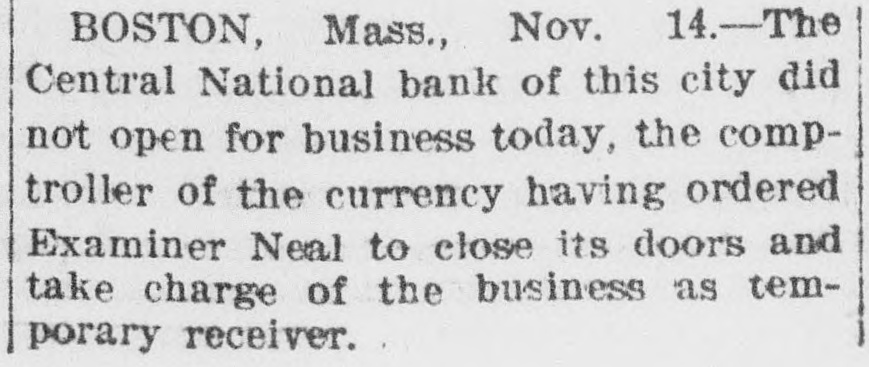
BOSTON, Mass., Nov. 14.-The Central National bank of this city did not open for business today, the comptroller of the currency having ordered Examiner Neal to close its doors and take charge of the business as temporary receiver.


Article from The Minneapolis Journal, November 14, 1902

Click image to open full size in new tab

Article Text

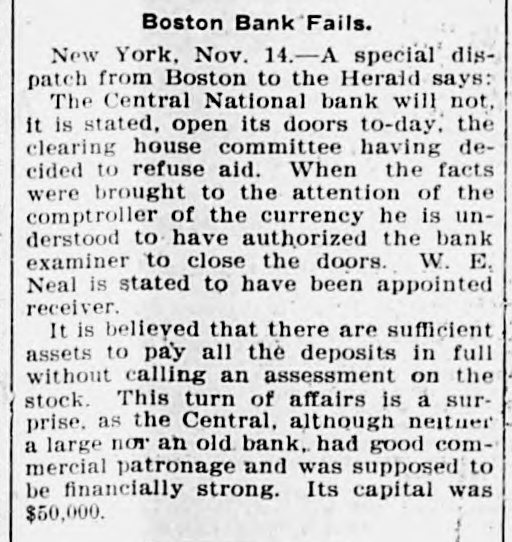
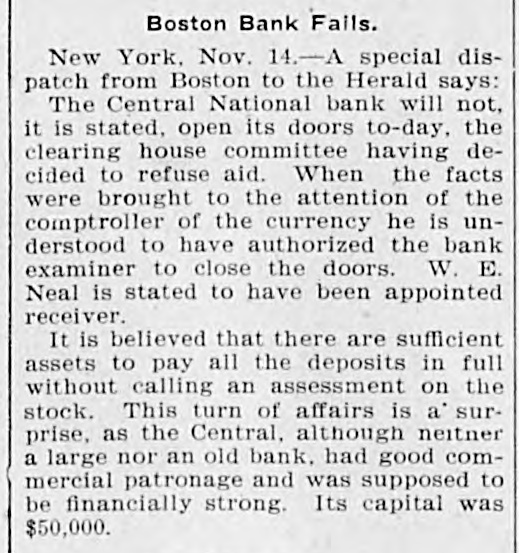
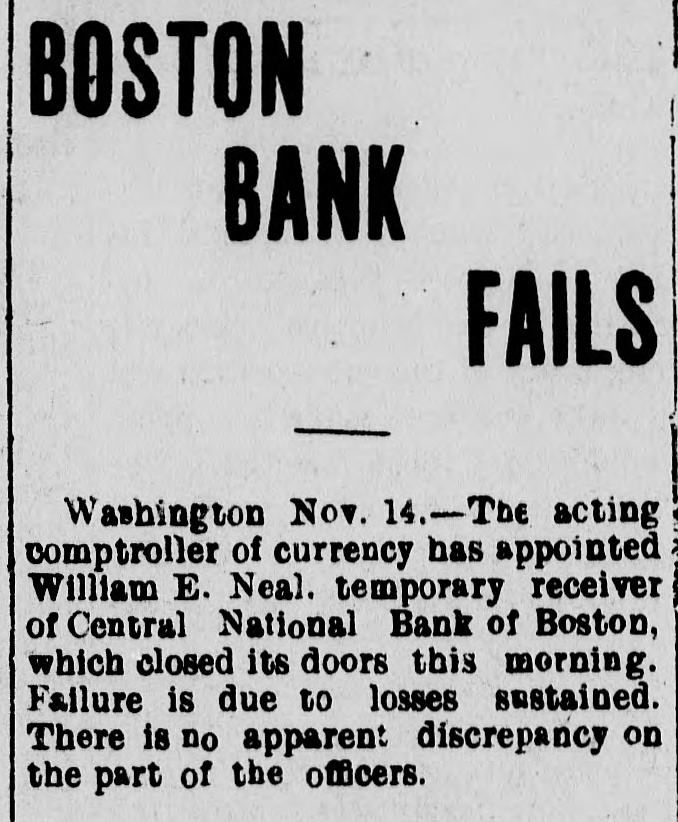
BOSTON BANK FAILS The Central National Bank Closed by Order of the United States Controller. It Is a Small Affair With Deposits of $2,700,000 Which Will Be Paid in Full. Boston, Nov. 14.-The Central National bank of this city did not open for business to-day, the controller of the currency having ordered the bank examiner to close its doors and take charge of its business. The closing of the bank is said to be due to excess loans and a lack of quick assets. An appeal for aid was made to the Boston Clearing House association, but the committee did not deem it advisable to assist the bank. The bank is among the smaller institutions of the city. It was organized in 1873 with a capital of $500,000. Its deposits aggregate $2,700,000 and it is delieved that this amount can be paid in full without an assessment on the stockholders. Otis N. Luke is president and J. Adams Brown cashier. Just before 9 o'colock to-day the following notice was posted on the bank's doors: "Closed by order of the controller of the currency." Inquiry at the bank elicited the information that the controller had ordered Bank Examiner Neal to take charge as temporary receiver. No one could be found who had authority to discuss the condition of the bank. This turn of affairs is a surprise, as the Central, although neither a large nor an old bank, had good commercial patronage and was supposed to be financially strong. The condition of the bank is understood to be due partly to an inheritance from the old Pacific bank. When the Pacific bank failed it was involved in the collapse of the Lebanon Springs railroad in Vermont. The Central bank then lost $350,000 and an assessment of about 100 per cent was made upon the stockholders and no dividends were paid for thirteen years. The failure of the bank showed that the liquidation proceedings were not progressing favorably. A meeting of the Central bank shockholders had been called for Dec. 10 to approve the plan of the Elliott e national to take over the business. Upon investigation, however, President Bure rage of the Eliot bank and his board of directors refused to accept the assets of go the Central bank as security for any h guarantee of the $2,700,000 deposits. t By the last report to the controller of a the currency the bank's standing was as follows: S S Resources-Loans and discounts. $3,073,786; overdrafts, $40,625: United States bonds. $450.o 000; premium on United States bonds. $16,750; r stocks. securities and real estate, $153,722; due from banks, $956,863; exchanges for clearings, $142,796; specie. $160,136; legal-tender notes, $200,000; redemption fund. $17,750. n Liabilities-Capital stock. $500,000; surplus f fund, $100,000; undivided profits, $129,633 bank 1. notes outstanding, $349.990; due to banks, etc., $917,721; deposits. $2,700,005; United States deposits, $50,000; bills payable, $465.900. d The National Shawmut bank announced f to-day that it would advance to depositors g of the Central National bank 50 per cent e of their present balances in that insti. tution. 1,


Article from The Indianapolis Journal, November 15, 1902

Click image to open full size in new tab

Article Text

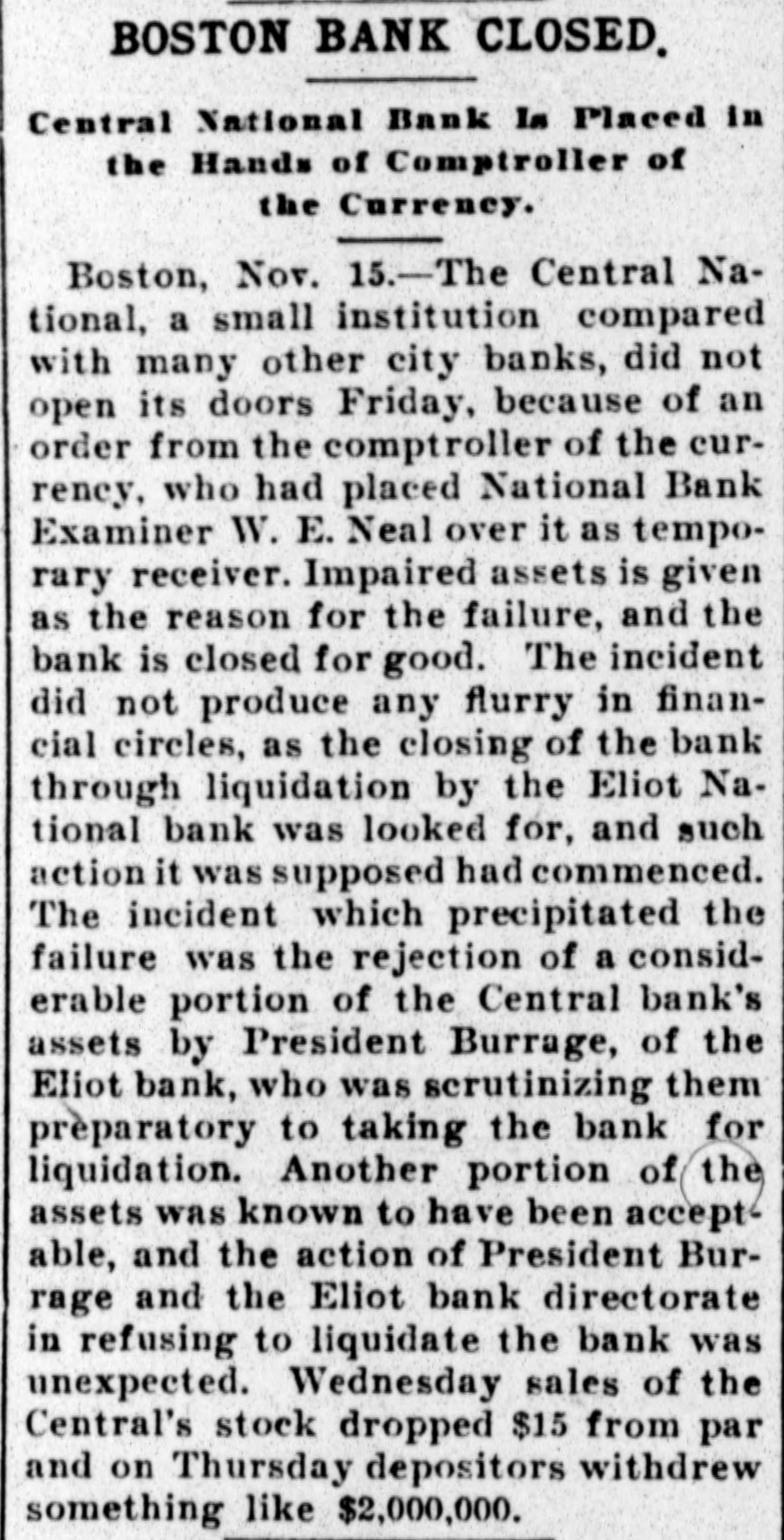
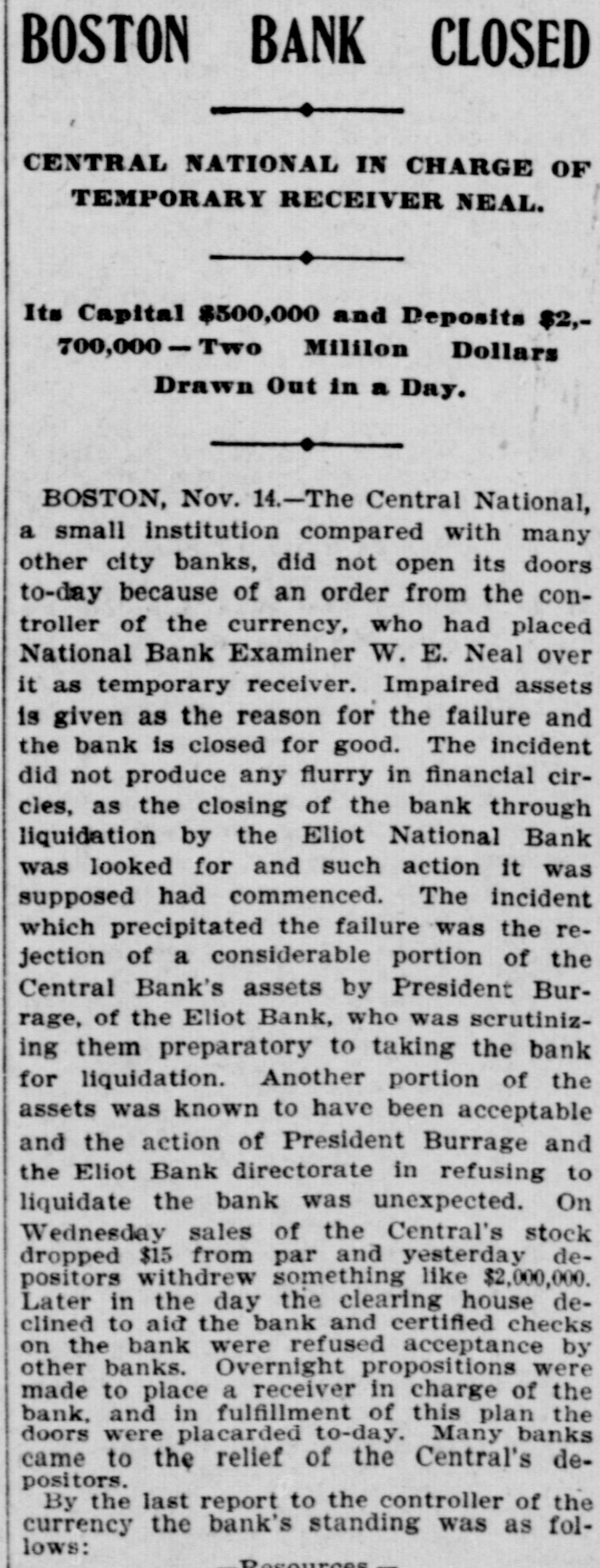
BOSTON BANK CLOSED CENTRAL NATIONAL IN CHARGE OF TEMPORARY RECEIVER NEAL. Its Capital $500,000 and Deposits $2,700,000-Two Mililon Dollars Drawn Out in a Day. BOSTON, Nov. 14.-The Central National, a small institution compared with many other city banks, did not open its doors to-day because of an order from the controller of the currency, who had placed National Bank Examiner W. E. Neal over it as temporary receiver. Impaired assets is given as the reason for the failure and the bank is closed for good. The incident did not produce any flurry in financial circles, as the closing of the bank through liquidation by the Eliot National Bank was looked for and such action it was supposed had commenced. The incident which precipitated the failure was the rejection of a considerable portion of the Central Bank's assets by President Burrage, of the Eliot Bank, who was scrutinizing them preparatory to taking the bank for liquidation. Another portion of the assets was known to have been acceptable and the action of President Burrage and the Eliot Bank directorate in refusing to liquidate the bank was unexpected. On Wednesday sales of the Central's stock dropped $15 from par and yesterday depositors withdrew something like $2,000,000. Later in the day the clearing house declined to aid the bank and certified checks on the bank were refused acceptance by other banks. Overnight propositions were made to place a receiver in charge of the bank, and in fulfillment of this plan the doors were placarded to-day. Many banks came to the relief of the Central's depositors. By the last report to the controller of the currency the bank's standing was as follows: Doonurons


Article from The Montgomery Advertiser, November 15, 1902

Click image to open full size in new tab

Article Text

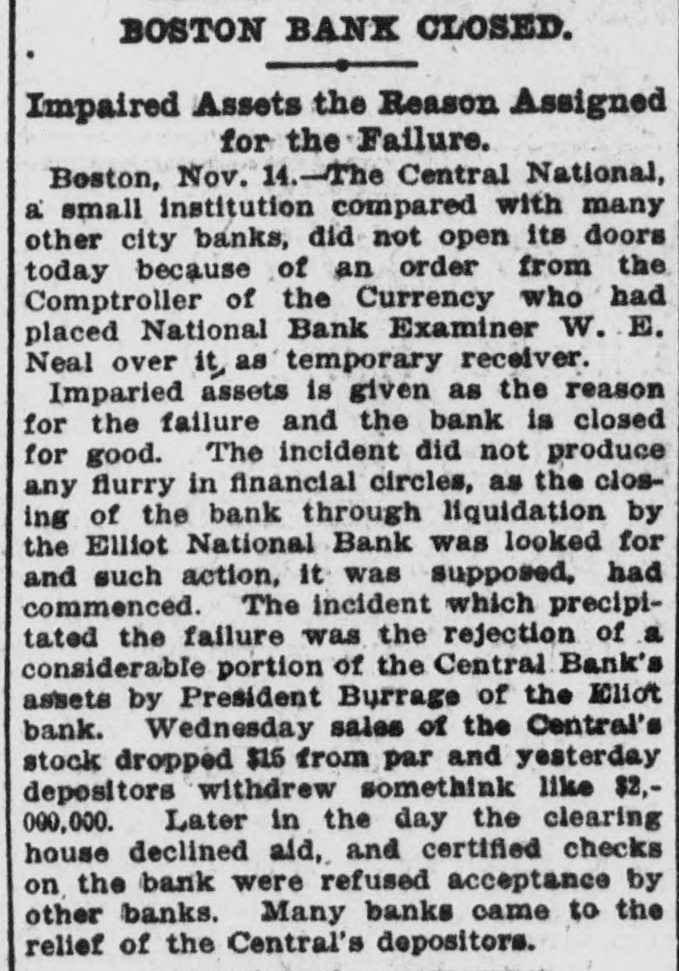
BOSTON BANK CLOSED. Impaired Assets the Reason Assigned for the Failure. Boston, Nov. 14.-The Central National, a small institution compared with many other city banks, did not open its doors today because of an order from the Comptroller of the Currency who had placed National Bank Examiner W. E. Neal over it, as temporary receiver. Imparied assets is given as the reason for the failure and the bank is closed for good. The incident did not produce any flurry in financial circles, as the closing of the bank through liquidation by the Elliot National Bank was looked for and such action, it was supposed, had commenced. The incident which precipitated the failure was the rejection of a considerable portion of the Central Bank's assets by President Burrage of the Illot bank. Wednesday sales of the Central's stock dropped $15 from par and yesterday depositors withdrew somethink like $2,000,000. Later in the day the clearing house declined aid, and certified checks on the bank were refused acceptance by other banks. Many banks came to the relief of the Central's depositors.


Article from The Birmingham Age-Herald, November 15, 1902

Click image to open full size in new tab

Article Text

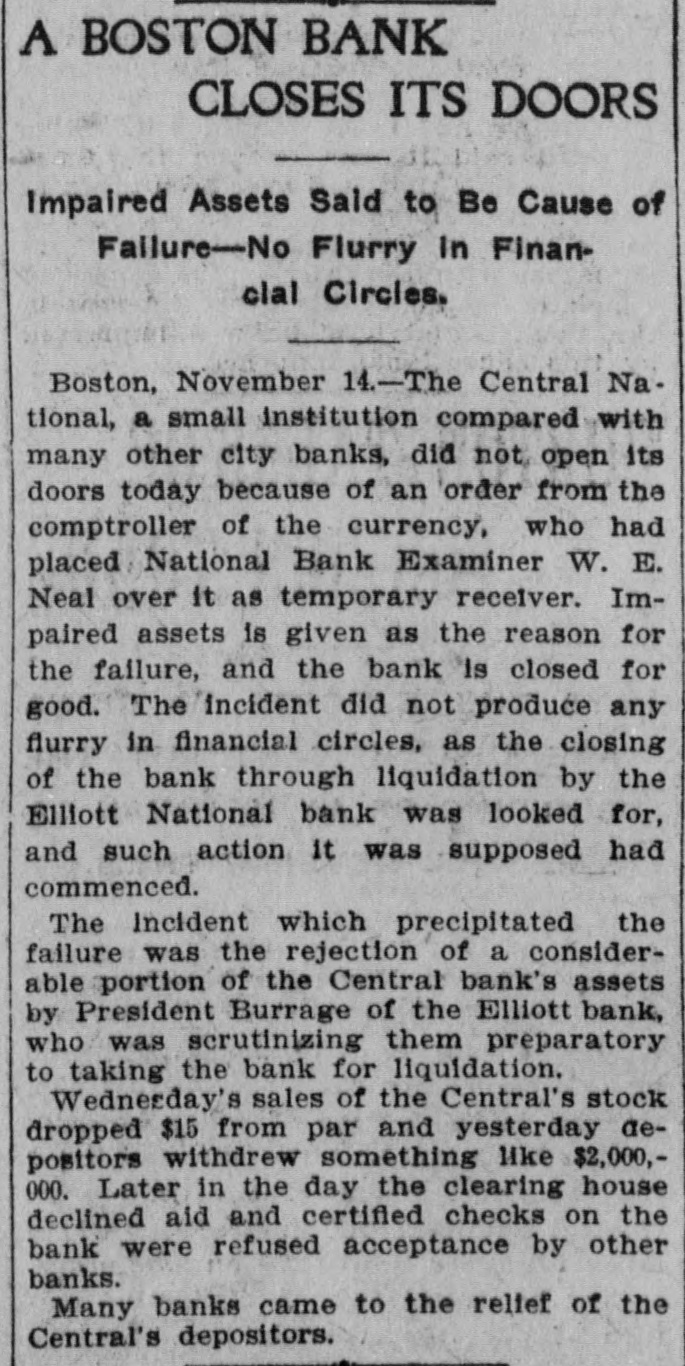
A BOSTON BANK CLOSES ITS DOORS Impaired Assets Said to Be Cause of Failure-No Flurry in Financlal Circles. Boston, November 14.-The Central Na. tional, a small institution compared with many other city banks, did not open its doors today because of an order from the comptroller of the currency, who had placed National Bank Examiner W. E. Neal over it as temporary receiver. Impaired assets is given as the reason for the failure, and the bank Is closed for good. The incident did not produce any flurry in financial circles, as the closing of the bank through liquidation by the Elliott National bank was looked for, and such action It was supposed had commenced. The Incident which precipitated the failure was the rejection of a considerable portion of the Central bank's assets by President Burrage of the Elliott bank, who was scrutinizing them preparatory to taking the bank for liquidation. Wednesday's sales of the Central's stock dropped $15 from par and yesterday depositors withdrew something like $2,000,000. Later in the day the clearing house declined aid and certified checks on the bank were refused acceptance by other banks. Many banks came to the relief of the Central's depositors.


Article from The Daily Republican, November 15, 1902

Click image to open full size in new tab

Article Text

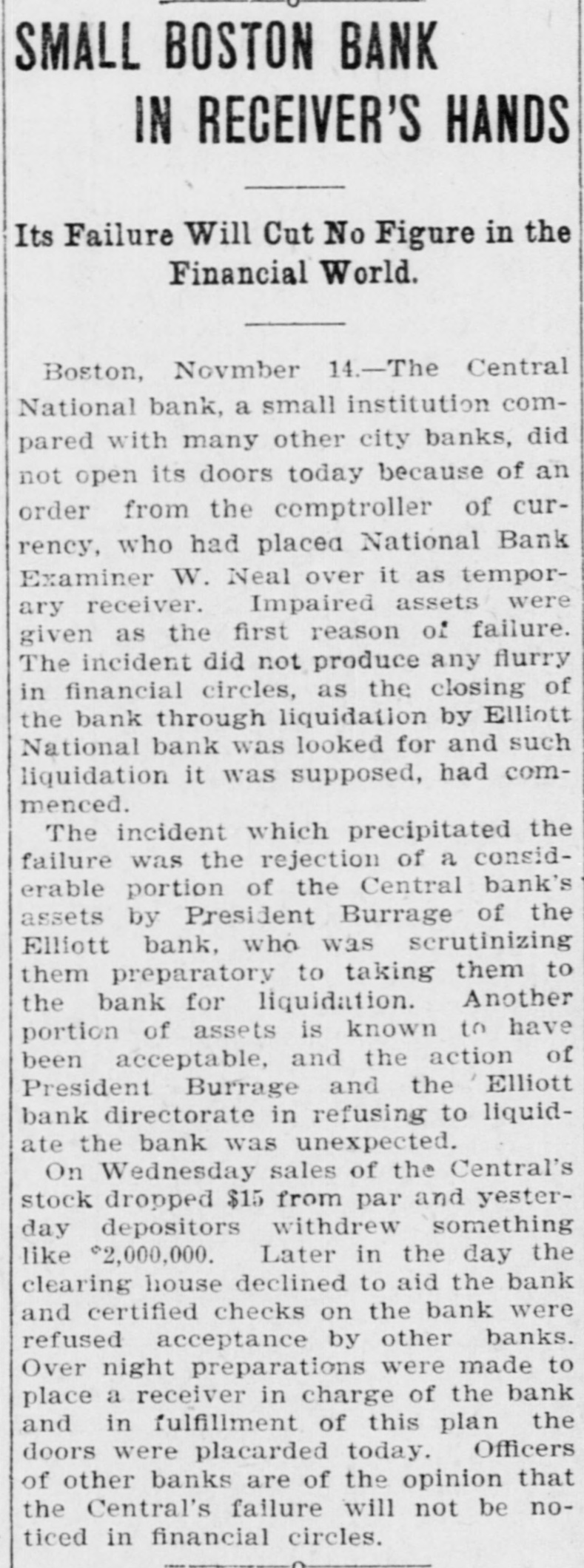
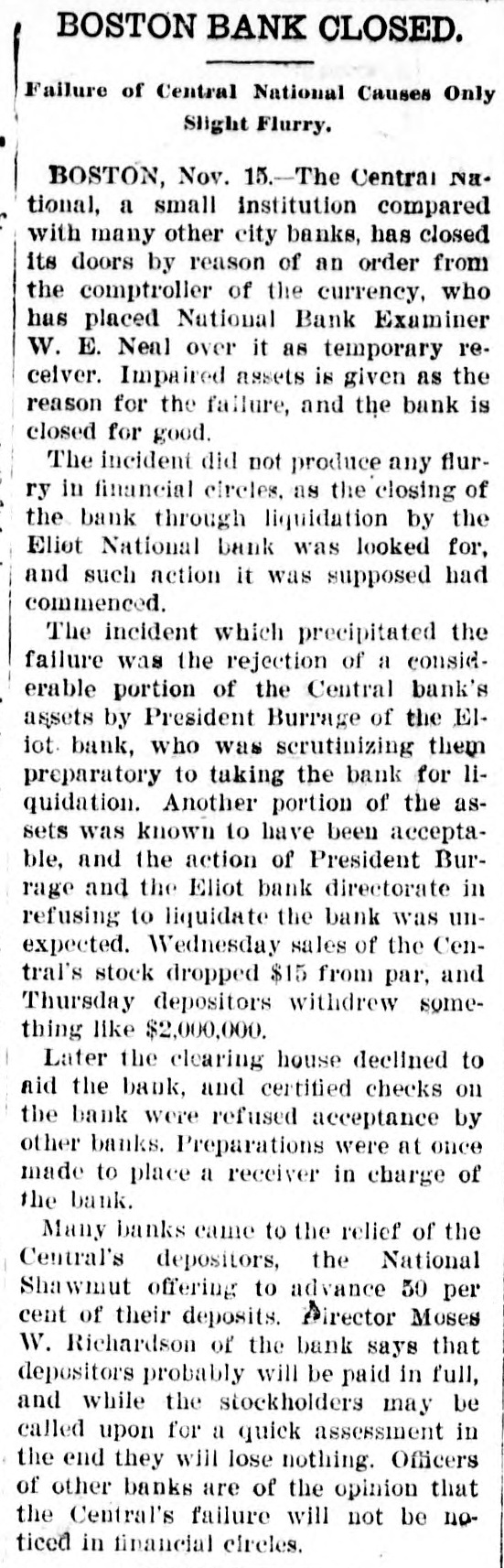
BOSTON BANK CLOSED. Failure of Central National Causes Only Slight Flurry. BOSTON, Nov. 15.-The Central National, a small institution compared with many other city banks, has closed its doors by reason of an order from the comptroller of the currency, who has placed National Bank Examiner W. E. Neal over it as temporary recelver. Impaired assets is given as the reason for the failure, and the bank is closed for good. The incident did not produce any flurry in financial circles, as the closing of the bank through liquidation by the Eliot National bank was looked for, and such action it was supposed had commenced. The incident which precipitated the failure was the rejection of a considerable portion of the Central bank's assets by President Burrage of the Ellot. bank, who was scrutinizing them preparatory to taking the bank for liquidation. Another portion of the assets was known to have been acceptable, and the action of President Burrage and the Ellot bank directorate in refusing to liquidate the bank was unexpected. Wednesday sales of the Central's stock dropped $15 from par, and Thursday depositors withdrew something like $2,000,000. Later the clearing house declined to aid the bank, and certified checks on the bank were refused acceptance by other banks. Preparations were at once made to place a receiver in charge of the bank. Many banks came to the relief of the Central's depositors, the National Shawmut offering to advance 50 per cent of their deposits. Director Moses W. Richardson of the bank says that depositors probably will be paid in full, and while the stockholders may be called upon for a quick assessment in the end they will lose nothing. Officers of other banks are of the opinion that the Central's failure will not be noticed in financial circles.


Article from New-York Tribune, November 15, 1902

Click image to open full size in new tab

Article Text

A BOSTON BANK CLOSED CENTRAL NATIONAL BANK HAD NOT RECOVERED FROM BLOW RECEIVED TWENTY YEARS AGO. Boston. Nov. 14.-The Central National Bank, of this city, a with other city open doors because of an of banks, small order institution did from net the Controller compared its the to-day many Currency. who had over W. E. Neal placed it as National temporary Bank receiver. Examiner Im. paired assets are given as the reason for the produce flurry in as the bank failure. The closing through financial of liquidation the circles bank here. did by the not the E.jot closing National any of Bank was looked for, and such action, it that supposed, tated the failure had begun the The rejection incident of precipt- was was a considerable part of the Central bank's assets by President Burrage was them preparatory for of the Eliot to taking bank, the who bank scrutinizing liquidation. Another portion of the assets was known to be and in to date was acceptable, the the Eliot bank bank and the unexpected. directorate action of President refusing Burraga liqui. 'on Wednesday sales of the Central's stock par, dropped withdrew $15 something from like and $2,000,000. yesterday depositors Later in the day the Clearing House declined to aid the bank, and on were by other Many certified banks. banks checks to the the relief bank refused cam of the Central's depositors, the Shawmut National offering to ad. vance 50 per cent of their deposits. Moses W. Richardson, a director of the bank, said to-night that depositors probably would be paid in full, and while the stockholders may be called upon for an assessment, in the end they will lose nothing The State of Massachusetts was a depositor In the Central National. State Treasurer Bradford says: "The commonwealth will not be hampered at all by the closing of the bank. The State carried only a small line there, and it will suffer no loss." The city of Bosten, which has deposits in thirty national banks and trust companies, had in the Central National Bank $208,320. The bank was organized in 1873 with a capital of $500,000. Its deposits aggregate $2,700,000. Otis H. Luke is president and J. Adams Brown cashier. The Central National had not fully recovered from a blow it received twenty years ago when, with the Pacific Bank, which failed at that time, it was volved in the collapse of the Lebanon Springs Rail. road, in Vermont. The Central Bank, then about nine years old. lost $350,000, and an assessment of about 100 per cent was made on the stockholders. No dividends were paid for thirteen years. Washington, Nov. 11-The following is part of a statement Issued to-day at the office of the Controller of the Currency: The Central National Bank of Boston was examined on September 11, 1902. and while the examiner's report showed losses equal to surplus and undivided profits then on hand, there was no evidence of insolvency, as the bank's assets seemed to be ample to meet its liabilities to creditors. Certain conditions were then imposed upon the bank with a view to providing for losses and securing the bank against further loss on its loans. Later it was determined to place the association in voluntary liquidation by having another bank in Boston take over its assets and assume its deposit liabilities, and it was thought that arrangements to this end were being successfully carried out, until the Acting Controller received a dispatch from Examiner Neal yesterday that efforts to liquidate had failed. After a conference by telephone with the examiners. who stated that a receivership was unavoidable, the bank was ordered closed. The failure is due to losses sustained. There is no apparent dishonesty on the part of the officers of the bank, so far as the records of the Controller's office show. The following is a statement of the resources and liabilities of the bank, as shown by the last report of condition September 15, 1902:


Article from The Savannah Morning News, November 15, 1902

Click image to open full size in new tab

Article Text

CENTRAL BANK FAILS. One of Boston's Biggest Financial Institutions Goes to the Wall. Boston, Nov. 14.-The Central National Bank, a small institution when compared with other Boston banks, did not open its doors to-day because of an order from the controller of the currency, who had placed National Bank Examiner W. E. Neal over it as temporary receiver. Impaired assets is given as the reason for the failure, and the bank is closed for good. The incident did not produce any flurry in financial circles. Many banks came to the relief of the Central's depositors, the National Shawmut offering to advance 50 per cent. of their deposits. Director Moses W. Richardson of the bank to-night said that depositors probably would be paid in full, and while the stockholders may be called upon for a quick assessment, in the end they will lose nothing. Boston, Nov. 14.-The Central National Bank of this city did not open for business to-day, the controller of the currency having ordered the bank examiner to close its doors and take charge of its business. The closing of the bank is said to be due to excess loans and a lack of quick assets. An appeal for aid was made to the Boston Clearing House Association, but the committee did not deem it advisable to assist the bank. The bank is among the smaller institutions of the city. It was organized in 1873 with a capital of $500,000. Its deposits aggregate $2,750,000, and it is believed that this amount can be paid in full without an assessment on the stockholders. Otis H. Luke is president and James Brown cashier. The failure of negotiations for the Eliot National Bank to liquidate the Central National is understood to have contributed to the failure. A meeting of the Central Bank stockholders had been called for Dec. 10 to approve the plan for the Eliot National to take over the business. Upon investigation, however, President Burrage of the Eliot Bank and his board of directors, refused to accept the assets of the Central Bank as security for any guarantee of the $2,700,000 deposits. Washington, Nov. 14.-The following statement was issued at the office of the controller of the currency: "The Central National Bank of Boston, Mass., has been closed by direction of the acting controller of the currency, as a result of a conference by telephone late last night with Examiners Neal and Ewer of Boston. The acting controller has appointed William E. Neal as temporary receiver. "The bank was last examined on Sept. 11, 1902, and while the examiner's report showed losses equal to surplus and undivided profits then on hand, there was no evidence of insolvency, as the bank's assets seemed to be ample to meet its liabilities to creditors. Certain conditions were then imposed upon the bank with a view to providing for losses and securing the bank against further loss on its loans. Later it was determined to place the association in voluntary liquidation by having another bank in Boston take over its assets and assume its deposit liabilities, and it was thought that arrangements to this end were being successfully carried out until the acting controller received a dispatch from Examiner Neal yesterday that efforts to liquidate had failed. After a conference by telephone with the examiners, who stated that a receivership was unavoidable, the bank was ordered closed. "The failure is due to losses sustained. There, is no apparent dishonesty on the part of the officers of the bank so far as the records of the controller's office show."


Article from Evening Journal, November 15, 1902

Click image to open full size in new tab

Article Text

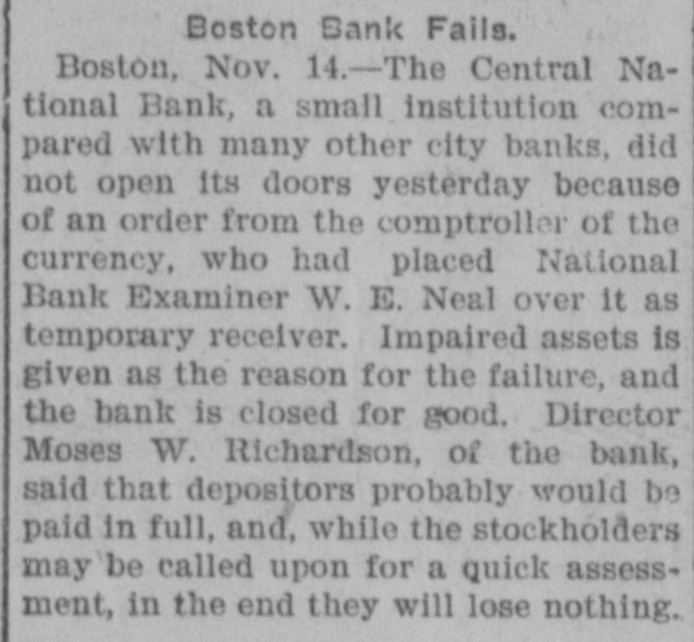
Boston Bank Fails. Boston, Nov. 14.-The Central National Bank, a small institution compared with many other city banks, did not open its doors yesterday because of an order from the comptroller of the currency, who had placed National Bank Examiner W. E. Neal over it as temporary receiver. Impaired assets is given as the reason for the failure, and the bank is closed for good. Director Moses W. Richardson, of the bank, said that depositors probably would be paid in full, and, while the stockholders may be called upon for a quick assessment, in the end they will lose nothing.


Article from Daily Kennebec Journal, November 17, 1902

Click image to open full size in new tab

Article Text

BANK FAILURE. The Central National of Boston Closes Its Doors. Never Recovered from Blow from the Pacific Bank Failure. The Wreck Due to Losses SustainedAccounts Are Straight. Boston, Nov. 16.-The Central National Bank, a small institution compared with many other city banks, did not open its doors, Friday, by reason of an order from the comptroller of the currency, who had placed National Bank Examiner W. E. Neal over it as temporary receiver. Impaired assets is given as the reason for the failure and the bank is closed for good. The incident did not produce any flurry in financial circles as the closing of the bank through liquidation by the Eliot National Bank was looked for and such action it was supposed had commenced. The incident which precipitated the failure was the rejection of a considerable portion of the Central Bank's assets by President Burrage of the Eliot Bank, who was scrutinizing them preparatory to taking the bank for liquidation. Another portion of the assets was known to have been acceptable and the action of President Burrage and the Eliot Bank directorate in refusing to liquidate the bank was unexpected. Wednesday, sales of the Central's stock dropped $15 from par, and, yesterday, depositors withdrew something like two millions. Later in the day the Clearing House declined to aid the bank and certified checks on the bank were refused acceptance by other banks. Over night operations were made to place a receiver in charge of the bank and in fulfilment of this plan the doors were placarded, today. Many banks came to the relief of the Central's depositors, the National Shawmut offering to advance 50 per cent. of their deposits. Director Moses W. Richardson of the bank. Friday, said that depositors probably would be paid in full, and while the stockholders may be called upon for a quick assessment in the end they will lose nothing. Officers of other banks are of the opinion that the Central's failure will not be noticed in financial circles. The failure for negotiations for the Eliot National Bank to liquidate the Central National and the refusal of the Boston Clearing House Association to aid the latter bank are understood to be the immediate causes of the failure, but it is said in banking circles that the Central National never fully re-


Article from Daily Kennebec Journal, November 17, 1902

Click image to open full size in new tab

Article Text

RESOURCES. $3,073,786 Loans and discounts, Overdrafts, 40,625 450,000 U. S. Bonds, 16,750 Premiums on U. S. bonds, 153,772 Stocks, real estate and securities, 956,863 Due from banks, 142,796 Exchanges for clearings, 160,136 Specie, 200,000 Legal tender notes, 17,750 Redemption fund, Total, $5,212,428 LIABILITIES. $500,000 Capital stock. 100,000 Surplus funds, 129,633 Undivided profits, 349,990 Bank notes outstanding, 2,700,805 Deposits, 50,000 U. S. deposits, 465,000 Bills payable, Total, $2,212,428 The failure of the bank was a surprise to many as it was understood that the liquidation proceedings were progressing favorably. A meeting of the stockholders had been called for Dec. 10, to approve the plan for the Eliot National to take over the business. Upon investigation, however, Pres. Burrage of the Eliot and his board of directors refused to accept the assets of the Central Bank and as security for any guarantee of the $2,700,000 deposits. At the same time there was an abnormal demand upon the bank by depositors. The Eliot Bank came to the assistance of the Central by buying such of their notes as were considered good beyond question. The matter came to the attention of the Clearing House and after consultation with the comptroller, it was decided to place the institution in a receiver's hands and have him liquidate the assets. The National Shawmut Bank announced, Friday, that it would advance to depositors of the Central National Bank, 50 per cent. of their present balances in that institution. The directors of the bank are Charles H. Allen, J. Adams Brown, F. W. Gregory, David Loring, O. H. Luke, Edward Mason, N. T. Porter, Moses W. Richardson and Andrew G. Weeks. It is not known whether the stockholders will be assessed or not. The city of Boston had in the Central National Bank $26,201. The sinking fund commissioners, however, fare somewhat worse than the city treasurer, for of their accounts $182,199 is in the Central Bank, making a total of $208,320 of the city's cash assets that are involved by the suspension. The state of Massachusetts was a small depositor in the failed bank.


Article from The Tucson Citizen, November 19, 1902

Click image to open full size in new tab

Article Text

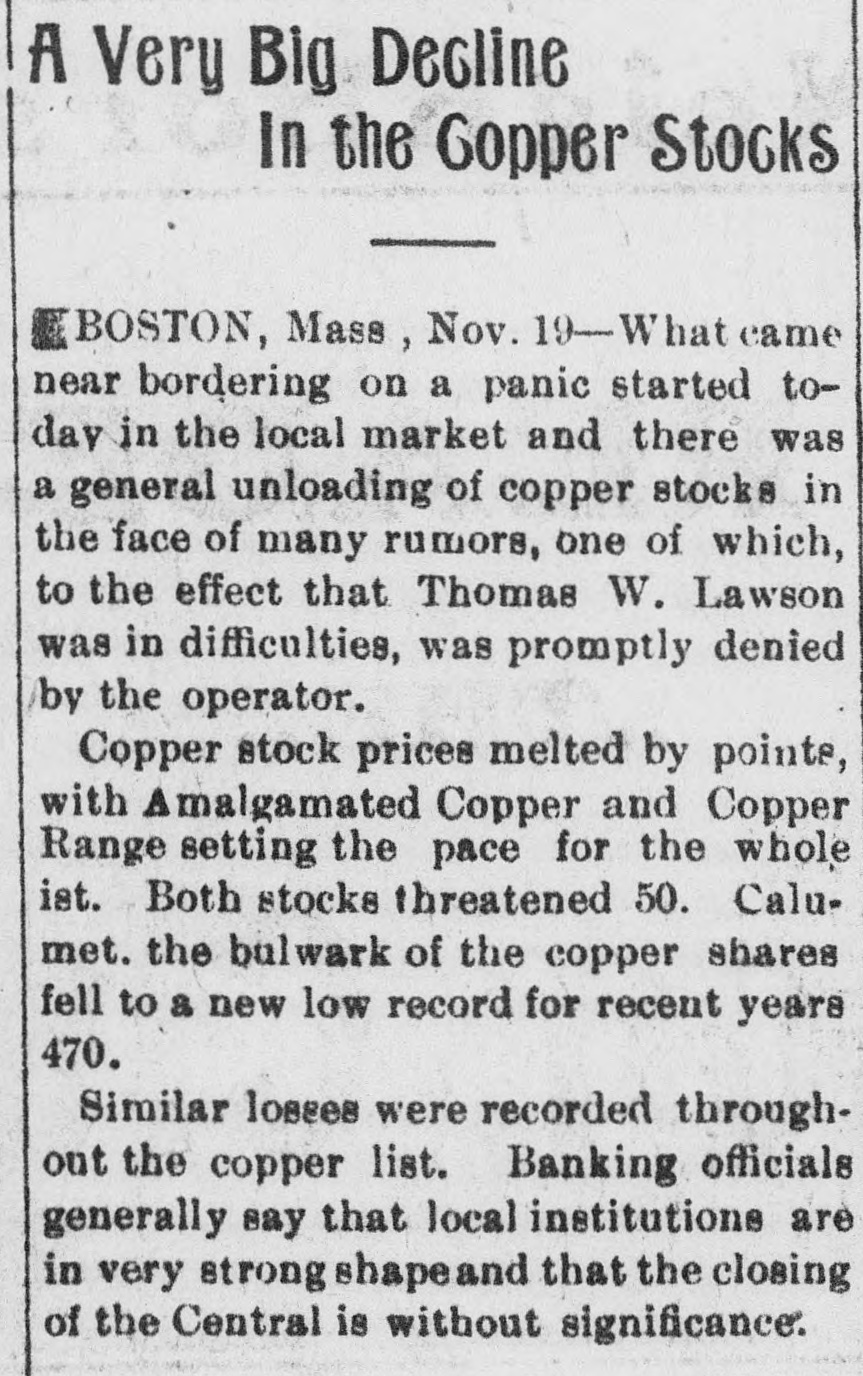
A Very Big Decline In the Copper Stocks BOSTON, Mass, Nov. 19-What came near bordering on a panic started today in the local market and there was a general unloading of copper stocks in the face of many rumors, one of which, to the effect that Thomas W. Lawson was in difficulties, was promptly denied by the operator. Copper stock prices melted by points, with Amalgamated Copper and Copper Range setting the pace for the whole ist. Both stocks threatened 50. Calumet. the bulwark of the copper shares fell to a new low record for recent years 470. Similar losses were recorded throughout the copper list. Banking officials generally say that local institutions are in very strongshapeand that the closing of the Central is without significance.


Article from Barre Evening Telegram, November 25, 1902

Click image to open full size in new tab

Article Text

Receiver For Boston Bank. Washington, Nov. 25.-The comptrolJer of the currency has appointed Frank D. Allen permanent receiver of the Central National bank of Boston.


Article from The Broad Ax, December 27, 1902

Click image to open full size in new tab

Article Text

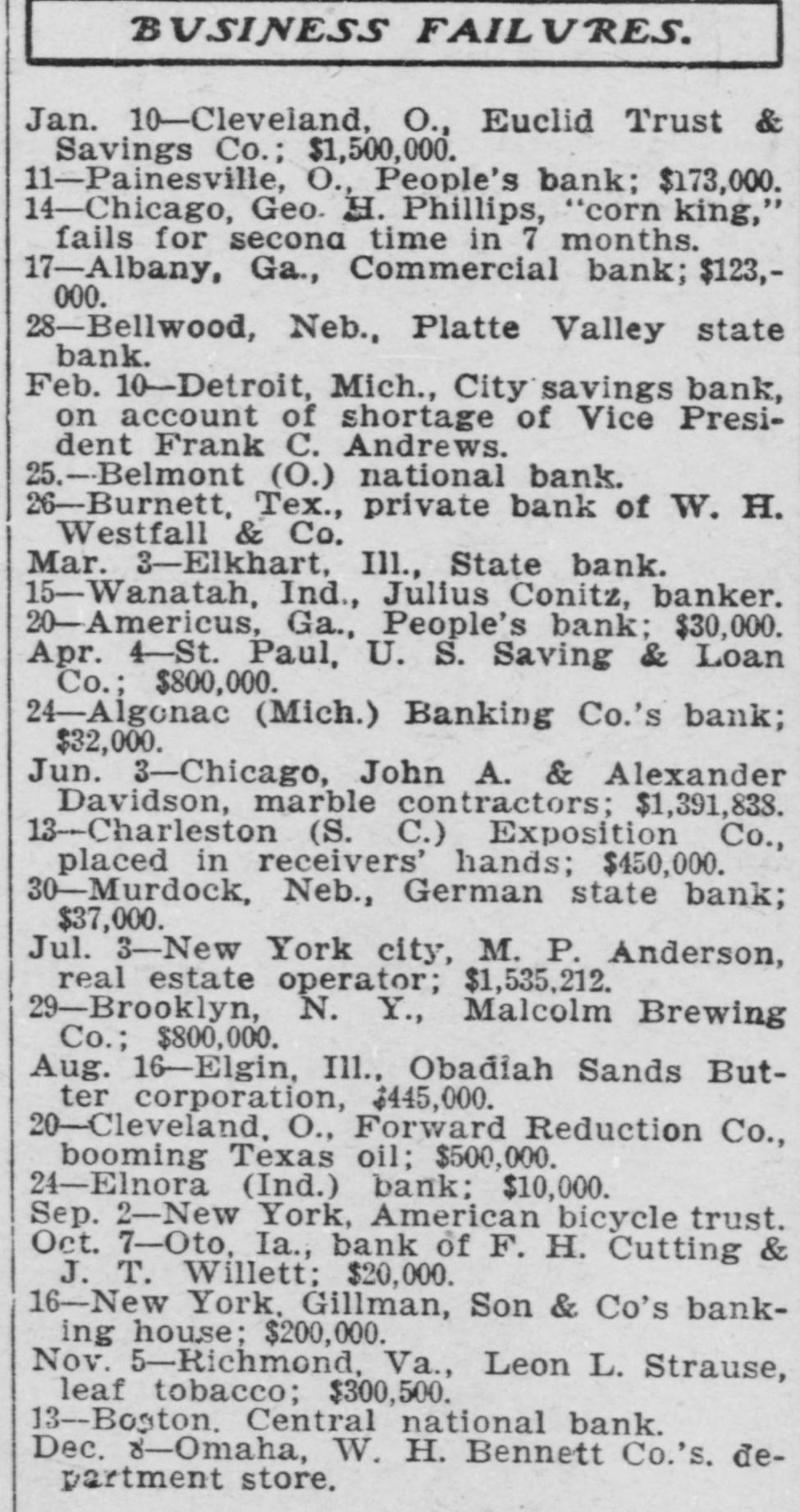
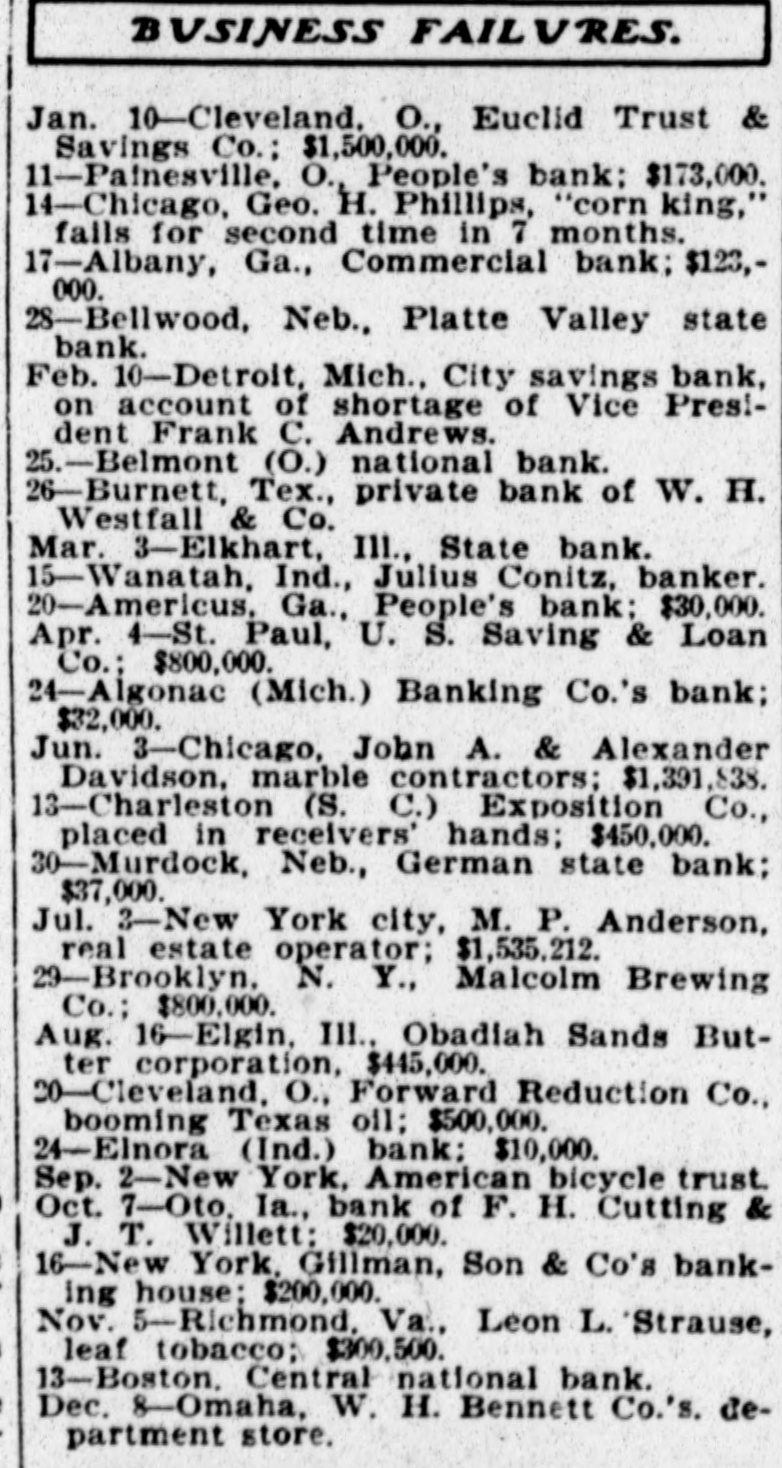
BUSINESS FAILVRES. Jan. 10-Cleveland, 0., Euclid Trust & Savings Co.; $1,500,000. 11-Painesville, 0., People's bank; $173,000. 14-Chicago, Geo. H. Phillips, "corn king," fails for second time in 7 months. 17-Albany, Ga., Commercial bank; $123,000. 28-Bellwood, Neb., Platte Valley state bank. Feb. 10-Detroit, Mich., City savings bank, on account of shortage of Vice President Frank C. Andrews. 25.-Belmont (0.) national bank. 26-Burnett, Tex., private bank of W. H. Westfall & Co. Mar. 3-Elkhart, III., State bank. 15-Wanatah, Ind., Julius Conitz, banker. 20-Americus, Ga., People's bank; $30,000. Apr. 4-St. Paul, U. S. Saving & Loan Co.; $800,000. 24-Algonac (Mich.) Banking Co.'s bank; $32,000. Jun. 3-Chicago, John A. & Alexander Davidson, marble contractors; $1,391,838. 13-Charleston (S. C.) Exposition Co., placed in receivers' hands; $450,000. 30-Murdock, Neb., German state bank; $37,000. Jul. 3-New York city, M. P. Anderson, real estate operator; $1,535,212. 29-Brooklyn, N. Y., Malcolm Brewing Co.; $800,000. Aug. 16-Elgin, Ill., Obadiah Sands Butter corporation, $445,000. 20-Cleveland, O., Forward Reduction Co., booming Texas oil; $500,000. 24-Elnora (Ind.) bank; $10,000. Sep. 2-New York, American bicycle trust. Oct. 7-Oto, Ia., bank of F. H. Cutting & J. T. Willett: $20,000. 16-New York, Gillman, Son & Co's banking house; $200,000. Nov. 5-Richmond, Va., Leon L. Strause, leaf tobacco; $300,500. 13-Boston. Central national bank. Dec. 8-Omaha, W. H. Bennett Co.'s. department store.


Article from The L'anse Sentinel, January 3, 1903

Click image to open full size in new tab

Article Text

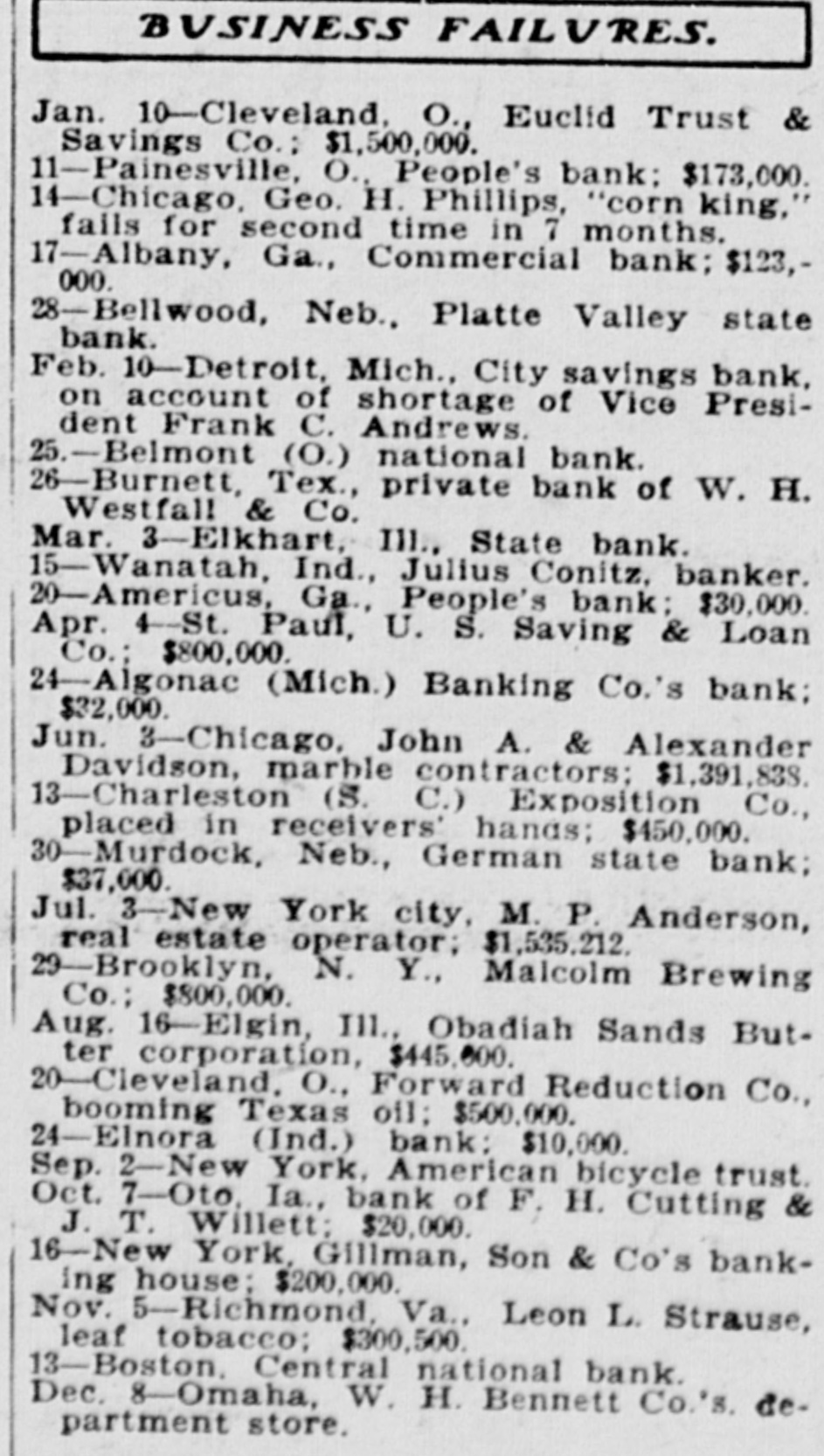
BUSINESS FAILVRES. Jan. 10-Cleveland. O., Euclid Trust & Savings Co.; $1,500,000. 11-Painesville, O., People's bank: $173,000. 14-Chicago, Geo. H. Phillips, "corn king," fails for second time in 7 months. 17-Albany, Ga., Commercial bank; $123,000. 28-Bellwood, Neb., Platte Valley state bank. Feb. 10-Detroit, Mich., City savings bank, on account of shortage of Vice President Frank C. Andrews. 25.-Belmont (O.) national bank. 26-Burnett, Tex., private bank of W. H. Westfall & Co. Mar. 3-Elkhart, III., State bank. 15-Wanatah, Ind., Julius Conitz, banker. 20-Americus, Ga., People's bank; $30,000. Apr. 4-St. Paul, U. S. Saving & Loan Co.; $800,000. 24-Algonac (Mich.) Banking Co.'s bank; $32,000. Jun. 3-Chicago, John A. & Alexander Davidson, marble contractors; $1,391,838. 13-Charleston (S. C.) Exposition Co., placed in receivers' hands; $450,000. 30-Murdock, Neb., German state bank; $37,000. Jul. 3-New York city, M. P. Anderson, real estate operator; $1,535,212. 29-Brooklyn. N. Y., Malcolm Brewing Co.; $800,000. Aug. 16-Elgin, III., Obadiah Sands Butter corporation, $445,000. 20-Cleveland, O., Forward Reduction Co., booming Texas oil; $500,000. 24-Elnora (Ind.) bank: $10,000. Sep. 2-New York, American bicycle trust. Oct. 7-Oto. Ia., bank of F. H. Cutting & J. T. Willett: $20,000. 16-New York, Gillman, Son & Co's banking house: $200,000. Nov. 5-Richmond, Va., Leon L. Strause, leaf tobacco; $300,500. 13-Boston, Central national bank. Dec. 8-Omaha, W. H. Bennett Co.'s. department store.


Article from Iron County Register, January 8, 1903

Click image to open full size in new tab

Article Text

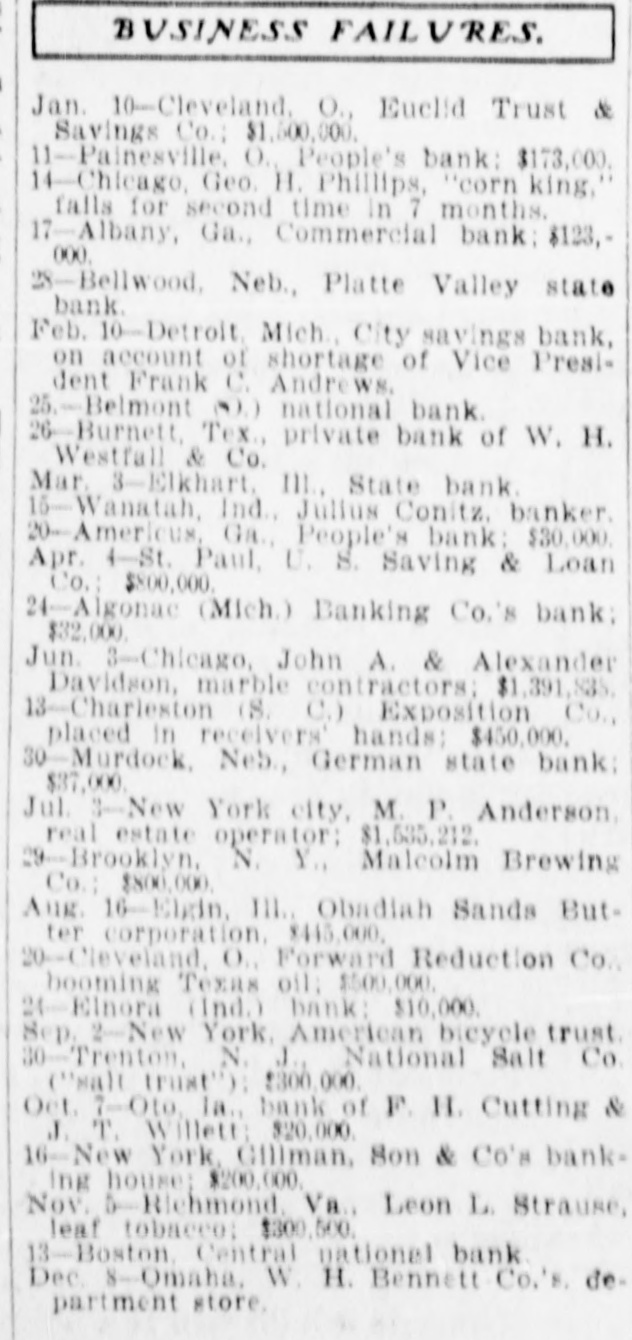
BUSINESS FAILVRES. Jan. 10-Cleveland. O., Euclid Trust & Savings Co.: $1,500,000. 11-Painesville, O., People's bank: $173,000. 14-Chicago, Geo. H. Phillips, "corn king," fails for second time in 7 months. 17-Albany, Ga., Commercial bank; $123,000. 28-Bellwood, Neb., Platte Valley state bank. Feb. 10-Detroit, Mich., City savings bank, on account of shortage of Vice President Frank C. Andrews. 25.-Belmont (O.) national bank. 26-Burnett, Tex., private bank of W. H. Westfall & Co. Mar. 3-Elkhart, Ill., State bank. 15-Wanatah, Ind., Julius Conitz. banker. 20-Americus. Ga., People's bank: $30,000. Apr. 4-St. Paul, U. S. Saving & Loan Co.: $800,000. 24-Algonac (Mich.) Banking Co.'s bank; $32,000. Jun. 3-Chicago, John A. & Alexander Davidson, marble contractors; $1,391,838. 13-Charleston (S. C.) Exposition Co., placed in receivers' hands; $450,000. 30-Murdock, Neb., German state bank; $37,000. Jul. 3-New York city, M. P. Anderson, real estate operator; $1,535,212. 29-Brooklyn, N. Y., Malcolm Brewing Co.; $800,000. Aug. 16-Elgin, Ill., Obadiah Sands Butter corporation, $445,000. 20-Cleveland, O., Forward Reduction Co., booming Texas oil; $500,000. 24-Elnora (Ind.) bank: $10,000. Sep. 2--New York, American bicycle trust. 30-Trenton, N. J., National Salt Co. ("salt trust"): $300,000. Oct. 7-Oto, Ia., bank of F. H. Cutting & J. T. Willett: $20,000. 16-New York, Gillman, Son & Co's banking house; $200,000. Nov. 5-Richmond, Va., Leon L. Strause, leaf tobacco; $300,500. 13-Boston. Central national bank. Dec. 8-Omaha, W. H. Bennett Co.'s. department store.


Article from The Jasper Weekly Courier, January 9, 1903

Click image to open full size in new tab

Article Text

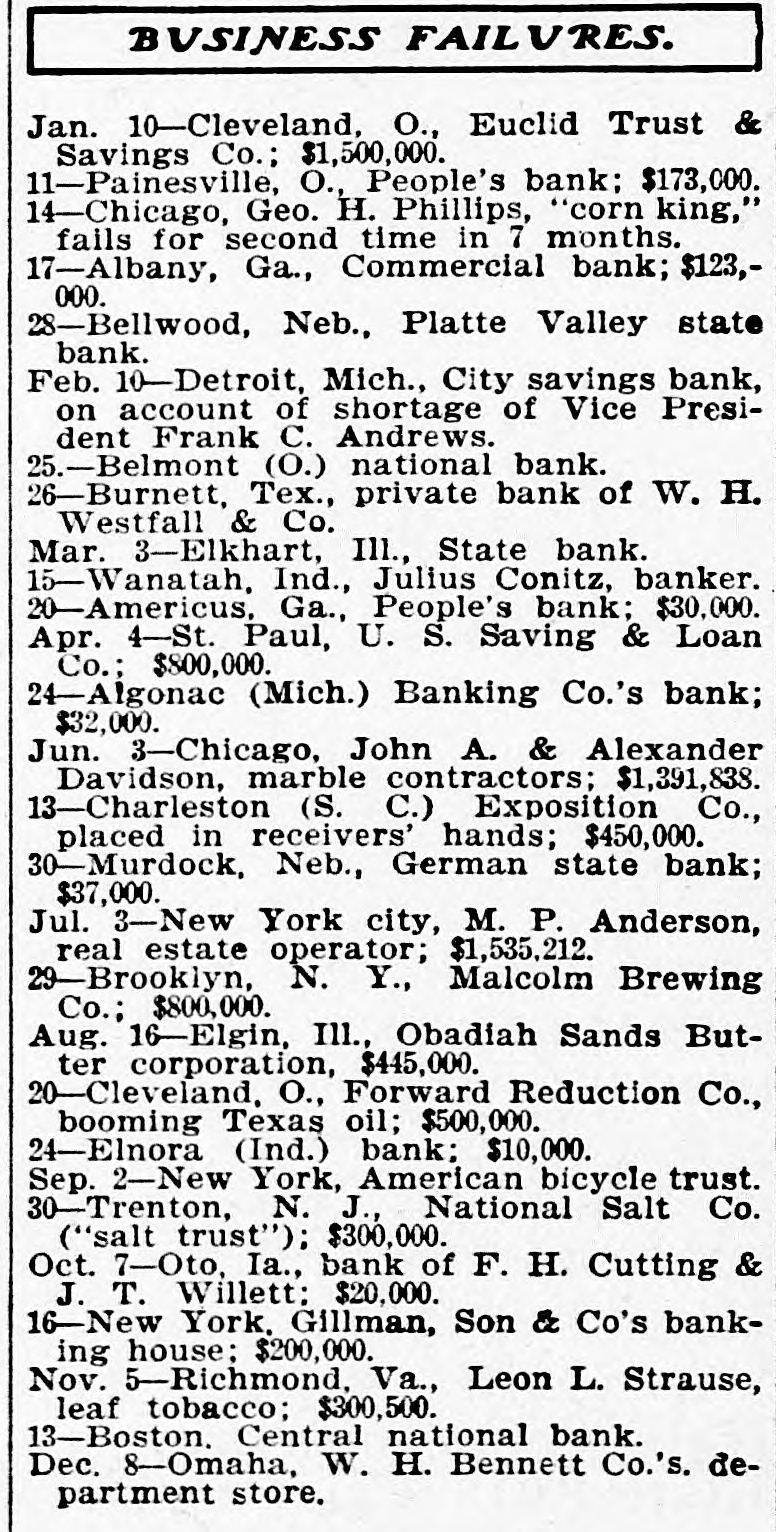
BUSINESS FAILVRES. Jan. 10-Cleveland, O., Euclid Trust & Savings Co.; $1,500,000. 11-Painesville, O., People's bank: $173,000. 14-Chicago, Geo. H. Phillips, "corn king," fails for second time in 7 months. 17-Albany, Ga., Commercial bank; $123,000. 2S-Bellwood, Neb., Platte Valley state bank. Feb. 10-Detroit, Mich., City savings bank, on account of shortage of Vice President Frank C. Andrews. 25.-Belmont (O.) national bank. 26-Burnett, Tex., private bank of W. H. Westfall & Co. Mar. 3-Elkhart, III., State bank. 15-Wanatah, Ind., Julius Conitz, banker. 20-Americus, Ga., People's bank: $30,000. Apr. 4-St. Paul, U. S. Saving & Loan Co.: $800,000. 24-Algonac (Mich.) Banking Co.'s bank; $32.000. Jun. 3-Chicago, John A. & Alexander Davidson, marble contractors; $1,391,838. 13-Charleston (S. C.) Exposition Co., placed in receivers' hands; $450,000. 30-Murdock, Neb., German state bank; $37,000. Jul. 3-New York city, M. P. Anderson, real estate operator; $1,535,212. 29-Brooklyn, N. Y., Malcolm Brewing Co.; $800,000. Aug. 16-Elgin, III., Obadlah Sands Butter corporation. $445,000. 20-Cleveland, O., Forward Reduction Co., booming Texas oil; $500,000. 24-Elnora (Ind.) bank: $10,000. Sep. 2-New York. American bicycle trust. Oct. 7-Oto. 1a., bank of F. H. Cutting & J. T. Willett: $20,000. 16-New York, Gillman, Son & Co's bank. ing house: $200,000. Nov. 5-Richmond, Va., Leon L. Strause, leaf tobacco: $300,500. 13-Boston Central national bank. Dec. 8-Omaha, W. H. Bennett Co.'s. department store.


Article from The Kinsley Graphic, January 9, 1903

Click image to open full size in new tab

Article Text

BUSINESS FAILVRES. Jan. 10-Cleveland, O., Euclid Trust & Savings Co.; $1,500,000. 11-Painesville, 0., People's bank; $173,000. 14-Chicago, Geo. H. Phillips, "corn king," fails for second time in 7 months. 17-Albany, Ga., Commercial bank; $123,000. 28-Bellwood, Neb., Platte Valley state bank. Feb. 10-Detroit, Mich., City savings bank, on account of shortage of Vice President Frank C. Andrews. 25.-Belmont (0.) national bank. 26-Burnett, Tex., private bank of W. H. Westfall & Co. Mar. 3-Elkhart, III., State bank. 15-Wanatah, Ind., Julius Conitz, banker. 20-Americus, Ga., People's bank; $30.000. Apr. 4-St. Paul, U. S. Saving & Loan Co.; $800,000. 24-Algonac (Mich.) Banking Co.'s bank; $32,000. Jun. 3-Chicago, John A. & Alexander Davidson, marble contractors; $1,391,838. 13-Charleston (S. C.) Exposition Co., placed in receivers' hands; $450,000. 30-Murdock, Neb., German state bank; $37,000. Jul. 3-New York city, M. P. Anderson, real estate. operator; $1,535,212. 29-Brooklyn, N. Y., Malcolm Brewing Co.; $800,000. Aug. 16-Elgin, III., Obadiah Sands Butter corporation, $445,000. 20-Cleveland, O., Forward Reduction Co., booming Texas oil; $500,000. 24-Elnora (Ind.) bank; $10,000. Sep. 2-New York, American bicycle trust. Oct. 7-Oto, la., bank of F. H. Cutting & J. T. Willett: $20,000. 16-New York, Gillman, Son & Co's banking house; $200,000. Nov. 5-Richmond, Va., Leon L. Strause, leaf tobacco; $300,500. 13-Boston. Central national bank. Dec. 8-Omaha, W. H. Bennett Co.'s. department store.