20954. Second National Bank (Nashville, TN)

Bank Information

Episode Type
Run → Suspension → Closure
Bank Type
national
Bank ID
771
Charter Number
771
Start Date
September 26, 1873
Location
Nashville, Tennessee (36.166, -86.784)

Metadata

Model
gpt-5-mini
Short Digest
adb6ec36

Response Measures

Partial suspension

Description

September 1873: depositors ran on the Second National (and other city national banks) amid the New York financial panic; the four Nashville national banks posted a notice suspending payments on balances over $200 (partial suspension). January 1874: newspaper reports the Second National Bank has gone into voluntary liquidation. June 1874 court notices reference a receiver handling funds. Sequence supports run -> suspension -> permanent closure/liquidation with receiver involvement.

Events (6)

1. January 31, 1865 Chartered
Source
historical_nic
2. September 26, 1873 Run
Cause
Macro News
Cause Details
Panic and financial crisis originating in New York and other cities produced nervousness and prompted depositors to withdraw funds.
Measures
Bank officers and other Nashville national banks agreed to partially suspend payments on balances exceeding $200 (notice posted).
Newspaper Excerpt
a considerable number of depositors in the Second and Third National Banks made a run on those respective establishments, and within two hours upwards of $100,000 had been drawn out
Source
newspapers
3. September 26, 1873 Suspension
Cause
Macro News
Cause Details
Partial suspension (paying balances under $200) was instituted in response to runs and the wider monetary crisis affecting New York and other cities.
Newspaper Excerpt
it is hereby agreed by the four National Banks of this city that we suspend payments on all balances exceeding $200
Source
newspapers
4. January 8, 1874 Voluntary Liquidation
Source
historical_nic
5. January 17, 1874 Other
Newspaper Excerpt
The Second National Bank of Nashville has gone into voluntary liquidation.
Source
newspapers
6. June 2, 1874 Receivership
Newspaper Excerpt
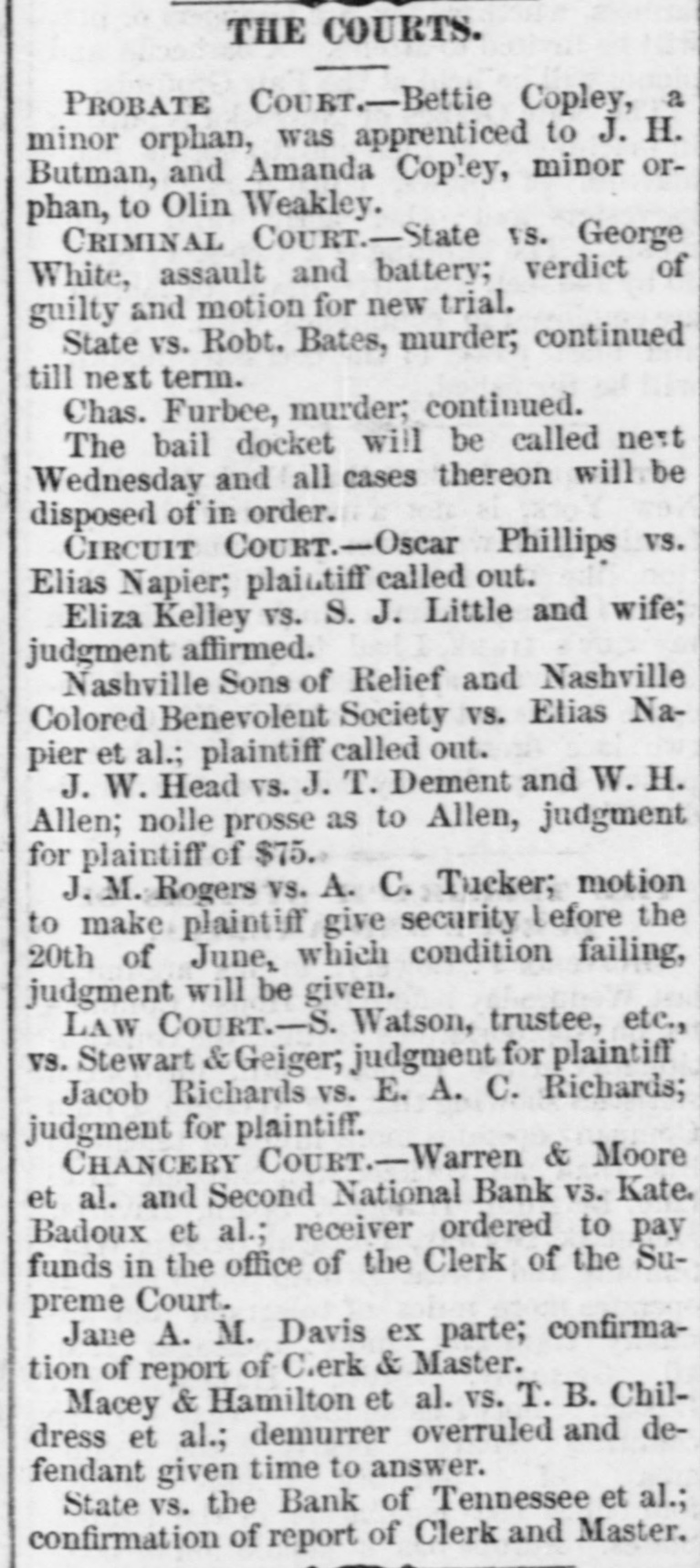
Warren & Moore et al. and Second National Bank vs. Kate Badoux et al.; receiver ordered to pay funds in the office of the Clerk of the Supreme Court.
Source
newspapers

Newspaper Articles (8)

Article from Nashville Union and American, September 26, 1873

Click image to open full size in new tab

Article Text

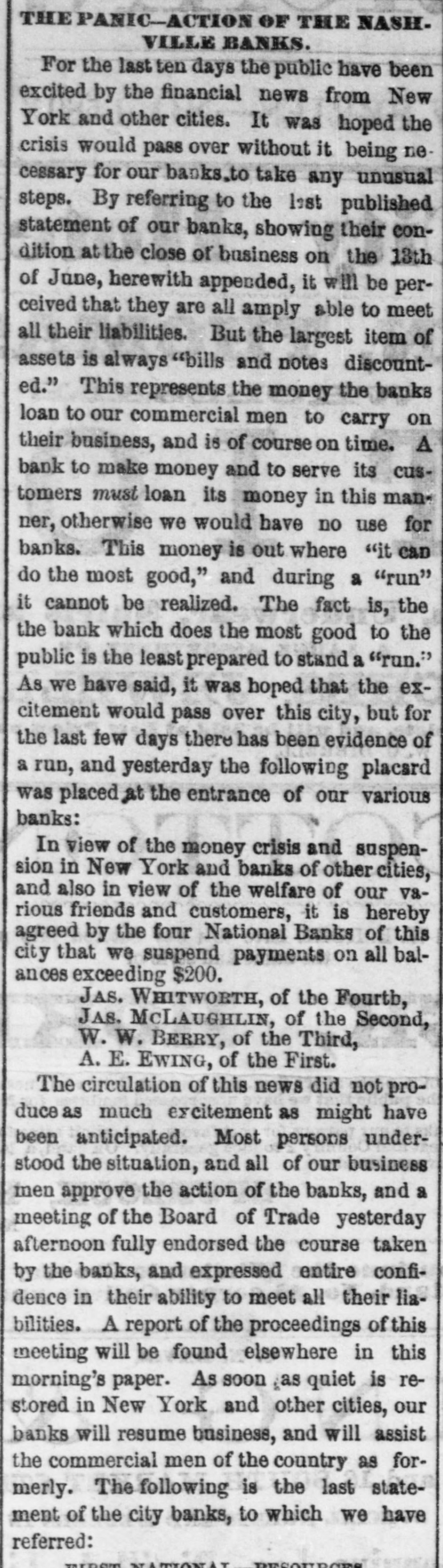
THEPANICACTION OF THE NASHVILLE BANKS. For the last ten days the public have been excited by the financial news from New York and other cities. It was hoped the crisis would pass over without it being necessary for our banks to take any unusual steps. By referring to the lost published statement of our banks, showing their condition at the close of business on the 18th of June, herewith appended, it will be perceived that they are all amply able to meet all their liabilities. But the largest item of assets is always "bills and notes discounted." This represents the money the banks loan to our commercial men to carry on their business, and is of course on time. A bank to make money and to serve its customers must loan its money in this manner, otherwise we would have no use for banks. This money is out where "it can do the most good," and during a "run" it cannot be realized. The fact is, the the bank which does the most good to the public is the least prepared to stand a "run." As we have said, it was hoped that the excitement would pass over this city, but for the last few days there has been evidence of a run, and yesterday the following placard was placed at the entrance of our various banks: In view of the money crisis and suspension in New York and banks of other cities, and also in view of the welfare of our VSrious friends and customers, it is hereby agreed by the four National Banks of this city that we suspend payments on all balances exceeding $200. JAS. WHITWORTH, of the Fourth, JAS. McLAUGHLIN, of the Second, W. W. BERRY, of the Third, A. E.EWING, of the First. The circulation of this news did not produce as much excitement as might have been anticipated. Most persons understood the situation, and all of our business men approve the action of the banks, and a meeting of the Board of Trade yesterday afternoon fully endorsed the course taken by the banks, and expressed entire confidence in their ability to meet all their liabilities. A report of the proceedings of this meeting will be found elsewhere in this morning's paper. As soon as quiet is restored in New York and other cities, our banks will resume business, and will assist the commercial men of the country as formerly. The following is the last statement of the city banks, to which we have referred:


Article from Nashville Union and American, September 26, 1873

Click image to open full size in new tab

Article Text

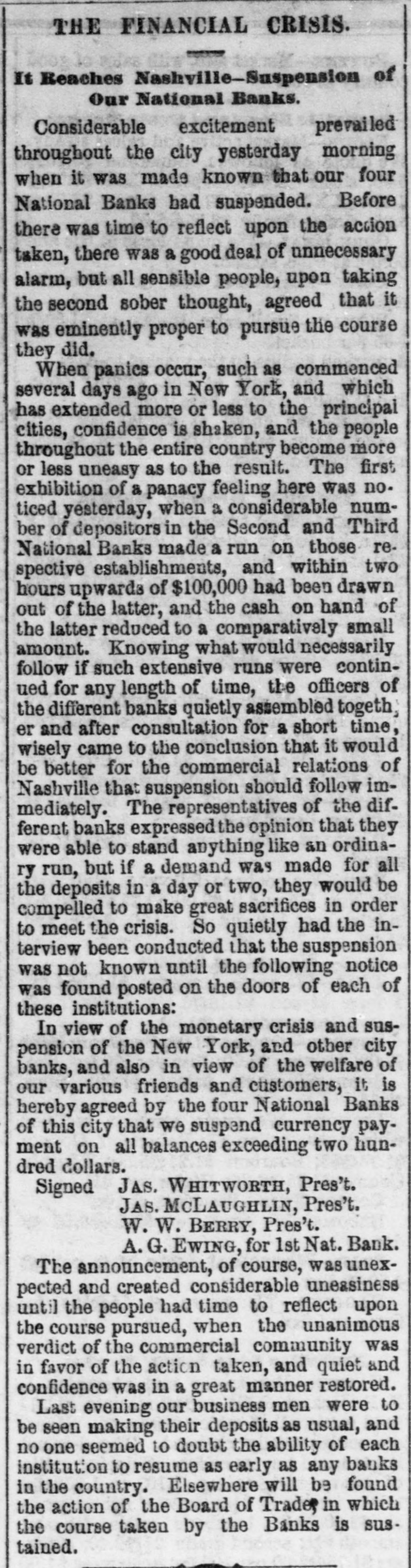
THE FINANCIAL CRISIS. It Reaches Nashville-Suspension of Our National Banks. Considerable excitement prevailed throughout the city yesterday morning when it was made known that our four National Banks had suspended. Before there was time to reflect upon the action taken, there was a good deal of unnecessary alarm, but all sensible people, upon taking the second sober thought, agreed that it was eminently proper to pursue the course they did. When panics occur, such as commenced several days ago in New York, and which has extended more or less to the principal cities, confidence is shaken, and the people throughout the entire country become more or less uneasy as to the result. The first exhibition of a panacy feeling here was no. ticed yesterday, when a considerable number of depositors in the Second and Third National Banks made a run on those respective establishments, and within two hours upwards of $100,000 had been drawn out of the latter, and the cash on hand of the latter reduced to a comparatively small amount. Knowing what would necessarily follow if such extensive runs were continued for any length of time, the officers of the different banks quietly assembled togeth er and after consultation for a short time, wisely came to the conclusion that it would be better for the commercial relations of Nashville that suspension should follow immediately. The representatives of the different banks expressed the opinion that they were able to stand anything like an ordinary run, but if a demand was made for all the deposits in a day or two, they would be compelled to make great sacrifices in order to meet the crisis. So quietly had the interview been conducted that the suspension was not known until the following notice was found posted on the doors of each of these institutions: In view of the monetary crisis and suspension of the New York, and other city banks, and also in view of the welfare of our various friends and customers, it is hereby agreed by the four National Banks of this city that we suspend currency payment on all balances exceeding two hundred dollars. Signed JAS. WHITWORTH, Pres't. JAS. McLAUGHLIN, Pres't. W. W. BERRY, Pres't. G.EWING, for 1st Nat. Bank. The announcement, of course, was unexpected and created considerable uneasiness until the people had time to reflect upon the course pursued, when the unanimous verdict of the commercial community was in favor of the action taken, and quiet and confidence was in a great manner restored. Last evening our business men were to be seen making their deposits as usual, and no one seemed to doubt the ability of each institution to resume as early as any banks in the country. Elsewhere will be found the action of the Board of Trade, in which the course taken by the Banks is sustained.


Article from Nashville Union and American, September 26, 1873

Click image to open full size in new tab

Article Text

THE BOARD OF TRADE. Conference with the Bankers of the City. The Financial [Situation Debated. The Course of the Benks'Endorsed. A called meeting of the Nashville Board of Trade was held at 4 o'clock yesterday afternoon in the office of the Commercial Insurance Company, President H. C. Henslot in the chair, and R. L. Armistead Secreivj tary. President Hensley stated the object was to confer with the bank officers as to what was best togbe done'under existing circumstances. Judge Whitworth, President of the Fourth National Bank, being called upon, said the present state of affairs was a novel one to him. He had never seen anything like it. He was here to consult with the business men as to what was best to be done. The banks he thought were entirely solvent and able within a very short time to meet all their obligations, but could not do it in a day without a great sacrifice of their means and a total destruction of the (trade of the community for the time. Af er a consultation with all the National PAnks it was agreed that they shou'd partially suspend payment on all balances; over $200, but with this understanding that all deposits made after that hour should be paid in full and the business in all respects so far as the public was conceived should be conducted just as it was before the suspension, trusting to the collection of means due the banks and such cash means as they have in bank to pay, off their depositors in full, which he felt confident could be done in a short time. The banks expect to go on as usual and take bills of exchange drawn against shipments to the extent of their ability, which he believed would be sufficient to meet the wants of the mercantile emmunity. He said he had been asked if a check given by a bank here on a bank in New York was not honored, then what would be the result. He replied upon the return of the check dishonored, it would be taken up and paid by the bank suing it. The alternative was presented this day to the banks, as he believed, to take the course they have taken or to be so crippled by a run of their depositors as to be unable to afford the mercantile community any facilities in conducting their business or handling the produce of the country. Mr. Hensley asked the question of Judge Whitworth whether some arrangement could not be made by the banks by which settlements could be made between merchants dealing with the banks by means of certified checks. In reply to which he stated that he had no doubt it could, but no plan had yet been formally adopted, by the banks looking to that end. And also sail that with an appreciation of the situation by both merchants and bankers, there would not be much difficulty in carrying forward the trade and commerce of the country. Mr. Edgar Jones, Cashier of the Third National Bank, endorsed fally the remarks made by Judge Whitworth and referring to the question of certified checks, said he presumed some system would be adapted of that sort, for all settlements between banks belonging to the Clearing House Association in New York were made by certified checks. Mr. John W. Terrass wished to know if the banks would furnish facilities for the moving of produce 88 usual. In response to which the officers of the several banks present stated that that was the object of the partial suspension, and that every facility in that direction the banks could afford, would be given. Mr. Jas. A. McLanghlin, President of the Second National Bank, in a few brief remarks fully endorsed the statements made by Judge Whitworth and Edgar Jones, Esq. Mr. T. D. Craighead offered the following resolutions: Resolved, that the Board of Trade sanction the action taken by the banks to-day, believing it to be the wisest measure that could be inaugurated. Resolved, that we continue as usual to deposit from time to time in the banks and render them all the assistance in our power; and that our confidence in our financial institutions remains unimpaired. The resolutions were adopted by scela. mation, without a dissenting voice, and the meeting adjourced.


Article from Fayetteville Observer, October 2, 1873

Click image to open full size in new tab

Article Text

The Cash Crisis. The money "equeeze" to which we referred last week has extended to the West and South, and bunks are shutting down in all directions. The scare is out of all to the cause. the four Thursday proportion Nashville Last national banks suspended. It was done as a precautionary measurenot of necessity. The banks claim to be able to pay three dollara for one that they owe. It was plain to the officers that if they suffered a spontaneous raid the of depositors, business sacrificed, of the banks would not only be but the general mercantile interest of the whole community, as well, by the consequent stagnation of trade. They met and agreed to issue the following notice, which was shortly after conspicuously posted in the respective banks: In view of the monetary crisis, and suspension of New York and other city banks, and also in view of the interests of our various friends and customers, it is hereby agreed by the four National Banks of this city, that we sus- all pend currency payment on balances exceeding two hundred ($200) dollars. President JAMES Fourth WHITWORTH, National Bank. JAS. McLAUGHLIN, President Second National Bank. W. W. BERRY, President Third National Bank. A. G. EWING, For First National Bank. This notice at first produced quite a little breeze, and brought good many depositors to the to inquire what They were genbanks a and portended. it meant could erally told every depositor obeck out $200, and that within bal reasonable time, all their ances could be settled, if desired If money was wanted for a legiti- be mate business, it would also furnished to help any merchant out of a difficulty, but when man simply came through th promptings of fear, and desire to check out by wholesale, the would simply call "time" on him It seems evident that had the banks continued to pay cut at call by the end of the week the to would have been co.npelled close, and thus a disastrous pan is might have been precipitated which would have ramified through Middle Tennessee Thi would have ruined trade for thi because the circulating which WAS would have aeason, medium pendent, upon been it the with ol de drawn and stored away in chests and trunks and cupboard and yarn socks, and every othe known receptacle and nook an corner which might have bee measurably considered safer than banks. The crisis was brought to a hea by the Louisville and Nashvill and Great Southern and St Lou and Southeastern railroads refus ing to receive checks on the Nash ville banks inpayment for ineights Per contra, the Nashville and Cha tanooga and St. Louis railroads If ceived the checks in payment. Thursday evening the Nash a ville Board of Trade met and dopted the following resolution by acclamation: Resolved, That the Board o Trade sanction the action take by the banks today, believing to be the wisest measure th could be inaugurated. Resolved. That we continue usual, to deposit from time as time in the banks, and rend them all the assistance in o power; and that our confidence r in our financial institutions maine unimpaired. Rest Thos. B. Kercheval, ra


Article from Whig and Tribune, January 17, 1874

Click image to open full size in new tab

Article Text

Fayette county, in 1873. Carroll county had two hundred and twenty-five marriages in 1878. Pork was selling at Bolivar last week at 134 cents per pound. Hardeman county has fixed the tax for county purposes, at 30 ets. The poll tax is onedollar per head. Green Williams, aged 61, died at his residence, five miles east of Humboldt, on the 9th. Marshall county has about $6,000 in cash in its treasury, and don't owe dollar. Happy Giles county! She is out of debt, and has ten thousand dollars in cash. Happy Giles Over in Humpbreys county, there were one hundred and fifteen marriages in 1873. The Overton Hotel, in Memphis, is recommended by the Shelby county court, for a Court House. The Banner says the county court of Davidson county costs about $30 per hour, while in session. The Second National Bank of Nashville has gone into voluntary liquidation. Jas. W. Bryant was last week confirmed as Collector of Internal Revenue for the tourth district of Tennessee. Jno. H. O'Neil, who had been for twelve years an Express messenger, died at Nashville, of Consumption, on the 8th. Wm. Orman shot and killed Robert Cunningham, at Rally hill, on the 31st of December. Both drunk. Orman fled. Judge James D. Porter, of Paris, has tendered his resignation as Circuit Judge to Gov. Brown. We hear no reason assigned. Rev. W. E. Hall, late pastor of the Christian Church in this city, commences a protracted meeting at Huntingdon, to-day. Alexander D. Neilson, of the mercantile firm of Neilson & Bro., died at his residence, at Bolivar last week, aged 55 years. Coffee county ain't populating in the 'good old way' very fast-at least there were only 83 marriage licenses issued in that county last year. The County Court of Hardeman, at its session on the 4th, voted a tax of fifty cents upon each of the dog population of Hardeman county for the year 1874. Robertson county-where they make so much mean whisky-had two hundred and ten weddings last year, against one hundred and eighty-two in 1873. The 'new assessment' blanks, for the use of revenue Assessors, will be generally in the hands of the County Clerks by the 1st of February. Joe Wyman, a boy fourteen years old was killed in Memphis last Saturday, by being struck upon the head with a billet of wood, by a man named Henry Benders. The Nashville Banner learns that Hon. Thos. H. Coldwell, of Shelbyville, will be an independent republican candidate for Governor at the November election. A man named Denman Bills, aged 63 years. was recently married in Marshall county, to a girl named South, aged 20. December to June. The Marshall county Gazette says: In obedience to an order of the Chairman of the county court, the tax collector paid $32,000 to the Trustee, at one payment, a few days ago. The Clarksville Chronicle says some incendiary fired and burned down the slaughter house of W. P. Lindley on Sunday the 4th. He had another up and in operation on the 10th. W. D. Hicks, Esq., for sixty years a citizen of Murfreesboro, and for thirty years a Justice of the Peace in Rutherford county, fell dead at the door of his residence on the 6th inst. The McKenzie Times says a stone two inches in length, and three inches in circumference, was successfully taken from the bladder of a little son of J. C. Herring ton, of Humphreys county, the other day. The Mississippi Central railroad last week, paid into the State Treasury, in past due coupons, on its interest account, the sum of $35,935; and the Mississippi and Tennessee road paid $26,335. The Clarksville Obronicle learns, from what it regards as reliable authority, that Hon. R. J. Morgan, Chancellor of the first Court in Memphis, will be a candidate for Governor next fall. He is a man of character and capacity. The bale of cotton presented by Creed Taylor of Arkansas, for benevolent purposes, in Memphis, in its various sales, netted $3,425 48. That amount has just been distributed to the various charitable institutions of Memphis. It is proposed to hold a State convention in Nashville, Feb 22d, of the soldiers who composed the Army of Tennessee' during the late war, for the purpose of putting on record theacts and doings shano


Article from Nashville Union and American, June 2, 1874

Click image to open full size in new tab

Article Text

THE COURTS. PROBATE Courr.-Bettie Copley, a minor orphan, was apprenticed to J. H. Butman, and Amanda Copley, minor orphan, to Olin Weakley. CRIMINAL Courr.-State vs. George White, assault and battery; verdict of guilty and motion for new trial. State vs. Robt. Bates, murder; continued till next term. Chas. Furbee, murder; continued. The bail docket will be called next Wednesday and all cases thereon will be disposed of in order. CIRCUIT COURT.-Oscar Phillips vs. Elias Napier; plaintiff called out. Eliza Kelley vs. S. J. Little and wife; judgment affirmed. Nashville Sons of Relief and Nashville Colored Benevolent Society vs. Elias Napier et al.; plaintiff called out. J. W. Head vs. J. T. Dement and W. H. Allen; nolle prosse as to Allen, judgment for plaintiff of $75. J. M. Rogers vs. A. C. Tucker; motion to make plaintiff give security before the 20th of June, which condition failing, judgment will be given. Law COURT.-S. Watson, trustee, etc., vs. Stewart & Geiger; judgment for plaintiff Jacob Richards vs. E. A. C. Richards; judgment for plaintiff. CHANCERY Court.-Warren & Moore et al. and Second National Bank V3. Kate. Badoux et al.; receiver ordered to pay funds in the office of the Clerk of the Supreme Court. Jane A. M. Davis ex parte; confirmation of report of Clerk & Master. Macey & Hamilton et al. vs. T. B. Childress et al.; demurrer overruled and defendant given time to answer. State vs. the Bank of Tennessee et al.; confirmation of report of Clerk and Master.


Article from Nashville Union and American, March 23, 1875

Click image to open full size in new tab

Article Text

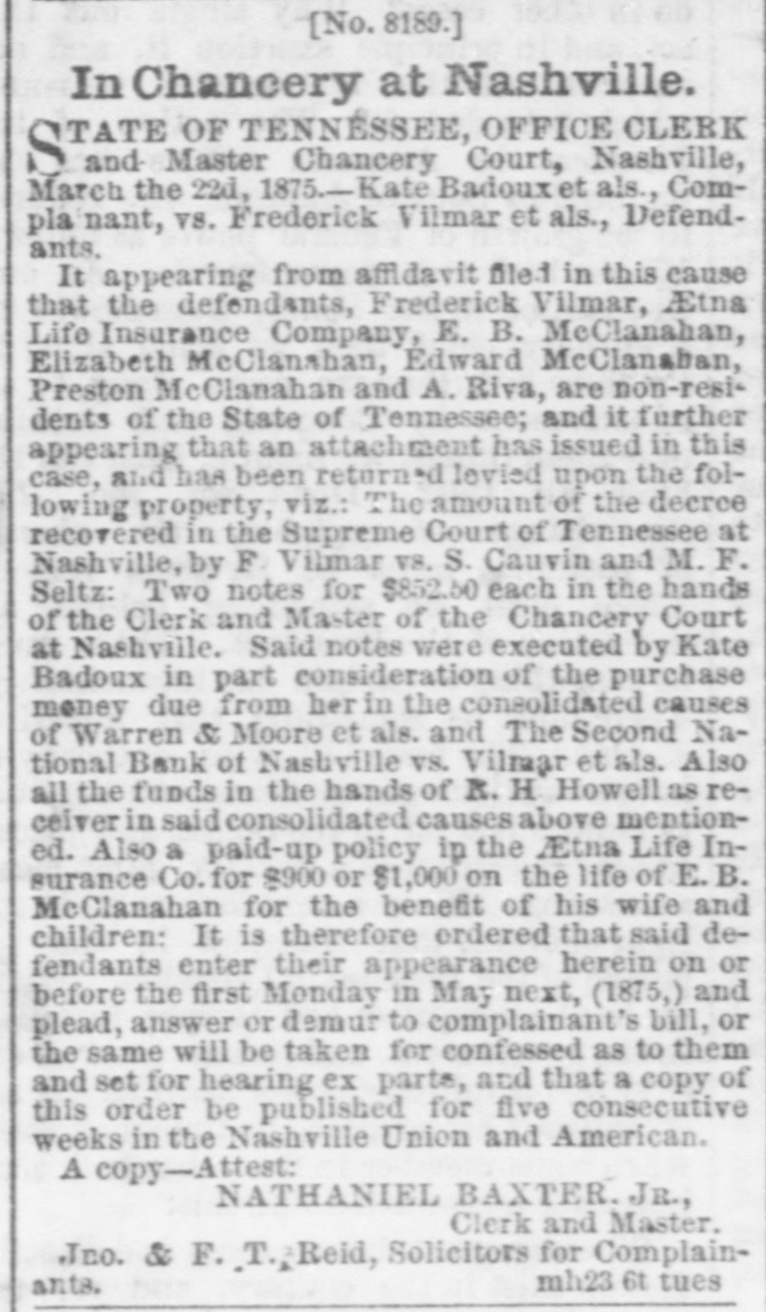
[No. 8189.] In Chancery at Nashville. TATE OF TENNÉSSEE, OFFICE CLERK and Master Chancery Court, Nashville, March the 22d, 1875.Kate Badoux et als., Compla nant, VS. Frederick Vilmar et als., Defendants, It appearing from affidavit filed in this cause that the defendants, Frederick Vilmar, Atna Life Insurance Company, E. B. McClanahan, Elizabeth McClanshan, Edward McClanaban, Preston McClanahan and A. Riva, are non-residents of the State of Tennessee; and it further appearing that an attachment has issued in this case, and has been return levied upon the following property, viz.: The amount of the decree recovered in the Supreme Court of Tennessee at Nashville, by F. Vilmar V8, S. Cauvin and M. F. Seltz: Two notes for $852.50 each in the hands of the Clerk and Master of the Chancery Court at Nashville. Said notes were executed by Kate Badoux in part consideration of the purchase money due from her in the consolidated causes of Warren & Moore et als. and The Second National Bank of Nashville vs. Vilmar et als. Also all the funds in the hands of R. H Howell as receiver in said consolidated causes above mentioned. Also a paid-up policy in the Etna Life Insurance Co. for $900 or $1,000 on the life of E.B. McClanahan for the benefit of his wife and children: It is therefore ordered that said defendants enter their appearance herein on or before the first Monday in May next, (1875,) and plead, answer or demur to complainant's bill, or the same will be taken for confessed as to them and set for hearing ex parts, and that a copy of this order be published for five consecutive weeks in the Nashville Union and American. A copy-Attest: NATHANIEL BAXTER. Jr., Clerk and Master. Jno. & F. T., Reid, Solicitors for Complainmh23 6t tues ants.


Article from Pittsburg Dispatch, October 6, 1892

Click image to open full size in new tab

Article Text

LATE NEWS IN BRIEF. -A suicide epidemic prevails in Chile. -Peruvians are dying off from the grip. -Typhus fever is epidemic at Za catecas, Mexico. -A gold discovery is reported from Lost Canyon, Col. -The wrecked whaleback Wetmore is going to pieces. -Caracas is still being defended against Crespo's advance. -Grasshoppers are overrunning Southwestern Missouri. -Brazil, Ind., claims to have gold and silPay u! JOA -The Second National Bank of Nashville has safely weathered a run. -Boise City, Idaho, will be heated by hot water from artesian wells. -The Russian Painir expedition has returned to Fergbana in Turkestan. -The freedom of the City of Liverpool will be conferred upon Gladstone. -The National Anti-Horse Thief Association is in session at Anderson, Ind. -Cardinal Tascherau, of Quebec, has issued his Columbus Day proclamation. -Rumored that the Prime Minister of health III JO tunoout uo restan IIIM BRAND -The Canadian Soo Canal will be ready for use at the opening of navigation in 1894. -The riotous Carmaux strikers have been sentenced to various terms of imprisonment. -Captain Andrews and his dory have arrived at Palos, Spain, where he received an ovation. -The execution of McNulty. the San Francisco murderer, has been stayed for the third time. -Colonel Elliott F. Shepard is in Chicago pushing his scheme for $1 railroad tickets for the World's Fair. -Willie Thrallkell, at Eureka, Ky., committed suicide because he was obliged to leave home to attend college. -The National Association of Local Preachers have elected as president Rev. John R. Wright, D. D., Washington. -Illinois militiamen refuse to parade at the World's Fair dedication. They object to paying their own traveling expenses. -Charles B. Murray, editor of the Price Current, was re-elected superintendent of the Cincinnati Chamber of Commerce Tuesday. -The Spaniard who attempted to assassinate Captain General Coello. of Seville, has been identified as an Anarchist named Ceballos. -The Spanish steamship Vera Cruz has been wrecked on a rock near the Mexican port of the same name. The crew are still "pruoq uo -A maniac patient in the Indianapolis asylum stabbed Miss Myers, an attendant, IIIM Aictin The scissors. JO and 1: THE probably die. -The sub-Committee on Naval Parade of the Columbian Celebration Committee has received word that from 250 to 500 steamers, tugs, steam yachts, etc., will take part in the naval parade. -The great Roosevelt Organ Manufacturing 0 npany. occupying an entire block in New York City and giving employment to several hundred workingmen. is to be closed. The business was established in 1879. -Obadiah C. Vosbett, paying teller of the Smyrna, Del., National Bank, has been charged with making false entries in the bank's books with intent to deceive the officers thereof. He was arrested and held in $6,000 bail for court. -The Navy Department will send the United States Marine Band to New York on the 11th inst. together with a battalion of marines from the Washington barracks now on duty at Sandy Hook to participate in the Columbian celebration. -The Secretary of the Interior has appointed Henry H. Harmon, George A. Welch and Kemper Peabody, all of North Dakota, as a commission to appraise the lands of the Ft. Rice abandoned military reservation in North Dakota under the act of July 5. 1884. -Cincionati wholesale and jobbing houses are SO much concerned about a deal between Havemeyer, of New York, and the Wholesale Grocers' Association, of Ohio, that they have decided to send a committee to protest personally to Havemever against the consummation of the deal. -In the Floyd Circuit Court at New Albany, Ind., Stuart G. and A. Percy Culbertson, of St. Paul, grandsons of the late Millionaire W. S. Culbertson, filed a suit to contest the will of their grandfather. He had cut them off with $100,000 because they engaged in horse racing. The estate is worth 000'000'8$ -When the British bark Lynwood, from La Plata, July 20, touchel at Falmonth, England, for orders, her crew sent letters to the Mayor complaining that Captain Ross S!H 'puel 01 them JO euou quartity pinom object, they said, was to prevent them from 04 mished She 04 B seeting complain of the terrible treatment they had been subjected to. -Major Joseph Magone walked into Chicago on the Rock Island tracks, completing a walk of 2,100 miles from Grant county, Ore. Major Magone under took his long tramp July 4, and, except swimming a river