20907. First National Bank (Nashville, TN)

Bank Information

Episode Type
Suspension → Reopening
Bank Type
national
Bank ID
150
Charter Number
150
Start Date
September 26, 1873
Location
Nashville, Tennessee (36.166, -86.784)

Metadata

Model
gpt-5-mini
Short Digest
ae00bab5

Response Measures

None

Description

Multiple articles (Sept. 26 and Oct. 2, 1873) report that the four National Banks of Nashville, including the First National Bank, agreed to suspend payments on balances over $200 as a precaution during the New York monetary panic and planned to resume business once conditions eased. One earlier article (Sept. 20) contains a line saying Edwin L. Stanton was appointed receiver of the First National Bank — this conflicts with the later reports that the bank was merely suspending payments and expected to reopen; that line may be an OCR/error or refer to a different matter. I classify the episode as a precautionary suspension with planned reopening.

Events (1)

1. September 26, 1873 Suspension
Cause
Macro News
Cause Details
Precautionary suspension in response to the monetary crisis and bank suspensions in New York and other cities (national panic/monetary squeeze).
Newspaper Excerpt
it is hereby agreed by the four National Banks of this city that we suspend payments on all balances exceeding $200.
Source
newspapers

Newspaper Articles (3)

Article from Nashville Union and American, September 20, 1873

Click image to open full size in new tab

Article Text

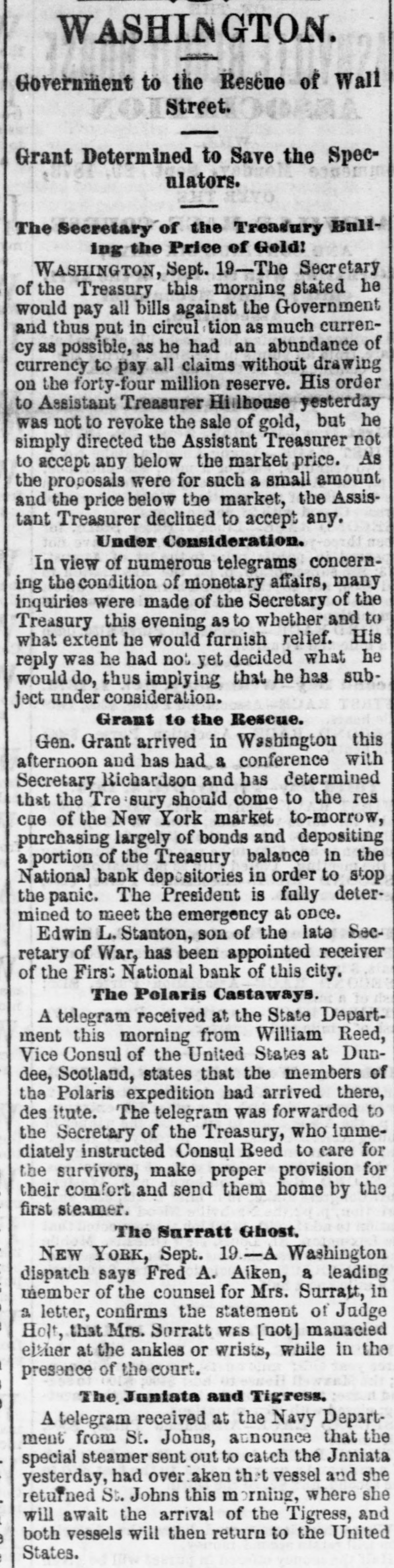
WASHINGTON Government to the Rescue of Wall Street. Grant Determined to Save the Speculators. The Secretary of the Treasury Balling the Price of Gold! WASHINGTON, Sept. 19-The Secretary of the Treasury this morning stated he would pay all bills against the Government and thus put in circul tion as much currency as possible, as he had an abundance of to all on the reserve. currency forty-four pay million claims without His drawing order to Assistant Treasurer Hillhouse yesterday was not to revoke the sale of gold, but he simply directed the Assistant Treasurer not to accept any below the market price. As the proposals were for such a small amount and the price below the market, the Assistant Treasurer declined to accept any. Under Consideration. In view of numerous telegrams concerning the condition of monetary affairs, many inquiries were made of the Secretary of the Treasury this evening as to whether and to what extent he would furnish relief. His reply was he had not yet decided what he would do, thus implying that he has subject under consideration. Grant to the Rescue. Gen. Grant arrived in Washington this afternoon and has had a conference with Secretary Richardson and has determined that the Tre sury should come to the res cue of the New York market to-morrow, purchasing largely of bonds and depositing a portion of the Treasury balance in the National bank depositories in order to stop the panic. The President is fully determined to meet the emergency at once. Edwin L. Stanton, son of the late Secretary of War, has been appointed receiver of the First National bank of this city. The Polaris Castaways. A telegram received at the State Department this morning from William Reed, Vice Consul of the United States at Dundee, Scotland, states that the members of the Polaris expedition had arrived there, des itute. The telegram was forwarded to the Secretary of the Treasury, who immediately instructed Consul Reed to care for the survivors, make proper provision for their comfort and send them home by the first steamer. The Surratt Ghost. NEW YORK, Sept. 19-A Washington dispatch says Fred A. Aiken, a leading member of the counsel for Mrs. Surratt, in that Was a Holt, letter, confirms Mrs. Sorratt the statement [not] manacied of Judge either at the ankles or wrists, while in the presence of the court. The Janiata and Tigress. A telegram received at the Navy Department from St. Johns, announce that the special steamer sent out to catch the Janiata yesterday, had over aken that vessel and she returned St. Johns this morning, where she will await the arrival of the Tigress, and both vessels will then return to the United States.

Article from Nashville Union and American, September 26, 1873

Click image to open full size in new tab

Article Text

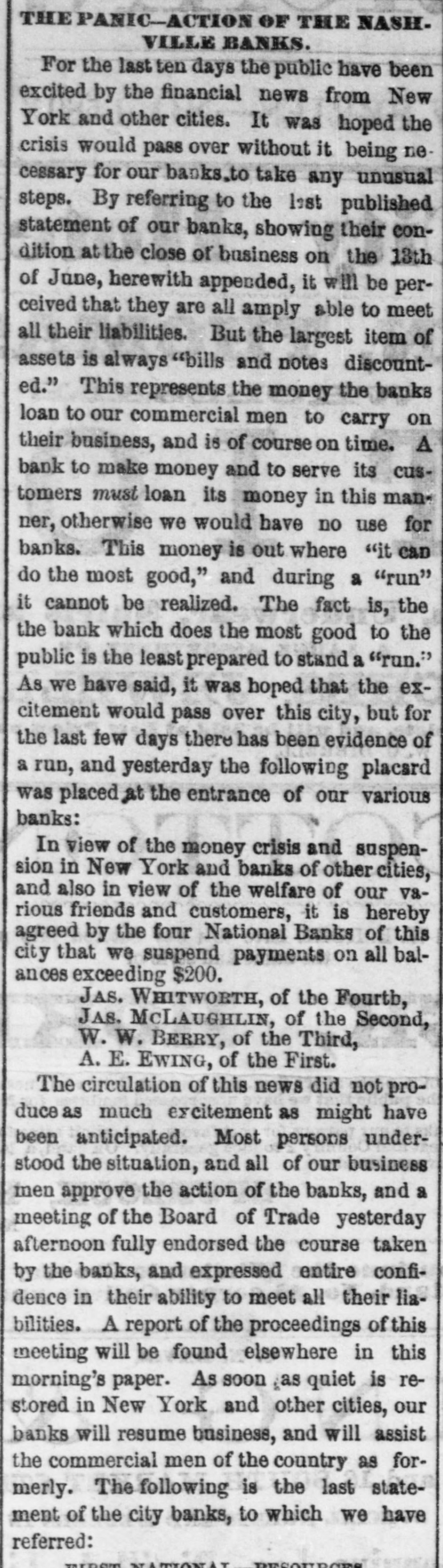
THEPANICACTION OF THE NASHVILLE BANKS. For the last ten days the public have been excited by the financial news from New York and other cities. It was hoped the crisis would pass over without it being necessary for our banks to take any unusual steps. By referring to the lost published statement of our banks, showing their condition at the close of business on the 18th of June, herewith appended, it will be perceived that they are all amply able to meet all their liabilities. But the largest item of assets is always "bills and notes discounted." This represents the money the banks loan to our commercial men to carry on their business, and is of course on time. A bank to make money and to serve its customers must loan its money in this manner, otherwise we would have no use for banks. This money is out where "it can do the most good," and during a "run" it cannot be realized. The fact is, the the bank which does the most good to the public is the least prepared to stand a "run." As we have said, it was hoped that the excitement would pass over this city, but for the last few days there has been evidence of a run, and yesterday the following placard was placed at the entrance of our various banks: In view of the money crisis and suspension in New York and banks of other cities, and also in view of the welfare of our VSrious friends and customers, it is hereby agreed by the four National Banks of this city that we suspend payments on all balances exceeding $200. JAS. WHITWORTH, of the Fourth, JAS. McLAUGHLIN, of the Second, W. W. BERRY, of the Third, A. E.EWING, of the First. The circulation of this news did not produce as much excitement as might have been anticipated. Most persons understood the situation, and all of our business men approve the action of the banks, and a meeting of the Board of Trade yesterday afternoon fully endorsed the course taken by the banks, and expressed entire confidence in their ability to meet all their liabilities. A report of the proceedings of this meeting will be found elsewhere in this morning's paper. As soon as quiet is restored in New York and other cities, our banks will resume business, and will assist the commercial men of the country as formerly. The following is the last statement of the city banks, to which we have referred:


Article from Fayetteville Observer, October 2, 1873

Click image to open full size in new tab

Article Text

The Cash Crisis. The money "equeeze" to which we referred last week has extended to the West and South, and bunks are shutting down in all directions. The scare is out of all to the cause. the four Thursday proportion Nashville Last national banks suspended. It was done as a precautionary measurenot of necessity. The banks claim to be able to pay three dollara for one that they owe. It was plain to the officers that if they suffered a spontaneous raid the of depositors, business sacrificed, of the banks would not only be but the general mercantile interest of the whole community, as well, by the consequent stagnation of trade. They met and agreed to issue the following notice, which was shortly after conspicuously posted in the respective banks: In view of the monetary crisis, and suspension of New York and other city banks, and also in view of the interests of our various friends and customers, it is hereby agreed by the four National Banks of this city, that we sus- all pend currency payment on balances exceeding two hundred ($200) dollars. President JAMES Fourth WHITWORTH, National Bank. JAS. McLAUGHLIN, President Second National Bank. W. W. BERRY, President Third National Bank. A. G. EWING, For First National Bank. This notice at first produced quite a little breeze, and brought good many depositors to the to inquire what They were genbanks a and portended. it meant could erally told every depositor obeck out $200, and that within bal reasonable time, all their ances could be settled, if desired If money was wanted for a legiti- be mate business, it would also furnished to help any merchant out of a difficulty, but when man simply came through th promptings of fear, and desire to check out by wholesale, the would simply call "time" on him It seems evident that had the banks continued to pay cut at call by the end of the week the to would have been co.npelled close, and thus a disastrous pan is might have been precipitated which would have ramified through Middle Tennessee Thi would have ruined trade for thi because the circulating which WAS would have aeason, medium pendent, upon been it the with ol de drawn and stored away in chests and trunks and cupboard and yarn socks, and every othe known receptacle and nook an corner which might have bee measurably considered safer than banks. The crisis was brought to a hea by the Louisville and Nashvill and Great Southern and St Lou and Southeastern railroads refus ing to receive checks on the Nash ville banks inpayment for ineights Per contra, the Nashville and Cha tanooga and St. Louis railroads If ceived the checks in payment. Thursday evening the Nash a ville Board of Trade met and dopted the following resolution by acclamation: Resolved, That the Board o Trade sanction the action take by the banks today, believing to be the wisest measure th could be inaugurated. Resolved. That we continue usual, to deposit from time as time in the banks, and rend them all the assistance in o power; and that our confidence r in our financial institutions maine unimpaired. Rest Thos. B. Kercheval, ra