20927. Nashville Bank (Nashville, TN)

Bank Information

Episode Type
Run → Suspension → Closure
Bank Type
state
Start Date
September 1, 1826
Location
Nashville, Tennessee (36.166, -86.784)

Metadata

Model
gpt-5-mini
Short Digest
7e2d32ad

Response Measures

Full suspension

Other: Directors announced plan to wind up the bank; legislative action to make notes receivable at new bank/its agencies for tax purposes.

Description

Newspapers from Dec 1826 report the Nashville Bank suspended specie payments (around Nov 16, 1826) after sustained heavy withdrawals since early September; directors intended to 'wind up' the bank's concerns, indicating permanent closure rather than a temporary halt. No reopening is mentioned.

Events (3)

1. September 1, 1826 Run
Cause
Bank Specific Adverse Info
Cause Details
Sustained heavy presenting of notes and large specie payments (about $260,000 in seventy days) produced pressure on the bank's specie reserves
Measures
Bank paid out large amounts of specie while attempting to call in debts and dispose of property; directors prepared a statement and planned winding up of concerns
Newspaper Excerpt
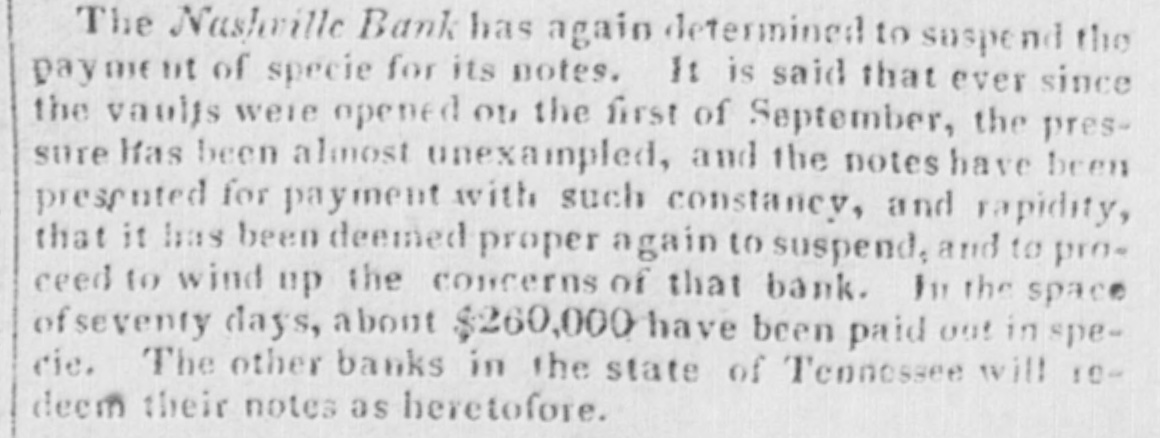
ever since the vaults were opened on the first of September, the pressure has been almost unexampled, and the notes have been presented for payment with such constancy, and rapidity
Source
newspapers
2. November 16, 1826 Suspension
Cause
Bank Specific Adverse Info
Cause Details
Suspension of specie payments after prolonged pressure and heavy specie outflows; directors to publish a statement and proceed to wind up the bank's concerns; belief directors were working to redeem paper as funds realized are collected and property disposed of
Newspaper Excerpt
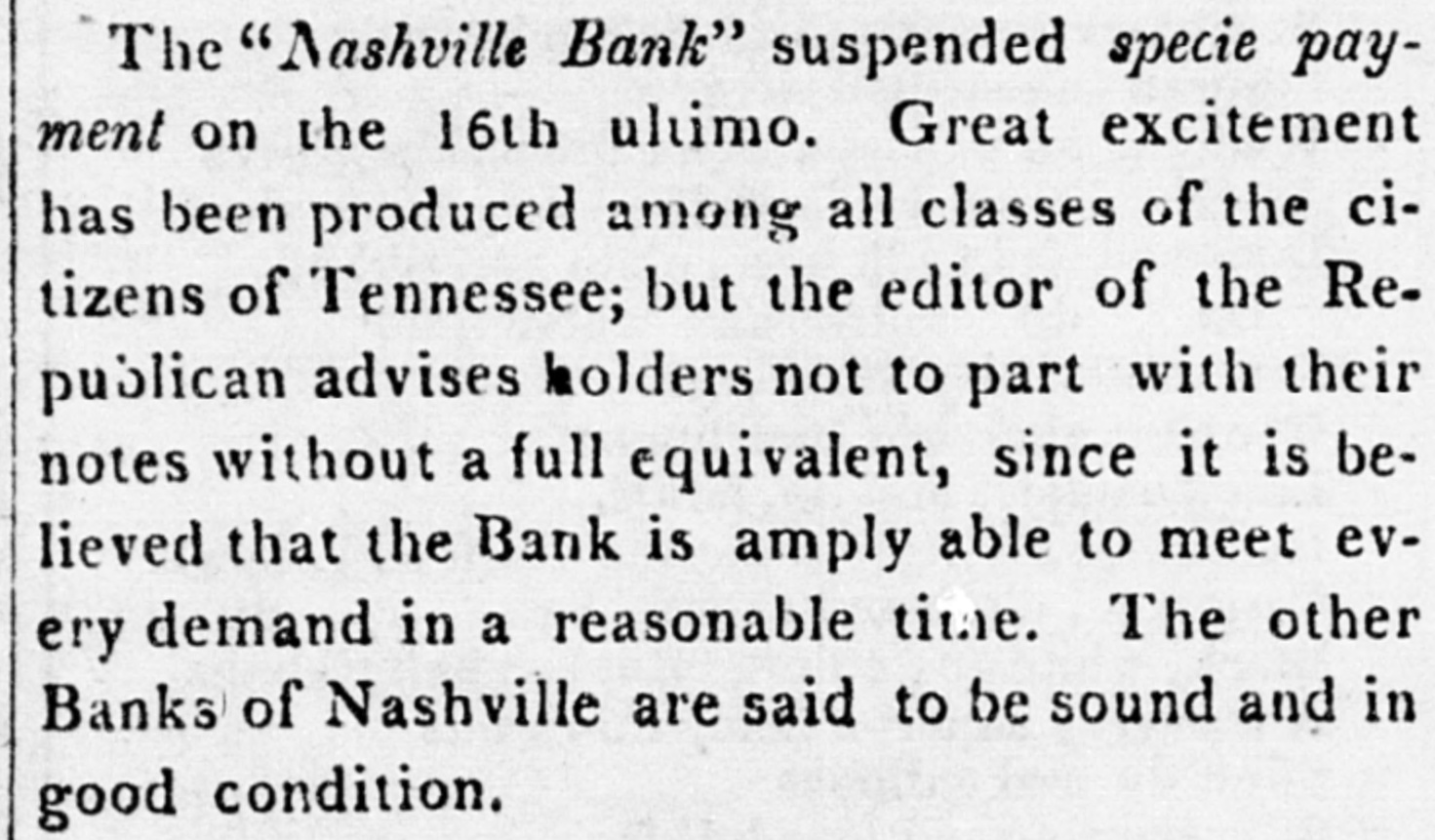
The Nashville Bank suspended specie payment on the 16th ultimo.
Source
newspapers
3. December 1, 1826* Other
Newspaper Excerpt
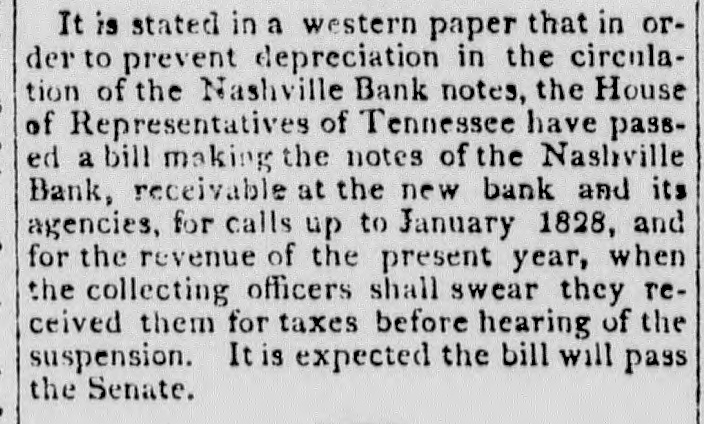
to proceed to wind up the concerns of that bank. In the space of seventy days, about $260,000 have been paid out in specie. The House of Representatives of Tennessee have passed a bill making the notes of the Nashville Bank receivable at the new bank ... to prevent depreciation in the circulation of the Nashville Bank notes ... when the collecting officers shall swear they received them for taxes before hearing of the suspension. Directors will make public a statement of the situation of this institution, will be made public on Monday next, by the Directors. Great excitement has been produced among all classes of the citizens of Tennessee; but the editor ... advises holders not to part with their notes without a full equivalent, since it is believed that the Bank is amply able to meet every demand in a reasonable time. It is said ... they are amply able to meet every demand, so soon as their debts can be called in and their property disposed and we have no doubt they have already set about effecting this subject. It is expected the bill will pass the Senate. (reported Dec 1826 - Jan 1827 newspapers.)
Source
newspapers

Newspaper Articles (5)

Article from Phenix Gazette, December 6, 1826

Click image to open full size in new tab

Article Text

The "Nashville Bank" suspended specie payment on the 16th ultimo. Great excitement has been produced among all classes of the citizens of Tennessee; but the editor of the Republican advises holders not to part with their notes without a full equivalent, since it is believed that the Bank is amply able to meet every demand in a reasonable time. The other Banks of Nashville are said to be sound and in good condition.


Article from Richmond Enquirer, December 9, 1826

Click image to open full size in new tab

Article Text

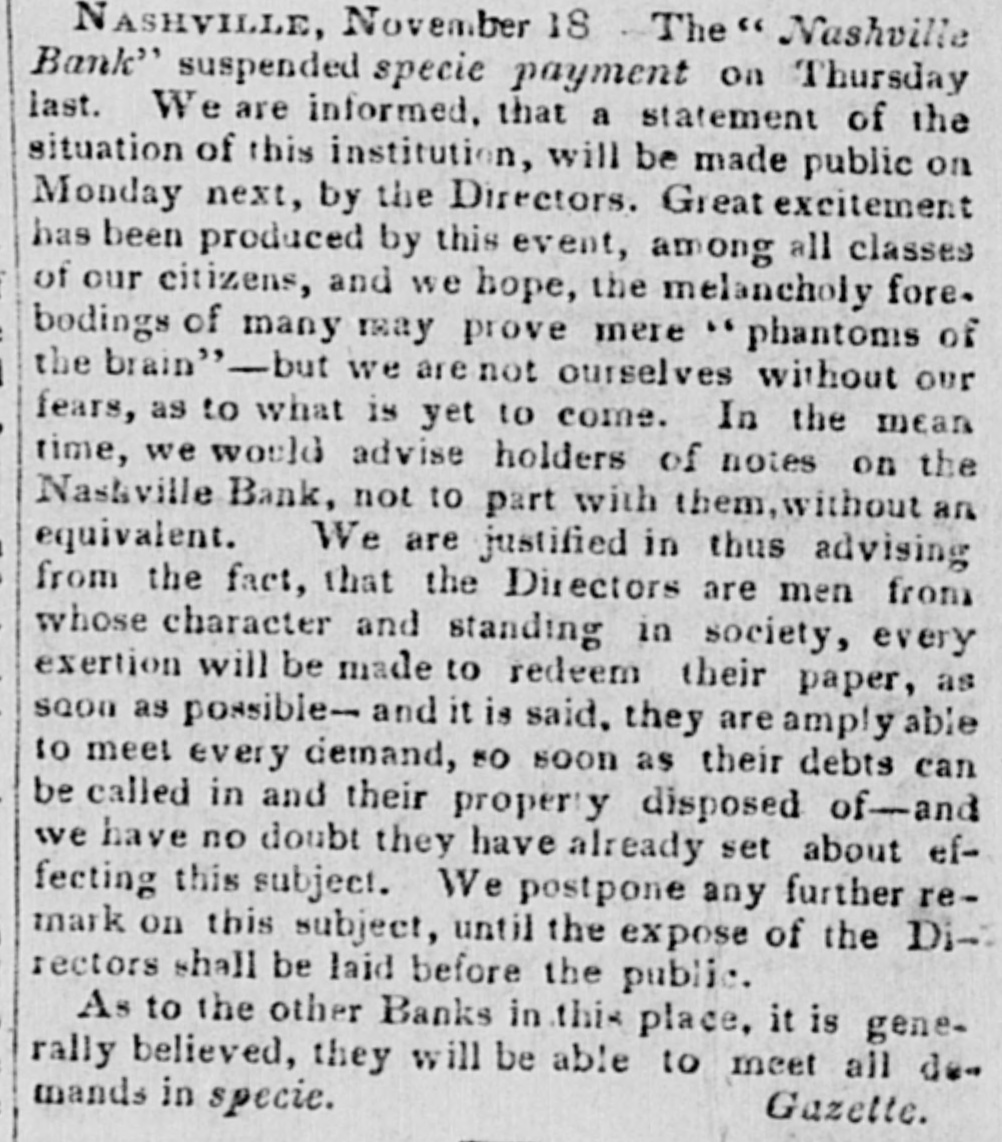
NASHVILLE, November 18 The Nashville Bank" suspended specie payment on Thursday last. We are informed. that a statement of the situation of this institution, will be made public on Monday next, by the Directors. Great excitement has been produced by this event, among all classes of our citizens, and we hope, the melancholy fore. bodings of many may prove mere "phantoms of the brain" - but we are not ourselves without our fears, as to what is yet to come. In the mean time, we would advise holders of notes on the Nashville Bank, not to part with them, without an equivalent. We are justified in thus advising from the fact, that the Directors are men from whose character and standing in society, every exertion will be made to redeem their paper, as soon as possible- and it is said, they are amply able to meet every demand, 80 soon as their debts can be called in and their property disposed and we have no doubt they have already set about effecting this subject. We postpone any further remark on this subject, until the expose of the Di-: rectors shall be laid before the public. As to the other Banks in this place, it is generally believed, they will be able to meet all demands in specie. Gazette.


Article from Constitutional Whig, December 12, 1826

Click image to open full size in new tab

Article Text

The Nashville Bank has again determined to suspend the payme 11 of specie for its notes. It is said that ever since the vaults were opened ou the first of September, the pressure Has been almost unexampled, and the notes have been presented for payment with such constancy, and rapidity, that it has been deemed proper again to suspend, and to proceed to wind up the concerns of that bank. III the space of seventy days, about $260,000 have been paid out in specie. The other banks in the state of Tennessee will 10deem their notes as heretofore.


Article from The Wilmingtonian, and Delaware Advertiser, January 4, 1827

Click image to open full size in new tab

Article Text

factories of the United States work up full one fourth part ot the whole crop of raw cotton raised in the Southern and Western States. As this statement is founded on data that cannot deceive, we may take it with an unusual degree of certainty. Of all the statistical facts which lately have come der our observation, we must be permitted to say this is the most gratifying. Only let us look back upon our internal industry for the last 10 years. Iu 1816 we were but in the commencement, but now our Cotton fabrics can compete with the English. If, in the short space of ten years, we have risen to the consumption of & of our whole raw cotton crop, what may we not expect from the succeeding ten? When did a nation possess such a prospect as the United States? In a very tew years, the whole cotton crop of the South will be worked up at the North and Fast. One portion of the country will supply the other with raw productions, and that in return with manufactured. Within the limits of the Republic we have every variety of soil and climate. We can produce every thing within ourselves. It is this peculiar character of the country that will become the great boad of union. A reciprocation of benefits will unite the South, the West, and the East, in one teeling and one interest. We shall then be beyond the com. mercial vicissitudes of Europe. Our dependence for every manufacture will be placed on our own artisans. This happy period is fast approaching, and neither the arts of foreign or secret enemies can prevent its ac complishment. The National Journal announces that the Convention between the United States and England, making provision for compensating the owners of private property taken from the United States after the close of the late war with Great Britain, has been ratified by the President and Senate. The promptness with which this Convention was decided en in the Senate, confirms the opinion that it provides for an ample restitution to those of our citizens whose property had been taken from them subsequent to the war, and that it does them justice, and will give satisfaction to all the claimants. It is stated in a western paper that in order to prevent depreciation in the circulation of the Nashville Bank notes, the House of Representatives of Tennessee have passed a bill making the notes of the Nashville Bank, receivable at the new bank and its agencies, for calls up to January 1828, and for the revenue of the present year, when the collecting officers shall swear they received them for taxes before hearing of the suspension. It is expected the bill will pass the Senate. / The York (Penn.) Gazette states, that from the surveys already made, it is ascertained to be impracticable to construct a continuous Canal through Pennsylvania, connecting the eastern and western waters; and that the Canal Commissioners will report in favor of adopting the Juniata route, im. proving the navigation of that river, by canals or otherwise, as high up as teasible, and then passing to the Alleghany river by means of a railway. It is calculated that more than one hundred and seventy volcanoes are at present in activity on this land, and there is reason to believe that there are at least as many and probably a greater number beneath the sea. Captain King in his late survey of Australasia, sailed along a continued line of coral reef for seven hundred miles, interrupted only by a few intervals not exceeding thirty miles. These reefs stretch from the north-east coast of Australasia, towards and far exceed length, chain of any New.Guinea, secondary very mountains rock in in has Europe. A calcarious concreted sand been found to exist in Australasia throughout a space of no less than twenty-five degress of latitude; and an equal extent of longitude on the southern, west and north-west coasts. -A letter from Washington says Mrs Decatur has again presented her claims to Congress, for an allowance to be made to her, for the destruction of the frigate Philadelphia, by her late husband, in the harbor of Tripoli, in 1804." We have seen a pamphlet of 62 pages, containing the documents published by Mrs. Decatur, relative to this claim, and think that the lady has made out a fair case, and to be justly entitled to the benevolence of a liberal and high minded legislature.-Bust Centinel. Copy of 3 letter from Commodore Stewart to Mrs. Decatur. Bordentown, Dec. 12th, 1826. My dear Mrs. Decatur: The re-assembling of the honorable Congress of the United States, renders it neces
Article from The Wilmingtonian, and Delaware Advertiser, January 4, 1827

Click image to open full size in new tab

Article Text

It is stated in a western paper that in order to prevent depreciation in the circulation of the Nashville Bank notes, the House of Representatives of Tennessee have passed a bill making the notes of the Nashville Bank, receivable at the new bank and its agencies, for calls up to January 1828, and for the revenue of the present year, when the collecting officers shall swear they received them for taxes before hearing of the suspension. It is expected the bill will pass the Senate.