20797. Farmers & Merchants Bank (Memphis, TN)

Bank Information

Episode Type
Suspension → Closure
Bank Type
state
Start Date
July 13, 1849
Location
Memphis, Tennessee (35.150, -90.049)

Metadata

Model
gpt-5-mini
Short Digest
1843b2d8

Response Measures

None

Description

Articles indicate the Farmers & Merchants Bank of Memphis was in the hands of a receiver (Miles Owen) by mid-1849 (Article 1) and is repeatedly described as a bankrupt institution in 1850 coverage. No newspaper describes a depositor run or a temporary reopening; the bank was in receivership, consistent with a suspension followed by closure/receivership. Also many 1850 articles recount a violent street affray connected to disputes over custody of the bank's books/assets (June 1850).

Events (2)

1. July 13, 1849 Receivership
Newspaper Excerpt
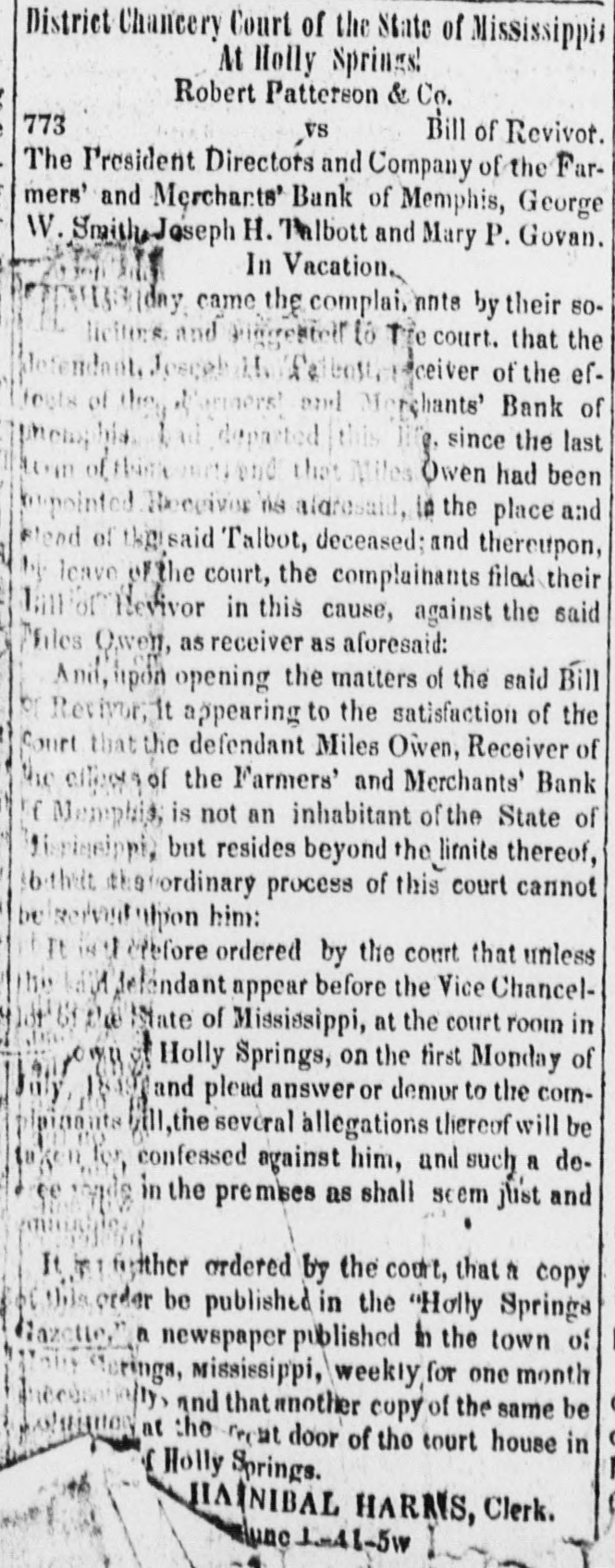
the said Miles Owen, Receiver of the effects of the Farmers' and Merchants' Bank of Memphis ... had been appointed Receiver as aforesaid
Source
newspapers
2. June 8, 1850 Other
Newspaper Excerpt
note ... that the assets of the Farmers' and Merchants' Bank should be taken out of the hands of Receiver Owen ... On Saturday morning ... Alanson Trigg was instantly killed ... connected with an effort in Court to remove the books and papers of the Farmers' and Merchants' Bank from the hands of receiver Owen
Source
newspapers

Newspaper Articles (6)

Article from Holly Springs Gazette, July 13, 1849

Click image to open full size in new tab

Article Text

District Chancery Court of the State of Mississippis At Holly Springs Robert Patterson & Co. 773 vs Bill of Revivot. The President Directors and Company of the Farmers' and Merchants' Bank of Memphis, George W. Smith Joseph H. Talbott and Mary P. Govan. In Vacation. day came the complai, nnts by their soand to Tife court. that the felent Sceiver of the efand rehants' Bank of 8. since the last Owen had been impointed Receiver ns aidresaid, in the place and of thersaid Talbot, deceased; and thereupon, leave of the court, the complainants filad their of Revivor in this cause, against the said files Owen, as receiver as aforesaid: Anii, upon opening the matters of the said Bill Revivor; it appearing to the satisfaction of the Court that the defendant Miles Owen, Receiver of effects of the Farmers' and Merchants' Bank Memphis, is not an inhabitant of the State of pigsippi, but resides beyond the limits thereof, their ordinary process of this court cannot served upon him: It crefore ordered by the court that unless deféndant appear before the Vice ChancelState of Mississippi, at the court room in Holly Springs, on the first Monday of and plead answer or demor to the comthe several allegations thereof will be confessed against him, and such a dein the premses as shall seem just and It further ordered by the court, that a copy order be published in the "Holty Springs a newspaper published in the town of rings, Mississippi, weekly for one month and that another copy of the same be at the recat door of the tourt house in Holly Springs. HAINIBAL HARRIS, Clerk. une 1-41-5w


Article from The Daily Crescent, June 15, 1850

Click image to open full size in new tab

Article Text

THE AFFRAY AT MEMPHIS.-The Memphis Eagle of the 10th brings us the particulars of the recent bloody affray in the streets of that city, of which we, a few days since, published a brief and, as we at the time thought it probable, an incorrect account. Instead of four persons, only one (Mr. Trigg) was killed. Gen. Coe, a man of high position, ability and of known personal courage, was seriously wounded, but we hope not mortally. Dr. Fowlkes was not engaged in the affray. But here is the account of the Eagle: On last Saturday morning, at about 11 o'clock, our city was startled by the report that an affray had occurred in the neighborhood of Exchange Buildings, in which Mr. Alanson Trigg had been killed and Majors Co nell and Gaines severely wounded. On flocking to the scene, hundreda of our citizens met melancholy attestation to the truth of the report, in the sight of the corpse of Alanson Trigg and the prostrate forms of Gen. Coe and Majors Gaines and Connell. The accounts of the affair are somewhat confused, but we will give them with as much precision as possible : On Friday evening Gen. Coe received a note of an extraordinary character, signed by E. W. M. King, (late Judge of the Commercial and Criminal Court) and by note its signers no for Alanson had heretofore Trigg. The had unkindly declared feelings that Gen. Coe, but that if, for the gratification of personal malice against Dr. Fowlkes, he opposed the taking of the books, papers and assets of the Farmers' and Merchants' Bank out of the hands of Receiver Owens, they should take such action on his part, in his professional capacity as an attorney, as an interference in their private and personal matters, and would notice it as such, although they had previously forborne. They further stated that it was a to assets of the bank, its families matter that the of vital importance themselves papers, et and should pass from the hands of Receiver Owen. This note Gen. Coe construed (very correctly, we think) into a threat of personal violence. But, on Saturday morning he proceeded to Court, and unhesitatingly opposed the motion to remove the present Receiver and place the affairs of the bank under the control of Dr. Jeptha Fowlkes and others. The hearing of argument upon the motion was continued to another day. In the meantime the report of Receiver Owen and an affidavit of new in Connell, making developments reference Major to the extraordinary manner in which this bankrupt institution had been managed, were filed. Gen. Coe then exhibited the note of King and Trigg to Judge Turley and several friends; expressed his conviction that an attempt to assassinate him would be made: placed the note in the hands of E. M. Yerger, Esq., and accompanied by Major Connell, left the court room. When they reached the corner of Maine and Monroe streets, five persons, Trigg, Gaines, Arand rington liams (Trigg's overseer,) Tompkins Joe Wilappeared, and Trigg immediately advanced and assaulted Connell. Seeing that the others also advanced, Gen. Coe concluded that the assault threatened him had commenced, drew a pistol and shot Trigg, killing him instantly. Whether or not Trigg had fired previously, is a disputed point; a to him was the Wilstreet discharged afterwards. pistol belonging Gaines, Tompkins, found Joe in liams and Arrington, in the meantime. were rapidly advancing upon Coe and Connell. whom he shot closed flesh of with the Connell, through Gaines the hip, and from whom he received six or seven bowie-knife thrusts, some of which are severe, dangerous. Williams in towards Arrington but not closed Tompkins, Gen. Coe, from differ- and ent directions, and with a wariness that showed they were determined to take his life. this had fired three attime tempting Gen. Coe shots, when, By on to draw a Colt's repeater, he found that it had slipped down into the lining of his coat. He then retreated, Joe Williams following and Aroff to a to renew rington their weapons. and Hopkins going grocery up, As Gen. Coe opened a door and entered the house, Joe Williams stepped to the muzzle of his against door, placed his back the pistol immediately up and shot him, the ball ranging across the spine-a terrible, but we yet hope, not fatal wound.


Article from The Organizer, June 15, 1850

Click image to open full size in new tab

Article Text

FROM THE MEMPHIS APPEAL. Melancholy and Fatal Affray morning last about the eleven o'clock, a serious hour between some or On of occurred Saturday six and fatal A'anson eight affray in which Mr. of was instantly killed, and Wm. Connell and were seriously and accounts of Trigg Coe, Esq., ed. The our Maj. different citizens, severely this P.G.Gaines, Gen.L sad found wound. affair it cionflicting that we have are so impossible to give a correct version from the best of the following will almost can it, gather though the truth: information probably we be found to approximate Friday evening Gen. Coe received On E. W. K ng and Alanson note to the effect that they no unkind Trigg, fore entertained from Judge feelings had lowards hereto- of his but that if, for the gratification he him, malice against Dr. Fowlkes, personal oppose the removal of the books, should assets, &c. of the Farmers' and Merchants' papers, Bank out of the hands of Receiv Owen, they would regard such actioner his part acting in his professional capacity on as an attorney, as an interference with their private and personal matters, would notice it as such, although they had and previous'y forborne; stating moreover, it was a matter of vital importance of to themselves that and families, that the assets the bank should be taken out of the hand, of the receiver. note was naturally regarded by Gen. This Coe as a threat of personal violence; to still not hesitating in what he conceived be the peformance of bis duty, he opposed the motion to remove the receiver, and the upon the motion was deferred till Before leaving Coe exhibited the note argument Monday. House, Gen. the he Court other had received, to the Judge and several time friends, expressing his belief at the that he would be attacked, and in company with Maj. Connell and Mr. Hightower, the started for his office. Having reached of Main and Poplar sts., Trigg from a grocery, with Gaines, emerged corner Williams (where he and was What Ar- in company and attacked Connell. rington) was here made by Trigg's we have been unable to that the was about to be made upon drew his pistol and demonstration sault friends, mediately Coe supposing contemplated shot learn, him, Trigg, im- the but as. him inst ntly. At this stage became general, as can learn indiscriminate, upon Coe and as killed friends affair we the s advancing firing when and Crnnell Trigg's of they far shot Connell in the hip, in with knives, and before both were severely this time Williams, are said to have closed separated, Tompkins Gaines During closed Arrington they wounded. in pistols, upon were and having discharged three that the fourth, a his pocket os his coat, and being made an effort ro get discovered lining Coe, slipped his who, knife, through unable revolver, behind he to coula into had the get at the door of the nearest house until get hold of them, and just as he was enterWilliams shot him, the ball entering lower ing, near the spine as to pralyze the exiremnies. Since the foregoing was in type, we have adreceived the fellowing copy of the letter In dressed by King and Trigg to Coe. inextricable confusion of the different from statements the we have heard, we forbear comments. With regard to the draw tenor of all the letter, we leave the publice to their own conclusions. We are much pleased to learn that Gen. rested easily yesterday evening, favora- and that his Coe. symptoms were much more ble than they were the day before. AT HOME JUNE 7tb, 1850. Gen. L. H. Coe. SIR: I regret that I am confined at home the shall be unable to attend court in as I understand that and others to the President and & M. Bank, which every of justice and right made tion of morning, and giving F. by wision, yourself Directors opposition the considera- imperious- have control motion seen is demand I had intended 10 interly in person on the subject of your which you ference further with this interest childrenextends to me, my wife, and my which have sought to preserve a position collision I involve me in no personal other with would you or with others about this or matters. It is proper that I kindly but firmly and respectfully ask you to desist from a purof Dr. Fowlkes where my personal interests be at stake; with your pecuniary [ am not a party and you me to become a must quarrels will_not_force which I party beg to quarrel, which ought not and interextend to me and my pecuniary internot I cannot quietly permit you to becomests, Tere further in this matter without ing a party in a peronal manner that I hope you will not firce upon me. have conferred with A. Trigg who me is siturted aud who has with Our similarly a similar determination. will og formed is fixed and we hope reflection and satisfy course you of the wrong. injustice will cease oppression to us, and that you mere futher to annoy and follow us, in a to pecuniary matter, in no way necessary


Article from The Athens Post, June 21, 1850

Click image to open full size in new tab

Article Text

From the Memphis Paper. # MELANCHOLY AND FATAL AFFRAY. On Saturday morning last about the hour of 11 o'clock, a serious and fatal affray occurred between some six or eight of our citizens, in which Mr. Alanson Trigg was instantly killed, and Gen. 1. H. Coe, Maj., Wm. Connell and P. G. Gaines, Esq., were seriously and severely wounded. The different accounts of this sad affair are so conflicting that we have found it almost impossible to give a correct version of it, though from the best information we can gather, the following will probably be found to approximate the truth: On Friday evening Gen. Coc received a note from Judge E. W. M. King and Alanson Trigg, to the effect that they had heretofore entertained no unkind teelings towards him, but that if, for the gratification of his personal malice against Dr. Fowlkes, he should oppose the removal of the books, papers, assets, &c., of the Farmers' and Merchants' Bank out of the hands of Receiver Owen, they would regard such action on l is part, acting in his professional capacity as an attorney as an interference with their private and personal matters, and would notice it as such although they had previously forborne; stating moreover, that it was a matter of vital importance to themselves and families, that the assets of the bank should be taken out of the hands of the receiver. This note was naturally regarded by Gen. Coe as a threat of personal violence; still not hesitating in what he conceived to be the performance of his duty, he opposed the motion to remove the receiver, and the argument upon the motion was deferred till Monday. Before leaving the Court House, Gen Coe exhibited the note he had received. to the Judge and several other friends, expressing his belief at the time that he would be attacked, and in company with Major Connell and Mr. Hightower, started for his office. Having reached the corner of Main and Poplar sts., Trigg emerged from a grocery, (where he was in company with Gaines, Willianas and Arzington) and attacked Connell. What demonstration twas here made by Trigg's friends, we have been unable to learn, but Coe supposing that the contemplated assault was about to be made upon him, immediately drew his pistol and shot Trigg, killing him instantly. At this stage of the affair the firing became general, and as far as we can learn indiscriminate, Trigg's friends advancing upon Coe and Cornell. Gaines shot Copnell in the hip, when they closed in with kajves, and before they were separated, both were severely wounded. During this time Williams, Arrington and Tompkins are said to have closed in upon Coe, who, having discharged three pistols, discovered that the fourth, a revolver, had slipped through his pocket behind the lining of his coat, and being unable to get at his knife, made an effort to get into the door of the nearest house until he could get hold of them, and just as he was entering, Williams shot him, the ball entering so near the spine as to paralyze the lower extremities. Since the foregoing was in type, we have received the following copy of the letter addressed by King and Trigg to Coe. In the inextricable confusion of the different statements we have heard, we forbear from all comments. With regard to the tenor of the letter, we leave the public to draw their own conclusions. We are much pleased to learn that Gen. Coe rested easily yesterday evening, and that his symptoms were much more favorable than they were the day before. AT HOME, June 7th, 1850. Gen. L. H. Coe: SIR: I regret that I am confined at home and shall be unable to attend court in the Gorning, as I understand that opposition is made by yourself and others to the motion giving the President and Directors control of F. & M. Bank, which every consideration of wisdom, justice and right imperiously demand. I had intended to have seen you in person on the subject of your interference further with this interest which extends to me, my wife, and my children. I have sought to preserve a position which would involve me in no personal collision with you or with others about this or other matters. It is proper that I kin lly but firmly and respectfully ask you to desist from


Article from New-York Daily Tribune, June 22, 1850

Click image to open full size in new tab

Article Text

The Late Terrible Affair in Memphis. The Charleston Courier gives the following statement of the bloody fight in Memphis, Tenn. on the 8th inst.: It seems to have some indirect connection with an effort in Court, to remove the books and papers of the Farmers' and Mechanics' Bank from the hands of receiver Owen into the custody of a Dr. Jeptha Fowlkes, and others. On Friday Hon E. W. M. King (formerly Judge of the Commercial and Criminal Court,) and Alabson Trigg, Esq had joined in a letter to Gen. L. H. Coe, urging him to desist from his opposition to a motion giving the President and Directors of the F. and M. Bank control of that institution-an opposition intimated to proceed from personal hostility to Fowlkes, and which could not be persevered in without pecuniary injury to the writers, and probably a personal collision between them and Gen. Coe; and also assuring Gen. C. that the writers would take np his entire liabilities for them, in a few days. On Saturday Gen. Coe appeared in Court, before Jadge Turley, and opposed the metion, and filed the report of Receiver Owen, and an affidavit of Major Wm. Connell, making new developements as to management of the Bank; but the hearing of the argument was postponed until another day. Gen. Coe and his friends then left the Court. It seems, also, that Trigg had notified Connell that he designed to thrash him, without intimating, however, a resort to any other than nature's weapons of offense. When Coe and his party reached the corner of Main and Poplar ats. Trigg, P. G. Gaines, Arrington, (Trigg's overseer) Col. Tompkins and Joseph C. Williams appeared there, and Trigg approached Coe and Connell, and was in the act of placing his band on Connell, when Coe stepped past Trigg, and placing a pistol to Trigg's back, in the direction toward his heart, deliberately shot him dead. Trigg's friends advanced, and Coe then fired at Williams (who bad taken none but a pacific part in the affair) without effect. Coe then ran, drawing another pistol and shooting as he ran. Williams pursued him some forty steps, and, as Coe was at. t mpting to enter a house and close the door, shot him in the back, near or on the spinal columa, near the kidneys. Gaines and Connell got into conflict, and the latter received a fleah wound in the rump, and Connell wounded Gaines (not very seriously) in eight or nine places with a bowie knife, but was disarmed by the latter and begged his life, which Gaines contemptuously granted. Coe was supposed at first to be mortally wounded, but hopes were since entertained of his recovery. Highly colored and partisan accounts of this disgraceful atfair are given in the Memphis Eagle and the Memphis Express, the former siding with Coe and his party, the latter with Trigg and his party. We have endeavored to condense as fair an account as we could from the conflicting statements.


Article from The Texas Republican, June 27, 1850

Click image to open full size in new tab

Article Text

The Memphis Street Fight. Extract from the Memphis Eagle of June 10th: # FATAL AFFRAY On last Saturday morning, at about 11 o'clock, our city was startled by the report that an affray had occurred in the neighborhood of Exchange Buildings, in which Mr. Alanson Trigg had been killed, and Gen. Coe, Majors Connell and Gaines, sorely wounded. On flocking to the scene, hundreds of our citizens met melancholly attestation to the truth of the report, in the sight of the corpse of Allison Trigg, and the prostrate forms of General Coe and Majors Gaines and Connell. The accounts of the affair are somewhat confused, but we will give them with as much precision as possible: On Friday evening, Gen. Coe received a note of an extraordinary character, signed by J. W. M. King (late Judge of the Commercial and Criminal Court) and by Alanson Trigg. The note declared that its signers had heretofore had no unkind feelings for Gen Coe; but that if for the gratification of personal malice against Dr. Fowlkes, he opposed the taking of the books, papers, and assets of the Farmers' and Merchants' Bank out of the hands of Receiver Owen, they would take such action on his part, in his professional capacity as an attorney, as an interference with their private and personal matters, and would notice it as such, although they had previously forborne. They further stated that it was a matter of vital importance to themselves and their families, that the assets of the bank, its papers, &c., should pass from the hands of Receiver Owen. This note Gen. Coe construed (very correctly, we think.) into a threat of personal violence. But, on Saturday morning, he proceed to court, and unhesitatingly opposed the motion to remove the present Receiver, and place the affairs of the bank under the control of Dr. Jeptha Fowlkes, and others. The hearing of arguments upon the motion was continued to another day. In the meantime, the report of Receiver Owen, and an affidavit of Major Connell, (new developments in reference to the extraordinary manner in which this bankrupt institution had been managed,) were filed. Gen. Coe then exhibited the note of King and Twigg to Judge Terrley and several friends, expressed his conviction that an attempt to assassinate him would be made, placed the note in the hands of J. M. Yerger, Esq., and, accompanied by Major Connell, left the court room. When they reached the corner of Main and Monroe streets, five persons, Trigg, Gaines, Arrington (Trigg's overseer), Tompkins, and Joe Williams, appeared, and Trigg immediately advanced and assaulted Connell. Seeing that the others also advanced, Gen. Coe concluded that the assault threatened him had commenced, drew a pistol and shot Trigg, killing him instantly. Whether or not Trigg had fired previously, is a disput point. A discharged pistol, belonging to him, was found in the street afterwards Gaines, Tompkins, Joe Willliams, and Arrington, in the meantime, were rapidly advancing upon Coe and Connell. Gaines closed with Connell, whom he shot through the flesh of the hip, and from whom he received six or seven bowie knife thrusts, some of which are severe, but not dange Tompkins, Williams, and Arrington, closed in towards Gen. Coe from different directions, and with a wariness that showed they were determined to take his life. By this time Gen. Coe had fired three shots, when, on attempting to draw a Colt's repeater, he found that it had slipped down into the lining of his coat. He then retreated, Joe Williams following up, and Arrington and Hopkins going off to a grocery to renew their weapons. As Gen. Coe opened a door and entered a house, Joe Williams stepped up to the door, placed the muzzle of his pistol immediately against his back, and shot him, the ball ranging across the spine-inflicting a terrible, but, we yet wope, not fatal wound. All the circumstances of this affair convince us that there was a deliberate plan to kill Gen. Coe, though the real plotters were out of harm's way. The previous threats-the waylaying of himself and Connell on the streets-the combination of three men in attacking him-their renewing of weapons at the neighboring grocery-are facts which, if correctly reported to us, indicate plainly the existence of a plan to assassinate. There was preadvisement, deliberation. ovision and precaution, in making the