20779. Citizens' Bank (Memphis, TN)

Bank Information

Episode Type
Suspension → Closure
Bank Type
state
Start Date
July 13, 1858
Location
Memphis, Tennessee (35.150, -90.049)

Metadata

Model
gpt-5-mini
Short Digest
aa4a5e8b

Response Measures

None

Description

Newspapers in July 1858 report the Citizens' Bank of Memphis stopped payment/suspended in mid-July 1858, followed by public meetings, an investigating committee, and assets placed in hands of a receiver. There is discussion of alleged fraud/defalcation and managers abandoning the bank; no clear description of a depositor run prior to suspension. I infer suspension ~1858-07-13 from contemporaneous reports (Article 1 references July 13).

Events (2)

1. July 13, 1858 Suspension
Cause
Bank Specific Adverse Info
Cause Details
Failure attributed to alleged fraud/defalcation, disputed transfers of stock, and mismanagement; investigations and reports cite embezzlement and insolvency.
Newspaper Excerpt
Three weeks ago the Citizens' Bank stopped payment ... The proof shows that the Bank did business on that day, to the close, and did not suspend until the next day.
Source
newspapers
2. July 14, 1858 Receivership
Newspaper Excerpt
the assets be placed in the hands of a receiver, in whom I and they and the public have confidence; that the debts be collected and applied to the payment of the liabilities of the Bank, without preference to any creditor. SAMUEL P. WALKER (July 14, 1858).
Source
newspapers

Newspaper Articles (10)

Article from Nashville Patriot, July 16, 1858

Click image to open full size in new tab

Article Text

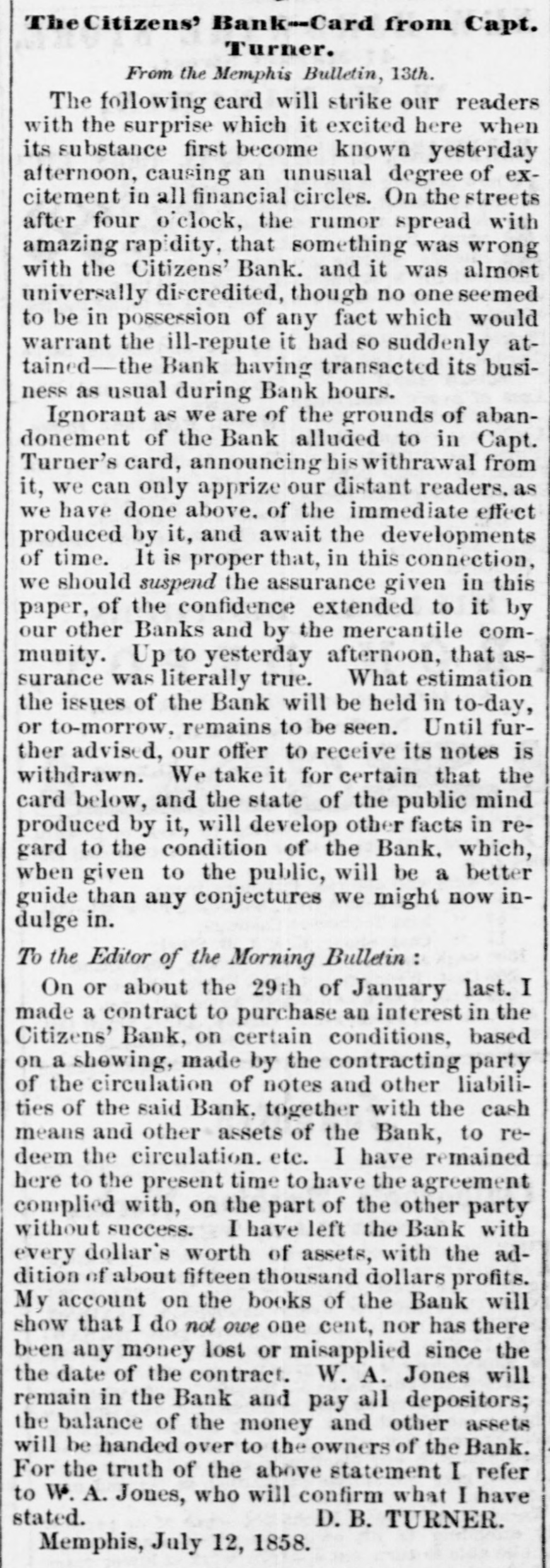
The Citizens' Bank-Card from Capt. Turner. From the Memphis Bulletin, 13th. The following card will strike our readers with the surprise which it excited here when its substance first become known yesterday afternoon, causing an unusual degree of excitement in all financial circles. On the streets after four o'clock, the rumor spread with amazing rapidity, that something was wrong with the Citizens' Bank. and it was almost universally discredited, though no one seemed to be in possession of any fact which would warrant the ill-repute it had so suddenly attained-the Bank having transacted its business as usual during Bank hours. Ignorant as we are of the grounds of abandonement of the Bank alluded to in Capt. Turner's card, announcing his withrawal from it, we can only apprize our distant readers, as we have done above. of the immediate effect produced by it, and await the developments of time. It is proper that, in this connection, we should suspend the assurance given in this paper, of the confidence extended to it by our other Banks and by the mercantile community. Up to yesterday afternoon, that assurance was literally true. What estimation the issues of the Bank will be held in to-day, or to-morrow. remains to be seen. Until further advised, our offer to receive its notes is withdrawn. We take it for certain that the card below, and the state of the public mind produced by it, will develop other facts in regard to the condition of the Bank. which, when given to the public, will be a better guide than any conjectures we might now indulge in. To the Editor of the Morning Bulletin : On or about the 29th of January last. I made a contract to purchase an interest in the Citizens' Bank, on certain conditions, based on a showing, made by the contracting party of the circulation of notes and other liabilities of the said Bank, together with the cash means and other assets of the Bank, to redeem the circulation. etc. I have remained here to the present time to have the agreement complied with, on the part of the other party without success. I have left the Bank with every dollar's worth of assets, with the addition of about fifteen thousand dollars profits. My account on the books of the Bank will show that I do not owe one cent, nor has there been any money lost or misapplied since the the date of the contract. W. A. Jones will remain in the Bank and pay all depositors; the balance of the money and other assets will be handed over to the owners of the Bank. For the truth of the above statement I refer to W. A. Jones, who will confirm what I have stated. D. B. TURNER. Memphis, July 12, 1858.


Article from Nashville Patriot, July 19, 1858

Click image to open full size in new tab

Article Text

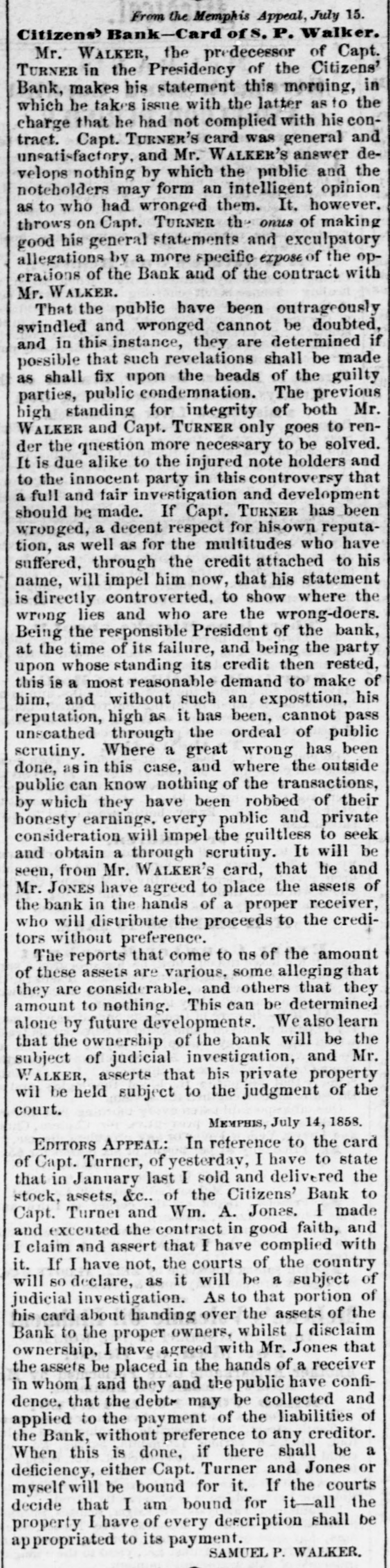
From the Memphis Appeal, July 15. Citizens Bank-Card ofs, P. Walker. Mr. WALKER, the predecessor of Capt. TURNER in the Presidency of the Citizens' Bank, makes his statement this morning, in which he takes issue with the latter as to the charge that he had not complied with his contract. Capt. TURNER'S card was general and unsatisfactory, and Mr. WALKER'S answer develops nothing by which the public and the noteholders may form an intelligent opinion as to who had wronged them. It. however. throws on Capt. TURNER the onus of making good his general statements and exculpatory allegations by a more specific expose of the operations of the Bank and of the contract with Mr. WALKER. That the public have been outrageously swindled and wronged cannot be doubted, and in this instance, they are determined if possible that such revelations shall be made as shall fix upon the heads of the guilty parties, public condemnation. The previous high standing for integrity of both Mr. WALKER and Capt. TURNER only goes to render the question more necessary to be solved. It is due alike to the injured note holders and to the innocent party in this controversy that a full and fair investigation and development should be made. If Capt. TURNER has been wronged, a decent respect for hisown reputation, as well as for the multitudes who have suffered, through the credit attached to his name, will impel him now, that his statement is directly controverted, to show where the wrong lies and who are the wrong-doers. Being the responsible President of the bank, at the time of its failure, and being the party upon whose standing its credit then rested, this is a most reasonable demand to make of him, and without such an exposttion, his reputation, high as it has been, cannot pass unscathed through the ordeal of public scrutiny. Where a great wrong has been done, as in this case, and where the outside public can know nothing of the transactions, by which they have been robbed of their bonesty earnings. every public and private consideration will impel the guiltless to seek and obtain a through scrutiny. It will be seen, from Mr. WALKER'S card, that be and Mr. JONES have agreed to place the assets of the bank in the hands of a proper receiver, who will distribute the proceeds to the creditors without preference. The reports that come to us of the amount of these assets are various. some alleging that they are considerable. and others that they amount to nothing. This can be determined alone by future developments. We also learn that the ownership of the bank will be the subject of judicial investigation, and Mr. WALKER, asserts that his private property wil be held subject to the judgment of the court. MEMPHIS, July 14, 1858. EDITORS APPEAL: In reference to the card of Capt. Turner, of yesterday, I have to state that in January last I sold and delivered the stock, assets, &c.. of the Citizens' Bank to Capt. Turner and Wm. A. Jones. I made and executed the contract in good faith, and I claim and assert that I have complied with it. If I have not, the courts of the country will so declare, as it will be a subject of judicial investigation. As to that portion of his card about handing over the assets of the Bank to the proper owners, whilst I disclaim ownership, I have agreed with Mr. Jones that the assets be placed in the hands of a receiver in whom I and they and the public have confidence. that the debtr may be collected and applied to the payment of the liabilities of the Bank, without preference to any creditor. When this is done, if there shall be a deficiency, either Capt. Turner and Jones or myself will be bound for it. If the courts decide that I am bound for it-all the property I have of every description shall be appropriated to its payment. SAMUEL P. WALKER.


Article from Nashville Union and American, July 21, 1858

Click image to open full size in new tab

Article Text

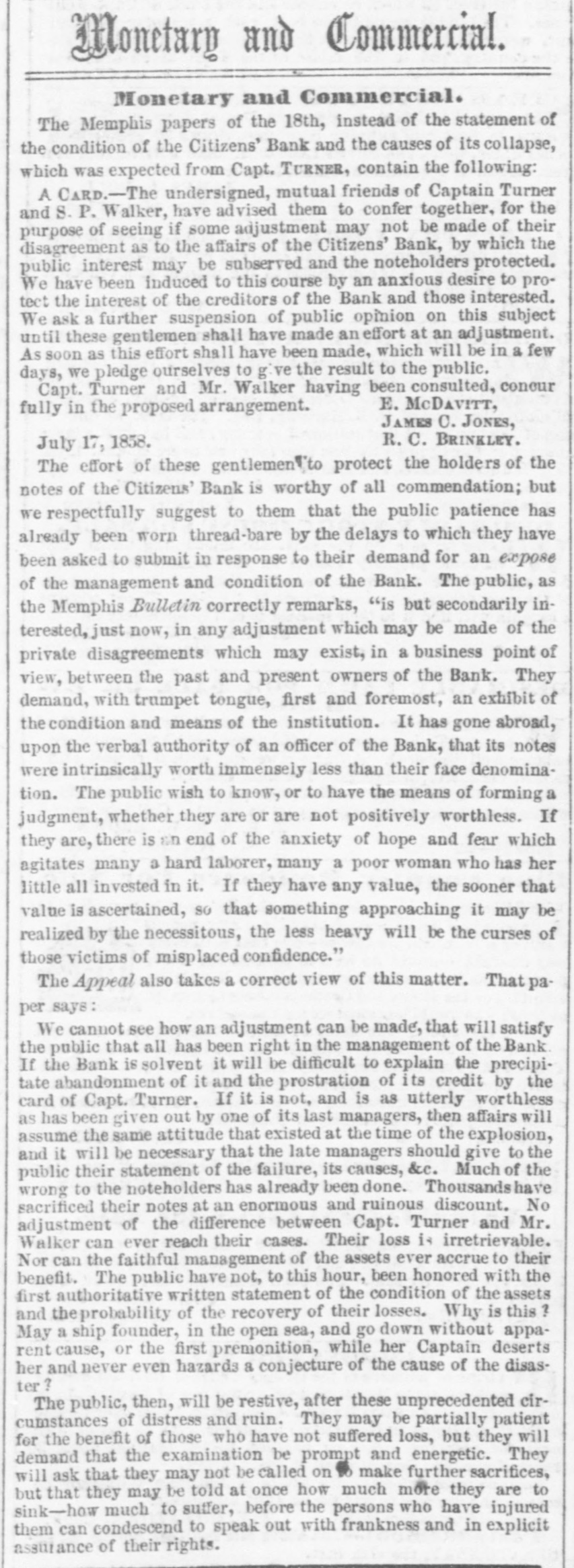
Monetary and Commercial. Monetary and Commercial. The Memphis papers of the 18th, instead of the statement of the condition of the Citizens' Bank and the causes of its collapse, which was expected from Capt. TURNER, contain the following: A CARD.-The undersigned, mutual friends of Captain Turner and S. P. Walker, have advised them to confer together, for the purpose of seeing if some adjustment may not be made of their disagreement as to the affairs of the Citizens' Bank, by which the public interest may be subserved and the noteholders protected. We have been induced to this course by an anxious desire to protect the interest of the creditors of the Bank and those interested. We ask a further suspension of public opinion on this subject until these gentlemen shall have made an effort at an adjustment. As soon as this effort shall have been made, which will be in a few days, we pledge ourselves to the result to the public. Capt. Turner and Mr. Walker having been consulted, concur E. McDavitt, fully in the proposed arrangement. JAMES C. JONES, R. C. BRINKLEY. July 17, 1858. The effort of these gentlemen to protect the holders of the notes of the Citizens' Bank is worthy of all commendation; but we respectfully suggest to them that the public patience has already been worn thread-bare by the delays to which they have been asked to submit in response to their demand for an expose of the management and condition of the Bank. The public, as the Memphis Bulletin correctly remarks, "is but secondarily interested, just now, in any adjustment which may be made of the private disagreements which may exist, in a business point of view, between the past and present owners of the Bank. They demand, with trumpet tongue, first and foremost, an exhibit of the condition and means of the institution. It has gone abroad, upon the verbal authority of an officer of the Bank, that its notes were intrinsically worth immensely less than their face denomination. The public wish to know, or to have the means of forming a judgment, whether they are or are not positively worthless. If they are, there is an end of the anxiety of hope and fear which agitates many a hard laborer, many a poor woman who has her little all invested in it. If they have any value, the sooner that value is ascertained, SO that something approaching it may be realized by the necessitous, the less heavy will be the curses of those victims of misplaced confidence." The Appeal also takes a correct view of this matter. That paper says: We cannot see how an adjustment can be made, that will satisfy the public that all has been right in the management of the Bank If the Bank is solvent it will be difficult to explain the precipitate abandonment of it and the prostration of its credit by the card of Capt. Turner. If it is not, and is as utterly worthless as has been given out by one of its last managers, then affairs will assume the same attitude that existed at the time of the explosion, and it will be necessary that the late managers should give to the public their statement of the failure, its causes, &c. Much of the wrong to the noteholders has already been done. Thousandshave sacrificed their notes at an enormous and ruinous discount. No adjustment of the difference between Capt. Turner and Mr. Walker can ever reach their cases. Their loss is irretrievable. Nor can the faithful management of the assets ever accrue to their benefit. The public have not, to this hour, been honored with the first authoritative written statement of the condition of the assets and theprobability of the recovery of their losses. Why is this ? May a ship founder, in the open sea, and go down without apparent cause, or the first premonition, while her Captain deserts her and never even hazards a conjecture of the cause of the disaster ? The public, then, will be restive, after these unprecedented circumstances of distress and ruin. They may be partially patient for the benefit of those who have not suffered loss, but they will demand that the examination be prompt and energetic. They will ask that they may not be called on make further sacrifices, but that they may be told at once how much more they are to sink-how much to suffer, before the persons who have injured them can condescend to speak out with frankness and in explicit assurance of their rights.


Article from Nashville Patriot, July 23, 1858

Click image to open full size in new tab

Article Text

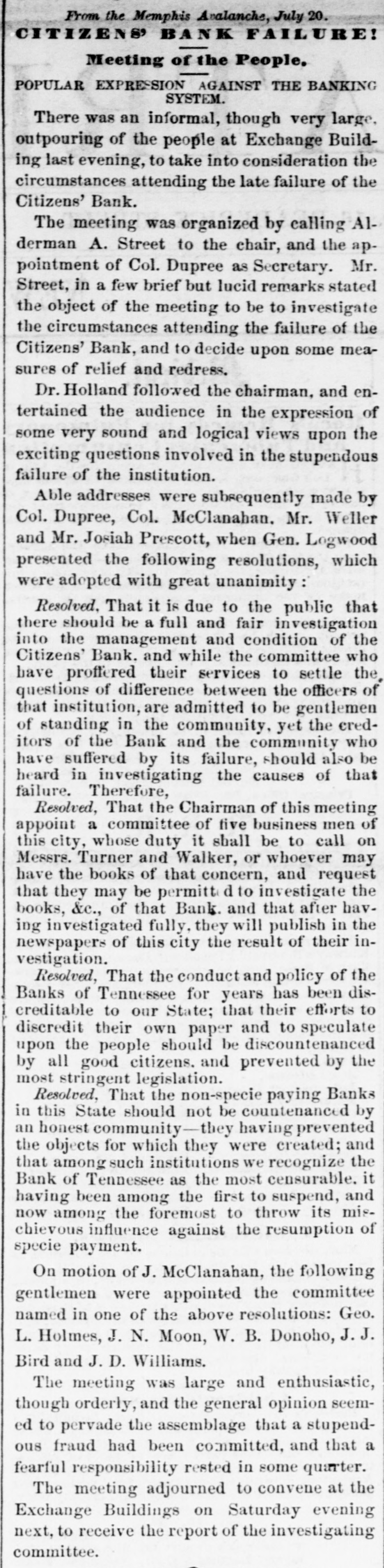
From the Memphis Avalanche, July 20. CITIZENS BANK FAILURE! Meeting of the People. POPULAR EXPRESSION AGAINST THE BANKING SYSTEM. There was an informal, though very large, outpouring of the people at Exchange Building last evening, to take into consideration the circumstances attending the late failure of the Citizens' Bank. The meeting was organized by calling Alderman A. Street to the chair, and the appointment of Col. Dupree as Secretary. Mr. Street, in a few brief but lucid remarks stated the object of the meeting to be to investigate the circumstances attending the failure of the Citizens' Bank, and to decide upon some measures of relief and redress. Dr. Holland followed the chairman, and entertained the audience in the expression of some very sound and logical views upon the exciting questions involved in the stupendous failure of the institution. Able addresses were subsequently made by Col. Dupree, Col. McClanahan. Mr. Weller and Mr. Josiah Prescott, when Gen. Logwood presented the following resolutions, which were adopted with great unanimity: Resolved, That it is due to the public that there should be a full and fair investigation into the management and condition of the Citizens' Bank. and while the committee who have proffered their services to settle the, questions of difference between the officers of that institution, are admitted to be gentlemen of standing in the community, yet the creditors of the Bank and the community who have suffered by its failure, should also be heard in investigating the causes of that failure. Therefore, Resolved, That the Chairman of this meeting appoint a committee of five business men of this city, whose duty it shall be to call on Messrs. Turner and Walker, or whoever may have the books of that concern, and request that they may be permitte d to investigate the books, &c., of that Bank. and that after having investigated fully, they will publish in the newspapers of this city the result of their investigation. Resolved, That the conduct and policy of the Banks of Tennessee for years has been discreditable to our State; that their efforts to discredit their own paper and to speculate upon the people should be discountenanced by all good citizens. and prevented by the most stringent legislation. Resolved, That the non-specie paying Banks in this State should not be countenanced by an honest community-they having prevented the objects for which they were created; and that among such institutions we recognize the Bank of Tennessee as the most censurable. it having been among the first to suspend, and now among the foremost to throw its mischievous influence against the resumption of specie payment. On motion of J. McClanahan, the following gentlemen were appointed the committee named in one of the above resolutions: Geo. L. Holmes, J. N. Moon, W. B. Donoho, J. J. Bird and J. D. Williams. The meeting was large and enthusiastic, though orderly, and the general opinion seemed to pervade the assemblage that a stupendous fraud had been committed, and that a fearful responsibility rested in some quarter. The meeting adjourned to convene at the Exchange Buildings on Saturday evening next, to receive the report of the investigating committee.


Article from The Athens Post, July 23, 1858

Click image to open full size in new tab

Article Text

CARD FROM MR. WALKER. MEMPHIS, Wednesday, July 14. To the Editors of the Morning Bulletin :In reference to the card of Capt. Turner of yesterday, I have to state, that in January last I sold and delivered the stock, assets, etc., of the Citizens' Bank to Capt. Turner and W. A. Jones. I made and executed the contract in good faith, and I claim and assert that I have complied with it. If I have not, the courts of the country will so declare, as it will be subject of judicial investigation.As to that portion of his card about handing the assets of the bank to its proper owners, while I disclaim ownership, I have agreed with Mr. Jones that the assets be placed in the hands of a receiver, in whom I and they, and the public, have confidence; that the debts be collected and applied to the payment of the liabilities of the Bank, without preference to any creditor. When this is done, if there shall be a deficiency, either Turner and Jones, or myself, will be bound for it. If the courts decide that I am bound for it, all the property I have, of every description, shall be appropriated to its payment. SAMUEL P. WALKER.


Article from Nashville Union and American, July 23, 1858

Click image to open full size in new tab

Article Text

BANK MEETING AT MEMPHIS -A meeting of citizens of Memphis was held on the 19th, to take action upon the subject of the failure of the Citizens' Bank. The meeting was numerously attended, and a number of speeches were made, none of which, however, threw any light upon the matter of greatest interest to the people, the condition of the Bank and the amount of its assets. Col. DUPREE said it was reported that, if the investigation then being made, should show that the assets are not sufficient to meet the liabilities of the Bank, Messrs. WALKER, TURNER and SANNONER would make it good out of their personal estate. Col. DUPREE seemed to have no other authority than rumor for making this statement. The following resolutions were offered and adopted: Resolved, That it is due to the public that there should be a full and fair investigation into the management and condition of the Citizens' Bank, and while the committee who have proffered their services to settle the questions of difference between the officers of that institution, are admitted to be gentlemen of standing in the community, yet the creditors of the Bank and the community who have suffered by its failure, should also be hea d in investigating the causes, of that failure. Therefore, Resolved, That the Chairman of this meeting appoint a committee of five business men of this city, whoseduty it shall be to call on Messrs. Turner and Walker, or whoever may have the books of that concern, and request that they may be permitted to Investigate the books, &c., of that Bank, and that after having investigated fully they will publish in the newspapers of this city the result of their investigation. Resolved, That the conduct and policy of the Banks of Tennessee for years have been discreditable to our State; that their efforts to discredit their own paper and to speculate upon the people should be discountenanced by all good citizens, and prevented by the most stringent legislation. Resolved, That the non-specie paying Banks in this State should not be countenanced by an honest community-they having prevented the objects for which they were created; and that among such institutions we recognize the Bank of Tennessee as the most censurable, it having been among the first to suspend, and now among the foremost to throw its mischievous influence against the resumption of specie payment. On motion of J. McClanahan, the following gentlemen were ap. pointed the committee named in one of the above resolutions: George L. Holmes, J. N. Moon, W. B. Donoho, J.J. Bird and J. D. Williams. Mr. J. PEARSON proposed the passage of a resolution for the arrest of the managers of the Bank, which was put and lost. The meeting then adjourned to last evening.


Article from Nashville Patriot, August 6, 1858

Click image to open full size in new tab

Article Text

Who is Responsible for the Citizens' Bank Fraud? Three weeks ago the Citizens' Bank stopped payment with $294,837 00 in circulation based on $11,144 57 of bank notes and coin. D. B. Turner. the ostensible President at the time of suspension, published a card disclaiming any ownership in the bank and abandoned it, giving as his reason, that Samuel P. Walker. the former President and owner would not comply with the contract of sale to him. Mr. Walker's card in reply denies Mr. Turner's statement. Next, J. C. Jones takes the matter in hand, and prevails upon two prominent and highly respectable citizens to sign a card with him, to bring about an adjustment as they were led to believe. As soon as Messrs. Brinkley and McDavitt saw the real position they were placed in, they promptly declined to act in the premises. In the meantime the Citizens held a meeting and appointed an Investigating Committee to examine the affairs of the Bank and report the same. That report has also been laid before the public, which, with the subsequent sale of the Banking house comprises all the outside transactions we have been able to lay before our readers. The report of the Investigating Committee shows that on the 29th of January, 1858, S. P. Walker transferred all his stock to D. B. Turner and W. A. Jones, and to this item of the report Mr. Turner enters his protest. Mr. Turner says it was an exparte transaction, without his knowledge or consent, and has no binding force or effect. This is bis position:-Mr. Walker was a candidate for the Presidency of the Branch of the State Bank at Memphis. It was necessary for him to show to the President of the Mother Bank, Hon. Cave Johnson, that he was wholly disconnected from the Citizens' Bank. He therefore, by the permission of W. A. Jones, the ostensible acting Cashier. makes the transfer on the books to D. B. Turner, and receives from Mr. Jones a certificate that he has no interest in the Citizens' Bank. To all this Mr. Turner is a stranger. He knows nothing about it. Mr. Walker's reply is the receipt itself. but circumstances may pr ponderate over that document. Who owned the stock on the 29th day of January last, and who elected D. B. Turner, President, and W. A. Jones. Cashier? They certainly did not step into the Bank and assume to be its officers without authority. Then how did they get there ?Were they elected by stock-hold rs? Who were they, and who voted in that election? If they were duly elected Preisdent and Cashier on the day they assumed to act as such, they must necessarily have known by what authority they were exercising the functions of office. If there was no election. and they went into the Bank by the permission of Mr. Walker they were mere agents of his and nothing more. Even the transfer of Stock without an election does not change the relation of the parties. But the receipt which satisfied Hon. Cave Johnson, that Mr. Walker was out and discharged from the Citizens' Bank, and by which he stepped into the Presidency of the Memphis Branch of the State Bank. did not tell the whole truth. Mr. Walker was by his own agreement a silent partner in the profits of the Citizens' Bank and at the same time President of the Branch of the State Bank. Like ANANIAS he "kept back part of the price," and his agents were privy to it. Could CEDIPUS come to earth long enough to unravel the mysteries of that incomprehensible corporation, the Citizens' Bank, Gough would have ample materials for another and widely different work on Banking. More than that, the diviner of the ambiguous words of the Sphinx would expose the di ception and falsehood of political bankers to an outraged people, who in turn would bury these worse than Theban monsters beneath the wave of popular indignation.-Memphis Eagle & Enq.


Article from Nashville Union and American, August 15, 1858

Click image to open full size in new tab

Article Text

MONETARY AND COMMERCIAL. At the New York Stock Exchange, on the 10th, $10,000 Tennessee 6's sold at 92½, $15,000 at 92%, and $15,000 at 92%. $2,000 Memphis 6's sold at auction at 66½. We understand one of our Brokers is buying the notes of the Exchange and Citizens' Banksat twenty five cents, to fill an order. We hear of no other demand for these notes. In Memphis the Brokers are paying thirty-five cents for Citizens' Bank notes. Other parties are paying higher rates. The circulation of the Lawrenceburg Bank had been reduced on the 6th inst., to $29,843. Gold and Silver are now quoted by our Brokers at X@1 per cent premium. The Athens Post of the 13th learns that a $50 counterfeit bill on the Branch of the Bank of Tennessee at that place, was presented at the counter of that Bank. It is not a new emission, but one of the batch of counterfeits floating around in 1854. Look out forthem. The Shelbyville Expositor says the Shelbyville Bank is now paying specie on its notes for ordinary purposes. This does not indicate a resumption. The Murfreesboro' Telegraph is proposing to take Exchange and Citizens' Bank notes in payment of subscriptions at the rate of $10 peryear. The Telegraph says: It appears difficult for this city to recover from the shock occasiened by the failure of the Exchange Bank, though business is beginning to assumesomething of itsformer tone. Money is very tight. Good paper is cut deep by the note brokers. We indulge the hope, however, that there is a good time coming." Our people are not badly involved in debt, and there is a prospect now for an abundant crop. The Legislative Investigating Committee concluded the labors assigned them Friday, and their report will be handed over to the Governor (who is now absent) upon his return to the city, which will be in the course of a few days, when it will, e placed before the public. In the meantime, we find in the Memphis Avalanche, of the 12th inst, an article in regard to the forth-coming report, which contains information of interest to our readers. The statements are based upon information derived from a private letter, and if we are not mistaken as to the author of the letter, the position he sustains to the Legislature, enables him to speak advisediy. We, therefore, print the following extract from the article in the Avalanche: The investigation has been a herculean task; the difficulties of which have been greatly augmented by the want of familiarity on the part of the members of the committee with the details of accounts, and by the loose and irregular manner in which the affairs of some of the offices have been kept. The committee have, nevertheless, elicited a mass of highly interesting information, and their report will exhibit a series of startling facts and embezzlements scarcely inferior to those which characterize the administration of the municipal government of New York. The defalcation of the late Secretary of State falls but little short of forty thousanddollars. These were funds that came into his hands as Internal Improvement Commissioner. This will be a total loss to the State Treasury-the official bonds of the defaulting Secretary, as well as the person of that unfortunate functionary, both having turned up missing. The investigation of the committee exhibits the astonishing fact that these defalcations began with the first monies that ever came into his hands officially, and that they embrace the last funds he ever received-being something more than two thousand dollars paid out by the treasurer of a turn-pike company, since the committee has been in session, and while they were investigating these very charges. We learn further from the letter of our correspondent, that the report of the committee will express the unanimous opinion of its members, that the bonds required by law to be deposited with the Comptroller, as security for the issues of the free banks, were in the case of the Exchange Bank, never deposited I The deficit in the amount of bonds claimed to have been deposited by the Messrs. Spence, it will be recollected, reaches the sum of one hundred and twenty three thousand dollars. This opinion of the committee reflects by implication, as a matter of course, II] on the official integrity of the late Comptroller, since only by collusion with that officer could this discrepancy arise. The high standing of the parties implicated in this transaction, and their well dished reputation for integrity, will subject this portion of the report to a severe and scrutinizing criticism. Public sentiment, in the best informed circles at Nashville, is represented to be very greatly divided in regard to the party justly amenable to censure in this fraudulent transaction. and the war between the Messrs. Spence and the late Comptroller on the one part, and the Cashier of the Bank of Tennessee on the other, will, it is predicted, break out with renewed vigor upon the publication of the committee's report.


Article from Fayetteville Observer, December 23, 1858

Click image to open full size in new tab

Article Text

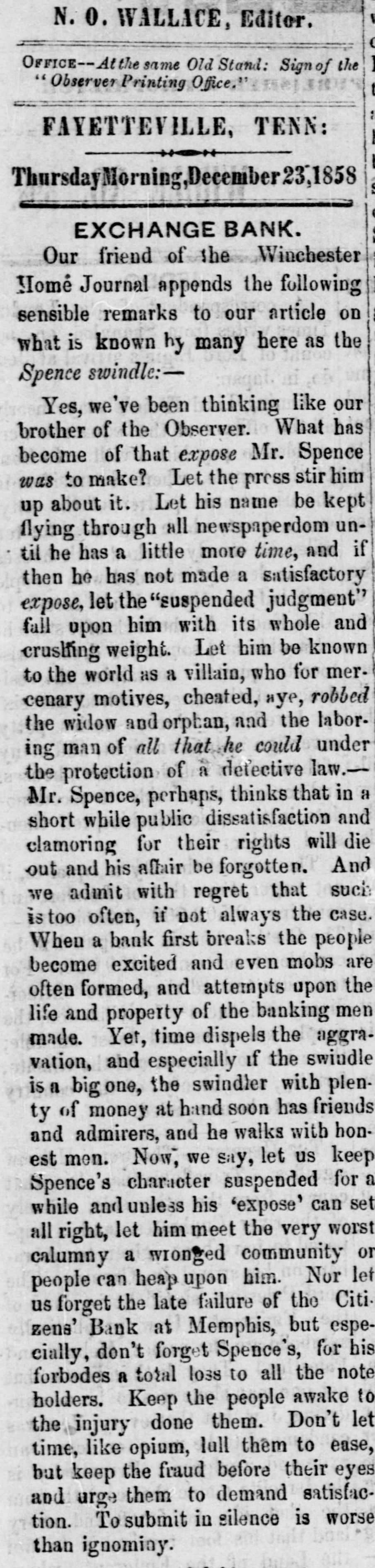
N.O. WALLACE, Editor. OFFICE--Atthe same Old Stand: Sign of the Observer Printing Office.' FAYETTEVILLE, TENN: ( : ] t I I ThursdayMorning,December23,1858 EXCHANGE BANK. Our friend of the Winchester Mome Journal appends the following sensible remarks to our article on what is known hy many here as the Spence swindle:Yes, we've been thinking like our brother of the Observer. What has become of that expose Mr. Spence was to make? Let the pross stir him up about it. Let his name be kept flying through all newspaperdom until he has a little more time, and if then he has not made a satisfactory expose, let the "suspended judgment" full upon him with its whole and crushing weight. Let him be known to the world as a villain, who for mercenary motives, cheated, "ye, robbed the widow and orphan, and the laboring man of all that he could under the protection of à defective law.Mr. Spence, perhaps, thinks that in a short while public dissatisfaction and clamoring for their rights will die out and his aftair be forgotten. And we admit with regret that such is too often, if not always the case. When a bank first breaks the people become excited and even mobs are often formed, and attempts upon the life and property of the banking men made. Yet, time dispels the aggravation, and especially if the swindle is a one, the swindler with plenty of money at hand soon has friends and admirers, and he walks with honest men. Now, we say, let us keep Spence's character suspended for a while and unless his 'expose' can set all right, let him meet the very worst calumny a wronged community or people can heap upon him. Nor let us forget the late failure of the Citi. zens' Bank at Memphis, but especially, don't forget Spence's, for his forbodes a total loss to all the note holders. Keep the people awake to the injury done them. Don't let time, like opium, lall them to ease, but keep the fraud before their eyes and urge them to demand satisfaction. To submit in silence is worse than ignominy.


Article from Nashville Union and American, October 8, 1859

Click image to open full size in new tab

Article Text

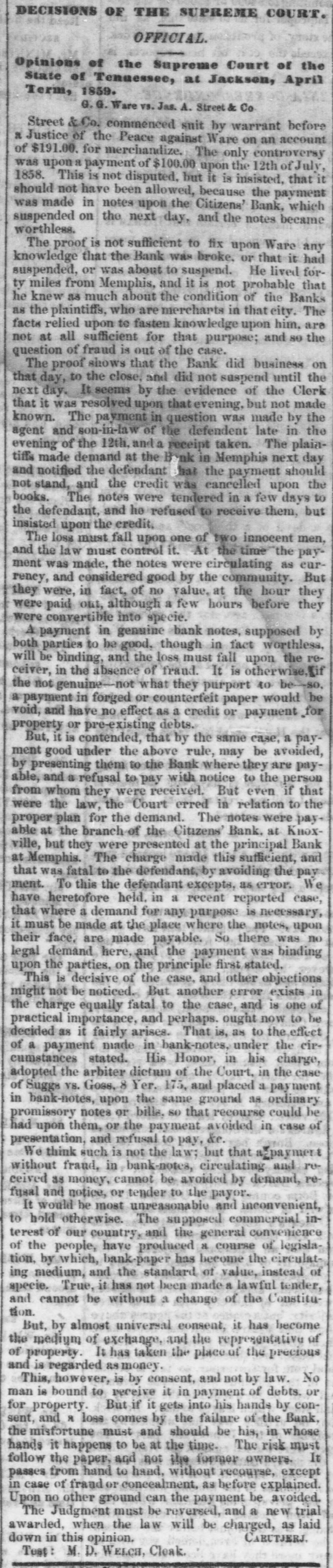
DECISIONS OF THE SUPREME COURT. OFFICIAL. Opinions of the Supreme Court of the State of Tennessee, at Jackson, April Term, 1859. G.G. Ware vs. Jas. A. Street & Co Street Co. commenced snit by warrant before a Justice of the Peace against Ware on an account of $191.00. for merchandize. The only controversy was upon a payment of $100.00 upon the 12th of July, 1858. This is not disputed. but it is insisted, that should not have been allowed, because the payment was made in notes upon the Citizens' Bank, which suspended on the next day, and the notes became worthless. The proof is not sufficient to fix upon Ware any knowledge that the Bank was broke. or that it had suspended, or was about to suspend. He lived forty miles from Memphis, and it is not probable that he knew as much about the condition of the Banks as the plaintiffs, who are mercharts in that city. The facts relied upon to fasten knowledge upon him. are not at all sufficient for that purpose; and so the question of fraud is out of the case. The proof shows that the Bank did business on that day, to the close, and did not suspend until the next day. It seems by the evidence of the Clerk that it was resolved upon that evening, but not made known. The payment in question was made by the agent and son-in-law of the defendent late in the evening of the 12th, and a receipt taken. The plaiatiffs made demand at the B nk in Memphis next day and notified the defendant hat the payment should the not stand, and the credit was cancelled upon books. The notes were tendered in a few days to the defendant, and he refused to receive them, but insisted upon the credit, The loss must fall upon one of two innocent men, and the law must control it. At the time the payment was made, the notes were circulating as eurreney, and considered good by the community. But they were, in fact, of no value, at the hour they were paid out, although a few hours before they were convertible into specie. A payment in genuine bank notes, supposed by both parties to be good. though in fact worthless, will be binding, and the loss must fall upon the receiver, in the absence of fraud. It is otherwise, if the not genuine not what they purport to be-so. be payment in forged or counterfeit paper would void, and have no effect as a credit or payment for property or pre-existing debts. But, it is contended, that by the same case, a payment good under the above rule, may be avoided, by presenting them to the Bank where they are payable, and a refusal to pay with notice to the person from whom they were received. But even if that were the law, the Court erred in relation to the proper ip for the demand. The notes were payable at the branch of the Citizens' Bank. at Knoxville, but were presented at the at The charge made this Memphis. they principal sufficient, Bank and that was fatal to the defendant, by avoiding the pay ment. To this the defendant excepts, as error. We have heretofore held. in a recent reported ease, that where a demand purpose is necessary, it must be made at the place where the notes, upon their face, are made payable. So there was no legal demand here. and the payment was binding upon the parties, on the principle first stated. This is decisive of the case, and other objections might not be noticed. But another error exists in the charge equally fatal to the case, and is one of practical importance, and perhaps. ought now to he decided as it fairly arises. That is, as to the effect cirof a payment made in bank-notes, under the cumstances stated. His Honor, in his charge, adopted the arbiter dietum of the Court, in the case of Suggs vs. Goss, 8 Yer. 175, and placed a payment in bank-notes, upon the same ground as ordinary promissory notes or bille, so that recourse could be of had upon them, OF the payment avoided in case presentation, and refusal to pay, &e We think such is not the law; but that a-payment without fraud, in bank-notes, circulating and re- received as money, cannot be avoided by demand, fusal and notice, or tender to the payor. It would be most unreasonable and inconvenient, hold otherwise. The supposed commercial interest to of our country, and the general convenience of the people, have produced 26 course of legisla tion, by which, bank-paper has become the circulat- of ing medium, and the standard of value, instead specie. True, it has net been made a lawful tender, and cannot be without a change of the Constitution. But, by almost universal consent, it has become of the medium of exchange, and the representative of property. It has taken the place of the precious and is regarded as money. This, however, is by consent, and not by law. No man is bound to receive it in payment of debts. or for property. But if it gets into his hands by consent, and R loss comes by the failure of the Bank, the misfortune must and should be his, risk in whose must hands it happens to be at the time. The follow the and not the former owners. It from hand to hand, without recourse, of fraud or concealment, passes in case paper, as before explained. avoided. except Upon no other ground can the payment be The Judgment must be reversed, and a new trial laid awarded, when the law will be charged, CARUTJERJ. as down in this opinion. Test M. D. WELCH, Cleak.