Click image to open full size in new tab
Article Text
RAMSEY DEALS CITED IN SUIT FOR $150,000
'Dishonest Acts' Caused $300,000 Bank Loss, Receiver Says in Surety Suit.
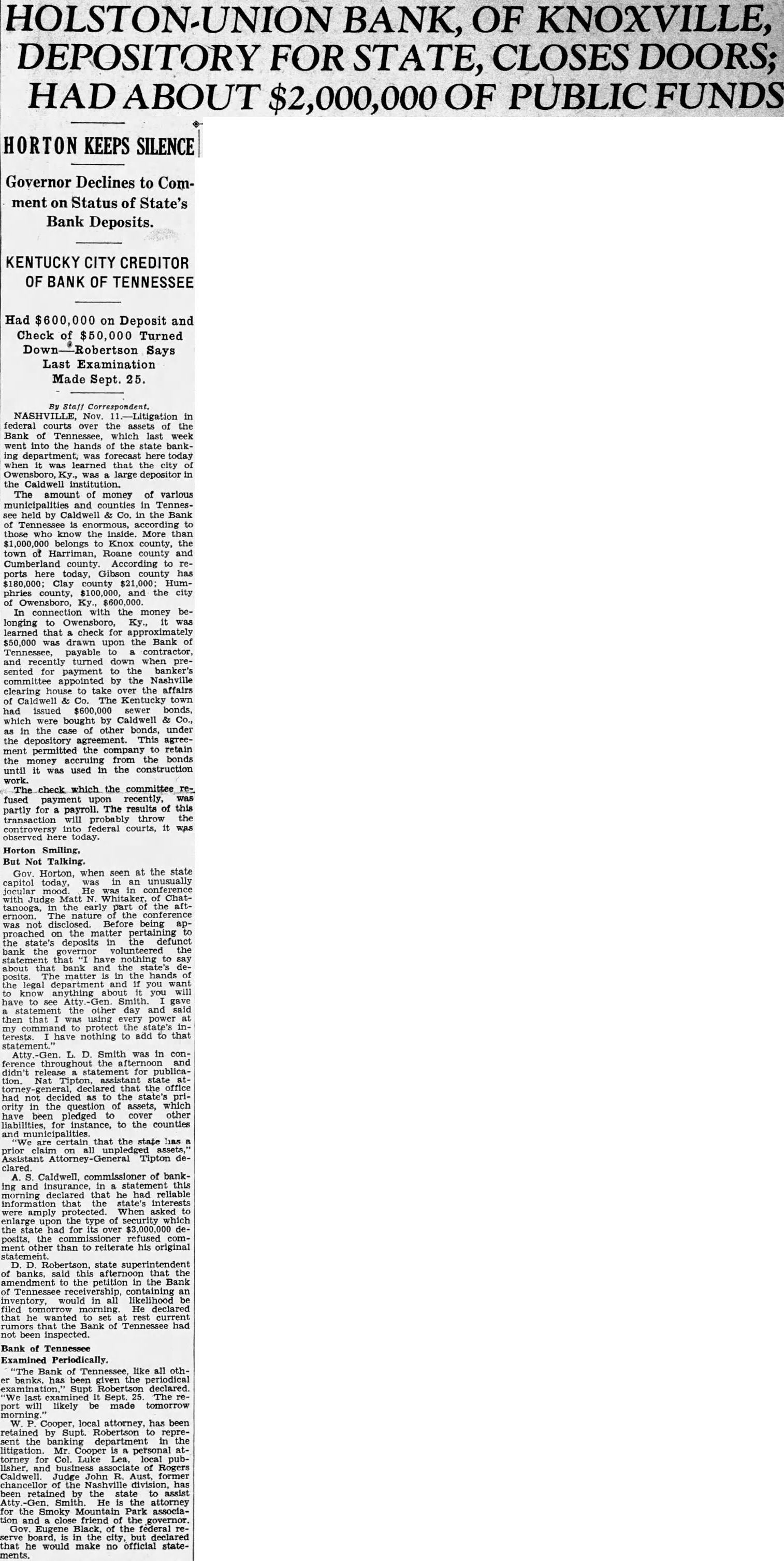
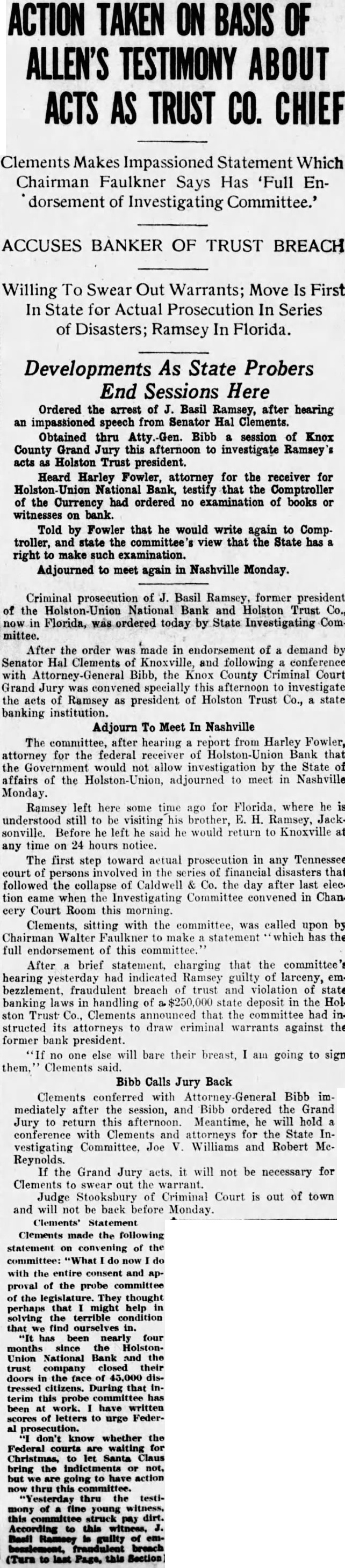
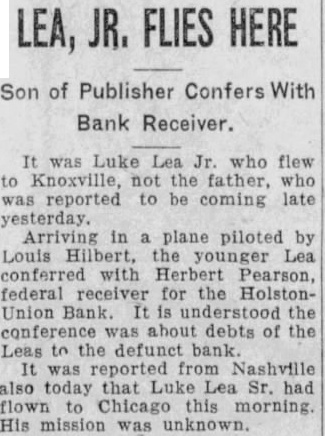
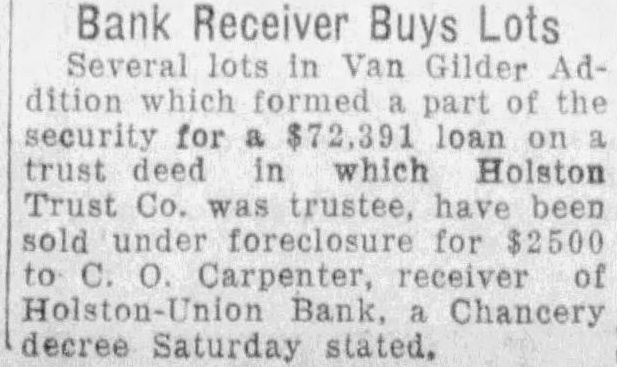
Declaring that J. Basil Ramsey's "dishonest acts' caused loss to the Hoiston-Union Bank exceeding $150,000 and describing the former president of the defunct bank as tool of Rogers Caldwell and Luke Lea, Herbert Pearson, Holston-1 receiver has filed two new suits totalling $150,000 in U. S. District Court He is seeking to recover from bonding companies for loses alleged to have resulted from Ramsey's acts. The defendants are the United States Fidelity & Guaranty Co. of Maryland and the Fidelity & Deposit Co. of Maryland Pearson is seeking to recover $75,000 from each for "indemnity against loss from defalcations of employes' and the interest on said bonds. The bill alleges that Ramsey as president of the Holston-Union was one of the employes of the concern for whose defalcation the bonding companies were liable and that it was estimated that losses to the bank thru Ramsey's "dishonest acts" exceeded $150,000.
Hits Political Angle Another loss charged was an alleged overdraft of $1212.57 in the account of "John L. Humbard, treasurer. consisting "of contributions by various and concerns interested in continuing those in power who were administering the state government. The bill sets out In one instance that Ramsey entered into an agreement with Caldwell and Co. to purchase from it socalled bonds of par value of $300,000 being as follows: Bonds 18sued by Cadet Hosiery Co., Inc $75,000: Rock Hill Printing and
Finishing Co. bonds of $75,000. Alabama Mills Co. bonds of $75,000 and Frank Silk Mills $75,000. Holston-Union, the bill avers. actually paid Caldwell and Co. $300,000 in cash for the bonds and describes a "round robin of paper transactions' whereby Caldwell & Co. took the $300,000 and purchased bonds from the state of Mississippi. The state of Mississippi placed the money on deposit in the Capital National Bank, of Jackson, Miss., and that bank, in turn, deposited it in the Holston-Union, the bill says. Thus, according to the bill "Caldwell and Co. obtained $300, 000 of bonds of the state of Mississippi and Holston-Union became indebted to the Capital National Bank for $300,000 and had, to offset this obligation, only these worthless bonds of par value of $300,000." "Helped Each Other" Ramsey, according to the bill. had business connections with Rogers Caldwell and the Bank of Tennessee and the two "were accustomed to favoring each other in matters pertaining to their personal affairs, their co-operation consisting principally of aidIng each other financially by loans of money. Said Caldwell caused companies in which he was interested to lend said Ramsey money and the latter, without authority, frequently caused the Hoiston-Union to lend or advance money to said Caldwell and companies in which he was interested." Luke Lea also was described as henchman of Ramsey's in that the two helped each other financially Ramsey thru Holston funds. "On Sept. 26, reads the bill. "Ramsey was insolvent and desired to procure the sum of $14,500. He caused the said HolstonUnion Bank to deliver the sum of $14,500 to the Bank of Tennessee and immediately borrowed said sum from latter bank which was at the time hopelessly insolvent, which said Ramsey fully knew. Said Ramsey knew that at the time the Bank of Tennessee was indebted to the said HolstonUnion Bank by note in the principal sum of $100,000 and that note. Said note, in fact, never has been paid. Said Ramsey also knew that said Bank of Tennessee was also indebted to a corporation known as the Knoxville Journat, Inc., in the proximate amount of $100,000 and said Bank of Tennessee was wholly unable to pay said indebtedness. The $14,500 which Ramsey is alleged to have caused the Holston-Union to deliver to the Bank of Tennessee was done by Ramsey without authority, the bill declared. The act was not approved by the Board of Directors or the bank's Finance Committee, it is alleged. On Feb. 21, 1930, according to Pearson's bill, Ramsey presented application for a loan of $150,000 to be evidenced by a note executed by persons known as William White, Edward Potter and Rogers Caldwell The loan was to be secured by 510 shares of the capital stock of East Tennessee National Bank Ramsey it is set out, was authorized by the Finance Committee to make the loan in reliance upon a note executed by White, Potter and Caldwell to be secured by the stock collateral. Ramsey "with dishonest Intent and in violation and advanced said sum in consideration of a note signed only by said William White with the described collateral deposited as security, reads the bill. The collateral at that time was of sufficient value to fully secure payment of the note. Pearson's bill declares, and continued to be 60 until after May 28, 1930, when Ramsey "with dishonest intent, surrendered said collateral upon receiving a payment of $110,000 on said note, leaving unpaid balance in principal amount of $40,000. Said William White at that time was insolvent and is insolvent now." This transaction was described in the bill among many others as a favor to Luke Lea, al-