20685. Bank of Knoxville (Knoxville, TN)

Bank Information

Episode Type
Run → Suspension → Closure
Bank Type
private
Start Date
November 12, 1930
Location
Knoxville, Tennessee (35.961, -83.921)

Metadata

Model
gpt-5-mini
Short Digest
5d6024b6

Response Measures

Full suspension, Books examined

Other: Receiver appointed; legal suits and allegations of internal defalcation and sham securities transactions involving Caldwell & Co. and political deposits.

Description

Articles primarily discuss the Holston Union National Bank and the Bank of Tennessee in Knoxville (Nov 1930). The provided bank name (Bank of Knoxville) does not match the primary bank in the articles (Holston Union National Bank / Holston-Union). I flag uncertainty but infer this episode concerns a Knoxville national bank that experienced heavy withdrawals, suspension by the board, and appointment of a receiver; eventual failure/receivership is described in follow-up reporting and litigation. Classified as run → suspension → closure.

Events (3)

1. November 12, 1930 Run
Cause
Bank Specific Adverse Info
Cause Details
Large, concentrated withdrawals (about $750,000) from depositors following revelations/rumors tied to connections with Caldwell & Co. and state deposit issues; heavy withdrawals depleted cash.
Measures
Clearing House advised use of 30-day notice for withdrawal of time deposits; no successful protective measures prevented depletion.
Newspaper Excerpt
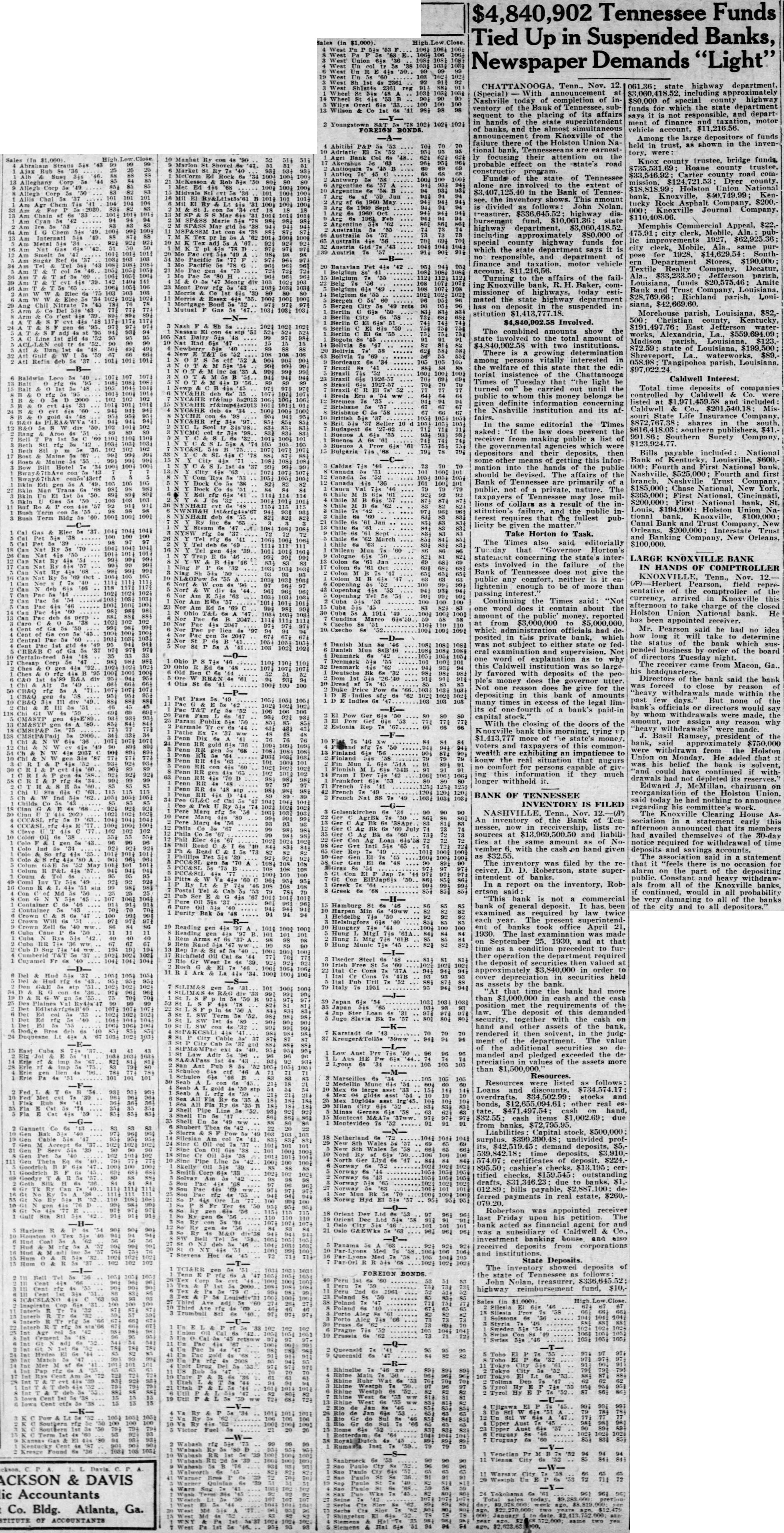
Directors of the bank said the bank was forced to close by reason heavy withdrawals' were made. J. Basil Ramsey, president of the bank, said approximately $750,000 were withdrawn from the Holston Union on Monday.
Source
newspapers
2. November 12, 1930 Suspension
Cause
Bank Specific Adverse Info
Cause Details
Board ordered closure/suspension after heavy withdrawals and apparent insolvency resulting from losses and interrelated transactions with Caldwell & Co.; comptroller took charge and appointed a receiver shortly after suspension was ordered by directors.
Newspaper Excerpt
the Holston Union National bank, are ... He has appointed receiver. Mr. Pearson said he had no idea how long it take to determine the status of the bank which susby order of the board of directors Tuesday night
Source
newspapers
3. November 13, 1930 Receivership
Newspaper Excerpt
Herbert field representative of the comptroller of the currency, arrived in Knoxville this afternoon to take charge of the closed Holston Union National bank. He has appointed receiver. Robertson was appointed receiver last Friday upon his petition. The bank acted as agent for and subsidiary of Caldwell & Co., ... inventory of the Bank of Tennessee, now lists resources ... Robertson was appointed receiver last Friday upon his petition.
Source
newspapers

Newspaper Articles (4)

Article from The Atlanta Constitution, November 13, 1930

Click image to open full size in new tab

Article Text

$4,840,902 Tennessee Funds Tied Up in Suspended Banks, Newspaper Demands "Light" ly focusing their attention on the probable effect on the state's road Funds of the state of Tennessee the extent of in the Bank of Tennesthe This amount divided as follows John Nolan, treasurer. $336,645. highway dis bursement fund, $10,061.36: state including approximately $80,000 of special county highway funds for which the state department says it is of finance motor vehicle Turning to the affairs of the fail ing Knoxville bank, R. H. Baker, commissioner of highways, today estimated the state highway department on in the suspended in$4,840,902.58 Involved The combined show the involved the total amount of $4,840,002.58 with two institutions. There is growing determination among vitally interested in the welfare of this state that the editorial insistence the Chattanooga Times of Tuesday that "the light on be out until the public to this money belongs be definite information concerning Nashville institution and its afIn the same editorial the Times asked the law does the from making public list of which were depositors and their deposits, then other of getting this information into the hands of the public should be devised. The affairs of the Bank of Tennessee are primarily of public, not of private, nature. The taxpayers of may Jose milof Collars as a result of the inand the public terest that the fullest publicity be given the Take Horton to Task. The Times also said editorially that Horton's statement the state's interinvolved in the failure of the of Tennessee does not give the public any comfort, is en enough to be of more than passing Continuing the Times said "Not word does contain about the amount of the public' reported from $3,000,000 to $5,000,000, which administration officials had deposited in this private bank, which Danish Mun not subject to either state or fedand Not word of explanation às to why Caldwell institution was so largefavored with deposits of the peomoney does governor utter. one does he give for the depositing in this bank of amounts times in the legal limits of a bank's paid stock With closing of the doors of the Knoxville bank this morning. tying $1,413,777 more of the state's money, voters and taxpayers of this commonwealth are exhibiting an impatience to konw the real situation that augurs for persons of ing this if they much withhold it. BANK OF TENNESSEE INVENTORY IS FILED inventory of the Bank of Tennessee, now lists resources at $13,969,500.50 and liabilities the amount as of No6. with the cash on hand given The inventory was filed by the receiver. D. Robertson, state super intendent of banks. report on the inventory, Robertson said: This bank is not a commercial bank of general deposit. It has examined as required by each year superintendent of banks took office April 21, 1930. The last examination was made on September 1930, and at that as a condition precedent to furoperat the required deposit of then valued at approximately $3,840,000 in order to cover depreciation in securities held as assets by the bank. At that time the bank had more than $1,000,000 in cash the cash the of the The deposit of this security, together with the cash on hand and other assets of the bank, rendered it then solvent, in the judgment of the department. The value the additional securities demanded and pledged exceeded the devalues of the assets more $1,500,000. Resources. Resources listed as follows Loans discounts, $734,574.17 overdrafts. stocks and bonds, $12,655,094.61 other real es $471,497.54 cash hand, $32.55 items $1,002.69; due banks, Liabilities Capital stock, $500,000; surplus. 48: undivided prof$42,519.45 demand deposits, $5, time deposits, $3,910.certificates of $224. cashier's $13,195 cerchecks, $159.545 outstanding drafts, 23 due to banks, $1, 012.89; bills payable, deferred payments in real estate, $260,Robertson was appointed receiver last Friday upon his petition. The bank acted as agent for and subsidiary of Caldwell & Co., investment banking house and deposits from corporations institutions. State Deposits. The showed deposits of FOREIGN the state of Tennessee as follows: John treasurer. $336,645 highway fund, $10,(in High CHATTANOOGA, Tenn., Nov. 12 (Special) Nashville today of completion of inventory of the Bank subsequent to the placing of its affairs hands of the state superintendent banks, and the almost simultaneous announcement Knoxville of the failure there of the Holston Union Na tional bank, are 061.36: state highway department, $3,060,418 including approximately $80,000 of special county highway funds for which the state department says it not responsible, and department finance taxation, motor vehicle account, $11,216.56. Among the large depositors of funds held in trust, as shown in the inventory, Knox county trustee, bridge funds, Roane $33,546.92 Carter mission $124,721.53 Dyer county. 99 Holston Union National bank, Knoxville, $40,749.99; Kentucky Rock Asphalt Company, $200.Knoxville Journal Company, Memphis Commercial Appeal, $22,475.91 clerk, Mobile, public 1927, $62,925.36 city clerk, Mobile. same purfor 1928, $14,629.54 SouthDepartment Stores, $190,000; Textile Realty Company, Decatur, $33,233.50 Jefferson parish, Louisiana, funds $20,575.46; Amite Bank Trust siana, $42,669.60. Morehouse parish, Louisiana, $82, 500: Christian county, Kentucky, $191 497 East waterworks, Alexandria, La., $559,694. Madison parish, Louisiana 872.59; state of Louisiana, $199,500; $89. 058.98 Tangipohoa parish, Louisiana, $97,022.24 Caldwell Interest Total time deposits companies controlled Caldwell & listed at and included Caldwell Co., $201,540.18 Missouri State Life Insurance Company, $872,767.38 shares the south. $616,418.03 southern publishers, $41.991.86: Surety Company, $123,924. Bills payable included: National Bank Kentucky, Louisville, $600,000: Fourth National bank. Nashville, $525,000; Fourth and first branch. Nashville Trust Company, $185,000; Chase National, New York, $365,000 First National, Cincinnati, $200,000; First National bank, St. Louis, $194,900 Holston Union NaCanal Bank and Trust Company, New Orleans, $200,000; Interstate Trust and Company, New Orleans, $100,000. LARGE KNOXVILLE BANK IN HANDS OF COMPTROLLER KNOXVILLE, Tenn., Nov. 12.Herbert field representative of the comptroller of the currency, arrived in Knoxville this afternoon to take charge of the closed Holston Union National bank. He has appointed receiver. Mr. Pearson said he had no idea how long it take to determine the status of the bank which susby order of the board of directors Tuesday night The came from Macon, Ga. his headquarters. Directors of the bank said the bank was forced to close by reason "heavy made within the past few days. But of the bank's or would say by made, the amount, assign any reason why "heavy withdrawals' were made. J. Basil Ramsey, president of the bank, said approximately $750,000 were withdrawn from the Holston Union on Monday. He added that it was his belief the bank solvent, "and could have continued if withdrawals had not depleted its Edward J. McMillan. chairman on reorganizatio of the Holston Union. said today he had nothing to announce his The Clearing House Association in statement early this afternoon announced that its had availed themselves of the 30-day notice required for withdrawal of time deposits and accounts. The said in a statement that "feels there is no occasion for alarm on the part of the depositing public. Constant and heavy withdrawals from all of the Knoxville banks, if continued, would in all probability very damaging to the banks of the city and to all depositors.' (in Youngstown FOREIGN BONDS. Abitibi
Article from The Commercial Appeal, February 18, 1931

Click image to open full size in new tab

Article Text

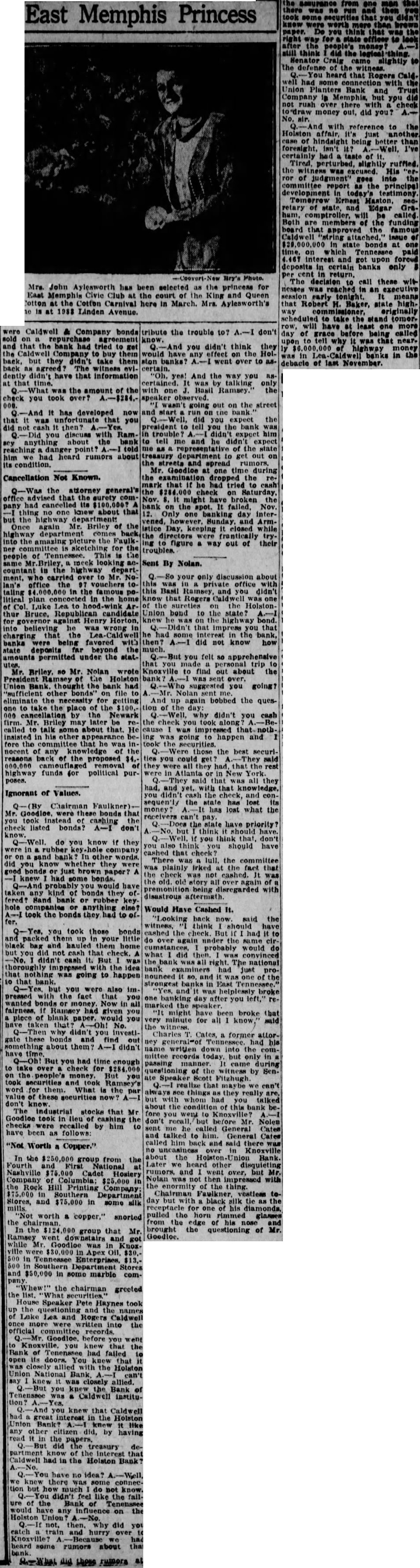
East Memphis Princess Cancellation Not Known. were Caldwell & Company bonds tribute the trouble to? don't that tried didn't think you the Company to buy them would have any effect Holback, but they didn't take them ston banks? went over to back agreed The witness certain. dently didn't have that information "Oh, yes! And the way you asat that time. certained. talking only was the amount of the with one Basil Ramsey.' the you took over? going out on the street It has developed now start bank unfortunate that you did you expect the did cash then? president to tell you the bank discuss with Ram- in trouble didn't expect him anything about the bank to tell me and he didn't expect reaching danger point? A.-1 told as representative the had heard rumors about department to get out on and Mr. Goodloe during the examination dropped the mark that if he had tried to the attorney general's the check on Saturday, office that surety Nov. might have broken the pany had on the It Nov. spot. thing no one knew about that Only one banking day interbut the Once Mr. Briley of the Day. closed highway department comes the into the amazing picture the Faulk to figure a way out of their ner is sketching for the troubles. people Tennessee. This is the same looking in the highway department, who carried over to Mr. lan's office 97 vouchers taling in the famous litical plan concocted in the home of Col. Luke to Arthur Bruce, Republican candidate for governor against Horton, believing was wrong charging the state deposits beyond the amounts permitted under the stat- Mr. Briley. so Mr. Nolan wrote the Holston Union thought the bank had "sufficient bonds" on file to eliminate the necessity for getting to take the place of the cancellation by the Newark firm. Mr. Briley may later be called to talk some about that. insisted in his other fore the that he was nocent of knowledge of the reasons back of the proposed camouflaged removal highway funds for political purposes. Ignorant of Values. Chairman Faulkner) Mr. Goodlee, were these bonds that you took cashing the check bonds? A-I don't do you know if they in rubber company on sand bank? other words. did you know whether they bonds or just brown paper? knew had some bonds. probably you would kind bonds fered? Sand bank or rubber keyhole anything else? took the bonds they had to of- you took those bonds and packed them up your little black bag and them home but did not cash didn't cash it. But the that nothing was going to happen 10 that bank. but you were also impressed with the fact that you wanted bonds or money. Now in all fairness, if Ramsey had given you piece of blank paper, you have that No. why didn't investigate these bonds and something have time. about them? A-1 didn't Q-Oh! But you had time enough to take over check for $284,000 on the people's money. But you took securities word for them. What the par value of securities A-1 don't know industrial stocks that Mr Goodlee took in lieu cashing the checks were recalled by him have been as follows: "Not Worth Copper." Fourth In the $250,000 group from the and National Nashville Cadet Hosiery Company of Columbia: $25,000 the Rock Hill Printing Company $75,000 Southern Department Stores, and $75,000 in some silk the worth a copper," snorted In the group that Mr. Ramsey while Mr. went and Goodloe was in Knoxwere Apex Oil, $30.in Tennessee Enterprises, $13,500 Southern Department Stores and $50,000 in some marble com- the chairman greeted the list. House the Speaker Pete Haynes took and the names Luke Lea and Rogers Caldwell more written into the official Goodloe, before Knoxville, you knew that the Bank Tenenssee had failed open its You that was closely allied with the Holston Union National Bank. say was closely allied. you knew the Bank of Tenenssee was Caldwell instituyou knew that Caldwell great interest in the Holston like any other citizen by having the did the treasury department know of the interest Caldwell had in the Holston Bank have no idea? knew there was some connection but do not feel the failure of the would any influence on the not, then. why did you eatch train and hurry over heard some rumors about that rumors Sent By Nolan. your only discussion about this was private office this Basil and you didn't Rogers Caldwell the sureties the Union to the the highway that had some the bank, much. you felt so apprehensive that you trip Knoxville to find out about the was over. you going? And again bobbed the question of the day: didn't you cash the check you took impressed noth. was going to happen and the best securities you could get said they that the rest in Atlanta or New York. that all they had, and yet, with that knowledge, you didn't the and conthe has lost money has lost what the can't Does the state priority? but think should if you think that, don't you also think should have that There the plainly the fact that check not It was the old. old story all being with disastrous aftermath. Would Have Cashed It. said the think have cashed the But had do over again the same probably would did convinced the bank all right. The national bank just pronounced and was one of the strongest East broke banking day after you left," remarked the speaker. "It might have been broke that very minute for all know, said the witness. Charles Cates, former attorney had written down into the committee records but passing manner. came during questioning of the witness by Senate Speaker Scott Fitzhugh that we can't see things they really but whom had you talked the of this fore you went to Knoxville? before Mr. Nolen sent me he called General Cates and talked to him. General Cates called him and said there was no in Knoxville about Bank. Later we rumers, and went over, but Nolan not then impressed with the enormity of the thing. Chairman Faulkner, vestlems today but black silk tie as the for one of his diamonds, pulled the glasses from the of nose and brought the questioning of Mr. from brown to slightly the defense Cald. Union Bank Company Memphis, but you over there with check money out, did you? A.Q.-And with reference to the Holston just hindsight being better than I've certainly taste was excused. His into the committee principal development today's testimony. Ernest Haston, retary of state, Edgar called Both are of the funding approved the famous state bonds at on which Tennessee paid 4.467 interest and got upon forcud deposits in certain banks only per cent return. The decision call these with nesses an session tonight. means that Robert state highoriginally scheduled take stand row, have least more day of grace before being called upon to tell why highway money in in the debacle of last


Article from The Cincinnati Enquirer, March 18, 1931

Click image to open full size in new tab

Article Text

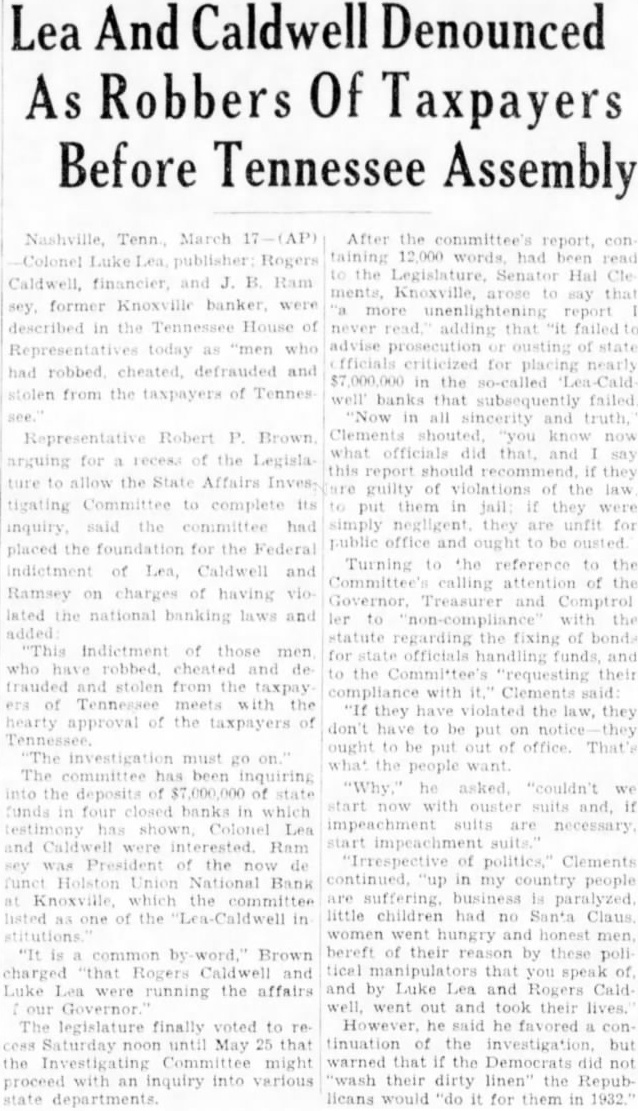
Lea And Caldwell Denounced As Robbers Of Taxpayers Before Tennessee Assembly Nashville, March Luke Rogers Caldwell, financier, and B. Ram sey, former Knoxville banker, were described in the Tennessee House of today as "men had robbed and from the taxpayers of Tennes Robert Brown arguing for the Legislature the Affairs Invesits the committee had placed the foundation the Federal of Caldwell and Ramsey on charges of having the national banking laws and Indictment of those men robbed. and de from the taxpay Tennessee the of the taxpayers "The must go on The has been the deposits of in closed banks in which and were Ram the Bank Knoxville the of the Lea-Caldwell in "It Brown Luke Lea were running the affairs our Governor The legislature finally voted to reuntil May 25 that the might with an inquiry various departments. After the report, con12,000 words. had the Legislature, Hal ments, Knoxville, arose say that more unenlightening report never adding advise prosecution ousting of state for in the so-called well' banks that failed Now in all sincerity and truth, Clements you know officials did that and report if they guilty of violations the law them in they simply are for Turning the reference to the Committee calling of the Comptrol to the statute regarding fixing bonds for handling and the Clements they the law, they have to be put on to That's the "couldn't are necessary tart politics," 'up in my people are little children had no Santa and honest men bereft of their by these poli tical that you and by Luke Lea and Rogers Cald went out and took their lives. However he he favored tinuation of the investigation. but warned that the did not "wash their dirty linen" the Republicans would it for them in 1932.'


Article from The Knoxville News-Sentinel, November 4, 1931

Click image to open full size in new tab

Article Text

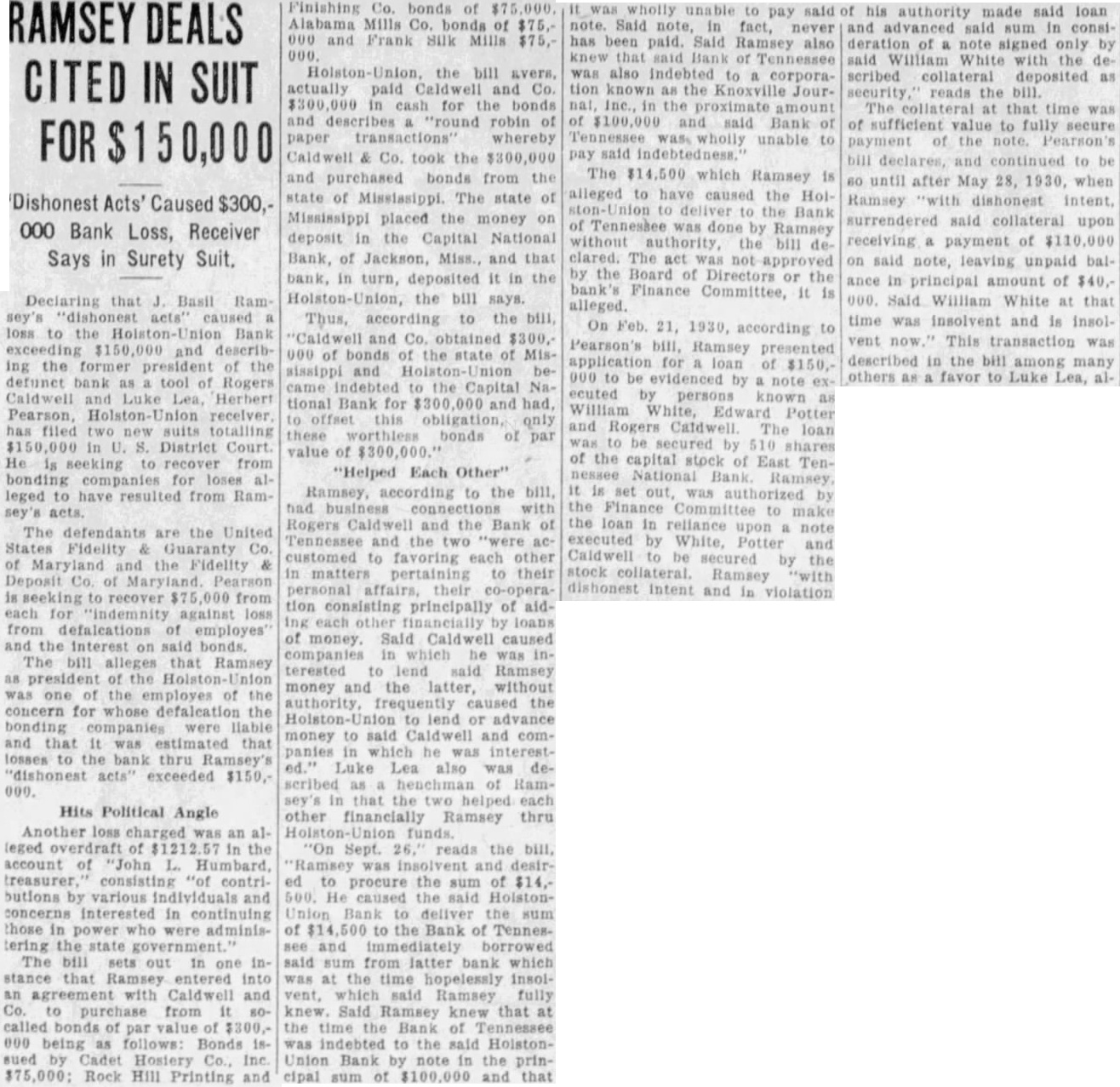
RAMSEY DEALS CITED IN SUIT FOR $150,000 'Dishonest Acts' Caused $300,000 Bank Loss, Receiver Says in Surety Suit. Declaring that J. Basil Ramsey's "dishonest acts' caused loss to the Hoiston-Union Bank exceeding $150,000 and describing the former president of the defunct bank as tool of Rogers Caldwell and Luke Lea, Herbert Pearson, Holston-1 receiver has filed two new suits totalling $150,000 in U. S. District Court He is seeking to recover from bonding companies for loses alleged to have resulted from Ramsey's acts. The defendants are the United States Fidelity & Guaranty Co. of Maryland and the Fidelity & Deposit Co. of Maryland Pearson is seeking to recover $75,000 from each for "indemnity against loss from defalcations of employes' and the interest on said bonds. The bill alleges that Ramsey as president of the Holston-Union was one of the employes of the concern for whose defalcation the bonding companies were liable and that it was estimated that losses to the bank thru Ramsey's "dishonest acts" exceeded $150,000. Hits Political Angle Another loss charged was an alleged overdraft of $1212.57 in the account of "John L. Humbard, treasurer. consisting "of contributions by various and concerns interested in continuing those in power who were administering the state government. The bill sets out In one instance that Ramsey entered into an agreement with Caldwell and Co. to purchase from it socalled bonds of par value of $300,000 being as follows: Bonds 18sued by Cadet Hosiery Co., Inc $75,000: Rock Hill Printing and Finishing Co. bonds of $75,000. Alabama Mills Co. bonds of $75,000 and Frank Silk Mills $75,000. Holston-Union, the bill avers. actually paid Caldwell and Co. $300,000 in cash for the bonds and describes a "round robin of paper transactions' whereby Caldwell & Co. took the $300,000 and purchased bonds from the state of Mississippi. The state of Mississippi placed the money on deposit in the Capital National Bank, of Jackson, Miss., and that bank, in turn, deposited it in the Holston-Union, the bill says. Thus, according to the bill "Caldwell and Co. obtained $300, 000 of bonds of the state of Mississippi and Holston-Union became indebted to the Capital National Bank for $300,000 and had, to offset this obligation, only these worthless bonds of par value of $300,000." "Helped Each Other" Ramsey, according to the bill. had business connections with Rogers Caldwell and the Bank of Tennessee and the two "were accustomed to favoring each other in matters pertaining to their personal affairs, their co-operation consisting principally of aidIng each other financially by loans of money. Said Caldwell caused companies in which he was interested to lend said Ramsey money and the latter, without authority, frequently caused the Hoiston-Union to lend or advance money to said Caldwell and companies in which he was interested." Luke Lea also was described as henchman of Ramsey's in that the two helped each other financially Ramsey thru Holston funds. "On Sept. 26, reads the bill. "Ramsey was insolvent and desired to procure the sum of $14,500. He caused the said HolstonUnion Bank to deliver the sum of $14,500 to the Bank of Tennessee and immediately borrowed said sum from latter bank which was at the time hopelessly insolvent, which said Ramsey fully knew. Said Ramsey knew that at the time the Bank of Tennessee was indebted to the said HolstonUnion Bank by note in the principal sum of $100,000 and that note. Said note, in fact, never has been paid. Said Ramsey also knew that said Bank of Tennessee was also indebted to a corporation known as the Knoxville Journat, Inc., in the proximate amount of $100,000 and said Bank of Tennessee was wholly unable to pay said indebtedness. The $14,500 which Ramsey is alleged to have caused the Holston-Union to deliver to the Bank of Tennessee was done by Ramsey without authority, the bill declared. The act was not approved by the Board of Directors or the bank's Finance Committee, it is alleged. On Feb. 21, 1930, according to Pearson's bill, Ramsey presented application for a loan of $150,000 to be evidenced by a note executed by persons known as William White, Edward Potter and Rogers Caldwell The loan was to be secured by 510 shares of the capital stock of East Tennessee National Bank Ramsey it is set out, was authorized by the Finance Committee to make the loan in reliance upon a note executed by White, Potter and Caldwell to be secured by the stock collateral. Ramsey "with dishonest Intent and in violation and advanced said sum in consideration of a note signed only by said William White with the described collateral deposited as security, reads the bill. The collateral at that time was of sufficient value to fully secure payment of the note. Pearson's bill declares, and continued to be 60 until after May 28, 1930, when Ramsey "with dishonest intent, surrendered said collateral upon receiving a payment of $110,000 on said note, leaving unpaid balance in principal amount of $40,000. Said William White at that time was insolvent and is insolvent now." This transaction was described in the bill among many others as a favor to Luke Lea, al-