Anonymous letters ('signed Hiram') attacked Southern Bank & Trust; that bank was taken over by the State Comptroller on Feb 6, 1928. Runs on the Citizens Bank and the Bank of Allapattah forced them to close temporarily; state examiners/banking department took the three institutions in charge and newspapers reported they were expected to reopen. Therefore sequence: run → suspension (state takeover) → planned reopening.
Events (3)
1.February 6, 1928Run
Cause
Rumor Or Misinformation
Cause Details
Circulation of anonymous letters (signed 'Hiram') predicting failure of the Southern Bank & Trust triggered withdrawals that led to runs on other local banks including the Bank of Allapattah.
Newspaper Excerpt
Runs forced the Citizens' Bank of Miami and the Bank of Allapattah to close.
Source
newspapers
2.February 6, 1928Suspension
Cause
Government Action
Cause Details
State Comptroller Ernest Amos ordered the Bank of Allapattah not to open (state takeover/temporary closure) after runs and anonymous letters threatened stability.
Newspaper Excerpt
Ernest Amos, State comptroller, had taken charge of the affairs of the Southern Bank and Trust company and ordered the Citizens bank and the Bank of Allapattah temporarily closed.
Source
newspapers
3.February 8, 1928Other
Newspaper Excerpt
All three institutions were taken over by the State Banking Department and the Southern Bank probably will be reopened about March 15. State examiners said the Citizens' Bank and the Bank of Allapattah were in good shape, but in no condition to stand a run.
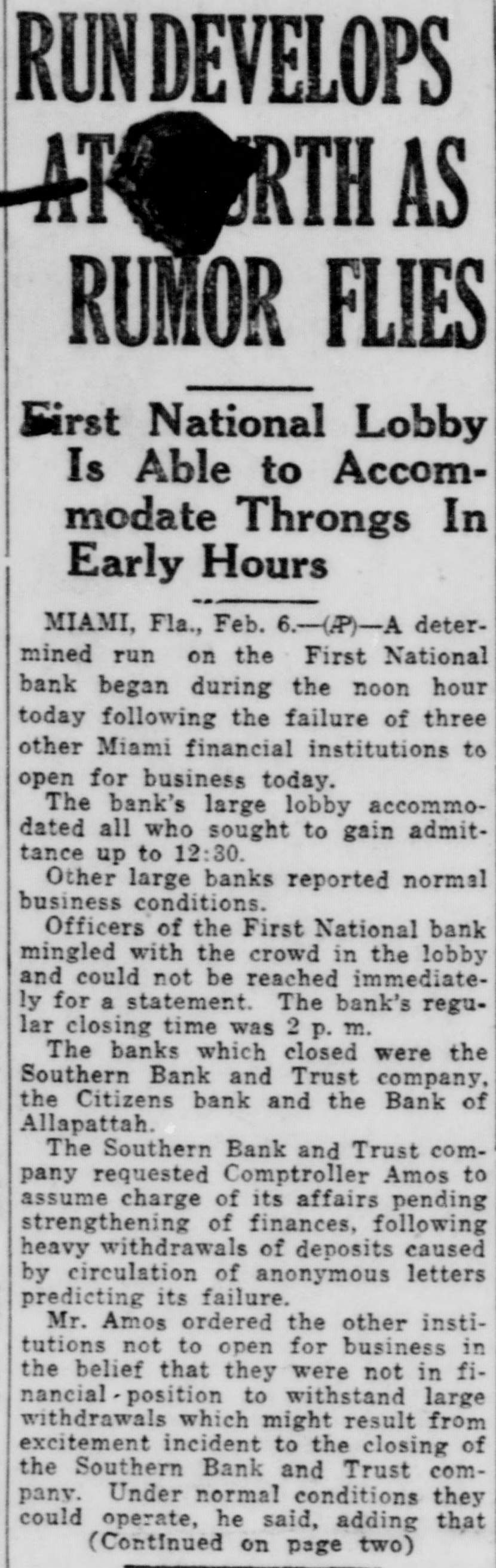
RUNDEVELOPS AT RTH AS RUMOR FLIES First National Lobby Is Able to Accommodate Throngs In Early Hours MIAMI, Fla., Feb. 6.-(AP)-A determined run on the First National bank began during the noon hour today following the failure of three other Miami financial institutions to open for business today. The bank's large lobby accommodated all who sought to gain admittance up to 12:30. Other large banks reported normal business conditions. Officers of the First National bank mingled with the crowd in the lobby and could not be reached immediately for a statement. The bank's regular closing time was 2 p. m. The banks which closed were the Southern Bank and Trust company, the Citizens bank and the Bank of Allapattah. The Southern Bank and Trust company requested Comptroller Amos to assume charge of its affairs pending strengthening of finances, following heavy withdrawals of deposits caused by circulation of anonymous letters predicting its failure. Mr. Amos ordered the other institutions not to open for business in the belief that they were not in financial . position to withstand large withdrawals which might result from excitement incident to the closing of the Southern Bank and Trust company. Under normal conditions they could operate, he said, adding that (Continued on page two)
2.February 6, 1928Lancaster Daily IntelligencerLancaster, PA
Click image to open full size in new tab
Article Text
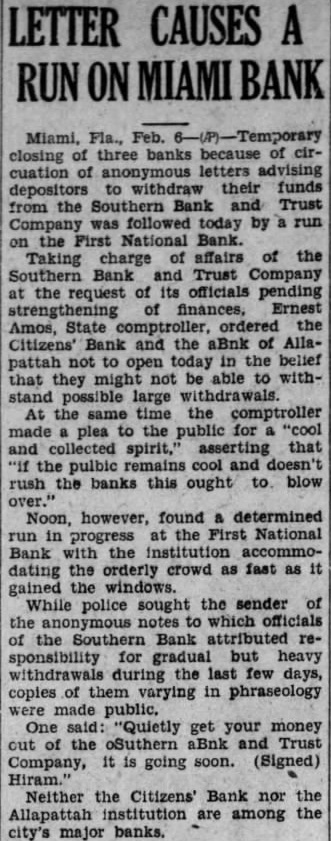
LETTER CAUSES
Miami, closing three banks because cuation of letters advising to withdraw their funds from the Bank Trust followed today run the First National Bank. Taking charge affairs of the Southern Bank and Trust Company the request of its officials pending strengthening of finances, Ernest Amos, State comptroller, ordered Citizens' Bank and the aBnk of Allapattah not to open today in the belief that they might not be able to withstand possible large At the same time the plea to the public for and spirit," asserting that the pulble remains cool and rush the banks this ought to. blow Noon, however, found determined run in the First National progress Bank the institution accommodating the orderly crowd as fast gained windows. While police sought the sender of the notes to which the Southern Bank responsibility for gradual but heavy during the few days, copies them varying in phraseology "Quietly get your money of the aBnk and Trust Company, going soon. (Signed) Hiram. Neither the Citizens' Bank nor the Allapattah institution among the city's major banks.
3.February 6, 1928Henryetta Daily Free-LanceHenryetta, OK
Click image to open full size in new tab
Article Text
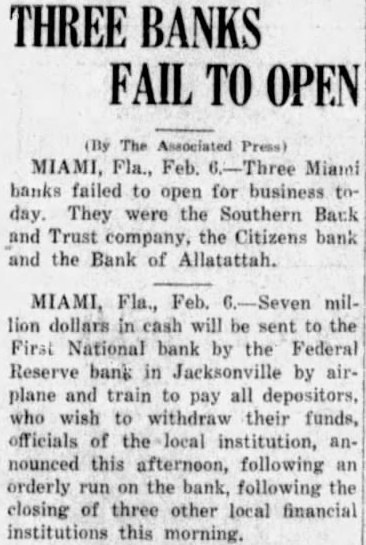
THREE BANKS FAIL TO OPEN
(By The Associated MIAMI, Fla., Feb. Miami banks failed to open for business day. They were the Southern Back and Trust company, the Citizens bank and the Bank of Allatattah.
MIAMI, Fla., Feb. million dollars in cash will be sent to the First National bank by the Federal Reserve bank in Jacksonville by plane and train to pay all depositors, who wish to withdraw their funds, officials of institution, announced this afternoon, following an orderly run on the bank, following the closing of three other local financial institutions this morning.
4.February 6, 1928Greenfield Daily RecorderGreenfield, MA
Click image to open full size in new tab
Article Text
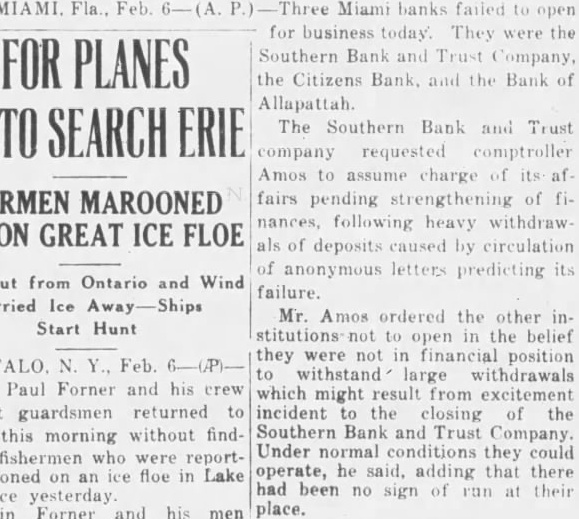
Miami banks failed for business They the Southern Bank and Trust Company, the Citizens Bank, and the Bank of Allapattah. The Southern Bank and Trust company requested comptroller Amos assume charge fairs pending strengthening of nances, following heavy withdraw of deposits caused by circulation of letters predicting its failure. Mr. Amos ordered the other stitutions in the belief they financial position withstand large withdrawals which might result from excitement incident the closing Southern Bank and Trust Company. Under normal conditions they could operate, he said, adding that there had been sign of their run place.
5.February 7, 1928The Times LeaderWilkes-Barre, PA
Click image to open full size in new tab
Article Text
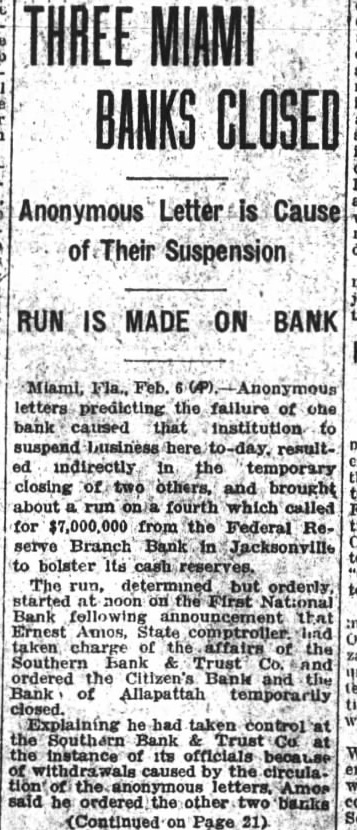
THREE BANKS CLOSED
Anonymous Letter Cause of Their Suspension
RUN IS MADE ON BANK
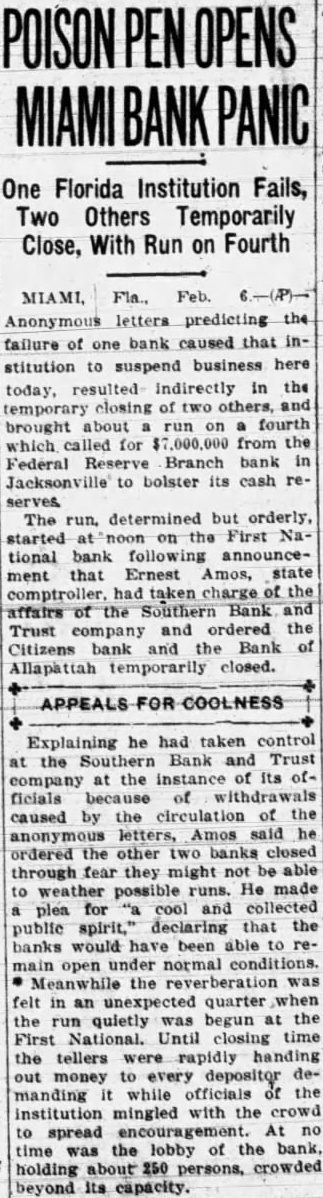
Miami, Feb. letters predicting the failure of one bank caused that institution suspend business resultindirectly the temporary closing others, and brought about fourth which called for the Federal Re. serve Branch Bank in to bolster Its cash The orderly, started on the First Bank Ernest Amos, comptroller. taken charge affairs Southern Bank Trust ordered the Citizen's Bank and Bank of Allapattah temporarily closed. Explaining had taken the Southern Trust instance its caused by the the he ordered other two banks (Continued on Page 21)
Three Florida Banks Close, Fourth Sustains Heavy Run
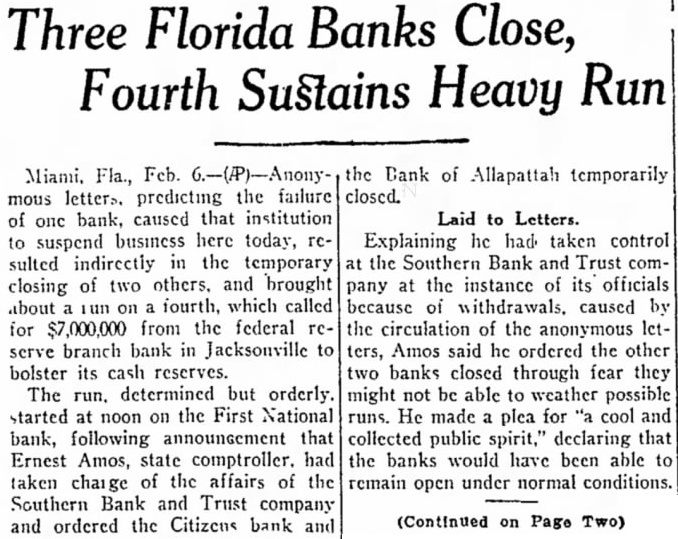
Miami, Fla., Feb. mous letters. predicting the failure of one bank, caused that institution to suspend business here today, resulted indirectly in the temporary closing of two others. and brought about on fourth, which called for $7,000,000 from the federal rcserve branch bank in Jacksonville to bolster its cash reserves. The run, determined but orderly. started at noon on the First National bank, following announcement that Ernest Amos, state comptroller. had taken charge of the affairs of the Southern Bank and Trust company and ordered the Citizens bank and the Bank of Allapattah temporarily closed.
Laid to Letters. Explaining he had taken control at the Southern Bank and Trust company at the instance of its officials because of withdrawals. caused by the circulation of the anonymous letters, Amos said he ordered the other two banks closed through fear they might not be able to weather possible runs. He made plea for cool and collected public spirit," declaring that the banks would have been able to remain open under normal conditions.
(Continued on Page Two)
7.February 7, 1928Republican and HeraldPottsville, PA
Click image to open full size in new tab
Article Text
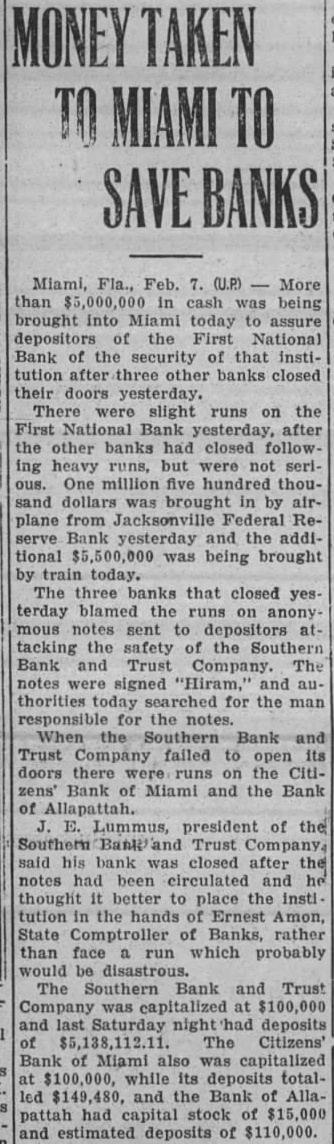
MONEY TAKEN TO MIAMI TO SAVE BANKS
Miami, Fla., Feb. 7. (U.P.) More than $5,000,000 in cash was being brought into Miami today to assure depositors of the First National Bank of the security of that institution after three other banks closed their doors yesterday. There were slight runs on the First National Bank yesterday, after the other banks had closed following heavy runs, but were not serious. One million five hundred thousand dollars was brought in by airplane from Jacksonville Federal Reserve Bank yesterday and the additional $5,500,000 was being brought by train today. The three banks that closed yes. terday blamed the runs on anonymous notes sent to depositors attacking the safety of the Southern Bank and Trust Company. The notes were signed "Hiram," and authorities today searched for the man responsible for the notes. When the Southern Bank and Trust Company failed to open its doors there were runs on the Citizens' Bank of Miami and the Bank of Allapattah. J. E. Lummus, president of the said his bank was closed after the notes had been circulated and he thought it better to place the insti tution in the hands of Ernest Amon, State Comptroller of Banks, rather than face run which probably would be disastrous. The Southern Bank and Trust was capitalized at $100,000 and last Saturday night had deposits of $5,138,112.11. The Citizens' Bank of Miami also was capitalized at $100,000, while its deposits totalled $149,480, and the Bank of Allapattah had capital stock of $15,000 and estimated deposits of $110,000.
Three Florida Banks Close, Fourth Sustains Heavy Run
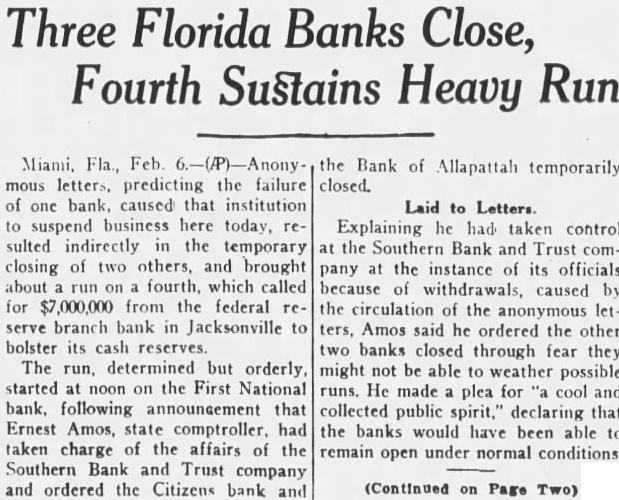
Miami, Fla., Feb. 6.-(P)-Anonymous letters, predicting the failure of one bank, caused that institution to suspend business here today, resulted indirectly in the temporary closing of two others, and brought about on fourth, which called for $7,000,000 from the federal reserve branch bank in Jacksonville to bolster its cash reserves. The run, determined but orderly, started at noon on the First National bank, following announgement that Ernest Amos, state comptroller. had taken charge of the affairs of the Southern Bank and Trust company and ordered the Citizens bank and the Bank of Allapattah temporarily closed.
Laid to Letters Explaining he had taken control at the Southern Bank and Trust company at the instance of its officials because of withdrawals, caused by the circulation of the anonymous letters, Amos said he ordered the other two banks closed through fear they might not be able to weather possible runs. He made plea for cool and collected public spirit," declaring that the banks would have been able to remain open under normal conditions.
(Continued on Page Two)
9.February 7, 1928Napa JournalNapa, CA
Click image to open full size in new tab
Article Text
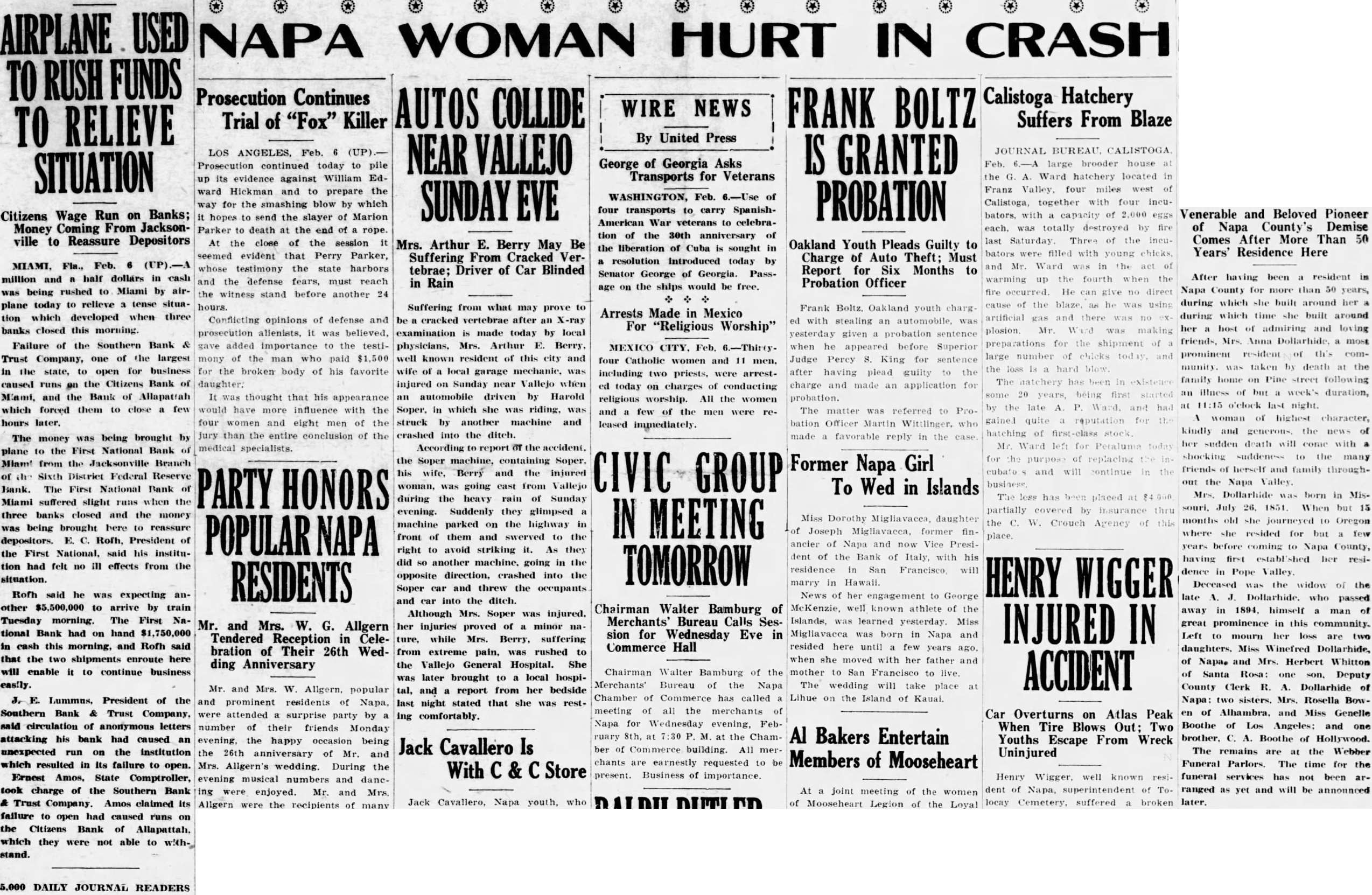
AIRPLANE USED
TO RUSH FUNDS TO RELIEVE SITUATION
Citizens Wage Run on Banks; Money Coming From Jacksonville to Reassure Depositors
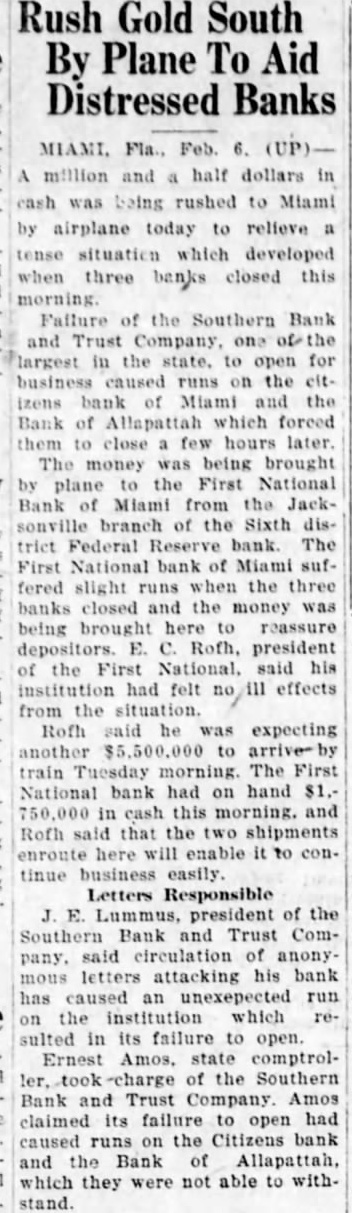
MIAMI, Fla., Feb. 6 (UP).-A million and a half dollars in cash was being rushed to Miami by airplane today to relieve a tense situation which developed when three banks closed this morning. Failure of the Southern Bank & Trust Company, one of the largest in the state, to open for business caused runs on the Citizens Bank of Mami, and the Bank of Allapatiah which forced them to close a few hours later.
The money was being brought by plane to the First National Bank of Miami from the Jacksonville Branch of the Sixth District Federal Reserve Bank. The First National Bank of Miami suffered slight runs when the three banks closed and the money was being brought here to reassure depositors. E. C. Rofh, President of the First National, said his institution had felt no III effects from the situation.
Rofh said he was expecting another $5,500,000 to arrive by train Tuesday morning. The First National Bank had on hand $1,750,000 in cash this morning, and Rofh said that the two shipments enroute here will enable it to continue business easily.
J. E. Lummus, President of the Southern Bank & Trust Company. said circulation of anonymous letters attacking his bank had caused an unexpected run on the institution which resulted in its failure to open. Ernest Amos, State Comptroller, took charge of the Southern Bank & Trust Company. Amos claimed its failure to open had caused runs on the Citizens Bank of Allapattah. which they were not able to withstand.
5,000 DAILY JOURNAL READERS
Venerable and Beloved Pioneer of Napa County's Demise Comes After More Than 50 Years' Residence Here
After having been a resident in Napa County for more than 50 years, during which she built around her during which time she built around her a host of admiring and loving friends, Mrs. Anna Dollarhide, a most prominent resident of this community. was taken by death at the family home on Pine street following an illness of but a week's duration, at 11:15 o'clock last night. \ woman of highest character, kindly and generous. the news of her sudden death will come with a shocking suddeness to the many friends of herself and family throughout the Napa Valley. Mrs. Dollarhide was born in Mis. souri, July 26. 1851. When but 15 months old she journeyed to Oregon where she resided for but few years before coming to Napa County, having first establ'shed her residence in Pope Valley. Deceased was the widow of the late A. J. Dollarhide. who passed away in 1894. himself a man of great prominence in this community. Left to mourn her loss are two daughters. Miss Winefred Dollarhide, of Napa. and Mrs. Herbert Whitton of Santa Rosa: one son. Deputy County Clerk R. A. Dollarhide of Napa: two sisters. Mrs. Rosella Bowen of Alhambra, and Miss Genelle Boothe of Los Angeles: and one brother. C. A. Boothe of Hollywood. The remains are at the Webber Funeral Parlors. The time for the funeral services has not been arranged as yet and will be announced later.
10.February 7, 1928The Spokesman-ReviewSpokane, WA
Click image to open full size in new tab
Article Text
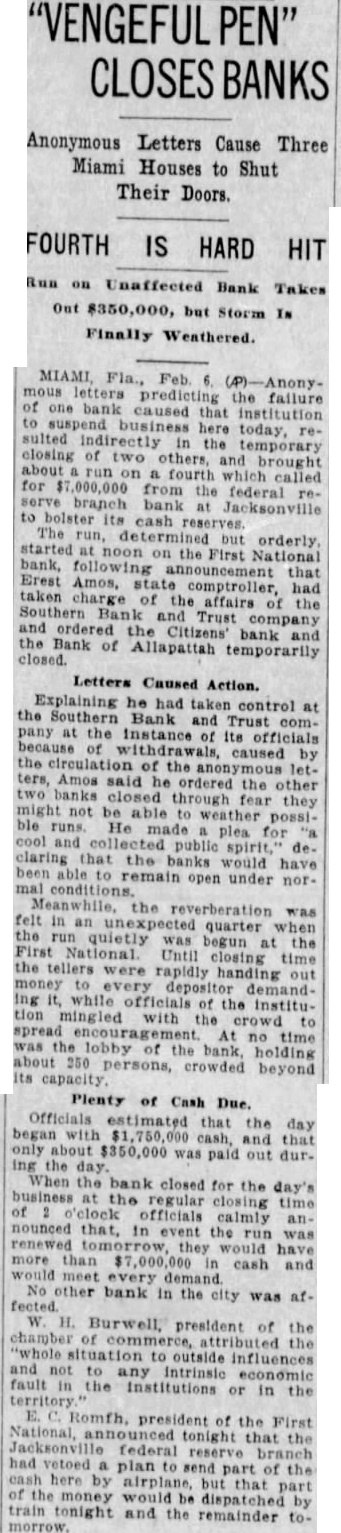
"VENGEFUL PEN" CLOSES BANKS
Anonymous Letters Cause Three Miami Houses to Shut Their Doors.
FOURTH IS HARD HIT
Run on Unaffected Bank Takes Out $350,000, but Storm IN Finally Weathered.
(P)-Anonypredicting the failure caused that institution here today, sulted the closing of brought about on fourth which called for from federal rebranch bank Jacksonville to bolster its cash reserves but started at noon on the First National bank, Erest Amos, state comptroller, had taken charge of the affairs of the Southern Bank and Trust company ordered the Citizens' bank and the Bank of Allapattah temporarily closed. Letters Caused Action. Explaining he had taken control at the Southern Bank and Trust company at the Instance of its officials because of withdrawals, caused by the of the letters, Amos said he ordered the other two banks closed through fear they might not be able to weather possible runs. He made plea for and public claring that the banks would have been able remain open under mal conditions the was felt in quarter when the run quietly was begun at the First National Until closing time the tellers were rapidly handing out depositor demandit, while officials of the institution mingled the spread was the lobby the holding about 250 persons, crowded beyond its
Plenty of Cash Due. Officials estimated that began with cash, about $350,000 was paid out the the bank closed the regular of officials nounced event the renewed would more than in cash and No other bank in the city was H. president the to outside and not any fault in Institutions or in territory president of the tonight federal had vetoed plan to send part of the cash here by of the money would be by train tonight and the remainder to.
11.February 7, 1928The Evening NewsHarrisburg, PA
Click image to open full size in new tab
Article Text
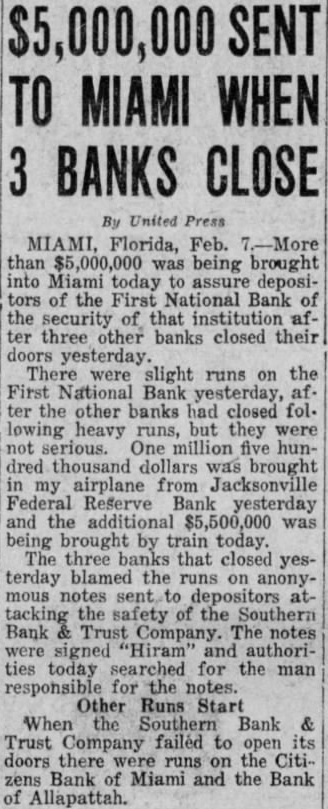
TO MIAMI WHEN 3 BANKS CLOSE
United
MIAMI, Florida, Feb. than $5,000,000 was being brought into Miami today to assure depositors of the First National Bank of the security of that institution after three other banks closed their doors yesterday. There were slight runs on the First National Bank yesterday, ter the other banks had closed lowing heavy runs, but they were not serious. One million five hundred thousand dollars was brought my airplane from Jacksonville Federal Reserve Bank yesterday and the additional $5,500,000 was being brought by train today. The three banks that closed yesterday the runs on anonymous notes sent. to attacking the safety of the Southern Bank Trust Company. The notes were signed "Hiram' and authorities today searched for the man responsible for the notes. Other Runs Start When Southern Bank Trust Company failed to open doors there runs on the Citizens Bank of Miami and the Bank of Allapattah.
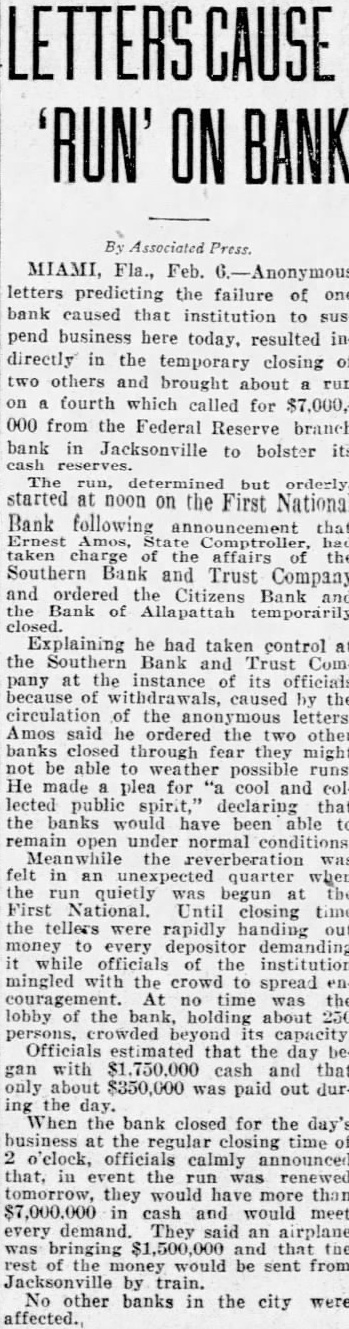
LETTERS CAUSE 'RUN' ON BANK
Associated
MIAMI, Fla., Feb. 6.-Anonymous letters predicting the failure of one bank caused that institution to suspend business here today, resulted indirectly in the temporary closing of two others and brought about a run on a fourth which called for $7,000,000 from the Federal Reserve branch bank in Jacksonville to bolster its cash The run, determined but orderly, started at noon on the First National Bank following announcement that Ernest Amos, State Comptroller, had taken charge of the affairs of the Southern Bank and Trust Company and ordered the Citizens Bank and the Bank of Allapattah temporarily closed. Explaining he had taken control at the Southern Bank and Trust Company at the instance of its officials because of withdrawals, caused by the circulation of the anonymous letters, Amos said he ordered the two other banks closed through fear they might not be able to weather possible runs. He made plea for "a cool and collected public spirit," declaring that the banks would have been able to remain open under normal conditions. Meanwhile the reverberation was felt in an unexpected quarter when the run quietly was begun at the First National. Until closing time the tellers were rapidly handing out money to every depositor demanding it while officials of the institution mingled with the crowd to spread encouragement. At no time was the lobby of the bank, holding about 250 persons, crowded beyond its capacity. Officials estimated that the day began with $1,750,000 cash and that only about $350,000 was paid out during the day. When the bank closed for the day's business at the regular closing time of 2 o'elock, officials calmly announced that, in event the run was renewed tomorrow, they would have more than $7,000,000 in cash and would meet every demand. They said an airplane was bringing $1,500,000 and that the rest of the money would be sent from Jacksonville by train. No other banks in the city were affected.
13.February 7, 1928The Springfield News-LeaderSpringfield, MO
Click image to open full size in new tab
Article Text
POISON BANK
One Florida Institution Fails, Two Others Temporarily Close, With Run on Fourth
MIAMI, Fla., Feb. letters predicting the Anonymous failure of one bank caused that stitution to suspend business here today, resulted indirectly in the temporary closing of two brought about run on fourth which called for from the Federal Reserve Branch bank in Jacksonville to bolster its cash reThe run, determined but orderly, started on First National bank following announcement that Ernest Amos, state comptroller. had taken of the affairs the Southern Bank and Trust company and ordered the Citizens bank the Bank of Allapattah temporarily closed.
APPEALS FOR COOLNESS
Explaining he had taken control at the Bank and Trust company at the of its officials because of caused by the circulation of the anonymous letters, Amos said he ordered the other two banks closed through fear they might not be able to weather possible He made plea for cool and collected public spirit," declaring that the banks would have been able to reopen under normal Meanwhile the was felt in an quarter when quietly was begun at the the run First National. Until closing time the tellers rapidly handing out money to every depositor demanding while officials of the institution mingled with the crowd to spread At no time was the lobby of the bank, holding about 250 persons, crowded beyond its capacity.
14.February 7, 1928The Modesto BeeModesto, CA
Click image to open full size in new tab
Article Text
PLANE RUSHES MILLION AND HALF DOLLARS TO FLORIDA
Money Being Sent South To Reassure Depositors, Says Official
BANK FAILURE CAUSES RUN ON TWO OTHERS
Circulation of Anonymous Letters Blamed For Act, By President
(By The United Press) MIAMI. Feb. million dollars cash was ing rushed Miami airplane to-day tense situation when three banks closed this Failure the Southern Bank and Trust one the the state, to open for runs on the Citizens Bank of Miami and the Bank of Allapattah which forced them close hours later. Run On Banks The money being brought plane the First National Bank of Miami from the Jackson. ville branch of the sixth district federal reserve bank. The First National Bank of Miami suffered slight runs when the closed the money was being brought here depospresident of the First National, said his had felt no effects from situation. Romfh said he was expecting another arrive by train morning. The National Bank had hand $1. in cash this morning. and Romfh that the two shipments route here will enable continue Laid To Attack Lummus. president of the Southern Bank Trust company, said circulation of anonyletters attacking his bank had caused an unexpected run on institution which resulted in its failure to open Police Hunt Sender The letters. he said, were signed "Hiram," and bore crudely emblem. They were mail Saturday January 28 in Miami. but Lummus was unable to estimate their number. more ac curately than that there were "more than dozen Some were sent persons who were police are seeking to trace the sender. President Lummus said the deposits open accounts and trust funds were fully protected Ernest Amos, state comptroller, took charge the Southern Bank and Trust company Amos claimed failure open had caused runs the Citizens Bank and the Bank Allapattah which they not able to withstand
15.February 7, 1928The Klamath NewsKlamath Falls, OR
Click image to open full size in new tab
Article Text
Rush Gold South By Plane To Aid Distressed Banks
MIAMI, Fla., Feb. 6. (UP) A million and a half dollars in cash was being rushed to Miami by airplane today to relieve a tense situation which developed when three banks closed this morning. Failure of the Southern Bank and Trust Company, one of the largest in the state. to open for business caused runs on the eitizens bank of Miami and the Bank of Allapattah which forced them to close a few hours later. The money was being brought by plane to the First National Bank of Miami from the Jacksonville branch of the Sixth district Federal Reserve bank. The First National bank of Miami suffered slight runs when the three banks closed and the money was being brought here to reassure depositors. E. Rofh, president of the First National, said his institution had felt no ill effects from the situation. Rofh said he was expecting another $5,500,000 to arrive by train Tuesday morning. The First National bank had on hand $1.750 in cash this morning. and Rofh said that the two shipments enroute here will enable it to continue business easily. Letters Responsible J. E. Lummus, president of the Southern Bank and Trust Company. said circulation of anonymous letters attacking his bank has caused an unexepected run on the institution which resulted in its failure to open. Ernest Amos, state comptroller. took-charge of the Southern Bank and Trust Company. Amos claimed its failure to open had caused runs on the Citizens bank and the Bank of Allapattah, which they were not able to withstand.
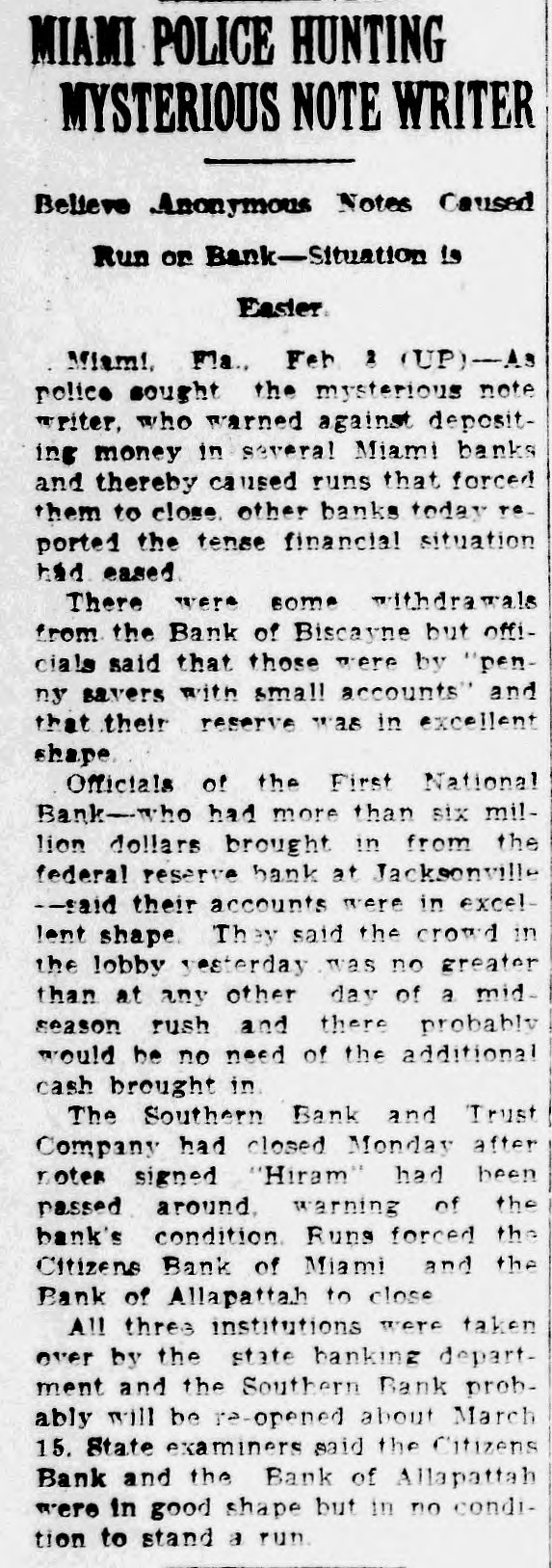
MIAMI POLICE HUNTING MYSTERIOUS NOTE WRITER Believe Anonymous Notes Caused Run or Bank-Situation is Easter Miami, Fla., Feb 2 (UP)-As police sought the mysterious note writer, who warned against depositing money in several Miami banks and thereby caused runs that forced them to close. other banks today reporte1 the tense financial situation had eased There were some withdrawals from the Bank of Biscayne but officials said that those were by "penny savers with small accounts and that their reserve was in excellent shape Officials of the First National Bank-who had more than six million dollars brought in from the federal reserve bank at Jacksonville --said their accounts were in excellent shape They said the crowd in the lobby yesterday was no greater than at any other day of a midseason rush and there probably would be no need of the additional cash brought in The Southern Bank and Trust Company had closed Monday after notes signed "Hiram" had been passed around. warning of the bank's condition. Runs forced the Citizens Bank of Miami and the Bank of Allapattah to close All three institutions were taken over by the state banking department and the Southern Bank probably will be re-opened about March 15. State examiners said the Citizens Bank and the Bank of Allapattah were in good shape but in no condition to stand a run
17.February 8, 1928Republican and HeraldPottsville, PA
Click image to open full size in new tab
Article Text
THE FINANCIAL SCARE AT MIAMI HAS EASED UP
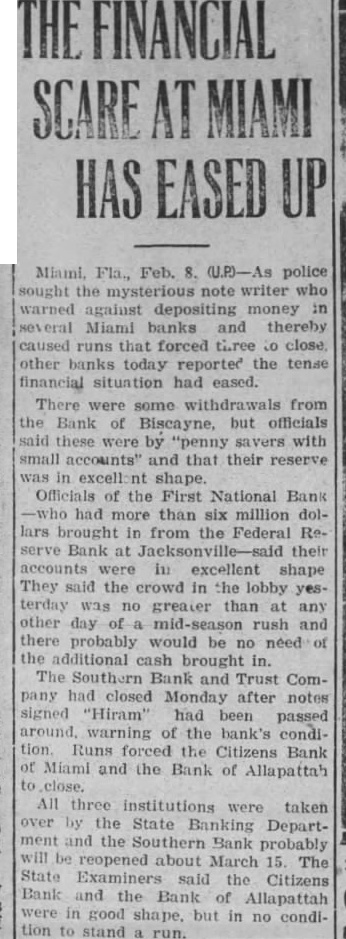
Miami, Fla., Feb. 8. (U.P)-As police sought the mysterious note writer who warned against depositing money in several Miami banks and thereby caused runs that forced three to close other banks today reported the tense financial situation had eased. There were some withdrawals from the Bank of Biscayne, but officials said these were by "penny savers with small accounts" and that their reserve was in excell nt shape Officials of the First National Bank had more than six million dollars brought in from the Federal Reserve Bank at Jaeksonville-said their accounts were in excellent shape They said the crowd in the lobby yes. terday was no greater than at any other day of mid-season rush and there probably would be no need of the additional cash brought in. The Southern Bank and Trust Company had closed Monday after notes signed "Hiram" had been passed around. warning of the bank's condition Runs forced the Citizens Bank of Miami and the Bank of Allapattah to All three institutions were taken over by the State Banking Department and the Southern Bank probably will be reopened about March 15. The State Examiners said the Citizens Bank and the Bank of Allapattah were in good shape, but in no condition to stand run.
18.February 8, 1928Evening CourierCamden, NJ
Click image to open full size in new tab
Article Text
CRISIS
Police Renew Search for NoteWriter Who Brought Needless Run
Miami, Fla., Feb. 8, polsought who in several Miami and thereby money runs that forced close, other banks today reported the tense financial situation had eased. There were withdrawals the Bank of Biscayne, but officials said these by "penny with and that their reOfficials the First shape. Bank had than $6,000,000 brought in from the Federal Reserve at their acThey said the in the was no greater any other day rush and probably would be no need of the additional cash brought The Southern Bank and Trust Comclosed Monday after signed "Hiram" had been passed the bank's condition. the of Miami and the Bank of Allapattas to close. All three institutions were taken over by banking department and Southern will be March 15. State said the Citizens and the Bank of in good shape, but in no condition to stand run.
19.February 8, 1928The Brooklyn CitizenBrooklyn, NY
Click image to open full size in new tab
Article Text
RESERVES OF MIAMI BANKS EASE TENSION
Three Banks Forced to Close by Sudden Run Will Reopen
MIAMI, Fla., Feb. 8 (United Prese). police sought the mysterious note writer, who warned against depositing money in several Miami banks and thereby caused runs that forced three to close, other banks to-day reported the tense financial situation had eased. There were some withdrawals from the Bank of Biscayne but officials said that these were by "penny savers with small accounts and that their reserve was in excellent shape. Officials of the First National Bank who had more than six million dollars brought in from the Federal Reserve Bank at Jacksonville-sa their ac counts were in excellent shape They said the crowd in the lobby yesterday was no greater than at any other day of a mid-season rush and there probably would be no need of the additional cash brought in. The Southern Bank and Trust Com pany had closed Monday after notes signed "Hiram" had been passed around. warning of the bank's condition. Runs forced the Citizens' Bank of Miami and the Bank of Allapattah to close. All three institutions were taken over by the State Benking Department. and the Southern Bank probably will be 10. opened about March 15. State exam iners said the Citizens' Bank and the Bank of Allapattah were in good shape. but in no condition to stand a run.
20.February 10, 1928The American GuardianOklahoma City, OK
Click image to open full size in new tab
Article Text
Letter Predicting Failure Starts Run banks their and fourth the throes on it the result of ure of the National here. The run started on the First tional Bank following word Ernest Amos, affairs Southern Bank and Trust ordered the Bank Bank Allapattah temporarily closed. Explaining he had taken control the and Trust the of its Company ficials because of by the circulation Amos said anonymous ordered the they might not through fear weather possible National with The First of from the several millions Federal Reserve was