19728. Milwaukee Trust Company (Milwaukee, WI)

Bank Information

Episode Type
Run Only
Bank Type
trust
Start Date
April 25, 1905
Location
Milwaukee, Wisconsin (43.039, -87.906)

Metadata

Model
gpt-5-mini
Short Digest
95f52b7f15258f1f

Response Measures

None

Description

Multiple articles (dated Apr 25–26, 1905) describe a depositor run on the Milwaukee Trust Company triggered by the confessed defalcation of Frank G. Bigelow (president of the First National). The Trust Company was not suspended or closed: the run subsided the same day/next day after clearinghouse examinations, public assurances, and use of the 30/90-day notice on time deposits. Many articles also discuss the First National Bank, but the Trust Company remained open.

Events (1)

1. April 25, 1905 Run
Cause
Bank Specific Adverse Info
Cause Details
Confession/defalcation of Frank G. Bigelow (former president of the First National) revealed shortage over $1,000,000; Bigelow had been a director of the Trust Company and was removed when defalcation became known.
Measures
Passbooks stamped invoking 30-day notice on sums under $100 and 90-day notice on larger sums; clearinghouse examined assets and issued reassuring statement; directors/leading citizens deposited funds publicly to restore confidence.
Newspaper Excerpt
Despite the assurances that the Milwaukee Trust Company was in no manner involved by the financial troubles of Frank G. Bigelow ... crowds today waited long before the opening of the trust company bank to withdraw their deposits.
Source
newspapers

Newspaper Articles (19)

Article from The Minneapolis Journal, April 25, 1905

Click image to open full size in new tab

Article Text

WOUJ SNOU VALHO BIGELOW AFFAIR Crowds of Depositors at First National and Milwaukee Trust Company Banks. BIGELOW ARRESTED AND RELEASED UNDER BOND Speculation and Bad Investments, Not High Living, the Cause of the Trouble. Milwaukee, April 25.-The run on the Milwaukee Trust Company bank and the First National bank of Milwaukee, in both of which Frank G. Bigelow was a director, continued this morning, but ceased in the afternoon, and business in these institutions was resumed under normal conditions. The two banks today decided to take advantage of the law requiring that a notice of thirty days be given before sums under $100 can be withdrawn and a notice of ninety days on sums exceeding $100. The passbooks were so stamped when presented at the bank windows. The same rule applies to certificates of deposits. The general display in the windows of the banks and prominent business houses of placards containing reassuring statements of the boards of directors of the First National bank and the Milwaukee clearinghouse committee also fidence. had an effect of restoring conCrowds at the Bank. When the doors of the two banks were thrown open, the crowd that had lined up two and four abreast for half a block from the main entrance of each, filed in as rapidly as the police would permit. More than a dozen sought admission at once and there was a lively scramble. Women and men, an old man on crutches among them, were jostled rudely. Those who sought to withdraw their funds were mostly small depositors, who applied at the savings departments. There were some depositors, chiefly lined up at the window of the First National bank. The directors of the Milwaukee Chamber of Commerce today voted unanimously not to withdraw the current fund from the First National bank. The opinion was generally expressed solvent. that the bank was perfectly Statement from Bank. The following statement was issued shortly before noon by the directors of the First National bank: The board of directors of the First National bank announce with absolute positiveness that the bank is perfectly solvent and able to pay every dollar of its indebtedness. The report of the clearinghouse committee confirms this statement. We have money on hand with which to withstand any run that may be made. Only small depositors are withdrawing. All banks in the city are taking advantage of the law on time deposits. The First National is safe. Bigelow Arrested. Bigelow was arrested late yesterday and was held to the federal jury under $25,000 bonds, which was furnished by Dr. Geesch, Horace M. Brown and Arthur McBigelow confession was made at a special meeting of the board of directors Saturday evening and continued Sundayand Sunday night. Bigelow said he had a painful statement to make-a confession that he had misdirected the funds of the bank u and that an examination of his books and a comparison of figures would 0 show that he was indebted to the bank to the amount of over $1,450,000. This money, he said, had been lost in speculation in wheat and stocks. lb Not a dollar of it could be recovered, and the only sum he could offer toward recompensing the bank was personal e 000. property valued at approximately $300,S Confession Is Last Resort. Mr. Bigelow said he had become involved in speculation several months 0 ago. This was on Wall street. More S recently he had been a persistent bull 0 in the wheat market with disastrous a result. From small manipulations of p the bank's funds he had extended the 4 defalcations until his shortage had reached the present stage. He saw no opportunity or possibility of making up 4 the amount and therefore confessed. The meeting of the directors, which was almost continuous for thirty-six 4 hours, was stormy at times. Several Π§ plans were suggested for protecting the interests of the bank. One was to accept the resignation of the president, E permit him to go to Europe, and the 7 directors make good his shortage. E The proposal met with determined op9 position from the directors who de8: manded that the defaulter be punished. The plan to make up the shortage was S then approved. Bigelow was removed from the presidency of the bank, and X the case was referred to the federal authorities. a 41 Wife Is Steadfast. e is. When the federal marshal called at the Bigelow residence to serve the warrant, the former bank president was in


Article from Evening Times-Republican, April 25, 1905

Click image to open full size in new tab

Article Text

RUN STARTED ON MILWAUKEE TRUST Defalcation of President of First National Starts Run on Another Big Concern IS RESTORED CONFIDENCE Long Line of Depositors in Front of Both Institutinons, but Clearing House Statement and Aid of Other Banks Result in Restoring Normal Conditions. Milwaukee, April 25. - Despite the assurances that the Milwaukee Trust Company was in no manner involved by the financial troubles of Frank G. Bigelow, former president of the First National bank, crowds of people today assembled long before the opening of the Trust company bank to withdraw their deposits. The depositors gathered at the National bank were compartively few at first, but the number continued to increase. Bigelow had been a director of the Trust company, but when his defalcation became known he was removed as such by the board of directors. Notices posted on the windows of the First National and Trust Company's banks announced both institutions were abundantly prepared to meet all demands of depositors and creditors. There was no evidence of any trouble at other banks. John I. Beggs, director of the First National, said the bank had today received two million dollars from outside and local banks with which to meet any demands. Beggs said the run would probably continue thruout today, but that beginning with tomorrow, after having shown stability of the institution, the excitement would subside. As the hour approached for opening the bank the crowds in front of each bank became larger and extended for half a square. A detail of present maintain order. police were to Both institutions decided to take advantage of the printed clause in the pass books of all saving deposits requiring notice of thirty days before sums under a hundred dollars can be withdrawn. When the doors of the First National Bank and Milwaukee Trust Company were thrown open the crowd which had lined up two and four abreast for a distance of half a block from the main entrance of each institution, filed in as rapidly as the police would permit. Women and men were jostled in their into the were to efforts police to get constantly the banks compelled who and push them back. Those sought to withdraw funds were mostly small depositors who applied at the savings There were some while a were to department. tors, number waiting deposiwithdraw their funds. Up to noon there had been no run on any other banks. The board of directors of the Chamber of Commerce today voted unanimously not to withdraw the current fund from the First National Bank. The opinion is generally expressed that the bank is perfectly solvent. Milwaukee, April 25.-The run on the two banks ceased entirely in the afternoon and business in ths institutions was resumed under normal conditions. Bank is Solvent. Milwaukee, April 25. - The Clearing House Association today issued a statement saying after examining carefully all assets and collateral of the First National it is satisfied the bank is perfectly solvent.


Article from The Roswell Daily Record, April 25, 1905

Click image to open full size in new tab

Article Text

DEPOSITORS FRIGHTENED. Million Dollar Defalcation of Milwaukee Bank President Causes a Temporary Local Panic. Milwaukee, Wis., April 25.-Despite the assurance that the Milwaukee TrustCompany was in no way involved by the financial trouble of Frank G. Bigelow, former president of the First National Bank of Milwaukee, and confessed defaulter for more than a million dollars, crowds of people were today in line long before the opening of the Trust Company's bank waiting to withdraw their deposits. The depositors gathered at the First National Bank were comparatively few at first, but the number continued to increase. Bigelow had been a director of the Milwaukee Trust Company, but when the defalcation became known he was removed as such by the board of directors. Notices posted on the bank window, which the depositors, mostly working people, eagerly scanned, announced this fact and that the Trust Company was abundantly able and prepared to meet the demands of all depositors and creditors. The notice posted on the windows of the First National Bank and signed by the directors stating that the corporation was solid seemed to reassure the depositors somewhat. No depositors gathered at any other banks at the time they were in evidence at the First National and at the Trust Company Bank. The members of the clearing house association today examined the af fairs of the bank, and the officers of other institutions in the city expressed their confidence in the strongest terms in the ability of the First National Bank to meet any emergency that might arise. Henry G. Goll, assistant cashier of the First National Bank of Milwaukee, who is charged in the U. S. District Attorney's complaint of embezzling a sum exceeding $100,000 of the bank's funds, has not yet been arrested. U. S. Marshal T. B. Reed said. however, that he expected to take Goll into custody to day. John I. Beggs, director of the First National Bank. and one of the men who gave $300,000 to make up the defalcation of Bigelow, said that the bank had borrowed $2,000,000 from outside and local banks with which they can meet any demands. He asserted that the bank had ample funds to meet all requirements. As the hour approached for the opening of the bank, the crowds gathered in front of the First National and the Milwaukee Trust Co. became larger and extended for half a square on Wisconsin and on East Water streets. De tails of police were present to maintain order. The report that Bigelow held a large amount of Northern Pacific stock was emphatically denied here today. Inquiry among brokers and friends of the former bank president developed that there was very little of that stock held by local capitalists. The First National Bank and the Milwaukee Trust Company today de cided to take advantage of the clause requiring that notice of thirty days be given before sums under $100 can be withdrawn and notice of ninety days on sums exceeding $100. The pass-books were so stamped when pre sented at the bank windows. The same rule applies to certificates of deposit. LATER (Bulletin) The run on the bank and the trust company ceased entirely in the afternoon, and the business of the institutions was resumed under normal conditions.


Article from The Spokane Press, April 25, 1905

Click image to open full size in new tab

Article Text

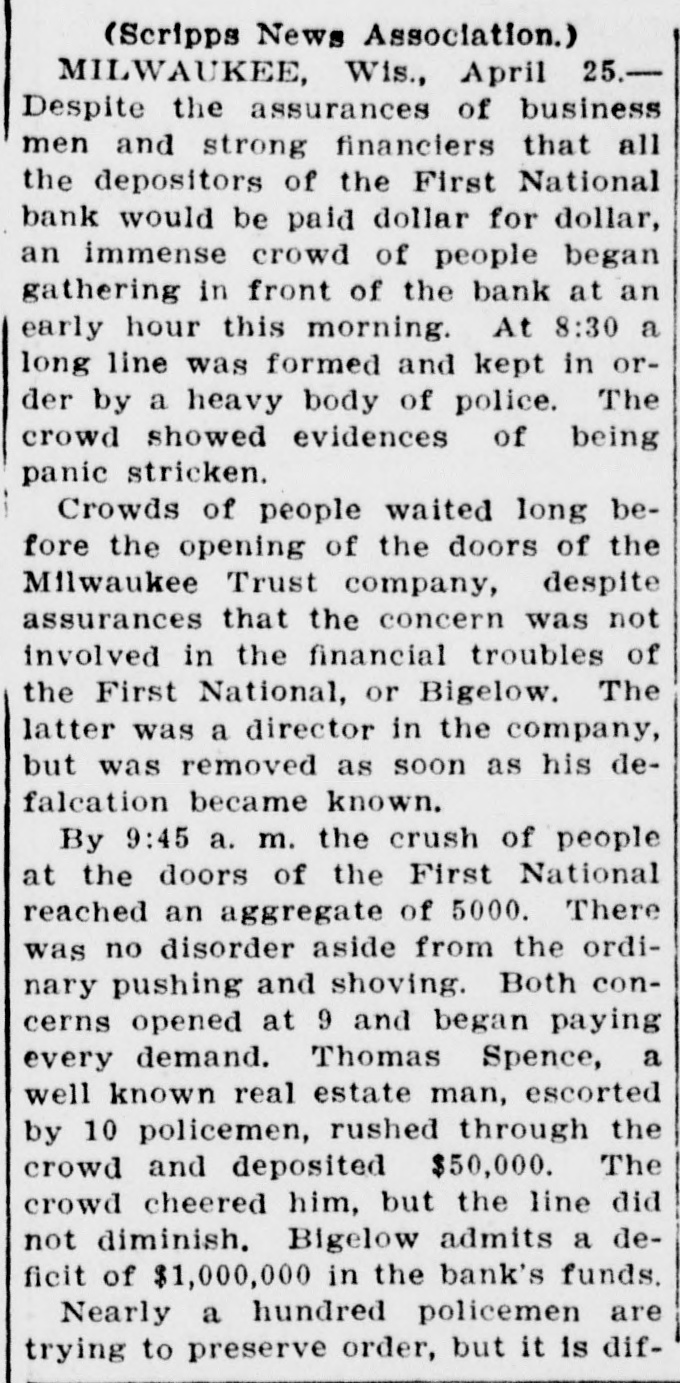
(Scripps News Association.) MILWAUKEE, Wis., April 25.Despite the assurances of business men and strong financiers that all the depositors of the First National bank would be paid dollar for dollar, an immense crowd of people began gathering in front of the bank at an early hour this morning. At 8:30 a long line was formed and kept in order by a heavy body of police. The crowd showed evidences of being panic stricken. Crowds of people waited long before the opening of the doors of the Milwaukee Trust company, despite assurances that the concern was not involved in the financial troubles of the First National, or Bigelow. The latter was a director in the company, but was removed as soon as his defalcation became known. By 9:45 a. m. the crush of people at the doors of the First National reached an aggregate of 5000. There was no disorder aside from the ordinary pushing and shoving. Both concerns opened at 9 and began paying every demand. Thomas Spence, a well known real estate man, escorted by 10 policemen, rushed through the crowd and deposited $50,000. The crowd cheered him, but the line did not diminish. Bigelow admits a deficit of $1,000,000 in the bank's funds. Nearly a hundred policemen are trying to preserve order, but it is dif-


Article from The Providence News, April 25, 1905

Click image to open full size in new tab

Article Text

BIGELOW'S FALL CAUSES A RUN. (Continued from page One John I. Beggs, a director of the First National bank, and one of the men who gave $300,000 to make up the defalcation of Bigelow, said that the bank had today received $2,000,000 from outside and local banks with which to meet demands. Mr. Beggs said that the run would continue throughout today, but that beginning with tomorrow. after having shown the stability of the institution. the excitement would subside. He asserted that the bank had ample funds to meet all requirements. As the hour approached for the opening of the bank. the crowds gathered in front of the First National bank and the Milwaukee Trust company became larger and extended for half a square on Wisconsin and on East Water streets. A detail of police maintained order.


Article from Deseret Evening News, April 25, 1905

Click image to open full size in new tab

Article Text

Crowds of Them Were on Hand Early to Withdraw Their Money. TIME NOTICE IS DEMANDED. Clearing House Issues a Statement That the Bank is Perfectly Solvent. Milwaukee, Wis., April 25.-Despite assurances that the Milwaukee Trust company was in no manner involver by the financial troubles of Frank G. Bigelow, former president of the First National bank of Milwaukee, and confessed defaulter of more than a million dollars, crowds today waited long before the opening of the trust company bank to withdraw their deposits. Bigelow had been a director of the Milwaukee Trust company, but when his defalcation became known he was removed as such by the board of directors. Notices posted on the bank windows which the depositors, mostly working people, eagerly scanned, announced that the trust company was abundantly able and prepared to meet the demands of all depositors and creditors. The notices posted on the windows of the First National bank and signed by the directors that the company is solvent seemed to reassure the depositors somewhat. John I. Beggs, a director of the First National bank, and one of the men who gave $300,000 to make up the defalcation of Bigelow, said that the bank had today received $2,000,000 from outside and local banks with which to meet any demands made on the bank. Mr. Beggs said that the run would probably continue throughout today but that beginning with tomorrow, after having shown the stability of the institution, the excitement would subside. He asserted that the bank had ample funds to meet all requirements. As the hour approached for the opening of the bank the crowds gathered in front of the First National bank and the Milwaukee Trust company became larger and extended for half a square on Wisconsin and on East Water streets. A detail of police was present to maintain order. The First National bank and the Milwaukee Trust company today decided to take advantage of the printed clause in the pass books of all saving deposits tice of 30 days be requiring that a given before sums under $100 can be withdrawn and a notice of 90 days on sums exceeding $100. The pass books were so stamped when presented at the bank windows. The same rule applies to certificates of deposit. At a meeting of the Milwaukee Clearing House association today the following statement was issued: "The Milwaukee Clearing House association, after examining carefully all the assets and collateral of the First National bank of Milwaukee, reports as a result from such examination that they are satisfied that the said bank is perfectly solvent and able to pay its debts." A report that Mr. Bigelow held a large amount of Northern Pacific railroad stock was emphatically denied here today. Inquiry among brokers and personal friends of the former bank president developed that there is very little of that stock held by local capitalists. Henry G. Goll, assistant cashier of the First National bank of Milwaukee, who is charged in the United States district attorney's complaint of embezzling a sum exceeding $100,000 of the bank's funds has not yet been arrested. United States Marshal Thomas Breed said, however, that he expected to take Goll into custody today.


Article from The Denison Review, April 26, 1905

Click image to open full size in new tab

Article Text

CONFIDENCE IS RESTORED MILWAUKEE BANKING AFFAIRS RESUME NORMAL CONDITION. RUN BY DEOSITORS IS ENDED Are Finally Convinced That First National and Trust Company Are Sound-Notice on Time Deposits. Assistant Cashier a Fugitive. Milwaukee, April 26.-Confidence has again been restored in the banking institutions of Milwaukee and the run on the First National and the Milwaukee Trust company, which was caused by the defalcation of Frank G. Bigelow, president of the bank, of over $1,000,000, is a thing of the past, and banking affairs in Milwaukee have resumed their normal condition. While the two banks affected are entirely separate institutions, the fact that they occupy adjoining buildings and that some of the First National's officers direct the affairs of the Milwaukee Trust company, caused many of the depositors to believe that one was a part of the other. Before the hour for opening the banks had arrived a meeting of the Milwaukee Clearing House association was held and a committee of that institution, after examining the assets and collΓ teral of the First National, issued a reassuring report. On top of this came word from the board of directors of the Milwaukee chamber of commerce announcing its decision not to withdraw its current expense fund from the First National. All of these statements had a reassuring effect on depositors as to the stability of the bank. The banks affected were well able to cope with a long run, but it was decided by all the banks in the city to take advantage of the law on time deposits requiring a notice of thirty days of withdrawal on amounts less than $100 and ninety days where the amount exceeded that sum. No trace has been found of Henry G. Goll, the deposed assistant cashier of the First National bank.


Article from The Bemidji Daily Pioneer, April 26, 1905

Click image to open full size in new tab

Article Text

ON BANKS AT AN END MILWAUKEE INSTITUTIONS AF. FECTED INSIST ON NOTICES OF WITHDRAWAL. Milwaukee, April 26.-Despite assurances that the Milwaukee Trust company was in no manner involved by the financial troubles of Frank G. Bigelow, former president of the First National bank and confessed defaulter of more than $1,000,000, crowds of persons waited long before the opening of the trust company bank to withdraw their deposits. The depositors gathered at the First National bank were comparatively few at first, but the number continued to increase. Bigelow had been a director of the Milwaukee Trust company, but when his defalcations became known he was removed as such by the board of directors. Notices posted on the bank windows, which the depositors, mostly working people, eagerly scanned, announced this fact and that the trust company was abundantly able and prepared to meet the demands of all depositors and creditors. As the hour approached for the opening of the bank the crowds gathered in front of the First National bank and the Milwaukee Trust company became larger and extended for half a square on Wisconsin and on East Water streets. A detail of police was present to maintain order. Demand Notice of Withdrawal, Later it was announced that the First National bank and the Milwaukee Trust company had decided to take advantage of the printed clause in the passbooks of all saving deposits requiring that a notice of thirty days be given before sums under $100 can be withdrawn and a notice of ninety days on sums exceeding $100. The passbooks were SO stamped when presented at the bank windows. The rule applies to certificates of deposit. When the doors of the First National bank and the Milwaukee Trust company were thrown open the crowd, which had lined up two and four abreast for a distance of half a block from the main entrance of each institution, filed in as rapidly as the police would permit. More than a dozen sought admittance at once and there was a lively scramble to enter. Those who sought to withdraw their funds were mostly small depositors who applied at the savings department of the First National bank or the Milwaukee Trust company. Up to noon there had been no run at any of the other banks. Everything at this time was quiet on the South and West Sides of the city, the banks in these sections doing business as usual. Later in the day the crowds of depositors dwindled away and business at both the First National bank and the Milwaukee Trust company resumed normal conditions.


Article from Alexandria Gazette, April 26, 1905

Click image to open full size in new tab

Article Text

TELEGRAPHIC BREVITIES. Failure in several business enterprises goading him to despondency, Charles W. Penlock, a well known grain dealer of Reading, Pa., committed suicide at his home this morning, by sending a bullet through his brain. The three masted schooner Harry L. Whiton, of Boston, was sunk eight miles east of the Orleans, Mass., life saving station at midnight, by the four masted schooner Charles Campbell, of Bath, and two seamen, Michael Shiers, of Calais, and John Anderson, of Cape Breton, were drowned in their berths. Capt. Smithell with his wife and baby, the mate, L. L. Mitchell, Steward Sidney P. Strout and Seaman John E. Emory escaped in their own boat and were taken on board the Campbell. Confidence has again been restered in the banking institutions of Milwaukee. The run on the First National Bank and the Milwaukee Trust Company, which was caused by the confession of Frank Q. Bigelow, is a thing of the past, and banking affairs in Milwaukee have resumed their normal condition, The Pennsylvania republican State convention today nominated by acelamation the following candidates: State treasurer, J. Lee Plummer; judges of Supreme Court-President judge, Charles E. Rice; judges, George B. Orlandy and James A. Beaver.


Article from The Times Dispatch, April 26, 1905

Click image to open full size in new tab

Article Text

BANK IS SOLVENT; EXCITEMENT OVER Confidence Restored in Milwaukee and Concern Over Situation Disappears. MAYOR DEPOSITS GREAT SUM Walked Down Street in Full View of Crowd With $500,000 in Currency and Gold. (By Associated Press.) MILWAUKEE, April 25.-Confidence has been restored In the banking institutions of Milwaukee and the run on the First National Bank and the Milwaukee Trust Company, which was caused by the confession of a defalcation by Frank G. Bigelow, until Monday president of the First National Bank, and a director of the Trust Company, of over $1,000,000 is a thing of the past, and banking affairs in Milwaukee have resumed their normal condition. Before the hour for opening the ban <8 had arrived a meeting of the Milwaukee Clearing /House Association was held and a committee of that institution after examining the assets and collateral of the First National Bank, issued a reassuring report declaring the bank perfectly solvent. Following this was a statement issued by the board of directors of the First Na'-


Article from Gainesville Daily Sun, April 27, 1905

Click image to open full size in new tab

Article Text

DEPOSITORS CAUSE RUN ON THE BANKS Excitement Intense In Milwaukee Over Defalcation. SHORTAGE IS OVER A MILLION Confidence Seems Hard to Restore in Wisconsin City-People Line Up Be fore Paying Teller's Windows and Demand Their Money. Milwaukee, April 26. Despite assurances that the Milwaukee Trust company was in no manner involved by the financial trouble of Frank B. Bige low, former president of the First Na tional bank of Milwaukee, and confessed defaulter of more than a milnon dollars, crowds of people today were in line long before the opening of the Trust company bankwaiting to withdraw their deposits.


Article from The News & Observer, April 27, 1905

Click image to open full size in new tab

Article Text

THE BANK SOLVENT Confidence is Restored in Milwaukee. Board of Directors of the First [National Bank Issue a Statement That Allays Apprehension. A Glimpse of Bigelow. By the Associated Press.) mrlwauke, Wis., April 25.-Confidence has again been restored in the banking institutions of Milwaukee and the run on the First National bank and the Milwaukee Trust Company, which was caused by the confession of a defalcation by Frank G. Bigelow, until Monday president of the First National Bank and a director of the trust company, of over $1,000,000 is a thing of the past and the banking affairs in Milwaukee have resumed their normal condition. Before the hour for opening the banks had arrived a meeting of the Milwaukee Clearing House Association was held and a committee of that institution after examining the assets and collateral of the First National Bank, issued an assuring report declaring the bank perfectly solvent. Following this was a statement issued by the board of directors of the First National Bank announcing with absolute positiveness that the bank was solvent. The banks affected were well able to cope with a long run, but it was decided by all the banks in the city to take advantage of the law on time deposits requiring a notice of thirty days of withdrawal on amounts less than $100 and ninety days where the amounts exceeded that sum. As rapidly as the depositors appeared at the wickets of the savings departments of the affected institutions their pass books were stamped acknowlegging the notice of withdrawal and the depositors took their departure. It only required about two hours to dispose of the line up of depositors. One of the most spectacular happenings of the day was the action of Mayor Rose in walking down Wisconsin street in full view of the crowd with $500,000 in currency and gold in canvass bags. He was surrounded by policemen and detectives and walked into the bank with the treasure. This money was part of the shipment from Chicago banks, and some from other Milwaukee banks. At noon the street assumed its normal appearance and the run was completely over. National Bank Examiner C. H. Bosworth, of Chicago, who was sent here by Comptroller of the Treasury Ridgely, is at work on the books of the First National and will report his findings to his superiors in Washington as soon as possible. Frank G. Bigelow, the deposed president of the First National Bank, walked down town today, but did not enter the bank building. He soon returned to his home, where he spent most of the day in seclusion. Up to a late hour no trace had been found of Henry G. Goll, the deposed assistant cashier of the First National Bank.


Article from Ottumwa Tri-Weekly Courier, April 27, 1905

Click image to open full size in new tab

Article Text

BANKS ARE SOLVENT TWO INSTUTIONS IN WHICH BIGELOW WAS INTERESTED ARE PRONOUNCED SOUND. DIRECTORS NOT ANXIOUS M.Iwaukee Clearing House Officials, After Examination of Affairs of Both Banks, Announce That They are Reliable-Millions of Dollars on Hand Milwaukee, April 25. - The run on the two banks ceased entirely in the afternoon and business in these institutions was resumed under normal conditions. Milwaukee, April 25.-Despite the assurance of the Milwaukee Trust company that it was in no manner involved by the financial troubles of Frank G. Bigelow, former president of the First National bank; crowds of people today assembled long before the opening of the trust company bank to withdraw their deposits. The depositors gathered at the National bank were comparatively few at first but the number continued to increase during the morning. Have Plenty of Funds. Bigelow had been a director of the trust company, but when his defalcation became known he was removed as such by the board of directors. Notices posted in the windows of the First National and Trust company's banks announce that both institutions are abundantly prepared to meet all demands of depositors and creditors. There is no evidence of any trouble at any of the other banks of the city. No Fear of Run. John I Beggs, a director of the First National, said the bank had today received $2,000,000 from outside and local banks with which to meet any demands. Beggs said the run would probably continue throughout today, but that beginning with tomorrow, after having shown the stability of the institutions, the excitement would subside. Many Withdraw Deposits. As the hour approached for the opening of the bank the crowds in front of each bank became larger and ex tended for half a square. A detail of police was present to maintain order. Both institutions decided to take advantage of the printed clause in the pass books regarding all savings deposits requiring that notice of thirty days be given before sums under $100 can be withdrawn. Clearing ouse Examines Books. The officers of the Milwaukee Clearing House association today issu a statement saying that after examining carefully all the assets and collateral of the First National bank they are satisfied that the bank is perfectly solvent Prominent in Milwaukee. Frank G. Bigelow's name as a banker and financier was national, and locally no one was better known socially or in a business way. He was prominently identified with various companies, commercial associations, and clubs. In private life he created about himself an ideal home and was noted for the extent and frequency of his charitable benefactions. There was no business venture of any size entered into in Milwaukee that he was not consulted about, and his connection with an enterprise was taken as evidence of its intrinsic worth Until last year he was president of the Bankers' National association, and at its annual meeting in New York last summer received marked attention from the greatest financiers in the country. He is still at the head of its executive committee. He is a trustee of the Northwestern a Mutual Life Insurance company, member of its executive committee and of its finance committee. He had been associated with the National Electric company since its inception and was one of its heaviest stockholders. Other corporations in which he had considerable stock were the Milwaukee Trust company and the North American company, controlling the street car lines in St. Louis, Milwaukee, and other cities. He was formerly vice president of the Wisconsin Telephone company, and is still a stockholder of that organization. His name appears on the membership rolls of the Milwaukee chamber of commerce and the Merchants' and Manufacturers' association, while at the same time he was connected with a number of lesser organizations. Largely Interested in Mining. He had immense holdings in a large number of mining companies and was engaged in a number of other outside business enterprises. He was always ready to interest himself in new enterprises and the number of investments was such that his money was scattered among a large number of companies


Article from Gainesville Daily Sun, April 27, 1905

Click image to open full size in new tab

Article Text

DE RUN Excitement Int kee Over Def SHORTAGE IS OVER Confidence Seems Hard to Re Wisconsin City-People Line U. fore Paying Teller's Windows Demand Their Money. Milwaukee, April 26.-Despite assur ances that the Milwaukee Trust company was in no manner involved by the financial trouble of Frank B. Bige low, former president of the First Na. tional bank of Milwaukee, and confessed defaulter of more than a mill. Non dollars, crowds of people today were in line long before the opening of the Trust company bank waiting to withdraw their deposits. The depositora gathered at the National bank were comparatively few at first but the number continued to increase. Bigelow nad been a director of the Milwaukes Trust company, but when his defalca tion became known he was removed as such by the board of directors. No. tices posted on the bank windows which the depositors for the most part working people, eagerly scanned, an nounced this fact and that the Trus: company was abundantly able and prepared to meet the demands of all de positors and creditors. The notices posted on the windows of the first National bank and signed by the directors that the company la solvent seemed to reassure the depos itors somewhat. No depositors gathered at any of the other banks at the time they were I nevidence at the institution men tiored. Members of the clea Ag house as sociation expected the affairs of the bank and officers of the other Institu tions in the city expressed their con Adence in the strongest terms in the ability of The First National bank to meetaliny emergency that might arise B. Goll, cashier of the First National bank. of Milwaukee, who is charged by the United States district attorney's complainants, with embezzling a . 'n exceeding $100,000 of the bank's funds, has not yet been arrested. Unted States Marshal Thomas B. Reed, said, however, that be expected to take Goll into custo dy today John 1. B. Beggs, a director of the First National bank and one of the men who gave $300,000 to make up the defalcation of Bigelow, said that the bank had today received $2,000, 000 from outside and local banks with which to meet any demands. He as serted that the bank had ample funds to meet all the requirements. As the hour approached for the open ing. the crowds gathered in front of the First National bank and the MII waukee Trust copany became larger and extended for half a square on Wis consin and on Most Water street. A detail of police was present to maintain order, A report that Mr. Bigelow held a large amount of North ern Pacific railroad stock was emphat leally denied here today. Inquiry among brokers and personal friends of the former bank president develop ed that there is very little of that stock held by local capitalists. The First National bank of Milwau kee, and the Milwaukee Trust compa ny today decided to take advantage of the clause requiring that a notice of 30 days be given before sums under $100 can be withdrawn and a notice of 90 days on NUMB exceeding $100 The pass books were so stamped when presented at the bank windows. The same rule applies to certificates of do posits.


Article from Abilene Weekly Reflector, April 27, 1905

Click image to open full size in new tab

Article Text

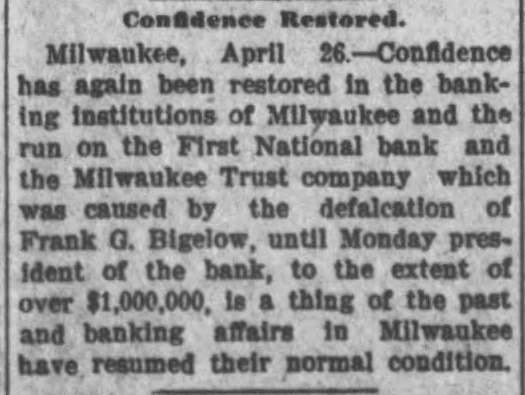
Confidence Restored. Milwaukee, April 26.-Confidence has again been restored in the banking institutions of Milwaukee and the run on the First National bank and the Milwaukee Trust company which was caused by the defalcation of Frank G. Bigelow, until Monday president of the bank, to the extent of over $1,000,000, is a thing of the past and banking affairs in Milwaukee have resumed their normal condition.


Article from The Ocala Banner, April 28, 1905

Click image to open full size in new tab

Article Text

DEPOSITORS CAUSE RUN ON THE BANKS Excirement Intense In Milwaukee Over Defalcation. SHORTAGE IS OVER A MILLION Confidence Seems Hard to Restore in Wisconsin City-People Line Up Before Paying Teller's Windows and Demand Their Money. Milwaukee, April 26.-Despite assurances that the Milwaukee Trust company was in no manner involved by the financial trouble of Frank B. Bige. low, former president of the First Na. tional bank of Milwaukee, and confessed defaulter of more than a million dollars, crowds of people today were in line long before the opening of the Trust company bank waiting to withdraw their deposits. The depositors gathered at the National bank were comparatively few at first but the number continued to increase. Bigelow bad been a director of the Milwaukee Trust company, but when his defalcation became known he was removed as such by the board of directors. Notices posted on the bank windows which the depositors for the most part working people, eagerly scanned, announced this fact and that the Trust company was abundantly able and prepared to meet the demands of all depositors and creditors. The notices posted on the windows of the first National bank and signed by the directors that the company is solvent seemed to reassure the depositors somewhat. No depositors gathered at any of the other banks at the time they were i nevidence at the institutions mentioned. Members of the clearing house association expected the affairs of the bank and officers of the other institutions in the city expressed their confidence in the strongest terms in the ability of the First National bank to meet anv emergency that might arise. Henry B. Goll, cashier of the First National bank, of Milwaukee, who is charged by the United States district attorney's complainants, with embezzling a sum exceeding $100,00 of the bank's funds, has not yet been arrested. Unted States Marshal Thomas B. Reed, said, however, that he expected to take Goll into custody today. John 1. B. Beggs, a director of the First National bank and one of the


Article from Troy Weekly News, April 28, 1905

Click image to open full size in new tab

Article Text

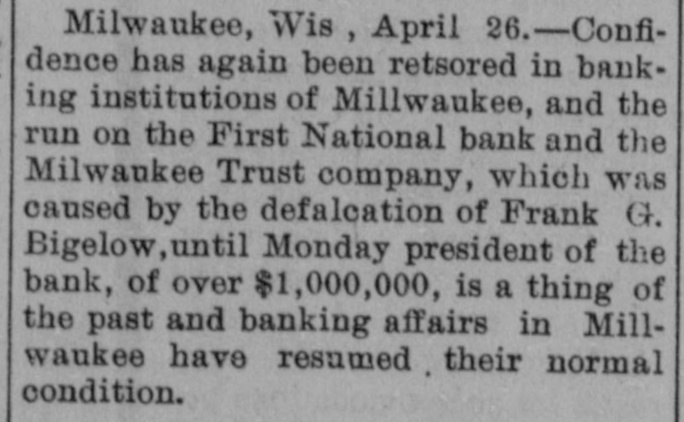
Milwaukee, Wis, April 26.-Confidence has again been retsored in banking institutions of Millwaukee, and the run on the First National bank and the Milwankee Trust company, which was caused by the defalcation of Frank G. Bigelow, until Monday president of the bank, of over $1,000,000, is a thing of the past and banking affairs in Millwaukee have resumed. their normal condition.


Article from The Kendrick Gazette, April 28, 1905

Click image to open full size in new tab

Article Text

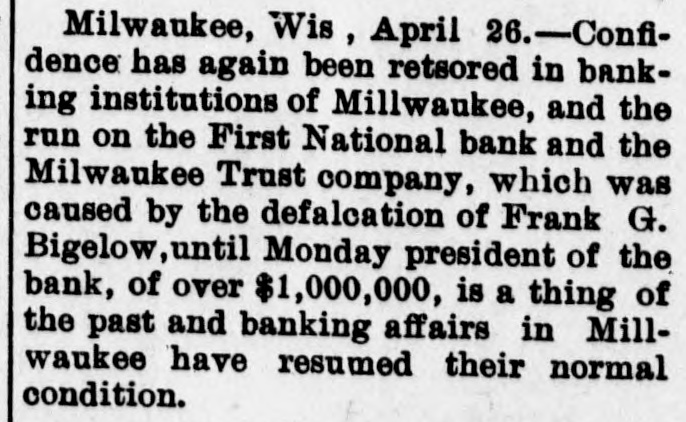
Milwaukee, Wis, April 26.-Confidence has again been retsored in banking institutions of Millwaukee, and the run on the First National bank and the Milwaukee Trust company, which was caused by the defalcation of Frank G. Bigelow, until Monday president of the bank, of over $1,000,000, is a thing of the past and banking affairs in Millwaukee have resumed their normal condition.


Article from Evening Star, April 9, 1906

Click image to open full size in new tab

Article Text

WALL STREET WHISPERS. Special Dispatch to The Star. NEW YORK, April 9.-In his report President L. A. Cole of the National Lead Company says: "Ample provision has now been made for the large working capital required to conduct our business. Our directors now hope and expect that beginning with July 1 next dividends will be earned and regularly paid on our common stock.' * * * It is reported from Fairmont, W. Va., that Alexander Brown & Sons of Baltimore are financing a consolidation of electric light and railway franchises in Fairmont and Mannington, W. Va. The Pennsylvania raflroad has notified the Trunk Line Association that it will withdraw from the party rate agreements coverlabor, theatrical and military traffic. The reason given is that party rates are 11legal. * The quantity of coal moved from the Pittsburg pools in March was the greatest for that month ever known. Over 2,000,000 bushels moved, or an equivalent of 800 boats. This is 500,000 bushels more than during March, 1905. * * The Lehigh Valley railroad has ordered a cessation of all improvement work which can safely be postponed and has cut down other expenses as much as possible. The retrenchment is to last until normal operating conditions are resumed in the coal fields. * According to a dispatch from Denver, the Milwaukee Trust Company has filed suit in the United States circuit court for the appointment of a receiver for the Ophir Consolidated Mines Company of Telluride. It is alleged the Ophir Company did not set aside 15 per cent of its earnings each year as a sinking fund for the redemption of $250,000 bonds in accordance with the agreement made with the trust company, and also that the property of the company has been allowed to deteriorate in value. Persons who have excellent sources of information believe confidently that there will be a larger inflow of gold from Europe within the next few weeks. They understand that in addition to $3,000,000 due to arrive next Monday. negotiations are well advanced for $5,000,000 more. They believe also that these amounts will be materially supplemented in the near future. They look for the stock market to be somewhat irregular and perhaps fractionally lower, but they are still very confident that as soon as money is made to appear easier stocks will advance sharply throughout the list. * From Cincinnati it is learned that Thomas W. Paxtor, attorney for the Central Trust Company of New York, has filed suit in the United State circuit court for foreclosure on a mortgage for $50,000,000, covering all the properties held by the Cincinnati, Hamilton and Dayton Railway Company. The suit is brought by the trust company in the interest of the bondholders. The Cincinnati, Hamilton and Dayton Railway Company in January, 1905, authorized an issue of $50,000,000 bonds, of which $17,500,000 were sold. The interest was defaulted in July and January, and the Central Trust Company, as trustee, asks for the sale of the road. The now trust company, in its action, also asks for the appointment of a receiver to represent the bondholders. * A Montreal dispatch says that in spite of all that has been said to the contrary, there is a strong effort being made by Montreal capitalists to sell the control Dominion Steel of and the Toronto Company and to it can the United States Steel Corporation, be added that confirmatory details may be forthcoming in a few days. It is said that a meeting of the interested parties has been held in New York within the past week, and that James J. Hill of the Great Northern is not by any means a stranger to the negotiations that have been going on for some weeks past. The statement is made that the promoters of the sale control already something like 100,000 shares of the Dominion Steel common. and that the acquisition of twenty or twenty-five thousand additional shares would make the merger or the control quite possible, This quantity the promoters of the new move will be able to secure on the open market as sobn as their New York principals tell them to go ahead