19704. First National Bank (Milwaukee, WI)

Bank Information

Episode Type
Run Only
Bank Type
national
Bank ID
64
Charter Number
2715
Start Date
April 25, 1905
Location
Milwaukee, Wisconsin (43.039, -87.906)

Metadata

Model
gpt-5-mini
Short Digest
f0e199e5695e573a

Response Measures

Accommodated withdrawals, Borrowed from banks or large institutions, Public signal of financial health, Capital injected, Partial suspension, Books examined

Description

Articles (April 25โ€“29, 1905) describe a heavy depositor run triggered by President Frank G. Bigelow's confession of embezzlement. The bank did not suspend payments; clearing house/bankers supplied funds, directors personally guaranteed coverage, and normal business resumed within days.

Events (3)

1. August 15, 1863 Chartered
Source
historical_nic
2. June 1, 1882 Chartered
Source
historical_nic
3. April 25, 1905 Run
Cause
Bank Specific Adverse Info
Cause Details
Run triggered by confession and arrest of President Frank G. Bigelow for embezzlement/defalcation of about $1,450,000 (speculation losses); assistant cashier was implicated/fugitive.
Measures
Directors and local/Chicago banks advanced funds (>$1,000,000 from Chicago; directors pledged $1,635,000); Clearing House issued solvency statement; used time-deposit withdrawal notice (30/90-day rule) for savings; receiving tellers set up (hole cut in plate glass) to accept deposits; mayor deposited $500,000 publicly to restore confidence.
Newspaper Excerpt
More than 2,000 depositors were clamoring for their money; nearly $1,000,000 had been paid out in two hours.
Source
newspapers

Newspaper Articles (25)

Article from New-York Tribune, April 25, 1905

Click image to open full size in new tab

Article Text

BIGELOW President of the First National Bank of Milwaukee, confesses embezzlement of $1,450,000. The arrest of Mr. Bigelow followed his confession to the board of directors of the bank that he was a defaulter to the extent of $1,450,000. Following Mr. Bigelow's confession he was removed from the presidency of the bank. and the facts in the case were laid before the federal authorities. The complaint was sworn to by United States District Attorney H. K. Butterfield. It charges that Bigelow, as president of the First National Bank, embezzled a sum exceeding $100,000. A complaint and a warrant, identical with those in Bigelow's case, were made out to Henry G. Goll, assistant cashier of the bank, but Goll could not be found. Mr. Bigelow was taken before United States Commissioner Bloodgood. Bail was fixed at $25,000. and he was released to appear before the next Federal Grand Jury. Mr. Bigelow's confession was made a special meeting of the board of directors Saturday evening. He met with the directors yesterday and all last night. In addressing his fellowdirectors President Bigelow said he had a painful statement to make, a confession that he had misdirected the funds of the bank, and that an examination of his books and a comparison of figures would show that he was indebted to the bank for more than $1,450,000. This money, he said, had been lost in speculation in wheat and stocks. Not a dollar of it could be recovered, and the only sum he could offer toward compensating the bank was personal securities valued at $300,000. MR. BIGELOW WIDELY KNOWN. Mr. Bigelow had been recognized as among the foremost financiers of the Northwest. He has been associated with the First National Bank in various capacities for more than fifteen years, and his business connections with trust companies, manufacturing concerns, real estate deals and other similar ventures numbered scores. He was honored a year ago by election to the presidency of the American Bankers' Association. In making his statement to the directors of the bank Mr. Bigelow said he had become involved in speculation in Wall Street several months ago. More recently he had been a persistent bull in the wheat market, and recent losses in grain had been added to heavy reverses in Wall Street. From small manipulations of the banks funds the defalcations had the million age he had extended passed dollar until mark. and his He short- there- saw no possibility of returning the money, fore confessed his actions. Funds were at once provided by the directors of the bank to protect depositors against loss and to save the bank from a stampede. More than a million dollars was guaranteed to the bank by various stockholders, and no serious run was made on the bank to-day. It is not thought that any complications with creditors of the bank will follow. At the meeting of directors, which was almost continuous for thirty-six hours, several plans suggested for protecting the interests of were the the bank. One, it is said, was to accept resignation of the president and to permit him to go to Europe while the directors make good the amount of his shortage. This would effectually protect the bank. This alleged proposal never came to a conclusion because several directors demanded that the defaulter be punished. A plan to make up the shortage for the protection of depositors was then approved. Bigelow was removed from the presidency of the bank and the case was referred to federal officers. WIFE HEARS WARRANT READ. When the federal marshal called at the Bigelow house to serve the warrant the former bank president was in the library with his wife. Mrs. Bigelow refused to withdraw and the warrant was read in her presence. "I'll be ready to go with you at once," said the banker; then he kissed his wife an affectionate farewell and left the house with the officer, the two walking to the Federal Building, where a United States commissioner was in waiting. None of Mr. Bigelow's friends were in the courtroom. When the resolution was adopted removing Mr. Bigelow from the presidency of the bank, Henry Goll, assistant cashier. was also removed. The removal of the assistant cashier was due to the statement of President Bigelow that he was aided by Goll in concealing the shortage in the bank's accounts. The method adopted was an old one. Collection accounts were manipulated 40 or even 50 Continued on second page.


Article from Evening Times-Republican, April 25, 1905

Click image to open full size in new tab

Article Text

RUN STARTED ON MILWAUKEE TRUST Defalcation of President of First National Starts Run on Another Big Concern IS RESTORED CONFIDENCE Long Line of Depositors in Front of Both Institutinons, but Clearing House Statement and Aid of Other Banks Result in Restoring Normal Conditions. Milwaukee, April 25. - Despite the assurances that the Milwaukee Trust Company was in no manner involved by the financial troubles of Frank G. Bigelow, former president of the First National bank, crowds of people today assembled long before the opening of the Trust company bank to withdraw their deposits. The depositors gathered at the National bank were compartively few at first, but the number continued to increase. Bigelow had been a director of the Trust company, but when his defalcation became known he was removed as such by the board of directors. Notices posted on the windows of the First National and Trust Company's banks announced both institutions were abundantly prepared to meet all demands of depositors and creditors. There was no evidence of any trouble at other banks. John I. Beggs, director of the First National, said the bank had today received two million dollars from outside and local banks with which to meet any demands. Beggs said the run would probably continue thruout today, but that beginning with tomorrow, after having shown stability of the institution, the excitement would subside. As the hour approached for opening the bank the crowds in front of each bank became larger and extended for half a square. A detail of present maintain order. police were to Both institutions decided to take advantage of the printed clause in the pass books of all saving deposits requiring notice of thirty days before sums under a hundred dollars can be withdrawn. When the doors of the First National Bank and Milwaukee Trust Company were thrown open the crowd which had lined up two and four abreast for a distance of half a block from the main entrance of each institution, filed in as rapidly as the police would permit. Women and men were jostled in their into the were to efforts police to get constantly the banks compelled who and push them back. Those sought to withdraw funds were mostly small depositors who applied at the savings There were some while a were to department. tors, number waiting deposiwithdraw their funds. Up to noon there had been no run on any other banks. The board of directors of the Chamber of Commerce today voted unanimously not to withdraw the current fund from the First National Bank. The opinion is generally expressed that the bank is perfectly solvent. Milwaukee, April 25.-The run on the two banks ceased entirely in the afternoon and business in ths institutions was resumed under normal conditions. Bank is Solvent. Milwaukee, April 25. - The Clearing House Association today issued a statement saying after examining carefully all assets and collateral of the First National it is satisfied the bank is perfectly solvent.


Article from The Cairo Bulletin, April 25, 1905

Click image to open full size in new tab

Article Text

TOOK $1,450,000 Once a Millionaire, Now Werse Than a Pauper OLD STORY OF STOCKS AND SPECULATORS-FINCT NA. TIONAL BANK OF MILWAUKEE THE SUFFERERHEAVY RUNS. Milwaukee, April 24.-Frank G. Big elow unt today president of the First National bank of Milwaukee, was arrested today charged with embezzlement (f over a hundred thousand dollars of the bank's funds. The arrest of Bigelow followed his confession to the board of directors of the bank that he was a defaulter to the extent of $1 450,000. Following Bigelow's confession he was removed from the presidency of the bank and facts in the ease were laid before the federal authorities. Cashier Also wanted. The complaint was sworn to by United States D strict Attorney ButIt charges that Bigelow, as of the Frst sum exceeding torfield. president embezzled-a National $100,000. bank, A complaint and warrant identical with those in Bigelow's case were made out for Henry G. Goll, a sistan cashier of the bank, but Goll could ant be found 112 to 7 o'clock tonight Bigclow was taken before United States Commissione Bloodgo d anN bail was five at $25,000. B gelow said he lost in speculating in stocks in Wall stree and in wheat Arrested in His Library. When the federal marshal called the Bigelow residence to serve the warrant, the former bank prosiden was in the library with his wife. Mr: Bigelow refused to withdraw and the warrant was read in her presence. "I'll be ready to (go with you a said the banker. Then, h wife an fare k once," ssed his affectionate the well and left with the officer, tw walking to the federal building, wher a court commission was in waiting the None of Bigelow's friends were in court room during the brief proceer ings. How He Covered Up His Tracks. The method of covering up u shortage is thus de cribed: Collect on accounts were manipula ed to the extent of 40 and in some it stances, 50 per cent, to make it appea that the resrve fund was intact, an the amount of the Increased collection fund was diverted to special stock or it erations. The reserve maintained eastern banks was tampered with, the books of the First National being fix ed so that the reserve appeared large by several hundred thousand dollars than it really was. and other is 'a) were pursued by B leged, These methods gelow. it The Cashier Helped. In falsifying records and the ma nipulation of resources Bigelow de clares he was added by As istant Cash ier Goll and two bookkeepers in the bank. These bookkeepers acted un der orders of Bigelow and they have neither been discharged nor suspend ed and they will he called as witness es in criminal pr. ceedings aga nst Big elow. The first intimation of irregularities was Friday evening when a bank em ploye*ca'led at Director Pfister's home and gave him meager informat on. In vestigation was started and Bigelov was accused of irregularities. He said to have admitted his guilt. At a directors meeting following he con fessed. The directors imme:lately ra sed $1,635,000 to make good the sur plus. Chicago banks sent $1 000,000 to Milwaukee and local banks trans ferred several hundred thousand dollars in gold to the First National. Depositors Demand Money. When the bank closed its doors this afternoon more than 2,000 depositors were clamoring for their money. Nearly $1,000,000 had been paid out in the course of two hours and but a small of the customers of their accounts ing per closing centage citters had demand- was been served. One of the first a business man who presented a check for $100,000. the entire amount of his account. He was followed by the city treasurer. who drew out $30,000 of the city funds. The chamber of commerce was one of the concerns that was quick to withdraw its funds. : The state of Wisconsin has several thousand -llars deposited in


Article from The San Francisco Call, April 25, 1905

Click image to open full size in new tab

Article Text

DIRECTORS PAY SHORTAGE. The manipulations of accounts has been going on for months, according to the statement of one of the directors, but so cleverly was the work done that neither the directors nor the National Examiners were able to discover that anything was wrong. The first intimation that there were irregularities came to Charles F. Pfister, one of the directors, on Friday evening. An employe of the bank called at Pfister's home and told him he had something to reveal regarding the bank. Although his confession was meager it was sufficient to awaken the suspicions of Pfister and to start an investigation. President Bigelow was taxed with the irregularities and he is said to have admitted his guilt. Then followed the meeting of the directors and the full confession. As soon as the directors ascertained the full extent of the peculations, steps were taken to protect the depositors and other creditors. Charles F. Pfister subscribed $600,000 to a fund to make good the surplus; John I. Biggs, president of the Milwaukee Electric Railway Company, gave $300,000; William Bigelow, a brother of the president, added $100,000 to the amount. Other directors subscribed lesser sums, until the amount raised reached $1,635,000. Then the following statement was prepared and formally issued: 'For value received, we, the undersigned, severally agree to advance and pay to the First National Bank of Milwaukee, Wis., the sums set opposite our respective names as the same may be needed, for the payment on demand of all deposits now in said bank, or which within thirty days from this date may be placed therein. Our claims hereunder for reimbursement shall be subordinate and postponed to the claims of all depositors and other creditors. (Signed) Charles F. Pfister, $600,000; Fred Vogel Jr., $300,000; John I. Peggs, $300,000; E. Mariner, $100,000; Fred F. Goll, $50,000; George P. Miller, $50,000; J. H. Van Dyke Jr., $50,000; J. K. Kipp. $50,000; Albert G. Trostel, $25,000; August H. Vogel, $10,000; William Bigelow, $100,000; total, $1,635,000." BIG RUN ON THE BANK. Prior to this the directors had been in conference with leading bankers of Chicago and New York. Three Chicago bankers, President Forgan of the First National Bank; Orson Smith, of Loan and Ernest A. the pany Merchants' and Hamill Trust of Com- the Corn Exchange National Bank, came to Milwaukee on an early train and went into conference with the directors of the First National. As a result of this meeting $1,000,000 was sent to Milwaukee by Chicago banks to reach the city before the news of the defalcation was made public. Several hundred thousand dollars in gold was transferred to the First National that was run that was for Bank, the so institution expected. prepared Every precaution was taken to keep the fact of the shortage from the public until the affairs of the bank could be put in condition to meet any emergency that might arise. When the bank closed its doors this afternoon more than 2000 depositors were clamoring for their money. Nearly $1,000,000 had been paid out in the course of two hours and but a small percentage of the customers demanding the closing of their accounts had been served. One of the first callers was a business man, who presented a check for $100,000, the entire amount of his account. He was followed by the City Treasurer, who drew out $300,000 of the city's funds. Withdrawals in sums ranging from $1000 to in the a peo$10,000 o'clock quickly afternoon followed the bank line and east of by 2 ple extended from on Wisconsin street to Broadway, and in


Article from Wausau Pilot, April 25, 1905

Click image to open full size in new tab

Article Text

F. G. BIGELOW, president of the First National bank of Milwaukee, is a defaulter to that bank in a sum amounting to $1,500,000. The knowledge precipitated a run on the bank yesterday, but it was found that no matter if every depositor called for his money it would be paid him as the institution is perfectly solvent. Bigelow has resigned and has been arrested.


Article from The Daily Morning Journal and Courier, April 25, 1905

Click image to open full size in new tab

Article Text

HEAVY DEFALCATION. (Continued from First Page.) make it appear that the amount reserve of to intact, and the difund increased was collection fund was The the to special stock operations. banks verted maintained in eastern of the reserve with, the books that the was tampered being fixed so First to be larger reserve dollars than it thousand National appeared really pursued by was. several and other methods were from the These in securing money records by the falsifying of of reserves, bank. the Bigelow manipulation In Assistant Bigelow and he was aided by in declares Goll and two bookkeepers acted on Cashier bank. These bookkeepers have the orders of Bigelow and suspended, they the been discharged nor witnesses in neither will be called as the and criminal they proceedings against manipulathe bank president. The on accounts has been according to the former tion of going statement cleverly for of months, the directors, but so the one of work done that neither examwas the the national bank with anything wrong of the bank: The funds there were iners the directors discovered nor irregularities first intimation that Charles F. Pfister, a director, of came to evening, when an employe information Friday bank gave Mr. Pfister Then the start an investigation. and sufficient followed a to meeting of the directors the confession. as the directors ascertained steps As soon extent of the peculations depositors the full taken to protect the F. Pfiswere other creditors. Charles fund to and $600,000 to a ter the surplus. John of the Milwaukee president make subscribed good I. Electric Beggs, gave and Light company brother of $300,000; Railway William Bigelow, $100,000 a to the president, added amount. sums until the amount lesser the Other directors subscribed raised reached $1,635,000. this the directors had Chicago been Prior to with bankers in York. As a result and New Milwaukee by in conference sent to the $1,000,000 Chicago defalwas before the news of hunbankers was made public. Several was cation thousand dollars in gold to the First banks so that dred by transferred local institution National bank was prepared the for bank a run. closed this afternoon for When 2,000 depositors were waiting was some Nearly $1,000,000 their money. two hours, and many their cuspaid out demanding in the closing of of tomers, not been served. One accounts, had a business man the first callers a check was for $100,000, He was the who of his account. by the city entire followed presented amount funds. treasurer, Withdraw- who of city to $10,drew $800,000 ranging from $1,000 o'clock als in sums followed, and by 2 extend000 quickly afternoon a line of people Wisconsin in the bank east on other ed from the and in the street to Broadway, corner and north direction around the The Chamber in East Water was street. one of the concerns funds. of Commerce quick to withdraw its several that was of Wisconsin has bank, The state thousand dollars in the hundred not withdrawn to-day. which was in East Water street The besieging depositors the Wisconsin Trust of Co., the were bank department run on and the First assumed the of large savings the savings National department bank, great- the Depositors withdrawest amounts proportions. apparently became ceased well known, als who sought and of the after those customers the facts their savings depositors deposits bank were while many savings funds, But seeking to withdraw their soundwere persons who Ibelieve in the forward other of the bank were coming closed ness deposits, and when the bank counwith a line of depositors withdraw to terbalance there was the line waiting to money. the bank was cleared through at the When of closing, a hole was cut Wisconhour plate glass window in the late hour the street front. and until a there sin this evening depositors were leaving there of the money. bank are preparing for Officers possible run to-morrow. of A request twenty any made for a detail extra force of to handle policemen, has be been employed and an the New business clerks York will is on the way from bank, to Money strengthen the resources of the


Article from The Times Dispatch, April 25, 1905

Click image to open full size in new tab

Article Text

CONFESSED THEFT OF OVER A MILLION (Continued from First Page.) forty or even fifty per cent. to make It appear that the reserve fund was Intact, and the amount of the increased collection fund was diverted to special stock operations. The reserve maintained in Eastern banks was tampered with, the books of the First National being fixed so that the reserve appeared to be larger by several hundred thousand dollars than It really was. These and other methods were pursued by Bigelow in securing money from the bank. In falsifying. the records and the manipulation of reserves, Bigelow declares he was aided by Assistant Cashier Goll and two bookkeepers in the bank. These bookkeepers noted on orders of Bigelow, and they have neither been discharged nor. suspended." and they will be called as witnesses in the criminal proceedings against the former bank president. The manipulation of accounts has been going on for months, according to the statement of one of the directors, but so cleverly was the work done that neither the directors nor the national bank examiners discovered that anything was wrong with the funds of the bank. Depositors Protected. The first intimation that there were irregularities came to Charles F. Pfister, a director, Friday evening. when an employe of the bank gave Mr. Pfister information sufficient to start an investigation. Then followed a meeting of the directors and the confession. As soon as the directors ascertained the full extent of the speculations, steps were taken to protect the depositors and other creditors. Charles F. Pfister subscribed $600,000 to a fund to make good the surplus. John I. Beggs, president of the Milwaukee Electric Railway and Light Company, gave $300,000. William Bigelow, a brother of President Bigelow, added $100,000 to the amount. Other directors subscribed lesser sums until the amount raised reached $1,635,000. Run on Bank. When the bank closed this afternoon, some two thousand depositors were waiting for their money. Nearly $1,000,000 was paid out in two hoyrs, and many customers, demanding the closing of their accounts, had not been served. One of the first callers was a business man, who presented a check for $100,000, the entire amount of his account. He was foilowed by the city treasurer, who drew out $300,000 of city funds. Withdrawais in sums ranging from $1,000 to $10,000 quickly followed, and soon a long line of people was waiting to withdraw. The depositors in East Water Street were besinging the Wisconsin Trust Company, the savings department of the First National Bank and the run on the savings department assumed the greatest proportions. Depositors of large amounts apparently ceased withdrawals after the facts became well known, and those who sought their deposits, were customers of the savings bank. But, while many savings depositors were seeking to withdraw their funds, other persons who believe in the soundness of the bank, were coming forward with deposits. Officers of the bank are preparing for any possible run to-morrow. A request has been made for a detail of twenty policemen, the same number that was required to handle the crowds to-day, and an extra force of clerks will be employed to handle the business. Money is on the way from New York to strengthen the resources of the bank, and the directors expect to be able to meet all demands promptly. They assert that the bank has


Article from New-York Tribune, April 26, 1905

Click image to open full size in new tab

Article Text

RUN ON BIG BANK OVER. ALLQUIETINMILWAUKEE More Than $2,000,000 DepositedBigelor Stays at Home. Milwaukee, April 25.--Confidence has again of been restored in the banking institutions Milwaukee The run on the First National Bank and the Milwaukee Trust Company which was caused by the confession of Frank G. Bigelow is a thing of the past. and banking affairs in Milwaukee have resumed their normal condition. While the two banks affected are entirely separate institutions, the fact that they occupy adjoining buildings and that some of the First National Bank's officers direct the affairs of the Milwaukee Trust Company caused many of the depositors to believe that one was a part of the other. Before the hour for opening the banks had arrived a meeting of the Milwaukee Clearing House Association was held, and a committee of that institution, after examining the assets and collateral of the First National Bank, issued a reassuring report, as follows: The Milwaukee Clearing House Association, after examining careful!y all the assets and collateral of the First National of Milwaukee, report as a result from such examination that they are satisfied that the bank is perfectly solvent and able to pay its debts. This report was printed in large type on placards and posted on the windows of the First National Bank, and also displayed in store windows in Wisconsin and East Water sts. Following this was a statement issued by the board of directors of the First National Bank announcing with absolute positiveness that the bank was perfectly solvent. On top of this came word from the board of directors of the Milwaukee Chamber of Commerce announcing its decision not to withdraw its current expense fund from the First National Bank. All of these statements had a reassur= ing effect on depositors as to the stability of the bank. The banks affected were well able to cope with a long run, but it was decided by all the banks in the city to take advantage of the law on time deposits requiring a notice of thirty days of withdrawal on amounts less than $100 and ninety days where the amounts exceeded that sum. As rapidly as the depositors appeared at the wickets of the savings departments of the affected institutions their passbooks were stamped acknowledging the notice of withdrawal and the depositors took their departure. It recuired only about two hours to dispose of the line-up of depositors. Early In the day crowds of men and women in all walks of life gathered in line two and four abreast and took up positions in front of the two big banking institutions and awaited the opening of the doors at 10 o'clock. The line extended about half a square in East Water and Wisconsin sts. from the main entrance of each institution. One of the most spectacular happenings of the day was the action of Mayor Rose in walking down Wisconsin-st. in full view of the crowd with $500,000 in currency and gold in canvas bags. He was surrounded by policement and detectives and walked into the bank with the treasure. This money was part of the shipment from Chicago banks and some from other Milwaukee banks. Frank J. Kipp. cashier, is authority for the statement that much more than $2,000,000 was received to-day by the bank. At noon the street assumed its normal appearance and the run was completely over. The First National Bank is depository for government departments in Milwaukee, the funds there including those of the Internal Revenue office, and of the offices in the Department of Justice. None will be withdrawn. C. H. Bosworth. of Chicago, National Bank Examiner, who was sent here by the Controller of the Currency, is at work on the books of the First Nasutional and will report his findings to his periors in Washington as soon as possible. Frank G. Bigelow, the deposed president of the First National Bank, walked downtown to-day, but did not enter the bank building. He soon returned to his home. where he spent most of the day in seclusion. According to the federal procedure, a prisoner cannot plead guilty or not guilty until he has been indicted by the grand jury. Frank G. Bigelow will not, therefore, appear in court until the grand jury has considered his case. Up to a late hour no trace had been found of Henry G. Goll, the deposed assistant cashier of the First National Bank. When asked concerning the report that a large of his shortage to the bank was on account part of having to make good the losses sustained by his son in wheat deals, Mr. Bigelow said: I have nothing to say upon the matter at this time. In fact, I have nothing to say beyond what appeared in the papers yesterday, that my family has at all times been in ignorance of any transactions in which I may have been involved. That covered all I wished to have appear as coming from me.


Article from Evening Star, April 26, 1905

Click image to open full size in new tab

Article Text

THE BANK RUNS CEASED INTEREST IN MILWAUKEE CASE CENTERS IN CAPTURE. MILWAUKEE, Wis., April 26.-The excitement in banking circles by the defalcation of Frank G. Bigelow, late president of the First National Bank l this city, has entirely subsided and business has again resumed normal conditions. There was a total absence of any depositors within the region of any of the banks prior to the opening of the doors for business today. The depositors who for two days clamored for their money at two of the banks were given reassurance from so many sources of the soundness of the institutions affected that the excitement died away almost as rapidly as it had sprung up. Interest now centers in the capture of the former assistant cashier, Henry G. Goll, who is believed to have left the city. United States Marshal Thomas B. Reed has enlisted the services of the city police, and Chief John T. Janssen has notified the police departments in every large city of the country to look out for him. Spent Personal Fortune. Frank G. Bigelow called at the First National Bank today, but remained only a few minutes. Mr. Bigelow received some mail and then returned to his home. A director of the bank stated today that as investigation of the bank's affairs goes on facts are revealed which tend to show that the defaulting banker spent his entire personal fortune before tampering with the bank's funds.


Article from The News & Observer, April 27, 1905

Click image to open full size in new tab

Article Text

THE BANK SOLVENT Confidence is Restored in Milwaukee. Board of Directors of the First [National Bank Issue a Statement That Allays Apprehension. A Glimpse of Bigelow. By the Associated Press.) mrlwauke, Wis., April 25.-Confidence has again been restored in the banking institutions of Milwaukee and the run on the First National bank and the Milwaukee Trust Company, which was caused by the confession of a defalcation by Frank G. Bigelow, until Monday president of the First National Bank and a director of the trust company, of over $1,000,000 is a thing of the past and the banking affairs in Milwaukee have resumed their normal condition. Before the hour for opening the banks had arrived a meeting of the Milwaukee Clearing House Association was held and a committee of that institution after examining the assets and collateral of the First National Bank, issued an assuring report declaring the bank perfectly solvent. Following this was a statement issued by the board of directors of the First National Bank announcing with absolute positiveness that the bank was solvent. The banks affected were well able to cope with a long run, but it was decided by all the banks in the city to take advantage of the law on time deposits requiring a notice of thirty days of withdrawal on amounts less than $100 and ninety days where the amounts exceeded that sum. As rapidly as the depositors appeared at the wickets of the savings departments of the affected institutions their pass books were stamped acknowlegging the notice of withdrawal and the depositors took their departure. It only required about two hours to dispose of the line up of depositors. One of the most spectacular happenings of the day was the action of Mayor Rose in walking down Wisconsin street in full view of the crowd with $500,000 in currency and gold in canvass bags. He was surrounded by policemen and detectives and walked into the bank with the treasure. This money was part of the shipment from Chicago banks, and some from other Milwaukee banks. At noon the street assumed its normal appearance and the run was completely over. National Bank Examiner C. H. Bosworth, of Chicago, who was sent here by Comptroller of the Treasury Ridgely, is at work on the books of the First National and will report his findings to his superiors in Washington as soon as possible. Frank G. Bigelow, the deposed president of the First National Bank, walked down town today, but did not enter the bank building. He soon returned to his home, where he spent most of the day in seclusion. Up to a late hour no trace had been found of Henry G. Goll, the deposed assistant cashier of the First National Bank.


Article from The Penn's Grove Record, April 28, 1905

Click image to open full size in new tab

Article Text

# Speculated in Wheat. It appears that Mr. Bigelow has been speculating in wheat for weeks. He had made some investments that had swept away his private fortune, and had turned to the bank's funds in the hope of recuperating his losses by deals in wheat. His son, Gordon Bigelow, was a member of Tracy & Co., brokers on the Chicago Board, and it is said that his father's investments were largely made through him. When the bank's funds were to be used Mr. Bigelow, according to the directors, effected a combination with some bookkeepers and the assistant cashier, Henry G. Goil. He took the bank's surplus and charged up the money taken to Chicago correspondent banks, but the other night, while working on the books, a bookkepeer not in the deal, discovered an incorrect entry. He notified Charles F. Pfister, of the Pfiister & Vogel Company, one of the directors of the bank, and a meeting of the directors was called, when steps were taken to prevent a collapse. Bigelow was asked to explain, and made a full confession. Chicago banks were notified, and the bank officials provided means for meeting the run which was certain. Before the public knew of the shortage $1,000,000 reached here; then, when the run was in full swing, heavily guarded automobiles brought from the railway stations another million sent by Chicago to prevent a panic. It looked as though the alarm would spread to other banks, but so carefully had the First National prepared for the event, that the fears were largely allayed. There was something of a jam at the doors, but the police kept the crowd orderly. Glass cutters chipped a hole in a big plate glass front window of the bank, and deposits were received in full view of the crowd on the streets. The full amount appropriated by Mr. Bigelow was $1,500,000, but he has made restitution in the shape of real estate and securities sufficient to reduce the amount to $1,300,000. The Board of Directors decided to meet the issue in a straightforward manner, and formulated a pledge, which was immediately signed by members of the board, whose aggregate wealth will probably approximate $25,000,000, to more than make good the shortage. The capital stock of the bank is $1,-500,000, and the undivided surplus amounts to $1,200,000. The personal guarantee of the directors more than covers the defalcation, and with the surplus and undivided profits which the bank carries over and above its capital, it is announced that the institution is more solid that it was before the defalcation became known. Charles F. Pfister heads the guarantee list with $600,000.


Article from The Times Dispatch, April 28, 1905

Click image to open full size in new tab

Article Text

BIGELOW OWES OVER $3,000,000 Startlingly Loose Methods of Bank President in His Private Business Affairs. ESTIMATED ASSETS $1,849,800 Confidence Entirely Restored in Milwaukee and City Is Quiet. (By Associated Press.) MILWAUKEE, WIS., April 27.-The latest step in the career of Frank G. Bigelow, formerly president of the First National Bank, of Milwaukee, who defaulted for $1,450,000, is the filing of a petition in voluntary bankruptcy. The revised schedules show the total liabilities of Mr. Bigelow to be $3,277,000, of which $1,975,000 is wholly or in part secured. Of the remainder $1,110,000 is n secondary liability on notes and bills discounted in which Bigelow figures as endorser. These Items are notes of the National Electric Company, the Grand Rapids Edison Company and S. W. Watkins, and are evidently connected with the financing of the National Electric Company, The rest, $192,000 represents unsecured loans, the largest one being an indebtedness of $100,000 to the Broadhead estate, of which Bigelow was exe cutor. The assets of the banker are estimated at $1,849,800 against which a homestead exemption of $5,000 is placed. The assets consist chiefly of stock In various Industrial and other enterprises, life insurance and 1,600 acres of coal land In Colorado, valued at $100,000, including $3,000 in stock of the Lowery National Bank, of Atlanta, Ga. The schedule states that Bigelow has no cash on hand. Very Loose Methods. Bigelow pursued startlingly loose methods in the transaction of his private busIness. He was not positive of the names of several of his creditors and had no memoranda with which to refresh his memory. Under the bankruptcy la WS, the turning over by Bigelow of $30,000 worth of property as a restitutionary measure to the bank, is null and void, the transfers having been made within four months of the filing of the petition in bankruptcy. This, however, will not affect the bank, the directios having more than made up the entire deficiency caused by the define cations of the president. Judge Landis to-day appointed the Wisconsin Trust and Security Co. receiver of the bankrupt estate of Frank G. Bigelow, This action was taken to-day because the premiums on one of the life Insurance policies on the life of F. G. Bigelow became due to-day and had to be paid in order to prevent its lapsing. A trustee will be appointed by the creditors of the estate at the meeting about May 8th. Absolute quiet prevailed in banking circles in Milwaukee throughout the day. The First National Bank and all other banks are doing business as usual, there f not being the least Incident aside from the normal order of things. Confidence has been entirely restored.


Article from Troy Weekly News, April 28, 1905

Click image to open full size in new tab

Article Text

Milwaukee, Wis, April 26.-Confidence has again been retsored in banking institutions of Millwaukee, and the run on the First National bank and the Milwankee Trust company, which was caused by the defalcation of Frank G. Bigelow, until Monday president of the bank, of over $1,000,000, is a thing of the past and banking affairs in Millwaukee have resumed. their normal condition.


Article from Gainesville Daily Sun, April 28, 1905

Click image to open full size in new tab

Article Text

When the First National Bank at Milwaukee, Wis., had been robbed of its entire capital, $1,500,000, by Frank Biglow, the president, there commenced a run on that institution. To restore confidence Mayor Rose was escorted to the bank by two policemen and deposited $500,000 in currency and gold. Business assumed its normal condition and the bank was saved.


Article from Evening Star, April 29, 1905

Click image to open full size in new tab

Article Text

THE BIGELOW DEFALCATION. Brodhead Estate Matters to Be Looked Into. MILWAUKEE, April 29.-Fred Vogel, jr., was today elected president of the First National Bank of this city, to fill the vacancy caused by the removal from office of Frank G. Bigelow, the defaulting president. Other officers were elected as follows. First vice president, J. H. Van Dike, jr.; second vice president, William Bigelow; cashier, Frank J. Kipp, and assistant cashier, Thomas E. Camp. Mr. Vogel is one of the wealthiest business men in Milwaukee and has long been a director of the bank. Mr. Van Dike, who also has been a director, is one of the best known financiers in the northwest. MILWAUKEE, Wis., April 29.-John C. Brodhead of Kingston, N. Y., who is interested in the Brodhead million-dollar estate of which Frank G. Bigelow, the defaulting banker, is trustee, has reached Milwaukee and will make a thorough examination of the affairs of the estate as conducted by Mr. Bigelow. The attorney for the estate said today it would require a week or ten days to find out the exact condition of the estate, and until this has been accomplished no proceeding of any kind against Bigelow was anticipated. The First National Bank today turned over to the Wisconsin Trust and Security Company, receiver of the estate of Frank G. Bigelow, the $300,000 of securities which were turned over by Bigelow to the bank. These securities will go toward the liquidation of Bigelow's debts. The action of the bank is in accordance with the provisions of the national bankruptcy law.


Article from Evening Star, April 29, 1905

Click image to open full size in new tab

Article Text

( state, declared that all the charges gainst him of official misconduct while el was American minister to Venezuela ere unqualified falsehoods; the question f whether Minister Herbert W. Bowen hould be recalled from Caracas to answer ese charges was submitted to the Presient by Secretary Taft. Negotiations for n immigration treaty between the United tates and China were abandoned. the repsentatives of the two countries being unble to reach an agreement. Attorney Genral Moody. in an opinion, sustained the ecretary of the Interior in his rebate greement with certain railroads. The nited States Supreme Court issued its andate for the removal of George W. eavers to Washington for trial on postal aud charges. A. gift of $10,000,000 was ade by Andrew Carnegie to provide anulties for college professors who: are not le to continue in active service. The conferce for southern education met in Columbia, C. The teamsters' strike in Chicago asimed serious proportions, daily scenes of lolence being reported: the Employers' eaming Association asked for an injuneon in the United States circuit court, hich was granted. restraining all deendarts from interfering with the busiess of the country, the government thus eing made a party to the strike. Frank . Bigelow. president of the First National ank of Milwaukee. Wis., confessed to a hortage of $1,450,000. and subsequent anouncement was made that he had filed a etition in bankruptcy with liabilities agregating over $2,000,000 and assets near e million and a half mark. Sixteen men ere killed and one will die as the reilt of an explosion in a mine near Big un, Pa. Among those who died were seph Jefferson, the famous actor, at his ome, the Reefs, Palm Beach, Fla., and rig. Gen. Charles Smart, assistant surgeon eneral of the United States army, at St. ugustine, Fla. Foreign Affairs. Pursuant to representations made by the apanese government to France, Admiral ojestvensky's fleet was forced to leave amranh bay; a dispatch from Tokyo anounced that the fleet had been sighted eventy miles north of that point; both the apanese and Russian plans for an engageent were closely guarded; it was officially anounced at Tokyo that the Russian cavry in Manchuria had attacked Kingscheng nd had been repulsed; a Russian reconaissance pushed as far south as Kai-Yuan at was forced back with a loss of 200 men; 000 troops entraining for the far east at orisoff mutined and smashed Red Cross irs and pillaged shops; rioting and insubdination occurred at St. Petersburg on e departure of the Omsk regiment; genal advices from Russia represented the tuation in that country as more menacing, oting having occurred in Vladikavkaz and ars being expressed for an uprising over 1 Poland on May day; an imperial maniAnd 01 Jorcing penssi SEM $10 r damages caused by peasants; all the ck hands on the Volga struck and an imense quantity of freight was blocked. ermany gave notice that the treaty entling the United States to the most-favorI-nation privileges will cease to be effecve after March 1, 1906. Paris newspapers used renewed anxiety at the French capi1 over the Moroccan situation. King Edard and Queen Alexandra arrived at Marille, the former leaving that point for aris. Advices from Aden told of the crushg defeat of the sultan's troops and the read of the revolt; the belief was exressed in London that the rising is likely imperil the entire Turkish empire. San$, the capital of Yemen, was taken by the surgents and Manakha, an important wn was besieged. An official estimate the loss of life in the recent earthquake India placed the number at not over .000. President Castro in a speech Calabazo, Venezuela, stated that the alor of patriots will support him to sustain ason, right and justice. In the District. The Commissioners filed a petition for a rit of certiorari to the Court of Appeals the District in the Supreme Court of the nited States in the case of the alleged olation of the regulation requiring the reoval of snow and ice from sidewalks by hn W. Lee; the Commissioners approved e new names for streets in the section of e District west of Rock creek and outside e limits of the city proper. Commissioner est announced the personnel of the comittee in charge of the scheme for the erecon of an auditorium building. Secretary up uo place 01 decided MRI inks about $3,000,000 of the taxes annually llected in the District. The police census dicated a total population for the District 322,445, as against a total of 277,782 in 07 The of 441


Article from Vilas County News, May 1, 1905

Click image to open full size in new tab

Article Text

Total $19,567,271.44 Thousands Clamor for Deposits. When the bank closed its doors yesterdayยฎ afternoon, more than 2,000 depositors were clamoring for their money. Nearly $1,000,000 had been paid out in the course of two hours and but a small percentage of the customers demanding the closing of their accounts had been served. One of the first callers was a business man who presented a check for $100,000, the entire amount of his account. He was followed by the city treasurer, who drew out $300,000 of city funds. The Chamber of Commerce was one of the concerns that was quick to withdraw its funds. The state of Wisconsin has several hundred thousand dollars deposited in the bank and it is said that this will also be withdrawn at the opening of business today. Great Throngs in Line. Throngs on East Water street were besieging the Wisconsin Trust company, the savings bank department of the First National bank, and here the run assumed the greatest proportions. When the doors were closed fully 2,000 anxious men and women surrounded the doors of the bank and trust company, clamoring for their money. But while many depositors were seeking to withdraw their funds, other people who believed in the soundness of the bank were coming forward with deposits. Friends Also Persistent. So persistent were the friends of the bank in offering money for deposit that when the bank closed there was a line of depositors in waiting in opposition to the line awaiting to withdraw money. While the bank could not honor checks it could receive deposits and to facilitate the business of the depositors, the bank was cleared at the hour for closing and a hole cut through the plate glass window on the Wisconsin street front. Receiving tellers were stationed here and until a late hour last evening depositors were there leaving their money. Millions on the Way. The officials of the bank expect the resumption of the run today. Money is on the way from New York to strengthen the resources of the bank and the directors expect to meet all demands promptly. They claim that the actual condition of the bank has not yet been impaired by Bigelow's defalcation. Restored Part of Loss. Bigelow's defalcation amounts to about $1,450,000 but he restored $300,000. The directors have subscribed $1,635,000 more, thus leaving the bank better off by about $400,000 than it was before the funds were depleted by the peculations of the president. Left a Poor Man. Bigelow himself is left a poor man. At one time he was personally rated a millionaire. This fortune has been lost, as well as the sum taken from the bank. His total losses in speculation in two years are estimated at over $3,000,000. In addition to his banking interests,


Article from River Falls Journal, May 4, 1905

Click image to open full size in new tab

Article Text

tive. Frank G. Bรญgelow, defaulting bank president of Milwaukee, filed a petition in bankruptcy, scheduling liabilities of $3,277,000 and assets of $1,489,800. It can be stated positively that Frank G. Bigelow, the defaulting ex-president of the First National bank, of Milwaukee, will be prosecuted to the full extent of the law. The receiver ousted Frank G. Bigelow, defaulting Milwaukee banker, from his palatial home. Jules Valentine, a negro, was hanged at Donaldsonville, La. In attempting to rob the home of W. C. Hazlip, Valentine aroused Mrs. Hazlip and knocked her left eyeball from its socket, forcing its subsequent removal. Attorneys for Nan Patterson decided to submit no defense on the contention that the state had failed to make out any case against the defendant. A motion to dismiss the indictment was denied. H. C. Frick, chairman of the directors committee investigating the Equitable Life Assurance society, has written a letter to the policy holders assuring them that the interest of every policy holder is absolutely safe. George Mahen, living in St. Paul, Minn., shot his wife, Hattie, three times through the heart, killing her instantly, and then shot himself fatally. By an explosion in a mine near Dubois, Pa., 12 men were killed and one had both legs and arms broken. Contest proceedings have been prepared by Judge John A. Talty, defeated republican candidate for mayor of St. Louis, against Mayor Rolla Wells. Four more bears have been killed by the president's party. All the members participated in the hunt. Dr. Lambert killed the biggest of the four and the president killed two of the animals. A buggy containing Wendell Whittaker and a negro named Lapham was struck by a switch engine in Cairo, III. Both were killed. Gen. H. H. Wright, adjutant general of Iowa under Gov. F. M. Drake, died at his home in Centerville, Ia. Germany regards notice as having been given America of the end of the tariff agreement. Secretary Taft has recommended to Roosevelt that Minister Bowen be recalled from Venezuela to explain the Loomis affair. Gen. Fitzhugh Lee died in Washington from apoplexy. He was stricken while on board a train. Weekly trade reviews report some interference with retail business by strikes but favorable conditions aside from this feature. Dr. Brown Ayres was formally inaugurated as president of the University of Tennessee, at Knoxville, Tenn. United States Senator James B. Frazier presided. Two boys, aged about ten years, were drowned while floating in the St. Joseph river at South Bend, Ind. The government crop report shows that the cool weather has given farmers a setback. Secretary Taft has written a letter showing that government ownership of the Panama railroad may be utilized to destroy the monopoly now enjoyed by the Pacific Mail Steamship company. Nan Patterson lost a point in her trial when Coroner's Physician O'Hanlor. testified that he has changed his opinion that Young committed suicide. Norway refuses to negotiate her troubles with Sweden until she is granted separate consular system and assured of independence in other ways. Life insurance companies, aroused by the Hyde charges, have raised the price of nonparticipating insurance. The draft of the new constitution of the Transvaal is made public. Restric-


Article from The L'anse Sentinel, May 6, 1905

Click image to open full size in new tab

Article Text

MISCELLANEOUS. Frank G. Bigelow, president of the First National bank of Milwaukee, confessed to embezzlement of $1,450,000. He was arrested and is out on bonds. Chicago banks saved disaster by sending $1,000,000. The depositors are being paid in full. The assistant cashier is a fugitive. Frank G. Bigelow. defaulting bank president of Milwaukee, filed a petition in bankruptcy, scheduling liabilities of $3,277,000 and assets of $1,489,800. It can be stated positively that Frank G. Bigelow, the defaulting ex-president of the First National bank, of Milwaukee, will be prosecuted to the full extent of the law. The receiver ousted Frank G. Bigelow, defaulting Milwaukee banker, from his palatial home. Jules Valentine, a negro, was hanged at Donaldsonville, La. In attempting to rob the home of W. C. Hazlip, Valentine aroused Mrs. Hazlip and knocked her left eyeball from its socket, forcing its subsequent removal. Attorneys for Nan Patterson decided to submit no defense on the contention that the state had failed to make out any case against the defendant. A motion to dismiss the indictment was denied. H. C. Frick, chairman of the directors committee investigating the Equitable Life Assurance society, has written a letter to the policy holders assuring them that the interest of every policy holder is absolutely safe. George Mahen, living in St. Paul, Minn., shot his wife, Hattie, three times through the heart, killing her instantly, and then shot himself fatally. By an explosion in a mine near Dubois, Pa., 12 men were killed and one had both legs and arms broken. Contest proceedings have been prepared by Judge John A. Talty, defeated republican candidate for mayor of St. Louis, against Mayor Rolla Wells. Four more bears have been killed by the president's party. All the members participated in the hunt. Dr. Lambert killed the biggest of the four and the president killed two of the animals. A buggy containing Wendell Whittaker and a negro named Lapham was struck by a switch engine in Cairo, III. Both were killed. Gen. H. H. Wright, adjutant general of Iowa under Gov. F. M. Drake, died at his home in Centerville, Ia. Germany regards notice as having been given America of the end of the tariff agreement. Secretary Taft has recommended to Roosevelt that Minister Bowen be recalled from Venezuela to explain the Loomis affair. Gen. Fitzhugh Lee died in Washington from apoplexy. He was stricken while on board a train. Weekly trade reviews report some interference with retail business by strikes but favorable conditions aside from this feature. Dr. Brown Ayres was formally inaugurated as president of the University of Tennessee, at Knoxville, Tenn. United States Senator James B. Frazier presided. Two boys, aged about ten years, were drowned while floating in the St. Joseph river at South Bend, Ind. The government crop report shows that the cool weather has given farmers a setback. Secretary Taft has written a letter showing that government ownership of the Panama railroad may be utilized to destroy the monopoly now enjoyed by the Pacific Mail Steamship company.


Article from Willmar Tribune, May 10, 1905

Click image to open full size in new tab

Article Text

MISCELLANEOUS. The receiver ousted Frank G. Bigelow, defaulting Milwaukee banker, from his palatial home. Fred Vogel, Jr., has been made president of Milwaukee's First National bank, to succeed defaulter Bigelow. Henry G. Goll, the former assistant cashier of the First National bank, of Milwaukee, Wis., charged with embezzlement, was arrested in Chicago and taken back to Milwaukee. The Krupps' immense contracts, partly for the rearmament of the German artillery and partly for Russian, Japanese and Turkish orders, have required the company to increase the number of workmen from about 24,000 to more than 30,000. Mamie Van Ranst, a daughter of the late C. W. Van Ranst, a publisher of New York, was found dead in her apartments. A shoe string was tied tightly about her neck. She had committed suicide. Three persons were killed and six injured, none fatally, by the collapse of a three-story building during a firce gale at Omaha. Neb. President Alexander of the Equitable society resigned as trustee of the stock left to James H. Hyde. The grand jury in Chicago indicted twelve labor officials on charge of conspiracy in connection with the strike. Thirteen miners were entombed and probably killed by an explosion in the Missouri, Kansas & Texas Coal company's mine No. 19, four miles west of Wilburton, Okla. A double header fast freight train on the Santa Fe railroad struck 7 washout near Gilman siding, 125 milesnorth of Beamont, TeK., overturning both engines and piling live stock in the ditch. Two men were killed. Four men committed suicide in Chicago after quarrels with their wives. Fire destroyed an entire block of buildings at Ettabena, Miss, the loss aggregating $75,000. Mae Woods sued President Roosevelt's private secretary and others for conspiracy to prevent her from publishing Senator T. C. Platt's love etters. Contest proceedings have been prepared by Judge John A. Talty, defeated republican candidate for mayor of St. Louis, against Mayor Rolla Wells. Richard Canfield and other gamblers driven from New York are said to have formed a syndicate to establish a $3,000,000 Monte Carlo in Cuba,


Article from Willmar Tribune, May 10, 1905

Click image to open full size in new tab

Article Text

MISCELLANEOUS. The receiver ousted Frank G. Bigeiow, defaulting Milwaukee banker, from his palatial home. Fred Vogel, Jr.. has been made president of Milwaukee's First National bank, to succeed defaulter Bigelow. Henry G. Goll, the former assistant cashier of the First National bank, of Milwaukee, Wis., charged with embezzlement, was arrested in Chicago and taken back to Milwaukee. The Krupps' immense contracts, partly for the rearmament of the German artillery and partly for Russian, Japanese and Turkish orders, have required the company to increase the number of workmen from about 24,000 to more than 30,000. Mamie Van Ranst, a daughter of the late C. W. Van Ranst, a publisher of New York, was found dead in her apartments. A shoe string ,was tied tightly about her neck. She had committed suicide. Three persons were killed and six injured, none fatally, by the collapse of a three-story building during a firce gale at Omaha. Neb. President Alexander of the Equitable society resigned as trustee of the stock left to James H. Hyde. The grand jury in Chicago indicted twelve labor officials on charge of conspiracy in connection with the strike. Thirteen miners were entombed and probably killed by an explosion in the Missouri, Kansas & Texas Coal company's mine No. 19, four miles west of Wilburton, Okla. A double header fast freight train on the Santa Fe railroad struck a washout near Gilman siding, 125 miles north of Beamont, Tex., overturning both engines and piling live stock in the ditch. Two men were killed. Four men committed suicide in Chicago after quarrels with their wives. Fire destroyed an entire block of buildings at Ettabena, Miss, the loss aggregating $75,000. Mae Woods sued President Roosevelt's private secretary and others for conspiracy to prevent her from publishing Senator T. C. Platt's love etters. Contest proceedings have been prepared by Judge John A. Talty, defeated republican candidate for mayor of St. Louis, against Mayor Rolla Wells. Richard Canfield and other gamblers driven from New York are said to have formed a syndicate to establish a $3,000,000 Monte Carlo in Cuba.


Article from The L'anse Sentinel, May 13, 1905

Click image to open full size in new tab

Article Text

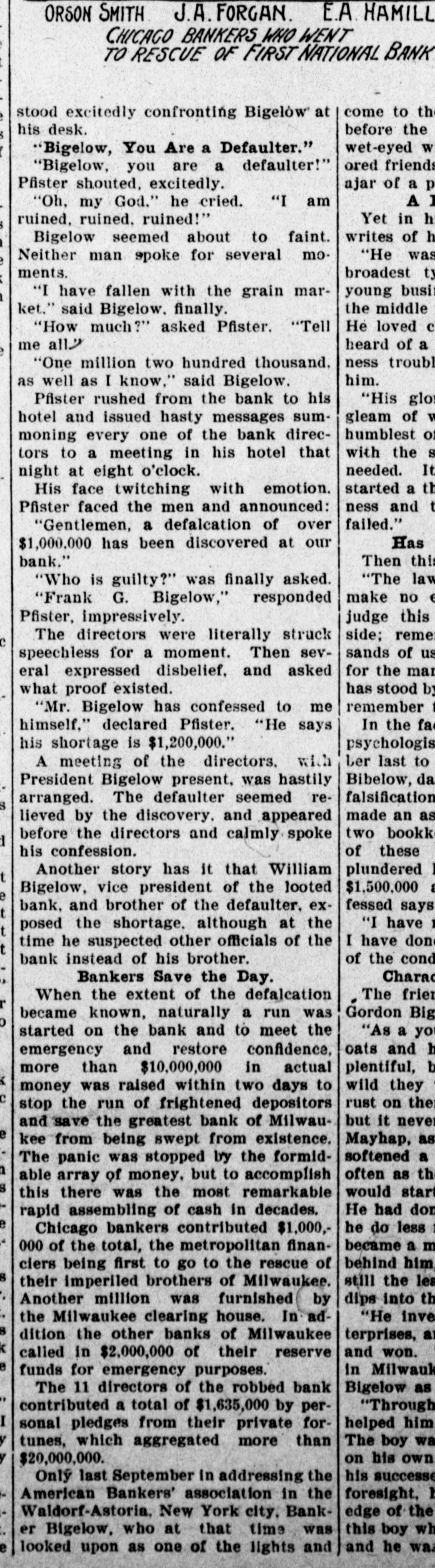
ORSON SMITH J.A. FORGAN. E.A. HAMILL CHICAGO BANKERS WHO WENT TO RESCUE OF FIRST NATIONAL BANK stood excitedly confronting Bigelow at his desk. "Bigelow, You Are a Defaulter." "Bigelow, you are a defaulter!" Pfister shouted, excitedly. "Oh, my God," he cried. "I am ruined, ruined, ruined!" Bigelow seemed about to faint. Neither man spoke for several moments. "I have fallen with the grain market." said Bigelow, finally. "How much?" asked Pfister. "Tell me all?" "One million two hundred thousand, as well as I know," said Bigelow. Pfister rushed from the bank to his hotel and issued hasty messages summoning every one of the bank directors to a meeting in his hotel that night at eight o'clock. His face twitching with emotion, Pfister faced the men and announced: "Gentlemen, a defalcation of over $1,000,000 has been discovered at our bank." "Who is guilty?" was finally asked. "Frank G. Bigelow," responded Pfister, impressively. The directors were literally struck speechless for a moment. Then several expressed disbelief, and asked what proof existed. "Mr. Bigelow has confessed to me himself," declared Pfister. "He says his shortage is $1,200,000." A meeting of the directors, with President Bigelow present, was hastily arranged. The defaulter seemed relieved by the discovery, and appeared before the directors and calmly spoke his confession. Another story has it that William Bigelow, vice president of the looted bank, and brother of the defaulter, exposed the shortage, although at the time he suspected other officials of the bank instead of his brother. Bankers Save the Day. When the extent of the defalcation became known, naturally a run was started on the bank and to meet the emergency and restore confidence, more than $10,000,000 in actual money was raised within two days to stop the run of frightened depositors and save the greatest bank of Milwaukee from being swept from existence. The panic was stopped by the formidable array of money, but to accomplish this there was the most remarkable rapid assembling of cash in decades. Chicago bankers contributed $1,000,000 of the total, the metropolitan financiers being first to go to the rescue of their imperiled brothers of Milwaukee. Another million was furnished by the Milwaukee clearing house. In addition the other banks of Milwaukee called in $2,000,000 of their reserve funds for emergency purposes. The 11 directors of the robbed bank contributed a total of $1,635,000 by personal pledges from their private fortunes, which aggregated more than $20,000,000. Only last September in addressing the American Bankers' association in the Waldorf-Astoria, New York city, Banker Bigelow, who at that time was looked upon as one of the lights and come to the before the wet-eyed w ored friends ajar of a p Yet in h writes of h "He was broadest ty young busin the middle He loved c heard of a ness troubl him. "His glom gleam of w humblest on with the s needed. It started a th ness and t failed." Has Then this "The law make no e judge this side; reme sands of us for the mar has stood by remember In the fa psychologists Ler last to Bibelow, da falsification made an as two bookk of these plundered $1,500,000 fessed says "I have I have done of the cond Charac The frien Gordon Big "As a you oats and h plentiful, b wild they rust on the but it never Mayhap, as softened a often as the would start He had don he do less became a m behind him, still the lea dips into th "He inve terprises, an and won. in Milwaukee Bigelow as "Through helped him The boy wa on his own his successe foresight, b edge of the this boy wh and he was


Article from The Abbeville Press and Banner, May 17, 1905

Click image to open full size in new tab

Article Text

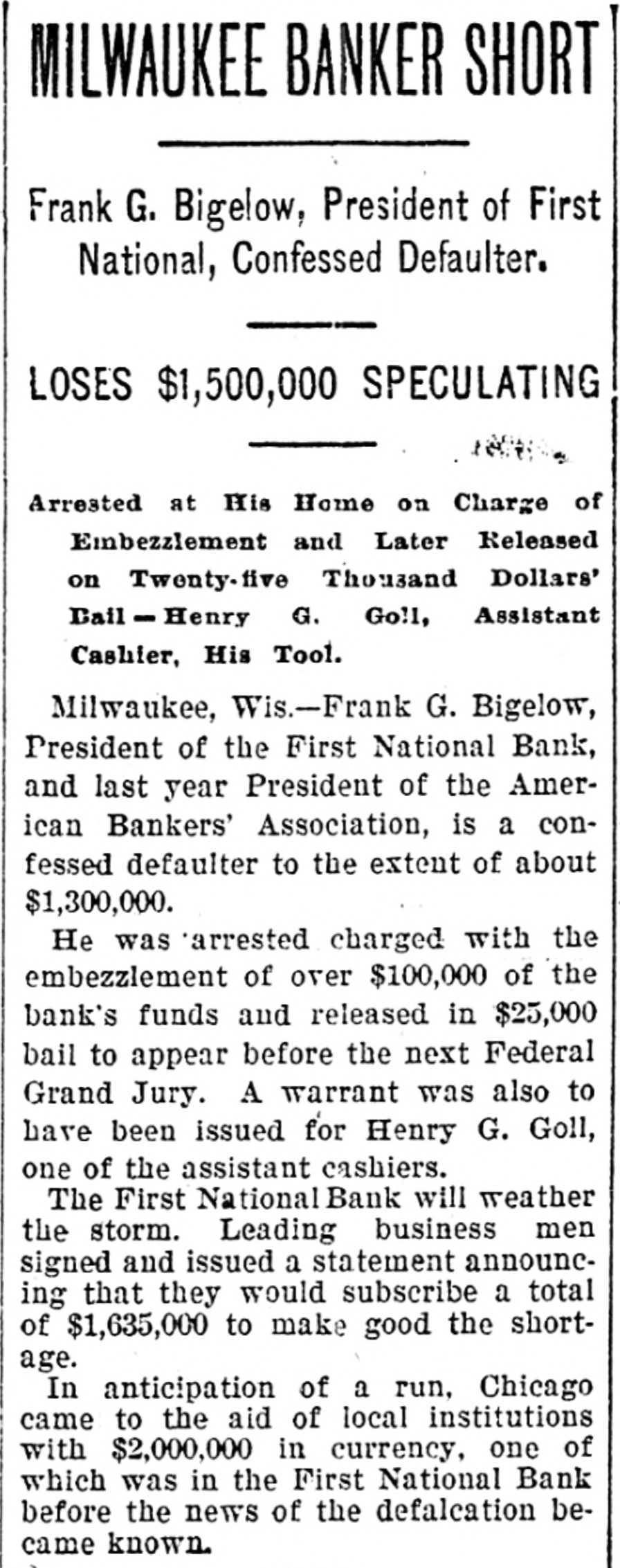
MILWAUKEE BANKER SHORT Frank G. Bigelow, President of First National, Confessed Defaulter. LOSES $1,500,000 SPECULATING Arrested at His Home on Charge of Embezzlement and Later Released on Twenty-five Thousand Dollars' Bail - Henry G. Goll, Assistant Cashier, His Tool. Milwaukee, Wis.-Frank G. Bigelow, President of the First National Bank, and last year President of the American Bankers' Association, is a confessed defaulter to the extent of about $1,300,000. He was 'arrested charged with the embezzlement of over $100,000 of the bank's funds and released in $25,000 bail to appear before the next Federal Grand Jury. A warrant was also to have been issued for Henry G. Goll, one of the assistant cashiers. The First National Bank will weather the storm. Leading business men signed and issued a statement announcing that they would subscribe a total of $1,635,000 to make good the shortage. In anticipation of a run, Chicago came to the aid of local institutions with $2,000,000 in currency, one of which was in the First National Bank before the news of the defalcation became known.


Article from Grant County Herald, May 17, 1905

Click image to open full size in new tab

Article Text

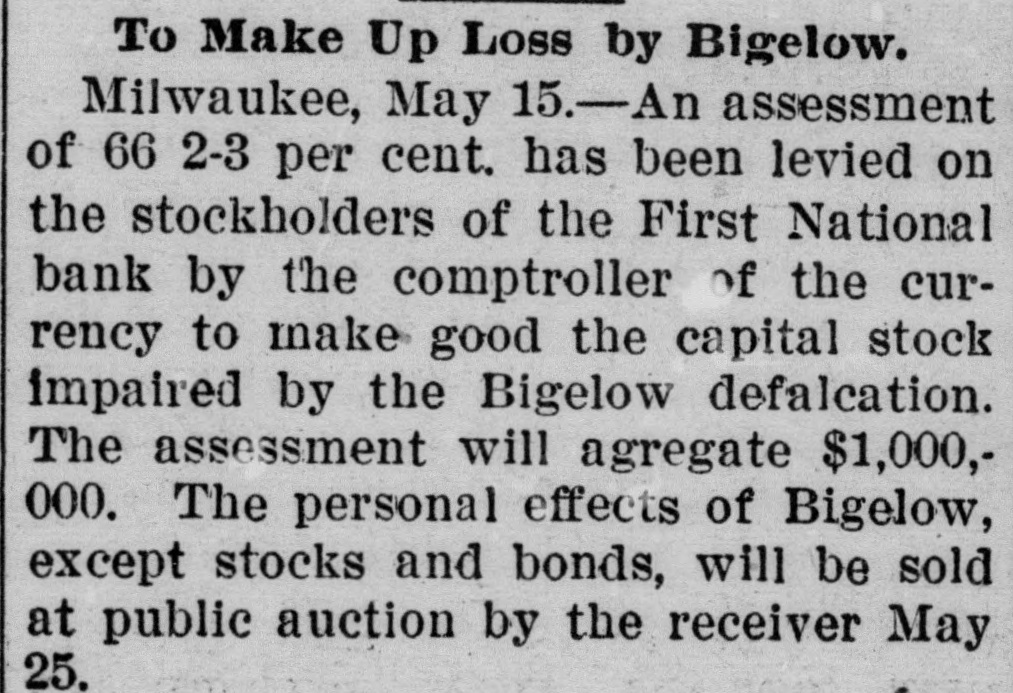
To Make Up Loss by Bigelow. Milwaukee, May 15.-An assessment of 66 2-3 per cent. has been levied on the stockholders of the First National bank by the comptroller of the currency to make good the capital stock impaired by the Bigelow defalcation. The assessment will agregate $1,000,000. The personal effects of Bigelow, except stocks and bonds, will be sold at public auction by the receiver May 25.


Article from The New Age, January 6, 1906

Click image to open full size in new tab

Article Text

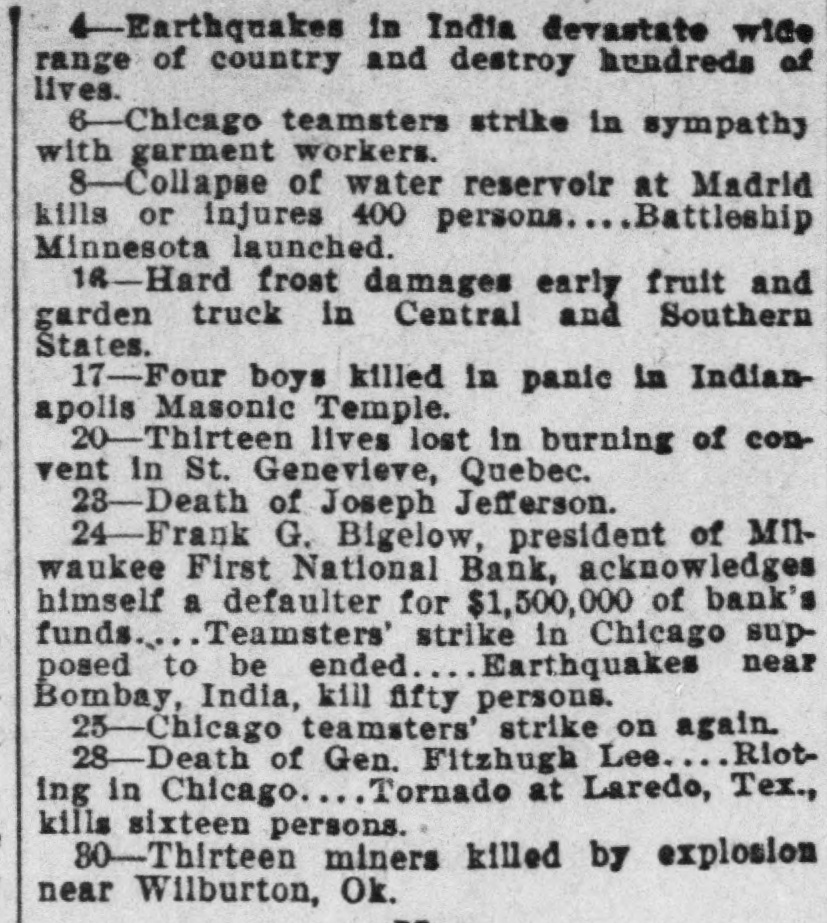
4-Earthquakes in India devastate wide range of country and destroy hundreds of lives. 6 -Chicago teamsters strike in sympathy with garment workers. 8-Collapse of water reservoir at Madrid kills or injures 400 persons. Battleship Minnesota launched. 1R Hard frost damages early fruit and garden truck in Central and Southern States. 17-Four boys killed in panic in Indianapolis Masonic Temple. 20-Thirteen lives lost in burning of convent In St. Genevieve, Quebec. 23-Death of Joseph Jefferson. 24-Frank G. Bigelow, president of Mnwaukee First National Bank, acknowledges himself a defaulter for $1,500,000 of bank's funds. Teamsters' strike in Chicago supposed to be ended Earthquakes near Bombay, India, kill fifty persons. 25-Chicago teamsters' strike on again. Rlot28-Death of Gen. Fitzhugh Lee Tornado at Laredo, Tex., ing in Chicago kills sixteen persons. 80-Thirteen miners killed by explosion near Wilburton, Ok.