Article Text
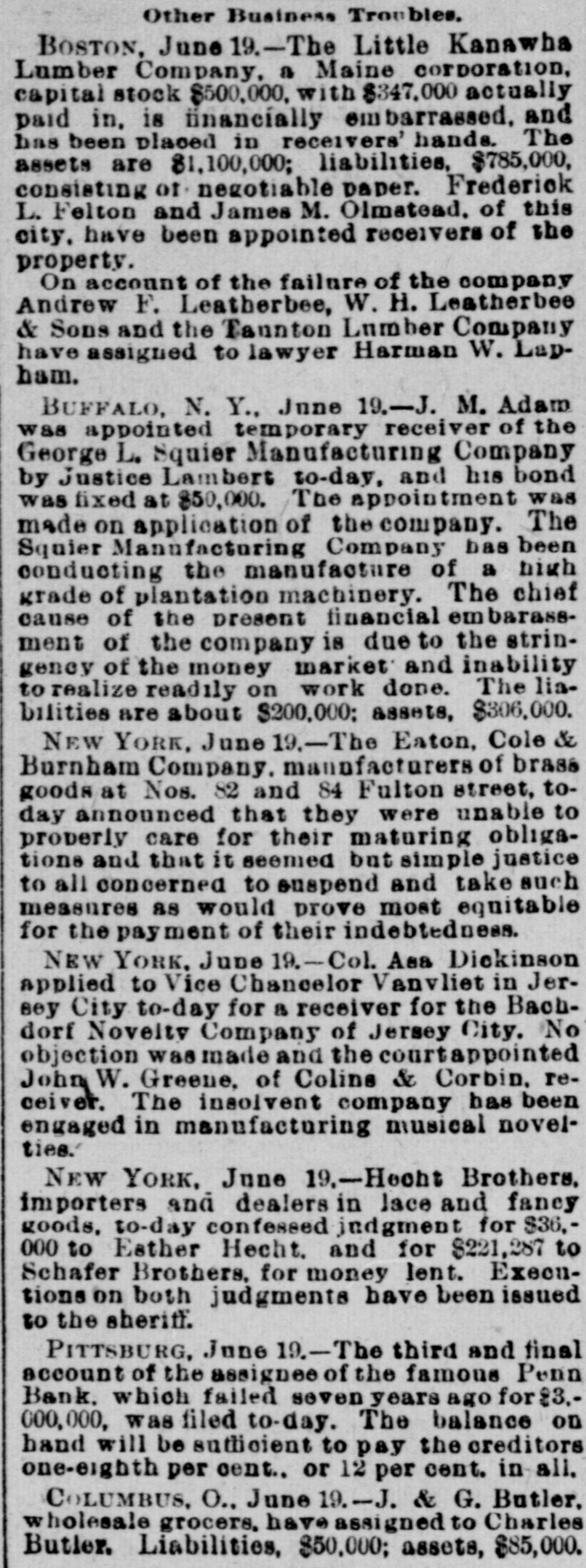
THEPENNI BANK AGAIN Arguments in the Supreme Court on Assignee Warner's Suit. A MUTUAL LIFE INSURANCE PLAN. Applications for Retrials of Three Convicted Murderers. THE NEWS OF THE COUNTY COURTS The defunct Penn Bank had another airing in the Supreme Court yesterday. The appeal of Henry Warner, assignee, against Thomas Hare and others was argued. This was the proceeding for the taking and stating of an account between the defendants and Mr. Warner, wherein the latter alleged that the defendants are largely indebted to him, assignee, for the proceeds of certain bills receivable of the Penn Bank, which, after the first suspension of the bank, and before the final failure, were indorsed, delivered taken and held by the defendants, directors of the bank, as collateral security, to indemnify them as accommodation makers of promissory notes, alleged to have been made for the accommodation of the bank. The question raised is whether or not the defendants are entitled to a credit for $44,956 93 claimed by them to have been paid to the Germania Savings Bank, and which is claimed to have been a misappropriation and improper payment of the proceeds of the bills receivable. Collecting Interest on Contracts. The case of Booth & Flinn against the city to recover a balance of $783 claimed to be due on the contract for paving South Twenty-eighth street from Carson to Jane street was argued. The question at issue is whether or not the plaintiffs were entitled to interest on the contract price from the time the work was completed until payment was made. There was an argument in the case of Mary E. Urias against the Pennsylvania Railway. The action was to recover damages for the death of the plaintiff's husband, who was killed at Copeland station July 20, 1891. A verdict for $25,000 was received in the lower court from which the railroad company appealed. The case of Harry T. Friend against Martha E. Lamb was argued. It was an action to compel the specific performance of a contract of purchase of real estate by the defendant. An interesting story developed in the argument of the case of Elizabeth Hill, administratrix of the estate of Laban S. Hooper, deceased, against the United Life Insurance Association. A Combination Against Death. Hooper was the ninth man in a party of ten men who had combined together to have their lives insured for $10,000 apiece, agreeing that when the first died his estate should receive $1,000 and the remainder should be divided between the other nine. When the second should die the same disposition was to be made of the insurance money, and so on until the ten men should be dead. When Hooper died the plaintiff objected to this kind of a distribution of his insurance on the ground that the agreement he had entered into was in the nature of a wager. She lost the case in the lower court and appealed the case. The other cases aagued were: The appeal of Robert F. Clever from the definite decree of the Orphans' Court of this county; W. C. O'Reilly against C. C. Craft and others, an election controversy from the borough of Crafton; petition of Jas. S. Young and George Estep relating to the time for holding elections in Duquesne borough; appeal of James Evans in regard to the voluntary assignment of Daniel B. Brown; W. L. Perry against the Pittsburg Union Passenger Railway Company, an action to recover damages; the Fidelity Title and Trust Company against Wm. Weitzel, an action on a will, and the appeal of Joseph Walton from the judgment of Common Pleas Court No. 2, in the American Bank case.