19239. banks of Philadelphia (Philadelphia, PA)

Bank Information

Episode Type
Suspension → Reopening
Bank Type
state
Start Date
October 1, 1839*
Location
Philadelphia, Pennsylvania (39.952, -75.164)

Metadata

Model
gpt-5-mini
Short Digest
a37b832e

Response Measures

None

Description

Multiple contemporary papers report that the banks of Philadelphia suspended specie payments in October 1839. There is no clear single-bank run described in these articles; rather, a collective suspension driven by national monetary strains and specie movements. Article 12 states specie payments were not fairly resumed until March 1842, so the episode is a suspension with later reopening. Bank type is given collectively and not a single chartered bank, so set to unknown.

Events (2)

1. October 1, 1839* Suspension
Cause
Macro News
Cause Details
Large national/specie movements and the fallout from federal revenue distribution and monetary policies (distribution law, heavy specie transfers) forced the banks collectively to suspend specie payments in October 1839; articles discuss systemic pressures rather than a single-bank insolvency.
Newspaper Excerpt
suspension of specie payments, yesterday, of the banks of Philadelphia.
Source
newspapers
2. March 1, 1842* Reopening
Newspaper Excerpt
Specie payments were not fairly resumed by the banks of Philadelphia till March, 1842.
Source
newspapers

Newspaper Articles (12)

Article from Richmond Enquirer, October 15, 1839

Click image to open full size in new tab

Article Text

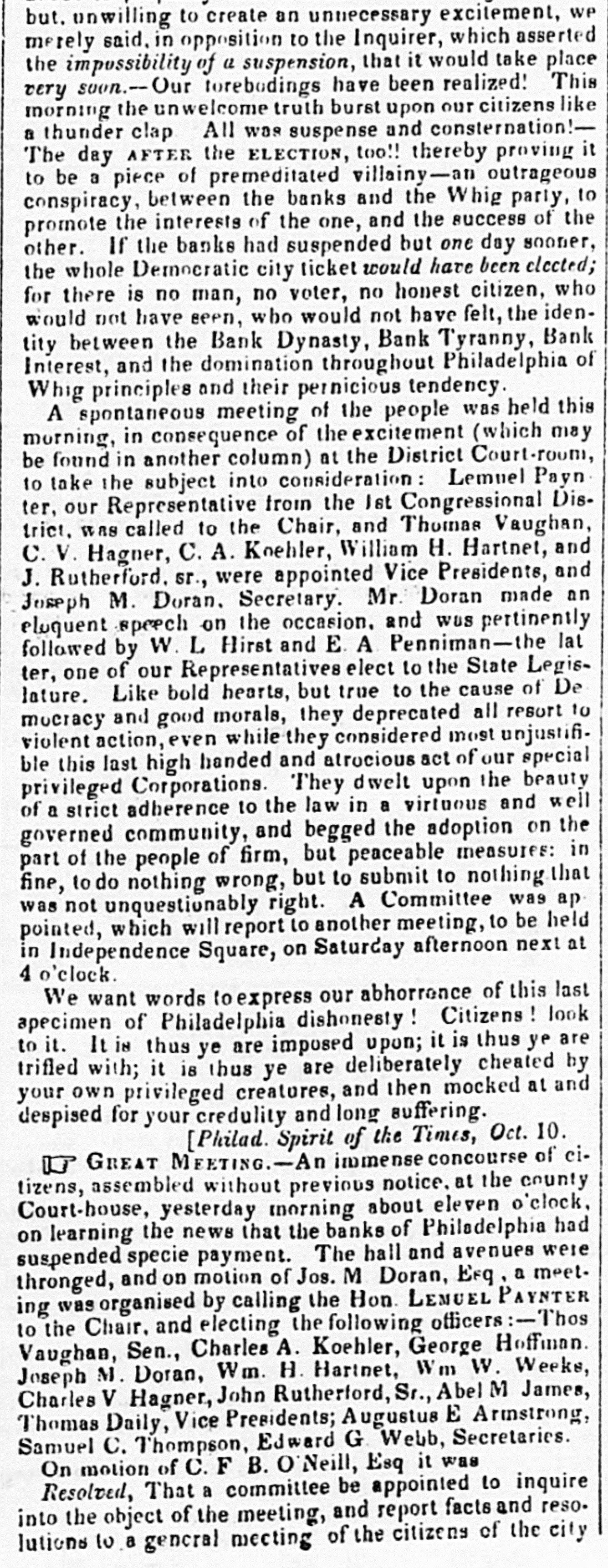
but, unwilling to create an unnecessary excitement, we merely said, in opposition to the Inquirer, which asserted the impossibility of a suspension, that it would take place very soon.--Our forebodings have been realized! This morning the unwelcome truth burst upon our citizens like a thunder clap All was suspense and consternation!- The day AFTER the ELECTION, too!! thereby proving it to be a piece of premeditated villainy-an outrageous conspiracy, between the banks and the Whig party, to promote the interests of the one, and the success of the other. If the banks had suspended but one day sooner, the whole Democratic city ticket would have been elected; for there is no man, no voter, no honest citizen, who would not have seen, who would not have felt, the iden- tity between the Bank Dynasty, Bank Tyranny, Bank Interest, and the domination throughout Philadelphia of Whig principles and their pernicious tendency. A spontaneous meeting of the people was held this morning, in consequence of the excitement (which may be found in another column) at the District Court-room, to take the subject into consideration: Lemuel Payn- ter, our Representative from the Ist Congressional Dis- trict, was called to the Chair, and Thomas Vaughan, C. V. Hagner, C. A. Koehler, William H. Hartnet, and J. Rutherford, sr., were appointed Vice Presidents, and Joseph M. Doran, Secretary. Mr. Doran made an eloquent speech on the occasion, and was pertinently followed by W. L Hirst and E. A Penniman-the lat- ter, one of our Representatives elect to the State Legis- lature. Like bold hearts, but true to the cause of De- mocracy and good morals, they deprecated all resort to violent action, even while they considered most unjustifi- ble this last high handed and atrocious act of our special privileged Corporations. They dwelt upon the beauty of a strict adherence to the law in a virtuous and well governed community, and begged the adoption on the part of the people of firm, but peaceable measures: in fine, to do nothing wrong, but to submit to nothing that was not unquestionably right. A Committee was ap- pointed, which will report to another meeting, to be held in Independence Square, on Saturday afternoon next at 4 o'clock. We want words to express our abhorrence of this last specimen of Philadelphia dishonesty! Citizens! look to it. It is thus ye are imposed upon; it is thus ye are trifled with; it is thus ye are deliberately cheated by your own privileged creatures, and then mocked at and despised for your credulity and long suffering. [Philad. Spirit of the Times, Oct. 10. # GREAT MEETING An immense concourse of ci- tizens, assembled without previous notice, at the county Court-house, yesterday morning about eleven o'clock, on learning the news that the banks of Philadelphia had suspended specie payment. The hall and avenues were thronged, and on motion of Jos. M. Doran, Esq, a meet- ing was organised by calling the Hon. LEMUEL PAYNTER to the Chair, and electing the following officers:--Thos Vaughan, Sen., Charles A. Koehler, George Hoffman. Joseph M. Doran, Wm. H. Hartnet, Wm W. Weeks, Charles V Hagner, John Rutherford, Sr., Abel M James, Thomas Daily, Vice Presidents; Augustus E Armstrong, Samuel C. Thompson, Edward G. Webb, Secretaries. On motion of C. F B. O'Neill, Esq it was Resolved, That a committee be appointed to inquire into the object of the meeting, and report facts and reso- lutions to a general meeting of the citizens of the city

Article from Herald of the Times, October 24, 1839

Click image to open full size in new tab

Article Text

[WHOLE NO. 470. From the N. Y. Commercial Advertiser of Oct. 16: # PHILADELPHÍA MANIFESTO The following article appeared in most of the Philadelphia papefs yesterday. No intimation is given on which conjecture inay be founded as to the authorship; but here, wd understand, it is ascribed to Mr. Biddle, and as we were informed that he was preparing a communication to the public, we think it probable that the opinion is correct, although the style differs in some respects from that of acknowledged publications by that distinguished financier. Certainly the paper is drawn up with great ability, and some of our great men at Washington might take example from its clearness and freedom froin atl ambiguity. But what of its tenor. For our own part, we have read it with satisfaction, and a strong hope that it tells just the truth. For, assuin-ing its statements and reasonings to be all correct, it follows as a necessary inference that our banks have taken the right course, and can maintain themselves in pursuing it. The causes that are alleged to have brought on the Philadelphia suspension have not operated, or have operated much less forcibly, in New York. They have been able to withstand all the pressure that has borne upon them; and now the worst of the pressure is over. The financial difficulties of the country, it appears by this document, are but temporary, and the hour of their cessation is rapidly drawing nigh. Moreover, the course taken by the institutions South of us has given relief, not only to themselves, but to the whole country-better times are coming -of course, then, if our banks could stand through the worst, they will continue to stand now that the worst has passed away. # SUSPENSION OF SPECIE PAY-MENTS. This step, on the part of the banks of Philadelphia, calls for a full exposition of the causes which have rendered that step necessary. These causes and their operation will be treated in a national point of view, merely, and without special reference to either of the political parties into which the nation is divided. To this end it will be necessary to take a retrospective glance. The peace of 1815 found the country involved in a national debt of about one hundred and twenty millions of dollars, some of it held abroad, but by far the greater portion at hom This was regarded as a burthen, and the policy of the government was strenuously directed to its extinguishment. To accomplish this object, a surplus revenue, derived wholly from the fruits of foreign commerce and the proceeds of the public lands, was the sole reliance. Credit, which has contributed so largely to the advancement of the prosperity of the country, was greatly extended, the banking institutions fostered, and the whole policy of the general government seemed directed to the expansion of commerce, and the increase of the tribute which it should pour into their coffers. The first day of the year 1835 exhibited to the world the unparalleled spectacle of a nation free from debt. That proud distinction belonged to these United States. The heavy obligation which had been incurred by the prosecution of two successful wars had been extinguished, chiefly through the instrumentality of the credit and commerce of the country, enriching both the nation and individuals. Such an epoch was well calculated to cause a jubilee to be held on the occasion, as it did at the metropolis, by the dignitaries of the government. With the extinguishinent of the public debt a new era was oponed; but the accumulation of revenue beyond the wants of the government did not cease nor diminish with the diminution of these wants. The stimulus that had been so abundantly administered, caused the revenue to continue to increase in an extraordinary ratio, when it was no longer called for, and could not be legitimately used. Under the encouragement which had thus been given for the purpose of raising revenue from sales of the public domain and from imports, the amount derived from the former was increased between 1834 and 1836, from $6,099,981 to $23,983,192, and the amount of foreign imports from $126,521,332 to $189,980,035, and the surplus revenue accruing therefrom in the short space of two years, amounted to but little less than forty millions of dollars. That surplus, Congress, with the sanction of the Executive, directed to be distributed among the states. In July, 1836, measures were commenced by. the head of the Treasury Department to carry the law into execution. Of the manner in which this was done, or of the skill or judgment exercised on the occasion, it is deemed unnecesssary here to offer an opinion, but with the beginning of the execution of that law, the previous seeming prosperity that had existed, received a severe and sudden check, aud difficulties and embarrassments both to the government and people rapidly succeeded. The monetary affairs of the whole country were convulsed-millions upon millions of coin were in transitu in every direction, and consequently withdrawn from useful employment. Specie was going up and down the same river, to and from the South and North and the East and West at the same time; millions were withdrawn from their usual and natural channels, and forced against the current of trade, in literal fulfilment of the distribution law, to points where public money had previously never been either collected or expended, except to a very limited extent. The consequences were obvious and inevitable. The duties which were imposed on the banks, acting as agents of the government at that time, became so onerous that many of them were obliged, in the space


Article from Maumee City Express, October 26, 1839

Click image to open full size in new tab

Article Text

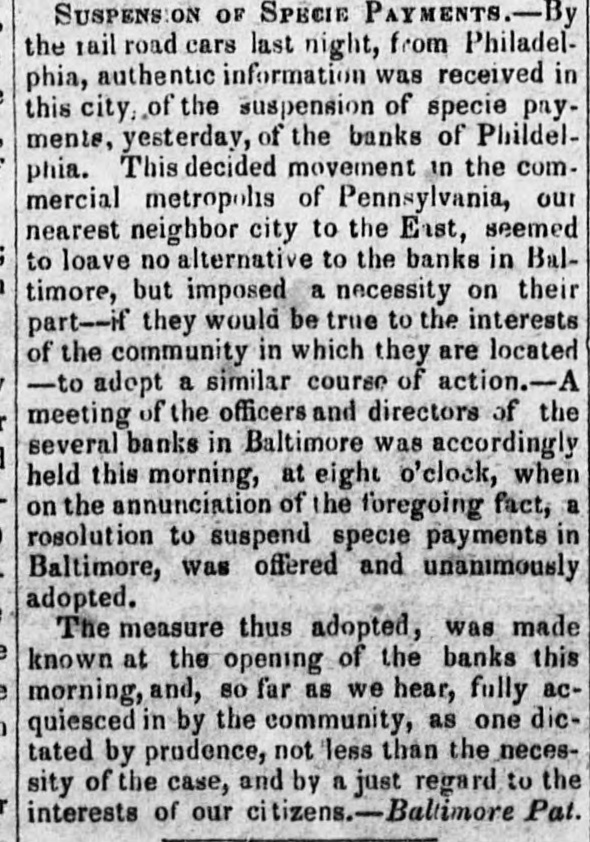
SUSPENS: ON OF SPECIE PAYMENTS.-By the rail road cars last night, from Philadelphia, authentic information was received in this city, of the suspension of specie paymente, yesterday, of the banks of Phildelphia. This decided movement in the commercial metropolis of Pennsylvania, our nearest neighbor city to the East, seemed to loave no alternative to the banks in Baltimore, but imposed a necessity on their part-if they would be true to the interests of the community in which they are located -to adopt a similar course of action.-A meeting of the officers and directors of the several banks in Baltimore was accordingly held this morning, at eight o'clock, when on the annunciation of the foregoing fact, a rosolution to suspend specie payments in Baltimore, was offered and unanimously adopted. The measure thus adopted, was made known at the opening of the banks this morning, and, so far as we hear, fully acquiesced in by the community, as one dictated by prudence, not less than the necessity of the case, and by a just regard to the interests of our citizens.-Bultimore Pat.


Article from Morning Herald, October 30, 1839

Click image to open full size in new tab

Article Text

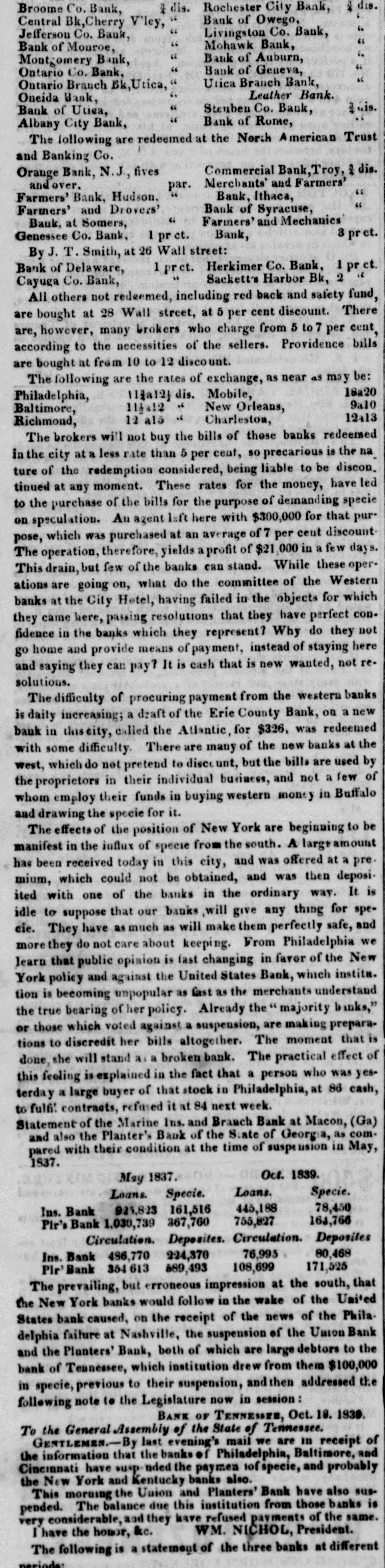
dis. dis. Rochester City Bank, Broome Co. Bank, Bank of Owego, Central Bk, Cherry V'ley, Livingston Co. Bank, Jefferson Co. Bank, " " Mohawk Bank, Bank of Monroe, " " Bank of Auburn, Montgomery Bank, " " Bank of Geneva, Ontario Co. Bank, " Utica Branch Bank, Ontario Brauch Bk,Utica, Leather Bank. Oneida Bank, " this. Steuben Co. Bank, Bank of Utiga, " Bank of Rome, Albany City Bank, The following are redeemed at the North American Trust and Banking Co. Commercial Bank,Troy, dis. Orange Bank, N.J., fives Merchants' and Farmers' and over. par. Bank, Ithaca, Farmers' Bank, Hudson. Farmers' and Drovers' Bank of Syracuse, Farmers' and Mechanics Bauk, at Somers, 3 pr ct. Genessee Co. Bank, 1 pr ct. Bank, By J. T. Smith, at 26 Wall street: Bank of Delaware, 1 pret. Herkimer Co. Bank, 1 pr ct. " Sackett's Harbor Bk, 2 Cayuga Co. Bank, All others not redeemed, including red back and safety fund, are bought at 28 Wall street, at 5 per cent discount. There are, however, many brokers who charge from 5 to 7 per cent according to the necessities of the sellers. Providence bills are bought at from 10 to 12 discount. The following are the rates of exchange, as near as may be: 18a20 112a12} dis. Mobile, Philadelphia, 9al0 New Orleans, 111x12 " Baltimore, 12:13 12 aló " Charleston, Richmond, The brokers will not buy the bills of these banks redeemed in the city at a less rate than 5 per cent, so precarious is the na ture of the redemption considered, being liable to be discon. tinued at any moment. These rates for the money, have led to the purchase of the bills for the purpose of demanding specie on speculation. An agent left here with $300,000 for that purpose, which was purchased at an average of 7 per ceut discount The operation, therefore, yields a profit of $21,000 in a few days This drain, but few of the banks can stand. While these operations are going on, what do the committee of the Western banks at the City Hetel, having failed in the objects for which they came here, passing resolutions that they have perfect con. fidence in the banks which they represent? Why do they not go home and provide means of payment, instead of staying here and saying they can pay? It is cash that is new wanted, not resolutions. The difficulty of procuring payment from the western banks daily increasing; a draft of the Erie County Bank, on a new bank in this city, called the Atlantic, for $326, was redeemed with some difficulty. There are many of the new banks at the west, which do net pretend te disco unt, but the bills are used by the proprietors in their individual business, and not a few of whom employ their funds in buying western money in Buffalo drawing the specie for it. The effects of the position of New York are beginning to be manifest in the influx of specie from the south. A large amount has been received today in this city, and was offered at a premium, which could not be obtained, and was then deposiited with one of the banks in the ordinary way. It is idle to suppose that our banks will give any thing for specie. They have as much as will make them perfectly safe, and more they do not care about keeping. From Philadelphia we learn that public opinion is fast changing in favor of the New York policy and against the United States Bank, which institu. tion is becoming unpopular as fast as the merchants understand the true bearing of her policy. Already the majority banks," or those which voted against a suspension, are making preparations to discredit her bills altogether. The moment that is done, she will stand as a broken bank. The practical effect of this feeling is explained in the fact that a person who was yesterday a large buyer of that stock in Philadelphia, at 86 cash, to fulfi: contracts, refused it at 84 next week. Statement of the Marine Ins. and Branch Bank at Macon, (Ga) and also the Planter's Bank of the State of Georgia, as com. pared with their condition at the time of suspension in May, 1937. Oct. 1839. May 1837. Loans. Specie. Loans. Specie. 78,450 445,188 Ins. Bank 925,823 161,516 164,766 755,827 Plr's Bank 1,030,739 367,760 Circulation. Deposites. Circulation. Deposites 76,995 80,468 Ins. Bank 496,770 224,370 171,525 108,699 Plr' Bank 354 613 689,493 The prevailing, but erroneous impression at the south, that the New York banks would follow in the wake of the United States bank caused, on the receipt of the news of the Phila. delphia failure at Nashville, the suspension of the Union Bank and the Planters' Bank, both of which are large debtors to the bank of Tennessee, which institution drew from them $100,000 in specie, previous to their suspension, and then addressed the following note to the Legislature now in session: BANK OF TENNESSEE, Oct. 18. 1839. To the General Assembly of the State of Tennessee. GENTLEMEN.-Bylast evening's mail we are in receipt of the information that the banks of Philadelphia, Baltimore, and Cincinnati have susp nded the paymen of specie, and probably the New York and Kentucky banks also. This morning the Union and Planters' Bank have also suspended. The balance due this institution from those banks is very considerable, and they have refused payments of the same. WM. NICHOL, President. I have the honor, &c. The following is a statement of the three banks at different neriods:


Article from Columbus Democrat, November 23, 1839

Click image to open full size in new tab

Article Text

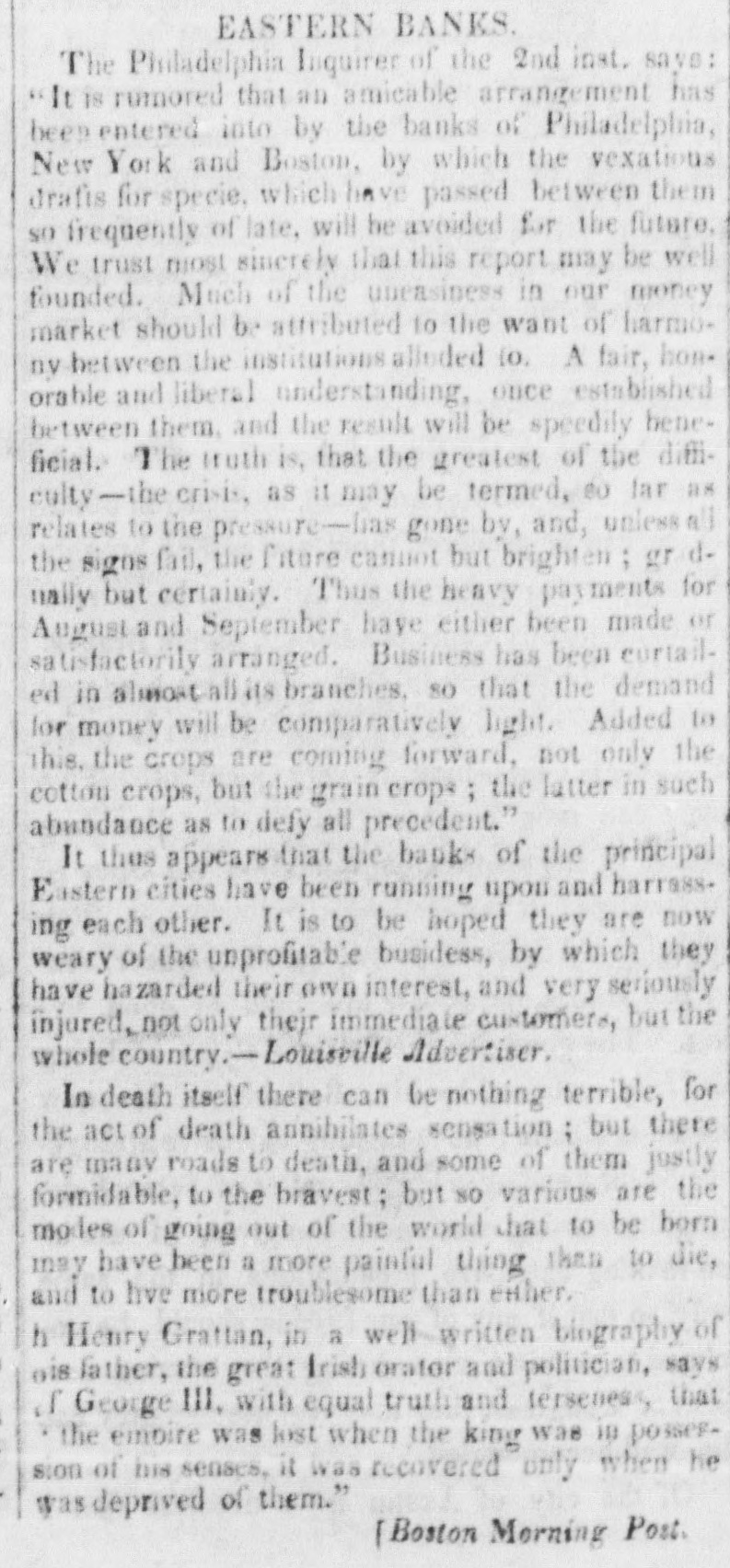
EASTERN BANKS. The Philadelphia Inquirer of the 2nd last. save: It is rumored that an amicable arrangement has been entered into by the banks of Philadelphia, New York and Boston, by which the vexations drafis for specie, which have passed between them so frequently of late, will he avoided for the future. We trust most sincerly that this report may be well founded. Much of the uneasiness in our money market should be attributed to the want of harmony between the institutions alluded (o. A fair, honorable and liberal understanding, once established between them. and the result will be speedily beneficial. The truth is, that the greatest of the difficulty-the crisis, as it may be termed, 80 far as relates to the pressure- has gone by, and, unless all the signs fail, the fiture cannot but brighten ; gr d. naily but certainly. Thus the heavy payments for August and September haye either been made or satisfactorily arranged. Business has been cortailed in almost all its branches, so that the demand for money will be comparatively light. Added to this. the crops are coming forward, not only the cottou crops, but the grain crops ; the latter in such abundance as to defy all precedent." It thus appears that the banks of the principal Eastern cities have been running upon and harressing each other. It is to be hoped they are now weary of the unprofitable busidess, by which they have hazarded their own interest, and very seriously injured, not only their immediate customers, but the whole country.-Louiseille Advertiser. In death itself there can be nothing terrible, for the act of death annihilates sensation ; but there are many roads to death, and some of them justly formidable, to the bravest; but so various are the modes of going out of the world that to be born may have been a more painful thing than to die, and to hve more troublesome than either. h Henry Grattan, in a well written biography of ois father, the great Irish orator and politician, says r George III, with equal truth and terseness, that the emoire was lost when the king was in possession of his senses, it was recovered only when he was deprived of them.' Boston Morning Post.


Article from Morning Herald, January 3, 1840

Click image to open full size in new tab

Article Text

MONEY MARKET. Thursday, Jan. 2, A small b usiness was done at the stock exchange this morning; prices were generally more firm, and in some cases an vance was evinc d over the rates of Tuesday. U S. Bank im. preved & cent; N.A.T. & B. r cent; Vicksburg 1 per ceat; Del. & Hudson & per cent: Harlem per cent; Mohawk & per cent. Some sales of Ohio 6 per cent to ks were made at 86. Drafts on Philadel phia and Baltimore at 92a921 Money remains excee dingly scarce, and the rates for country bills are rising. Red back money is new bought at five and sold at four per cent discount by the brokers. Philadelphia and Baltimore money is gradually improving, and the belief gains ground that the majority of the banks in t ose cities will soon resume. Letters from Baltimore, that we have seen speak confidently of resumption there in few days. There are again rumours afleat of frauds in the Giand Bank of Phila delphia. a he institutions of that city are in such bad odour at present that stories detrimen lal to the ir integrity gaiss dence. It is not to he supposed that they can continus in a state of suspension, in defiance of public opinion. and maintain a reputation for integrity at the same time. Sterling bills re £ main plentier at 8 81 per cent, or $4.80 a $1,82 cents the sterling; but little is going forward, the South America has none, and the St. James but $56,000. The year has been fraught with great changes in the and financial world. The cre dit system tered its and the basking power country. commercial to past foundation, in of this events, has totwhich has for two years stemmed the course and upheld prices in a stagnant market, has at last civen way be fore accumulated pressure, and property is seeking its proper level. that time ar feeling on the the federal has undergone a great sub In government popul which financial change, the and policy first the of blow treasury system, the bare mention of gave Le the overgrown credits of 1836, is, during the coming year, In likely to become the law of the land in its most ultra form. looking back upon the vents of the past two years, we cannot but be struck with the fact that the financial movements of the government on one side, and the movements of the back opposed to the measure, have both conspired to produce this change. When the extra session of Congress convened in Sept. 1837, the sub-treasury plan war apparently rejected by a strong vote. This fact was hailed by the adversaries of the bill as an indication that the government would ultimately be defeated in the measure, and the confidence thus inspired led the banks, in the policy of the U. S. Bank, into that system of operations that has resulted in the present disastrous position in which they find themselves. Instead of follow ng the course of the New York banks, and realizing all long and ac commoda. tion paper and confining their operations to business paper,they largely expanded and endeavored to bolster prices a measure tending to check any renewed activity in trade. Atthe same time, although the sub treasury bill was rejected 112 Congress, it was practically put in operation and the issue of $10,000,000 of treasury notes was authorised in Oct. 1937. The emission of these notes, some of them as low as $50, immediately filled the channels of circulation, previously occupied by the notes of the U. S. Bank, and severely crippled her movements. At the same time, the receipts of the government being mostly in or the bills of few of the banks, any ue on the part of the western expansion specie, institutions the checked financial after move und their return to payments. In this way ments of the have been silently of the United States and southern expansive policy specie government counteracting banks, cut until the the of these latter, to sustain was off by the of the European power stagnation themselves, markets. discover Prices that after are and the mass of the people of dorman trade, property has not its business its elasticity. The then falling value two years nor rapidly alternative recovered and is we find to let the government have its way in the matter, accordingly, that Congress is organized with a Speaker to in the House of Representatives, who is an opposition man every thing but the sub treasury system, which he favours, and and he has appointed an administration committee of ways means. As the administration have a majority in the H use, any bill The this committee will doubtless be carried. as we have shown, has gained and the with its strongest points, will no in- be reported measure original by bill, strength by it doubt delay, will be troduced, with such additional restrictions, as thought capable of bearing. At the same time its worst political feature is lost in the fact that the expenditures of the go. verament are estimated to exceed its receipts, and consequent ly no surplus will encumber the Treasury. The report estimates a deficiency in certain con in the means of the government. tingencies treasury issue The of lecoury first measure notes, will therefore, it is supposed, the in SUMIS as low as $20, and in at the government deposit offices. not specie bearing be, interest, The Union, made bills thus payable and put in circulation will be of par value all orer the en a much greater onfi lence for purposes of transmission joy than the bills of any of the banks, while the specie clause of the bill will keep these latter in wholesome check. The consequence must be as formerly, that the bank circulation will be ill proportion to the amount issued by the depart circulation of the United States the in 1837, was in ment. issue displaced of The post potes Bank, November, before dwindled to $4,000,000 This was about the of the treasury notes. 1838, had by operation mostly The issue effect brenght of on like amount in smaller sums will have a still greater tike smaller channels of circulation and be to the banks n ge. the neral what the Red Back bills in this state have been to Safety Fund bills. With this prospect in view, there is but little probability of increase of ease in the money market. The banks of York will net deviate from their past while a convulsion yet awaits as year, any New great great the policy credit business of system the the Philadelphia banks. to busi. men commanded in the exact ratio of the increase will conducted be by Money and the of actual ness,based on a demand arising from low prices of wants of the community. The short paper growing out the such business, will be readily discounted by the backs, and of interest will decrease with the high in the market. This process has been going OD rate floating accommodation of last paper years, and notwithstanding the COR plaints year, for two Custom House returnsprove the fiet that the regular|healthy the the business of the city of New York has been larger than for two previous years. as evisced by the following tables: COMPARATIVE TABLE OF THE PRINCIPAL ARTICLES PORT OF OF NEW 1 M EXPORT INTO AND FROM THE ON PORT YORK, AND FOR THE YEARS 1839. 1838, WITH THE PRICES THE 1st JANUARY OF EACH YEAR Prices Exports. Imports 1838 1939 1839 1839 Jan 1839. 1, Jan. 1840 1 bales, 224,850 261,780 141.966 194,923 11/a151 10.11} 9ja101 9x101 bags, Coffee, 3410 4.956 1611 1,221 Cotton, 225,892 236 197 23 500 28 027 86.90 100a125


Article from The Columbia Democrat, January 11, 1840

Click image to open full size in new tab

Article Text

porter,) for the information of our friends at a distance, that the banks of Philadelphia are about to resume. No time however, as yet, has been agreed upon. They, of course, discount very little, and yet money cannot be said to be in a very great de mand. A joint resolution has been introduced into and passed by the Lower House of the Tennessee Legislature. to compel the banks to resume specie payments forthwith. The mormons, having been driven from Missouri, have settled in Illinois on a tract of land which they have purchased at the head of the Des Moine rapids of the Mississippi. They have laid out a town which is called Nauvoo. A deputation of three persons of their fraternity has been despatched to Washington to petition Congress for relief on account of losses experienced by the Missouri tronbles. Persecution in their case has had its usual effect in strengthening those who are its victims. The mormon sect has increased largely; and it is said that many families of respectobility and influence in the adjoining counties have united themselves with this new denomination, A female is now living in Roxbury, Mass., at the age of 70, who has spent the whole of her life there, and never had the curiosity to visit Boston or to approach it nearer than the view which is afforded at the top of Parker's Hill, near the foot of which, in the house of the late Gen. William Heath and his decendants, she had resided as a domestic since the age of seven. A horned frog 18 stated to have been brought from Fort Towson, by Lieut. Willott Martin, of the 3d infantry, as a present from an officer stationed there, to Col. Hook of Washington. The body resembles that of a frog, and is about the same size, but the skin is like that of the lizard-scaly-and has a tail half as long as the body, tapering to a point. In New Orleans, it is the custom to farm out the markets annually. The beef marS ket of that city has been rented for the presf year for $54,000, being $3100 more than e last year, and the vegetable market for the same period for $36,000, being an advance of $2700. r Twelve hundred passengers arrived at l Texas in three days, with the intention of e setting permanently in that country. It is estimated that thirty thousand emigrants e have arrived at Galveston alone. during the 1 past season. Among the Chartist prisoners recently 19 arrested in Wales, was an American, who is said to be a quack doctor, called Israel, and who was thought to be deeply concerned in the treasonable plot to overturn the established institutions of the country. He is ninety-thee Years old, and is a remarkast ble shrewd mana S The bank of Wisconsin is "done." On e the 2d inst., the Sheriff of Green Bay took is the keys and sent the cashier, clerks and all, about their business. Cause,-The ineability or unwillingness to cash $300 of their issues. 1. d Ten thousand hogs were for sale in Coe lumbus county, Indiana, on the 11th inst. 1000 only had been sold, and they at $2 50 it to $3 the hundred, nett. No advance exer pected on these prices. d The condition of society in Portugal. e particularly in the large city Lisbor, must e be dreadful indeed. From an official reof turn published in the Diario, it appears that as during the months of April, May and June, as of 1839, 2778 crimes were known to have been committed in Lisbon, of which 333 were assassinations. During the three foled nt lowing months, there were 170 assassinations. 11y A bill to provide against the suspension nd by the Banks of South Carolina, is before he the Legislature of that State. It provides for the payment of seven per cent., interest by the suspended bank, on the whole ahe mount of notes in circulation,monthly stateby ments of its condition, and a forfeiture of g charter for refusing compliance with the provisions of the bill.


Article from The Hillsborough Recorder, February 18, 1841

Click image to open full size in new tab

Article Text

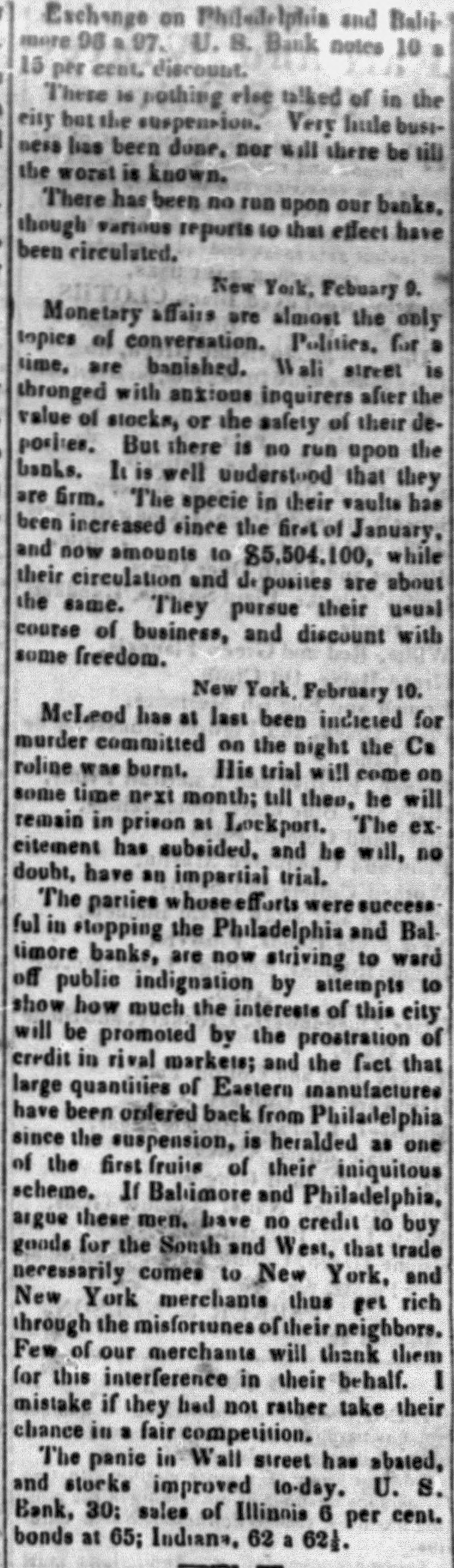
Exchange on Philadelphia and Babi more 98 a 97. U. 8. Bank notes 10 a 15 per cent. discount. These 16 nothing else talked of in the city but the suspension. Very hale business has been done. nor will there be ill the worst is known. There has been no run upon our banks, though various reports to that effect have been circulated. New York, Febuary 9. Monetary affairs are almost the only topics of conversation. Politics, for a time, are banished. Wali street is thronged with anitions inquirers after the value of stocks, or the safety of their deposites. But there is no run upon the banks. It is well understood that they are firm. The specie in their vaults has been increased since the first of January, now amounts to while and de about and their circulation $5,504,100, posites are the same. They pursue their usual course of business, and discount with some freedom. New York, February 10. MeLeod has at last been indicted for murder committed on the night the Cs roline was bornt. His trial wi!l come on some time next month; till theu, he will remain in prison at Lockport. The exeitement has subsided. and be will, no doubt, have an impartial trial. The parties whose efforts were success ful in stopping the Philadelphia and Bal. timore banks, are now striving to ward off public indignation by attempts to show how much the interests of this city will be promoted by the prostration of credit in rival markets; and the fact that large quantities of Eastern manufactures have been onlered back from Philadelphia since the suspension, is heralded as one of the first fruits of their iniquitous scheme. If Balimore and Philadelphia, aigue these men. have no credit to buy goods for the South and West, that trade necessarily comes to New York, and New York merchants thus gel rich through the misfortunes of their neighbors. Few of our merchants will thank them for this interference in their behalf. I mistake if they had not rather take their chance in a fair competition. The panic in Wall street has abated, and stocks improved to-day. U. S. Bank, 30: sales of Illinois 6 per cent. bonds at 65; Indian 62 a 621.


Article from The Camden Journal, September 22, 1841

Click image to open full size in new tab

Article Text

He went down knew himselfi the glass. to the landlord, and told him that he would never sleep in the !arnal house again, and get stung up in that way, Why says the landlord did you not sleep under the musquito bar? Johnny replied that he didn't know what he slept under, but he rolled up the shade on the bed, and got in, and such a tarnal biting he never got before." Here a general roar of laughter burst from the bystanders, and Johnny mistrusted his mistake, grabbed his hat, threw down his change, and made rapid strides for the steet, amid the shouts of the company. THE WHIG NATIONAL DEBT.-Henry Clay announced in the Senate, on Saturday that Congress, at its next session, will have to provide for another loan! From the Money Article of the Herald. The Bank of the United States having now ceased business, and its affairs gone into liquidation, the great pretext for refusing to pay specie is taken from the banks of Philadelphia. In January last tbose institutions professed their willing ness to return to honesty; but alleged that they could not do so while the United States Bank remained suspended in their midst. These assertions were so far conin the eastern loan sums of to was to money they consented fided alleged by to supply the the due banks place capitalists them large of that from that which they last- the United States Bank. The resumption ed but 3 few weeks, and on the final fail. ure of that concern they all a gain suspended and have continued so up to this time. The public have been taxed three to five per cent depreciation on the currency furnished by those institutions. What pretext will those banks find for continuing in this most disgraceful position? Do they imagine that the public will remain quiet under the present state of things? They may indeed plead the authority of the revenue law, but we apprehend that public opinion will have as much influence on the bank movements as those in stitutions had in causing the passage of that law. Not only in Philadelphia, but throughout the South. the community is moving en masse to put down bank rule. at Petersburg the report of the committee of the currency reform association appeals strongly to the interests of the people to discontinue the present banking system. The following is All extract: "The distressfroin 1819 until 1823, pro. duced by shaving Carolina money, cannot yet be forgotten here. Like causes produce like effects, and the same state of things must occur, unless this gambling in exchanges be checked by the Legislature's refusing a suspension of specie payments after next January, the time selected by. the banks and Legisluture as being the most appropriate for resumption. The banks are now taking four months bills on New York and Boston, at half per cent. discount from the face of the bills, and are selling their funds in those places at three and a half to four per cent, there. by making two to two and a half per cent exchange. This states the evil in strong terms, and the remedy is briefly pointed out as follows: "Already we are told that the Georgia plan of paying debts by notes, making the specie value of the note the basis, has had an admirable effect on exchanges." This is the true course-if the depreciated notes continue to circulate, take them for their actual value, and no more. This is applying mercantile law, which it is in every man's power to execute, and is far better than going to legislatures with the matter. Mr. Clay is a gentleman--he is not a gambler' nor a drunkard. nor a-,nor pirate; he is a gentleman-and so is his"boy


Article from New-York Daily Tribune, November 28, 1842

Click image to open full size in new tab

Article Text

VOL. II. NO. 198. United From the United States and Garatte the John MI. States Clayton Bank of continual Hon. EDITOR -Ithas was been no a competent source a reporter speech an MR. that there Delaware, to report was regret to meeting me, in Clayton. at late delivered by Mr. sense of the word, interest, full and of I cellent heard speech in every of national which instruction on great points of subjects well upon informed. teeming with People expositions cannot one of be these too subjects American Bank was and impressive United nothing could of the unfortunate Bank The the National history be more striking downfall of the institution institu- of than his Bank and of -the the United this States latter States which succeeded His it, account of of belief, perhaps Pennsylvania.com of the errors of many of his audition of the bitter to a distinguished as the some removed justice prejudices to stigmatize citizen, au- to tors, whom and of it the is did now bank's the fashion ruin-I allude, when of course, President ther Mr. Nicholas Biddle. said Mr. Clayton. National Bank, the no At the period, war upon the not 10 know that Jackson declared ignorant as possessed the it is best of the United in the could people one could be uniform so currency States ingenuity world most believed that human had a paper curdevised a to a specie one, a currency the and have scarcely to equal be better one. such We because experience it always specie, best commanded rency fully specie and with common than economists, is a better currency of the political tells us the inconveniencies the reit has none of exchange of the because jack them, and the rate of vast territory between the great United cities latter; points of the less than that Bordeaux, of for that inmotest States was actually Paris and circumstance. France- between under such personal quarrel the cause of Mr. Mason Biddle New of siance. with President Mr. It Biddle, Jackson, was refused falling to remove into Hampshire which a is well of Branch the known from Old of (Mr. Presidency of Bank, the at the bidding making war upon the United States the world by failed e effect declaring that created-that the Roman.) the Bank itself, astonished which it was it had adequate rate is, this the of the purpose for and an that a and the State furnishing to good the better country; currency effected by insisting on which Banks. the would the be point, the great Biddle (with nearly agreeing whole war people, at could exchanges object whole This was American turned that Mr. no currency that point, Government, time, be safe. and the with him,) arguing by the General National Bank must unless controlled destruction of the of State Banks; National which, that followed the by a great increase uncontrolled themselves, by a and the left themselves, destroy while the Jackson the Bank, must the country; insisted. to currency speedily of contrary, safer that means Banks the purposes whole on the a unficient, and of a National accomplishing President exhortations to of State administration.com It was under all and Jackson's the auspices banks the Bank. his direct advice banks, and to throwing -under to charter new their business, for the United themselves to of, and the Jackson course States the trammeis increase back to all respect this ruinous encouraged official paStates all Bank, (go of 1833, where rimid are Illinois, per, the strongly Globe, urged.) that and " Ohio, the resolved Indiana, to take kind care by is so the declaration Kentucky, are depend on the the Missouri, 330 of themselves, and of and Biddle, no longer Clay Branches & Co.; rose number,) from that guardianship Banks and greater to number of State afterward to a much sixty-one millions The to 823, (and circulation from millions of been dollars. predicted, and hundred and this was, as had And who was Biddle, or States Bank, one consequence their bankruptcy- of forty President Jackson? after to the cause The of conversion its of charter, the United from 2 National always dis the Mr. Clayton But was was State of and The radical vast to find approved expiration Bank, of its of ruin lamented. had was himself 100 evil Mr. Biddle that, the cause State Bank, its capital banking employn it was inbusiness it was and compelled-in course, it State when these of employment- means duced-or as commercial a in rather -legitimate Stocks; and, accordingly depreciation of stocks invest fell. State lost, first its It like other loss-it purchasers, was the this Bank-one of Dad the faith, this which ruined of that deliberate repudiavictims or which has ruined grown into of the States, or now stocks, and was greatest on the part victims-ins virtual institutions systematized with individuals dishonor. tion, 30 many other American name of the United individ- States covered the State Bank single deruin of Mr. Biddle, such a deed -and The the act, not the of competent to (no free, sovereign of the was was, perhaps, the 'States- the dishonored but its money, load of and struction, ual which borrowed it of to sink under a up its worthless gold given charge this State scrip, for us remember, investment of crime of Mr. States, debt, and Let left which this it had when we the means gilver. -resulting from State stocks-as the committed has the loss- of the Bank in other persons fact which counBiddle, how many us remember a before the having same yet crime been United let properly States brought Government, millions of dolnever that the Fund and several Creeks, Cherokees, of COR States try, the Smithsonian invest for the pursuance Indians- of an United act lars to it. in now the their investgress, in State more in proportion than the Bank of have in State stocks. of its wide Bank from - invested lost stocks and upon spread the Investiga- concerns, United ments States on the whole the report of This the is 8 fact which as appears Committee of 1341. which to ought ting to disarm censure. fact, said Mr. Clayton, and which, In in justice There is another to Mr. Biddle, be forgotten. which the were I mention him, in justice ought banks never of to Philadelp compulsoJanuary, 1841, into suspension, payments, just borbad been forced to resume Legislature specie " anted private to sured, and rily moment directed when Mr. the Biddle, then resume only a he they ascitizen, row the $800,000. exhorted endeavored the banks to not convince to them,


Article from Carroll Free Press, December 23, 1842

Click image to open full size in new tab

Article Text

# THE RUIN OF THE STATE BANK OF THE UNITED STATES now grown into virtual or systematized repudiation, on the part of the States, which has ruined so many other victims - institutions or individuals - and covered the American name with dishonor. The ruin of the State Bank of the United States was the act, not of Mr. Biddle, (no single individual was, perhaps, competent to such a deed of destruction) but of the States, the free, sovereign States, which borrowed its money, dishonored the debt, and left it to sink under a load of worthless State Scrip, for which it had given up its gold and silver. Let us remember, when we charge this loss, resulting from this investment of the means of the Bank in State Stocks as the crime of Mr. Biddle, how many other persons committed the same crime - let us remember a fact which has never yet been properly brought before the public, that the United States Government having the Smithsonian Fund and several millions of dollars to invest for the Indians, Creeks, Cherokees, &c, invested it, in puasuance of an act of Congress, in State stocks and how the United States have lost more in proportion upon their investments upon State stocks than the Bank of the United States on the whole of its wide spread concerns, as appears from the report of the Bank Investigating committee in 1841. This is a fact which ought to disarm censure. There is another fact, said Mr. Clayton, which I mention in justice to Mr. Biddle, and which, in justice to him ought never to be forgotten. In January, 1841, the banks of Philadelphia, which had been forced into suspension, were cumpulsorily directed to resume specie payments just at the moment when the Legislature wanted to borrow $800,000. Mr. Biddle, then only a private citizen, exhorted the banks not to resume; he assured and endeavored to convince them that they were wholly unprepared for resumption; for, he argued and solemnly declared (what his long financial experience enabled him to foresee) that if the banks lent the money and resumed, both they and the State mast inevitably break. But the Banks driven by popular clamor, both resumed and lent the money, and now we see the end of it-many of the banks gone and the State of Pennsylvania bankrupt. - Had Pennsylvania done what Virginia, Ohio, Kentucky and Tennessee did-had she allowed her banks to defer the return to specie payments until July, 1842, the banks might then have resumed with a prospect of safety, and the State and city of Philadelphia might, perhaps, have been spared the vast calamity, under which they are now laboring. There are other causes which contributed to the ruin of this unlucky State Bank. The bonus, and the whole amount paid for its charter in annual contributions to the school fund, subscriptions to public improvements &c. amounted to the enormous sum of twenty millions of dollars; in exacting which Pennsylvania deprived the Bank of its very life-blood. An additional feature of the bonus was the obligation of the bank to lend the State an immense amount of money at the pitiful and ruinous rate of four per cent. interest. Well! Pennsylvania was not content with demanding and receiving this loan. The money was scarcely in her Treasury before the Legislature repealed the tax, laid for the purpose of meeting and paying the interest on the loan, and thus the credit of the loan was destroyed, and the bank made the loser by the whole amount of depreciation. Add to these causes the return to the State Bank of the twenty two millions of circulation of the National Bank, which the former was obliged to redeem, and you have the true elements of the destruction of the Bank - beyond which it is unnecessary to go to seek an additional cause in any supposed mal-administration of Mr. Biddle. Mr. C. having shown the superiority of a National Bank system over the State Bank system, and traced the true cause of the explosion of the latter, predicted with perfect confidence, that the currency and exchanges of the country would remain distracted, in consequence of successive contractions and axpansions by the State banks, acting without concert and without check. He predicted that, so long as the State bank system, now existing should remain without the control of a national institution, the country would be convulsed by alternate suspensions and resumptions of specie payments by frequent explosions of State Banks, followed by all their disastrous consequences, and by continual fluctuations and distractions of the exchanges. He considered the party which favored the


Article from The New York Herald, July 31, 1850

Click image to open full size in new tab

Article Text

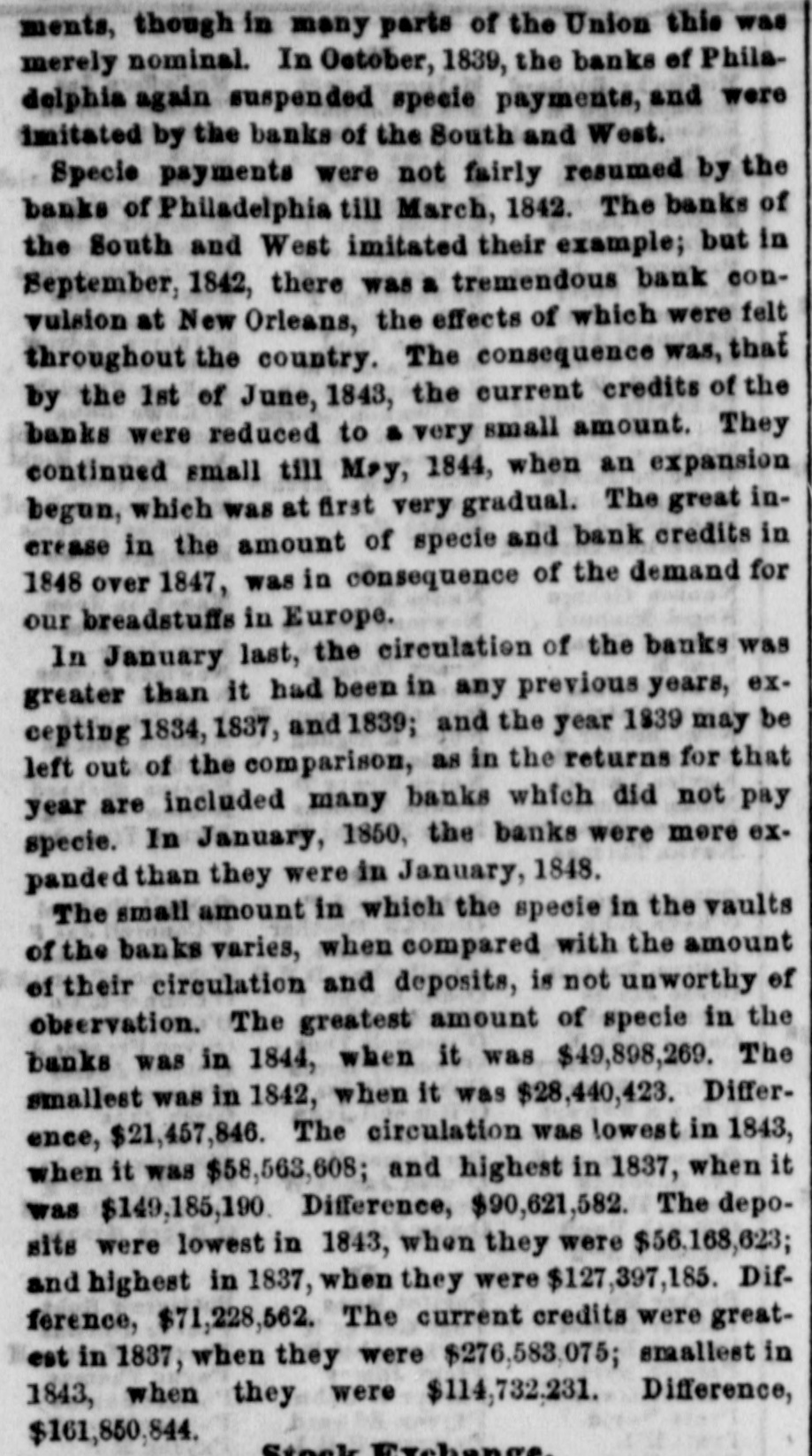
ments, though in many parts of the Union this was merely nominal. In October, 1839, the banks of Philadelphia again suspended specie payments, and were imitated by the banks of the South and West. Specie payments were not fairly resumed by the banks of Philadelphia till March, 1842. The banks of the South and West imitated their example; but in September, 1842, there was a tremendous bank convulsion at New Orleans, the effects of which were felt throughout the country. The consequence was, that by the 1st of June, 1843, the current credits of the banks were reduced to a very small amount. They continued small till May, 1844, when an expansion begun, which was at first very gradual. The great increase in the amount of specie and bank credits in 1848 over 1847, was in consequence of the demand for our breadstuffs in Europe. In January last, the circulation of the banks was greater than it had been in any previous years, excepting 1834, 1837, and 1839; and the year 1839 may be left out of the comparison, as in the returns for that year are included many banks which did not pay specie. In January, 1850, the banks were more expanded than they were in January, 1848. The small amount in which the specie in the vaults of the banks varies, when compared with the amount of their circulation and deposits, is not unworthy of observation. The greatest amount of specie in the banks was in 1844, when it was $49,898,269. The smallest was in 1842, when it was $28,440,423. Difference, $21,457,846. The circulation was lowest in 1843, when it was $58,563,608; and highest in 1837, when it was $149,185,190. Difference, $90,621,582. The deposits were lowest in 1843, when they were $56.168,623; and highest in 1837, when they were $127,397,185. Difference, $71,228,562. The current credits were greatest in 1837, when they were $276,583,075; smallest in 1843, when they were $114,732.231. Difference, $161,850,844. Stock Exchange.