19192. Puget Sound Loan Trust & Banking Company (Bellingham, WA)

Bank Information

Episode Type
Run โ†’ Suspension โ†’ Closure
Bank Type
private
Start Date
July 29, 1893
Location
Bellingham, Washington (48.760, -122.488)

Metadata

Model
gpt-5-mini
Short Digest
1b7d1a6ffa113490

Response Measures

None

Description

Articles describe an initial run/constant withdrawals and suspension on 1893-07-29, a receivership and prolonged receivership with restructuring and a reopening under new management (reopened late Nov 1894), followed by another run/heavy withdrawals and suspension on 1895-11-22 with a receiver/temporary receiver appointed. The final 1895 suspension appears to close the bank again (Whatcom is again without a bank). Causes: initial failure due to inability to realize on securities (bank-specific bad assets/insider loans); the 1895 failure was precipitated by heavy withdrawals after other local banks suspended (local_banks).

Events (9)

1. July 29, 1893 Receivership
Newspaper Excerpt
Comptroller...appointed Frank H. Richards as receiver... (articles refer to Richards as receiver and later reports).
Source
newspapers
2. July 29, 1893 Run
Cause
Bank Specific Adverse Info
Cause Details
Constant withdrawals driven by inability to realize on securities and heavy withdrawals over prior sixty days; institution carried doubtful paper and loans to insiders.
Measures
Posted notice of temporary suspension; receiver appointed (Frank H. Richards).
Newspaper Excerpt
Owing to the constant withdrawals of deposits and inability to realize on securities this bank has suspended temporarily.
Source
newspapers
3. July 29, 1893 Suspension
Cause
Bank Specific Adverse Info
Cause Details
Temporary suspension due to heavy withdrawals and inability to realize on securities; bank carried large bills receivable and loans to directors/stockholders.
Newspaper Excerpt
The following notice was posted on the doors of the Puget Sound Loan, Trust and Bank Company: 'Owing to the constant withdrawals of deposits and inability to realize on securities this bank has suspended temporarily.'
Source
newspapers
4. November 27, 1894 Other
Newspaper Excerpt
The bank will reopen for business next Monday under very favorable conditions...sufficient funds have been secured to pay all demand claims and have an ample surplus for the transaction of a conservative business.
Source
newspapers
5. November 27, 1894 Reopening
Newspaper Excerpt
Patch ... says the bank will reopen for business next Monday under very favorable conditions ... sufficient funds have been secured to pay all demand claims ... demand claims will be paid in installments under agreement with creditors.
Source
newspapers
6. November 22, 1895 Receivership
Newspaper Excerpt
He (L. L. Work) has been appointed temporary receiver, and if appointed permanent receiver he has offered to do the work for the same salary... (article describes temporary receiver).
Source
newspapers
7. November 22, 1895 Run
Cause
Local Banks
Cause Details
Heavy withdrawals triggered by suspensions of nearby banks (Bellingham Bay and Bennett National), producing inability to meet upcoming claims.
Measures
Posted notice of suspension; temporary receiver appointed (L. L. Work reported as temporary receiver).
Newspaper Excerpt
The failure was due to heavy withdrawals since the suspension of the Bellingham Bay and Bennett National banks two weeks ago...
Source
newspapers
8. November 22, 1895 Suspension
Cause
Local Banks
Cause Details
Suspension attributed to heavy withdrawals following the suspension of other local banks and inability to meet claims due Nov 27.
Newspaper Excerpt
The Puget Sound Loan, Trust & Banking Co. posted a notice of suspension this morning. The total liabilities are $58,000; nominal assets $176,000.
Source
newspapers
9. October 21, 1896 Other
Newspaper Excerpt
Expert examination of the books of the Puget Sound Loan & Banking company ... Will A. Langdon, formerly bookkeeper, was arrested ... on a charge of embezzlement; report shows astonishing irregularities.
Source
newspapers

Newspaper Articles (20)

Article from The Morning Call, July 30, 1893

Click image to open full size in new tab

Article Text

whv credit should not be sound. "No nation." said Harter, "bas ever successfully carried on business under two standards. PORTLAND'S TROUBLE. Three More Banks Fail to Open Their Doors. PORTLAND, Or., July 29.-Three banks failed to open their doors this morning. They were the Commercial National, Portland Savings and Ainsworth National. With the exception of a slight run on the First National there is no excitement. A notice posted on each of the suspended banks says the banks were forced to temporarily suspend, owing to the heavy withdrawal of deposits during the last sixty days and inability to realize on seourities. Dopositors will be paid in full. The Commercial National Bank has a paid-up capital stock of $250,000. Frank Dekum is president. The Portland Savings Bank is under the same management. L. L. Hawkins is president of the Alosworth National, which has a capital stock of $100,000. The statement of the Commercial National and Ainsworth National published July 12, shows the resources as follows: Commercial, $1,950,000; Ainsworth, $687.000. Deposits Commercial, $1,450,000; Ainsworth, $447,000. The Ainsworth National is a United States depository. No statement is yet made of the condition of the Portland Savings Bank. It has a capital stock of $260.000. with a surplus of $202,000. At the closing hour the situation was quiet, all other banks having stood the run. At each of the suspended banks a police officer is stationed to prevent any disorder. Small groups of men are standing on the streets discussing the situation, but there is no sign of any violence. All the three banks which were closed to-day are considered among the strongest in the city and depositors appear to have no fear of losing a cent. It is probable that all three banks will resume in a few days. On account of it being the end of the week most of the banks paid out more than was received. The Merchants' National, where the run occurred yesterday, received deposits in excess of the money paid out. J. Lowenberg, president of the Merchants', yesterday hypothecated all his real property in the city, and is said to have secured $200,000 in cash. This restored confidence and many persons drew their money from other banks and deposited it there. D. P. Thompson was appointed receiver of the Portland Savings Bank this afternoon. The statement of this bank shows resources estimated at $2,950,000. which 18 considered a conservative estimate. Its liabilities are placed at $2,475,000. During the last sixty days there has been a shrinkage of $600,000. while $800,000 has been withdrawn from the Commercial National during the same period. The Commercial National paid out $100,000 yesterday. A small bank at Forest Grove has closed owing to the Commercial National's suspension. The statement of the Union Banking Company, which closed yesterday. shows assets of $98,000 with liabilities of $53,000. The city has a claim for $13,000 and is the principal creditor. YOUNGSTOWN, Ohio, July 29.-As a.result of malicious rumors 8 run was started on the Dollar Savings and Trust Company this morning. The bank required legal notice, and not a dollar was paid out. It has wealthy stockholders. A number of merchants withdrew large sums from other banks and deposited with it, allaying the excitement. KANKAKEE, III., July 29.-The First National Bank failed this morning. The assets are sufficient to pay depositors in full. AKRON. Ohio, July 29-The Citizens' Savings and Loan Association failed this morning. It will pay in full. Capital, $100,000; surplus, $80,000. NEW WHATCOM, Wash., July 29.-This morning the following notice was posted on the doors of the Puget Sound Loan, Trust and Bank Company: "Owing to the constant withdrawals of deposits and inability to realize on securities this bank has suspended temporarily." The bank was incorporated under the State laws In 1890. with a capital stock of $125,000. The liabilities are $50,000 and the assets $200,000. WASHINGTON, July 29.-Comptroller Eckels appointed Louis C. Phelps receiver of the Merchants' National Bank of Great Falls, Mont. EAU CLAIRE, Wis., July 29.-The Commercial Bank, capital $50,000, was placed in the hands of a receiver to-day. President Allen said: "We calculate that the depositors will not lose a dollar." There were light runs on other banks. BOSTON. July 29.-A special from Manchester, N. H., says: Disclosures to-day tend to show that Cashier Morrell knew the worst and ran away rather than face the music. A director stated that in addition to the $60,000 of doubtful paper thrown out of the Derryfield Savings Bank, there is from $10,000 to $18,000 due depositors. It is now thought the deficiency in the bank mav go to $100,000. Rich Red Blood
Article from Capital Journal, July 31, 1893

Click image to open full size in new tab

Article Text

PACIFIC COAST NEWS. UNION, Or., July 31.-An accident occurred at the Oregon Roller mills in this city in which Lion Philips, an 8year-old boy, lost his life. He was going through the mill alone, having no particular business excepta desire to be around the machinery. The head miller was on the third floor when he heard two dull thuds. On descending to the second floor the lifeless form of the boy was lying on the floor with bis skull crushed in and his body otherwise fearfully mangled. Ascension school building at the Cove, six miles north of here, was destroyed by fire this morning. ASTORIA, July 31.-John Hausen has confessed that he murdered his wife at Bear creek, six miles from here, last Wednesday. He acknowledged that he killed her in order to secure money which she had under lock and key. He killed the woman with a club and took the keys but did not find the money. Hansen has been in jail since Thursday and the sheriff received word from the upper town that a mob of Finus and Scandanavians had gathered and were only waiting a leader to assail the jail and lynch Hansen. FOREST GROVE, July 31.-Today the contract for constructing the new col lege building was let. The contract was awarded Messrs. Hobkirk & Mackenzie for $50,000. DENVER, July 31.-It is reported that the Standard Oil company is again in control in Colorado, having absorbed its rival, the Rock Mountain Oil company. The cost is $1,000,000. NEW WHATCOM, July 31.-The fullowing notice was posted on the doors of the Puget Sound Loan, Trust & Bank Co: "Owing to coustant withdrawals of deposits and the inability to realize on securities, the bank suspended temporarily." The bank was incorporated under the state laws of 1890 with a cape ital stockjof $125,000. The liabilities are $50,000; assets 200,000.


Article from The Sun, July 31, 1893

Click image to open full size in new tab

Article Text

A Loan and Trust Bank Suspends. NEW WHATCOM. Wash.. July 30.-The following notice was posted yesterday on the doors of the Puget Sound Loan. Trust and Banking Company: "Owing to constant withdrawals of deposits and inability to realize on securities, this bank has suspended temporarily." It was capitalized at $125,000; liabilities $50,000; assets, $200,000.


Article from The Seattle Post-Intelligencer, September 27, 1893

Click image to open full size in new tab

Article Text

The Whatcom Boodlers. WHATCOM, Sept. 26.-{Special.]-Ex.Clerk and Marshal Meintosh, for whose arrest on charges of embezziement a warrant has been issued, wires his attorneys here from Oakland wharf, California, that he has heard of the complaint and "will take the next train home." He has been visiting friends in Los Angeles. The citizens' bond of $130,000 to replevin the property transferred by ex-Trensurer Isensee to his bondsmen has been completed and a writ issued. At the meeting of the city council last evening the city attorney was directed to prepare an ordinance making general fund warrants legal tender for the payment of city taxes. The council will sit as a board of equalization next Monday evening. F? Christman, the accountant who was employed for several months in making an examination of the books of the varlous city offices, and who has been bitterly assailed by the evening paper, has been appointed city auditor and deputy clerk. The city attorney has been authorized by the council to employ such legal assistance as he may consider necessary to test the legality of the ex-treasurer's claims to certain large commissions and to assist in collecting or endeavoring to collect the large sum of public money for which the ex-treasurer fails to account. The receivers of the Puget Sound Loan, Trust and Banking Company and the Columbia National bank have informed the finance committee of the council that the defaulting treasurer never had any money in those institutions to the credit of thecity of Whatcom. Receiver Richards, of the Puget Sound bank, however, states that the city has credits there as follows: Funding account, city of New Whate om, $7,084.33; Whatcom, $275.37; refunding bonds, series No. 1, $4,000; No.2, $1,000; all held subject to the orders of the council.


Article from The Seattle Post-Intelligencer, December 13, 1893

Click image to open full size in new tab

Article Text

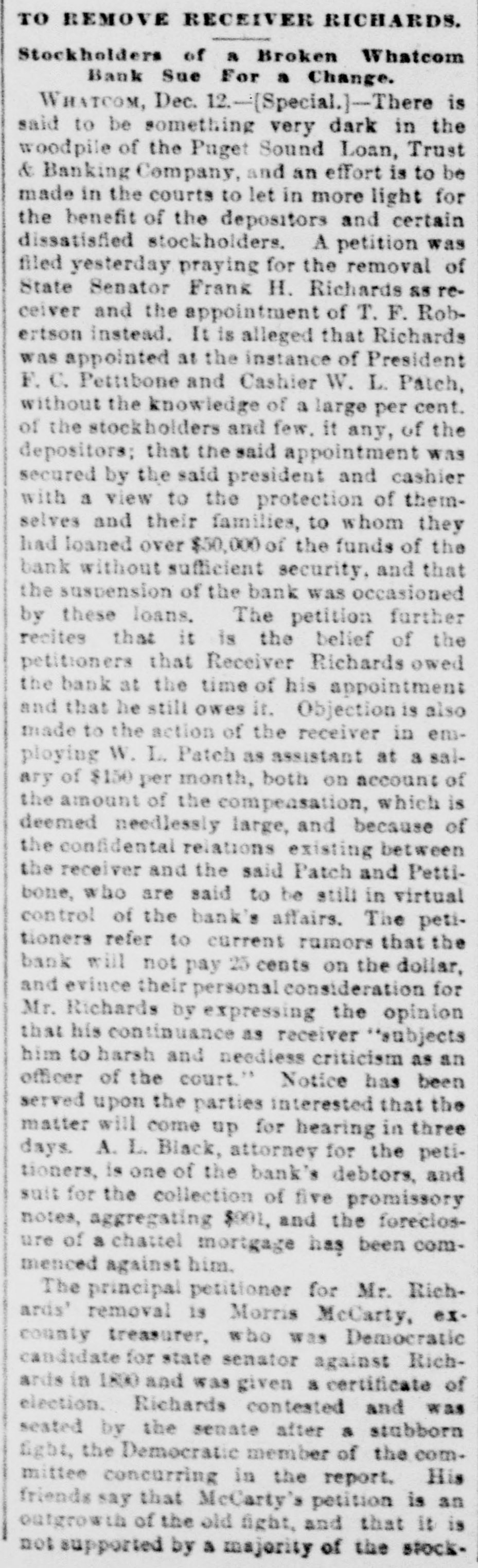
TO REMOVE RECEIVER RICHARDS. Stockholders of a Broken Whatcom Bank Sue For a Change. WHATCOM, Dec. 12.-(Special.)-There is said to be something very dark in the woodpile of the Puget Sound Loan, Trust & Banking Company, and an effort is to be made in the courts to let in more light for the benefit of the depositors and certain dissatisfied stockholders. A petition was filed yesterday praying for the removal of State Senator Frank H. Richards as receiver and the appointment of T. F. Robertson instead. It is alleged that Richards was appointed at the instance of President F. C. Pettibone and Cashier W. L. Patch, without the knowledge of a large per cent. of the stockholders and few. it any, of the depositors: that the said appointment was secured by the said president and cashier with a view to the protection of themselves and their families, to whom they had loaned over $50,000 of the funds of the bank without sufficient security, and that the suspension of the bank was occasioned by these loans. The petition further recites that it is the belief of the petitioners that Receiver Richards owed the bank at the time of his appointment and that he still owes it. Objection is also made to the action of the receiver in employing W. L. Patch as assistant at a salary of $150 per month, both on account of the amount of the compensation, which is deemed needlessly large, and because of the confidental relations existing between the receiver and the said Patch and Pettibone, who are said to be still in virtual control of the bank's affairs. The petitioners refer to current rumors that the bank will not pay 25 cents on the dollar, and evince their personal consideration for Mr. Richards by expressing the opinion that his continuance as receiver "subjects him to harsh and needless criticism as an officer of the court." Notice has been served upon the parties interested that the matter will come up for hearing in three days. A. L. Black, attorney for the petitioners, is one of the bank's debtors, and suit for the collection of five promissory notes, aggregating $901, and the foreclosure of a chattel mortgage has been commenced against him. The principal petitioner for Mr. Richards' removal is Morris McCarty, excounty treasurer, who was Democratic candidate for state senator against Richands in 1800 and was given a certificate of election. Richards contested and was seated by the senate after a stubborn fight, the Democratic member of the committee concurring in the report. His friends say that McCarty's petition is an outgrowth of the old fight, and that it is not supported by a majority of the stock-


Article from The Seattle Post-Intelligencer, December 19, 1893

Click image to open full size in new tab

Article Text

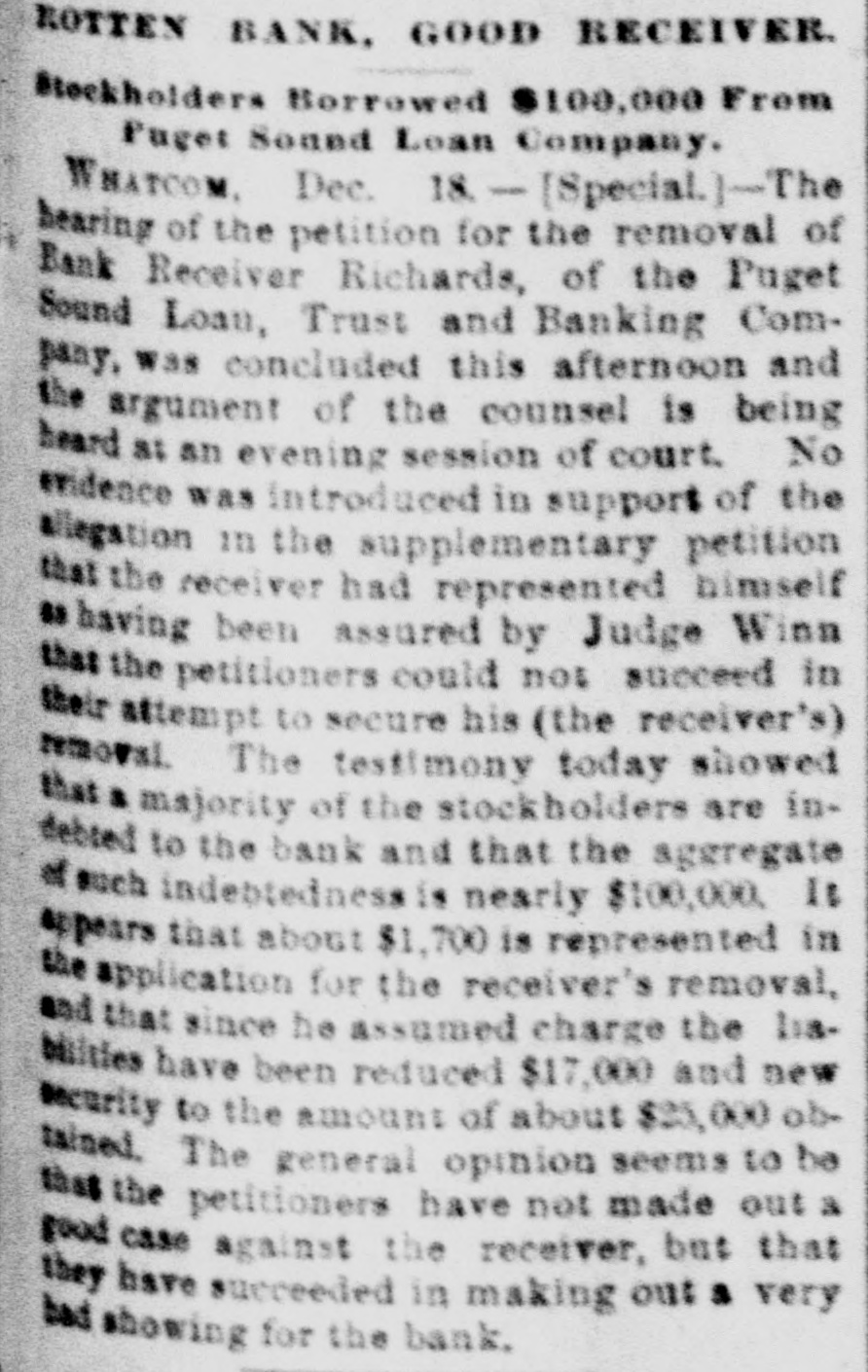
ROTTEN BANK, GOOD RECEIVER. #tockholders Borrowed $100,000 From Puget Sound Loan Company. WHATCOM. Dec. 18. - [Special.]-The hearing of the petition for the removal of Bank Receiver Richards, of the Puget Sound Loan, Trust and Banking Company, was concluded this afternoon and the argument of the counsel is being heard at an evening session of court. No evidence was introduced in support of the allegation in the supplementary petition that the receiver had represented himself as having been assured by Judge Winn that the petitioners could not succeed in their attempt to secure his (the receiver's) removal. The testimony today showed that a majority of the stockholders are indebted to the bank and that the aggregate of such indeptedness is nearly $100,000. It pears that about $1,700 is represented in the application for the receiver's removal, and that since he assumed charge the habilities have been reduced $17,000 and new occurity to the amount of about $25,000 obtained. The general opinion seems to be that the petitioners have not made out a good case against the receiver, but that they have succeeded in making out a very bad showing for the bank.


Article from The Seattle Post-Intelligencer, December 29, 1893

Click image to open full size in new tab

Article Text

Receiver Richards Resigns. WHATCOM, Dec. 28.-[Special.]-Hon, Frank H. Richards has tendered bis resignation as receiver of the Puget Sound Loan, Trust and Banking Company, and his report will be presented to the court Saturday. Hon. George A. Black, of Fairhaven, has been appointed to succeed him.


Article from The Seattle Post-Intelligencer, January 7, 1894

Click image to open full size in new tab

Article Text

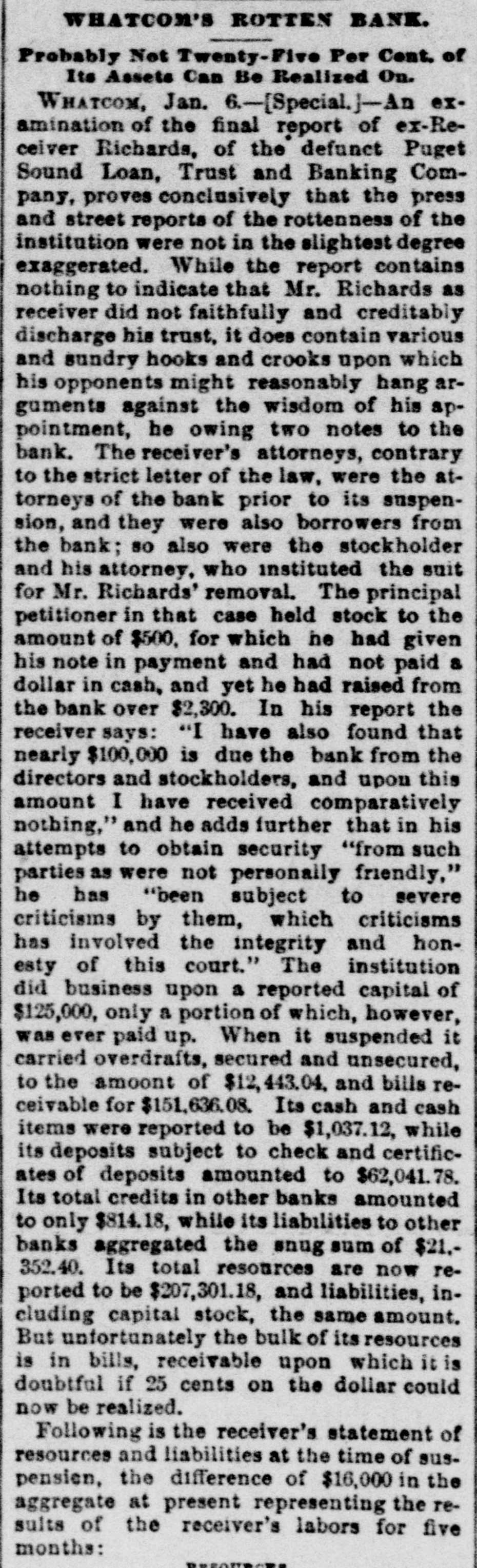
WHATCOM'S ROTTEN BANK. Probably Not Twenty-Five Per Cent. of Its Assets Can Be Realized On. WHATCOM, Jan. 6.-[Special.]-An examination of the final report of ex-Receiver Richards, of the defunct Puget Sound Loan, Trust and Banking Company, proves conclusively that the press and street reports of the rottenness of the institution were not in the slightest degree exaggerated. While the report contains nothing to indicate that Mr. Richards as receiver did not faithfully and creditably discharge his trust, it does contain various and sundry hooks and crooks upon which his opponents might reasonably hang arguments against the wisdom of his appointment, he owing two notes to the bank. The receiver's attorneys, contrary to the strict letter of the law, were the attorneys of the bank prior to its suspension, and they were also borrowers from the bank; so also were the stockholder and his attorney, who instituted the suit for Mr. Richards' removal. The principal petitioner in that case held stock to the amount of $500, for which he had given his note in payment and had not paid a dollar in cash, and yet he had raised from the bank over $2,300. In his report the receiver says: "I have also found that nearly $100,000 is due the bank from the directors and stockholders, and upon this amount I have received comparatively nothing," and he adds further that in his attempts to obtain security "from such parties as were not personally friendly," he has "been subject to severe criticisms by them, which criticisms has involved the integrity and honesty of this court." The institution did business upon a reported capital of $125,000, only a portion of which, however, was ever paid up. When it suspended it carried overdrafts, secured and unsecured, to the amoont of $12,443.04. and bills receivable for $151,636.08. Its cash and cash items were reported to be $1,037.12, while its deposits subject to check and certificates of deposits amounted to $62,041.78. Its total credits in other banks amounted to only $814.18, while its liabilities to other banks aggregated the snug sum of $21.352.40. Its total resources are now reported to be $207,301.18, and liabilities, including capital stock, the same amount. But unfortunately the bulk of its resources is in bills, receivable upon which it is doubtful if 25 cents on the dollar could now be realized. Following is the receiver's statement of resources and liabilities at the time of suspension, the difference of $16,000 in the aggregate at present representing the results of the receiver's labors for five months:


Article from The Seattle Post-Intelligencer, January 11, 1894

Click image to open full size in new tab

Article Text

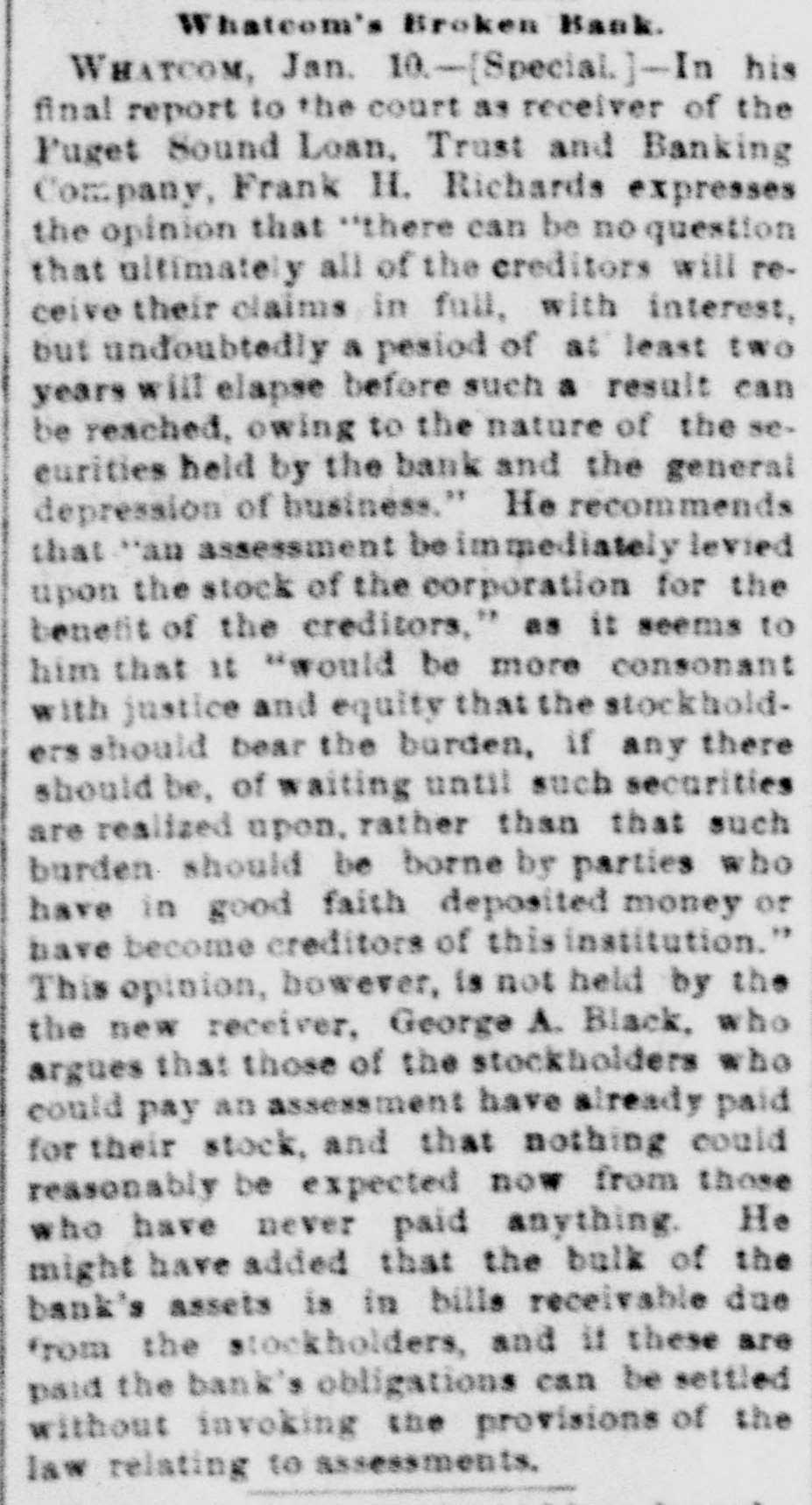
Whatcom's Broken Bank. WHATCOM, Jan. 10.-[Special.]-In his final report to the court as receiver of the Puget Sound Loan, Trust and Banking Company, Frank H. Richards expresses the opinion that "there can be no question that ultimately all of the creditors will receive their claims in full, with interest, but undoubtedly a pesiod of at least two years will elapse before such a result can be reached, owing to the nature of the seeurities held by the bank and the general depression of business." He recommends that "an assessment be immediately levied upon the stock of the corporation for the benefit of the creditors," as it seems to him that it "would be more consonant with justice and equity that the stockholders should bear the burden, if any there should be, of waiting until such securities are realized upon, rather than that such burden should be borne by parties who have in good faith deposited money or have become creditors of this institution." This opinion, bowever, is not held by the the new receiver, George A. Black, who argues that those of the stockholders who could pay an assessment have already paid for their stock, and that nothing could reasonably be expected now from those who have never paid anything. He might have added that the bulk of the bank's assets is in bills receivable due from the stockholders, and it these are paid the bank's obligations can be settled without invoking the provisions of the law relating to assessments.


Article from The Seattle Post-Intelligencer, February 12, 1894

Click image to open full size in new tab

Article Text

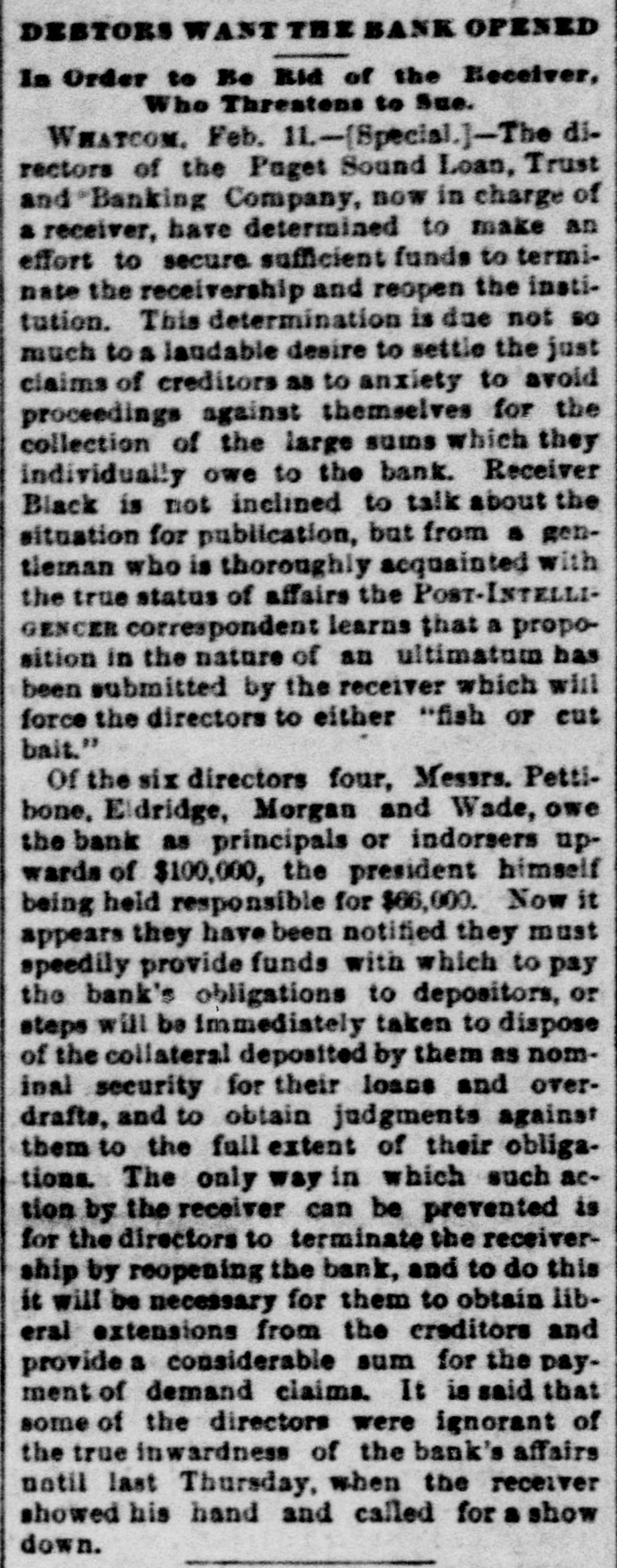
DESTORS WANT THE BANK OPENED Is Order to Be Rid of the Receiver, Who Threatens to Sue. WHATCOM. Feb. 11.-{Special.]-The directors of the Paget Sound Loan, Trust and Banking Company, now in charge of a receiver, have determined to make an effort to secure. sufficient funds to terminate the receivership and reopen the institution. This determination is due not so much to a laudable desire to settle the just claims of creditors as to anxiety to avoid proceedings against themselves for the collection of the large suins which they individually owe to the bank. Receiver Black is not inclined to talk about the situation for publication, but from a gentieman who is thoroughly acquainted with the true status of affairs the POST-INTELLIGENCER correspondent learns that a proposition in the nature of an ultimatum has been submitted by the receiver which will force the directors to either "fish or cut bait." Of the six directors four, Messrs. Pettibone, Eldridge, Morgan and Wade, owe the bank as principals or indorsers upwards of $100,000, the president himself being held responsible for $66,000. Now it appears they have been notified they must speedily provide funds with which to pay the bank's obligations to depositors, or steps will be immediately taken to dispose of the collateral deposited by them as nominal security for their loans and overdrafts, and to obtain judgments against them to the full extent of their obligations. The only way in which such action by the receiver can be prevented is for the directors to terminate the receivership by reopening the bank, and to do this it will be necessary for them to obtain liberal extensions from the creditors and provide a considerable sum for the payment of demand claims. It is said that some of the directors were ignorant of the true inwardness of the bank's affairs notil last Thursday, when the receiver showed his hand and called for a show down.


Article from The Seattle Post-Intelligencer, February 15, 1894

Click image to open full size in new tab

Article Text

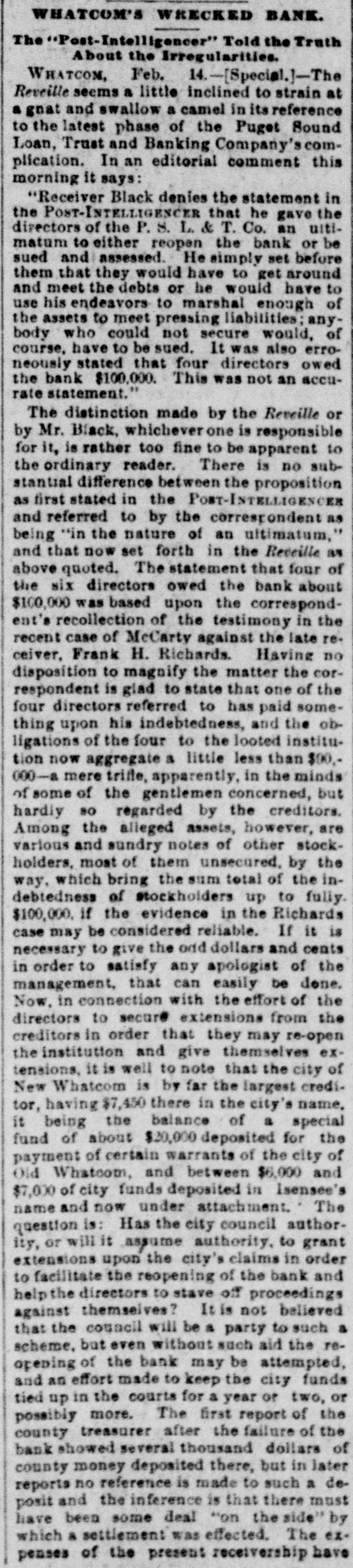
WHATCOM'S WRECKED BANK. The PPost-Intelligencer" Told the Truth About the Irregularities. WHATCON, Feb. 14.-[Special.]-The Reveille seems a little inclined to strain at a gnat and swallow a camel in its reference to the latest phase of the Puget Sound Loan, Trust and Banking Company's complication. In an editorial comment this morning it says: "Receiver Black denies the statement in the PosT-INTELLIGENCER that he gave the directors of the P. 8. L. & T. Co. an ultimatum to either reopen the bank or be sued and assessed. He simply set before them that they would have to get around and meet the debts or he would have to use his endeavors to marshal enough of the assets to meet pressing liabilities: anybody who could not secure would, of course, have to be sued. It was also erroneously stated that four directors owed the bank $100,000. This was not an accurate statement." The distinction made by the Reveille or by Mr. Black, whichever one is responsible for it, is rather too fine to be apparent to the ordinary reader. There is no substantial difference between the proposition as first stated in the POsT-ISTELLIGENCER and referred to by the correspondent as being "in the nature of an ultimatum," and that now set forth in the Receille as above quoted. The statement that four of the six directors owed the bank about $100,000 was based upon the correspondent's recollection of the testimony in the recent case of McCarty against the late receiver. Frank H. Richards. Having no disposition to magnify the matter the correspondent is glad to state that one of the four directors referred to has paid something upon his indebtedness, and the obligations of the four to the looted institution now aggregate a little less than $00.000-a mere trifle, apparently, in the minds of some of the gentlemen concerned, but hardly so regarded by the creditors. Among the alleged assets, however, are various and sundry notes of other stockholders, most of them unsecured, by the way, which bring the sum total of the indebtedness of stockholders up to fully. $100,000. if the evidence in the Richards case may be considered reliable. If it is necessary to give the odd dollars and cents in order to satisfy any apologist of the management, that can easily be done. Now. in connection with the effort of the directors to secure extensions from the creditors in order that they may re-open the institution and give themselves extensions, it is well to note that the city of New Whatcom is by far the largest creditor, having $7,450 there in the city's name, it being the balance of a special fund of about $20,000 deposited for the payment of certain warrants of the city of Old Whatoom, and between $6,000 and $7,000 of city funds deposited in lisensee's name and now under attachment. The question is: Has the city council authority, or will it assume authority. to grant extensions upon the city's claims in order to facilitate the reopening of the bank and help the directors to stave off proceedings against themselves? It i not believed that the council will be a party to such a scheme, but even without such aid the reopening of the bank may be attempted, and an effort made to keep the city funds tied up in the courts for a year or two, or possibly more. The first report of the county treasurer after the failure of the bank showed several thousand dollars of county money deposited there, but in later reports no reference is made to such a deposit and the inference is that there must have been some deal "on the side" by which a settlement was effected. The expenses of the present receivership have


Article from The Seattle Post-Intelligencer, February 18, 1894

Click image to open full size in new tab

Article Text

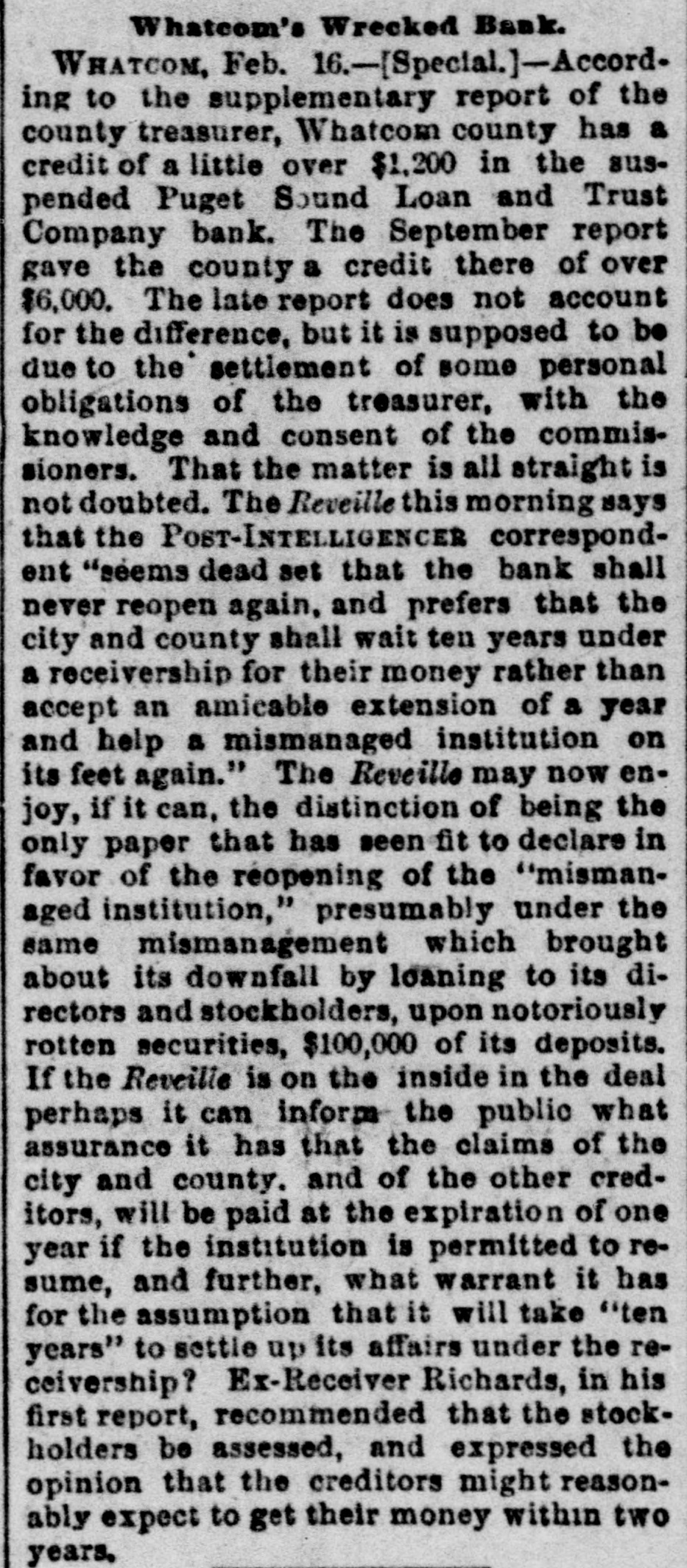
Whatcom's Wrecked Bank. WHATCOM, Feb. 16.-[Special.]-Aceord ing to the supplementary report of the county treasurer, Whatcom county has a credit of a little over $1,200 in the suspended Puget Sound Loan and Trust Company bank. The September report gave the county a credit there of over $6,000. The late report does not account for the difference, but it is supposed to be due to the' settlement of some personal obligations of the treasurer, with the knowledge and consent of the commissioners. That the matter is all straight is not doubted. The Reveille this morning says that the POST-INTELLIGENCER correspondent "seems dead set that the bank shall never reopen again, and prefers that the city and county shall wait ten years under a receivership for their money rather than accept an amicable extension of a year and help a mismanaged institution on its feet again." The Reveillo may now enjoy, if it can, the distinction of being the only paper that has seen fit to declare in favor of the reopening of the "mismanaged institution," presumably under the same mismanagement which brought about its downfall by loaning to its directors and stockholders, upon notoriously rotten securities, $100,000 of its deposits. If the Reveille is on the inside in the deal perhaps it can inform the public what assurance it has that the claims of the city and county. and of the other creditors, will be paid at the expiration of one year if the institution is permitted to resume, and further, what warrant it has for the assumption that it will take "ten years" to settle up its affairs under the receivership? Ex-Receiver Richards, in his first report, recommended that the stockholders be assessed, and expressed the opinion that the creditors might reasonably expect to get their money within two years.


Article from The Seattle Post-Intelligencer, May 17, 1894

Click image to open full size in new tab

Article Text

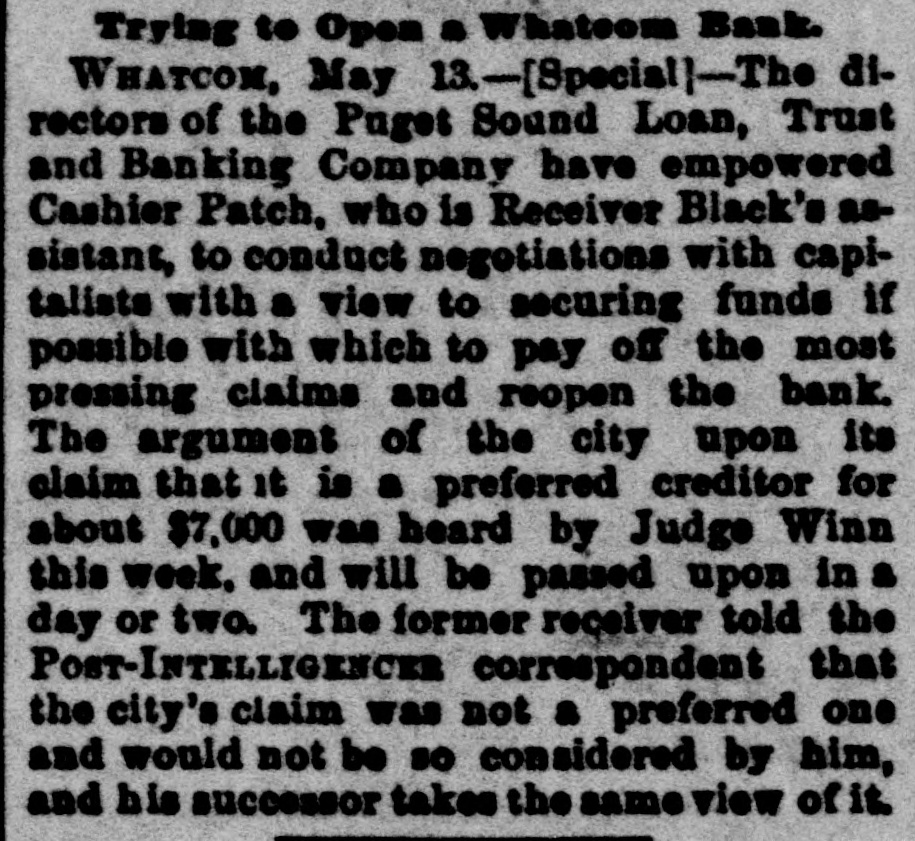
Trying to Open a Whatoom Bank. WHATCOM, May 13.-[Special]-The directors of the Puget Sound Loan, Trust and Banking Company have empowered Cashier Patch, who is Receiver Black's assistant, to conduct negotiations with capitalists with a view to securing funds if possible with which to pay off the most pressing claims and reopen the bank. The argument of the city upon its claim that it is a preferred creditor for about $7,000 was heard by Judge Winn this week, and will be passed upon in a day or two. The former receiver told the POST-INTELLIGENCER correspondent that the city's claim was not a preferred one and would not be so considered by him, and his successor takes the same view of it.


Article from The Seattle Post-Intelligencer, November 22, 1894

Click image to open full size in new tab

Article Text

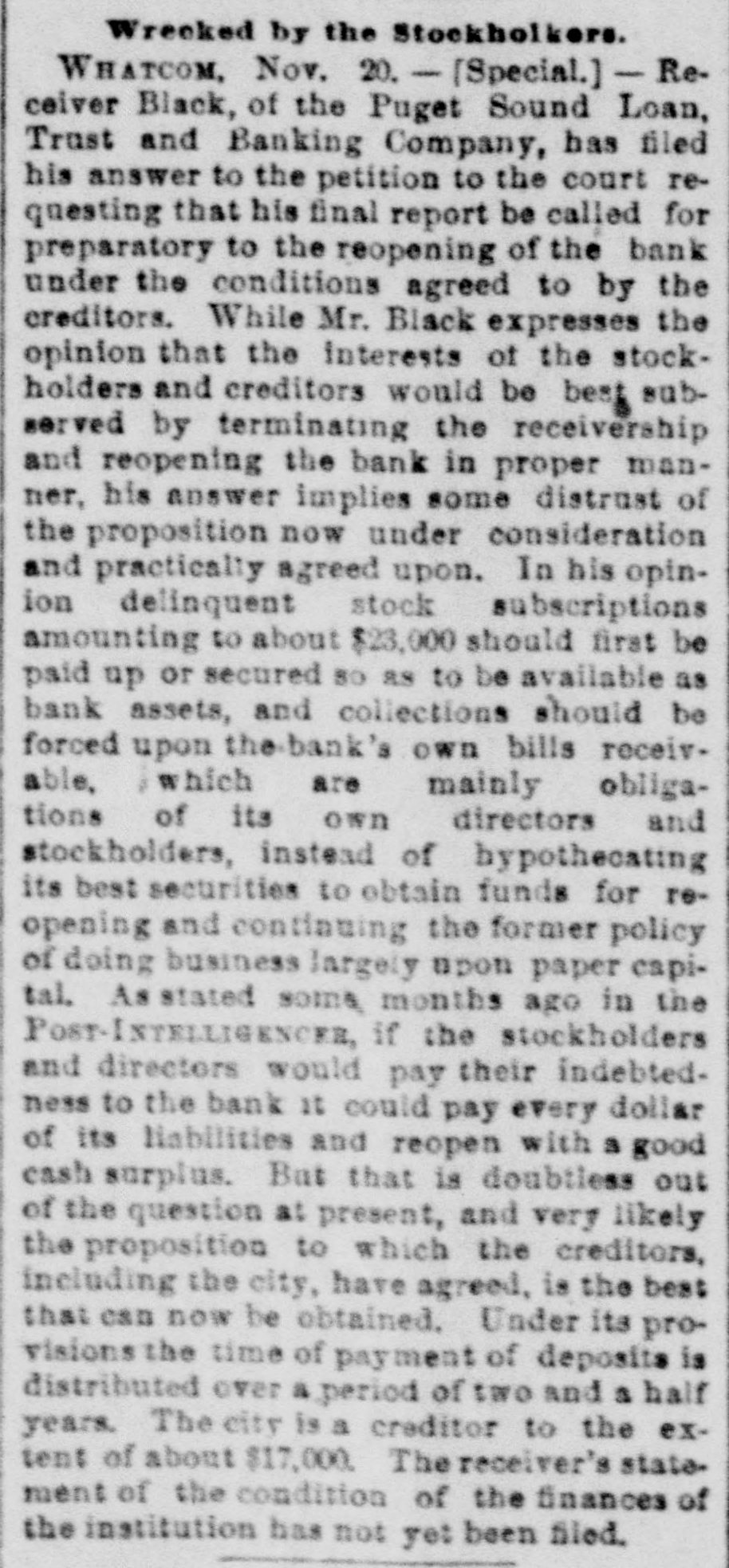
Wrecked by the Stockholkers. WHATCOM, Nov. 20. - [Special.] - Receiver Black, of the Puget Sound Loan, Trust and Banking Company, has filed his answer to the petition to the court requesting that his final report be called for preparatory to the reopening of the bank under the conditions agreed to by the creditors. While Mr. Black expresses the opinion that the interests of the stockholders and creditors would be best subserved by terminating the receivership and reopening the bank in proper manner, his answer implies some distrust of the proposition now under consideration and practically agreed upon. In his opinion delinquent stock subscriptions amounting to about $23,000 should first be paid up or secured 80 as to be available as bank assets, and collections should be forced upon the-bank's own bills receivable, which are mainly obligations of its own directors and stockholders, instead of hypothecating its best securities to obtain funds for reopening and continuing the former policy of doing business largely upon paper capital. As stated some months ago in the POST-INTELLIGENCER, if the stockholders and directors would pay their indebtedness to the bank it could pay every dollar of its liabilities and reopen with a good cash surplus. But that is doubtless out of the question at present, and very likely the proposition to which the creditors, including the city, have agreed, is the best that can now be obtained. Under its provisions the time of payment of deposits is distributed over a period of two and a half years. The city is a creditor to the extent of about $17,000. The receiver's state. ment of the condition of the finances of the institution has not yet been filed.


Article from The Seattle Post-Intelligencer, November 24, 1894

Click image to open full size in new tab

Article Text

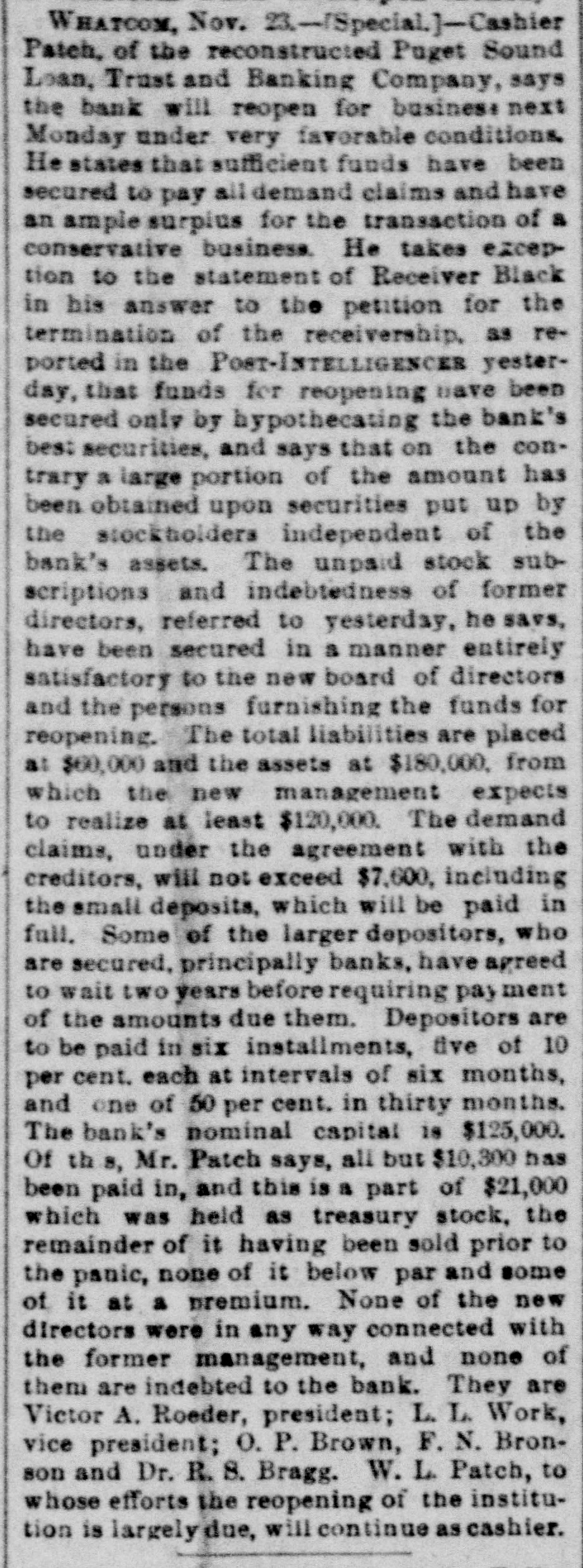
WHATCOM, Nov. 23.-7Special.]-Cs Patch, of the reconstructed Puget Sound Loan, Trust and Banking Company, says the bank will reopen for business next Monday under very favorable conditions, Hestates that sufficient funds have been secured to pay all demand claims and have an ample surpius for the transaction of a conservative business. He takes ezeeption to the statement of Receiver Black in his answer to the petition for the termination of the receivership, as reported in the PosT-INTELLIGENCER yesterday, that funds for reopening have been secured only by hypothecating the bank's best securities, and says that on the contrary a large portion of the amount has been obtained upon securities put up by the stockholders independent of the bank's assets. The unpaid stock subscriptions and indebtedness of former directors, referred to yesterday, he savs, have been secured in a manner entirely satisfactory to the new board of directors and the persons furnishing the funds for reopening. The total liabilities are placed at $60,000 and the assets at $180,000, from which the new management expects to realize at least $120,000. The demand claims, under the agreement with the creditors, will not exceed $7,600, including the small deposits, which will be paid in full. Some of the larger depositors, who are secured, principally banks, have agreed to wait two years before requiring pay ment of the amounts due them. Depositors are to be paid in six installments, dve of 10 per cent. each at intervals of six months, and one of 50 per cent. in thirty months. The bank's nominal capital is $125,000. Of th 8, Mr. Patch says, all but $10,300 has been paid in, and this is a part of $21,000 which was held as treasury stock, the remainder of it having been sold prior to the panic, none of it below par and some of it at a premium. None of the new directors were in any way connected with the former management, and none of them are indebted to the bank. They are Victor A. Roeder, president; L. L. Work, vice president; O. P. Brown, F. N. Bronson and Dr. R. 8. Bragg. W. L. Patch, to whose efforts the reopening of the institution is largely due, will continue as cashier.


Article from The Dalles Daily Chronicle, November 23, 1895

Click image to open full size in new tab

Article Text

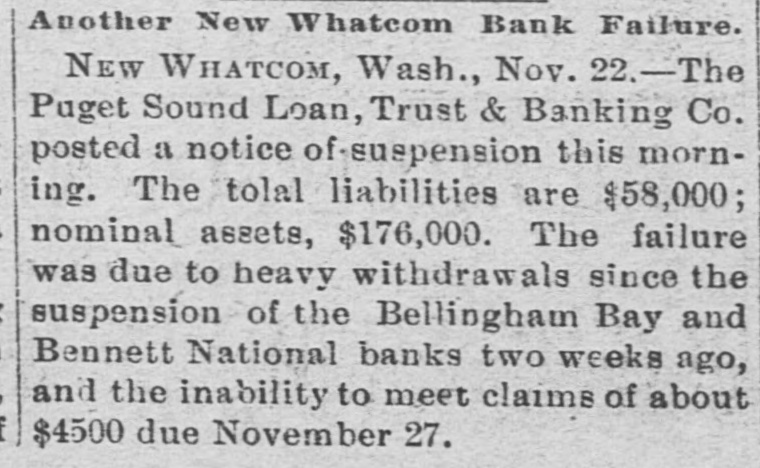
Another New Whatcom Bank Failure. NEW WHATCOM, Wash., Nov. 22.-The Puget Sound Loan, Trust & Banking Co. posted a notice of-suspension this morning. The tolal liabilities are $58,000; nominal assets, $176,000. The failure was due to heavy withdrawals since the suspension of the Bellingham Bay and Bennett National banks two weeks ago, and the inability to meet claims of about $4500 due November 27.


Article from The Seattle Post-Intelligencer, November 23, 1895

Click image to open full size in new tab

Article Text

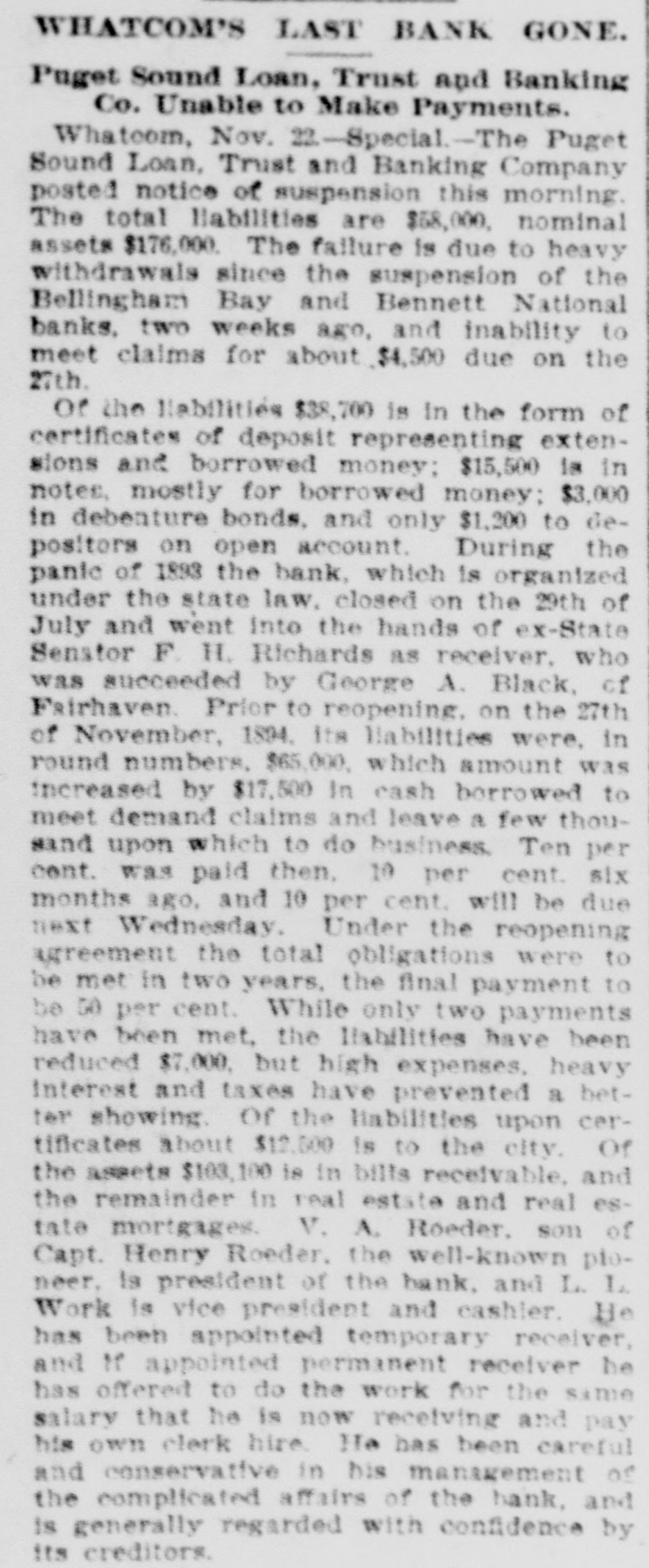
WHATCOM'S LAST BANK GONE. Puget Sound Loan, Trust and Banking Co. Unable to Make Payments. Whatoom, Nov. 22.-Special.-The Puget Sound Loan, Trust and Banking Company posted notice of suspension this morning. The total liabilities are $58,000, nominal assets $176,000. The failure is due to heavy withdrawals since the suspension of the Bellingham Bay and Bennett National banks, two weeks ago, and inability to meet claims for about $4,500 due on the 27th. or the liabilities $38,700 is In the form of certificates of deposit representing extensions and borrowed money; $15,500 is in notes, mostly for borrowed money; $3,000 in debenture bonds, and only $1,200 to depositors on open account. During the panic of 1893 the bank, which is organized under the state law. closed on the 29th of July and went into the hands of ex-State Senstor F. H. Richards as receiver. who was succeeded by George A. Black, of Fairhaven. Prior to reopening. on the 27th of November, 1894. its liabilities were, in round numbers, $65,000. which amount was increased by $17,500 In cash borrowed to meet demand claims and leave a few thousand upon which to do business. Ten per cent. was paid then, 10 per cent. six months ago, and 10 per cent. will be due next Wednesday. Under the reopening agreement the total obligations were to be met in two years, the final payment to be 50 per cent. While only two payments have been met, the liabilities have been reduced $7,000, but high expenses. heavy interest and taxes have prevented a betfor showing. Of the liabilities upon certificates about $12,500 is to the city. Of the assets $103,100 is in bills receivable, and the remainder in real estate and real estate mortgages. V. A, Roeder. son of Capt. Henry Roeder. the well-known pioneer, is president of the bank, and L. L. Work is vice president and cashier. He has been appointed temporary receiver, and If appointed permanent receiver he has offered to do the work for the same salary that he is now receiving and pay his own clerk hire. He has been careful and conservative in his management of the complicated affairs of the bank, and is generally regarded with confidence by its creditors.


Article from Aberdeen Herald, November 28, 1895

Click image to open full size in new tab

Article Text

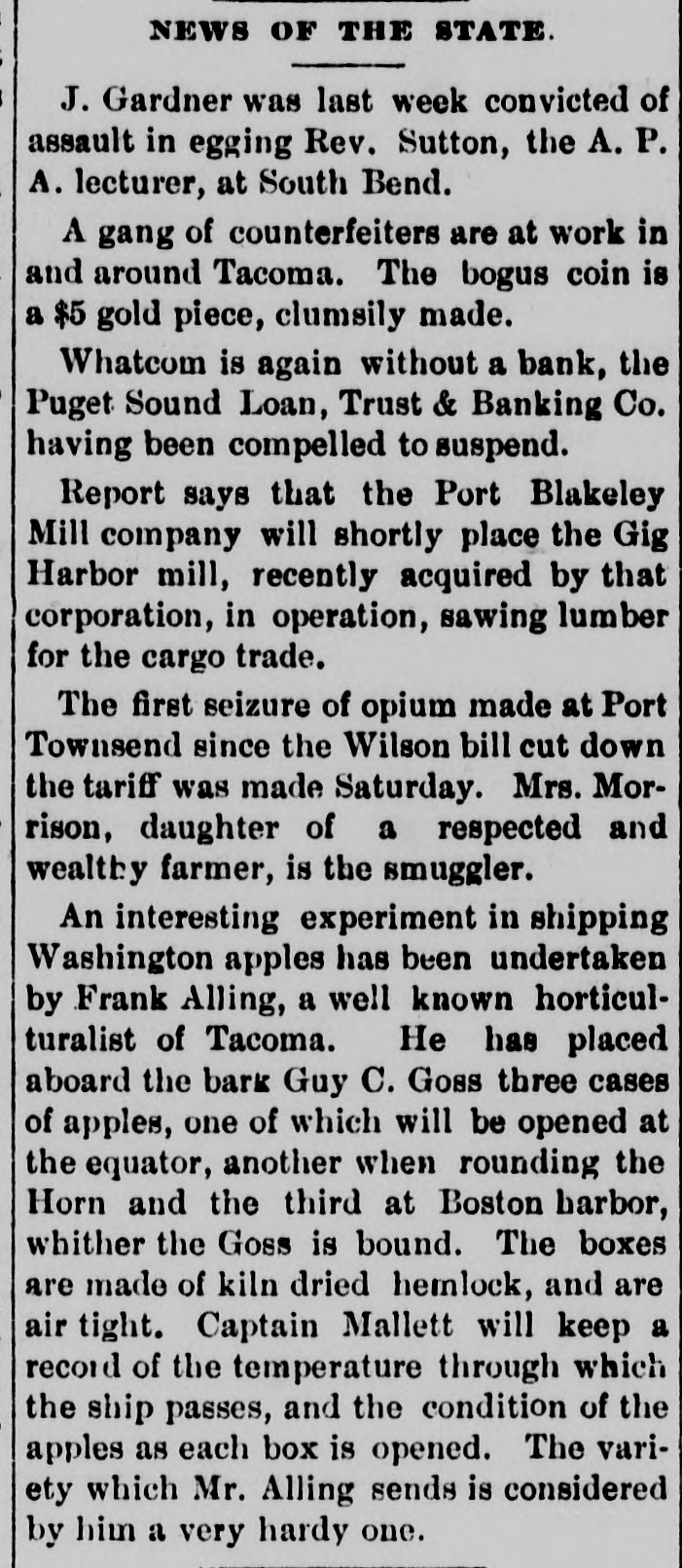
NEWS OF THE STATE. J. Gardner was last week convicted of assault in egging Rev. Sutton, the A. P. A. lecturer, at South Bend. A gang of counterfeiters are at work in and around Tacoma. The bogus coin is a $5 gold piece, clumsily made. Whatcom is again without a bank, the Puget Sound Loan, Trust & Banking Co. having been compelled to suspend. Report says that the Port Blakeley Mill company will shortly place the Gig Harbor mill, recently acquired by that corporation, in operation, sawing lumber for the cargo trade. The first seizure of opium made at Port Townsend since the Wilson bill cut down the tariff was made Saturday. Mrs. Morrison, daughter of a respected and wealthy farmer, is the smuggler. An interesting experiment in shipping Washington apples has been undertaken by Frank Alling, a well known horticulturalist of Tacoma. He has placed aboard the bark Guy C. Goss three cases of apples, one of which will be opened at the equator, another when rounding the Horn and the third at Boston harbor, whither the Goss is bound. The boxes are made of kiln dried hemlock, and are air tight. Captain Mallett will keep a record of the temperature through which the ship passes, and the condition of the apples as each box is opened. The variety which Mr. Alling sends is considered by him a very hardy one.


Article from The Anaconda Standard, October 22, 1896

Click image to open full size in new tab

Article Text

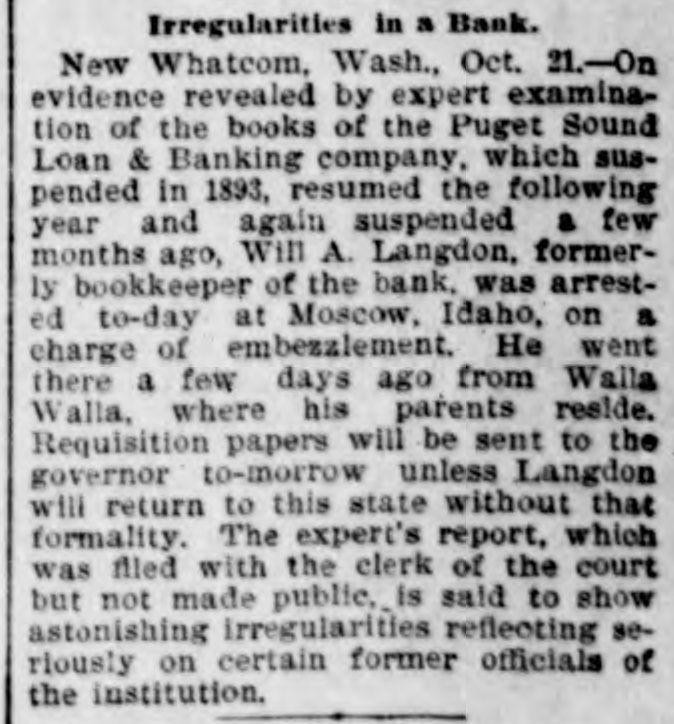
Irregularities in a Bank. New Whatcom, Wash., Oct. 21.-On evidence revealed by expert examination of the books of the Puget Sound Loan & Banking company, which suspended in 1893, resumed the following year and again suspended a few months ago, Will A. Langdon, formerly bookkeeper of the bank, was arrested to-day at Moscow, Idaho, on a charge of embezzlement. He went there a few days ago from Walla Walla, where his parents reside. Requisition papers will be sent to the governor to-morrow unless Langdon will return to this state without that formality. The expert's report, which was filed with the clerk of the court but not made public, is said to show astonishing irregularities reflecting seriously on certain former officials of the institution.


Article from The Seattle Post-Intelligencer, October 23, 1896

Click image to open full size in new tab

Article Text

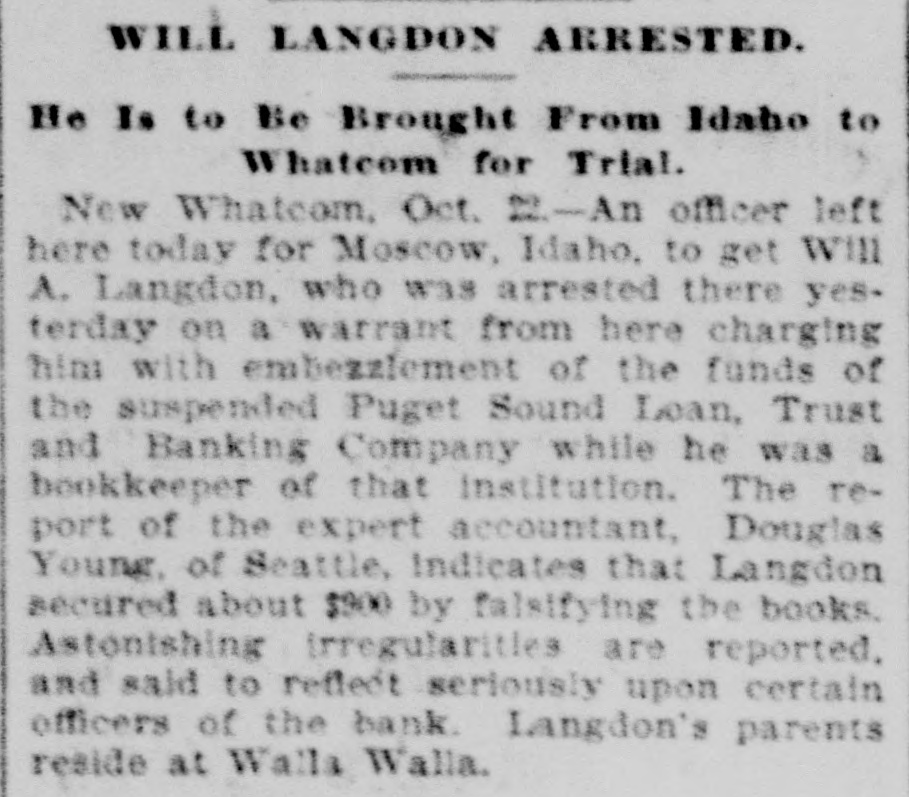
WILL LANGDON ARRESTED. He Is to Be Brought From Idaho to Whatcom for Trial. New Whatcom, Oct. 22-An officer left here today for Moscow, Idaho, to get Will A. Langdon, who was arrested there yesterday on a warrant from here charging him with embezzfement of the funds of the suspended Puget Sound Loan, Trust and Banking Company while he was a bookkeeper of that institution. The report of the expert accountant, Douglas Young, of Seattle, Indicates that Langdon secured about $900 by falsifying the books. Astonishing irregularities are reported. and said to reflect seriously upon certain officers of the bank. Langdon's parents reside at Walla Walla.