Articles describe a run in the panic/stringency of July 1893 that forced the bank to close (suspend) on 1893-07-29. The bank later resumed (May 1, 1894 under depositor extensions and 10% quarterly payouts) but ultimately failed to open and was placed in receiver's hands and liquidated on/around 1894-11-20. I classify the overall episode as run → suspension → eventual permanent closure (receivership). I note the bank did reopen between the initial suspension and final failure; the final outcome was permanent closure and receivership.
Events (6)
1.July 29, 1893Run
Cause
Macro News
Cause Details
Panic/stringency of money market in July 1893; depositors drawing funds faster than collections could be made.
Measures
Bank closed (suspended payments) as deposit outflows exceeded collections; later committees and chamber examinations were arranged.
Newspaper Excerpt
The Commercial National, Portland Savings bank and the Ainsworth National bank failed this morning... on account of depositors drawing money faster than collections could be made.
Source
newspapers
2.July 29, 1893Suspension
Cause
Macro News
Cause Details
Suspension caused by widespread withdrawals during the 1893 money-market stringency/panic; banks could not meet withdrawals from collections in time.
Newspaper Excerpt
Three Banks of Portland Close Their Doors... closed their doors this morning on account of depositors drawing money faster than collections could be made.
Source
newspapers
3.February 1, 1894Other
Newspaper Excerpt
the receiver will pay a 10 per cent. dividend on all deposits. Of the $2,400,000 of deposits, extensions had been signed by all but $700,000... the court ordered that 10 per cent. of the dividends be paid to all depositors. The bank will open for this purpose tomorrow morning. (payment/dividend action by receiver).
Source
newspapers
4.May 1, 1894Reopening
Newspaper Excerpt
the bank resumed business May, 1 of this year, under an agreement with the majority of the depositors that they were to draw out, quarterly, ten per cent of their deposits, ... Four payments of ten per cent each, were made to those depositors who signed off under the quarterly payment agreement. (article summary).
Source
newspapers
5.November 20, 1894Receivership
Newspaper Excerpt
O. N. Denny has been appointed receiver, and the bank will go into liquidation.
Source
newspapers
6.November 20, 1894Suspension
Cause
Rumor Or Misinformation
Cause Details
Contemporaneous accounts cite lack of public confidence and unremitting withdrawals—precipitated in part by the death of president Frank Dekum and depositors refusing extension agreements—leading to suspension and appointment of a receiver for liquidation.
Newspaper Excerpt
The Portland Savings bank failed to open its doors this morning. The lack of public confidence and unremitting withdrawals of deposits are given as the reason for the closing of the bank. O. N. Denny has been appointed receiver, and the bank will go into liquidation.
Source
newspapers
Newspaper Articles (22)
1.July 29, 1893Deseret Evening NewsSalt Lake City, UT
Click image to open full size in new tab
Article Text
TODAY'S FAILURES. One of the Oldest Firms in the Country. HAMILTON, Ohio, July 29.-McNeal & Urban, safe an 1 lock company, one ofthe oldest safe firms in the country assigned. The assets are $160,000; liabilitiesure unknown. The firm claims to be solvent. AKRON, O., July 29.-The Citizens' Savings and Loan association failed this morning. It will pay in full. The capital is $100,000 and the surplus $80,000. KANKAKEE, Ills., July 29.-The First National bank failed this moruing. The assets are sufficient to pay the depositors in full. PORTLAND, Ogn., July 29.-The Commercial National, Portland Savings bank and the Alnsworth National bank failed this morning. With the exception of a slight run on the First National, the largest bank in the city, there was no excitement.
2.July 30, 1893The Morning NewsSavannah, GA
Click image to open full size in new tab
Article Text
A FLURRY IN OREGON. Three Banks of Portland Close Their Doors and Others Apt to Do So. Portland, Ore., July 29.-The Commercial National Bank, the Portland Savings Bank, and the Ainsworth National, closed their doors this morning on account of depositors drawing money faster than collections could be made. Several other banks are paying out rapidly, and it is possible that some of the smaller ones may suspend. All are considered absolutely safe, however, and these which have been forced to suspend have more than ample security to meet their liabilities.
3.July 31, 1893The Portland Daily PressPortland, ME
Click image to open full size in new tab
Article Text
Part of the employes have not been paid for several weeks. Sound at the Bottom. PORTLAND, Or., July 29.-The Commercial national bank, the Portland savings bank and the Ainesworth national bank closed their doors this morning on account of the depositors drawing money faster than collections could be made. Several other banks are paying out rapidly, and it is possible that some of the smaller ones may suspend. All are considered absolutely safe, however, and those which have been forced to suspend have more than ample security to meet their liabilities. Will Probably Resume. NASHUA, July 29.-The bank commissioners today finished their examination of the affairs of the Security trust company, which was closed ten days ago. They report the company in fine condition, having sustained no losses. The company will probably resume. The closing was caused by the large number of depositors drawing out their money. Another Bank Defalcation. PATTERSON, N. J., July 29.-A defalcation of $10,550 has been discovered by the United States bank examiner in the case of the First National bank of this city. The money has been abstracted since July 1. Abram Fardon, paying teller. was arrested last evening, charged with stealing the money. The bank insured with the Fidelity and Casualty company of New York for $10,000. Fardon is 50 years old and has been connected with the bank 25 years. He has always been considered upright and had the confidence of the bank officers and depositors. Bank at Kankakee Closes. KANKAKEE, Ill., July 29.--The First National Bank of Kankakee closed its doors yesterday. Assets, $224,000; liabilities, $147,000. Stringency of the money market caused the suspension. The depositors will lose nothing. In the Hands of a Receiver. AKRON, O., July 0.--The Pittsburg, Akron & Western railroad yesterday passed into the hands of a receiver. The receiver is W. A. Lynch, president of the road. The company is capitalized at $3,350,000; bonded indebtedness $3,000000. No statement of the assets and liabilities can be obtained. The road extends from Akron to Delphos, 165 miles. The promoters of the line hoped to sell it to the Baltimore & Ohio, but that system built a line of its own from Chlcago Junction to Akron. Since then the road has been operated at a loss. The financial stringency was the immediate cause of the present trouble.
4.August 19, 1893The Morning CallSan Francisco, CA
Click image to open full size in new tab
Article Text
PORTLAND BANKS. The Chamber of Commerce Looking Into Their Solvency. PORTLAND, Or., Aug. 18.-The committee of the Chamber of Commerce appointed a few days ago to examine into the affairs of the suspended national banks of this city to-day obtained permission from Comptroller Eckles to proceed. The securities will be examined and the committee will report on a plan which will lead to a speedy resumption by the banks. All the banks are having good success in making collections and manv depositors are signing agreements to wait a reasonable time for their money. President Delkum of the Portland Sav. ings Bank states that he is willing to put into legal form his guarantee that the depositors will be paid in full. The resignation of D. P. Thompson as receiver has not yet been accepted, and it is probable that the court will allow him to remain.
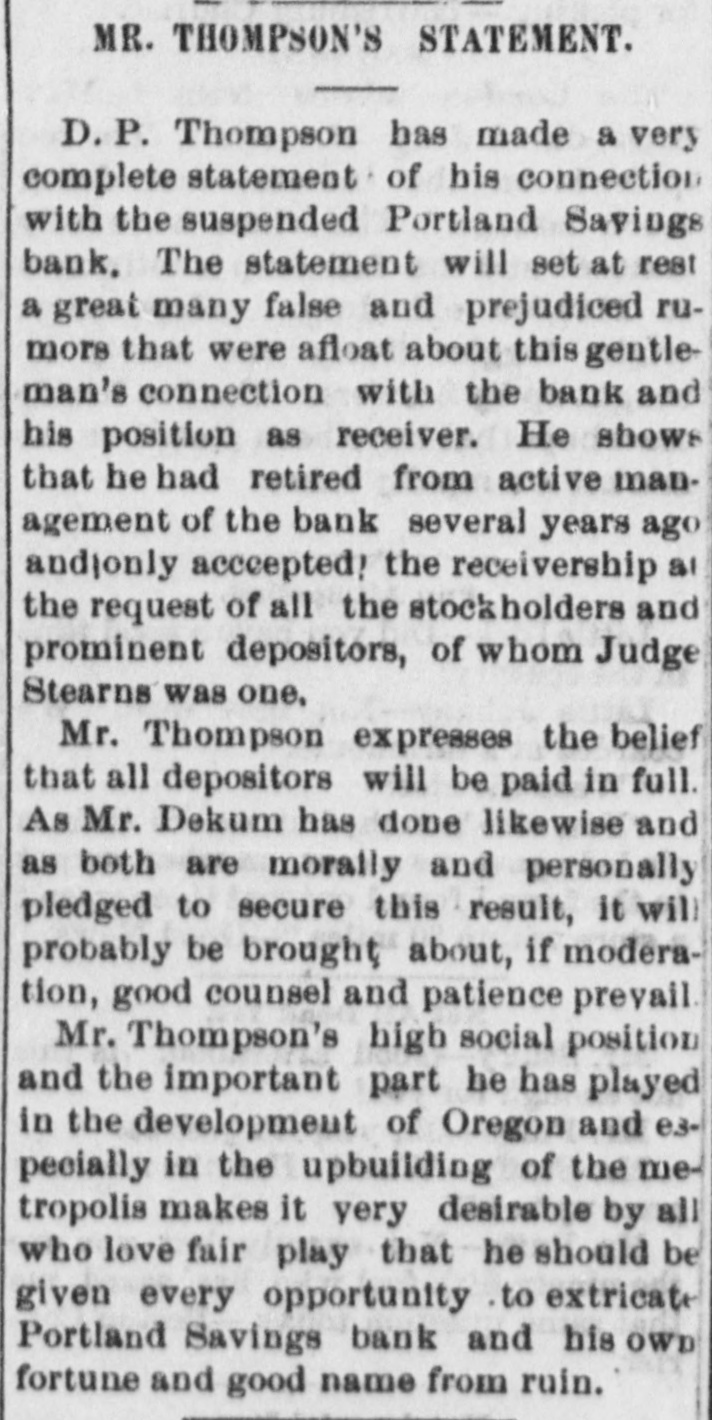
5.August 21, 1893Capital JournalSalem, OR
Click image to open full size in new tab
Article Text
MR. THOMPSON'S STATEMENT. D.P. Thompson has made a very complete statement of his connection with the suspended Portland Savings bank, The statement will set at rest a great many false and prejudiced rumore that were afloat about this gentleman's connection with the bank and his position as receiver. He shows that he had retired from active management of the bank several years ago andjonly acceepted! the receivership at the request of all the stockholders and prominent depositors, of whom Judge Stearns was one, Mr. Thompson expresses the belief that all depositors will be paid in full. As Mr. Dekum has done likewise and as both are morally and personally pledged to secure this result, it will probably be brought about, if moderation, good counsel and patience prevail Mr. Thompson's high social position and the important part be has played in the development of Oregon and especially in the upbuilding of the metropolis makes it very desirable by all who love fair play that he should be given every opportunity to extricate Portland Savings bank and his OWD fortune and good name from ruin.
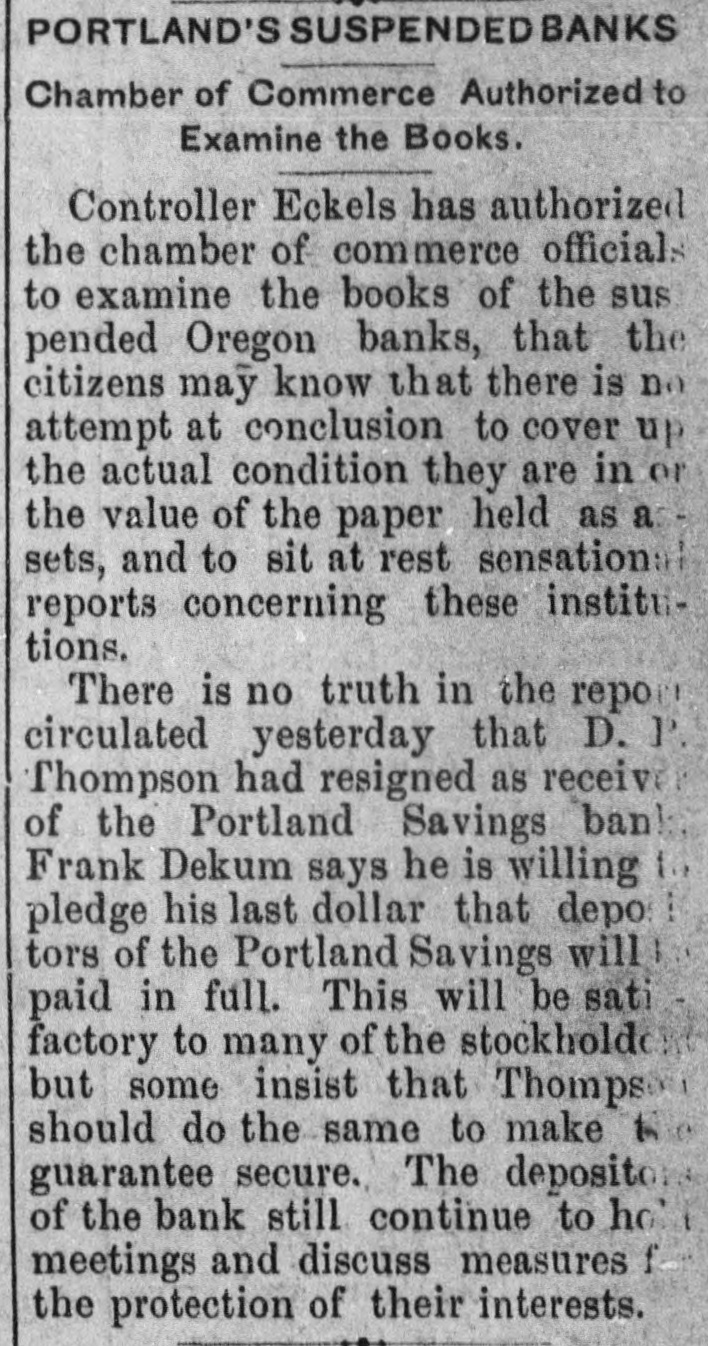
6.August 25, 1893The Athena PressAthena, OR
Click image to open full size in new tab
Article Text
PORTLAND'S SUSPENDED BANKS Chamber of Commerce Authorized to Examine the Books. Controller Eckels has authorized the chamber of commerce officials to examine the books of the sus pended Oregon banks, that the citizens may know that there is no attempt at conclusion to cover up the actual condition they are in or the value of the paper held as a sets, and to sit at rest sensation: reports concerning these institutions. There is no truth in the report circulated yesterday that D. P. Thompson had resigned as receiv of the Portland Savings ban! Frank Dekum says he is willing pledge his last dollar that depos tors of the Portland Savings will paid in full. This will be sati factory to many of the stockhold but some insist that Thomps should do the same to make to guarantee secure. The deposito of the bank still continue to ho meetings and discuss measures f the protection of their interests.
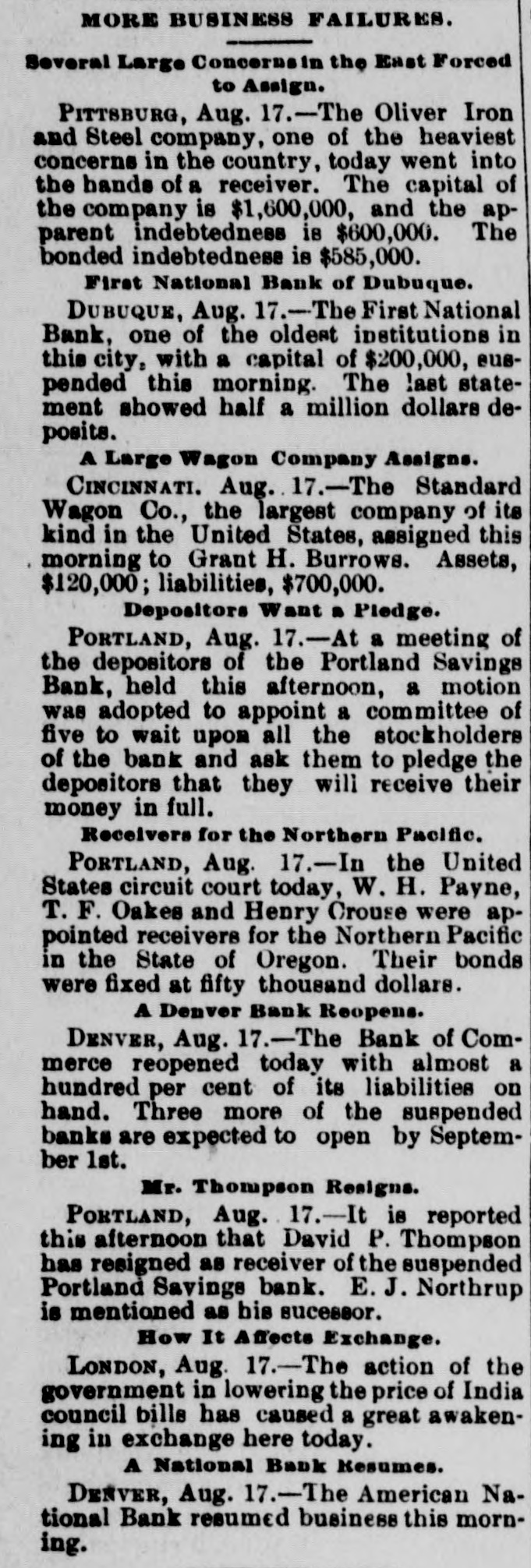
7.August 25, 1893Idaho County Free PressGrangeville, ID
Click image to open full size in new tab
Article Text
MORE BUSINESS FAILURES. Several Large Concernsin the East Forced to Assign. PITTSBURG, Aug. 17.-The Oliver Iron and Steel company, one of the heaviest concerns in the country, today went into the hands of a receiver. The capital of the company is $1,600,000, and the apparent indebtedness is $600,000. The bonded indebtedness is $585,000. First National Bank of Dubuque. DUBUQUE, Aug. 17.-The First National Bank, one of the oldest institutions in this city, with a capital of $200,000, euspended this morning. The last statement showed half a million dollars deposits. A Large Wagon Company Assigns. CINCINNATI. Aug. 17.-The Standard Wagon Co., the largest company of its kind in the United States, assigned this morning to Grant H. Burrows. Assets, $120,000; liabilities, $700,000. Depositors Want a Piedge. PORTLAND, Aug. 17.-At a meeting of the depositors of the Portland Savings Bank, held this afternoon, a motion was adopted to appoint a committee of five to wait upon all the stockholders of the bank and ask them to pledge the depositors that they will receive their money in full. Receivers for the Northern Pacific. PORTLAND, Aug. 17.-In the United States circuit court today, W. H. Payne, T. F. Oakes and Henry Crouse were appointed receivers for the Northern Pacific in the State of Oregon. Their bonds were fixed at fifty thousand dollars. A Denver Bank Reopens. DENVER, Aug. 17.-The Bank of Commerce reopened today with almost a hundred per cent of its liabilities on hand. Three more of the suspended banks are expected to open by September 1st. Mr. Thompson Resigns. PORTLAND, Aug. 17.-It is reported this afternoon that David P. Thompson has resigned as receiver of the suspended Portland Savings bank. E. J. Northrup is mentioned as bis sucessor. How It Affects Exchange. LONDON, Aug. 17.-The action of the government in lowering the price of India council bills has caused a great awakening in exchange here today. A National Bank Resumes. DENVER, Aug. 17.-The American National Bank resumed business this morning.
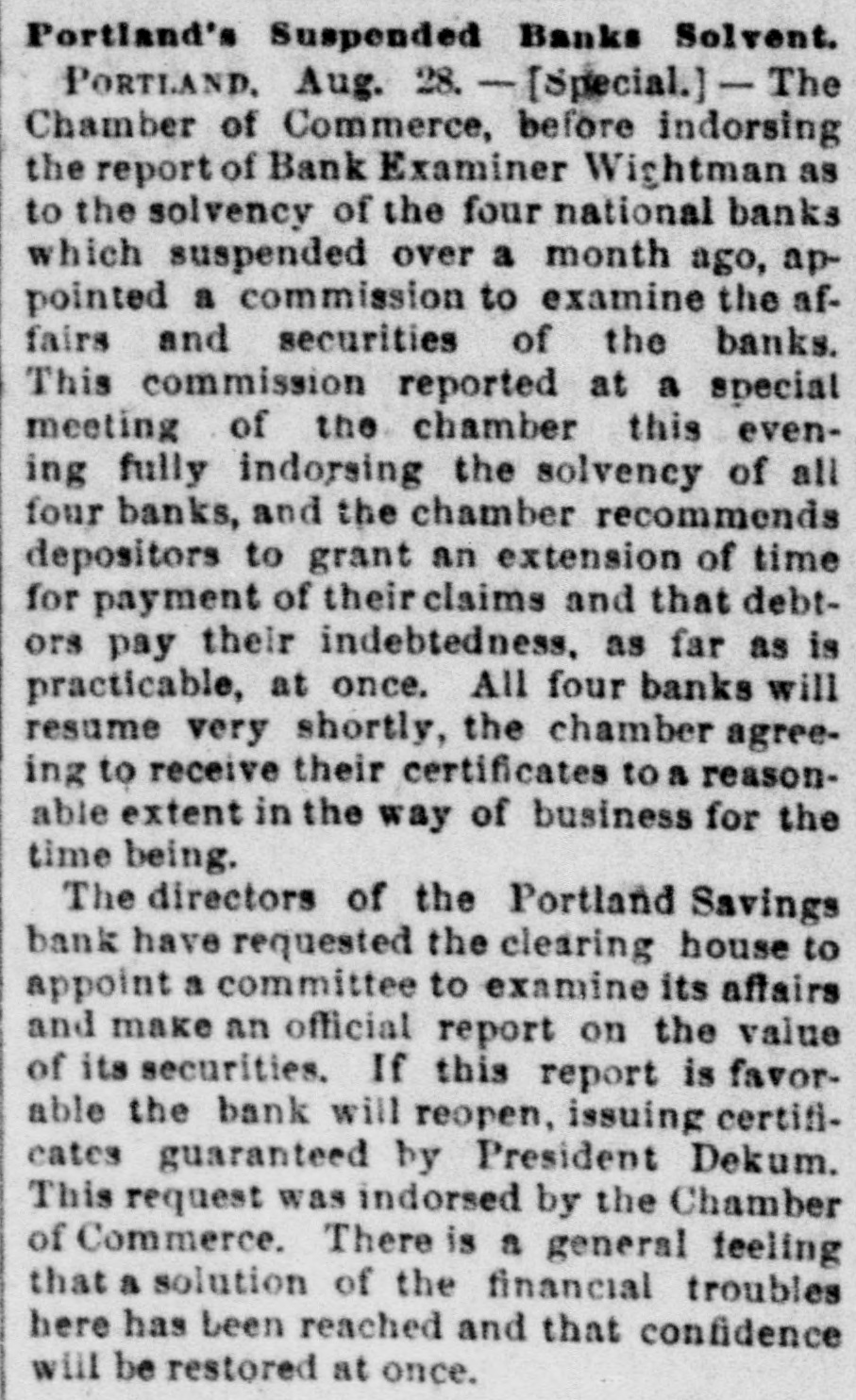
8.August 29, 1893The Seattle Post-IntelligencerSeattle, WA
Click image to open full size in new tab
Article Text
Portland's Suspended Banks Solvent. PORTLAND. Aug. 28. - [Special.] - The Chamber of Commerce, before indorsing the report of Bank Examiner Wightman as to the solvency of the four national banks which suspended over a month ago, appointed a commission to examine the affairs and securities of the banks. This commission reported at a special meeting of the chamber this evening fully indorsing the solvency of all four banks, and the chamber recommends depositors to grant an extension of time for payment of their claims and that debtors pay their indebtedness, as far as is practicable, at once. All four banks will resume very shortly, the chamber agreeing to receive their certificates to a reasonable extent in the way of business for the time being. The directors of the Portland Savings bank have requested the clearing house to appoint a committee to examine its affairs and make an official report on the value of its securities. If this report is favorable the bank will reopen, issuing certificates guaranteed by President Dekum. This request was indorsed by the Chamber of Commerce. There is a general feeling that a solution of the financial troubles here has been reached and that confidence will be restored at once.
9.September 19, 1893The Evening WorldNew York, NY
Click image to open full size in new tab
Article Text
Port Townsend Bank Closes. PORT TOWNSEND. Wash., Sept. 19. -The Port Townsend National Bank failed to open yesterday. A notice announced the suspension as the result of the suspension of the Commercial National and Portland Savings Bank of Portland. Total liabilities of the Port Townsend National Bank are less than $100,000; assets between $120,000 and $130,000. The officials say they will resume in thirty days.
10.September 20, 1893New-York TribuneNew York, NY
Click image to open full size in new tab
Article Text
A NATIONAL BANK FORCED TO SUSPEND. Port Townsend, Wash., Sept. 19.-The Port Townsend National Bank failed to open yesterday mornIng. A notice on the door announced that the suspension was the result of the suspension of the Commercial National and Portland Savings Bank of Portland. The total liabilities are less than $100,000; assets between $120,000 and $130,000. The officials say they will resume in thirty days, and the directors give personal pledge to pay depositors in full.
11.February 1, 1894The Seattle Post-IntelligencerSeattle, WA
Click image to open full size in new tab
Article Text
THE PORTLAND SAVINGS BANK. Not Able to Open Because Some Depositors Are Greedy. PORTLAND, Jan. 31.-[Special.]-The Portland Savings bank, which suspended six months since, will not resume business tomorrow, as was hoped, but the receiver will pay a 10 per cent. dividend on all deposits. Of the $2,400,000 of deposits, extensions had been signed by all but $700,000, when a report was circulated that the bank would resume on February 1, and the depositors stopped signing, and brokers were buying deposits at 90 per cent. of the face value. A number of the largest depositors, who are able to wait, would not sign, and were ready to rush in and draw all their money. This was not considered fair to those who bad signed extensions, and the court ordered that 10 per cent. of the dividends be paid to all depositors. The bank will open for this purpose tomorrow morning. The courts will not hasten to throw the bank into liquidation, and it is hoped that arrangements will yet be made to enable it to resume business, as the assets are ample to pay all depositors if reasonable time is given.
12.February 2, 1894The Dalles Daily ChronicleDalles, OR
Click image to open full size in new tab
Article Text
Spokane has a Cultus club. Do you dance? If not watch those who do at the ball of the East End hose company. They're all going. An old gentleman named Ordway, who has been sick for a long time, died in Hood River on Monday and was buried Wednesday. The Diamond mills have shut down for a short time for the purpose of lining up machinery and making some slight repairs and changes. The "geography" party occurs tonight at Fraternity hall. It is rumored that some of the localities to be used will be far fetched, but nothing under 12,500 miles. The Union Republican has brought out the name of Hon. J. A. Wright of Sparta for gubernatorial honors, and calls him "Eastern Oregon's favorite son." Billy V. gave the business away this morning. In a conversation referring to its profitableness he said: "You can't run a dairy ranch without plenty of good water" (for the cows.) The Union Pacific company are storing large quantities of coal at this point. A force of fourteen men are now at work. There is at present between 1,200 tons and 1,500 tons in the yard. We are in receipt of No. 2 of the Midland Monthly published at Des Moines, Iowa. It is very neat typographically, well illustrated, and its contributions are from the pens of well known authors. The Portland Savings bank opened yesterday for the purpose of paying depositors a 10 per cent. dividend. There were more present than could be accommodated, and several days will be required to pay all who are anxious to get their money. The '94 social club gave a banquet at the Columbia Candy Factory last evening. About thirty-seven were present. Oysters were served the entire party inside of two minutes by Sam Campbell, while Newt. ladled out the soup in the culinary department. The absence of Pease & Mays advertisement during the past month has
13.May 10, 1894The Farmers' UnionMemphis, MO
Click image to open full size in new tab
Article Text
FINANCIAL AND INDUSTRIAL -According to Bradstreet's, trade is decreasing in the large cities Labor disturbances are assigned as the principal cause. -Colonel W. P. Rend. of Chicago, largely interested in Pennsylvania and Ohio coal fields. will let his men return to work at the old scale unless the strike is soon settled. -By the suspension of a bank in St. Joseph. Mo.. the City Treasurer is deprived by law of any place to deposit the city funds. -Great Northern strikers hissed the proposition by St. Paul business men to submit the trouble to arbitration. -Wisconsin Central receivers issued a manifesto announcing their intention to re-ume work on the ore docks at Ashland and warning all persons against interferonce. -Through the efforts of the business men of St. Pant and Minneapolis the Great Northern strike has been settled, the men securing most of their demands. -Riotous demonstrations characterized the parade of unemployed in Cleveland. Several motormen who refused to stop their cars were badly beaten. -A highly sensational complaint against the Southern Pacific Railroad Company has been filed at San Francisco by John R. Robinson. It demands an accounting, Robinson alleging that he was defrauded of ten shares of stock of Central Pacific Railroad in 1877. At that time, the complainant alleges, the stock was worth $1,200,000 in cash and 150,050 acres of land held in trust, but to which directors claimed private ownership. Robinson prays for judgment for $1,200,000 with legal interest. A sensational feature of the suit is an allegation that Attorney A. A Cohen, while supposed a bitter enemy of the railroad companies, was really in their employ, drawin; $10,000 a year. and that while serving in that capacity he contracted with Robinson to conduct his lawsuit. Robinson alleges that the suit was compromised by Cohen under these circumstances for $17,000. of which Cohen retained 50 percent. as his share. -The twenty-fourth annual report of the Lake Shore and Michigan Southern Railroad. submitted to the stockholders, shows a reduction in the funded debt durinz 1893 from $44,192,000 to $43,942,000 by the cancellation for the sinking fund of $250,000 in bonds secured by first mortgage. The total amount of bonds thus canceled is $5,750,000. --H. O. Smith. member of the Stockton. Cal., firm of Southworth & Gratton, grocers, has filed a petition of insolvency. Indebtedness, $234.000: assets, $255,000. The business of the firms is not affected, and Southworth's interest in the firm is held in trust for the benefit of his creditors Accommodation to friends and the depreciation in the value of real estate is assigned as the cause. -The Portland (Oregon) Savings Bank. which was closed during the financial crisis of last July, has resumed business -The Diamond Match Company proposes to form a combination to control the manufacture of matches throughout the world. As a part of the plan it intends to estab.
14.October 24, 1894The Seattle Post-IntelligencerSeattle, WA
Click image to open full size in new tab
Article Text
# The Late Frank Dekum.
A Portland reader of the POST-INTELLIGENCER, one who knew the late Frank Dekum, the Portland pioneer and banker, more than a score of years, takes exceptions to the statement that Mr. Dekum was not progressive and did not improve his property as promptly as his neighbors did theirs: The Portland man writes:
"The exact reverse of this statement is the truth. Mr. Dekum was one of our most progressive citizens, especially in the matter of building. The Dekum block, one of the finest in the Northwest, is only one of his efforts in that line. Long ago he put up one of the best buildings on First street, and another on Washington street. The only other citizen who equaled him in this respect is Hon. H. W. Corbett. Mr. Dekum has taken an interest in all public improvements, especially the water works, public parks, introduction of song birds, contributing his time and money with a liberality exceeded by none. He has been very unjustly blamed on account of the suspension of the Portland Savings bank, for which he was not responsible, and has been obliged to bear all the abuse and worriment caused by that affair, which others should have shared with him, and which would all have been avoided if these men would have done what he was willing and anxious to do."
15.November 21, 1894Richmond DispatchRichmond, VA
Click image to open full size in new tab
Article Text
A SAVINGS BANK FAILS. The Trouble Precipitated by Death of the Institution's President. PORTLAND, ORE., November 20. - The Portland Savings Bank failed to open its doors this morning. The lack of public confidence and unremitting withdrawals of deposits are given as the reason for the closing of the bank. O. N. Denny has been appointed receiver, and the bank will go into liquidation. The assets of the bank are given at $1,650,000; the liabilities at $1,430,000. The closing of the bank was doubtless precipitated by the death of Frank Dekum, the president, about a month ago. The bank first closed its doors in the panie of 1893, but resumed in May of this year, under an agreement with the depositors that they, were to draw out quarterly 10 per cent. of their deposits. Many depositors refused to sign off under any conditions, and withdrew their deposits when the bank resumed, materially aiding the present suspension.
A Bank Failure, Portland, Ore., Nov. 20.-The Portland Savings bank failed to open its doors this morning. The lack of pubHe confidence and uncessing withdrawals of deposits are given as reasons of the closing of the bank. O. N. Denny has been appointed receiver and the bank will go Into liquidation. The assets of the bank are given at $1,050,000;
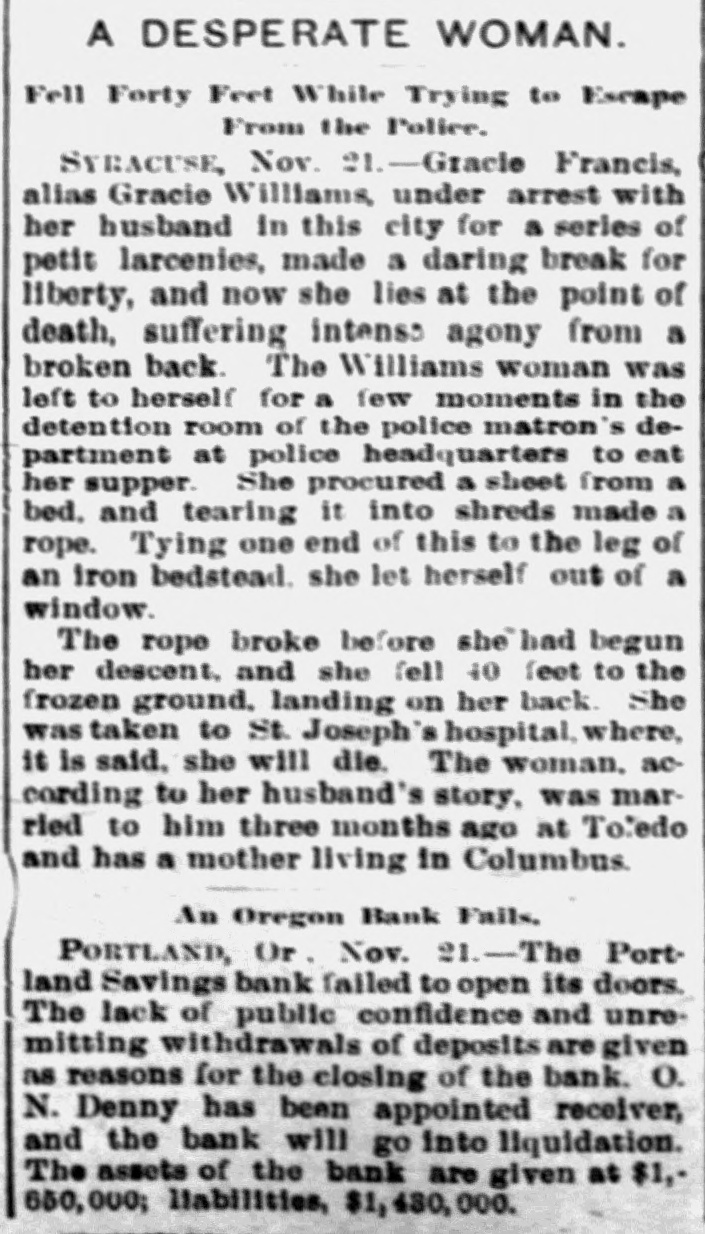
A DESPERATE WOMAN. Fell Forty Feet While Trying to Escape From the Police. STRACUSE, Nov. :1.-Gracle Francis, alias Gracie Williams, under arrest with her husband In this city for a series of petit larcenies, made a daring break for liberty, and now she lies at the point of death, suffering intens: agony from a broken back. The Williams woman was left to herself for a few moments in the detention room of the police matron's department at police headquarters to eat her supper. She procured a sheet from a bed. and tearing it into shreds made a rope. Tying one end of this to the leg of an Iron bedstead. she let herself out of a window. The rope broke before she had begun her descent. and she fell 40 feet to the frozen ground. landing on her back She was taken to St. Joseph's hospital, where, it is said. she will die. The woman, according to her husband's story. was married to him three months ago at To:edo and has a mother living in Columbus An Oregon Bank Fails, PORTLAND, Or. Nov. 21.-The Portland Savings bank failed to open its doors. The lack of public confidence and unremitting withdrawals of deposits are given as reasons for the closing of the bank. O. N. Denny has been appointed receiver, and the bank will go into liquidation. The assets of the bank are given at $1,. 650,000; liabilities, $1,430,000.
18.November 21, 1894The Daily Morning AstorianAstoria, OR
Click image to open full size in new tab
Article Text
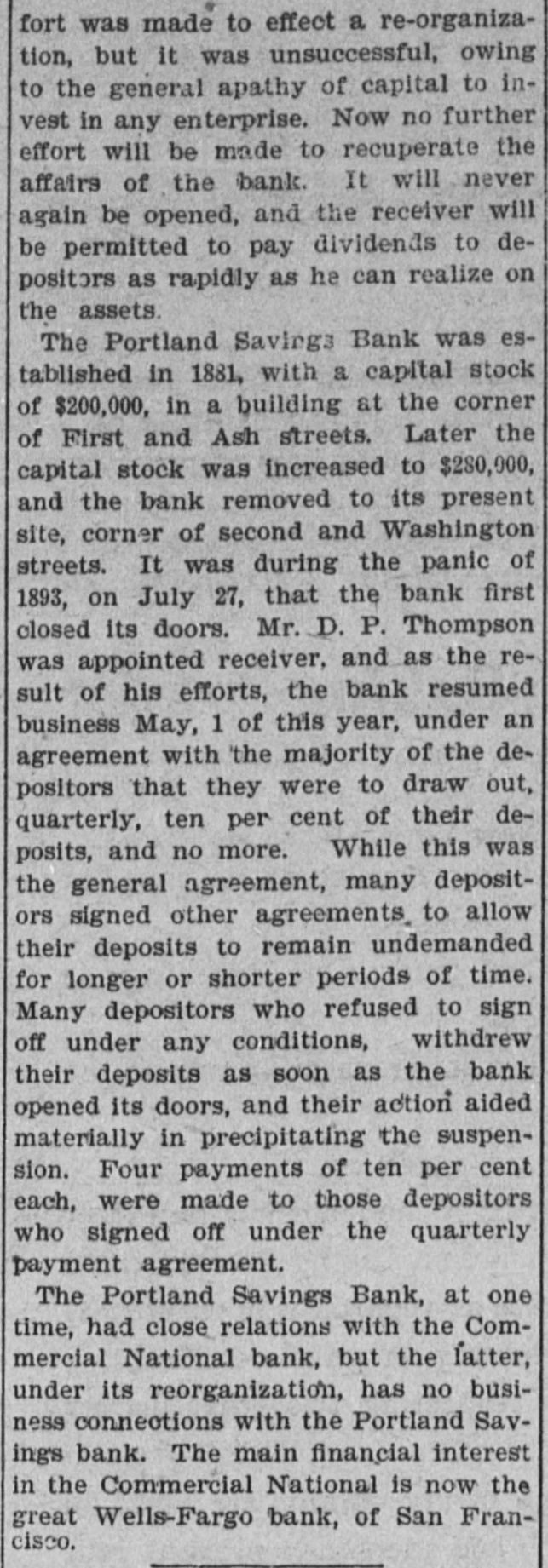
fort was made to effect a re-organization, but it was unsuccessful, owing to the general apathy of capital to invest in any enterprise. Now no further effort will be made to recuperate the affairs of the bank. It will never again be opened, and the receiver will be permitted to pay dividends to depositors as rapidly as he can realize on the assets. The Portland Savings Bank was established in 1881, with a capital stock of $200,000, in a building at the corner of First and Ash streets. Later the capital stock was increased to $280,000, and the bank removed to its present site, corner of second and Washington streets. It was during the panic of 1893, on July 27, that the bank first closed its doors. Mr. D. P. Thompson was appointed receiver, and as the result of his efforts, the bank resumed business May, 1 of this year, under an agreement with the majority of the depositors that they were to draw out, quarterly, ten per cent of their deposits, and no more. While this was the general agreement, many depositors signed other agreements to allow their deposits to remain undemanded for longer or shorter periods of time. Many depositors who refused to sign off under any conditions, withdrew their deposits as soon as the bank opened its doors, and their action aided materially in precipitating the suspension. Four payments of ten per cent each, were made to those depositors who signed off under the quarterly payment agreement. The Portland Savings Bank, at one time, had close relations with the Commercial National bank, but the fatter, under its reorganization, has no business connections with the Portland Savings bank. The main financial interest in the Commercial National is now the great Wells-Fargo bank, of San Francisco.
19.November 21, 1894The Salt Lake HeraldSalt Lake City, UT
Click image to open full size in new tab
Article Text
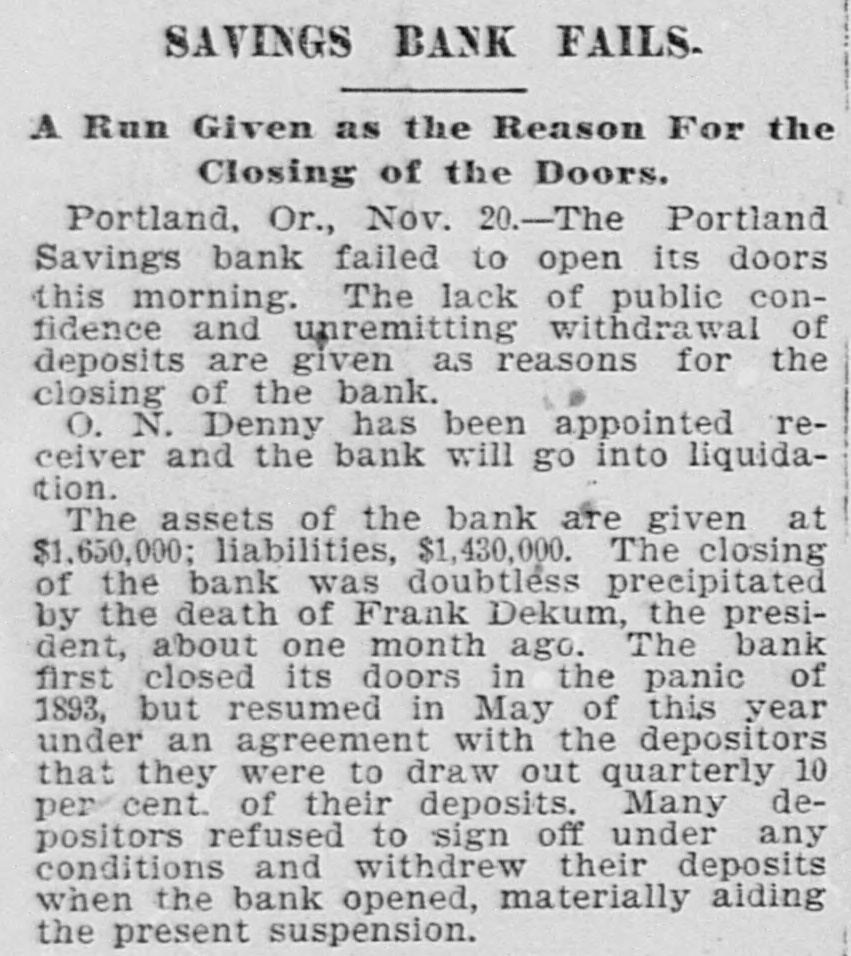
SAVINGS BANK FAILS. A Run Given as the Reason For the Closing of the Doors. Portland, Or., Nov. 20.-The Portland Savings bank failed to open its doors this morning. The lack of public confidence and unremitting withdrawal of deposits are given as reasons for the closing of the bank. O. N. Denny has been appointed receiver and the bank will go into liquidation. The assets of the bank are given at $1,650,000; liabilities, $1,430,000. The closing of the bank was doubtless precipitated by the death of Frank Dekum, the president, about one month ago. The bank first closed its doors in the panic of 1893, but resumed in May of this year under an agreement with the depositors that they were to draw out quarterly 10 per cent. of their deposits. Many depositors refused to sign off under any conditions and withdrew their deposits when the bank opened, materially aiding the present suspension.
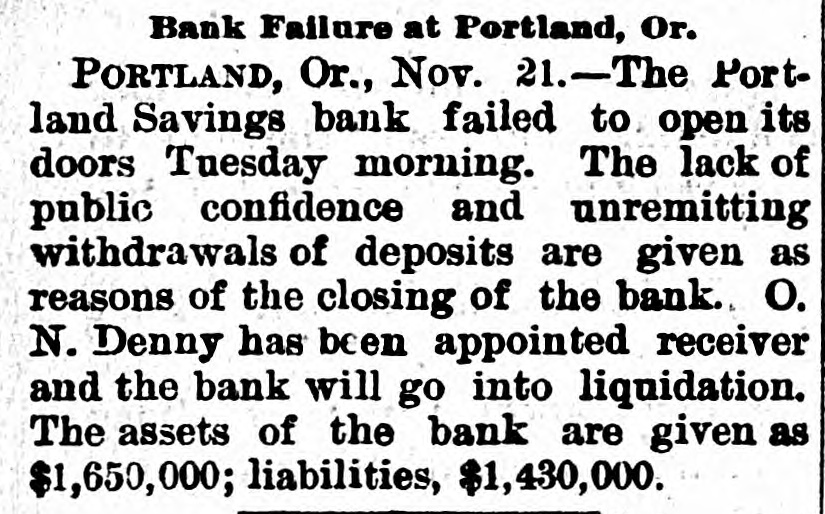
Bank Failure at Portland, Or. PORTLAND, Or., Nov. 21.-The Portland Savings bank failed to open its doors Tuesday morning. The lack of public confidence and unremitting withdrawals of deposits are given as reasons of the closing of the bank. O. N. Denny has been appointed receiver and the bank will go into liquidation. The assets of the bank are given as $1,650,000; liabilities, $1,430,000.
21.February 4, 1896Daily Capital JournalSalem, OR
Click image to open full size in new tab
Article Text
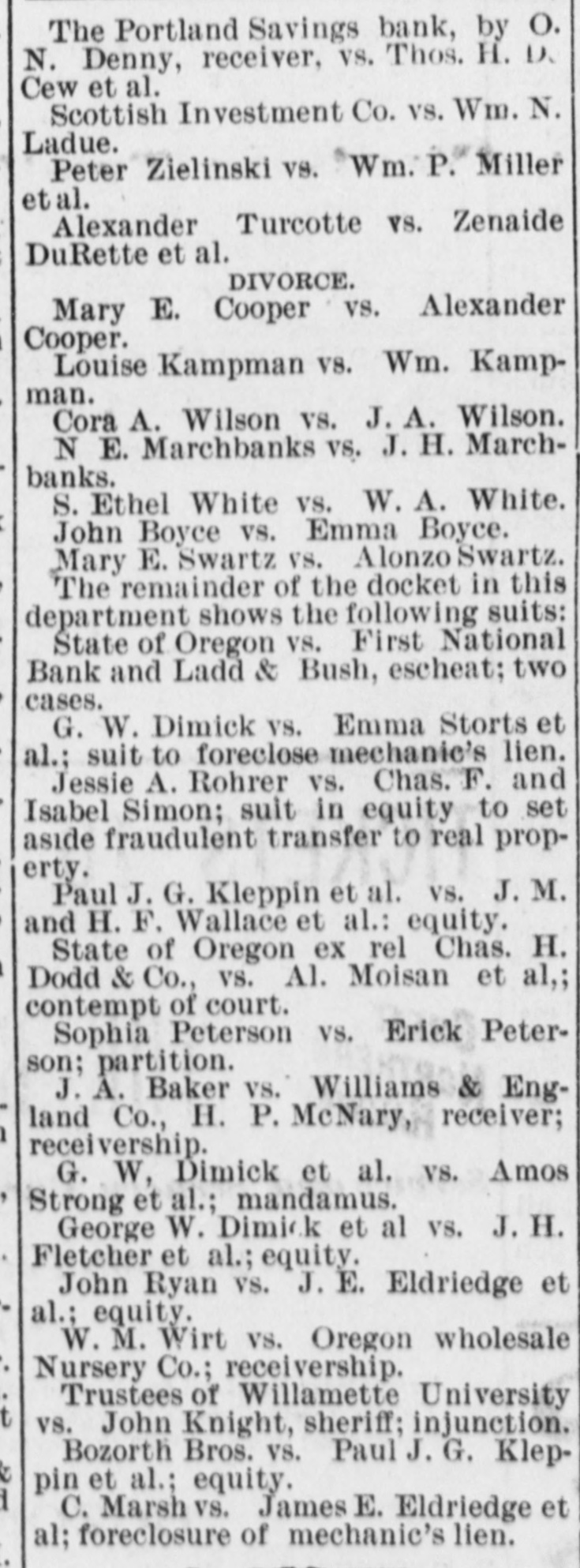
The Portland Savings bank, by O. N. Denny, receiver, vs. Thos. H. D. Cew et al.
Scottish Investment Co. vs. Wm. N. Ladue.
Peter Zielinski vs. Wm. P. Miller et al.
Alexander Turcotte vs. Zenaide DuRette et al.
DIVORCE.
Mary E. Cooper vs. Alexander Cooper.
Louise Kampman vs. Wm. Kampman.
Cora A. Wilson vs. J. A. Wilson.
N E. Marchbanks vs. J. H. Marchbanks.
S. Ethel White vs. W. A. White.
John Boyce vs. Emma Boyce.
Mary E. Swartz vs. Alonzo Swartz.
The remainder of the docket in this department shows the following suits:
State of Oregon vs. First National Bank and Ladd & Bush, escheat; two cases.
G. W. Dimick vs. Emma Storts et al.; suit to foreclose mechanic's lien.
Jessie A. Rohrer vs. Chas. F. and Isabel Simon; suit in equity to set aside fraudulent transfer to real property.
Paul J. G. Kleppin et al. vs. J. M. and H. F. Wallace et al.: equity.
State of Oregon ex rel Chas. H. Dodd & Co., vs. Al. Moisan et al,; contempt of court.
Sophia Peterson vs. Erick Peterson; partition.
J. A. Baker vs. Williams & England Co., H. P. McNary, receiver; receivership.
G. W, Dimick et al. vs. Amos Strong et al.; mandamus.
George W. Dimick et al vs. J. H. Fletcher et al.; equity.
John Ryan vs. J. E. Eldriedge et al.; equity.
W. M. Wirt vs. Oregon wholesale Nursery Co.; receivership.
Trustees of Willamette University vs. John Knight, sheriff; injunction.
Bozorth Bros. vs. Paul J. G. Kleppin et al.; equity.
C. Marsh vs. James E. Eldriedge et al; foreclosure of mechanic's lien.
22.September 12, 1896The San Francisco CallSan Francisco, CA
Click image to open full size in new tab
Article Text
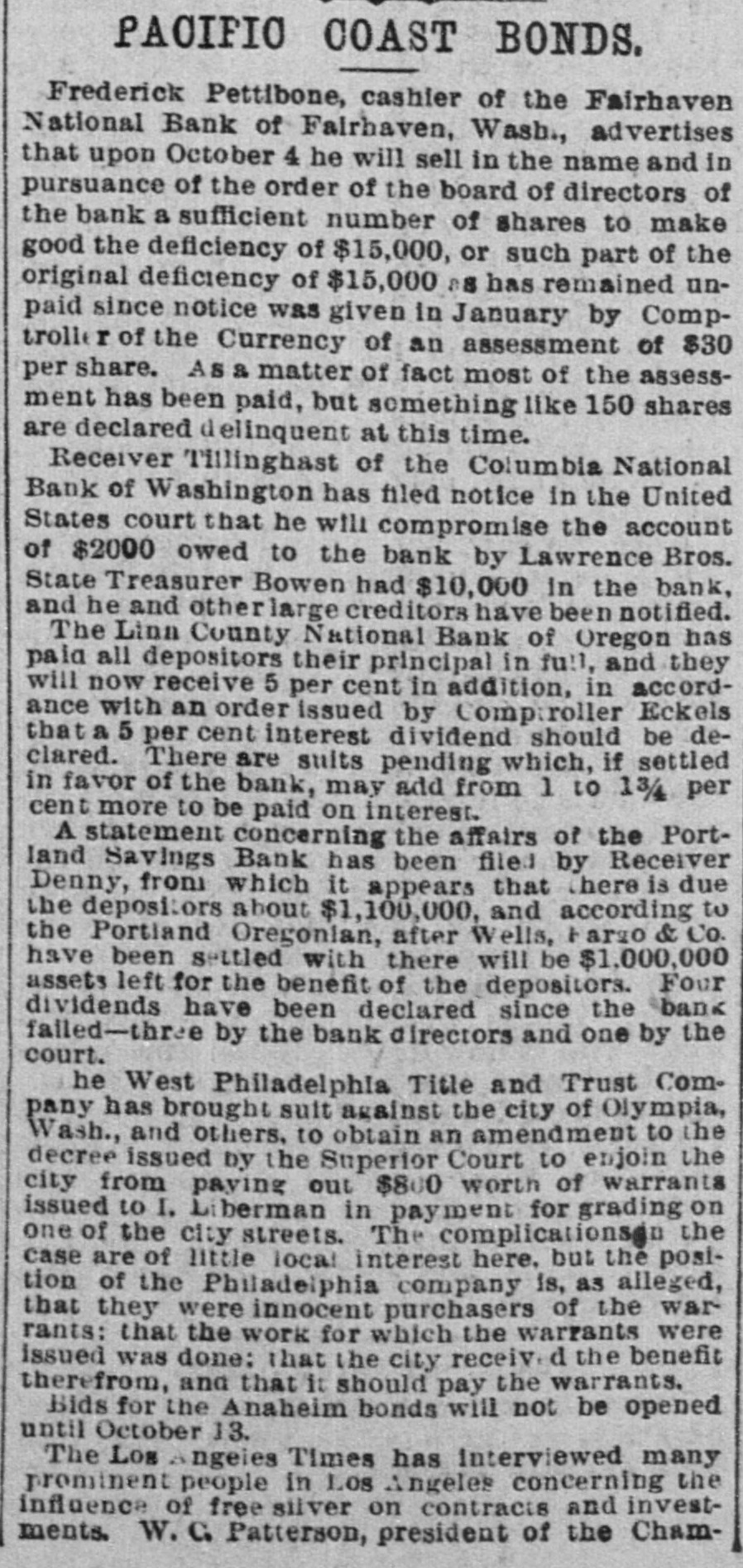
PACIFIC COAST BONDS. Frederick Pettibone, cashier of the Fairhaven National Bank of Fairhaven, Wash., advertises that upon October 4 he will sell in the name and in pursuance of the order of the board of directors of the bank a sufficient number of shares to make good the deficiency of $15,000, or such part of the original deficiency of $15,000 88 has remained unpaid since notice was given in January by Comptrolle r of the Currency of an assessment of $30 per share. As a matter of fact most of the assessment has been paid, but something like 150 shares are declared delinquent at this time. Receiver Tillinghast of the Columbia National Bank of Washington has filed notice in the United States court that he will compromise the account of $2000 owed to the bank by Lawrence Bros. State Treasurer Bowen had $10,000 in the bank, and he and other large creditors have been notified. The Linn County National Bank of Oregon has paia all depositors their principal in full, and they will now receive 5 per cent in addition, in accordance with an order issued by Comp:roller Eckels that a 5 per cent interest dividend should be declared. There are suits pending which, if settled in favor of the bank, may add from 1 to 13/4 per cent more to be paid on interest. A statement concerning the affairs of the Portland Savings Bank has been filed by Receiver Denny, from which it appears that there is due the depositors about $1,100,000, and according to the Portland Oregonian, after Wells, Farzo & Co. have been settled with there will be $1,000,000 assets left for the benefit of the depositors. Four dividends have been declared since the bank falled-three by the bank directors and one by the court. he West Philadelphia Title and Trust Company has brought suit against the city of Olympia, Wash., and others, to obtain an amendment to the decree issued by the Superior Court to enjoin the city from paying out $800 worth of warrants issued to I. Liberman in payment for grading on one of the city streets. The complicationsen the case are of little local interest here. but the position of the Philadelphia company is, as alleged, that they were innocent purchasers of the warrants: that the work for which the warrants were issued was done: that the city receiv. d the benefit therefrom, and that it should pay the warrants. Bids for the Anaheim bonds will not be opened until October 13. The Los ngeles Times has interviewed many prominent people in Los Angeles concerning the influence of free silver on contracts and investments. W. C. Patterson, president of the Cham-