19084. Keystone Bank (Philadelphia, PA)

Bank Information

Episode Type
Suspension → Closure
Bank Type
state
Start Date
October 15, 1898
Location
Philadelphia, Pennsylvania (39.952, -75.164)

Metadata

Model
gpt-5-mini
Short Digest
66f54b29

Response Measures

None

Description

Articles (Oct–Dec 1898) refer to the Keystone Bank's president Gideon W. Marsh absconding and to the bank being 'looted' and a receiver of People's Bank finding papers; a receiver is mentioned and Marsh is later sentenced. There is no description of a depositor run in the excerpts. The bank therefore appears to have been placed in receivership/closed (suspension followed by closure). Dates: Oct 15, 1898 article mentions receiver; Dec 1898 article notes sentencing of the president.

Events (3)

1. October 15, 1898 Receivership
Newspaper Excerpt
papers found by the receiver of the People's Bank, and that suits had been instituted for restitution. ... return of Gideon W. Marsh, the absconding president of the Keystone Bank, and that he would do all in his power to assist ... to bring him back.
Source
newspapers
2. October 15, 1898 Suspension
Cause
Government Action
Cause Details
Receiver appointed (people's bank receiver found unpaid notes and other malfeasance tied to Keystone Bank president's absconding), leading to suspension/closure.
Newspaper Excerpt
New evidence of the rottenness of the State finances was presented in the announcement that unpaid notes ... were among the papers found by the receiver of the People's Bank
Source
newspapers
3. December 14, 1898 Other
Newspaper Excerpt
Gideon W. Marsh, president of the looted Keystone bank, Philadelphia, has been sentenced to a fine and imprisonment of 12 years and 3 months.
Source
newspapers

Newspaper Articles (2)

Article from The Times, October 16, 1898

Click image to open full size in new tab

Article Text

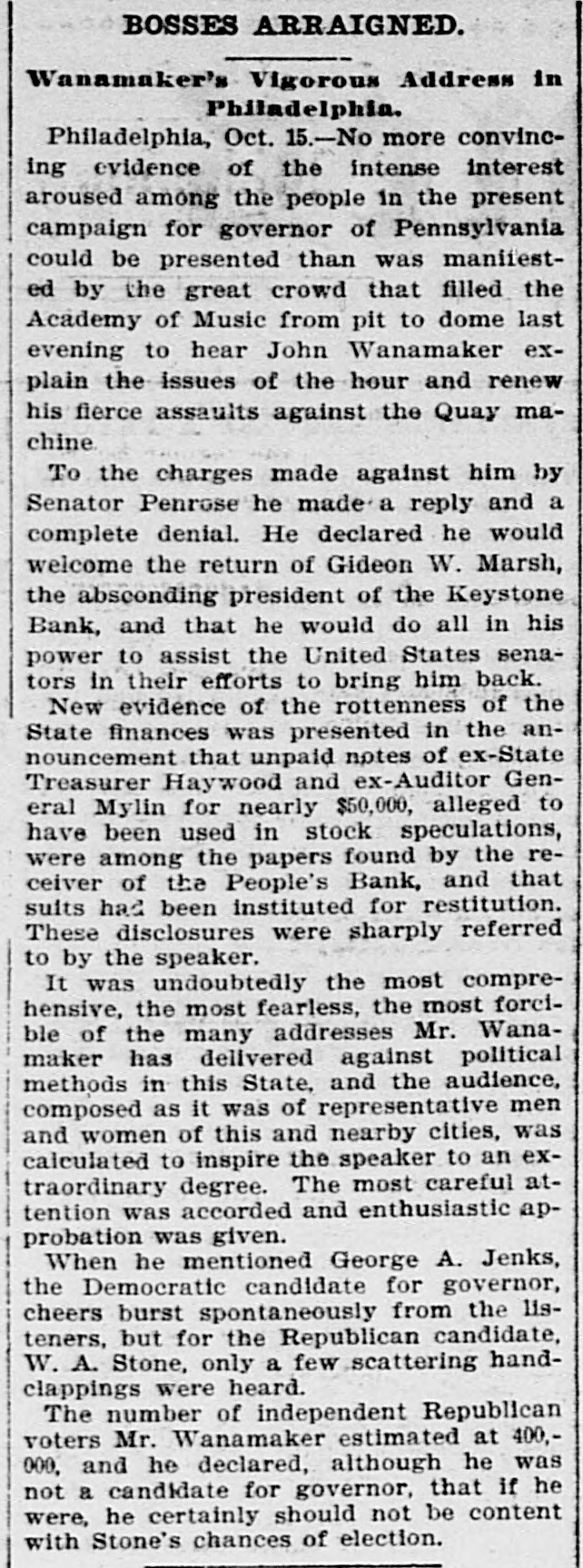
BOSSES ARRAIGNED. Wanamaker's Vigorous Address in Philadelphia. Philadelphia, Oct. 15.-No more convincing evidence of the intense interest aroused among the people in the present campaign for governor of Pennsylvania could be presented than was maniiested by the great crowd that filled the Academy of Music from pit to dome last evening to hear John Wanamaker explain the issues of the hour and renew his fierce assaults against the Quay machine To the charges made against him by Senator Penrose he made a reply and a complete denial. He declared he would welcome the return of Gideon W. Marsh, the absconding president of the Keystone Bank, and that he would do all in his power to assist the United States senators in their efforts to bring him back. New evidence of the rottenness of the State finances was presented in the announcement that unpaid notes of ex-State Treasurer Haywood and ex-Auditor General Mylin for nearly $50,000, alleged to have been used in stock speculations, were among the papers found by the receiver of the People's Bank, and that suits had been instituted for restitution. These disclosures were sharply referred to by the speaker. It was undoubtedly the most comprehensive, the most fearless, the most forcible of the many addresses Mr. Wanamaker has delivered against political methods in this State, and the audience, composed as it was of representative men and women of this and nearby cities, was calculated to inspire the speaker to an extraordinary degree. The most careful attention was accorded and enthusiastic approbation was given. When he mentioned George A. Jenks, the Democratic candidate for governor, cheers burst spontaneously from the listeners, but for the Republican candidate, W. A. Stone, only a few scattering handclappings were heard. The number of independent Republican voters Mr. Wanamaker estimated at 400,000. and he declared, although he was not a candidate for governor, that if he were, he certainly should not be content with Stone's chances of election.


Article from Little Falls Herald, December 23, 1898

Click image to open full size in new tab

Article Text

Wednesday, Dec. 14. Secretary of Interior Bliss will resign. apMajor General Brooke has been pointed military governor of Cuba The province of Pinar del Rio, Cuba, is now under the Stars and Stripes. Four American war vessels have been ordered to Havana to prevent further rioting The Northern Pacific executive committee has recommended a 1 per cent dividend. William Vernon Harcourt has Sir English resigned the leadership of the Liberal party. President McKinley has issued proclamations regarding the collection of customs in Cuba and Porto Rico. Gideon W. Marsh, president of the looted Keystone bank, Philadelphia, has been sentenced to a fine and imprisonment of 12 years and 3 months. The president has left Washington for Atlanta, Ga., to attend the peace jubilee celebration there. Generals Wheeler and Lawton and several members of the cabinet accompany him. Thursday, Dec. 15. The Ohio river is frozen over at Wheeling and Parkersburg and navigation has been suspended for all upper river points. The house naval affairs committee has a favorable report upon the bill the rank of admiral ordered to create and vice admiral in the navy. Mayor Graham of Lincoln, Neb., has been acquitted in the district court on the charge of bribery following an indictment by the grand jury. A bill increasing the pension of Eleazir Smith of New Hampshire, who is over 100 years old, and one of the three survivors of the war of 1812, to $30 a month, passed the senate. Frank Moran, one of the most widely minstrels in this country, died at hospital in known the German Philadelphia, of the founaged 73 years. He was one ders of the Benevolent and Protective Order of Elks. Friday, Dec. 16. Ex-Senator Calvin S. Brice is dead. He was ill only a week. Judge I. E. Waite, chief justice of the Oregon supreme courtfrom 1859 to 1862, is dead, aged 85. Mrs. R. J. Bright, wife of Colonel Bright, sergeant-at-arms of the United States senate, is dead. The executive council of the national of the G. A. R. has 18 to 24 for the Sept. council encampment appointed at Philadelphia. The Illinois State Grange has adopted resolutions advocating the state furnishing free text books to public schools, the books to be made by convict labor. The Wabash has given formal notification to the Western Passenger association of its intention to withdraw from that organization on the 15th of next month. Saturday, Dec. 17. Street-lighting companies will combine. The tin plate trust has been incorporated. Hawaii is to be made a customs district, with three subports of entry. board of pronounced against postal The national savings trade banks. The pension bill, carrying $145,233, 830 passed the house without debate in 20 minutes. Havana is excited over the report that the Americans will depreciate Spanish gold and silver. The president attended the Atlanta peace jubilee and made two speeches. For one he received the thanks of the Georgia legislature. which has been invesLower says tigating The committee Mississippi solution floods of the good levees are the only problem. The work would cost $18,000,000 to $20,000,000. Monday, Dec. 19. Senator Davis is confident that the senate will ratify the peace treaty. Clement Scott, the noted London dramatic critic, will lecture in the United States. The steamer Werra, which sailed from Havana on Dec. with about 2,000 Spanish soldiers, has arrived at Malaga, Spain. According to a Boston paper Professor Charles Eliot Norton has accepted the "expansion policy as inevitable and expressed confidence in our success as a colonial power, after making some blunders and paying for them." Henry A. Chapin, the multi-millionaire mine owner, and richest man in Michigan, died during the night at his home in Niles, Mich. He was 86 years old, and his wealth was estimated at from $10,000,000 to $30,000,000 Tuesday Den 90