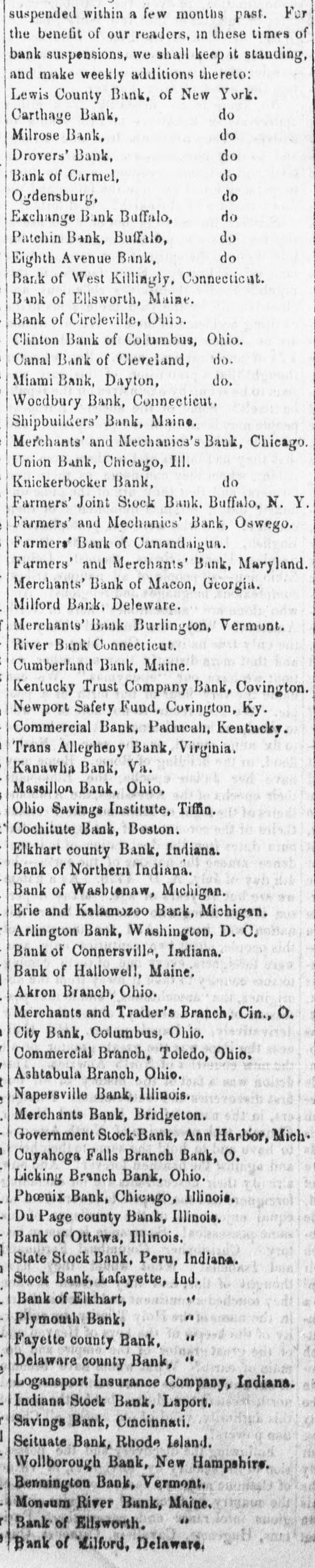
Click image to open full size in new tab
Article Text
# MONEY MARKET.
Tuesday, Sept. 1-6 P. M.
Notwithstanding the favorable advices from Mexico, and the probable speedy settlement of our difficulties with that government, there was a decline in the stock market. Harlem fell off ½ per cent; Norwich and Worcester; Reading; Long Island and Morris Canal left off at yesterday's prices. The sales were not large, and we attribute the decline to the fact that the accounts alluded to above, were not generally believed, the way they first came to hand being very unsatisfactory. If it is confirmed, there must be an immediate improvement in the stock market; and if it results as anticipated, there will be one great cause of the present depression removed.
The books for subsciption to the capital stock of the Hudson River Railroad were opened to-day, at No. 6 Wall street.
The Canal Bank of Albany has declared a dividend of three per cent.
The Girard Bank, of Philadelphia, resumed business a few days since, in its banking house in that city, upon an availabie capital of about two hundred thousand dollars, with the annexed board of directors.
BOARD OF DIRECTORS-GIRARD BANK, PHILADELPHIA.
Charles S. Boker,
J Bingham,
James Harper,
W H. Reid,
S. Hood,
Thomas Prichett,
Edmond Wilcox,
Wm. M. Muzzey,
John G. Whelan,
R. Lukens,
S. C. Ford,
A. H. Julian,
W. M. Han sell.
Those acquainted with the business men of Philadelphia, will see that the board is composed of some of the best merchants of that city. Six of the board are extensively engaged in the dry goods trade, and the character of the board throughout is such as to give the public great confidence in the institution over which they preside. The vicissitudes this bank has passed through-the immense losses it has experienced in its capital, and in its other assets-the rapid depreciation in the value of its property-and the immense amount of its liabilities, which have in nearly every instance been paid in full, guarantee a more favorable result in the liquidation of its remaining liabilities, and a more favorable resumption o business than its most sanguine friends have anticipatedf
Commencing business with an available capital of two hundred thousand dollars, and assets varying in value from three to five millions of dollars, it does so under auspices the most flattering. It will be much easier to realize on the remaining assets, when the bank is in active operation, than when it was in the hands of trustees. The debtors of a bank, as well as those of an individual do not make that effort to pay up, when that bank or that individual, is in a state of suspension, as when their creditors are engaged in active business. The Girard Bank will have much greater facilities for the collection of its assets and for the settlement of claims now, than it has even possessed; and we have no doubt the directors will realize a much larger amount from their assets' than the trustees would under the most favorable circumstances. In making this assertion, we do not wish to be understood as detracting an iota from the credit due the trustees for their successful management of the affairs of the company, as we think they are entitled to the thanks of the stockholders; but the position the bourd of directors occupies, gives them much greater facilities for realizing on the assets of the bank, than the trustees enjoyed.
The original capital of the Girard Bank was five millions of dollars, composed of one hundred thousand shares at fitty dollars each. In the liquidation of the affairs of the bank, since its suspension, the trustees came into possession of thirty five thousand shares, leaving afloat sixty-five thousand shares, the market value of which, at the present time, is about ten dollars per share, representing, at this rate, a capital of six hundred and fifty thousand dollars. There is very little doubt but that a much larger sum than this will be realized out of the assets of the bank, independent of the cash and available capital the institution has commenced business upon. The sock is permanently held by those who have great confidence in an ultimate improvement to some extent, in its real value as an investment; and there is, therefore, very little floating about in the market. The board of directors feel much encouraged, and have full faith in eventually establishing the bank upon a better basis than it ever before enjoyed. The experience of the past seven years' purchase so dearly, will be very serviceable in regulating the operations of this institution, and there is, therefore, very little danger of its progressing too rapidly, or adopting a course likely to lead it from the regular and legitimate business of banking. We have more confidence in banking institutions properly revived, those which have saved a moderate capital from the wreck of a large one, and resumed business upon it; than we have in hundreds of the new concerns which have been chartered within the past three years, and no one knows, out of the banks, whether they have in fact any capital or not, the chances being that they have not one-half, or perhaps one-quarter, of the capital represented.
It may require a little time to get the Girard Bank once more fairly and successfully under way, but it must, before the lapse of many months, take its rank along side the other banking institutions of Philadelphia. Its business, since the resumption, has been to a very fair extent and is steadily increasing.
The returns of the Canal and Banking Company of New Orleans, for the week ending the 17th of August, make the following exhibit.
CANAL AND BANKING COMPANY OF NEW ORLEANS.
Cash Liabilities.
Circulation. $765,830 00
Individual depositors. 1,140 924 86
Wm. Selden, Treasurer of the United States. 690,366 37
Due distant banks for collections. 127,532 43
Total. $2,724,653 86
Cash Assets.
Specie. $1,670,178 42
Paper payable within 90 days. 809,305 50
Foreign and domestic bills of exchange. 644 792 12
Paper payable in over 90 days, &c. 430.812 51
Total. $3,555,199 55