Accommodated withdrawals, Borrowed from banks or large institutions, Clearinghouse loan, Fed/other loan, Capital injected, Partial suspension, Full suspension, Books examined
Clearinghouse involved: Yes
(loan, examination, or other measures)
Receivership Details
Depositor recovery rate
82.8%
Date receivership started
1897-01-27
Date receivership terminated
1900-07-09
OCC cause of failure
Losses
Share of assets assessed as good
32.7%
Share of assets assessed as doubtful
54.1%
Share of assets assessed as worthless
13.2%
Notes
Receivership appointment reported 1897-01-27; suspension followed runs in Sept 1896 after earlier brief August run.
Events (6)
1.November 10, 1871Chartered
Source
historical_nic
+25 years
2.August 10, 1896Run
Cause
Rumor Or Misinformation
Cause Details
Panicky feeling among depositors caused a brief, short-lived run; confidence restored by bounty inflows.
Measures
Influx of bounty money into the banks restored confidence
Newspaper Excerpt
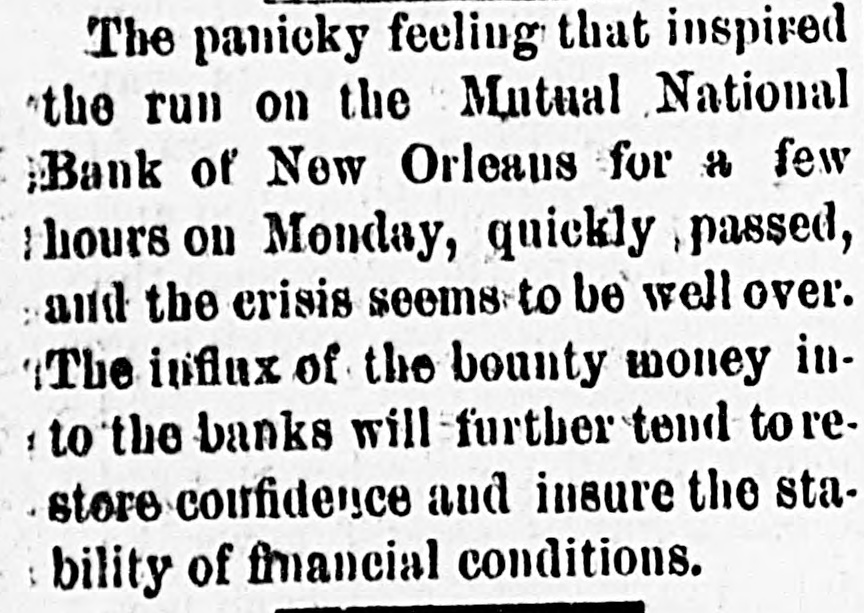
The panicky feeling that inspired the run on the Mutual National Bank of New Orleaus for a few hours on Monday, quickly passed
Source
newspapers
+31 days
3.September 10, 1896Run
Cause
Local Banks
Cause Details
Run triggered by failures/suspensions of other New Orleans banks (American National, Union National) and general panic.
Measures
Clearing house advances and other banks provided temporary assistance; clearing house later refused further aid
Newspaper Excerpt
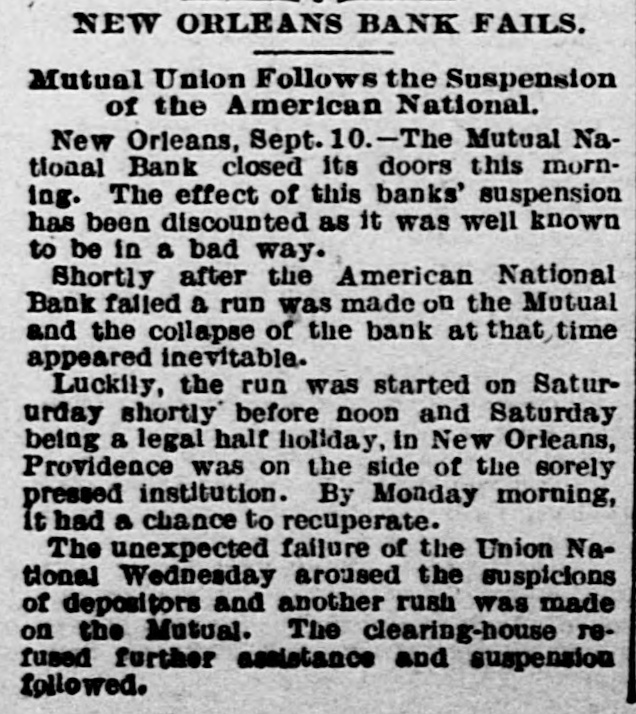
Shortly after the American National Bank failed a run was made on the Mutual and the collapse of the bank at that time appeared inevitable.
Source
newspapers
same day
4.September 10, 1896Suspension
Cause
Local Banks
Cause Details
Suspension followed heavy withdrawals and refusal of further clearing-house assistance after runs tied to other bank failures.
Newspaper Excerpt
The Mutual National Bank closed its doors this morning. ... the clearing-house refused further assistance and suspension followed.
Source
newspapers
+5 months
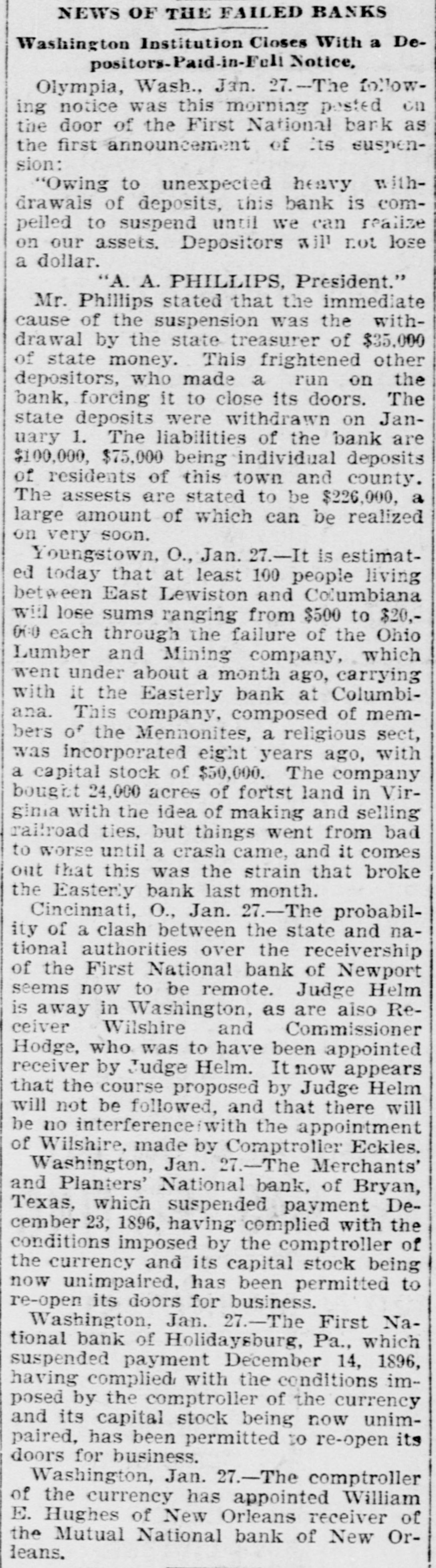
5.January 27, 1897Receivership
Newspaper Excerpt
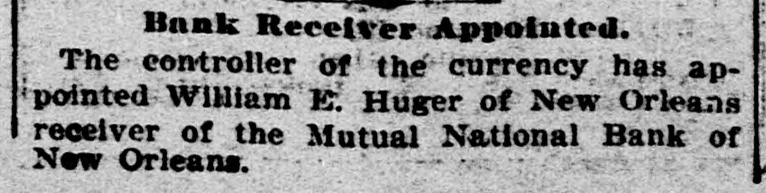
The comptroller of the currency has appointed William E. Huger of New Orleans receiver of the Mutual National Bank of New Orleans.
Source
newspapers
same day
6.January 27, 1897Receivership
Source
historical_nic
Newspaper Articles (24)
1.August 15, 1896The True DemocratSaint Francisville, Bayou Sara, LA
Click image to open full size in new tab
Article Text
The panicky feeling that inspired the run on the Mutual National Bank of New Orleaus for a few I hours on Monday, quickly passed, and the erisis seems to be well over. : The influx of the bounty money into the banks will further tend to restore confidence and insure the sta: bility of frnancial conditions.
2.September 10, 1896Rock Island ArgusRock Island, IL
Click image to open full size in new tab
Article Text
lank Suspends
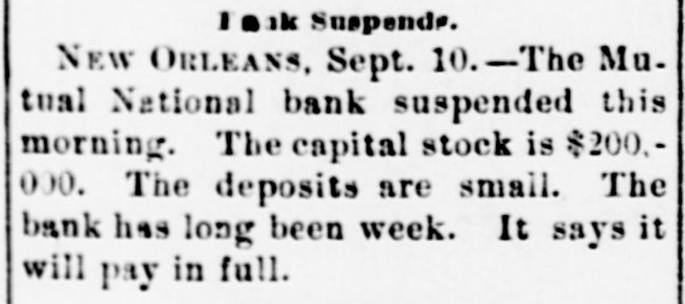
NEW ORLEANS, Sept. 10.-The Mu. tual National bank suspended this morning. The capital stock is $200.000. The deposits are small. The bank has long been week. It says it will pay in full.
3.September 11, 1896The Topeka State JournalTopeka, KS
Click image to open full size in new tab
Article Text
PANIC IN NEW ORLEANS
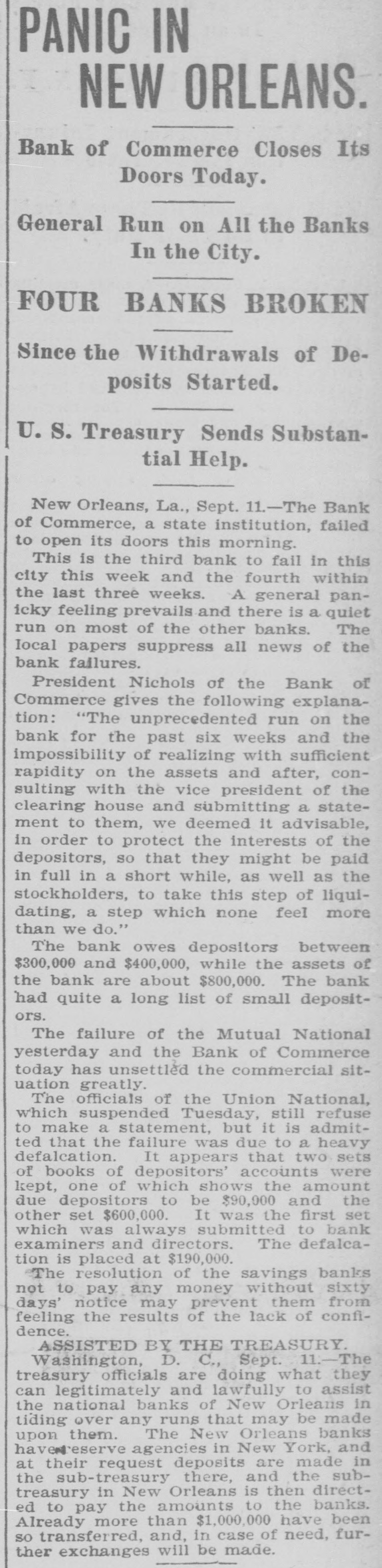
Bank of Commerce Closes Its Doors Today. General Run on All the Banks In the City. FOUR BANKS BROKEN Since the Withdrawals of Deposits Started. U.S. Treasury Sends Substantial Help. New Orleans, La., Sept. 11.-The Bank of Commerce, a state institution, failed to open its doors this morning. This is the third bank to fail in this city this week and the fourth within the last three weeks. A general panicky feeling prevails and there is a quiet run on most of the other banks. The Iocal papers suppress all news of the bank failures. President Nichols of the Bank of Commerce gives the following explanation: "The unprecedented run on the bank for the past six weeks and the impossibility of realizing with sufficient rapidity on the assets and after, consulting with the vice president of the clearing house and submitting a statement to them, we deemed it advisable, in order to protect the interests of the depositors, so that they might be paid in full in a short while, as well as the stockholders, to take this step of liquidating, a step which none feel more than we do." The bank owes depositors between $300,000 and $400,000, while the assets of the bank are about $800,000. The bank had quite a long list of small depositors. The failure of the Mutual National yesterday and the Bank of Commerce today has unsettled the commercial situation greatly. The officials of the Union National, which suspended Tuesday, still refuse to make a statement, but it is admitted that the failure was due to a heavy defalcation. It appears that two sets of books of depositors' accounts were kept, one of which shows the amount due depositors to be $90,000 and the other set $600,000. It was the first set which was always submitted to bank examiners and directors. The defalcation is placed at $190,000. The resolution of the savings banks not to pay any money without sixty days' notice may prevent them from feeling the results of the lack of confidence. ASSISTED BY THE TREASURY. Washington, D. C., Sept. 11.-The treasury officials are doing what they can legitimately and lawfully to assist the national banks of New Orleans in tiding over any runs that may be made upon them. The New Orleans banks havenreserve agencies in New York, and at their request deposits are made in the sub-treasury there, and the subtreasury in New Orleans is then directed to pay the amounts to the banks. Already more than $1,000,000 have been so transferred, and, in case of need, further exchanges will be made.
4.September 11, 1896The Norfolk VirginianNorfolk, VA
Click image to open full size in new tab
Article Text
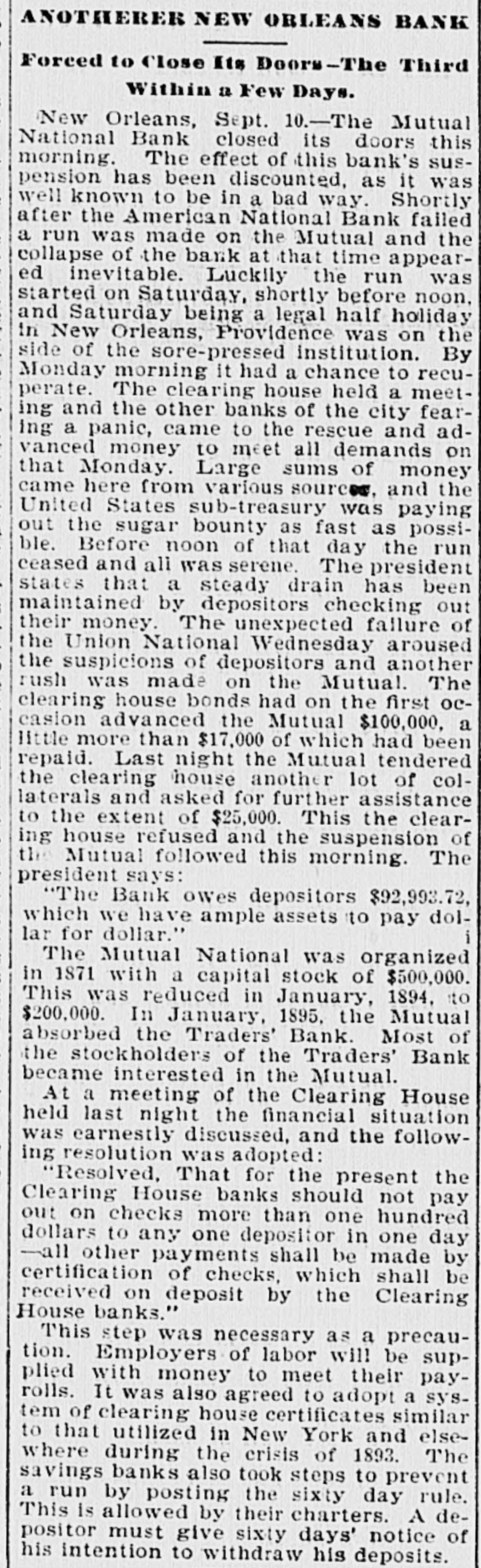
ANOTIERER NEW ORLEANS BANK Forced to Close Its Doors-The Third Within 12 Few Days. New Orleans, Sept. 10.-The Mutual National Bank closed its doors this morning. The effect of this bank's suspension has been discounted, as it was well known to be in a bad way. Shortly after the American National Bank failed a run was made on the Mutual and the collapse of the bank at that time appeared inevitable. Luckily the run was started on Saturday, shortly before noon, and Saturday being a legal half holiday in New Orleans, Providence was on the side of the sore-pressed institution. By Monday morning it had a chance to recuperate. The clearing house held a meeting and the other banks of the city fearing a panic, came to the rescue and advanced money to meet all demands on that Monday. Large sums of money came here from various sources and the United States sub-treasury was paying out the sugar bounty as fast as possible. Before noon of that day the run ceased and all was serene. The president states that a steady drain has been maintained by depositors checking out their money. The unexpected failure of the Union National Wednesday aroused the suspicions of depositors and another rush was made on the Mutual. The clearing house bonds had on the first occasion advanced the Mutual $100,000. a little more than $17,000 of which had been repaid. Last night the Mutual tendered the clearing house another lot of collaterals and asked for further assistance to the extent of $25,000. This the clearing house refused and the suspension of the Mutual followed this morning. The president says: "The Bank owes depositors $92,993.72, which we have ample assets to pay dollar for dollar." The Mutual National was organized in 1871 with a capital stock of $500,000. This was reduced in January, 1894, to $200,000. In January, 1895. the Mutual absorbed the Traders' Bank. Most of the stockholders of the Traders' Bank became interested in the Mutual. At a meeting of the Clearing House held last night the financial situation was earnestly discussed, and the following resolution was adopted: "Resolved, That for the present the should Clearing House banks not pay out on checks more than one hundred dollars to any one depositor in one day -all other payments shall be made by certification of checks, which shall be received on deposit by the Clearing House banks." This step was necessary as a precaution. Employers of labor will be supplied with money to meet their payrolls. It was also agreed to adopt a system of clearing house certificates similar to that utilized in New York and elsewhere during the crisis of 1893. The savings banks also took steps to prevent a run by posting the sixty day rule. This is allowed by their charters. A depositor must give sixty days' notice of his intention to withdraw his deposits.
5.September 11, 1896The San Francisco CallSan Francisco, CA
Click image to open full size in new tab
Article Text
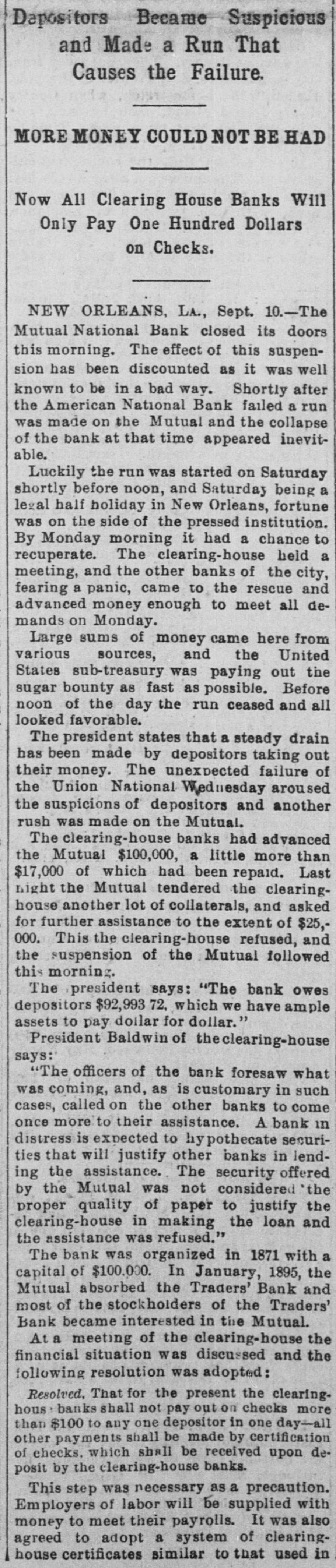
Dapositors Became Suspicious and Made a Run That Causes the Failure. MORE MONEY COULD NOT BE HAD Now All Clearing House Banks Will Only Pay One Hundred Dollars on Checks. NEW ORLEANS, LA., Sept. 10.-The Mutual National Bank closed its doors this morning. The effect of this suspension has been discounted as it was well known to be in a bad way. Shortly after the American National Bank failed a run was made on the Mutual and the collapse of the bank at that time appeared inevitable. Luckily the run was started on Saturday shortly before noon, and Saturday being a legal half holiday in New Orleans, fortune was on the side of the pressed institution. By Monday morning it had a chance to recuperate. The clearing-house held a meeting, and the other banks of the city, fearing a panic, came to the rescue and advanced money enough to meet all demands on Monday. Large sums of money came here from various sources, and the United States sub-treasury was paying out the sugar bounty as fast as possible. Before noon of the day the run ceased and all looked favorable. The president states that a steady drain has been made by depositors taking out their money. The unexpected failure of the Union National Wednesday aroused the suspicions of depositors and another rush was made on the Mutual. The clearing-house banks had advanced the Mutual $100,000, a little more than $17,000 of which had been repaid. Last night the Mutual tendered the clearinghouse another lot of collaterals, and asked for further assistance to the extent of $25,000. This the clearing-house refused, and the suspension of the Mutual followed this morning. The president says: "The bank owes depositors $92,993 72. which we have ample assets to pay dollar for dollar." President Baldwin of the clearing=house says: "The officers of the bank foresaw what was coming, and, as is customary in such cases, called on the other banks to come once more to their assistance. A bank in distress is expected to hy pothecate securities that will justify other banks in lending the assistance. The security offered by the Mutual was not considered *the proper quality of paper to justify the clearing-house in making the loan and the assistance was refused." The bank was organized in 1871 with a capital of $100.000. In January, 1895, the Mutual absorbed the Traders' Bank and most of the stockholders of the Traders' Bank became interested in the Mutual. At a meeting of the clearing-house the financial situation was discussed and the following resolution was adopted: Resolved, That for the present the clearing. hous banks shall not pay out on checks more than $100 to any one depositor in one day-all other payments shall be made by certification of checks. which shall be received upon deposit by the clearing-house banks. This step was necessary as a precaution. Employers of labor will be supplied with money to meet their payrolls. It was also agreed to adopt a system of clearinghouse certificates similar to that used in
6.September 11, 1896Great Falls Weekly TribuneGreat Falls, MT
Click image to open full size in new tab
Article Text
Still Another Closed
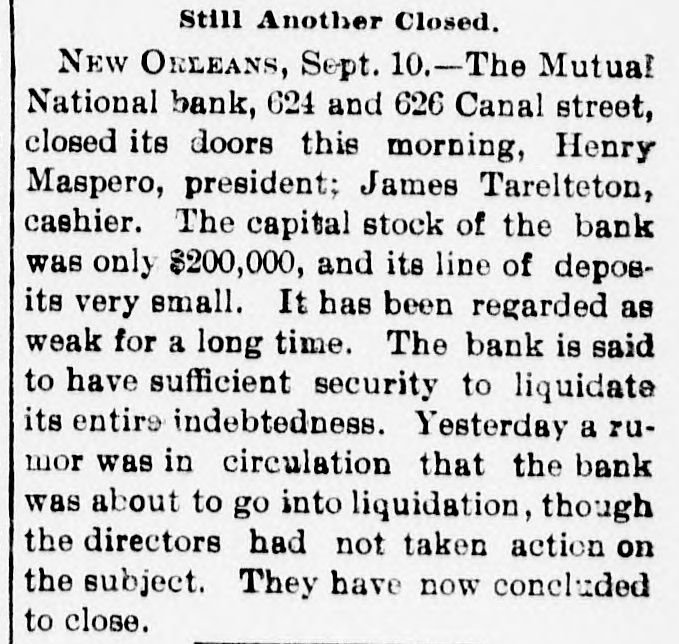
NEW ORLEANS, Sept. 10.-The Mutual National bank, 624 and 626 Canal street, closed its doors this morning, Henry Maspero, president; James Tarelteton, cashier. The capital stock of the bank was only $200,000, and its line of deposits very small. It has been regarded as weak for a long time. The bank is said to have sufficient security to liquidate its entire indebtedness. Yesterday a rumor was in circulation that the bank was about to go into liquidation, though the directors had not taken action on the subject. They have now concluded to close.
7.September 11, 1896The Copper Country Evening NewsCalumet, MI
Click image to open full size in new tab
Article Text
Another New Orleans Bank Closed
New Orleans, Sept. 11.-The Mutual National bank suspended Thursday,
8.September 11, 1896Wheeling RegisterWheeling, WV
Click image to open full size in new tab
Article Text
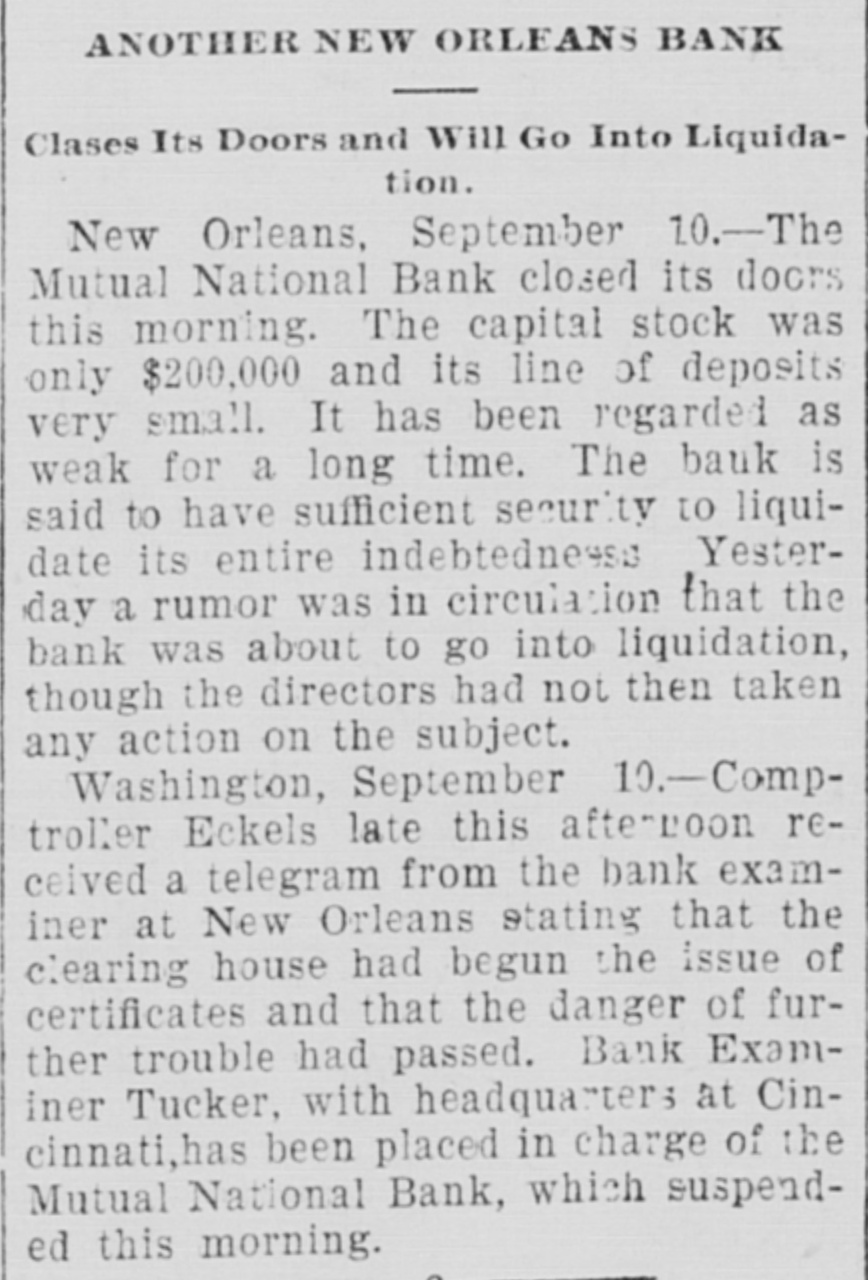
ANOTHER NEW ORLEANS BANK Clases Its Doors and Will Go Into Liquidation. New Orleans, September 10.-The Mutual National Bank closed its doors this morning. The capital stock was only $200,000 and its line of deposits very small. It has been regarded as weak for a long time. The bauk is said to have sufficient security to liquidate its entire indebtedness Yesterday a rumor was in circulation that the bank was about to go into liquidation, though the directors had not then taken any action on the subject. Washington, September 10.-Comptroller Eckels late this afterroon received a telegram from the bank examiner at New Orleans stating that the clearing house had begun the issue of certificates and that the danger of further trouble had passed. Bank Examiner Tucker, with headquarter3 at Cincinnati,has been placed in charge of the Mutual National Bank, which suspended this morning.
9.September 11, 1896The Salt Lake HeraldSalt Lake City, UT
Click image to open full size in new tab
Article Text
BANK BURSTS
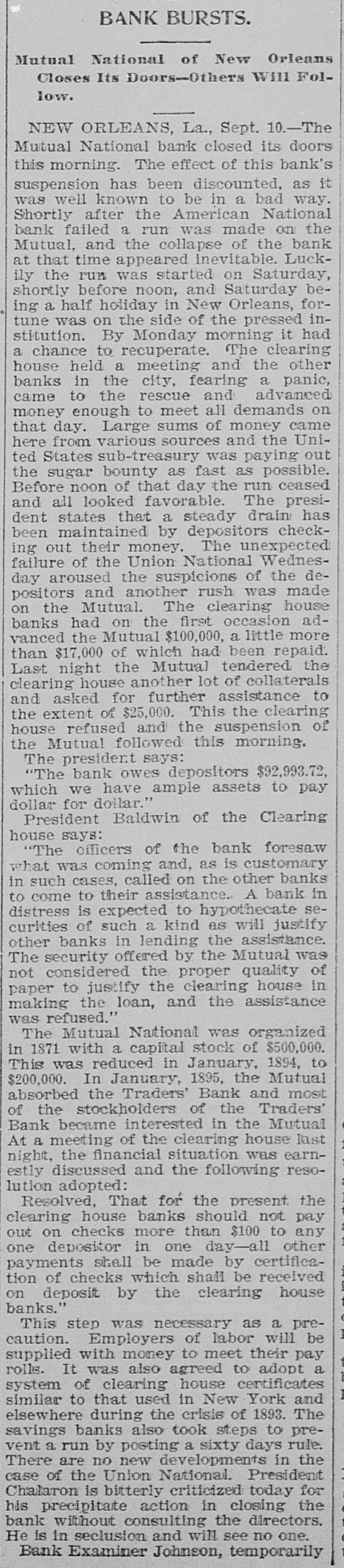
Mutual National of New Orleans Closes Its Doors-Others Will Follow. NEW ORLEANS, La., Sept. 10.-The Mutual National bank closed its doors this morning. The effect of this bank's suspension has been discounted, as it was well known to be in a bad way. Shortly after the American National bank failed a run was made on the Mutual, and the collapse of the bank at that time appeared inevitable. Luckily the run was started on Saturday, shortly before noon, and Saturday being a half holiday in New Orleans, fortune was on the side of the pressed institution. By Monday morning it had a chance to recuperate. The clearing house held a meeting and the other banks in the city, fearing a panic, came to the rescue and advanced money enough to meet all demands on that day. Large sums of money came here from various sources and the United States sub-treasury was paying out the sugar bounty as fast as possible. Before noon of that day the run ceased and all looked favorable. The president states that a steady drain has been maintained by depositors checking out their money. The unexpected failure of the Union National Wednesday aroused the suspicions of the depositors and another rush was made on the Mutual. The clearing house banks had on the first occasion advanced the Mutual $100,000, a little more than $17,000 of which had been repaid. Last night the Mutual tendered the clearing house another lot of collaterals and asked for further assistance to the extent of $25,000. This the clearing house refused and the suspension of the Mutual followed this morning. The president says: "The bank owes depositors $92,993.72, which we have ample assets to pay dollar for dollar." President Baldwin of the Clearing house says: "The officers of the bank foresaw what was coming and, as is customary in such cases, called on the other banks to come to their assistance. A bank in distress is expected to hypothecate securities of such a kind as will justify other banks in lending the assistance. The security offered by the Mutual was not considered the proper quality of paper to justify the clearing house in making the loan, and the assistance was refused." The Mutual National was organized in 1871 with a capital stock of $500,000. This was reduced in January, 1894, to $200,000. In January, 1895, the Mutual absorbed the Traders' Bank and most of the stockholders of the Traders' Bank became interested in the Mutual At a meeting of the clearing house last night, the financial situation was earnestly discussed and the following resolution adopted: Resolved, That for the present the clearing house banks should not pay out on checks more than $100 to any one depositor in one day-all other payments shall be made by certification of checks which shall be received on deposit by the clearing house banks." This step was necessary as a precaution. Employers of labor will be supplied with money to meet their pay rolls. It was also agreed to adopt a system of clearing house certificates 1 similar to that used in New York and elsewhere during the crisis of 1893. The savings banks also took steps to prevent a run by posting a sixty days rule. There are no new developments in the case of the Union National. President Chalaron is bitterly criticized today for his precipitate action in closing the bank without consulting the directors. He is in seclusion and will see no one. Bank Examiner Johnson, temporarily
10.September 11, 1896The Morning TimesWashington, DC
Click image to open full size in new tab
Article Text
NEW ORLEANS BANK FAILS
Mutual Union Follows the Suspension of the American National. New Orleans, Sept. 10.-The Mutual National Bank closed its doors this morning. The effect of this banks' suspension has been discounted as it was well known to be in a bad way. Shortly after the American National Bank failed a run was made on the Mutual and the collapse of the bank at that time appeared inevitable. Luckily, the run was started on Satururday shortly' before noon and Saturday being a legal half holiday, in New Orleans, Providence was on the side of the sorely pressed institution. By Monday morning, it had a chance to recuperate. The unexpected failure of the Union National Wednesday aroused the suspicions of depositors and another rush was made on the Mutual. The clearing-house refused further assistance and suspension followed.
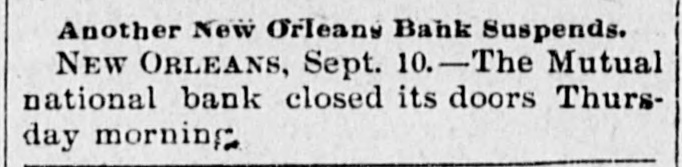
NEW ORLEANS, Sept. 10.-The Mutual national bank closed its doors Thursday morning
12.September 12, 1896The Daily Morning Journal and CourierNew Haven, CT
Click image to open full size in new tab
Article Text
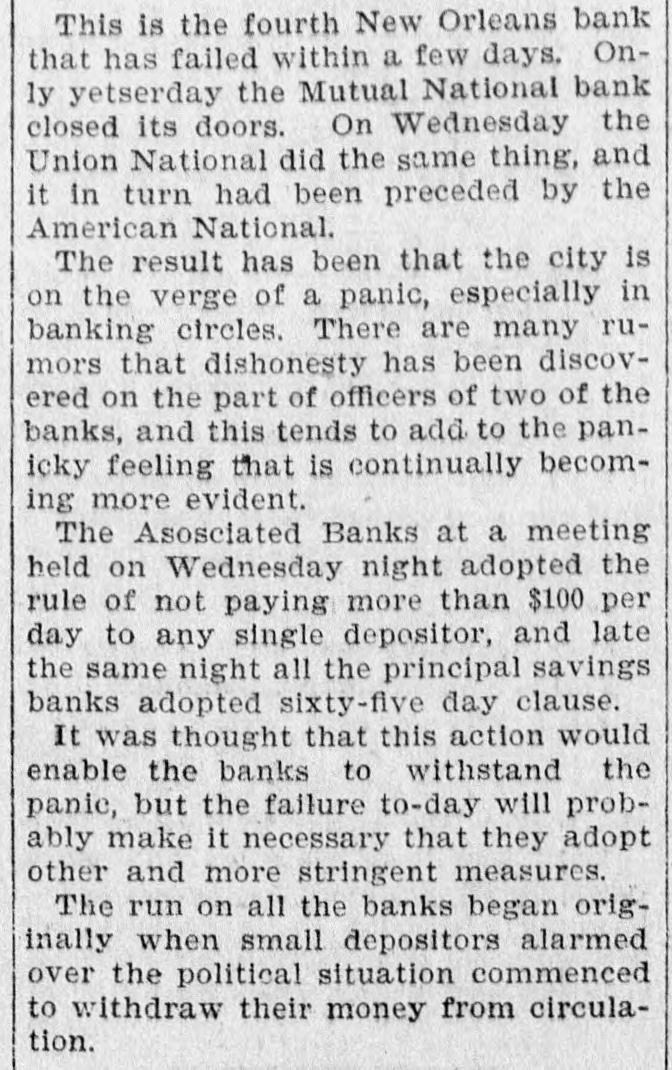
This is the fourth New Orleans bank that has failed within a few days. Only yetserday the Mutual National bank closed its doors. On Wednesday the Union National did the same thing, and it in turn had been preceded by the American National. The result has been that the city is on the verge of a panic, especially in banking circles. There are many rumors that dishonesty has been discovered on the part of officers of two of the banks, and this tends to add to the panicky feeling that is continually becoming more evident. The Asosciated Banks at a meeting held on Wednesday night adopted the rule of not paying more than $100 per day to any single depositor, and late the same night all the principal savings banks adopted sixty-five day clause. It was thought that this action would enable the banks to withstand the panic, but the failure to-day will probably make it necessary that they adopt other and more stringent measures. The run on all the banks began originally when small depositors alarmed over the political situation commenced to withdraw their money from circulation.
13.September 12, 1896Birmingham State HeraldBirmingham, AL
Click image to open full size in new tab
Article Text
Johnson Has Been Relieved
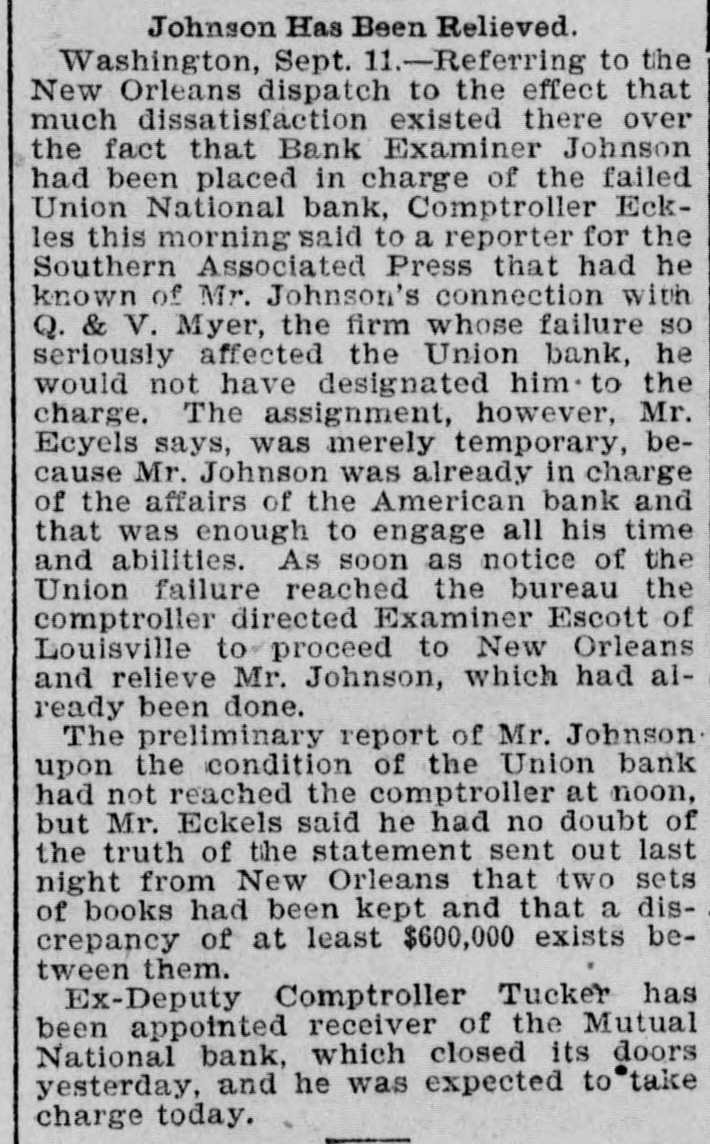
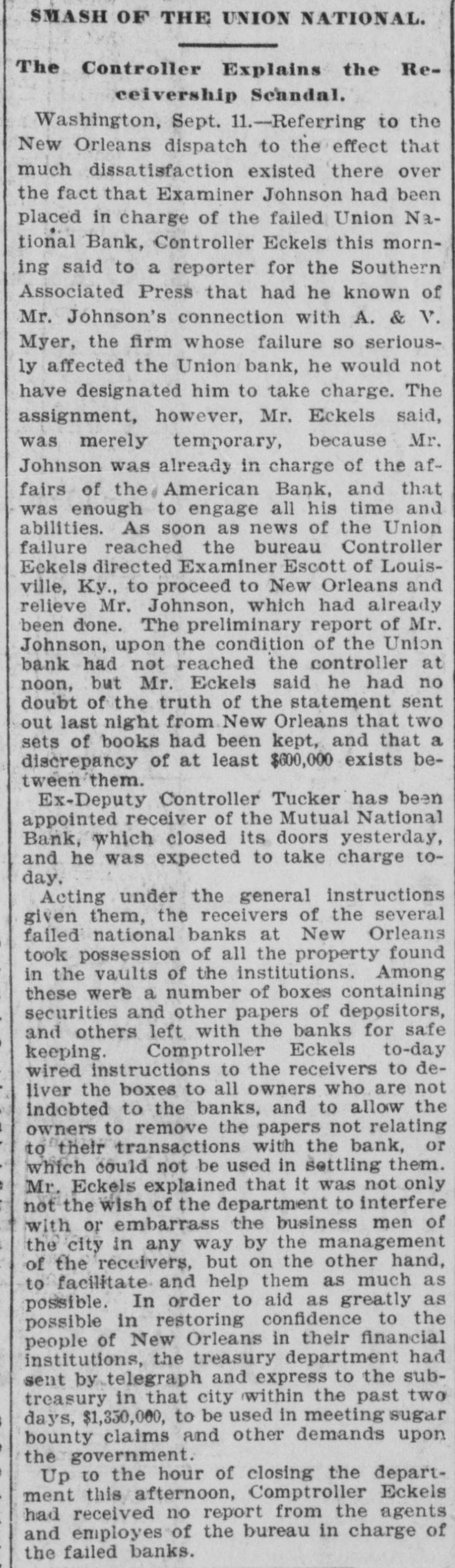
Washington, Sept. 11.-Referring to the New Orleans dispatch to the effect that much dissatisfaction existed there over the fact that Bank Examiner Johnson had been placed in charge of the failed Union National bank, Comptroller Eckles this morning said to a reporter for the Southern Associated Press that had he known of Mr. Johnson's connection with Q. & V. Myer, the firm whose failure so seriously affected the Union bank, he would not have designated him. to the charge. The assignment, however, Mr. Ecyels says, was merely temporary, because Mr. Johnson was already in charge of the affairs of the American bank and that was enough to engage all his time and abilities. As soon as notice of the Union failure reached the bureau the comptroller directed Examiner Escott of Louisville to proceed to New Orleans and relieve Mr. Johnson, which had already been done. The preliminary report of Mr. Johnson upon the condition of the Union bank had not reached the comptroller at noon, but Mr. Eckels said he had no doubt of the truth of the statement sent out last night from New Orleans that two sets of books had been kept and that a discrepancy of at least $600,000 exists between them. Ex-Deputy Comptroller Tucker has been appointed receiver of the Mutual National bank, which closed its doors yesterday, and he was expected to take charge today.
14.September 12, 1896The Morning NewsSavannah, GA
Click image to open full size in new tab
Article Text
SMASH OF THE UNION NATIONAL
The Controller Explains the Receivership Scandal. Washington, Sept. 11.-Referring to the New Orleans dispatch to the effect that much dissatisfaction existed there over the fact that Examiner Johnson had been placed in charge of the failed Union National Bank, Controller Eckels this morning said to a reporter for the Southern Associated Press that had he known of Mr. Johnson's connection with A. & V. Myer, the firm whose failure so seriously affected the Union bank, he would not have designated him to take charge. The assignment, however, Mr. Eckels said, was merely temporary, because Mr. Johnson was already in charge of the affairs of the American Bank, and that was enough to engage all his time and abilities. As soon as news of the Union failure reached the bureau Controller Eckels directed Examiner Escott of Louisville, Ky., to proceed to New Orleans and relieve Mr. Johnson, which had already been done. The preliminary report of Mr. Johnson, upon the condition of the Union bank had not reached the controller at noon, but Mr. Eckels said he had no doubt of the truth of the statement sent out last night from New Orleans that two sets of books had been kept, and that a discrepancy of at least $600,000 exists between them. Ex-Deputy Controller Tucker has been appointed receiver of the Mutual National Bank, which closed its doors yesterday, and he was expected to take charge today. Acting under the general instructions given them, the receivers of the several failed national banks at New Orleans took possession of all the property found in the vaults of the institutions. Among these were a number of boxes containing securities and other papers of depositors, and others left with the banks for safe keeping. Comptroller Eckels to-day wired instructions to the receivers to deliver the boxes to all owners who are not indebted to the banks, and to allow the owners to remove the papers not relating to their transactions with the bank, or which could not be used in settling them. Mr. Eckels explained that it was not only not the wish of the department to interfere with or embarrass the business men of the city in any way by the management of the receivers, but on the other hand, to facilitate and help them as much as possible. In order to aid as greatly as possible in restoring confidence to the people of New Orleans in their financial institutions, the treasury department had sent by telegraph and express to the subtreasury in that city within the past two days, $1,350,000, to be used in meeting sugar bounty claims and other demands upon the government. Up to the hour of closing the department this afternoon, Comptroller Eckels had received no report from the agents and employes of the bureau in charge of the failed banks.
15.September 12, 1896The Providence NewsProvidence, RI
Click image to open full size in new tab
Article Text
ANOTHER BANK CLOSED
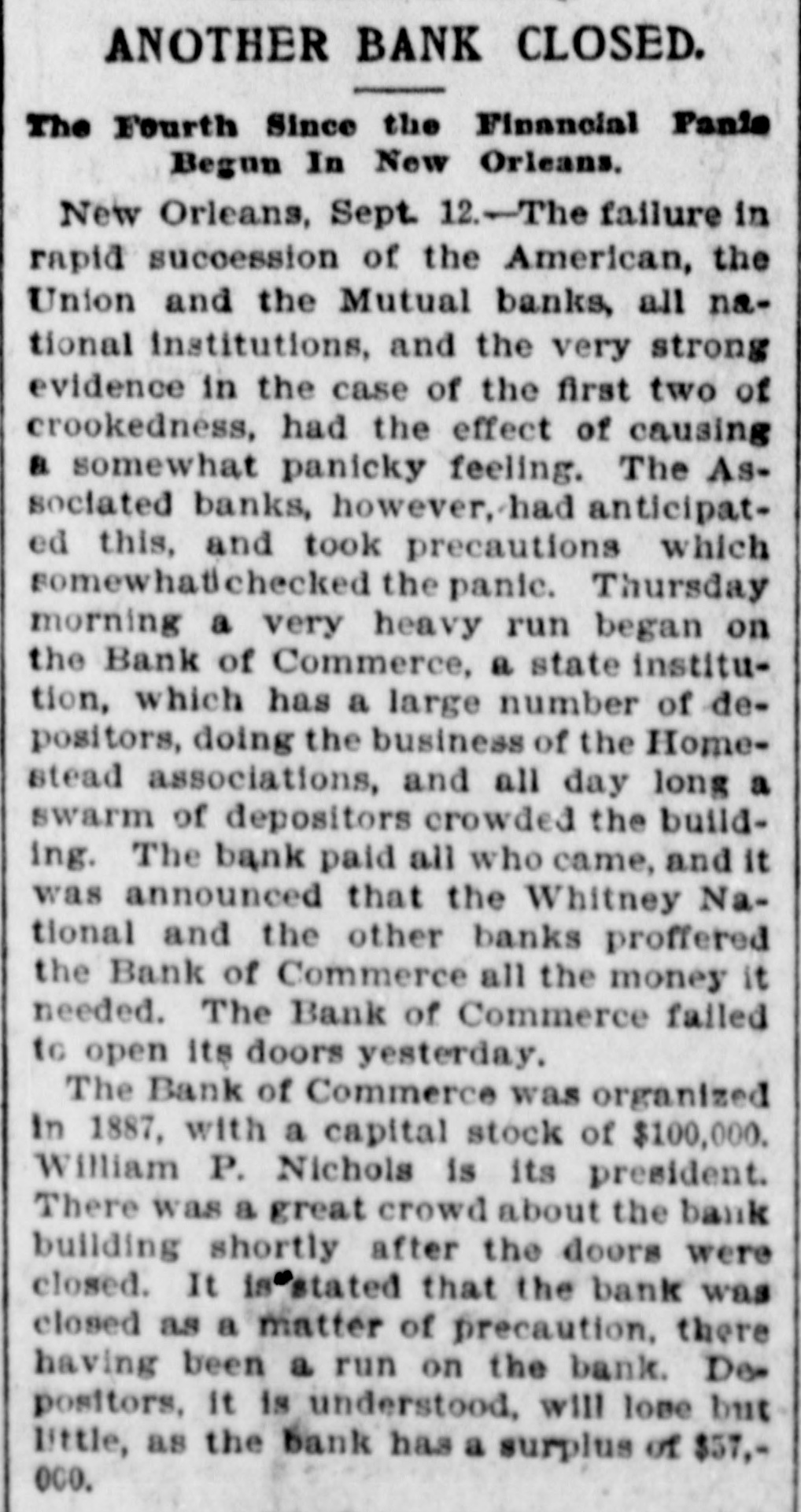
The Fourth Since the Financial Fanis Begun In New Orleans. New Orleans, Sept. 12-The failure in rapid succession of the American, the Union and the Mutual banks, all national institutions, and the very strong evidence in the case of the first two of crookedness, had the effect of causing a somewhat panicky feeling. The Associated banks, however, had anticipated this, and took precautions which somewhatichecked the panic. Thursday morning a very heavy run began on the Bank of Commerce, a state institution, which has a large number of depositors, doing the business of the Homestead associations, and all day long a swarm of depositors crowded the building. The bank paid all who came, and it was announced that the Whitney National and the other banks proffered the Bank of Commerce all the money it needed. The Bank of Commerce failed to open its doors yesterday. The Bank of Commerce was organized In 1887, with a capital stock of $100,000. William P. Nichols is its president. There was a great crowd about the bank building shortly after the doors were closed. It is stated that the bank was closed as a matter of precaution, there having been a run on the bank. Depositors, it is understood, will lose but little, as the bank has a surplus of $57,000.
16.September 17, 1896The Free PressPoplarville, MS
Click image to open full size in new tab
Article Text
The Mutual National Bank, of New Orleans, suspended on the 10.
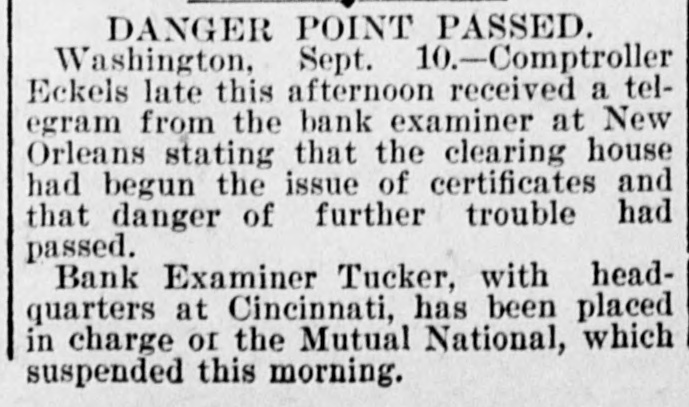
Washington, Sept. 10.-Comptroller Eckels late this afternoon received a telegram from the bank examiner at New Orleans stating that the clearing house had begun the issue of certificates and that danger of further trouble had passed. Bank Examiner Tucker, with headquarters at Cincinnati, has been placed in charge or the Mutual National, which suspended this morning.
18.September 18, 1896The Red Cloud ChiefRed Cloud, NE
Click image to open full size in new tab
Article Text
Another New Orleans Bank Failure
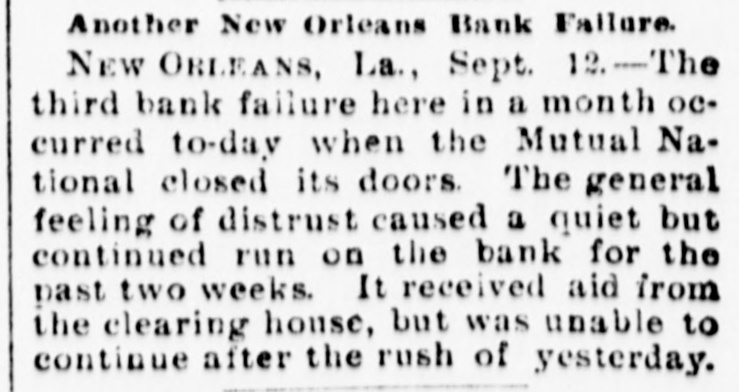
NEW ORLEANS, La., Sept. 12.-The third bank failure here in a month occurred to-day when the Mutual National closed its doors. The general feeling of distrust caused a quiet but continued run on the bank for the past two weeks. It received aid from the clearing house, but was unable to continue after the rush of yesterday.
19.September 19, 1896The American GuideLittle Rock, AR
Click image to open full size in new tab
Article Text
THROUGHOUT LOUISIANA
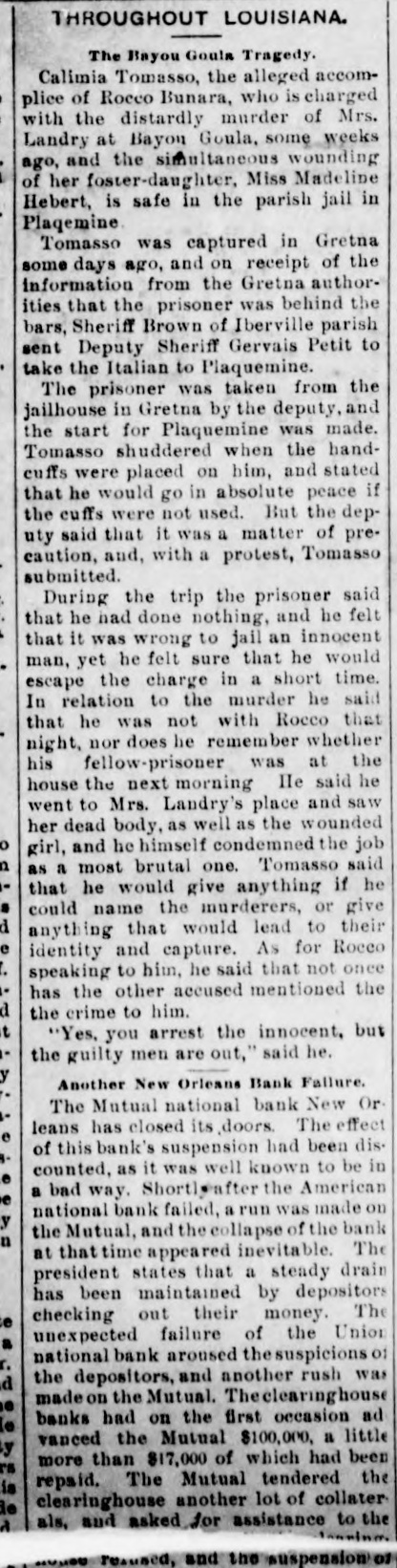
The Bayou Goula Tragedy. Calimia Tomasso, the alleged accomplice of Rocco Bunara, who is charged with the distardly murder of Mrs. Landry at Bayon Goula, some weeks ago, and the simultaneous wounding of her foster-daughter, Miss Madeline Hebert, is safe in the parish jail in Plaqemine Tomasso was captured in Gretna some days ago, and on receipt of the information from the Gretna authorities that the prisoner was behind the bars, Sheriff Brown of Iberville parish sent Deputy Sheriff Gervais Petit to take the Italian to Plaquemine. The prisoner was taken from the jailhouse in Gretna by the deputy, and the start for Plaquemine was made. Tomasso shuddered when the handcuffs were placed on him, and stated that he would go in absolute peace if the cuffs were not used. But the deputy said that it was a matter of precaution, and, with a protest, Tomasso submitted. During the trip the prisoner said that he had done nothing, and he felt that it was wrong to jail an innocent man, yet he felt sure that he would escape the charge in a short time. In relation to the murder he said that he was not with Rocco that night, nor does he remember whether his fellow-prisoner was at the house the next morning He said he went to Mrs. Landry's place and saw her dead body, as well as the wounded o girl, and he himself condemned the job n as a most brutal one. Tomasso said that he would give anything if he a could name the murderers, or give d anything that would lead to their e identity and capture. As for Rocco . speaking to him, he said that not once has the other accused mentioned the a the crime to him. t "Yes, you arrest the innocent, but the guilty men are out," said he. y Another New Orleans Bank Failure. The Mutual national bank New Or leans has closed its doors. The effect e of this bank's suspension had been dis. Ncounted, as it was well known to be in e a bad way. Shortlyafter the American e national bank failed, a run was made on y the Mutual, and the collapse of the bank n at that time appeared inevitable. The president states that a steady drain has been maintained by depositors checking out their money. The e unexpected failure of the Union national bank aroused the suspicions of r. the depositors, and another rush was d made on the Mutual. The clearing house e banks had on the first occasion ad le vanced the Mutual $100,000, a little y more than $17,000 of which had been rs repaid. The Mutual tendered the is clearinghouse another lot of collater de als, and asked for assistance to the a reaused, and the suspension of
20.September 25, 1896Tensas GazetteSaint Joseph, LA
Click image to open full size in new tab
Article Text
THE NEW ORLEANS BANK FAILURES
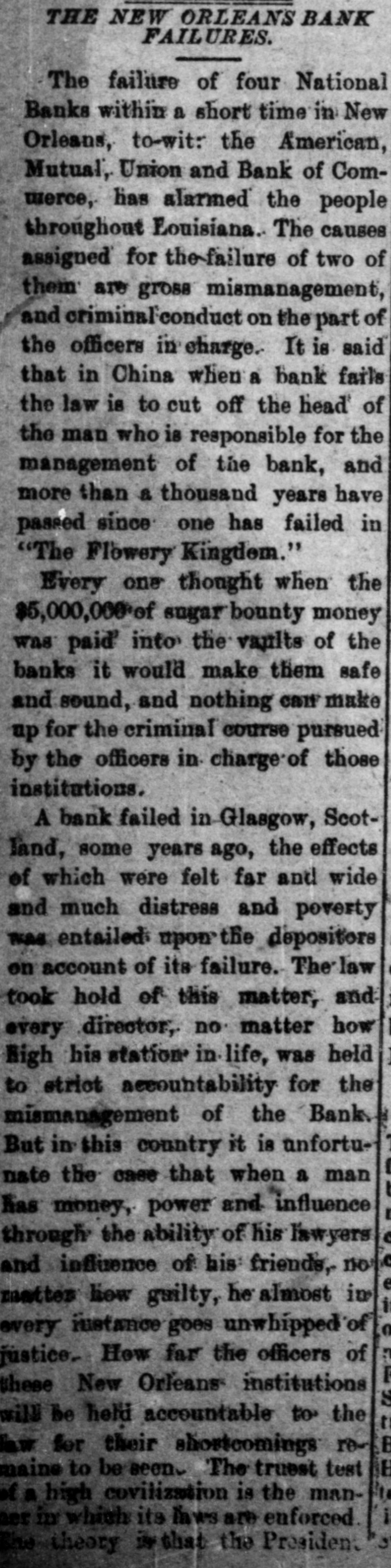
The failure of four National Banks within a short time in New Orleans, to-wit: the American, Mutual, Union and Bank of Comшегсе, has alarmed the people throughout Eouisiana. The causes assigned for the-failure of two of them are gross mismanagement, and criminal conduct on the part of the officers in charge.. It is said that in China when a bank fails the law is to cut off the head of the man who is responsible for the management of the bank, and more than a thousand years have passed since one has failed in "The Flowery Kingdom." Every one thought when the $5,000,000 of sugar bounty money was paid into the vaults of the banks it would make them safe and sound, and nothing can make up for the criminal course pursued by the officers in charge of those institutions. A bank failed in Glasgow, Scotland, some years ago, the effects of which were felt far and wide and much distress and poverty was entailed upon the depositors on account of its failure. The law took hold of this matter, and every director, no matter how High his station in life, was held to strict accountability for the mismanagement of the Bank. But in this country it is unfortunate the case that when a man has money, power and influence through the ability of his law yers and influence of his friends,- no matter how guilty, he almost in every instance goes unwhipped of justice- How far the officers of these New Orleans institutions will be held accountable to the law for their shortcomings remaine to be seen- The truest test of a high covilization is the manthem enfureed
21.October 18, 1896San Antonio Daily LightSan Antonio, TX
Click image to open full size in new tab
Article Text
A NEW BANK STARTS
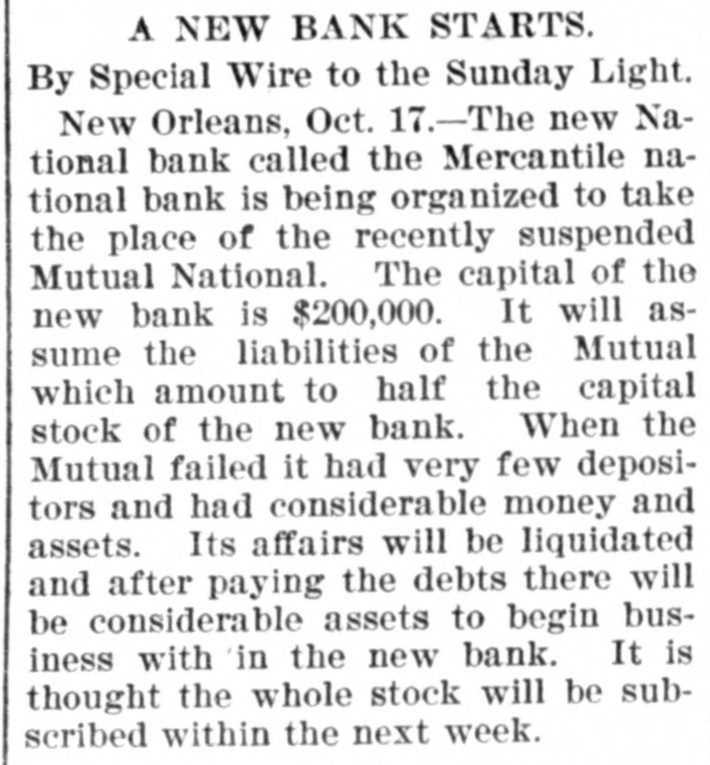
By Special Wire to the Sunday Light. New Orleans, Oct. 17.-The new National bank called the Mercantile national bank is being organized to take the place of the recently suspended Mutual National. The capital of the new bank is $200,000. It will assume the liabilities of the Mutual which amount to half the capital stock of the new bank. When the Mutual failed it had very few depositors and had considerable money and assets. Its affairs will be liquidated and after paying the debts there will be considerable assets to begin business with 'in the new bank. It is thought the whole stock will be subscribed within the next week.
22.January 28, 1897Evening StarWashington, DC
Click image to open full size in new tab
Article Text
Bank Receiver Appointed
The controller of the currency has appointed William E. Huger of New Orleans receiver of the Mutual National Bank of New Orleans.
NEWS OF THE FAILED BANKS Washington Institution Closes With a Depositors-Pa1d-in-Fuli Notice, Olympia, Wash., Jan. 27.-The following notice was this morning posted on the door of the First National bank as the first announcement of its suspension: "Owing to unexpected heavy withdrawals of deposits, this bank is compelled to suspend until we can realize on our assets. Depositors will not lose a dollar. "A. A. PHILLIPS, President." Mr. Phillips stated that the immediate cause of the suspension was the withdrawal by the state treasurer of $35,000 of state money. This frightened other depositors, who made a run on the bank, forcing it to close its doors. The state deposits were withdrawn on January 1. The liabilities of the bank are $100,000, $75,000 being individual deposits of residents of this town and county. The assests are stated to be $226,000, a large amount of which can be realized on very soon. Youngstown, O., Jan. 27.-It is estimated today that at least 100 people living between East Lewiston and Columbiana will lose sums ranging from $500 to $20,000 each through the failure of the Ohio Lumber and Mining company, which went under about a month ago, carrying with it the Easterly bank at Columbiana. This company, composed of members of the Mennonites, a religious sect, was incorporated eight years ago, with a capital stock of $50,000. The company bought 24,000 acres of fortst land in Virginia with the idea of making and selling railroad ties, but things went from bad to worse until a crash came, and it comes out that this was the strain that broke the Easterly bank last month. Cincinnati, O., Jan. 27.-The probability of a clash between the state and national authorities over the receivership of the First National bank of Newport seems now to be remote. Judge Helm is away in Washington, as are also Receiver Wilshire and Commissioner Hodge, who was to have been appointed receiver by Judge Helm. Itnow appears that the course proposed by Judge Helm will not be followed, and that there will be no interference/with the appointment of Wilshire. made by Comptroller Eckles. Washington, Jan. 27.-The Merchants' and Planters' National bank, of Bryan, Texas, which suspended payment December 23, 1896, having complied with the conditions imposed by the comptroller of the currency and its capital stock being now unimpaired, has been permitted to re-open its doors for business. Washington, Jan. 27.-The First National bank of Holidaysburg, Pa., which suspended payment December 14, 1896, having complied with the conditions imposed by the comptroller of the currency and its capital stock being now unimpaired, has been permitted to re-open its doors for business. Washington, Jan. 27.-The comptroller of the currency has appointed William E. Hughes of New Orleans receiver of the Mutual National bank of New Orleans.
24.February 4, 1897People's VoiceWellington, KS
Click image to open full size in new tab
Article Text
Dan Stuart has admitted that the attle ground of the Corbett-Fitzsimnons mill is to be in Nevada. Oranament, Typhoon and Dr. Cutett are quoted at 6 to 1 in a winter ook for the Kentucky derby. The senate by a vote of 41 to 15, has confirmed W.S. Foreman, of Illinois, internal revenue commissioner. Eleven men were severely burned, fatally, by an explosion in a coal mine at Foster, Ia., Wednesday night. According to official reports, there have been 4,395 cases of plague at Bombay, and 3,275 deaths from that disease. Building Inspector John R. Gillman has been arrested in connection with the Minneapolis, Minn., boodling scandal. Mrs. J. L. Flood, wife of the well known California millionaire, died in San Francisco Wednesday night of pneumonia. John P. Jones was re-elected to the senate from Nevada Tuesday. The vote in the assembly stood: Jones, 28; McMillan, 2. The following postoffices have been established; Indiana-Sharon, Jasper county; Tennessee-Compton, Rutherford county. Fire in the malt house of Overman & Schoeder at Cincinnati early Thursday morning did damage aggregating nearly $200,000. Jack Glasscock led the batters, Arthur Twineham the catchers and Bill Hassamear the second basemen in the Western league last season. The comptroller of the currency has appointed William F. Huger of New Orleans, receiver of the Mutual National bank of New Orleans. The senate has confirmed the ap pointment of William C. McCreery to be collector of internal revenue for the First district of Missouri. A movement is on foot to postpone the February term of the district court in Douglas county, Kas., until the contest between Riggs and Smart is settled. C. C. Merrill of Los Angeles, Cal. has secured the contract for putting in a sewer system in the City of Mex ico. The contract will amount to $3,000,000. The Nebraska senate has adopted : resolution directing Senator Thursto to vote for any measure providing fo the free coinage of silver at the rati of 16 to 1.
Bank runs are almost always and everywhere a deterioration of bank fundamentals.
But not for you.
You are the measure-zero exception: great fundamentals, solid bank, and yet the Diamond Dybvig fairy spread its rumor. Depositors woke up. Your collateral was not prepositioned. The Clearinghouse had it for you.
Do not pass Go. Do not collect $200. Go directly to jail… or worse.