Mutual National Bank (New Orleans, LA)

Episode Information

Episode UID
189800885
Episode Type
Suspension β†’ Reopening
Bank Type
national
Bank ID
18980 national
Charter Number
1898
Start Date
September 25, 1873
Location
New Orleans, Louisiana (29.955, -90.075)

Metadata

Model
gpt-5-mini (chosen from majority vote of a three-model LLM ensemble)
Short Digest
c56ed2e919d4739c

Response Measures

None

Receivership Details

Depositor recovery rate
82.8%
Date receivership started
1897-01-27
Date receivership terminated
1900-07-09
OCC cause of failure
Losses
Share of assets assessed as good
32.7%
Share of assets assessed as doubtful
54.1%
Share of assets assessed as worthless
13.2%

Events (4)

1. November 10, 1871 Chartered
Source
historical_nic
2. September 25, 1873 Suspension
Cause
Macro News
Cause Details
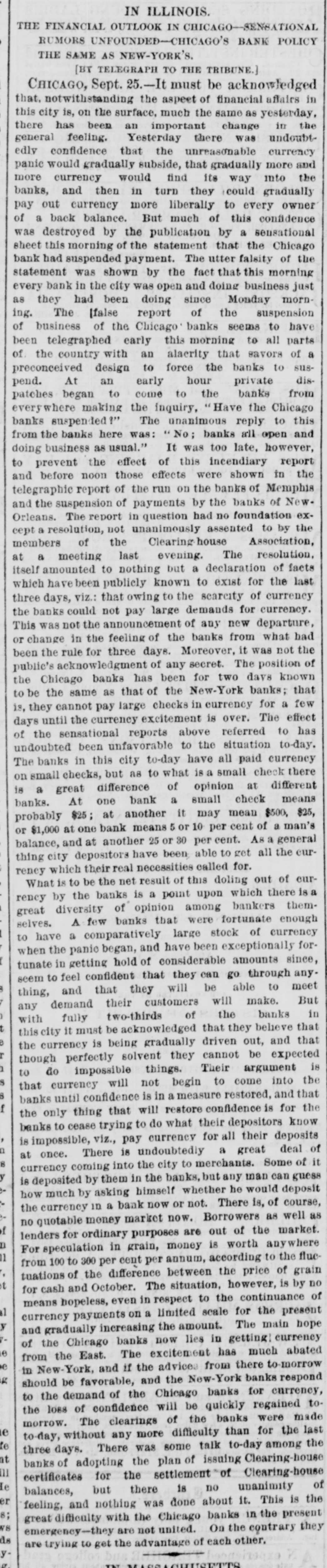
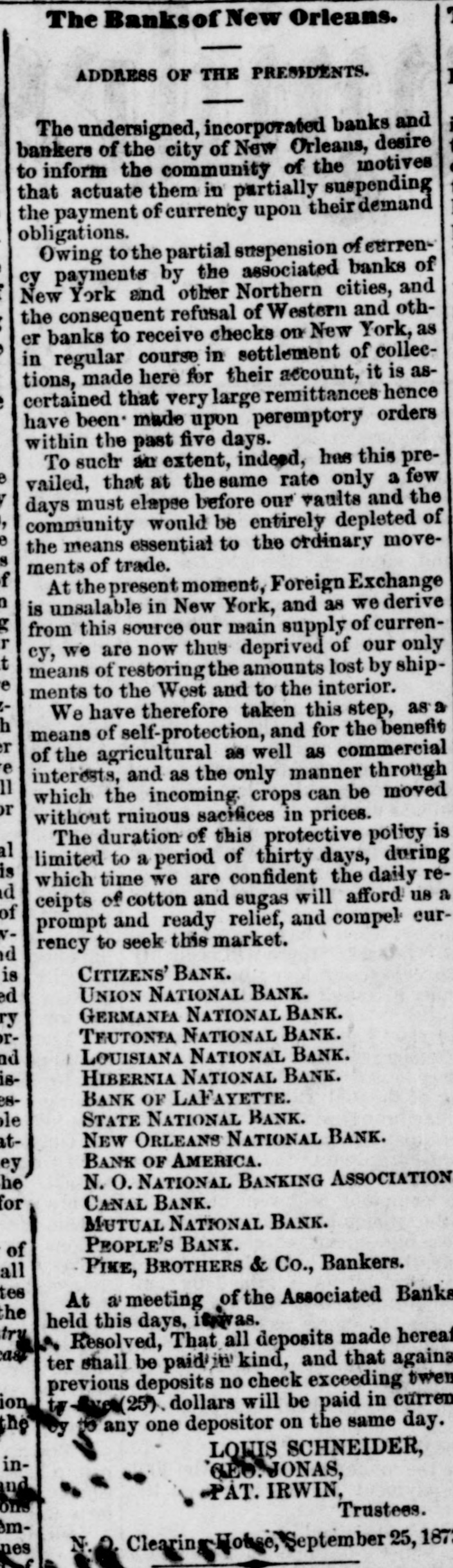
Associated banks, reacting to the failure of Jay Cooke & Co. and the New York banking crisis, agreed via Clearing House resolution to partially suspend currency payments (limit currency to $25 per depositor per day and pay in certified checks) to stop a drain of specie.
Newspaper Excerpt
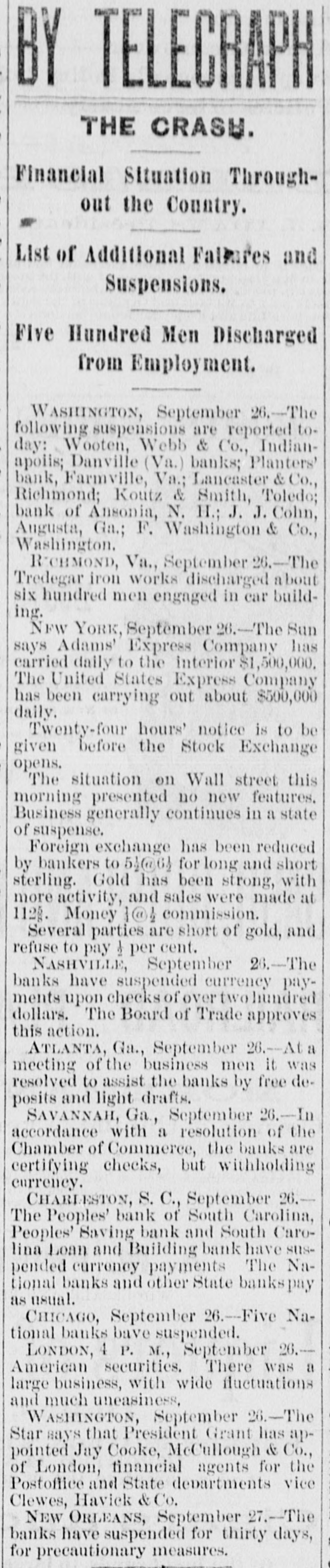
The New Orleans banks ... have suspended currency payment.
Source
newspapers
3. December 22, 1873 Reopening
Newspaper Excerpt
The banks of New Orleans resumed currency payment Monday.
Source
newspapers
4. January 27, 1897 Receivership
Source
historical_nic

Newspaper Articles (15)

Article from Evening Star, September 25, 1873

Click image to open full size in new tab

Article Text

# The New Orleans Banks Suspend, [By Automatic Telegraph.] NEW ORLEANS, Sept. 25. - The New Orleans banks, with the exception of the Southern, have suspended currency payment.


Article from Public Ledger, September 25, 1873

Click image to open full size in new tab

Article Text

LATEST TELEGRAMS. AMERICAN FRESS ASSOCIATION. VIA 8. P. AND/IA. TELEGRAPH COMPANY. Specials to thelLedger. Suspension of Banks. NASHVILLE, September 25.-All Na. tional banks in this city suspended at 11:30 a.m. KOITA NEW ORLEANS, September 25.--All the banks here have suspended, but are paying large cheeks which go through the clearing house.


Article from New Orleans Republican, September 26, 1873

Click image to open full size in new tab

Article Text

# Monetary--Commercial. MONETARY. OFFICE OF THE DAILY REPUBLICAN, THURSDAY EVENING, September 25, 1873. Our financial circles were taken by surprise at about half-past ten this morning by the announce-ment that at a meeting of presidents of nearly all the city banks, held at half-past nine, it was re-solved to suspend payments of currency on all de-mand obligations, in lieu thereof certifying checks or remitting New York Exchange, but with the proviso that depositors might draw currency for change purposes to the extent of $100 each diem. In a few moments the intelligence caused some excitement, but it very soon subsided, and after the appearance of the evening papers, con-taining the official announcement, wh en will be found in another column, the market appeared to be nearly as quiet as if nothing extraordinary had occurred. As far as our observation extended, the measure was received with emphatic approval. It was evident that under the course of the banks and bankers in other cities our city was steadily and rapidly losing its currency, and that serious re-sults would follow if the efflux was not arrested this has been effected by the measure adopted. New York bankers who send notes here for col-lection will be paid in New York exchange. The certified checks are received by all the banks in payment of maturing obligations as well as by fac-tors and all others for cotton or other merchan-dise without any difference in price. In fact they may fairly be regarded as being as valuable as bank notes, representing as they do currency in the banks or loaned out by them on unexception-able security. Of course there's no cause what-ever for any distrust nor should there be any hesi-tation in receiving such checks in trade or are liquidation of debts. It was not only the banks and bankers in other cities who were draining our banks of their currency. Even small shipments of produce were made to this market from the West with instructions to sell on arrival and remit the proceeds in currency by express. It will be observed that the banks which have united in this measure anticipate that it will not be required for more than thirty days, but in the solvent condition of our banking institutions the currency movement may actually be resumed at an earlier date. The Southern Bank is the only one of the banks which did not unite in this meas-ure. It will be recollected it did not suspend specie payments during the war, and now pursues the same course with regard to currency payments. We hear that the savings banks also are paying currency as usual.


Article from The Louisiana Democrat, October 1, 1873

Click image to open full size in new tab

Article Text

The financial crisis has reached New Orleans. All the Banks have partially suspended "payment of currency upon their demand obligations." This is to continue thirty days.


Article from The Ouachita Telegraph, October 3, 1873

Click image to open full size in new tab

Article Text

THE BANKS AND THE MARKET. On Thursday our commercial and financial circles were literally "taken by surprise" at the resolution adopted by the Clearing House banks, at a meeting at 9:30 A. M., the purport of which is shown by the official announcement to the public which we give elsewhere. While we say "taken by surprise" we do not mean to intimate that the measure was not proper and necessary, and might not have been foreseen by close observers of the movement in other cities. The course of the New York banks for a week previous had stimulated transmission of currency to that money center from all parts of the country; and especially from New Orleans, which was temporarily a debtor city, as shown by the premium on New York exchange previous to and at the time of the New York crisis. The consequence was that, while the movement in foreign exchange was suspended and the offerings of domestic were consequently light, the former being the basis of a large part of the latter, the proceeds of paper sent by the banks of other cities to our banks and bankers for collection were called for in currency. The table of an agent for a Northern banking house was piled up with currency for transmission to New York. In addition to this heavy drain, Western merchants ordered the proceeds of consignments to be remitted to them in currency. New Orleans was thus ciclimized for the benefit of the North and West, especially of New York, and while our banks were never in a sounder condition, and had seldom, or perhaps never held, so little paper that was not unquestionably good, they were compelled to discontinue payments in currency and resort instead to certified checks. We say discontinued, for although literally speaking, suspended may be the proper word, "suspension" is popularly understood to imply a situation which does not exist in our city. No bank has closed its doors; no bank fails to respond at the Clearing House to all its obligations; none refuses to certify checks and charge the amount to the depositor; nor do they refuse to receive such checks on deposit and in payment of all obligations maturing at their


Article from The Donaldsonville Chief, October 4, 1873

Click image to open full size in new tab

Article Text

The financial scare, which began with the failure of Jay Cooke & Co., and spread like wild-fire over the country, still prevails and prostrates every description of trade. The New Orleans banks suspended payments in larger sums than $25 per day to any one depositor, for the purpose of preventing a run upon their vaults, and when confidence is restored and business is resumed upon the former basis the wisdom of this action will be apparent to all. The foolish panic has been the result of want of confidence, and it will turn out that all were more scared than hurt. It is thought the crisis will end during the coming week.


Article from Rapides Gazette, October 4, 1873

Click image to open full size in new tab

Article Text

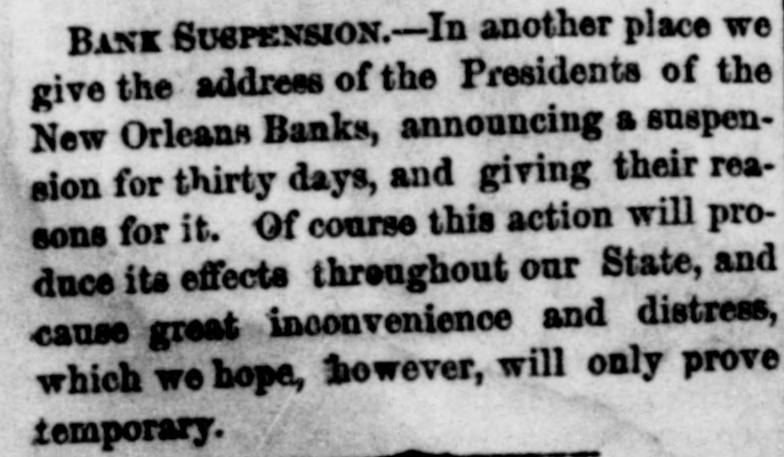
# BANK SUSPENSION.-- In another place we give the address of the Presidents of the New Orleans Banks, announcing a suspension for thirty days, and giving their reasons for it. Of course this action will produce its effects throughout our State, and cause great inconvenience and distress, which we hope, however, will only prove temporary.


Article from Rapides Gazette, October 4, 1873

Click image to open full size in new tab

Article Text

The Banks of New Orleans. ADDRESS OF THE PRESIDENTS. The undersigned, incorporated banks and bankers of the city of New Orleans, desire to inform the community of the motives that actuate them in partially suspending the payment of currency upon their demand obligations. Owing to the partial suspension of currency payments by the associated banks of New York and other Northern cities, and the consequent refusal of Western and other banks to receive checks on New York, as in regular course in settlement of collections, made here for their account, it is ascertained that very large remittances hence have been made upon peremptory orders within the past five days. To such any extent, indeed, has this prevailed, that at the same rate only a few must before our would be entirely days community elapse vaults depleted and the of the means essential to the ordinary movements of trade. At the present moment, Foreign Exchange is unsalable in New York, and as we derive from this source our main supply of currency, we are now thus deprived of our only means of restoring the amounts lost by shipe ments to the West and to the interior. We have therefore taken this step, as a h means of self-protection, and for the benefit r of the agricultural as well as commercial e interests, and as the only manner through 11 which the incoming crops can be moved r without rninous sacifices in prices. The duration of this protective policy is al limited to a period of thirty days, during is which time we are confident the daily red ceipts of cotton and sugas will afford us a of prompt and ready relief, and compel eurVrency to seek this market. d CITIZENS' BANK. is UNION NATIONAL BANK. ed GERMANIA NATIONAL BANK. ry TEUTONTA NATIONAL BANK. rLOUISIANA NATIONAL BANK. nd HIBERNIA NATIONAL BANK. isBANK OF LAFAYETTE. esSTATE NATIONAL BANK. le NEW ORLEANS NATIONAL BANK. atBANK OF AMERICA. ey he N.O. NATIONAL BANKING ASSOCIATION for CANAL BANK. MUTUAL NATIONAL BANK. PEOPLE'S BANK. of PIKE, BROTHERS & Co., Bankers. all tes At a meeting of the Associated Banks the held this days, itawas. try Resolved, That all deposits made hereaf ter shall be paid its kind, and that againa previous deposits no check exceeding twen ion (25) dollars will be paid in curren the to any one depositor on the same day. LOWIS SCHNEIDER, inGEO JONAS, and PAT. IRWIN, ons Trustees. mClearing House, September 25, 187 nes


Article from New-York Tribune, October 30, 1873

Click image to open full size in new tab

Article Text

thrown out of employment, including the body of opera- tives who were most prominent in the strike of last Sum- mer, and who, it may be supposed, drew most largely on their savings to support that movement. The Atlantic Delaine Mills are controlled by Hoyt, Spragues & Co. of New-York, though not run in their name. Messrs. Sprague have shown themselves very chary of informa- tion as to the steps they have taken or propose to take in curtailing their production, and seem inclined to allow the cloud, which Rhode Island manufacturers say hangs over all interests in the State from the enormous volume of their obligations, to put on its darkest aspect. # REDUCTION OF THE PRICE OF GOODS BY BROWN & IVES. The Lonsdale Manufacturing Company, which is con- trolled by the house of Brown & Ives, runs five mills at Lonsdale and Ashton, manufacturing villages in the valley of the Blackstone, a few miles from Providence. Here are manufactured cambrics, Lonsdale bleached shirtings, jaconets, etc., and in these five mills are 144,000 spindles and about 3,000 operatives. These mills are still running on full time and with no reduction of wages or employΓ©s. The agents state that they desire to keep with them all their operatives, some of whom have been in their employ 30 years and even more, and have as yet decided on no curtailment on account of the financial troubles. Unless matters soon mend, how- ever, they will be forced to retrench. The reduction would probably be made in the wages rather than in hours or force. The agents assert that the operatives have been getting such very high wages that they can well stand a reduction. They look, however, for an early revival of business. The Lonsdale Company this week reduced the price of their goods one cent per yard. Other manufacturers following the example have given orders to their selling agents in New-York to re- duce prices correspondingly. The agents of the Lons- dale Company say that as cotton is falling Β½ of a cent per pound daily, with reduced wages they can make a fair profit at the lower rate. The reduction has not been wel- comed by their competitors, who say that they could keep up their mills at full time at the old rate, but must now curtail. Brown & Ives also control the Hope Mill, at Scituate, which makes shirtings. The mill contains 28,000 spindles and employs 350 hands. They also control the Berkeley Mill, in Cumberland, seven miles from Providence, which is a new enterprise. The mill is now running over 300 looms, and, having a capacity of 40,000 spindles, employs about 400 persons. Here are made fine goods, sixties, eighties, and one-hundreds. The Hope and Berkeley mills are running on full time, and at the latter place new looms are being frequently added. The manufacture of the class of goods made at the Berkeley is said to be new in this country. The same policy will be pursued at these two mills as at Lonsdale and Ashton. Beside these a print cloth manufactory in Blackstone, Mass., with 50,000 spindles and some 600 hands, is con- trolled by Brown & Ives. This manufactory was shut yesterday, partly for repairs, but more on account of the depression. The present intention is to resume at full time on Monday next, but action will be governed by the condition of trade. Belonging to the Crawford-Allen estate, and now con- trolled by M. B. I. Goddard of this city, are the Allen Print Works in Providence, the print cloth mill of the Bernon Manufacturing Company at Georgiaville, R. I., the Woonsocket Company's cotton mill at Woonsocket, R. I., and the two mills of the Smithfield Manufacturing Company, one in Alleaville, R. I., the other in Dedham, Mass. Mr. Goddard also acts as agent for the Fitchville Manufacturing Company, whose mill, at Fitchville, Conn., manufactures shirtings. The Allen Print Works, which have a dozen machines with a capacity of about 15,000 pieces per week, and employ nearly 400 hands, stopped a month ago. At these, as at other print works, a stop of a fortnight twice a year, in the Spring and Autumn, for repairs and preparation for the change between light and dark goods, has been cus- tomary. The time of the Autumn closing has been Nov. 1. The panic hastened the suspension this season, and no time of resumption is yet fixed upon. The Bernon Mill, which has 603 looms, 30,000 spindles, and about 450 hands; the mill of the Woonsocket Company, with 13,000 spindles and 170 hands, and the Allenville Works of the Smithfield Manufacturing Company, with 10,200 spindles and 150 hands, all stopped on Saturday, the 11th inst. When they resume-a time as yet not fixed with certainty, but possibly Monday next-there will be some reduction, probably in time. It is thought by the representatives of these mills that a suspension of a few weeks will be lightly borne by the operatives, but longer idleness would drive many of the French Canadians of whom there is a large number employed throughout Rhode Island-to Canada for the Winter, and cause distress among them and trouble to the em- ployers to get labor in the Spring. The Fitchville Com- pany-whose new works have a capacity of 15,000, now running 12,000 spindles-has made no reduction of any kind. Two hundred hands are employed. At the Ded- ham Mill of the Smithfield Company, now running on full time, are 163 hands and 12,000 spindles. # PARTIAL SUSPENSION OF WORK IN OTHER MILLS. The Albion Manufacturing Company at Albion, R. I., runs a mill for the manufacture of print cloths, which has 400 looms and about 22,000 spindles. It will run on full time up to Jan. 1, as it has contracts to fill up to that time. The Monville Manufacturing Company, whose new mill at Monville, R. I., is one of the largest cotton mills in the country, having a capacity for 100,000 spindles, has as yet put in but 1,200 looms, and has been employing 1,000 hands in the manufacture of print cloths, jaconets, &c. On Saturday, the 11th inst., the mill was closed, with the intention of resuming this week on half time. The Chace Mill at Washington Village, Pawtuxet, R. I., which has 4,000 spindles, was closed the same day. The Central Manufacturing Company, which has a mill at Plainfield, Conn., with 10,000 spindles, is now running on two-thirds time. The great cotton mills at Wauregan, Conn., and at Ponema, near Nor- wich-the latter ranking among the chief mills of the country, and having 72,000 spindles, and the former hav- ing 56,000 spindles-which are controlled by Providence capitalists, have been running on half time since Mon- day, the 20th instant. Their agent in this city, Edward P. Taft, says that the operatives are excellently well sit- uated to bear the reduction, being a very thrifty class, and having saved from 30 to 35 per cent of their abun- dant wages. The Warren Manufacturing Company of Warren, R. I., which has near 60,000 spindles, shut down entirely for a few days, and with the Cutler Manufac- turing Company of the same place is now running on half time. Mills in the Quinebaug Valley, in Eastern Connecticut, which are controlled by Rhode Island man- ufacturers, have almost all cut down their running time to seven hours per day for five days in the week. The owners of the large woolen mills at Woonsocket, R. I., and Waterford, Mass., are now considering the question of running only half time. None of the Rhode Island woolen mills have yet stopped entirely. The closing of a woolen mill causes so much more derangement and loss than that of a cotton mill that the woolen manufac- turers are very loth to suspend wholly, even though they cannot sell their goods. The Greene Manufacturing Company, at Norwich, R. I., which has 25,000 spindles, and makes print cloths, shirtings, and similar goods, has been running for a fortnight on three-quarters time. The Luppitt Mill, at the same place, which makes print cloths and has 7,000 spindles, will run full time to Nov. 1, when it will either stop or reduce. The Coventry Mills, at Anthony village, Coventry, R. I., with 10,000 spindles, making print cloths, will pursue the same course. Many other small mills have either reduced their running time or will do so soon. # GENERAL PROSPECTS. NEW-ORLEANS BANKS TO RESUME NOV. 10-A STRIKE OF COLORED LABORERS.

Article from The Ouachita Telegraph, October 31, 1873

Click image to open full size in new tab

Article Text

ORLEANS. PLAIN COUNTRY TALK. It is in no fault-finding spirit we enter our protest against the action of the banks and business men of New Orleans. In truth, we believed and felt when the notice of the thirty days' suspension was first announced that the movement deserved to be universally censured. Under the pretext (in the words of the official announcement) of benefiting "the agricultural as well as the commercial interests, and as the only manner through which the incoming crops can be moved without ruinous sacrifices in prices," the banks of New Orleans united in the suspension movement. In the light of what has transpired it must seem to have been a "ruinous" policy when the banks resolved to close their vaults. How could the incoming crops be moved without the money held by the banks? And how could the banks possibly obtain relief when there were no cotton bales "incoming?" The New Orleans merchant was bound to notify his agent, or his planter, that he could get no money from the banks to pay for cotton, and this was what came by mail, by wire and by newspapers to merchants and planters all over the country. The news fell like a pall upon "the incoming crops," and the blockade of trade and of the payment of debts, as well as the heated pursuit of debtors, began. The very idea of shipping, or selling cotton without a little money, gave the producer the "studs," and the flow of the staple almost instantly stopped. As a consequence, money ceased to flow from the country to New Orleans. The stream had been dammed by the banks, and no supply went down. And now, in the face of this stagnation caused by suspension of the banks, these institutions have agreed to extend the thirty days' suspension indefinitely. Merchants write to their customers, For God's sake draw no drafts upon us. The man, in fact, who has money in his merchant's hands, has had to pay 7 per cent to have his draft cashed, and instead of receiving $100 on his draft for that amount, receives only $93. If it should become necessary to send this $93 to New York, exchange costs 4Β½ per cent, (when it ought at this season of the year to be at par, if not at a discount,) which reduces the $100 to $88.22Β½, making the actual loss $11.77Β½, or more than 10 per cent on money on trust and for a single transaction. Where does the "benefit" come in in this transaction? This is what we are asked to consider financial wisdom! This is what has been done to move "the incoming crops," and "to benefit the agricultural as well as the commercial interests!" In our opinion this movement has more of the features of a combined swindle in the interest of monied men, than a movement for the benefit of commerce and agriculture ought to have. Why should a bank, any more than a planter, refuse to pay its indebtedness to the last dollar in its keeping? What are the banks doing with their greenbacks? Keeping them from circulation to relieve commerce and agriculture? Or, is this same money carried to Carondelet street, and there invested in the certified checks of these same banks at 7 per cent discount on the face of their own checks? If neither of these means are employed "to benefit commerce and agriculture," then what has become of the currency of the banks? It does not come to the country to help "move the incoming crops." Cotton cannot be sold for money in the interior. It is, therefore, real stupidity in the Manager of the Clearing House of New Orleans to tell the country, as he has just done, that "the only remedy we


Article from New Orleans Republican, December 13, 1873

Click image to open full size in new tab

Article Text

The Banks. It is now stated that all the banks in the city are in line and fully competent to resume payment, except one, which, it is stated, is indebted to the Clearing Honse some $292,000, with nothing to meet it with, and that the Clearing House has decided to "carry" the bank through to prevent its absolute bankruptcy. A committee of the Clearing House has been appointed to report on Monday on the propriety of resuming, and it is thought by those best informed that resumption will not be delayed beyond next week. It is to be hoped the banks will make no further delay. The injury done our trade by the action of the banks has been severe. The fact that this is the only city in the United States whose banks do not pay out currency has induced people in the country to lose confidence in us, and the result has been the diversion of trade into other channels. The immense increase in the export trade of other ports in the South demonstrates this fact very clearly. Here is an effect of suspension to which we would especially call the attention of our factors. There are competing cotton markets in the valley and on the Atlantic coast, which are little better than way stations or agencies of New York. New York acceptance can be employed to command currency. This enables these markets to meet our customers with money in hand when they might not find the same facilities here. The greater premium on currency here has also had an unfavorable effect upon transactions with the country. The resumption of currency payment will equalize these advantages and restore the prestige of our market.


Article from The Portland Daily Press, December 23, 1873

Click image to open full size in new tab

Article Text

# MINOR TELEGRAMS. Beinforcements are going forward rapidly for the government troops before Cartagena. The British ship America foundered off the Newfoundland banks, and the captain and three men were drowned. The crew were out in a boat six days before they were picked up. Bell & Co.'s tobacco warehouse at Hadley, Mass., was burned Monday morning, with 330 cases tobacco. Loss $28,000; insurance $25,000. In a fight between two Chicago policemen and four thieves, one of the latter was shot. Eighteen lives were lost by a late explosion of a magazine in Cartagena. A Washington despatch says there are twenty candidates for the Kansas Senatorial vacancy, and really but two parties in the State, the grangers and the railroad interest. In Chicago a large meeting of workingmen passed resolutions demanding labor of the city when other sources fail. J. W, Morrison's store and outbuildings in Plymouth, N. H., were burned Monday. Loss $3000. Hayti has a political trouble. President Saget will not vacate the presidency except to Dominique, whom the House of Representatives don't want. Yellow fever prevails at Port Royal, Hayti, among Europeans. George B. Noyes was killed at Manchester, N. H., Monday, by being run over by a load of wood which he was driving. Capt. J. E. Michener, chief opener of dead letters at Washington, has been held to the action of the grand jury on the charge of robbing letters. The Catholic Bishop Queretara of Mexico, advises his people to submit to the civil authorities. The government candidate has been elected Speaker of the Mexican House of Representatives. The banks of New Orleans resumed currency payment Monday. A despatch dated at Rome says that on Monday the Pope delivered an allocution and appointed twelve cardinals. A Belgian pleasant is said to have discovered a substitute for coal. He saturates earth with a solution of soda. It gives a strong and steady heat. The St. Albans Messenger says George W. Jones, a well known citizen of Brandon, Vt., has been lodged in jail at Rutland for chastising his daughter with whips and chains. Six thousand dollars was realized for the Centennial by the Philadelphia tea party. In New York last night Maurice Daly beat Francis Ubassy at a game of three ball French carom billiards, by a score of 350 to 303. Internal revenue receipts Monday were $576,725. David Nesbitt of Lindsey, Canada, was hung Monday for the murder of Miss Hapwood last July. Five or six boys ranging from 15 to 18 years of age were arrested Monday in Schnectady, N. Y., for setting buildings on fire. A lot of striking longshoremen in Philadelphia attempted to get up a riot yesterday but were quelled by the police.


Article from The Opelousas Courier, December 27, 1873

Click image to open full size in new tab

Article Text

We learn from the New Orleans Picayune of the 23d that the associated banks of that city resumed currency payments the day before, after a suspension of nearly three months Cotton was pouring in the city with unexampled rapidity, one boat alone-the R. E. Leebringing in last Monday 5741 bales, the largest load of the season. The largest load ever brought to that port was 6500 bales; the steamer Magnolia brought it in 1859.


Article from The Morning Star and Catholic Messenger, December 28, 1873

Click image to open full size in new tab

Article Text

# New Year's. Before another number of this paper issues, the new year-1874-will have written its name upon the roll of the century. When the last of its years shall have been inscribed on that roll, when its full list shall have been folded up and laid away for ever, and the spotless new roll of the twentieth century opened out before man to write thereon his history with many a stain of tears, and blood, and fire, then the world shall be just as busy and bustling and just as intent upon its own transient interests as now. But how many of us shall take a part in its busy scenes ? This is one view of the case, but it shall not, by any means, prevent us from wishing a happy New Year now to our contemporaries. The present alone is ours. If people are never content with what they have that is the present-let them at least look at the near future only. There we may find a good deal of consolation apparently in store for us. The hard times are rapidly passing away, and green backs are once more coming prominently before the public. Our banks have resumed payment and we can hardly want better assurance that the storm is over. The safe, skilful financiers in control of them, who so prudently shortened sail in the hour of danger, can be relied on as pilots throughout. Then cotton is commanding a better price and fortunately a great deal of it yet remains to be shipped. Very soon people will find themselves entirely over their panic, their pockets well lined and the spirit of adventure growing strong within them. This will set all the wheels a-going -not only commerce, but manufacture and agriculture and building. Improvements on real estate will go forward once more, and mechanics and laborers find plenty of employment. In politics the signs indicate relief. Animosities resulting from the war are disappearing, and the political corruption which plunged the whole country in debt-not only South but North also-is awakening a storm of general execration that will drive it from its bad and impudent pre-eminence into comparative obscurity. Our Northern brethren begin to see that robbers are not safe agents to employ. A Government which openly robs and plunders a helpless section of the country, cannot be relied on as honest in the other sections. Our beautiful New Orleans is spoken of farther North, even by its friends, as the "doomed city," but their sympathy is probably uncalled for. Rivalry and money have thus far been able to check that prosperity to which nature has manifestly destined our queenly city. So far as capital in its thousand appliances of railroads and canals and banking facilities has been able to supersede nature and its works, so far New Orleans has hitherto been doomed; but to all this there is a limit. There is a period when the tidal wave of natural development will burst all the barriers that human skill can interpose to cramp it. In wishing a happy New Year to our friends, we experience a conviction that a day will come when the royal banner of the world's commerce and the world's wealth, will wave from the towers of the Queen City of the South.


Article from New Orleans Republican, September 1, 1874

Click image to open full size in new tab

Article Text

aging, the demand revived, and factors were enabled to recover ΒΎ @ β…žc of the previous decline. Passing over the advance during the first fortnight, and comparing the closing with the opening rates, the quotations on September 30 showed a net falling off of only ⅝ @ 1c. The improvement, however, was somewhat illusive, being partly caused by the change in the measure of value from currency to certified checks, which was equal to β…“ @ ΒΌc β…Ÿβ‚ˆ lb on the price of cotton. This change took place on September 25, when the following resolution was adopted by the Clearing House banks: "Resolved, That all deposits made hereafter shall be paid in kind, and that against previous deposits no checks exceeding $25 will be paid in currency to any one depositor on the same day." The resolution was followed by the publication of the agreement for self-protection, which was signed by nearly all the incorporated banks. The cotton movement in September had been only moderately active, the sales summing up 17,900 bales, against gross receipts of 26,732, while the stock by our running statement had increased to 22,386, and the amount unsold was 11,400. This indicates that although the demand had not been very animated the supplies were proportionately light, an actual supply of 11,400 bales, a considerable part of which was unmerchantable or held off the market for further developments, showing that the offerings had been pretty well absorbed by the demand. Buyers having adjusted their operations to the new order, October opened with a more active demand, and, although the New York panic had still a disturbing and unfavorable influence, yet, the supply being light, the previous upward tendency continued, and at the end of the first ten days factors had been enabled to establish an advance of β…œc, but on the eleventh, in response to a decline at New York, the market took an unfavorable turn, and prices receded from day to day until they closed at a net falling off of 1β…œ @ 1ΒΌc from the opening rates and a reduction of 2β…œ @ 2Β½c from the highest point. The movement at the same time had exhibited considerable activity, the month's sales amounting to