18980. Banks of Philadelphia (Philadelphia, PA)

Bank Information

Episode Type
Suspension → Reopening
Bank Type
state
Start Date
November 23, 1860
Location
Philadelphia, Pennsylvania (39.952, -75.164)

Metadata

Model
gpt-5-mini
Short Digest
451baa07

Response Measures

None

Description

Multiple articles report a coordinated suspension of specie payments by the banks of Philadelphia on/around Nov 23, 1860, attributed to political troubles following the presidential election (secession-related uncertainty). Subsequent items report the banks resumed specie payments in March 1861. No article describes a depositor run on these banks, so this is a suspension without a run and with reopening.

Events (3)

1. November 23, 1860 Suspension
Cause
Macro News
Cause Details
Coordinated suspension attributed to political troubles and uncertainty following the 1860 presidential election and secession fears.
Newspaper Excerpt
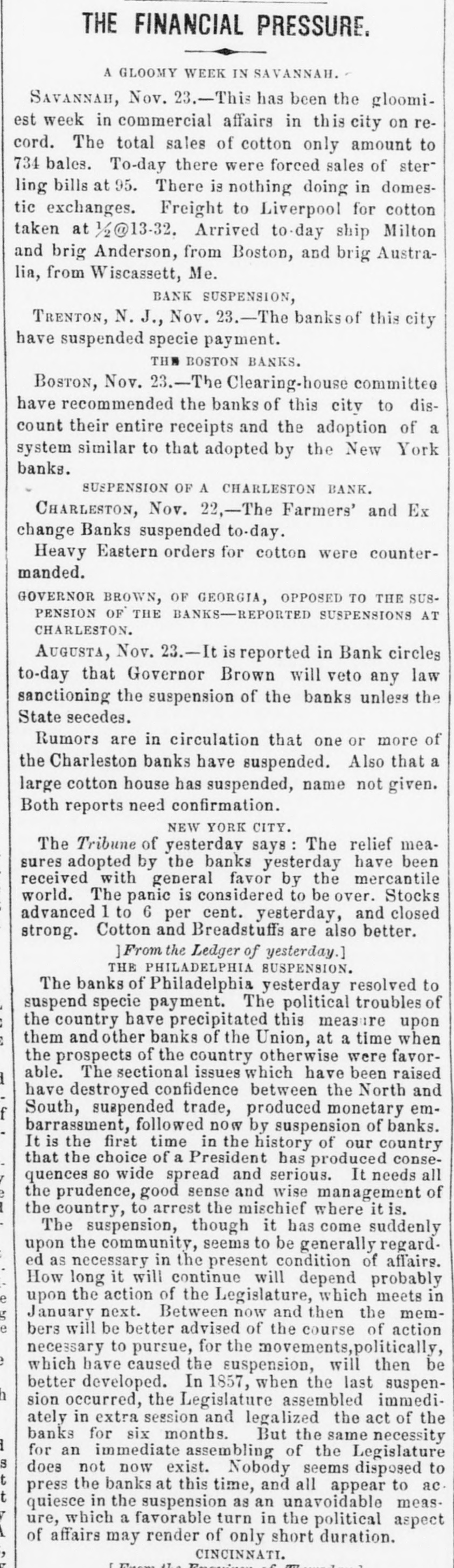
THE PHILADELPHIA SUSPENSION. The banks of Philadelphia yesterday resolved to suspend specie payment.
Source
newspapers
2. March 16, 1861 Reopening
Newspaper Excerpt
The banks of Philadelphia resumed specie payment on Saturday.
Source
newspapers
3. December 30, 1861 Suspension
Cause
Correspondent
Cause Details
Reported suspension tied to the suspension of banks in New York (contagion from correspondent/market suspension).
Newspaper Excerpt
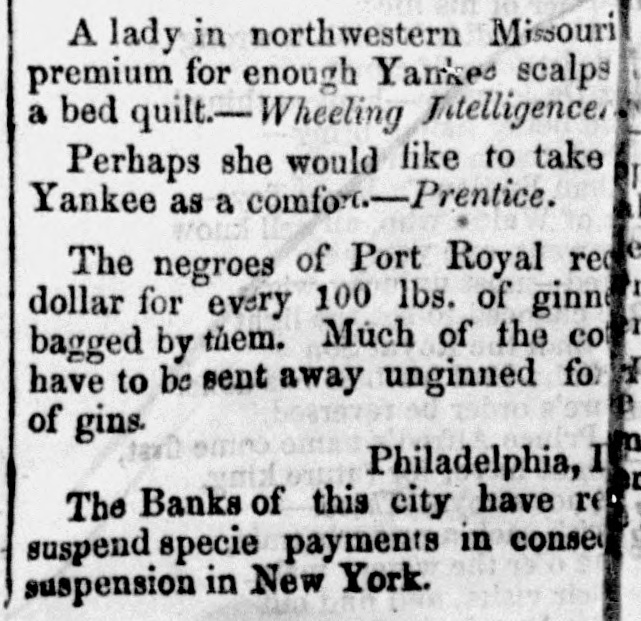
PHILADELPHIA, Dec. 30. -The Banks of this city have suspended in consequence of the New York suspension.
Source
newspapers

Newspaper Articles (13)

Article from The Daily Exchange, November 24, 1860

Click image to open full size in new tab

Article Text

THE FINANCIAL PRESSURE. A GLOOMY WEEK IN SAVANNAH. SAVANNAH, Nov. 23.-This has been the gloomiest week in commercial affairs in this city on record. The total sales of cotton only amount to 734 bales. To-day there were forced sales of ster ling bills at 95. There is nothing doing in domestic exchanges. Freight to Liverpool for cotton taken at 1/2@13-32. Arrived to-day ship Milton and brig Anderson, from Boston, and brig Australia, from Wiscassett, Me. BANK SUSPENSION, TRENTON, N. J., Nov. 23.-The banks of this city have suspended specie payment. TH# BOSTON BANKS. BOSTON, Nov. 3.-The Clearing-house committee have recommended the banks of this city to discount their entire receipts and the adoption of a system similar to that adopted by the New York banks. SUSPENSION OF A CHARLESTON BANK. CHARLESTON, Nov. 22,-The Farmers' and Ex change Banks suspended to-day. Heavy Eastern orders for cotton were countermanded. GOVERNOR BROWN, OF GEORGIA, OPPOSED TO THE SUSPENSION OF THE BANKS-REPORTED SUSPENSIONS AT CHARLESTON. AUGUSTA, Nov. 23.-It is reported in Bank circles to-day that Governor Brown will veto any law sanctioning the suspension of the banks unless the State secedes. Rumors are in circulation that one or more of the Charleston banks have suspended. Also that a large cotton house has suspended, name not given. Both reports need confirmation. NEW YORK CITY. The Tribune of yesterday says: The relief measures adopted by the banks yesterday have been received with general favor by the mercantile world. The panic is considered to be over. Stocks advanced 1 to 6 per cent. yesterday, and closed strong. Cotton and Breadstuffs are also better. From the Ledger of yesterday.] THE PHILADELPHIA SUSPENSION. The banks of Philadelphia yesterday resolved to suspend specie payment. The political troubles of the country have precipitated this measure upon them and other banks of the Union, at a time when the prospects of the country otherwise were favorable. The sectional issues which have been raised have destroyed confidence between the North and South, suspended trade, produced monetary emf barrassment, followed now by suspension of banks. It is the first time in the history of our country that the choice of a President has produced consequences so wide spread and serious. It needs all the prudence, good sense and wise management of the country, to arrest the mischief where it is. The suspension, though it has come suddenly upon the community, seems to be generally regard. ed as necessary in the present condition of affairs. How long it will continue will depend probably e upon the action of the Legislature, which meets in January next. Between now and then the memg bers will be better advised of the course of action necessary to pursue, for the movements, ,politically, which have caused the suspension, will then be better developed. In 1857, when the last suspension occurred, the Legislature assembled immediately in extra session and legalized the act of the banks for six months. But the same necessity I for an immediate assembling of the Legislature S does not now exist. Nobody seems disposed to t press the banks at this time, and all appear to ac. t quiesce in the suspension as an unavoidable meas. ure, which a favorable turn in the political aspect ( of affairs may render of only short duration. CINCINNATI. , Neem
Article from The Lambertville Press, November 28, 1860

Click image to open full size in new tab

Article Text

# Suspension of Specie Payments. The Phila. Ledger of the 23d says: The banks of Philadelphia yesterday resolved to suspend specie payments. The political troubles of the country have precipitated this measure upon them and other banks of the Union, at a time when the prospects of the country otherwise were favorable. The sectional issues which have been raised have destroyod confidence between the North and South, suspended trade, produced monetary embarrassment, followed now by suspension of the banks. It is the first time in the history of our country that the choice of a President has produced consequences so wide spread and serious. It needs all the prudence, good sense and wise management of the country, to arrest the mischief where it is. The suspension, though it has come suddenly upon the community, seems to be generally regarded as necessary in the present condition of affairs. How long it will continue will depend probably upon the action of the Legislature, which meets in January next. Between now and then the members will be better advised of the course of action necessary to pursue, for the movements, politically, which have caused the suspension, will then be better developed. In 1857 when the last suspension occurred, the Legislature assembled immediately in extra session and legalized the act of the banks for six months. But the same necessity for an immediate assembling of the Legislature does not now exist. Nobody seems disposed to press the banks at this time, and all appear to acquiese in the suspension as an unavoidable measure, which a favorable turn in the political aspect of affairs may render of only short duration.


Article from Bradford Reporter, November 29, 1860

Click image to open full size in new tab

Article Text

The Banks of Philadelphia, last week, after consultation, resolved to suspend specie payments, as a measure of relief to their customers. As a matter of course, the county banks nearly all followed their example. Rumors prejudicial to the Pittston Bank, and the Bank of Commerce, at Erie, have produced a feeling of insecurity in regard to the notes of those banks. The bills of the Pittston Bank are freely taken here, and we do not believe that the holders of the Bank of Commerce money will suffer loss.


Article from Belmont Chronicle, December 6, 1860

Click image to open full size in new tab

Article Text

Heaton on the Panic. A deplorable penic has indeed spread all over the country, but that it should get into our town and be so personal as to creep into the private sanctum of our good natured neighbor of the Gazette is too bad. It has even had the effect of making him dream dreams; for never will hold him responsible for such wild visions as he put forth inghis last issue. Get out your bandkerchiefs and weep with the Captain while you read his doleful lament. He says: 05 Banks of New York, (not true) Philadelphia, Baltimore, Wheeling, and other places have suspended specie payment. A general panic perv ades the Eastorn cities,-(a phansy) thousands of male and female workmen have been thrown out of employment (we would like to know where). Glorious results are following the Republican victory (the gloom of the Democratic funeral). If the mere election of Lincoln causes such a terrible state of things, what must we expect when this party takes control of the Government (that peace and qiuet will prevail). General distrust is now stalking abroad in the land (General Democracy on the rogues march, he means). Civil war has already commenced in Kansas, and the drums are beating to arms in Misssouri (magnified view of about 30 robbers who never contemplated war). Thrilling accounts of burning towns and cities will soon greet our ears (that's the place to cry);all the work of (the Captains's dream) the (rrepressible dogmas that have been preached by the ultra men who have control of the Republican organization. The people have been warned of these things, but they (had more sense than to believe in dreams) would not heed the warnings-and have suffered fanaticism to plunge the country headlong to ruin, that a few miserable creatures might be gratified, without any practical good resulting to the country-but poverty, misery, want and wret chedness to thousands of operatives who will necessarily be thrown out of employment, (the thousand operatives are the Democratic office-holdors) that a few hungry politicians may get office."


Article from Clarksville Chronicle, December 7, 1860

Click image to open full size in new tab

Article Text

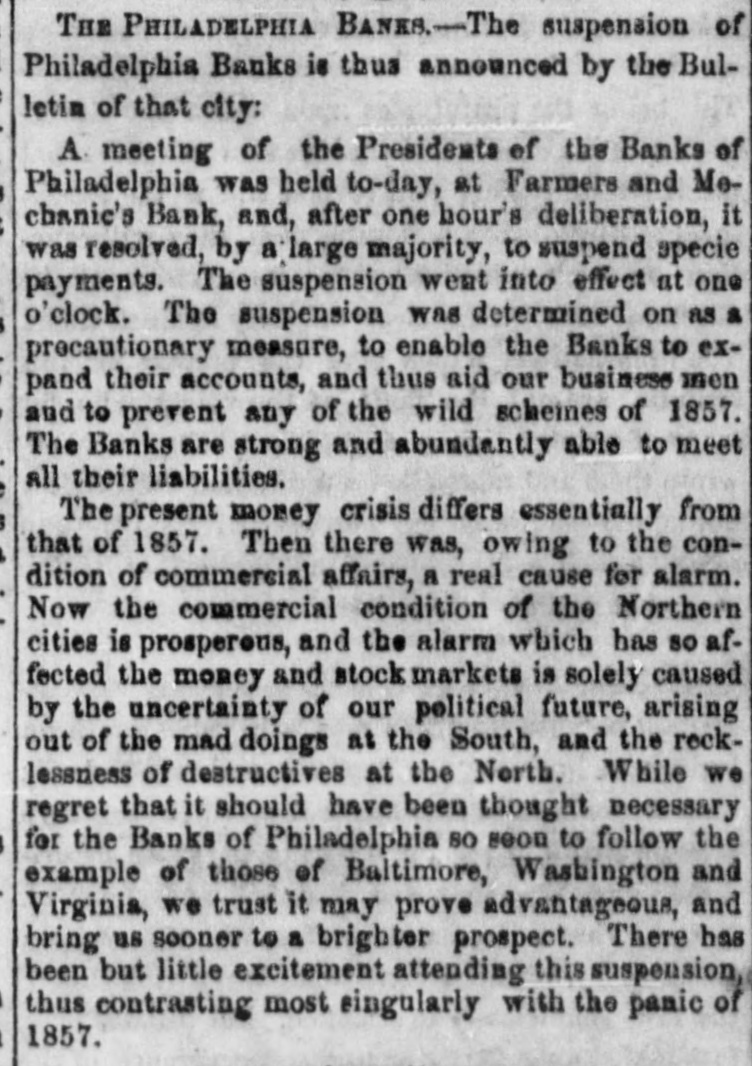
THE PHILADELPHIA BANES.-The suspension of Philadelphia Banks is thus announced by the Bulletin of that city: A. meeting of the Presidents of the Banks of Philadelphia was held to-day, at Farmers and Mochanic's Bank, and, after one hour's deliberation, it was resolved, by a large majority, to suspend specie payments. The suspension went into effect at one o'clock. The suspension was determined on as a precautionary measure, to enable the Banks to expand their accounts, and thus aid our business men and to prevent any of the wild scheines of 1857. The Banks are strong and abundantly able to meet all their liabilities. The present money crisis differs essentially from that of 1857. Then there was, owing to the condition of commercial affairs, a real cause for alarm. Now the commercial condition of the Northern cities is prosperous, and the alarm which has so affected the money and stock markets is solely caused by the uncertainty of our political future, arising out of the mad doings at the South, and the recklessness of destructives at the North. While we regret that it should have been thought necessary for the Banks of Philadelphia so seon to follow the example of those of Baltimore, Washington and Virginia, we trust it may prove advantageous, and bring us sooner to a brighter prospect. There has been but little excitement attending this suspension, thus contrasting most singularly with the panic of 1857.


Article from The Plymouth Weekly Democrat, December 13, 1860

Click image to open full size in new tab

Article Text

of trade is largely in our favor ss a nation. Therefore it is obvious to the most super- ficial observer, that a general distrust, and the secession movement in the south con- sequent upon Lincoln's election, have brought about our present financial troub- les. We frequently hear it stated that the South has no reason te complain, for a ma- jority should rule. Whether the South -has reason to complain or not, she does complain, and in our humble opinion, unless there should, at the present session of Congress, be a compromise effected by f the conservative men of the two extremes, our financial troubles have only commen- -ced. Our western money is principally based on southern State Bonds. The se- acession movement has caused a general distrust, which has caused the bonds to depreciate in value, consequently the bills for which the bonds were deposited as se- curity, which have been the principal cir- -culating medium have also depreciated to the tune of ten per cent or more. This secession movement has not only caused bankruptcy and ruip in the North. in the midst of plenty, but is making bad work in the South. When South Carolina began to exhibit symptoms of setting up on her own hook, the business men saw the storm gatherering, and those bills is- sued by the Banks of that state, hurried them home for redemption before the evil day would come upon them, consequently the Banks suspended which added fuel to the fire; in quick succession the Banks of Richmond, Baltimore, Philadelphia and Pittsburgh followed in their wake, in order to escape bankruptcy. But the end is not yet. Exchange on New York has run up in one short month, from one to ten per cent and the culminating point is probably not yet reached. It was promulgated by all the Democratic papers and speakers of the North, in the late campaign that if a sectional man, as was Mr. Lincoln, was elected, that the Union would be in great danger of dissolu- tion, and that bankruptev and ruin wou'd be the consequence. These predictions were considered by the Republicans, as made for electioneering purposes--as ille talk. They feared no darger, they would soon "whip the South into submission," and we would hear nothing more of disun- ion after Mr. Lincoln was elected. The matter was usually disposed of in this man- rer before the election, but now, after the campaign excitement has subsided, the notes of preperation in the South and the financial crisis which is upon us, are like- ly to open their eyes to the fearful respon- sibilities which they will have to shoulder. That the South has good cause to complain of many of the Northern States, all admi: as some six or seven of the free states have enacted laws, declaring the Fugitive slave law unconstitutional and making it a criminal offence to assist a United States Marshal in reclaiming a fugitive from a slave state. It is very seldom that a slave who is caught in a free state is ever per- mitted to be returned. Even if he is iden- tified and caught, he is generally rescued by a mob, and if the Marshal and owner escape with whole bones they are thankful. In our humble opinion, unless those Abo- lition states give some assurance that they will repeal those laws making the fugitive slave law void, and that they will dis- countenance all such expeditions as these, that Jim Lane, John Brown and Montgom- ery have been engaged in, that even an at- tempt to make a compromise would be useless. The south has endured those insuits and wrongs until in her opinion, "forbearance has ceased to be a virtue."- On the other hand the south ought to con- sent to a modification of the fugitive slave law. The idea of a man violating the law by giving a starving fugitive a peice of bread, is entirely repugnant to the north- ern idea of philanthropy. There are sev- eral items in the law that could be modi- fied, that would not materially conflict with the interest of the slaveholder and at the same time be much more palatable to the north. It appears to us that the natural way to dispose of the matter, would be for Con- gress to raise a committee of good sound conservative men, of age and experience, from both parties and submit the whole question of difference to them for adjust- ment. The report of such a committee, gotten up under such circumstances would have great weight with all parties. The South will not remain as a part of the Un- ion, unless those laws, declaring the fugi- tive slave law inoperative, be repealed.- The states that enacted those laws, will undoubtedly demand a nullificacion of the


Article from Vermont Watchman and State Journal, March 22, 1861

Click image to open full size in new tab

Article Text

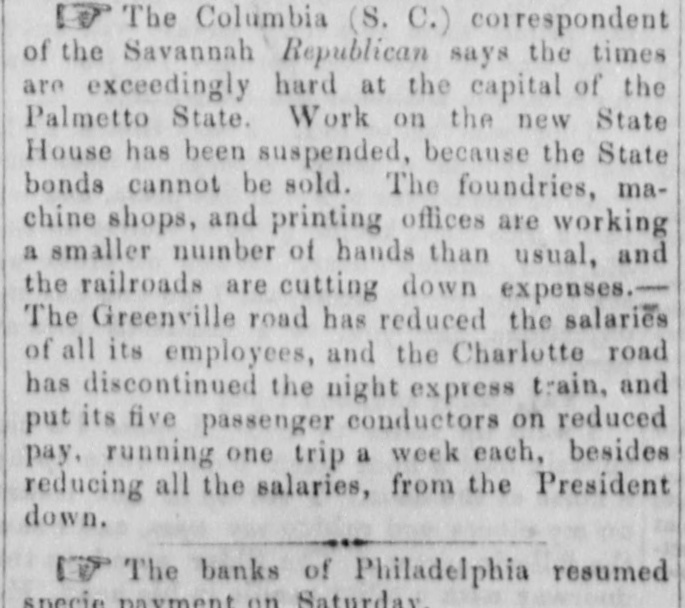
The Columbia (S. C.) correspondent of the Savannah Republican says the times are exceedingly hard at the capital of the Palmetto State. Work on the new State House has been suspended, because the State bonds cannot be sold. The foundries, machine shops, and printing offices are working a smaller number of hands than usual, and the railroads are cutting down expenses. The Greenville road has reduced the salaries of all its employees, and the Charlotte road has discontinued the night express train, and put its five passenger conductors on reduced pay, running one trip a week each, besides reducing all the salaries, from the President down. The banks of Philadelphia resumed specie payment on Saturday.


Article from Yorkville Enquirer, April 4, 1861

Click image to open full size in new tab

Article Text

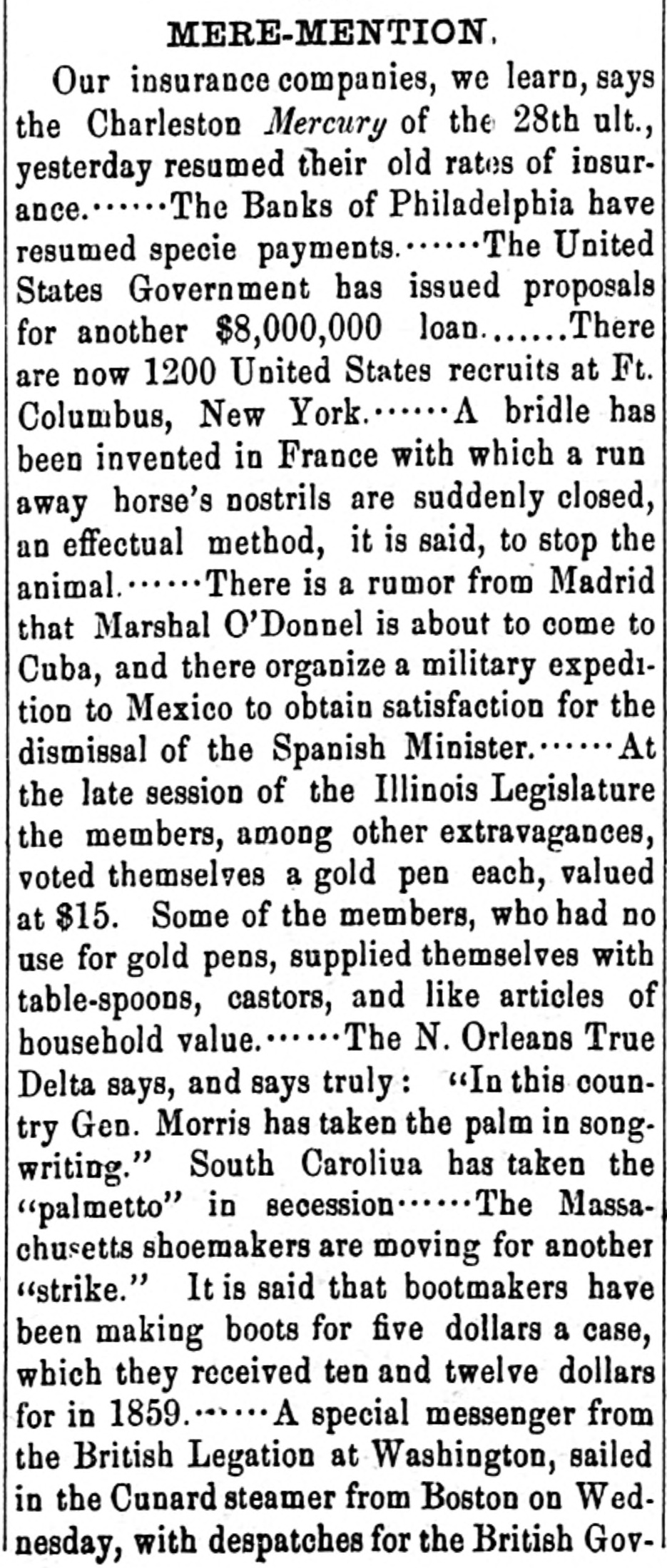
# MERE-MENTION, Our insurance companies, we learn, says the Charleston Mercury of the 28th ult., yesterday resumed their old rates of insurance. The Banks of Philadelphia have resumed specie payments. The United States Government has issued proposals for another $8,000,000 loan. There are now 1200 United States recruits at Ft. Columbus, New York. A bridle has been invented in France with which a run away horse's nostrils are suddenly closed, an effectual method, it is said, to stop the animal. There is a rumor from Madrid that Marshal O'Donnel is about to come to Cuba, and there organize a military expedition to Mexico to obtain satisfaction for the dismissal of the Spanish Minister. At the late session of the Illinois Legislature the members, among other extravagances, voted themselves a gold pen each, valued at $15. Some of the members, who had no use for gold pens, supplied themselves with table-spoons, castors, and like articles of household value. The N. Orleans True Delta says, and says truly: "In this country Gen. Morris has taken the palm in song-writing." South Caroliua has taken the "palmetto" in secession. The Massachusetts shoemakers are moving for another "strike." It is said that bootmakers have been making boots for five dollars a case, which they received ten and twelve dollars for in 1859. A special messenger from the British Legation at Washington, sailed in the Cunard steamer from Boston on Wednesday, with despatches for the British Gov-


Article from The Evansville Daily Journal, December 31, 1861

Click image to open full size in new tab

Article Text

PHILADELPHIA, Dec. 30. -The Banks of this city have suspended in consequence of the New York suspension.


Article from Evening Star, January 1, 1862

Click image to open full size in new tab

Article Text

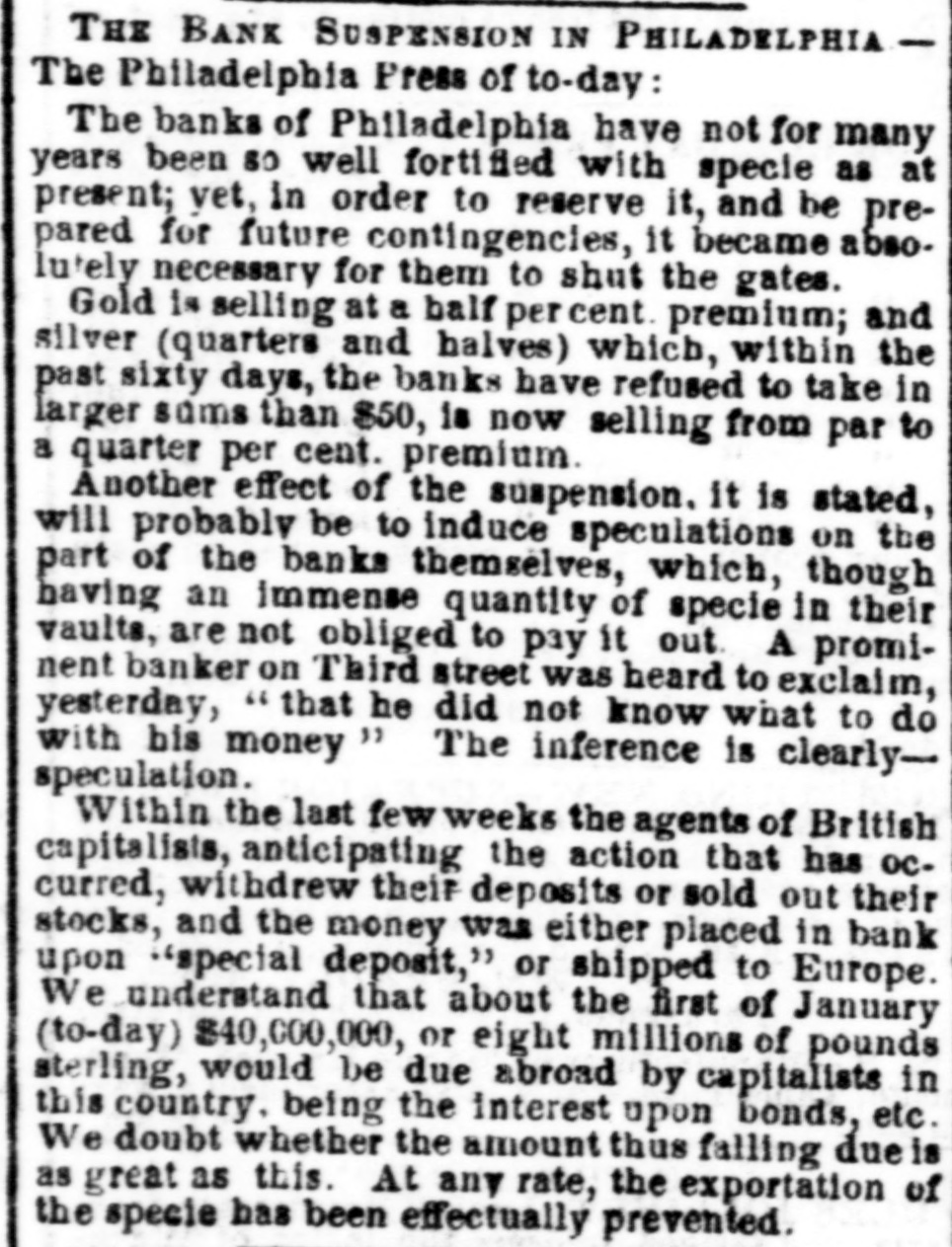
# THE BANK SUSPENSION IN PHILADELPHIA - The Philadelphia Press of to-day : The banks of Philadelphia have not for many years been so well fortified with specie as at present; yet, in order to reserve it, and be prepared for future contingencies, it became absolutely necessary for them to shut the gates. Gold is selling at a half percent. premium; and silver (quarters and halves) which, within the past sixty days, the banks have refused to take in larger sums than $50, is now selling from par to a quarter per cent. premium. Another effect of the suspension, it is stated, will probably be to induce speculations on the part of the banks themselves, which, though having an immense quantity of specie in their vaults, are not obliged to pay it out. A prominent banker on Third street was heard to exclaim, yesterday, "that he did not know what to do with his money " The inference is clearly-speculation. Within the last few weeks the agents of British capitalists, anticipating the action that has occurred, withdrew their deposits or sold out their stocks, and the money was either placed in bank upon "special deposit," or shipped to Europe. We understand that about the first of January (to-day) $40,000,000, or eight millions of pounds sterling, would be due abroad by capitalists in this country, being the interest upon bonds, etc. We doubt whether the amount thus falling due is as great as this. At any rate, the exportation of the specie has been effectually prevented.


Article from Rutland Weekly Herald, January 2, 1862

Click image to open full size in new tab

Article Text

A lady in northwestern Missouri premium for enough Yankee scalps a bed quilt.—Wheeling Intelligence. Perhaps she would like to take Yankee as a comfort.—Prentice. The negroes of Port Royal receive a dollar for every 100 lbs. of ginned bagged by them. Much of the cotton will have to be sent away unginned for want of gins. Philadelphia, The Banks of this city have resumed specie payments in consequence of the suspension in New York.


Article from Holmes County Farmer, January 2, 1862

Click image to open full size in new tab

Article Text

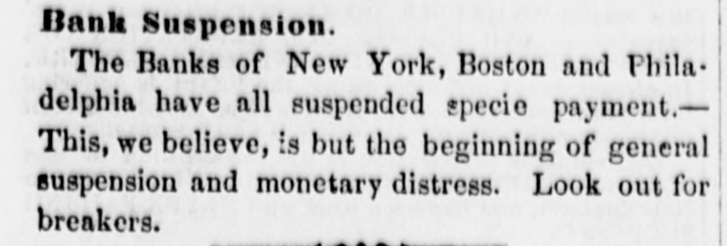
Bank Suspension. The Banks of New York, Boston and Phila. delphia have all suspended specie payment.This, we believe, is but the beginning of general suspension and monetary distress. Look out for breakers.


Article from Bradford Reporter, January 16, 1862

Click image to open full size in new tab

Article Text

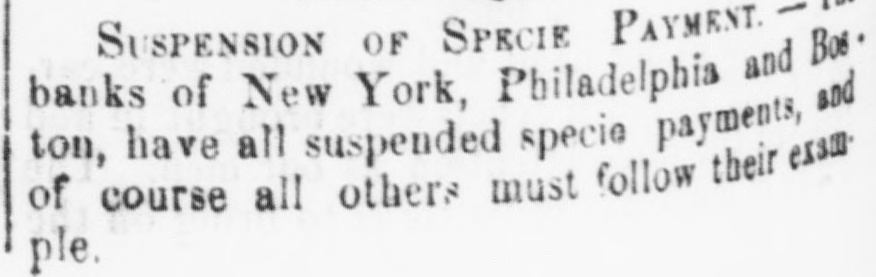
SUSPENSION OF SPECIE PAYMENT banks of New York, Philadelphia and Bos. ton, have all suspended specie payments, and of course all others must follow their exam ple.