
18977. Banks of Philadelphia (Philadelphia, PA)

Bank Information

Episode Type
Suspension → Reopening
Bank Type
state
Start Date
August 31, 1814
Location
Philadelphia, Pennsylvania (39.952, -75.164)

Metadata

Model
gpt-5-mini
Short Digest
6c6956eb

Response Measures

None

Description

Articles discuss the historic suspension of specie payments around the War of 1812 (banks suspended in Aug 1814 period) and the resumption of specie payments on 1817-02-20 for New York, Trenton, Philadelphia, Baltimore and Richmond. No discrete depositor run is described for a single bank; this is a general suspension and later reopening.

Events (2)

1. August 31, 1814 Suspension
Cause
Macro News
Cause Details
Suspensions occurred during the War of 1812 period and government borrowing/pressures (government paid out depreciated notes); banks suspended specie payments in late August 1814 as part of the wartime disturbance.
Newspaper Excerpt
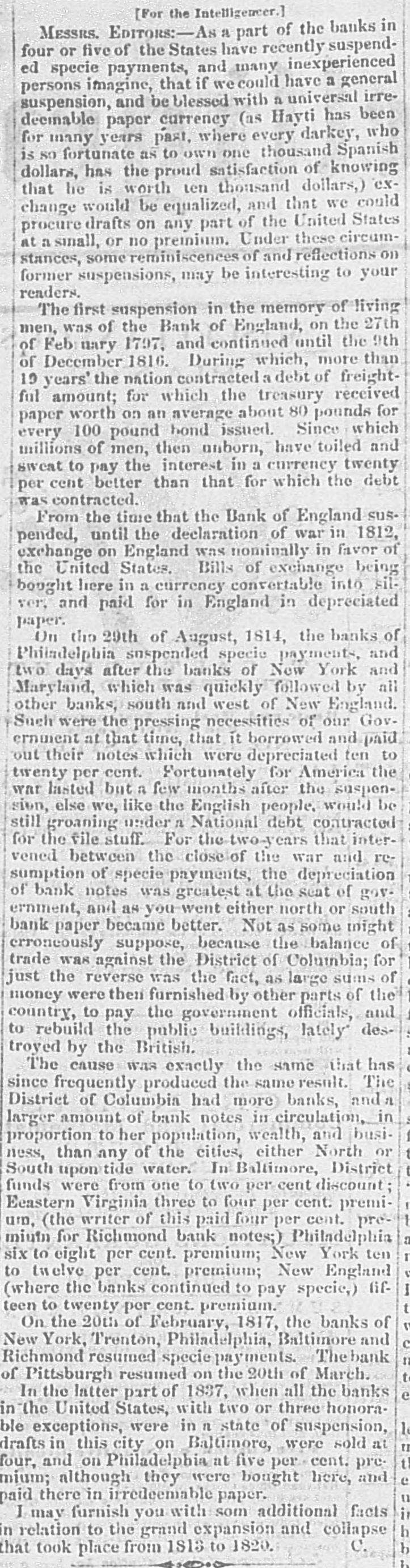
On the 29th of August, 1814, the banks of Philadelphia suspended specie payments, and two days after the banks of New York and Maryland, which was quickly followed by all other banks, south and west of New England.
Source
newspapers
2. February 20, 1817 Reopening
Newspaper Excerpt
On the 20th of February, 1817, the banks of New York, Trenton, Philadelphia, Baltimore and Richmond resumed specie payments.
Source
newspapers

Newspaper Articles (3)

Article from Richmond Enquirer, February 20, 1834

Click image to open full size in new tab

Article Text

effect of the the improper they of and it to carry on the of fiscal the The wholl to the Bank under the Cons and stution, the value money regulate in the taken thereof, the upon prohibitio or bills coining money making and ten in payment in vested for reg Congress hich that time in States, any thing but power of the country, since sub-titut If there ed United of function the of deb's the and silver, bills or paper. be created by Concurrency, the lating was generally by Bauk States cannot the Federal Governine which sup disand of possess in currency great Bank of that the the value of is made the by U.Sales should of the gress, the coin, tial that the every part the what the were reminded of effects the the by State Banks, the when present the States. Kentucky her had by Bank*; Union. Mr. Winston such of and 1917, amongst Wesaw others Banks thereof, detely under Mr. Winthe was what it not in the utBanks were wrought far their long State could Banks for the interest interest carrying they into circuof lation specie which about and 1815, of many the had late imme of the exactly country, in rion+ in or redemption gold local current the Banks 22 beper cent. Washington to cent. belo 7 to 10 from per in the per cent industry. economy, issues, no Bank National of effect this and of the the Bank paper by the tion Constitu the U. sound, is that these publie on them than not the detail these the neces of sity to what power even currency, making He fisel specie of the Alter Bank S. the U. in 1517, January, the delegates of New Banks York, Philadelphia, in Baltimore an by agreement to be resumed United States, upon Hionies, But have Banks of ments, the of without Bank the United and from Virginia the Bank, specie Bank the transfer of the of umed the public specie States pay; Bank combined the United Banks obliged their Mr. paper. Winston therefore has this United effect the under to coin gradu the to of of the the make delegated uniform only the power the so when money said, and to may say money the and coined is reguin currency its paperlated and can which Mr. of the of the but Banks, ought and to be regulated by United could place, that only be Winston done said, again, he them our if buf, value and branches. of metallic currency could be put genius dow of eable let States the Bank to the days all these banks the spirit and and indispen purpose Found Mr. said, Winston the of but to of God in banks with be them be lied could by Spartan age to it and be silver, would let banks, such have currency. not from comes not hat Bank, provided all The times fourth our go well; sound the and Bank paper made, or red deemable from at the That General the tional, has will where by whom good in it itself, solution and is in cannot these power which been Bank, States as United by they Assembly, that United Congress of the and General stitution declared, of fre- the in by the Congrer by General the Assembly the word Delegates. ask. United States power have When he from when House did the of un. but of at and that time the then Bank with quently quently Bank then of the the were session adopt- the to our request of the charof ter the to about ex. What pire. our under One, 1810, ed, declaring our against States Bank, the by those Senators the inthe effect; ed the they United course taken while he obeyed other disobe the censured of the bank, because but Giles) vital in principle to the right instruct had Brent) that disobeye or before since time, the or a Bank, resolutions and States then of mainly state Mr. and Winparties; ston has Virginia with of S. W. Mr. if Bank, that of the shew, that the these Bank of the said, U that and direct she assent, the stronge possible U. States. on James elected of the 10 United States. the by of that, her Bank too, Chat by the of 2d the day supply of Jan- the death Mr. Brent, having that was by given of the As. General that kembly on ancholy the the first Bill was Bank and nary, 10 day both Houses and that upon too, its by pas- the Represtive the Cheves, And elec. Speaker. was thus hasvacancy, that be up, knowing brought in Congress. supply the important, and that Did Virginia her Did reprehis use best They the fully colemo instruct actions Bill, to or did gaid, his he got petitions in very favor her go of the did Bank not. Mr. up W. in this ng Congress tional that, our new Senator in the form by that sing of this hment Bank, to eay. The first tional. Bank Calhoun of filly millions of on by of Mr. dollars; notes. six That mil
Article from Wheeling Daily Intelligencer, October 7, 1857

Click image to open full size in new tab

Article Text

[For the Intelligencer.] MESSRS. EDITORS:-As a part of the banks in four or five of the States have recently suspended specie payments, and many inexperienced persons imagine, that if we could have a general suspension, and be blessed with a universal irredeemable paper currency (as Hayti has been for many years past, where every darkey, who is so fortunate as to own one thousand Spanish dollars, has the proud satisfaction of knowing that he is worth ten thousand dollars,) exchange would be equalized, and that we could procure drafts on any part of the United States at a sinall, or no premium. Under these circumstances, some reminiscences of and reflections on former suspensions, may be interesting to your readers. The first suspension in the memory of living men, was of the Bank of England, on the 27th of February 1797, and continued until the 9th of December 1816. During which, more than 19 years' the nation contracted a debt of freightful amount; for which the treasury received paper worth on an average about 80 pounds for every 100 pound bond issued. Since which millions of men, then unborn, have toiled and sweat to pay the interest in a currency twenty per cent better than that for which the debt was contracted. From the time that the Bank of England suspended, until the declaration of war in 1812, exchange on England was nominally in favor of the United States. Bills of exchange being bought here in a currency convertable into silver, and paid for in England in depreciated paper. On the 29th of August, 1814, the banks of Phindelphia suspended specie payments, and two days after the banks of New York and Maryland, which was quickly followed by all other banks, south and west of New England. Such were the pressing necessities of our Government at that time, that it borrowed and paid out their notes which were depreciated ten to twenty per cent. Fortunately for America the war lasted but a few months after the suspension, else we, like the English people, would be still groaning under a National debt contracted for the vile stuff. For the two years that intervened between the close of the war and resumption of specie payments, the depreciation of bank notes was greatest at the seat of government, and as you went either north or south bank paper became better. Not as some might erroneously suppose, because the balance of trade was against the District of Columbia; for just the reverse was the fact, as large sums of money were then furnished by other parts of the country, to pay the government officials, and to rebuild the public buildings, lately destroyed by the British. The cause was exactly the same that has since frequently produced the same result. The District of Columbia had more banks, and a larger amount of bank notes in circulation, in proportion to her population, wealth, and business, than any of the cities, either North or South upon tide water. In Baltimore, District funds were from one to two per cent discount; Eastern Virginia three to four per cent. premium, (the writer of this paid four per cent, premium for Richmond bank notes;) Philadelphia six to eight per cent. premium; New York ten to twelve per cent. premium; New England (where the banks continued to pay specie,) fifteen to twenty per cent. premium. On the 20th of February, 1817, the banks of New York, Trenton, Philadelphia, Baltimore and Richmond resumed specie payments. The bank of Pittsburgh resumed on the 20th of March. In the latter part of 1837, when all the banks in the United States, with two or three honorable exceptions, were in a state of suspension, drafts in this city on Baltimore, were sold at four, and on Philadelphia at five per cent. premium; although they were bought here, and paid there in irredeemable paper. I may furnish you with som additional facts in relation to the grand expansion and collapse that took place from 1813 to 1820. C.


Article from The New York Herald, May 22, 1865

Click image to open full size in new tab

Article Text

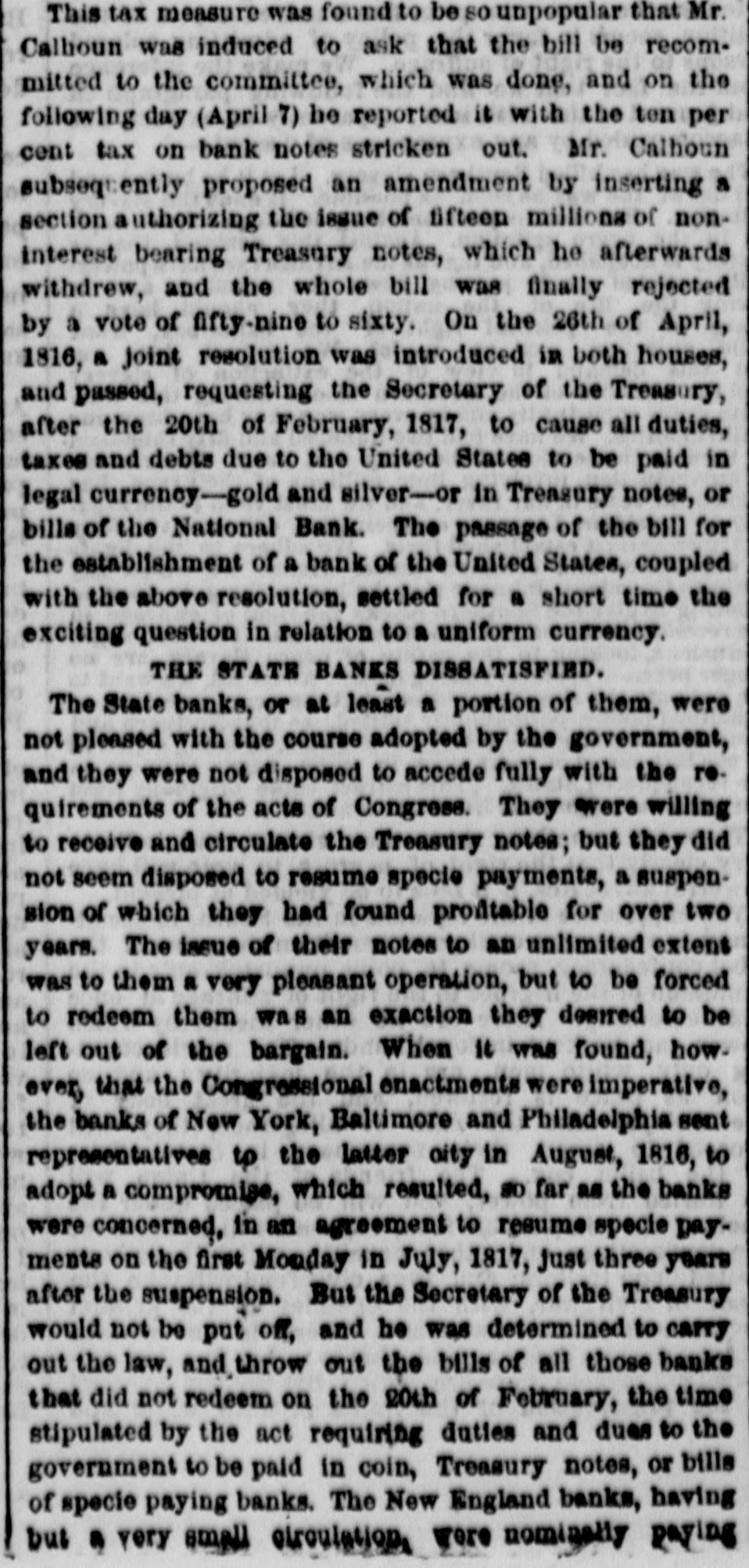
This tax measure was found to be so unpopular that Mr. Calhoun was induced to ask that the bill be recommitted to the committee, which was done, and on the following day (April 7) he reported it with the ten per cent tax on bank notes stricken out. Mr. Calhoun subsequently proposed an amendment by inserting a section authorizing the issue of fifteen millions of non-interest bearing Treasury notes, which he afterwards withdrew, and the whole bill was finally rejected by a vote of fifty-nine to sixty. On the 26th of April, 1816, a joint resolution was introduced in both houses, and passed, requesting the Secretary of the Treasury, after the 20th of February, 1817, to cause all duties, taxes and debts due to the United States to be paid in legal currency—gold and silver—or in Treasury notes, or bills of the National Bank. The passage of the bill for the establishment of a bank of the United States, coupled with the above resolution, settled for a short time the exciting question in relation to a uniform currency. # THE STATE BANKS DISSATISFIED. The State banks, or at least a portion of them, were not pleased with the course adopted by the government, and they were not disposed to accede fully with the requirements of the acts of Congress. They were willing to receive and circulate the Treasury notes; but they did not seem disposed to resume specie payments, a suspension of which they had found profitable for over two years. The issue of their notes to an unlimited extent was to them a very pleasant operation, but to be forced to redeem them was an exaction they desired to be left out of the bargain. When it was found, however, that the Congressional enactments were imperative, the banks of New York, Baltimore and Philadelphia sent representatives to the latter city in August, 1816, to adopt a compromise, which resulted, so far as the banks were concerned, in an agreement to resume specie payments on the first Monday in July, 1817, just three years after the suspension. But the Secretary of the Treasury would not be put off, and he was determined to carry out the law, and throw out the bills of all those banks that did not redeem on the 20th of February, the time stipulated by the act requiring duties and dues to the government to be paid in coin, Treasury notes, or bills of specie paying banks. The New England banks, having but a very small circulation, were nominally paying