
15432. Bank of Wooster (Wooster, OH)

Bank Information

Episode Type
Suspension โ†’ Closure
Bank Type
state
Start Date
August 17, 1853
Location
Wooster, Ohio (40.805, -81.935)

Metadata

Model
gpt-5-mini
Short Digest
e30a7b9a37094dd4

Response Measures

None

Description

Articles mention the Bank of Wooster historically among institutions that suspended or failed (19th-century context). No detailed contemporaneous run is described; references are general/historical (Article 1, 1853 editorial describing banks that had... pronounced the bank as busted; or... suspended, and Article 2, 1898 retrospective mentioning the Bank of Wooster among banks that suspended). I infer a suspension leading to failure (closure) but the sources do not provide a specific incident narrative, precise date of failure, or detailed causes. OCR errors in Article 1 corrected (e.g., 'bursted' -> 'busted', contextual smoothing).

Events (2)

1. August 17, 1853 Suspension
Cause Details
General banking insolvency/decision by banks not to redeem notes (19th-century state bank suspensions mentioned in an 1853 editorial).
Newspaper Excerpt
Granville, dollar a time, and for instance one is another Urbana, another Wooster, and then comes the eastern funds which is comes next, and ... had pronounced the bank as bursted; or to use a more polite and business term had He unfolds them one at suspended.
Source
newspapers
2. February 17, 1898 Other
Newspaper Excerpt
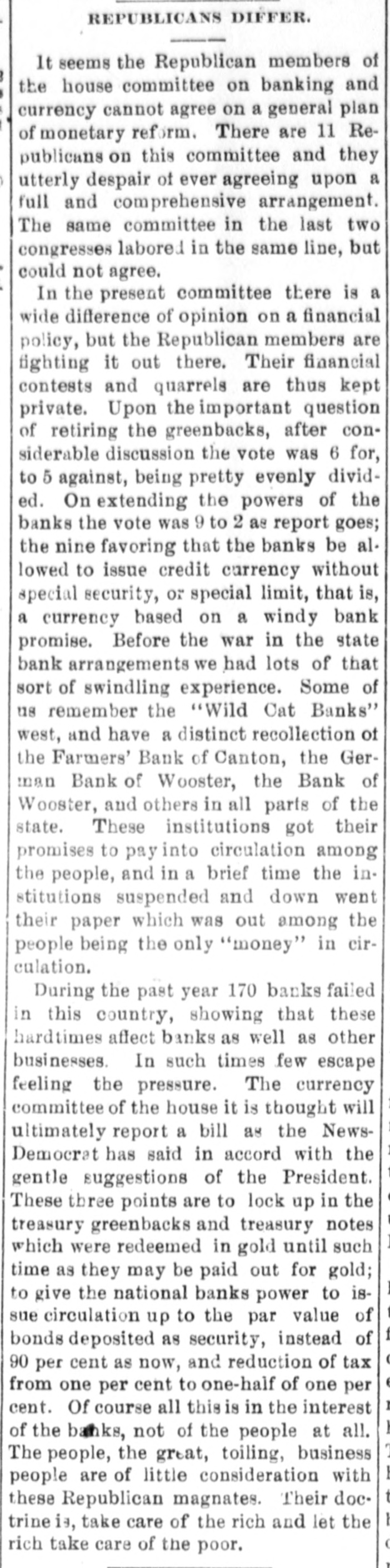
Some of us remember the 'Wild Cat Banks' west, and have a distinct recollection of the Farmers' Bank of Canton, the German Bank of Wooster, the Bank of Wooster, and others in all parts of the state. These institutions got their promises to pay into circulation among the people, and in a brief time the institutions suspended and down went their paper which was out among the people being the only 'money' in circulation.' (retrospective mention).
Source
newspapers

Newspaper Articles (2)

Article from The Democratic Sentinel, August 17, 1853

Click image to open full size in new tab

Article Text

ges in his pockets, lie hies noute his little ones around him and draw consolntion from his hearth stone, for the many hard hours he has to lead to win his pittance, Saturday night! How the poor woman sighs for relief as she realizes that again sent her time for rest; have been small, yet her God rewards hes heart and though is builds she content to live no, for even her up in the future, a house where 'tis always eve! How the care worn man of business relaxes his brow and closing his shop saun litters deliberately around to gather up a He gossip ere he goes quickly home to take rest.' Now thisis all very beautiful indeed; and if it is never marred by the misfortunes that sometime overtake people, it would be very well. But what must that poor man's feelings be, when he visits the market or, the grocery to provide for those"little ones, and be is told that his little "pittance" which he has "toiled so many hard hours to win" is good for nothing. After he repaired to his home and retired to rest, the whose notes he beld, had met in and concluced was their bankers dark room, it and not best touredeem any more of their notes, had pronounced the bank as bursted; or to use a more polite and business term had He unfolds them one at suspended. Granville, dollar a time, and for instance one is another Urbana, another Wooster, and then comes the eastern funds which is comes next, and Kellingsly others above of par! like kind; but all is a like; all will not purchase the wherewith to feed and clothe those "little ones" for whose support he has "toiled so many hard hours," and his "weeks wages in his pocket" had better remained with the No that is not right; the "God" sent that "poor woman to employer. that time and of rest," that placed in the earth the metal, metal our government has made money that would not have rotted in that poor man's pocket during Sunday, and that is what he should have received for his "hard hours of toil." But no, the money changers whose tables Christ in the temple upset people have believe ingeniously managed to make that such stulf was too heavy for them to carry, and they had better let them lock it up in their vaults and issue in its stead their promissory notes, which was to be a safe, sound, and convenient currency; always redeemable in gold and silver, at the courte until the bankers concluded not to do it. And how much more deep would that "poor woman sighed" when her small rer wards for her weeks labor is reduced to nothing by the ingenious financiering of these public benefacturers! Then let the "care worn man of 'business" he returns to his shop on Monday and examine among the morning, when rags unlucky that fill the drawer, if he'has been SO to have done a large cash business on and see how much Saturday, as of his profit's when has vanished into the air on Sunday he was a church or perhaps conning over "little which he up before he Saturday the night gossip" gathered retired it to the his home. Perhaps he may take to neighboring bank to deposit,"as is his custom, but the wary banker knew the value of his money before he did, and of course refuses it as uncurrent. This is the other side of the beautiful picture drawn by the "Sandusky Register," and thousands of martyrs to the system of will attest, that it is no fancy sketch, but real life; and yet we poor talerant souls permit it to go on, and see the toiling millions this nation fleeced of millions of their and of hard earnings, to sustain a "safe sound solvent system of banking," which issues their debts as currency, because it is light in the pocket and convenient to handle.There is perhaps, nothing in our government, which is so detrimental to interests and prosperity of the people that is tolerated to such an extent, as the banking system for it is now and has been carried on years as in this country. When will the throw peoarise in their majesty and over S. ple the tables of the money changers?- - O. Democrat. DO The Richmond Va. Whig proposes Maine

Article from The Stark County Democrat, February 17, 1898

Click image to open full size in new tab

Article Text

REPUBLICANS DIFFER. It seems the Republican members of the house committee on banking and currency cannot agree on a general plan of monetary reform. There are 11 Republicans on this committee and they s utterly despair of ever agreeing upon a full and comprehensive arrangement. The same committee in the last two congresses labored in the same line, but could not agree. In the present committee there is a wide difference of opinion on a financial policy, but the Republican members are fighting it out there. Their financial contests and quarrels are thus kept private. Upon the important question of retiring the greenbacks, after considerable discussion the vote was 6 for, to 5 against, being pretty evenly divided. On extending the powers of the banks the vote was 9 to 2 as report goes; the nine favoring that the banks be allowed to issue credit currency without special security, or special limit, that is, a currency based on a windy bank promise. Before the war in the state bank arrangements we had lots of that sort of swindling experience. Some of us remember the "Wild Cat Banks" west, and have a distinct recollection of the Farmers' Bank of Canton, the German Bank of Wooster, the Bank of Wooster, and others in all parts of the state. These institutions got their promises to pay into circulation among the people, and in a brief time the institutions suspended and down went their paper which was out among the people being the only "money" in circulation. During the past year 170 banks failed in this country, showing that these hardtimes affect banks as well as other businesses. In such times few escape feeling the pressure. The currency committee of the house it is thought will ultimately report a bill as the NewsDemocrat has said in accord with the gentle suggestions of the President. These three points are to lock up in the treasury greenbacks and treasury notes which were redeemed in gold until such time as they may be paid out for gold; to give the national banks power to issue circulation up to the par value of bonds deposited as security, instead of 90 per cent as now, and reduction of tax from one per cent to one-half of one per cent. Of course all this is in the interest of the banks, not of the people at all. The people, the great, toiling, business I people are of little consideration with t these Republican magnates. Their docI trine is, take care of the rich and let the ( rich take care of the poor.