18142. First National Bank (Nashville, TN)

Bank Information

Episode Type
Suspension β†’ Reopening
Bank Type
national
Bank ID
150
Charter Number
150
Start Date
March 27, 1893
Location
Nashville, Tennessee (36.166, -86.784)

Metadata

Model
gpt-5-mini
Short Digest
9ef8c33824d2a945

Response Measures

None

Description

A small, short-lived run occurred Mar 27, 1893 that did not close the bank (depositors redeposited). The bank later suspended after banking hours on 1893-08-10 due to the money-market stringency and drain of deposits related to other local failures, and was authorized to reopen and did resume in mid-September (permission noted 1893-09-11). The suspension appears driven by market/stringency (macro/local contagion) rather than a bank-specific insolvency; the bank later reopened.

Events (5)

1. December 11, 1863 Chartered
Source
historical_nic
2. March 27, 1893 Run
Cause
Rumor Or Misinformation
Cause Details
Curbstone loungers/rumors predicted failures of principal banks, producing a brief panic and small withdrawals that were promptly redeposited.
Measures
Depositors withdrew briefly then redeposited; bank paid out demands without suspending.
Newspaper Excerpt
a small run was made on the First National, but the depositors got their money so rapidly that they became convinced their fright was an error, and in nearly every instance redeposited.
Source
newspapers
3. August 10, 1893 Suspension
Cause
Macro News
Cause Details
Stringency of the money market and drain of deposits following other local bank suspensions/ failures; inability to collect and general market tightness.
Newspaper Excerpt
The First National Bank of this city suspended after banking hours this afternoon.
Source
newspapers
4. September 11, 1893 Reopening
Newspaper Excerpt
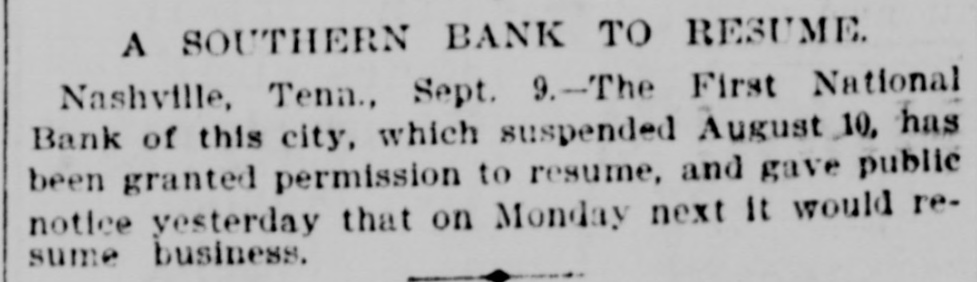
The First National Bank of this city, which suspended August 10, has been granted permission to resume, and gave public notice yesterday that on Monday next it would resume business.
Source
newspapers
5. July 8, 1912 Voluntary Liquidation
Source
historical_nic

Newspaper Articles (23)

Article from The Indianapolis Journal, March 28, 1893

Click image to open full size in new tab

Article Text

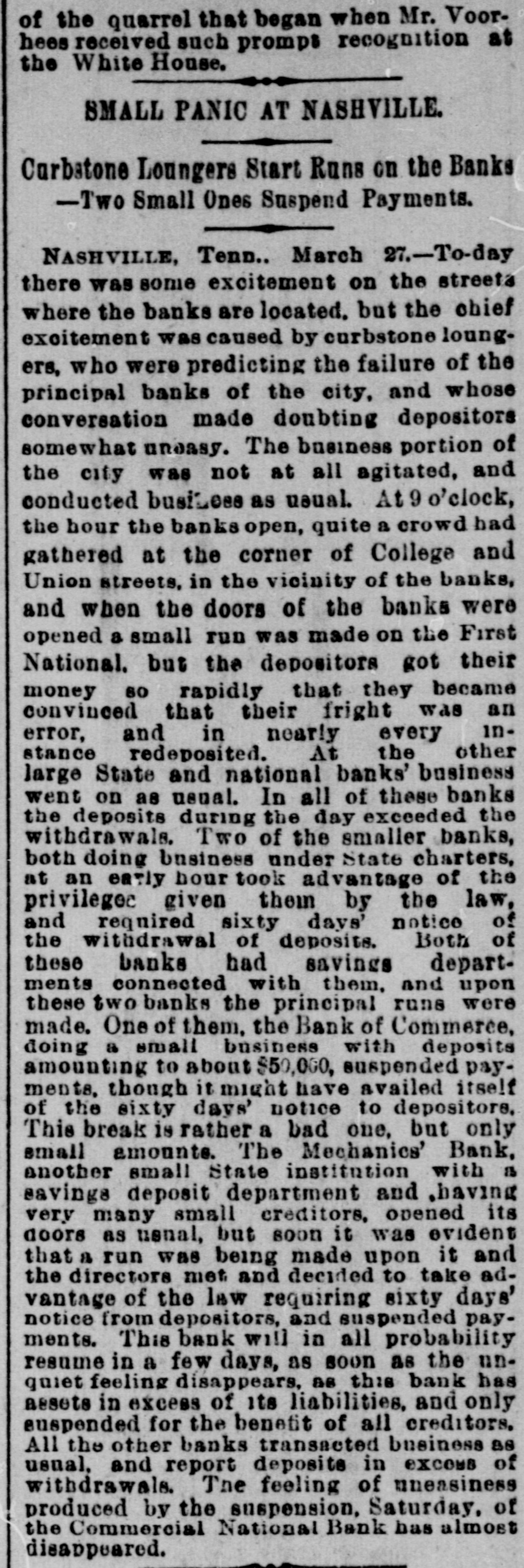
of the quarrel that began when Mr. Voorhees received such prompt recognition at the White House. SMALL PANIC AT NASHVILLE. Carbstone Loungers Start Runs on the Banks -Two Small Ones Suspend Payments. NASHVILLE, Tenn.. March 27.-To-day there was some excitement on the streets where the banks are located. but the chief exoitement was caused by curbstone loung. ers, who were predicting the failure of the principal banks of the city, and whose conversation made doubting depositors somewhat uneasy. The business portion of the city was not at all agitated, and conducted busiLees as usual. At9 o'clock, the hour the banks open, quite a crowd had gathered at the corner of College and Union streets, in the vicinity of the banks, and when the doors of the banks were opened a small run was made on the First National. but the depositors got their money 60 rapidly that they became convinced that their fright was an error, and in nearly every instance redeposited. At the other large State and national banks' business went on as usual. In all of these banks the deposits during the day exceeded the withdrawals Two of the smaller banks, both doing business under State charters, at an early hour took advantage of the privilegee given them by the law, and required sixty days' notice of the withdrawal of deposits. Both of these banks had savings departments connected with them. and upon these two banks the principal runs were made. One of them. the Bank of Commerce, doing a small business with deposits amounting to about $50,000, suspended payments. though it might have availed itself of the eixty days' notice to depositore. This break is rather a bad one, but only email amounts. The Mechanics' Bank, another small State institution with a savings deposit department and having very many small creditors, opened its doors as usual, but soon it was evident that a run was being made upon it and the directors met and decided to take advantage of the law requiring sixty days' notice from depositors, and suspended payments. This bank will in all probability resume in a few days, as soon as the unquiet feeling disappears, as this bank has assets in excess of its liabilities, and only suspended for the benefit of all creditors. All the other banks transacted business as usual, and report deposits in excess of withdrawals. The feeling of uneasiness produced by the suspension, Saturday. of the Commercial National Bank has almost disappeared.

Article from The Helena Independent, March 28, 1893

Click image to open full size in new tab

Article Text

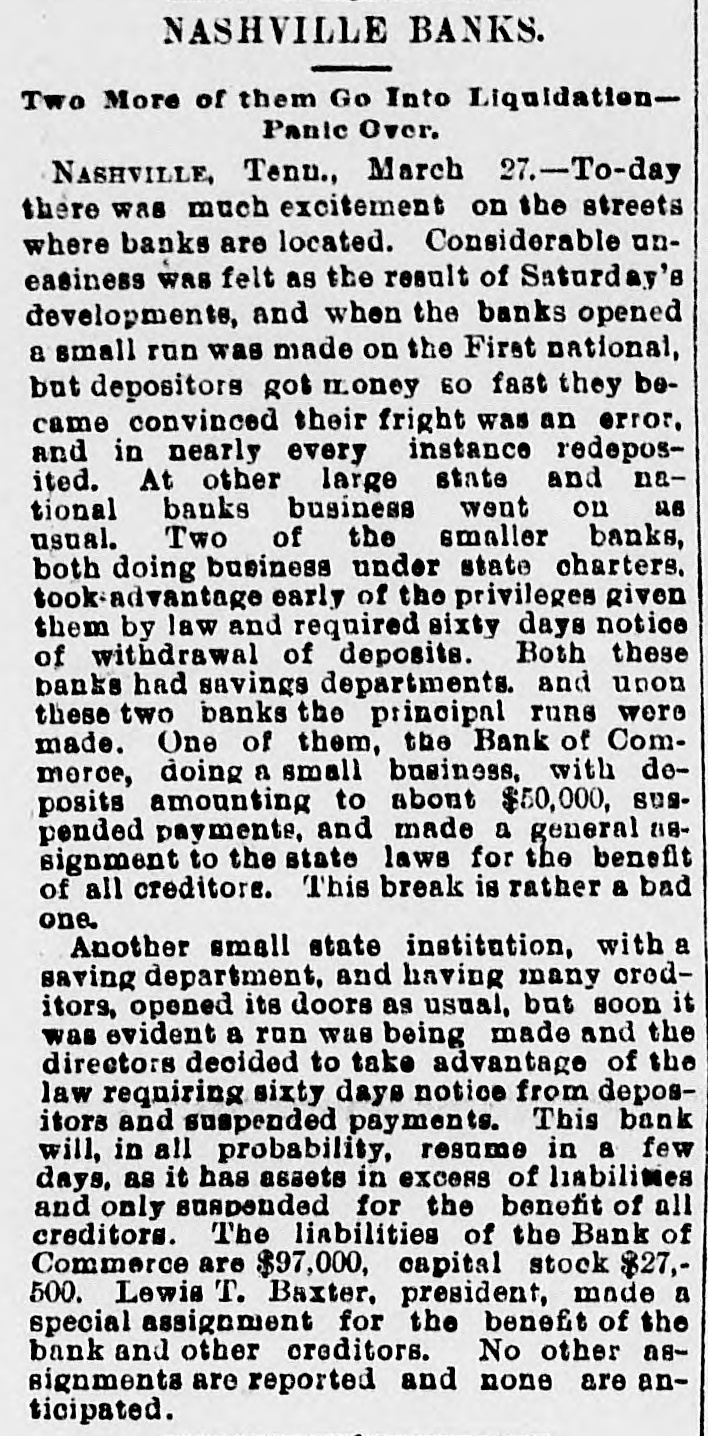
NASHVILLE BANKS. Two More of them Go Into LiquidationPanic Over. NASHVILLE, Tenn., March 27. - -To-day there was much excitement on the streets where banks are located. Considerable uneasiness WAS felt as the result of Saturday's developments, and when the banks opened a small run was made on the First national, but depositors got money 60 fast they became convinced their fright was an error, and in nearly every instance redeposited. At other large state and national banks business went on as usual. Two of the smaller banks, both doing business under state charters. took-advantage early of the privileges given them by law and required sixty days notice of withdrawal of deposits. Both these banks had savings departments. and upon these two banks the principal runs were made. One of them, the Bank of Commerce, doing a small business, with deposits amounting to about $50,000, suspended payments, and made a general 818signment to the state laws for the benefit of all creditore. This break is rather a bad one. Another small state institution, with a saving department, and having many creditors, opened its doors as usual, but soon it was evident a run was being made and the directors decided to take advantage of the law requiring sixty days notice from depositors and suspended payments. This bank will, in all probability, resume in a few days, as it has assets in excess of liabilities and only suspended for the benefit of all creditors. The liabilities of the Bank of Commerce are $97,000, capital stock $27,500. Lewis T. Baxter. president, made a special assignment for the benefit of the bank and other creditors. No other assignments are reported and none are anticipated.


Article from New-York Tribune, March 28, 1893

Click image to open full size in new tab

Article Text

ANOTHER NASHVILLE FAILURE. THE BANK OF COMMERCE MAKES AN AS SIGNMENT THE MECHANICS' BANK DEMANDS SIXTY DAYS' NOTICE OF WITHDRAWAL OF DEPOSITSCREDITORS OF BOTH LIKELY TO GET THEIR MONEY - PRECAUTIONS AGAINST RUNS ON OTHER INSTITUTIONS. [BY TELEGRAPH TO THE TRIBUNE.] Nashville, Tenn., March 27.-The Bank of Commerce of this city did not open its doors to-day at 9 o'clock, the usual time: and an hour or two later, after a conference of the directors had been held, an assignment was made. John T. Lellyette was named as assignee. The bank was a small one, its assets and liabilities being approximately as follows: Assets-Notes discounted, $76,000; real estate and cash, $21,700; total, $97,700. Liabilities-Capital stock paid in. $27,500; deposits, savings account, $14,000; deposits, special account, $15,000; general deposits, $19,000; profit and loss, $22,200; total, $97,700. The Mechanics' Savings Bank and Trust Company, capital $250,000, took advantage of the State law permitting sixty days' notice to be demanded before deposits can be withdrawn. At least a dozen small banks in adjacent towns are said to Le in temporary financial straits. The assignment of the Bank of Commerce was filed late in the afternoon. The closing of the doors was brought about by an apprehension that a run on the bank would be made in the course of the day. Under the State Banking laws the bank could have required small depositors in the savings department to give sixty days' notice of their intention to withdraw deposits. This, however, would not have prevented the withdrawal of regular deposits, which would leave the small depositors at a disadvantage. The directors there. fore decided, in the interest of all depositors alike, to close the bank. The failure of certain persons, who owe the bank large sums, to meet these obligations was the principal cause of the suspension. None of the directors or officers of the bank are indebted to the institution. Mr. Brooks, the cashier, thinks the stockholders, as well as the depositors, will be paid in full if the amounts due the bank can be collected, and that if only 50 per cent of the indebtedness can be collected the depositors ought to get all that is due them. The suspension of the Commercial National Bank on Saturday afternoon occasioned considerable excitement, which had, however, quieted down by this morning, a change of feeling largely due to the belief of various bankers that the depositors of the Commercial Bank would not lose anything. Before beginning business to-day all the banks had fortified themselves with money sufficient to meet all demands that might be made, and had arranged for large amounts in addition. There was a mild run for a while on the First National Bank, but the amount deposited largely exceeded the amount checked out. This was the case at all the banks in the city, men of means pouring ample funds into the vaults. At no time was there the least excitement. The depositors who felt panicky simply drew out their money and went quietly away. The First National was more crowded all the morning than any other bank. Everything was quiet at the American National Bank, and the doors were open till 4 o'clock. Several of the wealthy stockholders signed a notice, which was conspicuously displayed, pledging and binding their personal estates to satisfy any obligations of the bank. After a number of persons had entered the Mechanics' Savings Bank and Trust Company's office and several small checks had been cashed, the directors saw that a run was possible, and to prevent demoralizing excitement, decided to take advantage of the statute which gives a bank organized under the State laws the privilege of demanding a sixty-day notice from depositors before they can withdraw their deposits. Payments were accordingly stopped, and an explanatory notice was posted, which closed with an announcement that the bank would keep its doors open and continue to do business as usual, save that the sixty days' notice of withdrawals would be required for the present, and a denial of the rumor that the bank had sustained a loss by the suspension of the Commercial National Bank. After this business proceeded quietly as usual. United States Bank Examiner J. M. McKnight arrived in the city this morning, and at once took charge of the affairs of the Commercial Bank. S. J. Keith, president of the Fourth National Bank, said to-day that the situation was not nearly as bad as it might appear. Although one small bank had closed its doors permanently and another had availed itself of the sixty days allowed savings banks, yet it was evident that the other banks were amply prepared to take care of themselves. He added that the business condition of the city was entirely healthy.


Article from The Morning Call, March 28, 1893

Click image to open full size in new tab

Article Text

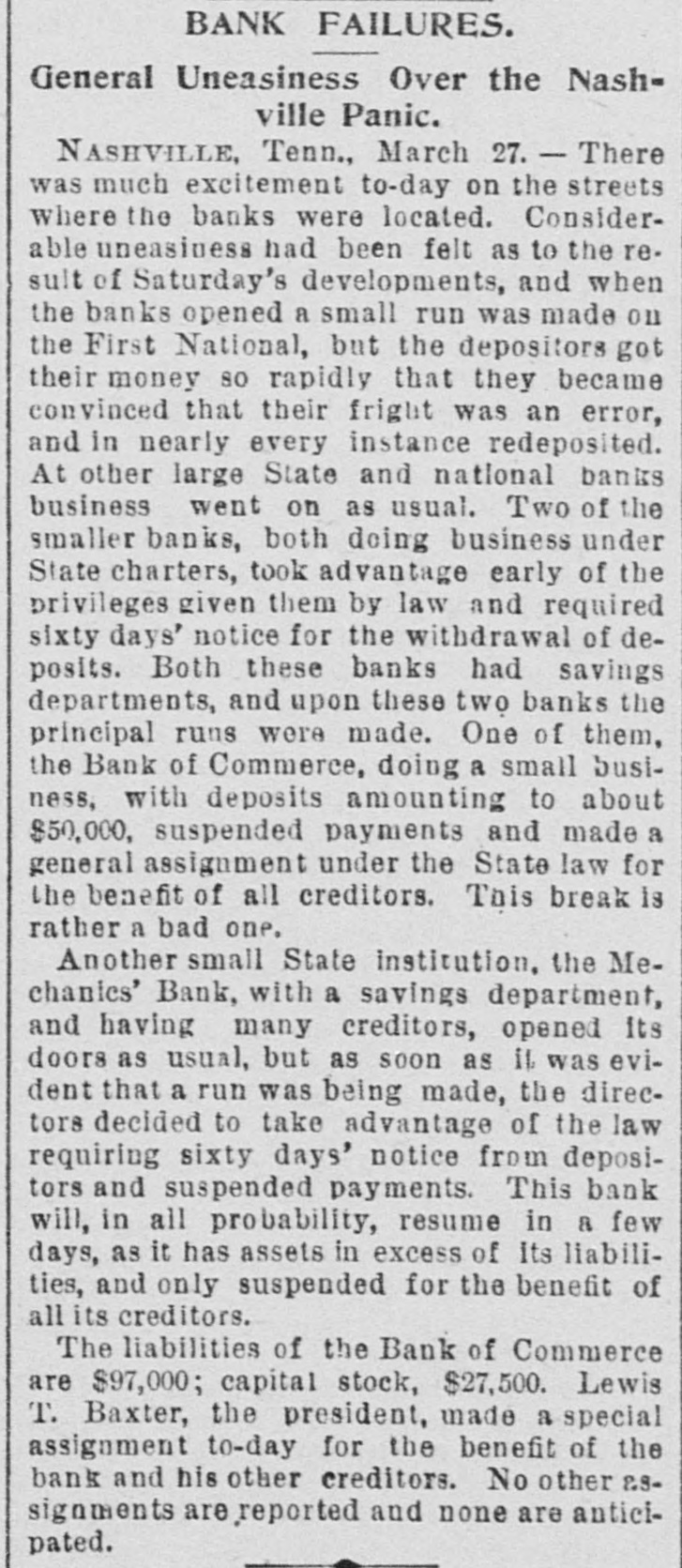
BANK FAILURES. General Uneasiness Over the Nashville Panic. NASHVILLE, Tenn., March 27. - There was much excitement to-day on the streets where the banks were located. Considerable uneasiness had been felt as to the result of Saturday's developments, and when the banks opened a small run was made on the First National, but the depositors got their money so rapidly that they became convinced that their fright was an error, and in nearly every instance redeposited. At other large State and national banks business went on as usual. Two of the smaller banks, both doing business under State charters, took advantage early of the privileges given them by law and required sixty days' notice for the withdrawal of deposits. Both these banks had savings departments, and upon these two banks the principal runs were made. One of them, the Bank of Commerce, doing a small business, with deposits amounting to about $50,000, suspended payments and made a general assignment under the State law for the benefit of all creditors. This break is rather a bad one. Another small State institution, the Mechanics' Bank, with a savings department, and having many creditors, opened its doors as usual, but as soon as il was evident that a run was being made, the directors decided to take advantage of the law requiring sixty days' notice from depositors and suspended payments. This bank will, in all probability, resume in 8 few days, as it has assets in excess of Its liabilities, and only suspended for the benefit of all its creditors. The liabilities of the Bank of Commerce are $97,000; capital stock, $27,500. Lewis T. Baxter, the president, made a special assignment to-day for the benefit of the bank and his other creditors. No other 23signments are reported and none are anticipated.


Article from The Portland Daily Press, March 28, 1893

Click image to open full size in new tab

Article Text

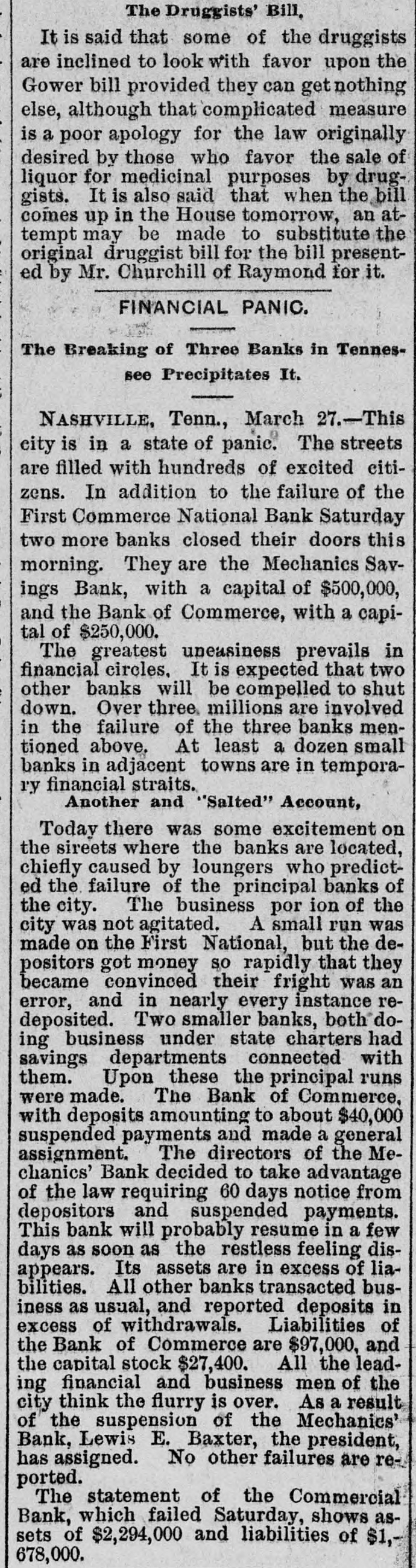
The Druggists' Bill, It is said that some of the druggists are inclined to look with favor upon the Gower bill provided they can get nothing else, although that complicated measure is a poor apology for the law originally desired by those who favor the sale of liquor for medicinal purposes by druggists. It is also said that when the bill comes up in the House tomorrow, an attempt may be made to substitute the original druggist bill for the bill presented by Mr. Churchill of Raymond for it. FINANCIAL PANIC. The Breaking of Three Banks in Tennessee Precipitates It. NASHVILLE, Tenn., March 27.-This city is in a state of panic. The streets are filled with hundreds of excited citizens. In addition to the failure of the First Commerce National Bank Saturday two more banks closed their doors this morning. They are the Mechanics Savings Bank, with a capital of $500,000, and the Bank of Commerce, with a capital of $250,000. The greatest uneasiness prevails in financial circles, It is expected that two other banks will be compelled to shut down. Over three. millions are involved in the failure of the three banks mentioned above. At least a dozen small banks in adjacent towns are in temporary financial straits. Another and "Salted" Account, Today there was some excitement on the sireets where the banks are located, chiefly caused by loungers who predicted the failure of the principal banks of the city. The business por ion of the city was not agitated. A small run was made on the First National, but the depositors got money so rapidly that they became convinced their fright was an error, and in nearly every instance redeposited. Two smaller banks, both doing business under state charters had savings departments connected with them. Upon these the principal runs were made. The Bank of Commerce, with deposits amounting to about $40,000 suspended payments and made a general assignment. The directors of the Mechanics' Bank decided to take advantage of the law requiring 60 days notice from depositors and suspended payments. This bank will probably resume in a few days as soon as the restless feeling disappears. Its assets are in excess of liabilities. All other banks transacted business as usual, and reported deposits in excess of withdrawals. Liabilities of the Bank of Commerce are $97,000, and the capital stock $27,400. All the leading financial and business men of the city think the flurry is over. As a result of the suspension of the Mechanics' Bank, Lewis E. Baxter, the president, has assigned. No other failures are reported. The statement of the Commercial Bank, which failed Saturday, shows assets of $2,294,000 and liabilities of $1,678,000.


Article from The Seattle Post-Intelligencer, March 28, 1893

Click image to open full size in new tab

Article Text

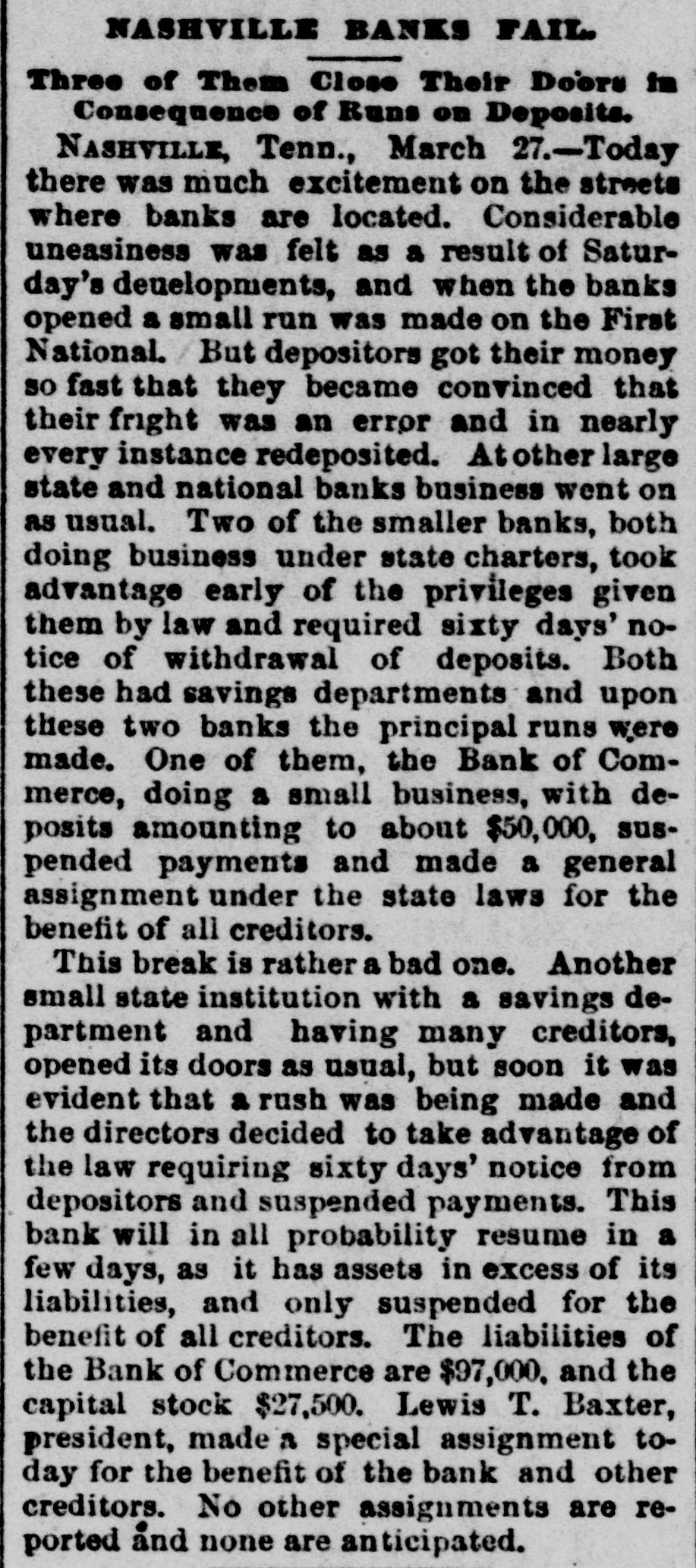
NASHVILLE BANKS FAIL. Three of Them Close Their Doors in Consequence of Runs on Deposits. NASHVILLE, Tenn., March 27.-Today there was much excitement on the streets where banks are located. Considerable uneasiness was felt as a result of Saturday's developments, and when the banks opened a small run was made on the First National. But depositors got their money so fast that they became convinced that their fright was an error and in nearly every instance redeposited. Atother large state and national banks business went on as usual. Two of the smaller banks, both doing business under state charters, took advantage early of the privileges given them by law and required sixty days' notice of withdrawal of deposits. Both these had savings departments and upon these two banks the principal runs were made. One of them, the Bank of Commerce, doing a small business, with deposits amounting to about $50,000, suspended payments and made a general assignment under the state laws for the benefit of all creditors. This break is rather a bad one. Another small state institution with a savings department and having many creditors, opened its doors as usual, but soon it was evident that a rush was being made and the directors decided to take advantage of the law requiring sixty days' notice from depositors and suspended payments. This bank will in all probability resume in a few days, as it has assets in excess of its liabilities, and only suspended for the benefit of all creditors. The liabilities of the Bank of Commerce are $97,000. and the capital stock $27,500. Lewis T. Baxter, president, made a special assignment today for the benefit of the bank and other creditors. No other assignments are reported and none are anticipated.


Article from The Salt Lake Herald, March 28, 1893

Click image to open full size in new tab

Article Text

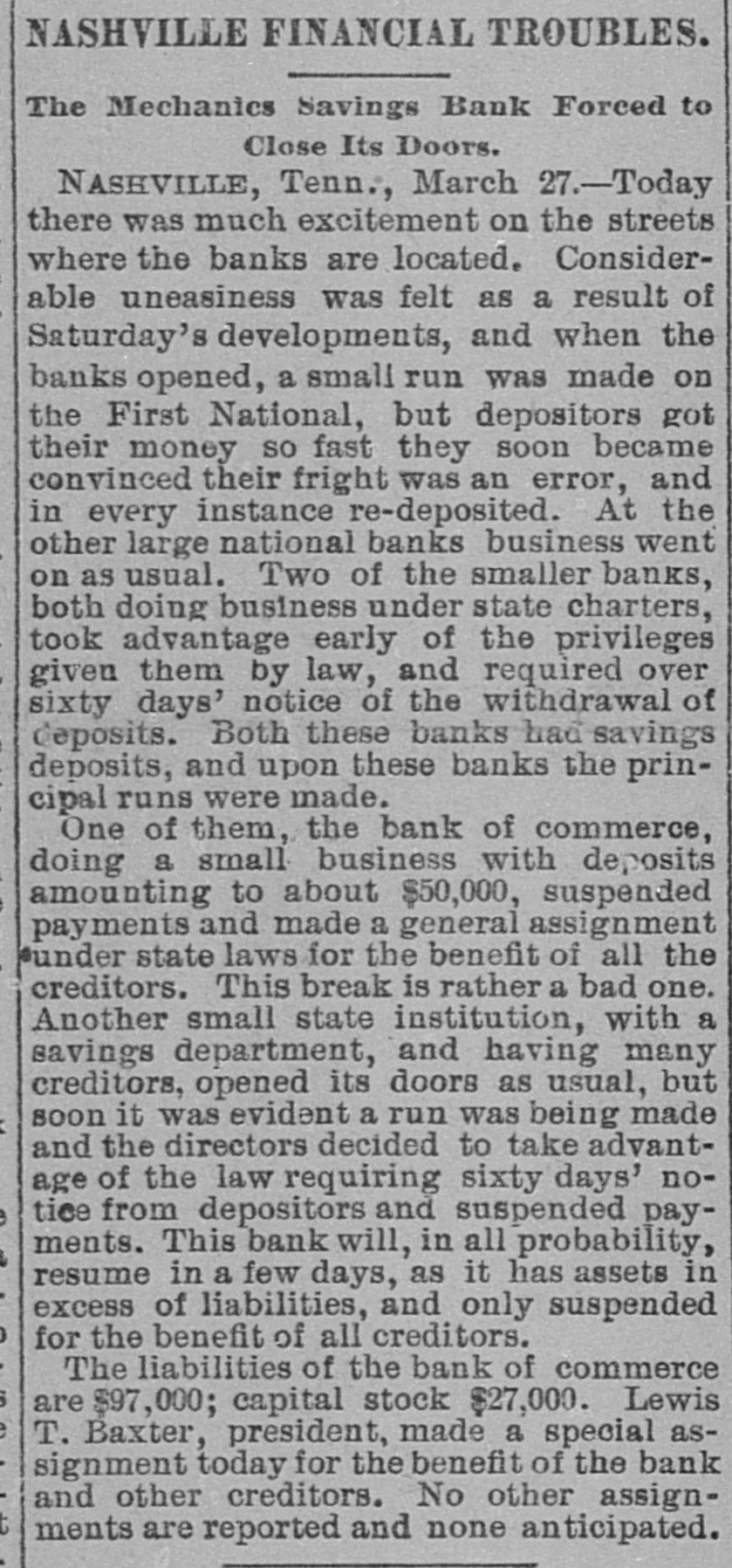
NASHVILLE FINANCIAL TROUBLES. The Mechanics Savings Bank Forced to Close Its Doors. NASHVILLE, Tenn., March 27.-Today there was much excitement on the streets where the banks are located. Considerable uneasiness was felt as a result of Saturday's developments, and when the banks opened, a small run was made on the First National, but depositors got their money so fast they soon became convinced their fright was an error, and in every instance re-deposited. At the other large national banks business went on as usual. Two of the smaller banks, both doing business under state charters, took advantage early of the privileges given them by law, and required over sixty days' notice of the withdrawal of deposits. Both these banks had savings deposits, and upon these banks the principal runs were made. One of them, the bank of commerce, doing a small business with deposits amounting to about $50,000, suspended payments and made a general assignment #under state laws for the benefit of all the creditors. This break is rather a bad one. Another small state institution, with a savings department, and having many creditors, opened its doors as usual, but soon it was evident a run was being made and the directors decided to take advantage of the law requiring sixty days' notice from depositors and suspended payments. This bank will, in all probability, resume in a few days, as it has assets in excess of liabilities, and only suspended for the benefit of all creditors. The liabilities of the bank of commerce are $97,000; capital stock $27,000. Lewis T. Baxter, president, made a special assignment today for the benefit of the bank and other creditors. No other assignments are reported and none anticipated.


Article from The Morning Call, August 10, 1893

Click image to open full size in new tab

Article Text

NEW YORK, Aug. 9.-Wall street morn- rea disagreeable surprise this the asceived in the shape of a notice from had sociated ing national banks that they rates unanimously decided to increase the 12 per loans of a recent date to on those of long standing to for this is so many say laid down on them for Brothers have ers necessary cent call have the and reason self-protection. been advised that 10. borrow- They it by is Ellinger that the report from San Francisco San cable the 4th, giving mail advices from on de Costa Rica, stating a disastrous that Jose of affairs prevailed there and financial state de la Union was in and its notes no longer rein commercial circles, is, as as to the bank. utterly of the Banco de difficulties the lates The Banco capital false. far la accepted Union it fund surplus $500,000. reserve June is dividend was July 10. The cash on 30 Ellinger is was the circulation of the $250,000. $1,200,000, and that $1,510,000. paid A Brothers declared bank and further hand its say by the Government notes accepted by every body legal tender for taxes. F. R. Mills has been of the Hamilton Loan and guaranteed receiver William are duties. etc. W. appointed and Popple Trust are at 150 Broadway. F. at Denver. Colo., a was of the property ago the Northwest, it having and Kearney, pany Company Omaha receiver appointed in Nebr.. of the branches company few Denver, com- days at Tacoma, Wash. The organized in March. to on farm mortgages and The company has on Western loans them. Colo., was $2,000,000 and loaned, farms 1887, guarantee it and the is make office said, had over paid-up capital of $358,000. At had a it was said to-day that the receivers protection been appointed as a matter of claimed to save the assets, as it is liaand there is a large surplus of assets over bilities. Fuller Bros. & Co., commission merto-day assigned to C. B. Mulligan. Bradchants. Fuller Bros. & Co. were rated by and streets at from $300,000 to $400,000 firm their credit was reported A1. The the transacted a heavy business all over, country. No statement has been fried yet. The finance committee of the General afterElectric Company announced this that arrangements had been comnoon pleted for discharging the Hoating debt, amounting to $4,000,000. large crowd of small depositors assem- which A before the St. Nicholas Bank, bled refused to clear for the Madison-square Bank to-day. and a run was started. the Later, however, Henry Goldstein. give millionaire coat-dealer, agreed to bond in $300,000 to pay all depositors. INDIANAPOL16. Ind., Aug. 9.-It has decided to institute legal proceedings against been the men charged with wrecking the Indianapolis National Bank. WHEELING. W. Va., Aug. 9.-A. the W. has been appointed receiver There for is Nail Paull City Stamping Company. assets statement beyond one that the are no three to one greater than the liabilities. CHICAGO, Aug. 9.-The investigation far into the condition of Lazarus of Silverman's thus Bank shows total liabilities $1,691,079 and assets $2,521,244. Nothing disof a suspicious nature has yet been covered. LEBANON, Pa.. Aug. 9. - Robert have H. iron millionaire, and wife, The liaexecuted Coleman, a deed of assignment. it is are about $3,500,000 and. Coleman's bilities exceed the assets. claimed, was wrecked in the Jacksonville, His esfortune and Key West Railway. for a tate Tampa has been in the hands of trustees year. PITTSBURG. Aug. 9.-Judgments against aggre$60,000 have been entered of the gating Steel Company, one the Linden concerns in the city, with a large Government largest contract for the manufacture armor-plate. It will ask an extension, will and of it is believed the embarrassment only ROCHESTER. be temporary. Minn., 9.-The Union this Bank closed temporarily the morning. National It will resume without appointment of a receiver. MINNEAPOLIS, Aug. 9.-The Commercial dehas failed. Capital, $200,000: Bank $400,000; time deposits, statement, $222,000; posits, and discounts at last depositors loans $642,000. The officers say the will be paid in full. WASHINGTON, Aug. 9. - Comptroller Jr. to-day appointed E. W. Knight National receiver Eckels of the Stock-growers' Bank at Miles City, Mont. NASHVILLE, Tenn., Aug. 9.-The oldest First naBank of this city, the River. National institution south of the Ohio The capitional its doors this afternoon. surclosed $1,000,000: deposits, $1,000,000; $100,000. tal is and undivided profits, Bank plus fund of the Fourth National Directors other capitalists, representing a several guarand of property, have signed their inmillions pledging themselves and all deantee dividual estates to the payment of


Article from The Times, August 10, 1893

Click image to open full size in new tab

Article Text

nim Summit TO selling the ore and makes monthly settlements with the holders of the stock. There are many furnaces which use this ore, and these are also divided among the heirs, Robert H. Coleman has the three Colebrook furnaces. two anthracite furnaces and the Coleman furnaces. Robert H. Coleman is also a joint owner of the North Lebanon furnaces and an important member of the firm of Coleman & Brock, manufacturers of pig iron. Other Business Troubles. MINNEAPOLIS, MINN.. August 9.The Commercial Bank of this city closed its doors this morning. NASHVILLE, TENN., August 9.-The First National Bank of this city suspended after banking hours this afternoon. A statement has not yet been given out. After the suspension of the First National Bank this afternoon the directors of the Fourth National had a meeting, those present reprΓ©senting several millions of property, and signed a guaranty pledging themselves and their individual estates to the payment of all deposits. They further state that the bank is able to meet all of its obligations. The directors of the City Savings Bank held a meeting to night and unanimously decided to suspend payment for sixty days. The suspension is caused by the stringency of the money market. The bank is considered solvent. and will pay depositors and stockholders in full. Deposits, $40,707.90; assets, $151,499.92; ninety per cent. of which is good. The directors of the bank have personally pledged themselves and their estates to the payment of all deposits in full. Edgar Jones, president of the Union Bank and Trust Company, says in an interview with a reporter that his bank will open as usual to-morrow. John M. Sperry, president of the Merchants' National. in an interview says his bank will also open to-morrow as usual. PITTSBURG. PA., August 9.-The Linden Steel Company. one of the largest manufacturing concerns in Pittsburg has suspended operations on account of the stringency of the times and the difficulty in procpring discounts and inability to make collections. All employees, about eighty, have been discharged. ROCHESTER, MINN., August 9.-The Union National Bank closed temporarily this morning. There is no statement. The bank is solvent, and will resume without the appointment of a receiver. The other banks are all considered solid COLFAX. WASH., August 9.-The Bank of Colfax has closed. Capital $100,000; assets exceed liabilities two to one. MINNEAPOLIS, MINN., August 9.The Commercial Bank closed its doors this morning. The bank is a small local institution, doing business in this city. Capital, $200,000: deposits, $400,000. and its time deposits $222,000. The loans and discounts at the last statement amounted to $642,000. It is stated by the officers that depositors will be paid in full. NEW YORK, August 9.-Fuller Brothers, commission merchants at 139 Greenwich street, assigned to-day. They are said to be the largest wholesale dealers in nalls in this city, and the oldest concern in that line here. They have always been regarded as conservative and reliable. Members of the firm said that the assignment was the result of the terribly hard times. As commission merchants they had dealings with many nail mills, had made advances to them, and now were unable to collect from them. The firm had been absolutely unable to raise money to meet their obligations coming 01 su ou DATE pinoo show "anp their condition, but the totals will be large. A Run Avoided. NEW YORK, August 9.-A crowd of small depositors gathered before the doors of the closed Madison Squars Bank this morning and anxiously inquired as to the safety of their money. Large depositors, It was stated, had full confidence in the bank and were not on hand. About 11 o'clock Harry Goldstein, a son of Isaac Goldstein, a millionaire dealer of Sixty-second and Hudson streets, stated to depositors that his father had authorized him to say he would bond himself in $300,000 to pay all depositors. He did this because he was a friend of President Blant and was confident the affairs of the bank were all right. Ten minutes later the janitor appeared and stated that one of the directors was on hand with $40,000, prepared to settle with the depositors on the spot at ninety cents on the dollar. If they were willing however. to wait, every cent would be paid. No one took up the offer and the crowd dwindled away. Depositors Become Quiet. NEW ORLEANS, LA., August 9.-A run was started yesterday on the Germania Savings Bank, and all who came were promptly paid. When the doors of the Germania were opened this morning there was a motly group of people waiting on the outside with their deposit books grasped tightly in their hands. They had not heard of the new order of things. Last night the Savings Bank managers decided to enforce the sixty-day clause. This action has apparently had the effect of allaying the fears of depositors and the run has ceased.


Article from Richmond Dispatch, August 10, 1893

Click image to open full size in new tab

Article Text

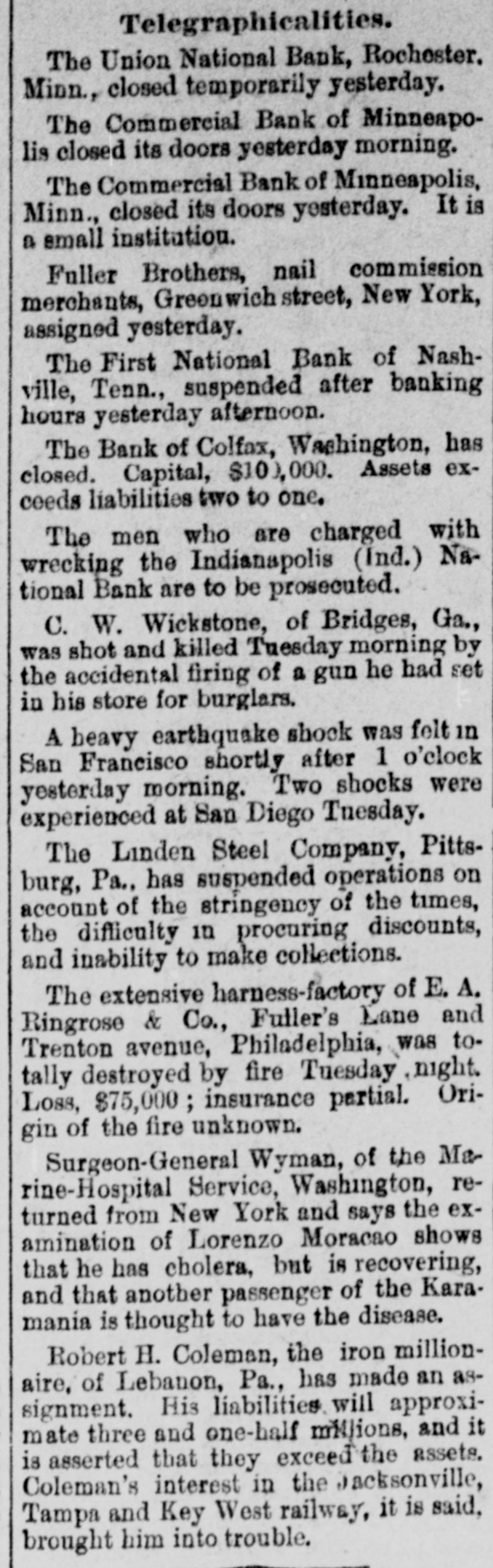
Telegraphicalities. The Union National Bank, Rochester. Minn, closed temporarily yesterday. The Commercial Bank of Minneapolis closed its doors yesterday morning. The Commercial Bank of Minneapolis, Minn., closed its doors yesterday. It is a small institution. Fuller Brothers, nail commission merchants, Greenwich street, New York, assigned yesterday. The First National Bank of Nashville, Tenn., suspended after banking hours yesterday afternoon. The Bank of Colfax, Washington, has closed. Capital, $100,000. Assets exceeds liabilities two to one. The men who are charged with wrecking the Indianapolis (Ind.) National Bank are to be prosecuted. C. W. Wickstone, of Bridges, Ga., was shot and killed Tuesday morning by the accidental firing of a gun he had set in his store for burglars. A heavy earthquake shock was felt in San Francisco shortly after 1 o'clock yesterday morning. Two shocks were experienced at San Diego Tuesday. The Linden Steel Company, Pittsburg, Pa., has suspended operations on account of the stringency of the times, the difficulty in procuring discounts, and inability to make collections. The extensive harness-factory of E. A. Ringrose & Co., Fuller's Lane and Trenton avenue, Philadelphia, was totally destroyed by fire Tuesday night. Loss, $75,000; insurance partial. Origin of the fire unknown. Surgeon-General Wyman, of the Marine-Hospital Service, Washington, returned from New York and says the examination of Lorenzo Moracao shows that he has cholera, but is recovering, and that another passenger of the Karamania is thought to have the disease. Robert H. Coleman, the iron millionaire, of Lebanon, Pa., has made an assignment. His liabilities. will approximate three and one-half millions, and it is asserted that they exceed the assets. Coleman's interest in the Jacksonville, Tampa and Key West railway, it is said, brought him into trouble.


Article from Rock Island Daily Argus, August 11, 1893

Click image to open full size in new tab

Article Text

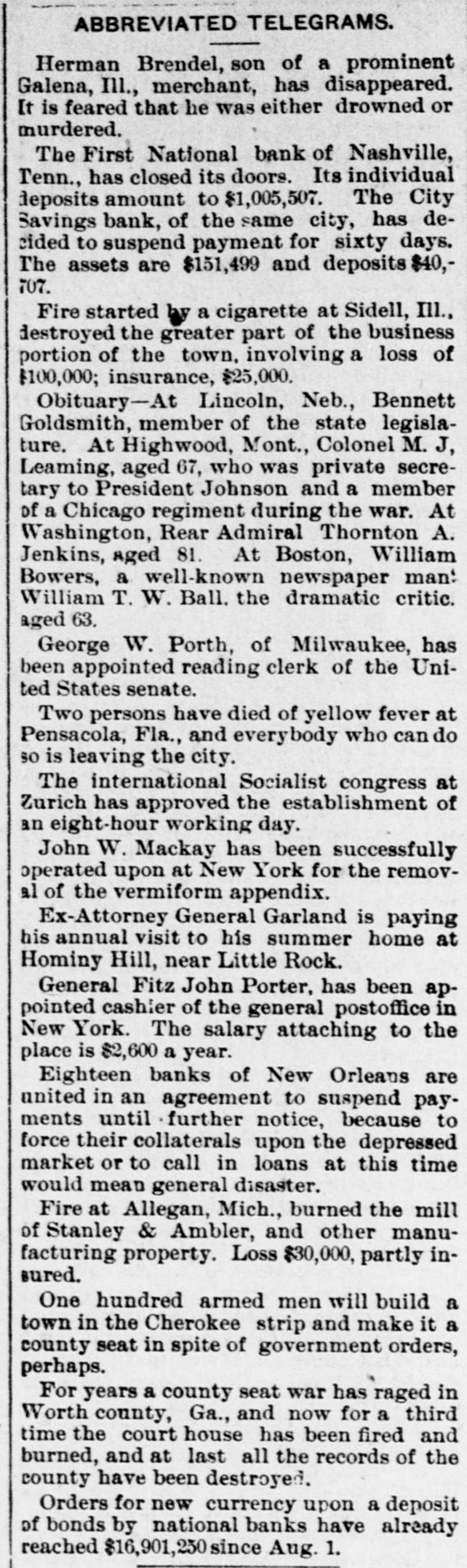
ABBREVIATED TELEGRAMS. Herman Brendel, son of a prominent Galena, III., merchant, has disappeared. It is feared that he was either drowned or murdered. The First National bank of Nashville, Tenn., has closed its doors. Its individual deposits amount to $1,005,507. The City Savings bank, of the same city, has decided to suspend payment for sixty days. The assets are $151,499 and deposits $40,707. Fire started by a cigarette at Sidell, Ill., destroyed the greater part of the business portion of the town, involving a loss of $100,000; insurance, $25,000. Obituary-At Lincoln, Neb., Bennett Goldsmith, member of the state legislature. At Highwood, Mont., Colonel M. J, Leaming, aged 67, who was private secretary to President Johnson and a member of a Chicago regiment during the war. At Washington, Rear Admiral Thornton A. Jenkins, aged 81. At Boston, William Bowers, a well-known newspaper man: William T. W. Ball. the dramatic critic. aged 63. George W. Porth, of Milwaukee, has been appointed reading clerk of the United States senate. Two persons have died of yellow fever at Pensacola, Fla., and everybody who can do so is leaving the city. The international Socialist congress at Zurich has approved the establishment of an eight-hour working day. John W. Mackay has been successfully operated upon at New York for the removal of the vermiform appendix. Ex-Attorney General Garland is paying his annual visit to his summer home at Hominy Hill, near Little Rock. General Fitz John Porter, has been appointed cashier of the general postoffice in New York. The salary attaching to the place is $2,600 a year. Eighteen banks of New Orleans are united in an agreement to suspend payments until further notice, because to force their collaterals upon the depressed market or to call in loans at this time would mean general disaster. Fire at Allegan, Mich., burned the mill of Stanley & Ambler, and other manufacturing property. Loss $30,000, partly insured. One hundred armed men will build a town in the Cherokee strip and make it a county seat in spite of government orders, perhaps. For years a county seat war has raged in Worth county, Ga., and now for a third time the court house has been fired and burned, and at last all the records of the county have been destroyed. Orders for new currency upon a deposit of bonds by national banks have already reached $16,901,250 since Aug. 1.


Article from Huntsville Gazette, August 12, 1893

Click image to open full size in new tab

Article Text

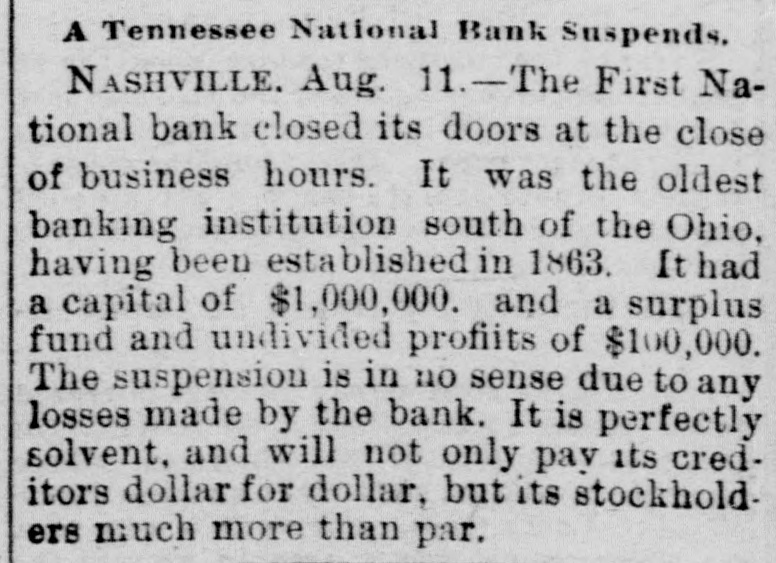
A Tennessee National Bank Suspends. NASHVILLE. Aug. 11.-The First National bank closed its doors at the close of business hours. It was the oldest banking institution south of the Ohio, having been established in 1863. It had a capital of $1,000,000. and a surplus fund and undivided profiits of $100,000. The suspension is in no sense due to any losses made by the bank. It is perfectly solvent, and will not only pay its creditors dollar for dollar, but its stockholders much more than par.


Article from New-York Tribune, August 13, 1893

Click image to open full size in new tab

Article Text

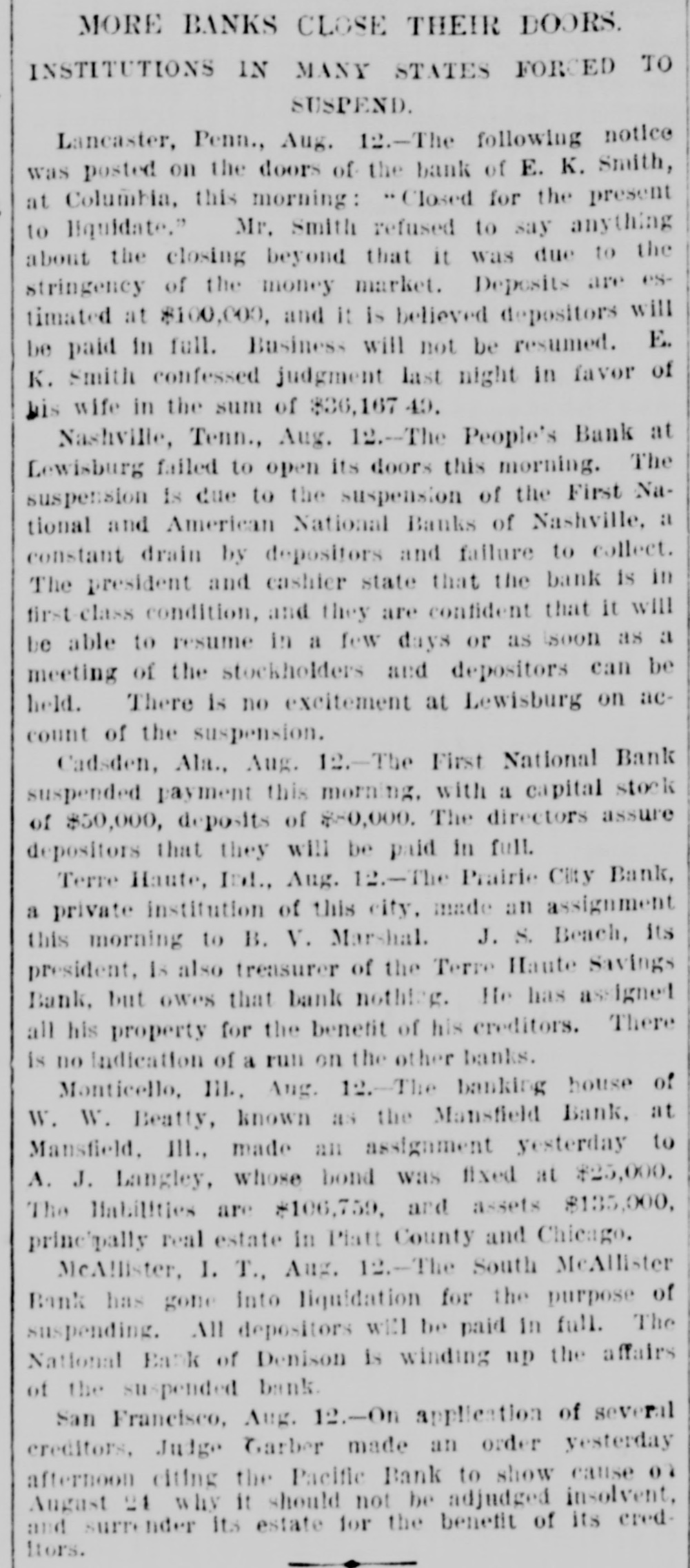
MORE BANKS CLOSE THEIR DOORS. INSTITUTIONS IN MANY STATES FORCED TO SUSPEND. Lancaster, Penn., Aug. 12.-The following notice was posted on the doors of the bank of E. K. Smith, at Columbia, this morning: "Closed for the present to Hquidate." Mr. Smith refused to say anything about the closing beyond that it was due to the stringency of the money market. Deposits are estimated at $100,000, and it is believed depositors will be paid in full. Business will not be resumed. E. K. Smith confessed judgment last night in favor of his wife in the sum of $36,167 4 Nashville, Tenn., Aug. 12.-The People's Bank at Lewisburg failed to open its doors this morning. The suspension is due to the suspension of the First National and American National Banks of Nashville, a constant drain by depositors and failure to collect. The president and cashier state that the bank is in first-class condition, and they are confident that it will be able to resume in a few days or as soon as a meeting of the stockholders and depositors can be held. There is no excitement at Lewisburg on account of the suspension. Cadsden, Ala., Aug. 12.-The First National Bank suspended payment this morning, with a capital stock of $50,000, deposits of $80,000. The directors assure depositors that they will be paid in full. Terre Haute, Ind., Aug. 12.-The Prairie City Bank, a private institution of this city, made an assignment this morning to B. V. Marshal. J. S. Beach, its president, is also treasurer of the Terre Haute Savings Bank, but owes that bank nothing. He has assigned all his property for the benefit of his creditors. There is no indication of a run on the other banks. Monticello, III., Aug. 12.-The banking house of W. W. Beatty, known as the Mansfield Bank, at Mansfield, III., made an assignment yesterday to A. J. Langley, whose bond was fixed at $25,000. The liabilities are $106,759, and assets $135,000, principally real estate in Platt County and Chicago. McAllister, 1. T., Aug. 12.-The South McAllister Bank has gone into liquidation for the purpose of suspending. All depositors will be paid in full. The National Bank of Denison is winding up the affairs of the suspended bank. San Francisco, Aug. 12.-On application of several creditors, Judge Garber made an order yesterday afternoon citing the Pacific Bank to show cause or August 24 why it should not be adjudged insolvent, and surrender its estate for the benefit of its credItors.


Article from The Weekly Union Times, August 18, 1893

Click image to open full size in new tab

Article Text

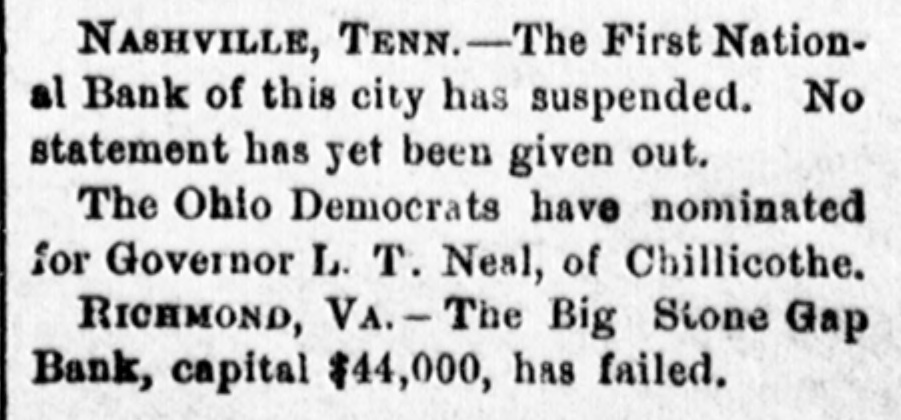
NASHVILLE, TENN.-The First National Bank of this city has suspended. No statement has yet been given out. The Ohio Democrats have nominated for Governor L. T. Neal, of Chillicothe, RICHMOND, VA. - The Big Stone Gap Bank, capital $44,000, has failed.


Article from Baxter Springs News, August 19, 1893

Click image to open full size in new tab

Article Text

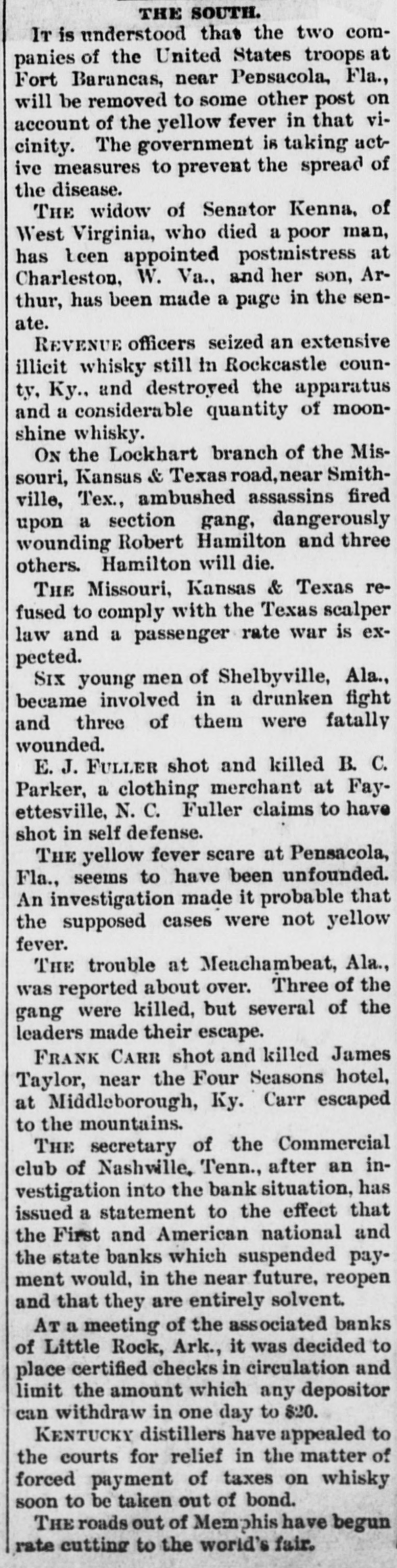
THE SOUTH. IT is understood that the two companies of the United States troops at Fort Barancas, near Pensacola, Fla., will be removed to some other post on account of the yellow fever in that vicinity. The government is taking active measures to prevent the spread of the disease. THE widow of Senator Kenna, of West Virginia, who died a poor man, has been appointed postmistress at Charleston, W. Va., and her son, Arthur, has been made a page in the senate. REVENUE officers seized an extensive illicit whisky still in Rockcastle county, Ky., and destroyed the apparatus and a considerable quantity of moonshine whisky. ON the Lockhart branch of the Missouri, Kansas & Texas road, near Smithville, Tex., ambushed assassins fired upon a section gang, dangerously wounding Robert Hamilton and three others. Hamilton will die. THE Missouri, Kansas & Texas refused to comply with the Texas scalper law and a passenger rate war is expected. Six young men of Shelbyville, Ala., became involved in a drunken fight and three of them were fatally wounded. E. J. FULLER shot and killed B. C. Parker, a clothing merchant at Fayettesville, N. C. Fuller claims to have shot in self defense. THE yellow fever scare at Pensacola, Fla., seems to have been unfounded. An investigation made it probable that the supposed cases were not yellow fever. THE trouble at Meachambeat, Ala., was reported about over. Three of the gang were killed, but several of the leaders made their escape. FRANK CARR shot and killed James Taylor, near the Four Seasons hotel, at Middleborough, Ky. Carr escaped to the mountains. THE secretary of the Commercial club of Nashwille, Tenn., after an investigation into the bank situation, has issued a statement to the effect that the First and American national and the state banks which suspended payment would, in the near future, reopen and that they are entirely solvent. AT a meeting of the associated banks of Little Rock, Ark., it was decided to place certified checks in circulation and limit the amount which any depositor can withdraw in one day to $20. KENTUCKY distillers have appealed to the courts for relief in the matter of forced payment of taxes on whisky soon to be taken out of bond. THE roads out of Memphis have begun rate cutting to the world's fair.


Article from The Camden Chronicle, September 8, 1893

Click image to open full size in new tab

Article Text

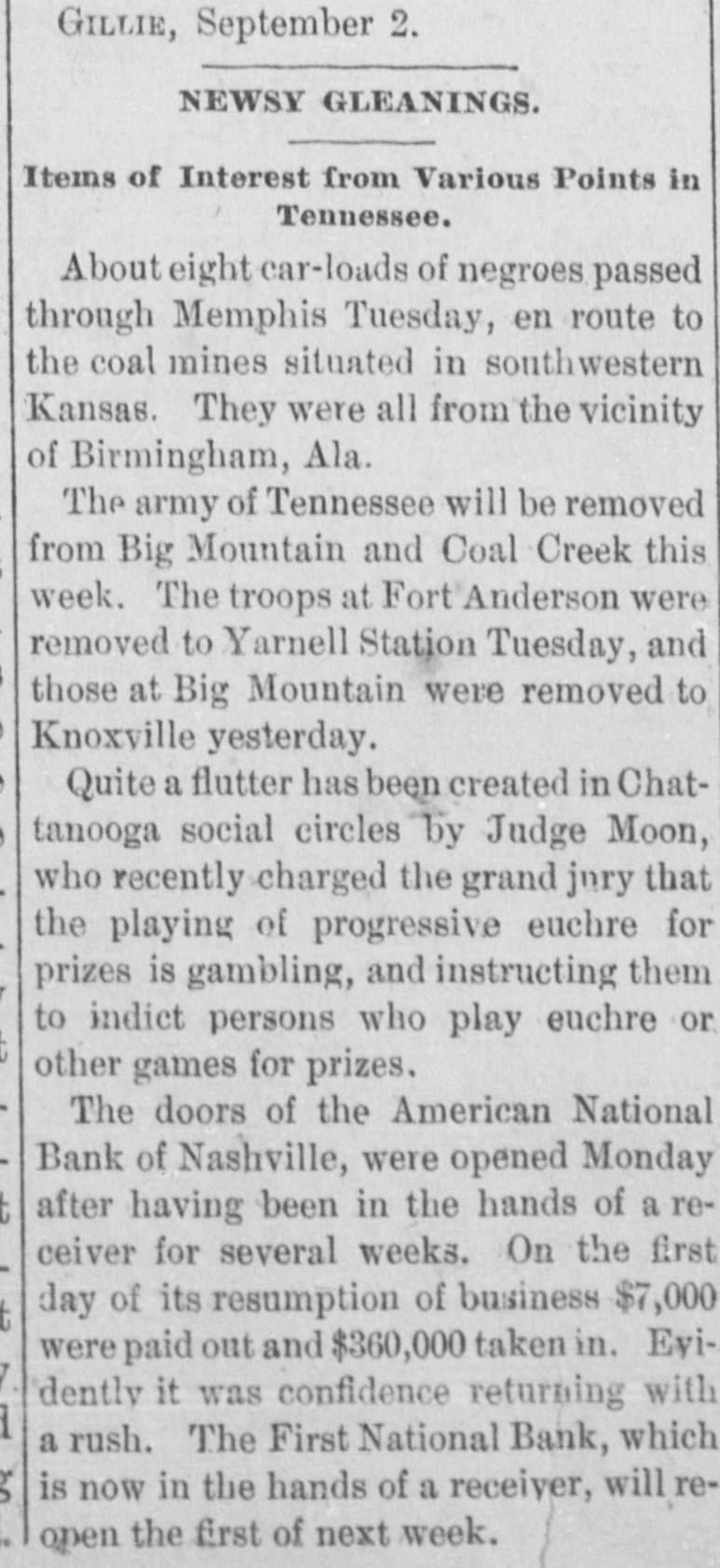
GILLIE, September 2. NEWSY GLEANINGS. Items of Interest from Various Points in Tennessee. About eight car-loads of negroes passed through Memphis Tuesday, en route to the coal mines situated in southwestern Kansas. They were all from the vicinity of Birmingham, Ala. The army of Tennessee will be removed from Big Mountain and Coal Creek this week. The troops at Fort Anderson were removed to Yarnell Station Tuesday, and those at Big Mountain were removed to Knoxville yesterday. Quite a flutter has been created in Chattanooga social circles by Judge Moon, who recently charged the grand jury that the playing of progressive euchre for prizes is gambling, and instructing them to indict persons who play euchre or other games for prizes. The doors of the American National Bank of Nashville, were opened Monday after having been in the hands of a receiver for several weeks. On the first day of its resumption of business $7,000 were paid out and $360,000 taken in. Evidently it was confidence returning with a rush. The First National Bank, which is now in the hands of a receiver, will reopen the first of next week.


Article from The Times, September 10, 1893

Click image to open full size in new tab

Article Text

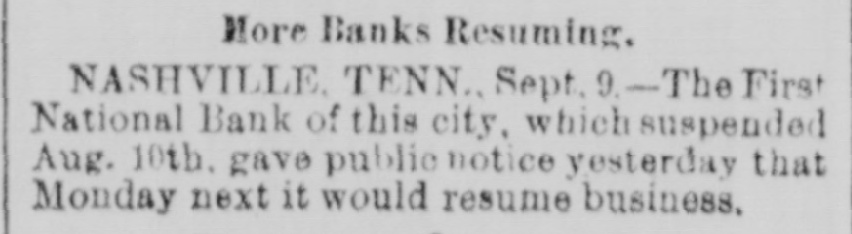
More Banks Resuming. NASHVILLE. TENN., Sept. 9.-The First National Bank of this city, which suspended Aug. 10th. gave public notice yesterday that Monday next it would resume business.


Article from Richmond Dispatch, September 10, 1893

Click image to open full size in new tab

Article Text

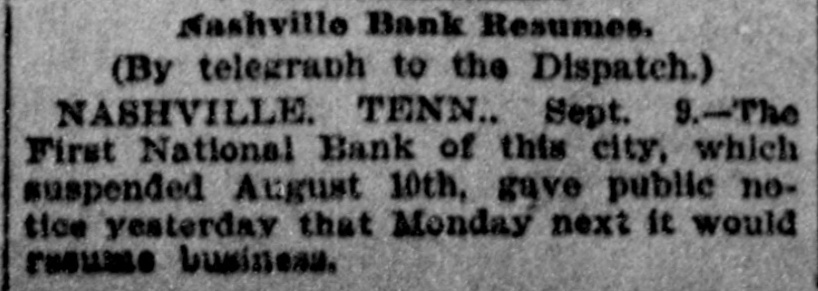
Nashville Bank Resumes. (By telegraph to the Dispatch.) NASHVILLE. TENN.. Sept. 9.-The First National Bank of this city, which suspended August 10th, gave public notice yesterday that Monday next it would resume business.


Article from New-York Tribune, September 10, 1893

Click image to open full size in new tab

Article Text

A SOUTHERN BANK TO RESUME. Nashville, Tenn., Sept. 9.-The First National Bank of this city, which suspended August 10, has been granted permission to resume, and gave public notice yesterday that on Monday next It would resume business.


Article from Evening Star, September 11, 1893

Click image to open full size in new tab

Article Text

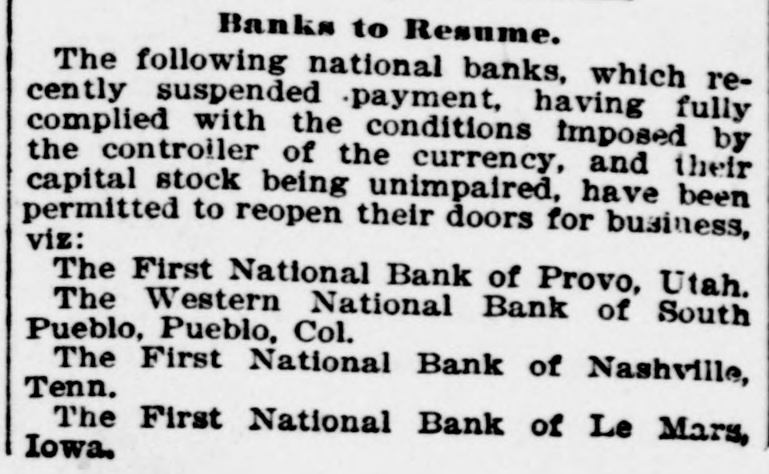
Banks to Resume. The following national banks, which recently suspended payment, having fully complied with the conditions imposed by the controiler of the currency, and their capital stock being unimpaired, have been permitted to reopen their doors for business, viz: The First National Bank of Provo, Utah. The Western National Bank of South Pueblo, Pueblo, Col. The First National Bank of Nashville, Tenn. The First National Bank of Le Mars, Iowa.


Article from The Comet, September 14, 1893

Click image to open full size in new tab

Article Text

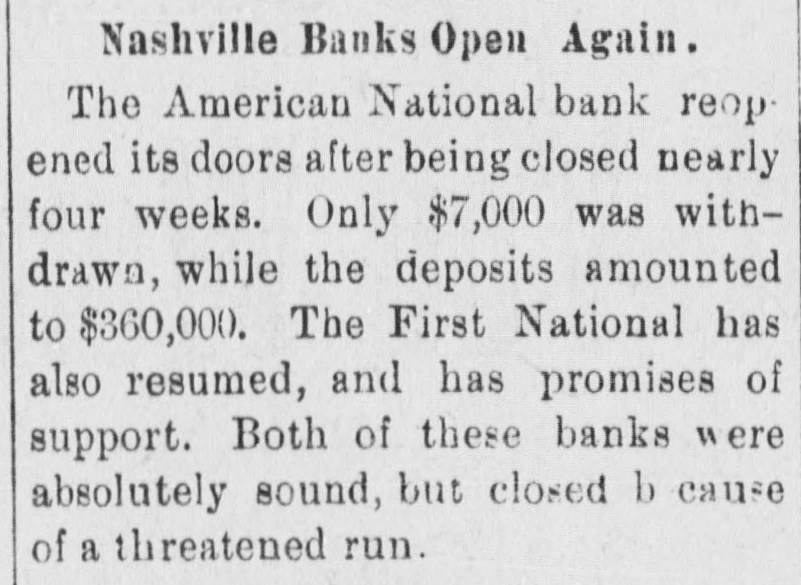
Nashville Banks Open Again. The American National bank reopened its doors after being closed nearly four weeks. Only $7,000 was withdrawn, while the deposits amounted to $360,000. The First National has also resumed, and has promises of support. Both of these banks were absolutely sound, but closed b cause of a threatened run.


Article from The Middleburgh Post, September 14, 1893

Click image to open full size in new tab

Article Text

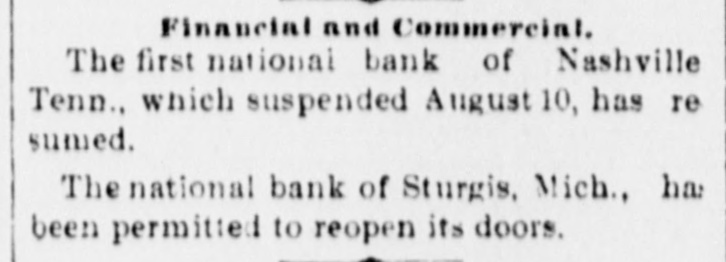
Financial and Commercial. The first national bank of Nashville Tenn., which suspended August 10, has re sumed. The national bank of Sturgis, Mich., has been permitted to reopen its doors.


Article from The Hattiesburg News, March 21, 1916

Click image to open full size in new tab

Article Text

of Calhoun; affirmed. Leontine Hesdorffer vs. Effie Green Hiller et al., circuit of Madison; reversed and remanded. J. M. Ladner vs. H. G. Smith, chancery of Lamar; motion to revive and dismiss sustained. Rufus Page vs. Pine Export Company, circuit of Harrison; suggestion of error overruled. Gulf & Ship Island Railroad vs. R. J. Buddendroff, circuit of Harrison; suggestion of error overruled. R. F. Tate vs. R. R. Scott, circuit of DeSoto; affirmed. F. V. Brahan vs. city of Meridian, chancery of Lauderdale; affirmed and dismissed. Yazoo and Mississippi Valley Railroad VS. Parrish & Co., circuit of Tallahatchie; affirmed. By Potter, J. C. Johnston, state revenue agent, vs. Puffer Manufacturing Company, chancery of Hinds; motion to set forward sustained. Mrs. S. P. Southworth VS. Pearley Brister, circuit of Leflore; affirmed. T. H. Montgomery, sheriff and administrator, and the state of Mississippi vs. Mutual Life Insurance Company of New York et al.; affirmed. First National Bank of Nashville, Tenn. vs. W. T. Bennett, receiver et al., chancery of Tishomingo; reversed and remanded. New Orleans, Mobile and Chicago Railroad Company vs. J. T. Young, circuit of Union; affirmed. Illinois Central Railroad VS. T. J. Tandy, circuit of Clay; affirmed. Laurel Compress Company VS. Geo. B. Power and Oscar Newton, trustees of Farmers' Warehouse Company, circuit of Jones; reversed and remanded. R. O. Brassfield vs. New Orleans, Mobile and Chicago Railroad. circuit of Winston; affirmed. Yazoo and Mississippi Valley Railroad Company vs. J. N. Sibley, circuit of Coahoma; affirmed. Louisville and Nashville Railroad