1792. Prudential Bank (Washington, DC)

Bank Information

Episode Type
Run Only
Bank Type
state
Start Date
January 1, 1932*
Location
Washington, District of Columbia (38.895, -77.036)

Metadata

Model
gpt-5-mini
Short Digest
28b8fe17249999f9

Response Measures

None

Description

Multiple July 1932 articles document a discrete run (July 15-16, 1932) caused by false rumors/merchants refusing checks; the bank was kept open after depositor pledges and support and 'resumed business' within days. There is later evidence the bank ultimately closed in 1932 and entered receivership (Article 11), but no article here describes a suspension immediately following the July run. Following the decision rules, the episode documented here is a run that did not lead to an immediate suspension, so classified as 'run_only'. Key corrective OCR/interpretation: dates for the run are given as July 15-16, 1932; reopening described the following Monday/July 18โ€“21, 1932. Receiver John F. Moran referenced in 1941 articles notes the bank closed in 1932.

Events (4)

1. January 1, 1932* Other
Newspaper Excerpt
Prudential Bank ... the defunct Prudential Bank, which closed in 1932. John F. Moran, receiver of the bank, which closed in 1932.
Source
newspapers
2. July 15, 1932 Run
Cause
Rumor Or Misinformation
Cause Details
False rumors circulated after four downtown banks closed and some merchants refused to accept Prudential checks, triggering mass withdrawals July 15-16, 1932.
Measures
Mass meetings; depositors asked to sign pledges not to withdraw more than 10% in 30 days; directors subscribed additional capital ($10,000) and solicited cash from borrowers; public appeals from pulpits; bank examiners inspected.
Newspaper Excerpt
the Prudential weathered a two-day run on it last Friday and Saturday
Source
newspapers
3. July 18, 1932 Reopening
Newspaper Excerpt
resumed business as usual Monday morning. Depositors who had withdrawn their money have already redeposited them; more than $10,000 in deposits was received at the bank yesterday and a number of new accounts had been opened.
Source
newspapers
4. August 1, 1932* Other
Newspaper Excerpt
Prudential Bank ... has received loan from the Reconstruction Finance Corporation ... total received on loans from the Finance Corporation $100,000.
Source
newspapers

Newspaper Articles (12)

Article from Evening Star, July 21, 1932

Click image to open full size in new tab

Article Text

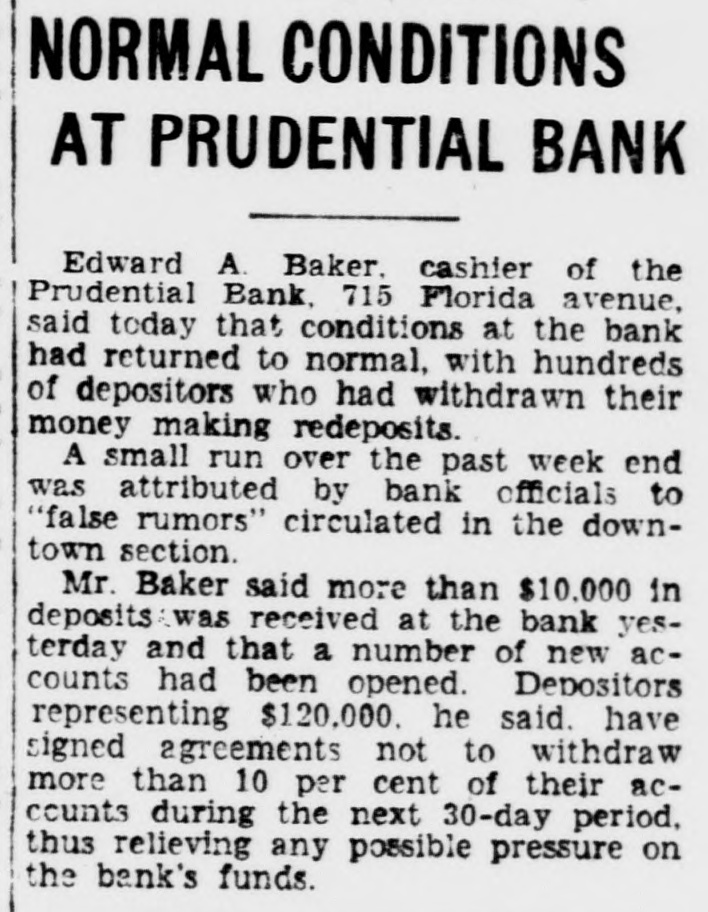
NORMAL CONDITIONS AT PRUDENTIAL BANK Edward A. Baker, cashier of the Prudential Bank, 715 Florida avenue, said today that conditions at the bank had returned to normal, with hundreds of depositors who had withdrawn their money making redeposits. A small run over the past week end was attributed by bank officials to "false rumors" circulated in the downtown section. Mr. Baker said more than $10.000 in deposits was received at the bank yesterday and that a number of new accounts had been opened. Depositors representing $120.000. he said. have signed agreements not to withdraw more than 10 per cent of their accounts during the next 30-day period, thus relieving any possible pressure on the bank's funds.


Article from The Northwest Enterprise, July 28, 1932

Click image to open full size in new tab

Article Text

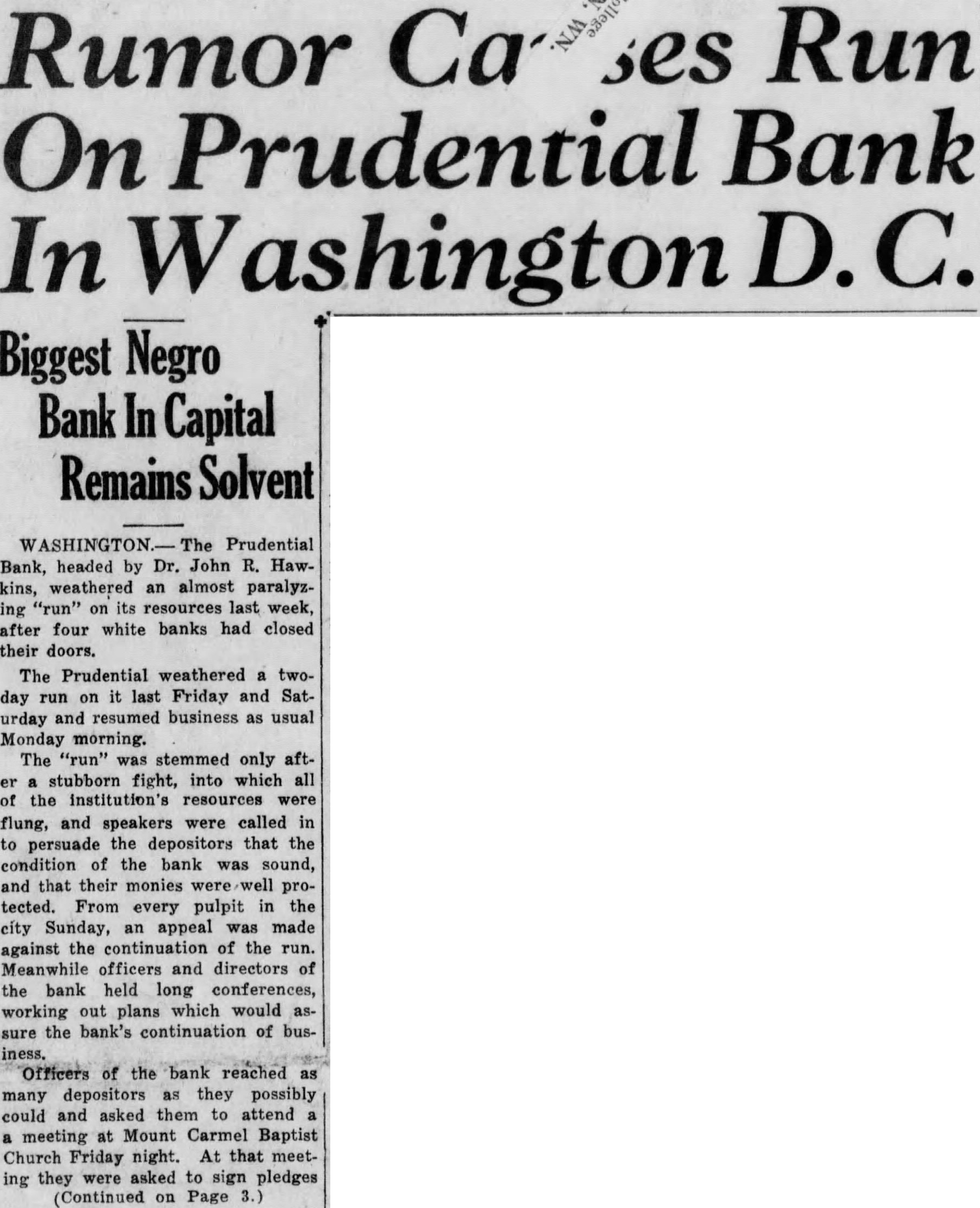
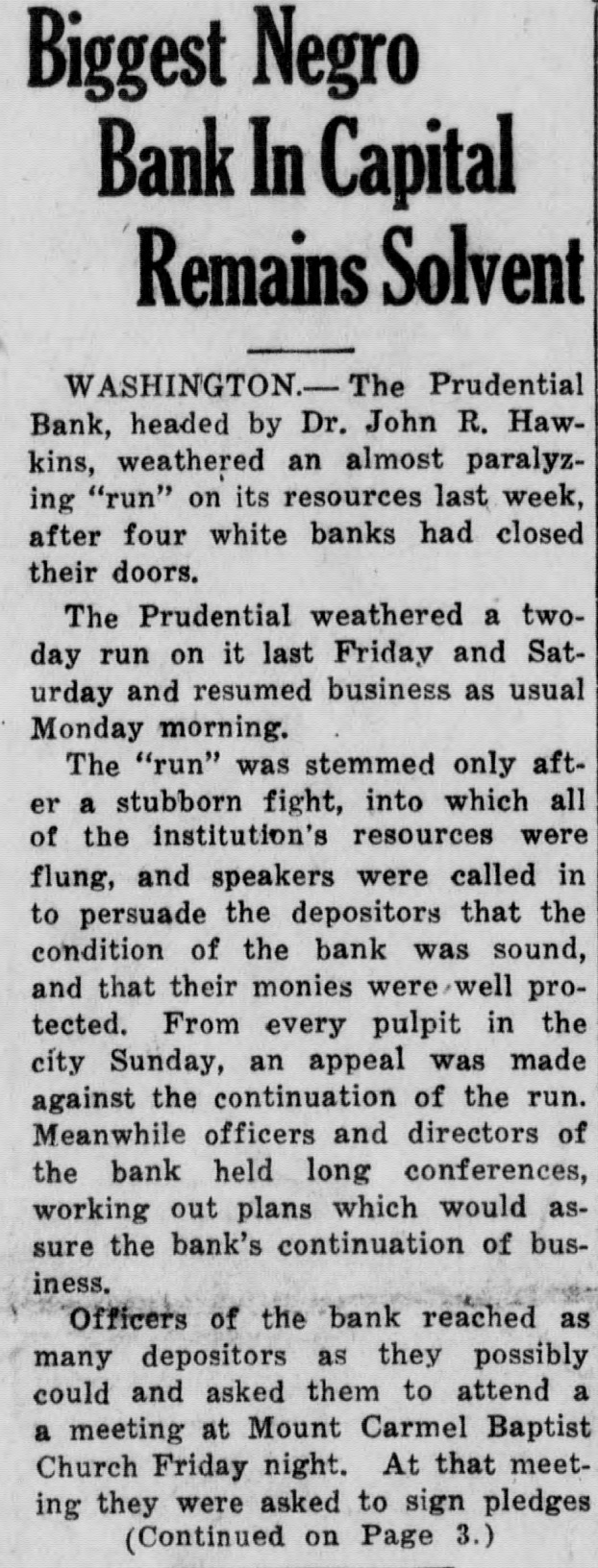
Biggest Negro Bank In Capital Remains Solvent WASHINGTON.- The Prudential Bank, headed by Dr. John R. Hawkins, weathered an almost paralyzing "run" on its resources last week, after four white banks had closed their doors. The Prudential weathered a twoday run on it last Friday and Saturday and resumed business as usual Monday morning. The "run" was stemmed only after a stubborn fight, into which all of the institution's resources were flung, and speakers were called in to persuade the depositors that the condition of the bank was sound, and that their monies were well protected. From every pulpit in the city Sunday, an appeal was made against the continuation of the run. Meanwhile officers and directors of the bank held long conferences, working out plans which would assure the bank's continuation of business. Officers of the bank reached as many depositors as they possibly could and asked them to attend a a meeting at Mount Carmel Baptist Church Friday night. At that meeting they were asked to sign pledges (Continued on Page 3.)


Article from The Northwest Enterprise, July 28, 1932

Click image to open full size in new tab

Article Text

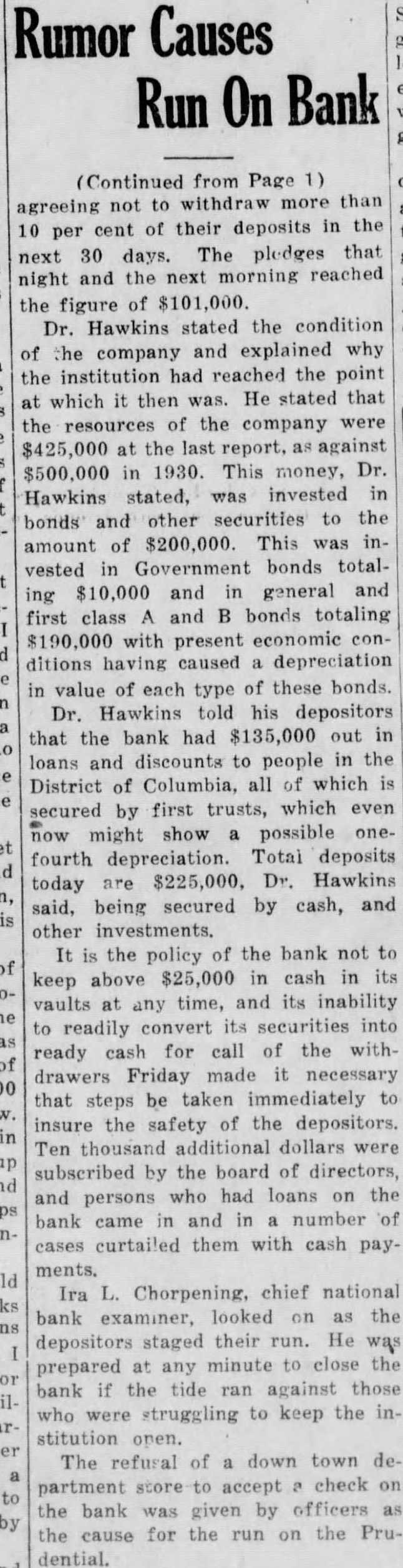
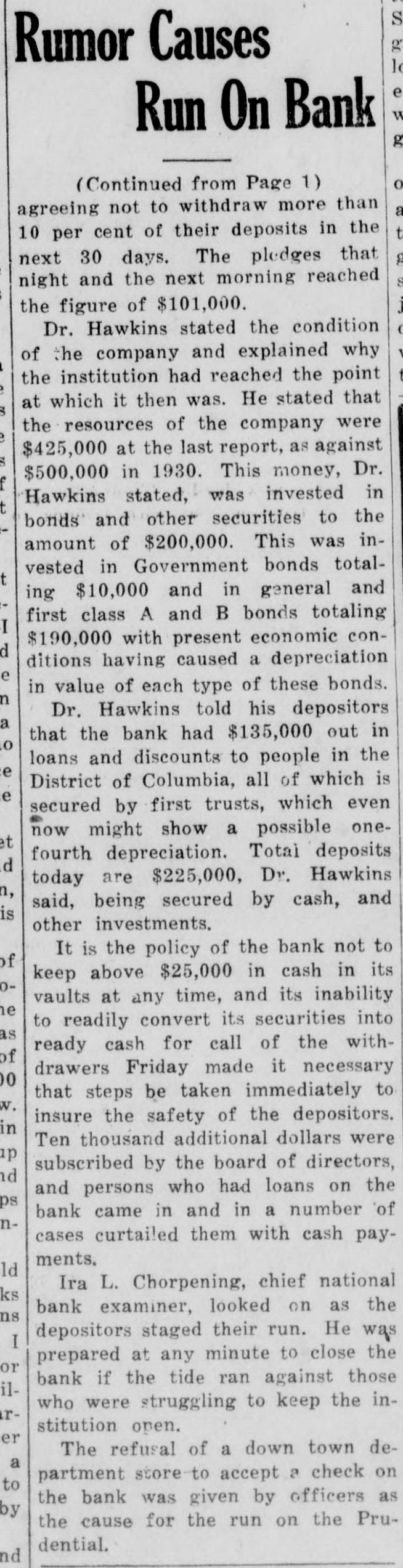
# Rumor Causes # Run On Bank (Continued from Page 1) agreeing not to withdraw more than 10 per cent of their deposits in the next 30 days. The pledges that night and the next morning reached the figure of $101,000. Dr. Hawkins stated the condition of the company and explained why the institution had reached the point at which it then was. He stated that the resources of the company were $425,000 at the last report, as against $500,000 in 1930. This money, Dr. Hawkins stated, was invested in bonds and other securities to the amount of $200,000. This was invested in Government bonds totaling $10,000 and in general and first class A and B bonds totaling $190,000 with present economic conditions having caused a depreciation in value of each type of these bonds. Dr. Hawkins told his depositors that the bank had $135,000 out in loans and discounts to people in the District of Columbia, all of which is secured by first trusts, which even now might show a possible one-fourth depreciation. Total deposits today are $225,000, Dr. Hawkins said, being secured by cash, and other investments. It is the policy of the bank not to keep above $25,000 in cash in its vaults at any time, and its inability to readily convert its securities into ready cash for call of the withdrawers Friday made it necessary that steps be taken immediately to insure the safety of the depositors. Ten thousand additional dollars were subscribed by the board of directors, and persons who had loans on the bank came in and in a number of cases curtailed them with cash payments. Ira L. Chorpening, chief national bank examiner, looked on as the depositors staged their run. He was prepared at any minute to close the bank if the tide ran against those who were struggling to keep the institution open. The refusal of a down town department store to accept a check on the bank was given by officers as the cause for the run on the Prudential.


Article from The Northwest Enterprise, July 28, 1932

Click image to open full size in new tab

Article Text

Run Rumor ses On Prudential Bank In Washington Biggest Negro Bank In Capital Remains Solvent WASHINGTON.- The Prudential Bank, headed by Dr. John R. Hawkins, weathered an almost paralyzing "run" on its resources last week, after four white banks had closed their doors. The Prudential weathered a twoday run on it last Friday and Saturday and resumed business as usual Monday morning. The "run" was stemmed only after a stubborn fight, into which all of the institution's resources were flung, and speakers were called in to persuade the depositors that the condition of the bank was sound, and that their monies protected. From every pulpit in the city Sunday, an appeal was made against the continuation of the run. Meanwhile officers and directors of the bank held long conferences, working out plans which would assure the bank's continuation of business. Officers of the bank reached as many depositors as they possibly could and asked them to attend meeting at Mount Carmel Baptist Church Friday night. At that meeting they were asked to sign pledges (Continued on Page 3.)


Article from The Northwest Enterprise, July 28, 1932

Click image to open full size in new tab

Article Text

Rumor Causes Run On Bank (Continued from Page 1) agreeing not to withdraw more than 10 per cent of their deposits in the next 30 days. The pledges that night and the next morning reached the figure of $101,000. Dr. Hawkins stated the condition of the company and explained why the institution had reached the point at which it then was. He stated that the resources of the company were $425,000 at the last report, as against $500,000 in 1930. This money, Dr. Hawkins stated, was invested in bonds and other securities to the amount of $200,000. This was invested in Government bonds totaling $10,000 and in general and first class A and B bonds totaling $190,000 with present economic conditions having caused a depreciation in value of each type of these bonds. Dr. Hawkins told his depositors that the bank had $135,000 out in loans and discounts to people in the District of Columbia, all of which is secured by first trusts, which even now might show a possible onefourth depreciation. Total deposits today are $225,000. Dr. Hawkins said, being secured by cash, and other investments. It is the policy of the bank not to keep above $25,000 in cash in its vaults at any time, and its inability to readily convert its securities into ready cash for call of the withdrawers Friday made it necessary that steps be taken immediately to insure the safety of the depositors. Ten thousand additional dollars were subscribed by the board of directors, and persons who had loans on the bank came in and in a number of cases curtailed them with cash payments. Ira L. Chorpening, chief national bank examiner, looked on as the depositors staged their run. He was prepared at any minute to close the bank if the tide ran against those who were struggling to keep the institution open. The refusal of a down town department store to accept a check on the bank was given by officers as the cause for the run on the Prudential.


Article from Twin-City Herald, July 30, 1932

Click image to open full size in new tab

Article Text

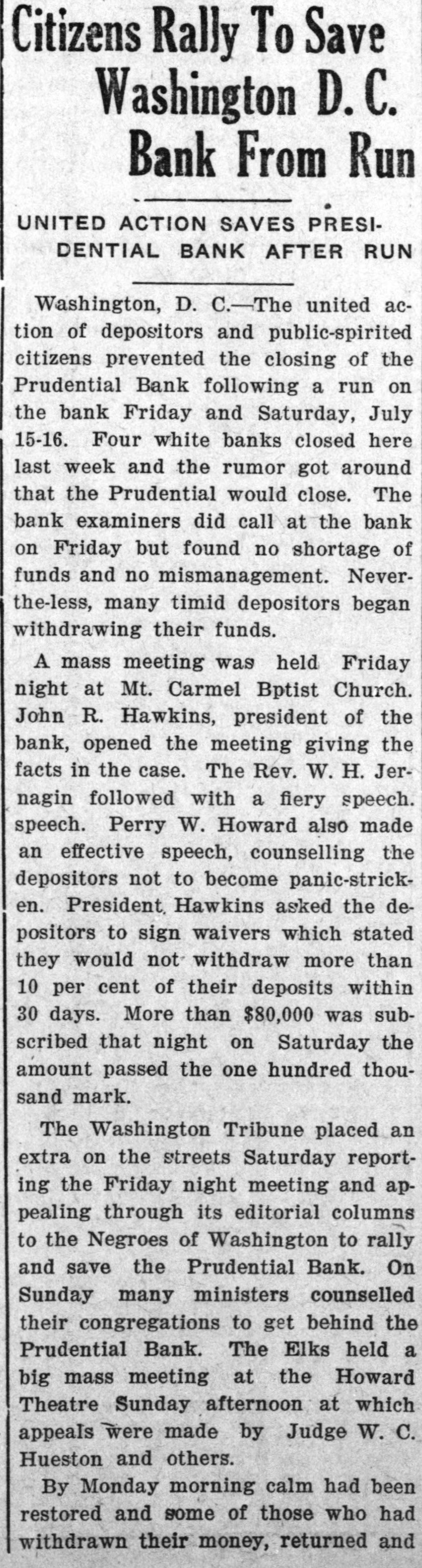
Citizens Rally To Save Washington D.C. Bank From Run UNITED ACTION SAVES PRESIDENTIAL BANK AFTER RUN Washington, D. C.-The united action of depositors and public-spirited citizens prevented the closing of the Prudential Bank following a run on the bank Friday and Saturday, July 15-16. Four white banks closed here last week and the rumor got around that the Prudential would close. The bank examiners did call at the bank on Friday but found no shortage of funds and no mismanagement. Neverthe-less, many timid depositors began withdrawing their funds. A mass meeting was held Friday night at Mt. Carmel Bptist Church. John R. Hawkins, president of the bank, opened the meeting giving the facts in the case. The Rev. W. H. Jernagin followed with a fiery speech. speech. Perry W. Howard also made an effective speech, counselling the depositors not to become panic-stricken. President Hawkins asked the depositors to sign waivers which stated they would not withdraw more than 10 per cent of their deposits within 30 days. More than $80,000 was subscribed that night on Saturday the amount passed the one hundred thousand mark. The Washington Tribune placed an extra on the streets Saturday reporting the Friday night meeting and appealing through its editorial columns to the Negroes of Washington to rally and save the Prudential Bank. On Sunday many ministers counselled their congregations to get behind the Prudential Bank. The Elks held a big mass meeting at the Howard Theatre Sunday afternoon at which appeals were made by Judge W. C. Hueston and others. By Monday morning calm had been restored and some of those who had withdrawn their money, returned and


Article from The New York Age, July 30, 1932

Click image to open full size in new tab

Article Text

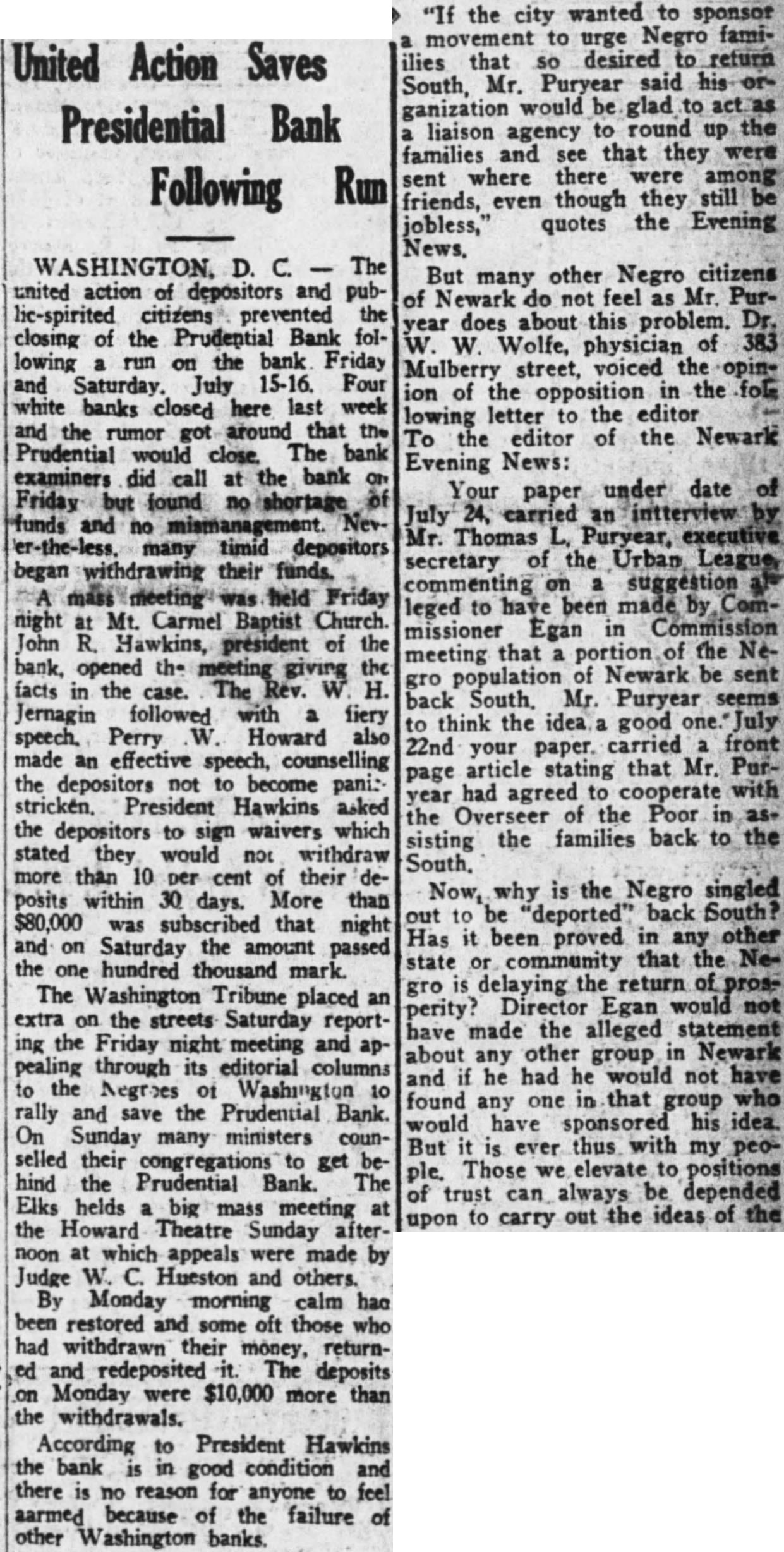
United Action Saves Presidential Bank Following Run WASHINGTON. D. The united action of depositors and public-spirited citizens prevented the closing of the Prudential Bank following run on the bank Friday Saturday. July 15-16. Four white banks closed here last week and the rumor got around that the Prudential would close. The bank examiners did call at the bank Friday but found shortage funds and no Never-the-less. many timid depositors began withdrawing their funds. mass held Friday night Mt. Carmel Baptist Church. John Hawkins, president of the opened the the facts in the case. The Rev. H. Jernagin followed with fiery Perry Howard also made an effective speech, the depositors not become pani: President Hawkins asked the depositors to sign waivers which stated they would not withdraw more than 10 per of their posits within 30 days. More than $80,000 subscribed that night and on Saturday the amount passed one hundred thousand mark. The Washington Tribune placed extra on the streets Saturday reporting the Friday night meeting and appealing through its editorial columns the Negroes Washington rally and save the Prudential Bank. On Sunday many ministers counselled their congregations get hind the Prudential Bank. The Elks helds mass meeting the Howard Theatre Sunday afternoon appeals were made by Judge W. Hueston and others. By Monday morning calm has restored and some oft those who had withdrawn their money, returnand redeposited deposits Monday were $10,000 more than the withdrawals. According to President Hawkins the bank in good condition and there is no reason for anyone to feel aarmed because of the failure of other Washington banks. "If the city wanted to sponsor to urge Negro famiilies that so desired to return South, Mr. Puryear said his ganization would be glad to liaison agency to round up the families and see that they were sent where there among friends, though they still jobless," quotes the Evening But many other Negro citizens of Newark do not feel as Mr. Puryear does about this problem. W. Wolfe, physician of 383 Mulberry street, voiced the opinion of the opposition in the folm lowing letter to the editor To the editor the Newark Evening News: Your paper under date July carried an intterview by Mr. Thomas Puryear, executive secretary of the Urban League, commenting on suggestion leged to have been made missioner Egan in Commission meeting that portion of the Negro population of Newark be sent back South. Mr. Puryear seems think the idea good 22nd carried front your paper. article stating that Mr. Purpage year had agreed to cooperate with the Overseer of the Poor sisting the families back to the Now, why is the Negro singled be "deported" back Has it been proved other state that the Nethe return of delaying Director Egan would perity? have made the alleged statement about other group Newark any and he had he would not have found any one in that group would have sponsored his idea. But ever thus with ple. Those elevate to trust can always be depended upon to carry out the ideas of the


Article from New Pittsburgh Courier, August 6, 1932

Click image to open full size in new tab

Article Text

STRENGTH PROVEN, NEW DRIVE LAUNCHED WASHINGTON, Aug. The Prudential Bank having withstood three-day run on it, its officers and directors plan a campaign to add to the number of depositors and stockholders and strengthen the institution financially. John R. Hawkins, president, announced meeting of in the auditorium Junior High School last Monday night. authorized capital stock the bank $200,000, Hawkins stated. Only $100,000 worth stock beer. The mainder never offered the public. The comptroller Mr. Hawkins said, approves the offering of the remaining stock to the public. At meeting of the stockholders last "hursday night, Mr. Hawkins told the picture of the situation bank was presented. They agreed with the directors, he said, that this time for the Bank close. They pledged to add to their present deposits the bank and aid in campaign for the deof greater The Bank opened July 23, 1923, deposits totaling $42,000. June, 1931, its peak $536,000 The slump came in the latter part of 1931. Its what considered first class bonds in real estate. The bond situation brought depreciation in the of the securities. When four white were cently closed, depositors became nervous nd restless and great many presumed that colored banks would close. stood the test," Mr. Hawkins. "Friends resque. and womwho had not with before time and deposited money "We took our Government bonds and he continued. "We got offered other curities were given more cash. We went to the Finance Corporaand they accepted sufficient amount for to withstand the run and keep bank open.' Mr. lawkins rged not to withdraw their furids the expiration their pledge not withdraw more than 10 per cent within the next days. He that bank's charter had been amended time incr from $100,000 $200,000. that no stock of the new series had been sold. The comptroller the currency, he stated, Edward cashier, that would the proper thing to do to get much capital and much surplus possible. Mr. Hawkins expressed his
Article from The Omaha Guide, August 6, 1932

Click image to open full size in new tab

Article Text

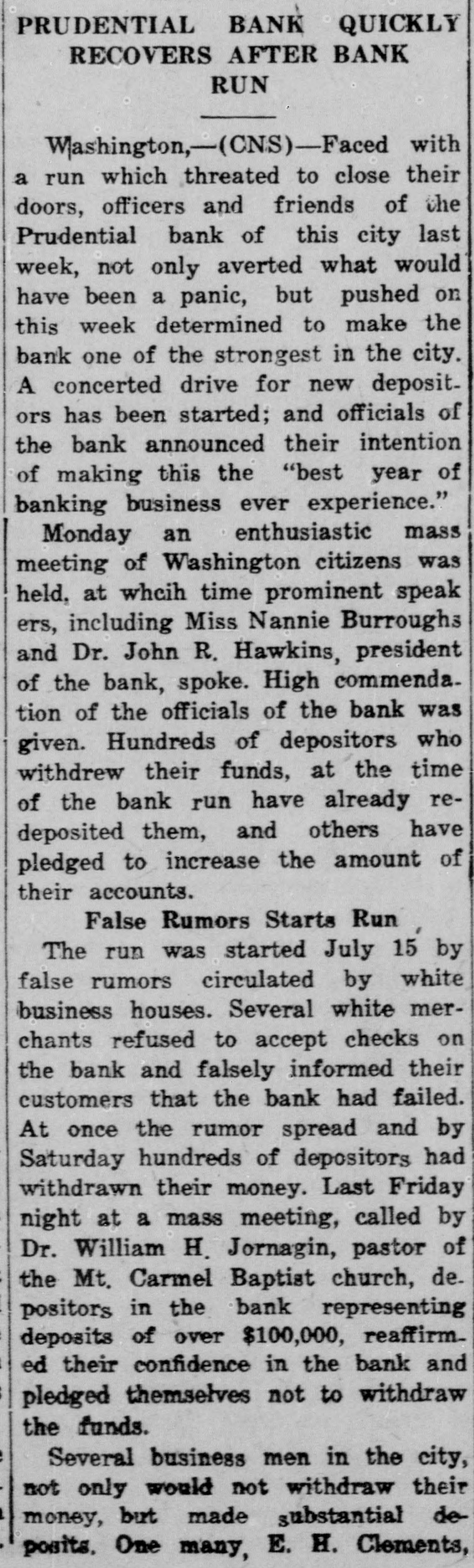
PRUDENTIAL BANK QUICKLY RECOVERS AFTER BANK RUN Wlashington,-(CNS)-Faced with a run which threated to close their doors, officers and friends of the Prudential bank of this city last week, not only averted what would have been a panic, but pushed on this week determined to make the bank one of the strongest in the city. A concerted drive for new depositors has been started; and officials of the bank announced their intention of making this the "best year of banking business ever experience." Monday an enthusiastic mass meeting of Washington citizens was held, at wheih time prominent speak ers, including Miss Nannie Burroughs and Dr. John R. Hawkins, president of the bank, spoke. High commendation of the officials of the bank was given. Hundreds of depositors who withdrew their funds, at the time of the bank run have already redeposited them, and others have pledged to increase the amount of their accounts. False Rumors Starts Run The run was started July 15 by false rumors circulated by white business houses. Several white merchants refused to accept checks on the bank and falsely informed their customers that the bank had failed. At once the rumor spread and by Saturday hundreds of depositors had withdrawn their money. Last Friday night at a mass meeting, called by Dr. William H. Jornagin, pastor of the Mt. Carmel Baptist church, de. positors in the bank representing deposits of over $100,000, reaffirmed their confidence in the bank and pledged themselves not to withdraw the funds. Several business men in the city, not only would not withdraw their money, but made substantial deposits. One many, E. H. Clements,


Article from Atlanta Daily World, September 3, 1932

Click image to open full size in new tab

Article Text

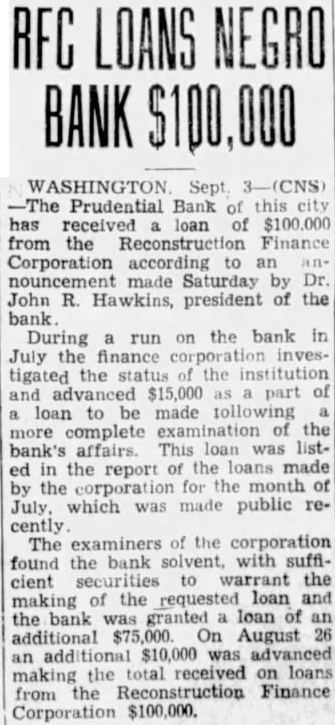
LOANS WASHINGTON Prudential Bank this has received loan from the Reconstruction Finance Corporation according nouncement made Saturday Dr. John R. Hawkins, president of the bank During run the bank July finance tigated the status institution $15,000 part loan to be made tollowing more complete examination the bank's affairs. This loan was listed the the loans made report by the for the month July, which was made public cently The examiners the corporation found bank with suffithe cient warrant the making of the loan and the granted loan of additional $75,000. On August $10,000 was advanced making the total received on loans from the Finance Corporation $100,000.


Article from Evening Star, February 4, 1941

Click image to open full size in new tab

Article Text

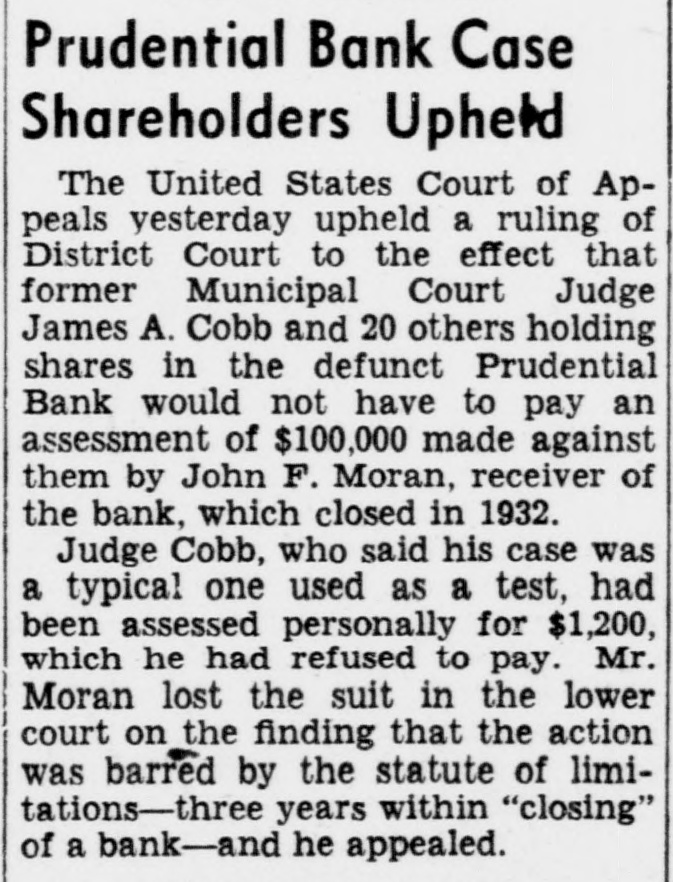
Prudential Bank Case Shareholders Upheld The United States Court of Appeals yesterday upheld a ruling of District Court to the effect that former Municipal Court Judge James A. Cobb and 20 others holding shares in the defunct Prudential Bank would not have to pay an assessment of $100,000 made against them by John F. Moran, receiver of the bank, which closed in 1932. Judge Cobb, who said his case was a typical one used as a test, had been assessed personally for $1,200, which he had refused to pay. Mr. Moran lost the suit in the lower court on the finding that the action was barred by the statute of limitations-three years within "closing" of a bank-and he appealed.


Article from Evening Star, October 5, 1941

Click image to open full size in new tab

Article Text

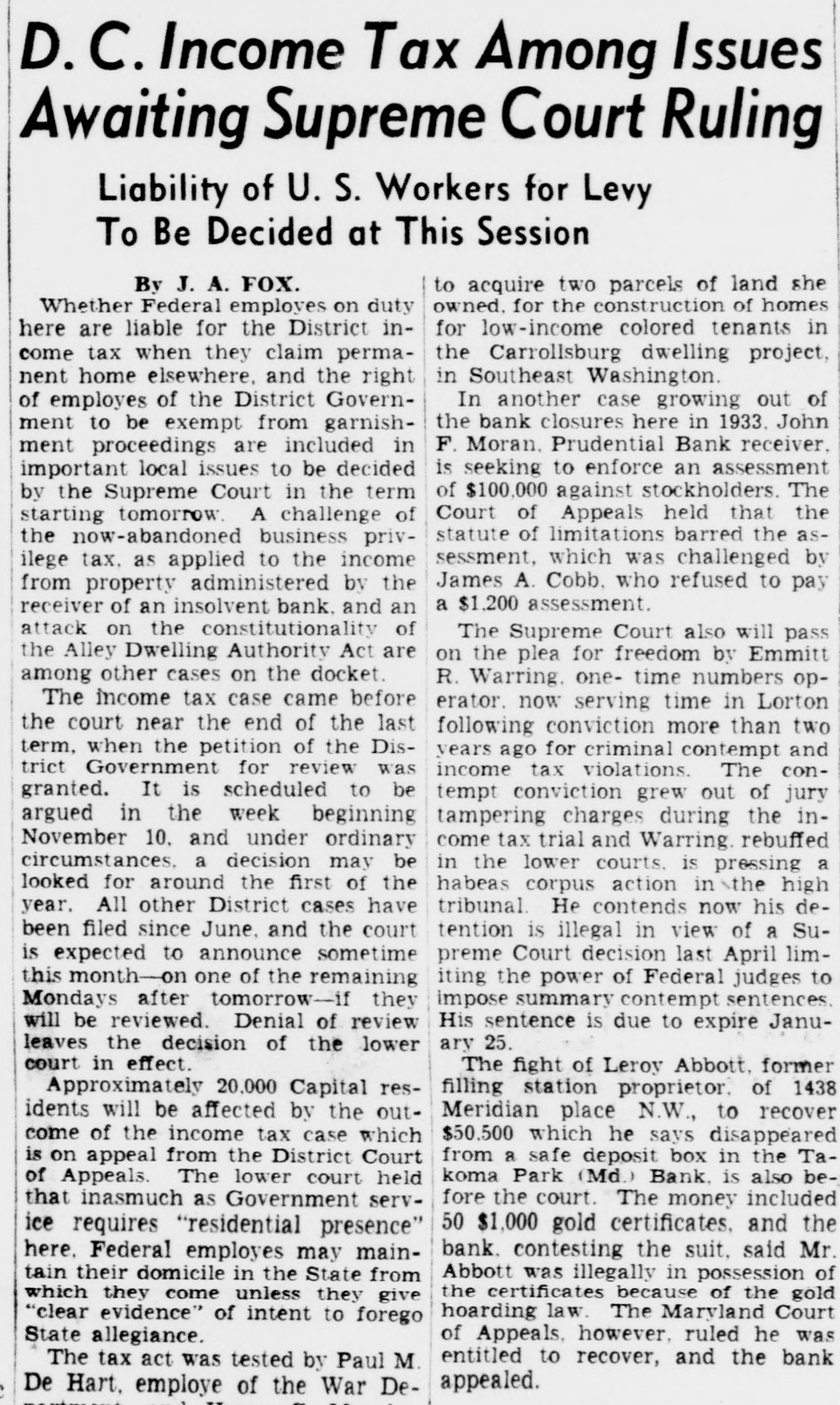
D. C. Income Tax Among Issues Awaiting Supreme Court Ruling Liability of U. S. Workers for Levy To Be Decided at This Session By J. A. FOX. to acquire two parcels of land she owned, for the construction of homes Whether Federal employes on duty for low-income colored tenants in here are liable for the District inthe Carrollsburg dwelling project, come tax when they claim permain Southeast Washington. nent home elsewhere, and the right In another case growing out of of employes of the District Governthe bank closures here in 1933. John ment to be exempt from garnishF. Moran. Prudential Bank receiver. ment proceedings are included in is seeking to enforce an assessment important local issues to be decided of $100,000 against stockholders. The by the Supreme Court in the term Court of Appeals held that the starting tomorrow. A challenge of statute of limitations barred the asthe now-abandoned business privsessment, which was challenged by ilege tax. as applied to the income James A. Cobb. who refused to pay from property administered by the a $1,200 assessment. receiver of an insolvent bank. and an attack on the constitutionality of The Supreme Court also will pass the Alley Dwelling Authority Act are on the plea for freedom by Emmitt among other cases on the docket. R. Warring, one- time numbers opThe income tax case came before erator. now serving time in Lorton the court near the end of the last following conviction more than two term, when the petition of the Disyears ago for criminal contempt and trict Government for review was income tax violations. The congranted. It is scheduled to be tempt conviction grew out of jury argued in the week beginning tampering charges during the inNovember 10. and under ordinary come tax trial and Warring. rebuffed circumstances, a decision may be in the lower courts. is pressing a looked for around the first of the habeas corpus action in \the high tribunal. He contends now his deyear. All other District cases have been filed since June, and the court tention is illegal in view of a Suis expected to announce sometime preme Court decision last April limiting the power of Federal judges to this month-on one of the remaining impose summary contempt sentences. Mondays after tomorrow-if they will be reviewed. Denial of review His sentence is due to expire Januleaves the decision of the lower ary 25. court in effect. The fight of Leroy Abbott, former Approximately 20,000 Capital resfilling station proprietor, of 1438 idents will be affected by the outMeridian place N.W., to recover come of the income tax case which $50.500 which he says disappeared is on appeal from the District Court from a safe deposit box in the Takoma Park (Md.) Bank, is also beof Appeals. The lower court held that inasmuch as Government servfore the court. The money included 50 $1,000 gold certificates, and the ice requires "residential presence" bank. contesting the suit. said Mr. here. Federal employes may maintain their domicile in the State from Abbott was illegally in possession of the certificates because of the gold which they come unless they give hoarding law. The Maryland Court "clear evidence" of intent to forego of Appeals, however, ruled he was State allegiance. entitled to recover, and the bank The tax act was tested by Paul M appealed. De Hart, employee of the War De-