Article Text
OF INSTITUTIONS IN 1877 ARE DOING BUSINESS IN 1927
Old Locations Maintained or Sites Nearby Taken for New Buildings.
INVASION OF BRITISH ONCE FORCED REMOVAL
Georgetown Bank Was Organized in 1793 by Samuel Blodgett.
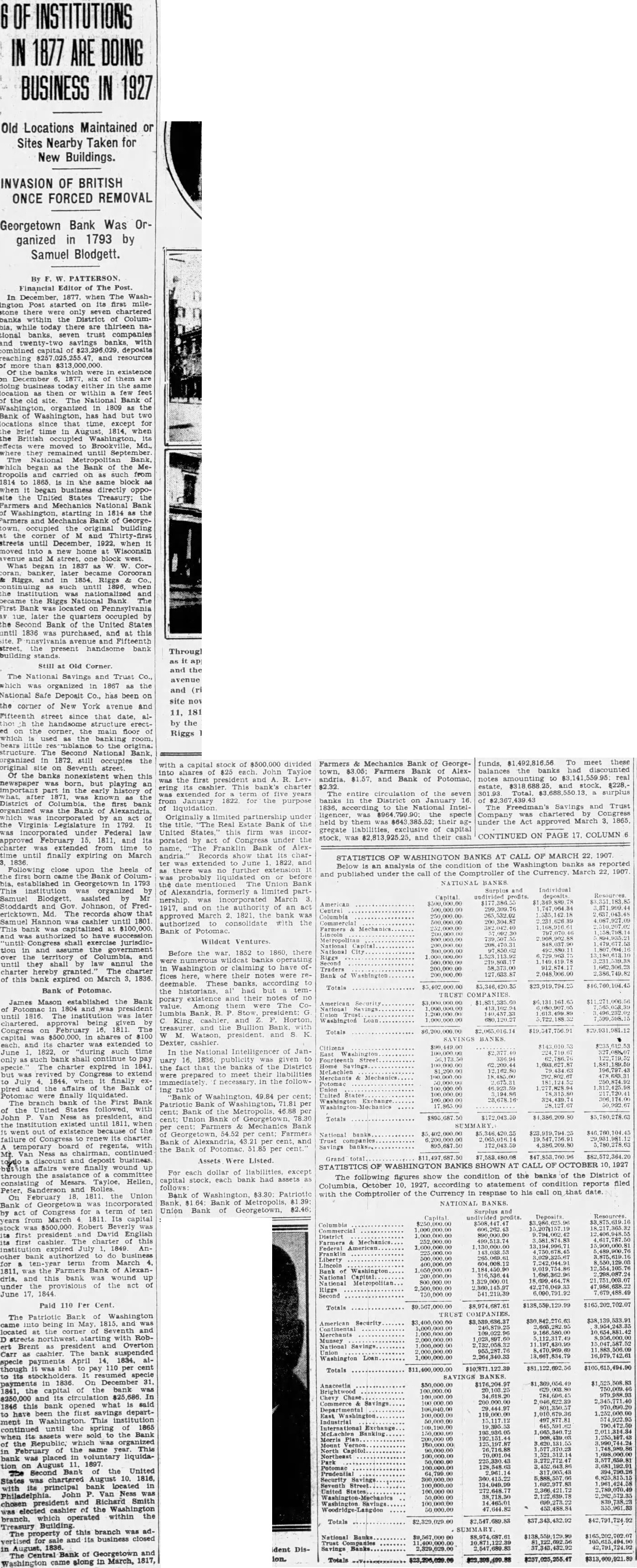
Financial Editor The Post. December, 1877. when The Washington Post started on its first milestone chartered banks Columare thirteen nabanks, companies twenty-two savings with combined capital deposits reaching and resources more than existence December 1877. them are doing today either in the location as then within few feet the old The National Bank of Washington. organized in as the Bank Washington, has had but two since that time, except for time in British Washington, effects moved Md., where remained until September The National Metropolitan Bank, Bank the Metropolis carried on from in same block when it began business directly oppothe United States Treasury; the Farmers and Mechanics National Bank Washington, starting 1814 the Bank of Georgeoccupied the original building the corner of M streets until 1922, when it moved into new home avenue and M street, block west. What began in Corand Riggs when the institution the Riggs National Bank The located on Pennsylvania later the occupied by the Second Bank of the United States until 1836 was purchased. and this bank building
Still Old Corner
The Savings and Trust Co., which was organized in 1867 as the National Safe Deposit Co., has been on the corner of New York avenue and Fifteenth street since that date, the handsome structure erected on the corner. the main floor which the bears mblance the structure. The Second National Bank, organized in still occupies the original on Seventh street. Of the banks nonexistent when this newspaper was born. but playing the early was the District Columbia, the first organized was the Bank Alexandria, incorporated by the Virginia under Federal law approved February and its charter to time until finally expiring on March close upon the heels of the first Bank bia, established in in 1793 institution organized by Samuel Blodgett. assisted Stoddardt and Fredericktown Md. The records show that Samuel Hannon was cashier until 1801 This $100,000 have succession "until shall exercise jurisdiction assume the government over the territory of Columbia, until shall by law annul charter The of this bank expired on March 3, 1836 Bank of Potomac.
James Mason established the Bank Potomac 1804 president chartered. by Congress February 1811. The capital was $500,000. in shares of $100 and charter was extended to "during time shall to pay expired in 1841 but by extend July when finally pired and the affairs the Bank of finally Bank The Van Ness as president, and the existed 1811, existence of the failure of Congress to with Mr. continued discount and deposit business affairs were finally wound up through the assistance of committee consisting of Messrs Tayloe, Hellen, On February Union Georgetown incorporated of term of ten act Congress March 1811 Its capital years stock was $500,000. Robert Beverly its president David English first cashier. this expired bank do business ten-year term from March 1811, Farmers of Alexandria, and bank was wound of the act June 17, 1844
Paid 110 Per Cent.
The Patriotic Bank of Washington came being 1815. located the corner and with RobBrent Overton ert Carr The suspended specie payments April 1834, 110 per cent though pay its stockholders resumed in 1836. On December 31, payments capital the was $250,000 its In 1846 this opened what have the first savings departWashington. This institution ment until the spring of 1865 continued when its assets to the Bank the Republic, which the This bank was in voluntary liquidaAugust Bank the United Second States The was chartered August 10, 1816, with principal Ness was John Van Philadelphia. and Smith chosen cashier the Washington branch. which operated within the Treasury of this branch was adThe property and its business closed vertised for sale in 1836. of Georgetown and in March, 1817, along with capital of $500,000 divided into $25 was the first and ering charter extended for five years from January 1822 for the purpose of liquidation Originally partnership under the Estate Bank the United firm was porated of under the name, Franklin Bank of Alexandria.' Records that charter was extended June 1822, and there further extension before the mentioned The Union Bank of Alexandria, formerly limited partnership. was incorporated March 1917, and on the authority an act approved March the bank authorized consolidate the Bank Potomac.
Ventures
Before 1852 there wildcat in or claiming to have offices where their notes were deemable These banks. according porary existence of value. Among The CoKing. treasurer. and the Bullion W M. Watson, president and S. K Dexter, cashier. In Intelligencer of Jangiven the fact the of the meet liabilities immediately. necessary. in the following ratio Bank of Washington. per cent; Patriotic Bank of Washington, per cent: Bank Union Bank Georgetown 78.30 per Mechanics Bank 54.52 per cent; Farmers Bank per and the Bank Potomac per cent.
Assets Were Listed.
For each dollar of except capital stock, had assets follows: Bank of Washington, Patriotic Bank, Union Bank of Georgetown,
Farmers Mechanics Bank of Georgetown, Farmers Alexandria. $1.57. and Bank of Potomac, The entire circulation of the District January 16. National Intelheld them aggregate exclusive of capital stock, was $2,813,925.25 and their cash
81 492,816.56 To meet these funds, had discounted amounting real notes and $228, surplus of Savings and Trust The under the Act approved March 3, 1865, CONTINUED ON PAGE 17. COLUMN
STATISTICS OF WASHINGTON BANKS AT CALL OF MARCH 22. 1907 of the the reported Below of the Currency March 22, 1907 and published under call the Comptroller NATIONAL BANKS Individual Capital 500,000.00 Traders Washington 200,000.00 127,633.87 2,048,006.00 2,386,749.82 Bank Totals $5,402,000.00 $23,919,794.25 TRUST COMPANIES American Security Totals $2,065,016.14 Citizens $2,377.40 Merchants Washington Exchange 28,678.16 Mechanics 28,127.67 $5,780,278.63 Totals banks $5,346,420.35 2,065,016.14 895,687.50 172,043.59 4,386,209.80 5,780,278.63 $47,853,760.96 $82,572,364.20 Grand OF WASHINGTON BANKS SHOWN AT CALL OF OCTOBER 1927 STATISTICS The following figures show the condition of the banks of the District Columbia, October 10, 1927 according to statement condition reports filed of the Currency in his call on date. with the Comptroller respnse NATIONAL BANKS Deposits District 890,000.00 Farmers American. 7,242,044.91 Washington 1,050,000.00 316,536.44 1,329,000.01 18,699,464.78 Metropolitan 2,360,145.97 541,210.39 7,679,488.49 750,000.00 $9,567,000.00 $8,974,687.61 $165,202,702.07 Totals TRUST $38,139,533.91 American Security $3,539,636.37 Savings 2,732,058.32 2,264,340.33 13,667,834.79 16,979,742.61 Washington 1,000,000.00 $81,122,692.56 $105,615,494.90 Totals $176,204.97 $1,369,056.49 $1,525,508.83 Anacostia 106,040.00 119,000.00 1,010,679.36 15,117.12 Morris 225,330.43 128,548.63 134,049.99 United Mechanics 38,718.50 $2,547,689.83 $37,343,432.92 $42,791,724.92 National Banks 2,547,689.83 42,791,724.92 Totals