New Orleans National Bank (New Orleans, LA)

Episode Information

Episode UID
177800885
Episode Type
Suspension β†’ Closure
Bank Type
national
Bank ID
17780 national
Charter Number
1778
Start Date
September 25, 1873
Location
New Orleans, Louisiana (29.955, -90.075)

Metadata

Model
gpt-5-mini (chosen from majority vote of a three-model LLM ensemble)
Short Digest
3695243303207eb6

Response Measures

None

Description

Suspension was citywide/clearing-house action tied to the 1873 financial panic; the bank subsequently went into liquidation/receiver.

Events (4)

1. January 30, 1871 Chartered
Source
historical_nic
2. September 25, 1873 Suspension
Cause
Macro News
Cause Details
Precautionary partial suspension in response to the New York banking crisis and heavy currency drain following Jay Cooke & Co. collapse; clearing-house limited currency payouts to $100 (or $25 in some notices) for 30 days.
Newspaper Excerpt
The New Orleans banks, with the exception of the Southern, have suspended currency payment.
Source
newspapers
3. October 27, 1873 Receivership
Newspaper Excerpt
John Cochran, Receiver of the New Orleans National Bank This National bank desired to wind up its own affairs, but some legal technicalities made Federal interference permissible
Source
newspapers
4. July 15, 1919 Voluntary Liquidation
Source
historical_nic

Newspaper Articles (23)

Article from Evening Star, September 25, 1873

Click image to open full size in new tab

Article Text

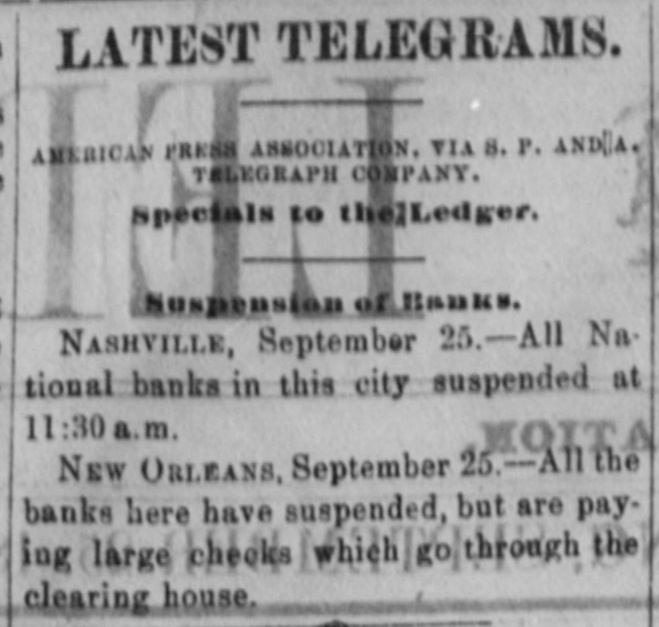
# The New Orleans Banks Suspend, [By Automatic Telegraph.] NEW ORLEANS, Sept. 25. - The New Orleans banks, with the exception of the Southern, have suspended currency payment.


Article from New Orleans Republican, September 26, 1873

Click image to open full size in new tab

Article Text

# Monetary--Commercial. MONETARY. OFFICE OF THE DAILY REPUBLICAN, THURSDAY EVENING, September 25, 1873. Our financial circles were taken by surprise at about half-past ten this morning by the announce-ment that at a meeting of presidents of nearly all the city banks, held at half-past nine, it was re-solved to suspend payments of currency on all de-mand obligations, in lieu thereof certifying checks or remitting New York Exchange, but with the proviso that depositors might draw currency for change purposes to the extent of $100 each diem. In a few moments the intelligence caused some excitement, but it very soon subsided, and after the appearance of the evening papers, con-taining the official announcement, wh en will be found in another column, the market appeared to be nearly as quiet as if nothing extraordinary had occurred. As far as our observation extended, the measure was received with emphatic approval. It was evident that under the course of the banks and bankers in other cities our city was steadily and rapidly losing its currency, and that serious re-sults would follow if the efflux was not arrested this has been effected by the measure adopted. New York bankers who send notes here for col-lection will be paid in New York exchange. The certified checks are received by all the banks in payment of maturing obligations as well as by fac-tors and all others for cotton or other merchan-dise without any difference in price. In fact they may fairly be regarded as being as valuable as bank notes, representing as they do currency in the banks or loaned out by them on unexception-able security. Of course there's no cause what-ever for any distrust nor should there be any hesi-tation in receiving such checks in trade or are liquidation of debts. It was not only the banks and bankers in other cities who were draining our banks of their currency. Even small shipments of produce were made to this market from the West with instructions to sell on arrival and remit the proceeds in currency by express. It will be observed that the banks which have united in this measure anticipate that it will not be required for more than thirty days, but in the solvent condition of our banking institutions the currency movement may actually be resumed at an earlier date. The Southern Bank is the only one of the banks which did not unite in this meas-ure. It will be recollected it did not suspend specie payments during the war, and now pursues the same course with regard to currency payments. We hear that the savings banks also are paying currency as usual.


Article from New-York Tribune, September 26, 1873

Click image to open full size in new tab

Article Text

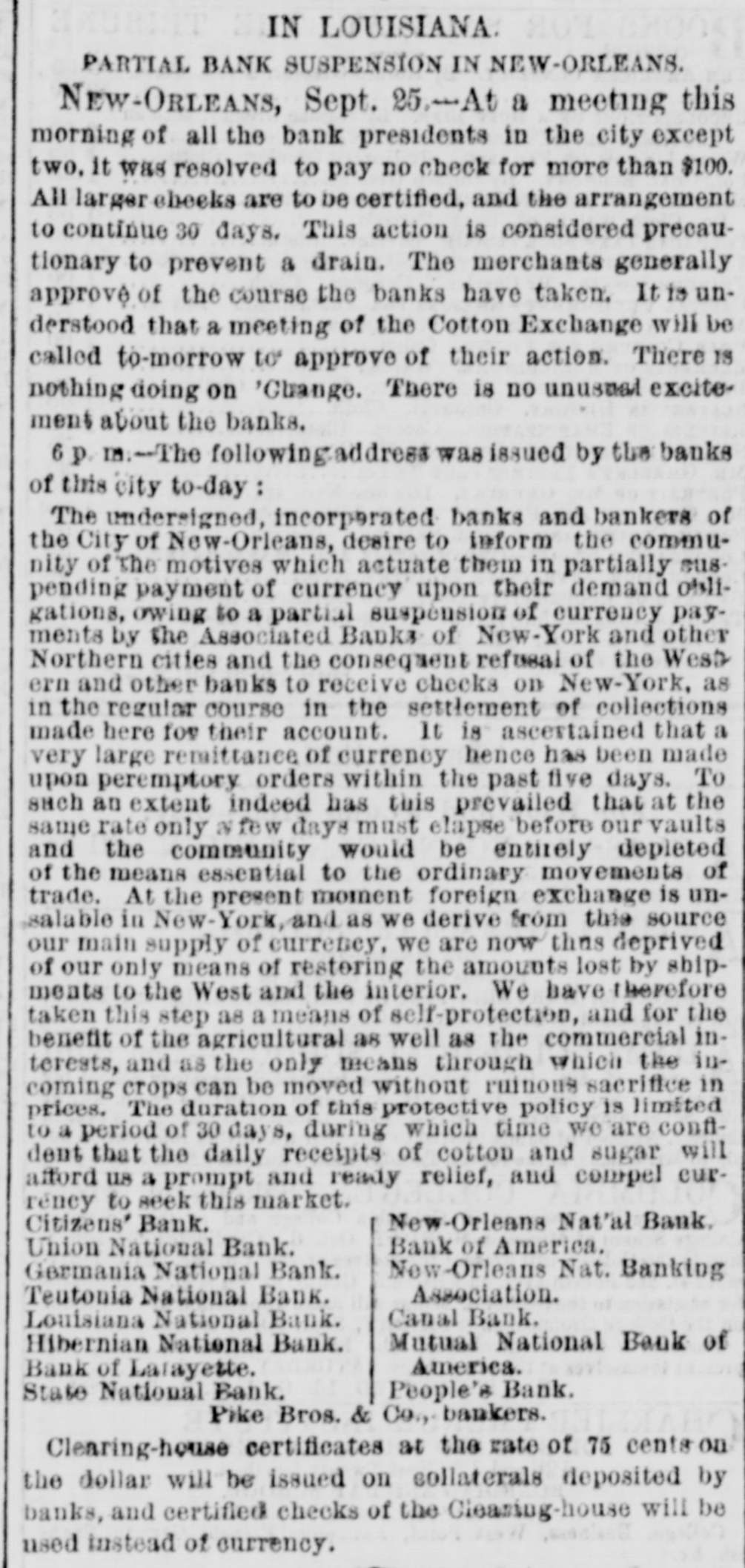
IN LOUISIANA PARTIAL BANK SUSPENSION IN NEW-ORLEANS. NEW-ORLEANS, Sept. 25.-At a meeting this morning of all the bank presidents in the city except two, it was resolved to pay no check for more than $100. All larger cheeks are to be certified, and the arrangement to continue 30 days. This action is considered precautionary to prevent a drain. The merchants generally approve of the course the banks have taken. It is understood that a meeting of the Cotton Exchange will be called to-morrow to approve of their action. There IS nothing doing on 'Change. There is no unusual excitement about the banks. p n.-The following address was issued by the banks of this city to-day The undersigned, incorperated banks and bankers of the City of New-Orleans, desire to inform the community of The motives which actuate them in partially suspending payment of currency upon their demand obligations, owing to a partial suspension of currency payments by the Associated Banks of New-York and other Northern cities and the consequent refusal of the West ern and other banks to receive checks on New-York, as in the regular course in the settlement of collections made here for their account. It is ascertained that a very large remittance of currency hence has been made upon peremptory orders within the past five days. To such an extent indeed has this prevailed that at the same rate only a few days must elapse before our vaults and the community would be entirely depleted of the means essential to the ordinary movements of trade. At the present moment foreign exchange is unsalable in New-York, and as we derive from this source our main supply of currency, we are now thus deprived of our only means of restoring the amounts lost by shipmeats to the West and the interior. We have therefore taken this step as a means of self-protection, and for the benefit of the agricultural as well as the commercial interests, and as the only means through which the incoming crops can be moved without ruinous sacrifice in prices. The duration of this protective policy is limited to a period of 30 days, during which time we are conftdent that the daily receipts of cotton and sugar will afford us a prompt and ready relief, and compel curreney to seek this market. New-Orleans Nat'al Bank. Citizens' Bank. Bank of America. Union National Bank. New-Orleans Nat. Banking Germania National Bank. Association. Teutonia National Bank. Canal Bank. Louisiana National Bank. Mutual National Bank of Hibernian National Bank. America. Bank of Lalayette. State National Bank. People's Bank. Pike Bros. & Co., bankers. Clearing-house certificates at the rate of 75 cents on the dollar will be issued on sollaterals deposited by banks, and certified checks of the Cleaning-house will be used instead of currency.


Article from The Dallas Daily Herald, September 27, 1873

Click image to open full size in new tab

Article Text

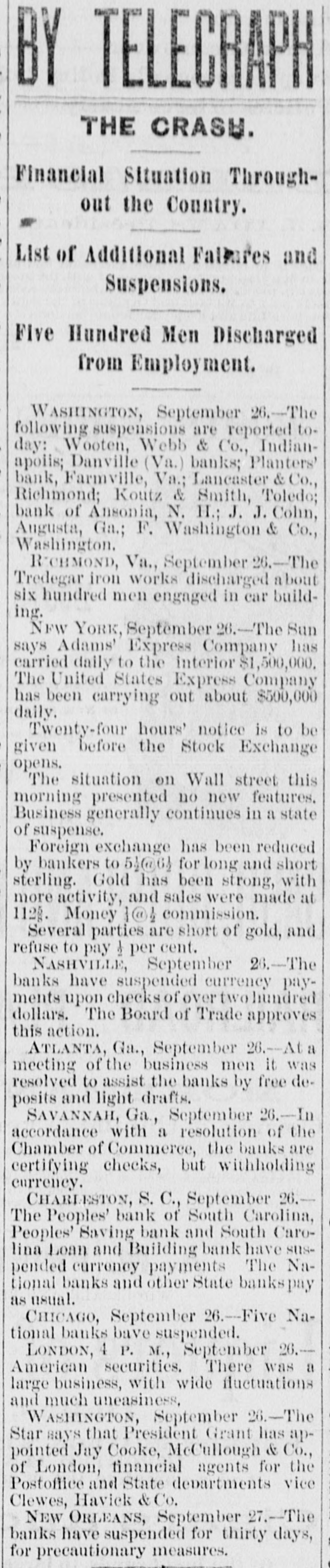
BY TELEGRAPH THE CRASH. Financial Situation Throughout the Country. List of Additional Fallures and Suspensions. Five Hundred Men Discharged from Employment. WASHINGTON, September 26.-The following suspensions are reported today: Wooten, Webb & Co., Indianapolis; Danville (Va.) banks; Planters' bank, Farmville, Va.; Lancaster & Co., Richmond; Koutz & Smith, Toledo; bank of Ansonin, N. H.; J. J. Cohn, Augusta, Ga.; F. Washington & Co., Washington. RICHMOND, Va., September 26.-The Tredegar iron works discharged about six hundred men engaged in car building. NEW YORK, September 26.-The Sun says Adams' Express Company has carried daily to the interior $1,500,000. The United States Express Company has been carrying out about $500,000 daily. Twenty-four hours' notice is to be given before the Stock Exchange opens. The situation on Wall street this morning presented no new features. Business generally continues in a state of suspense. Foreign exchange has been reduced by bankers to 54@64 for long and short sterling. Gold has been strong, with more activity, and sales were made at 112g. Money 1@1 commission. Several parties are short of gold, and refuse to pay of per cent. NASHVILLE, September 26.-The banks have suspended currency payments upon checks of over two hundred dollars. The Board of Trade approves this action. ATLANTA, Ga., September 26.-At a meeting of the business men it was resolved to assist the banks by free deposits and light drafts. SAVANNAH, Ga., September 26.-In accordance with a resolution of the Chamber of Commerce, the banks are certifying checks, but withholding currency. CHARLESTON, S. C., September 26.The Peoples' bank of South Carolina, Peoples' Saving bank and South Carolina Loan and Building bank have suspended currency payments The National banks and other State bankspay as usual. CHICAGO, September 26.--Five National banks have suspended. LONDON, 4 P. M., September 26.--American securities. There was a large business, with wide fluctuations and much uneasiness, WASHINGTON, September 26.-The Star says that President Grant has appointed Jay Cooke, McCullough & Co., of London, financial agents for the Postoffice and State departments vice Clewes, Haviek & Co. NEW ORLEANS, September 27.-The banks have suspended for thirty days, for precautionary measures.


Article from The Louisiana Democrat, October 1, 1873

Click image to open full size in new tab

Article Text

The financial crisis has reached New Orleans. All the Banks have partially suspended "payment of currency upon their demand obligations." This is to continue thirty days.


Article from The Ouachita Telegraph, October 3, 1873

Click image to open full size in new tab

Article Text

THE BANKS AND THE MARKET. On Thursday our commercial and financial circles were literally "taken by surprise" at the resolution adopted by the Clearing House banks, at a meeting at 9:30 A. M., the purport of which is shown by the official announcement to the public which we give elsewhere. While we say "taken by surprise" we do not mean to intimate that the measure was not proper and necessary, and might not have been foreseen by close observers of the movement in other cities. The course of the New York banks for a week previous had stimulated transmission of currency to that money center from all parts of the country; and especially from New Orleans, which was temporarily a debtor city, as shown by the premium on New York exchange previous to and at the time of the New York crisis. The consequence was that, while the movement in foreign exchange was suspended and the offerings of domestic were consequently light, the former being the basis of a large part of the latter, the proceeds of paper sent by the banks of other cities to our banks and bankers for collection were called for in currency. The table of an agent for a Northern banking house was piled up with currency for transmission to New York. In addition to this heavy drain, Western merchants ordered the proceeds of consignments to be remitted to them in currency. New Orleans was thus ciclimized for the benefit of the North and West, especially of New York, and while our banks were never in a sounder condition, and had seldom, or perhaps never held, so little paper that was not unquestionably good, they were compelled to discontinue payments in currency and resort instead to certified checks. We say discontinued, for although literally speaking, suspended may be the proper word, "suspension" is popularly understood to imply a situation which does not exist in our city. No bank has closed its doors; no bank fails to respond at the Clearing House to all its obligations; none refuses to certify checks and charge the amount to the depositor; nor do they refuse to receive such checks on deposit and in payment of all obligations maturing at their


Article from The Donaldsonville Chief, October 4, 1873

Click image to open full size in new tab

Article Text

The financial scare, which began with the failure of Jay Cooke & Co., and spread like wild-fire over the country, still prevails and prostrates every description of trade. The New Orleans banks suspended payments in larger sums than $25 per day to any one depositor, for the purpose of preventing a run upon their vaults, and when confidence is restored and business is resumed upon the former basis the wisdom of this action will be apparent to all. The foolish panic has been the result of want of confidence, and it will turn out that all were more scared than hurt. It is thought the crisis will end during the coming week.


Article from Rapides Gazette, October 4, 1873

Click image to open full size in new tab

Article Text

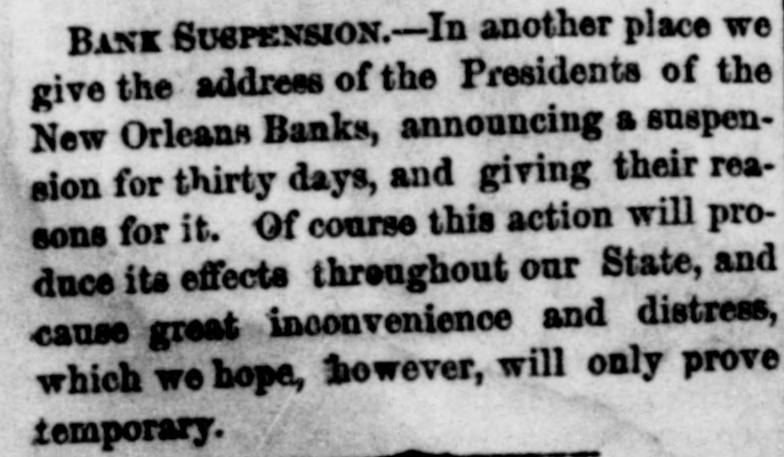
# BANK SUSPENSION.-- In another place we give the address of the Presidents of the New Orleans Banks, announcing a suspension for thirty days, and giving their reasons for it. Of course this action will produce its effects throughout our State, and cause great inconvenience and distress, which we hope, however, will only prove temporary.


Article from Rapides Gazette, October 4, 1873

Click image to open full size in new tab

Article Text

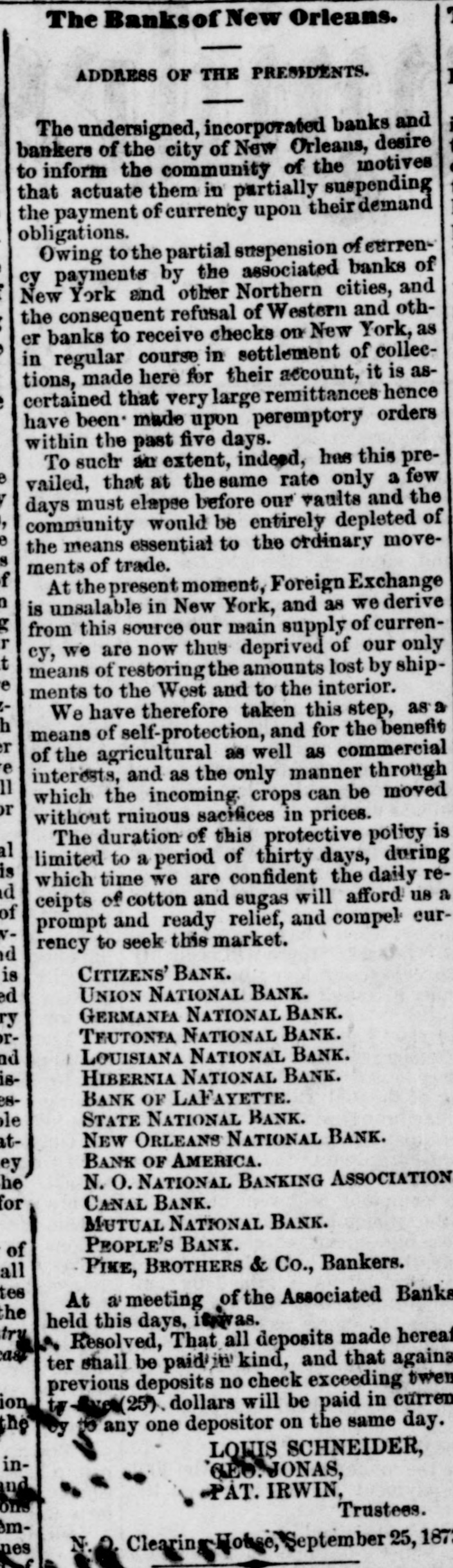
The Banks of New Orleans. ADDRESS OF THE PRESIDENTS. The undersigned, incorporated banks and bankers of the city of New Orleans, desire to inform the community of the motives that actuate them in partially suspending the payment of currency upon their demand obligations. Owing to the partial suspension of currency payments by the associated banks of New York and other Northern cities, and the consequent refusal of Western and other banks to receive checks on New York, as in regular course in settlement of collections, made here for their account, it is ascertained that very large remittances hence have been made upon peremptory orders within the past five days. To such any extent, indeed, has this prevailed, that at the same rate only a few must before our would be entirely days community elapse vaults depleted and the of the means essential to the ordinary movements of trade. At the present moment, Foreign Exchange is unsalable in New York, and as we derive from this source our main supply of currency, we are now thus deprived of our only means of restoring the amounts lost by shipe ments to the West and to the interior. We have therefore taken this step, as a h means of self-protection, and for the benefit r of the agricultural as well as commercial e interests, and as the only manner through 11 which the incoming crops can be moved r without rninous sacifices in prices. The duration of this protective policy is al limited to a period of thirty days, during is which time we are confident the daily red ceipts of cotton and sugas will afford us a of prompt and ready relief, and compel eurVrency to seek this market. d CITIZENS' BANK. is UNION NATIONAL BANK. ed GERMANIA NATIONAL BANK. ry TEUTONTA NATIONAL BANK. rLOUISIANA NATIONAL BANK. nd HIBERNIA NATIONAL BANK. isBANK OF LAFAYETTE. esSTATE NATIONAL BANK. le NEW ORLEANS NATIONAL BANK. atBANK OF AMERICA. ey he N.O. NATIONAL BANKING ASSOCIATION for CANAL BANK. MUTUAL NATIONAL BANK. PEOPLE'S BANK. of PIKE, BROTHERS & Co., Bankers. all tes At a meeting of the Associated Banks the held this days, itawas. try Resolved, That all deposits made hereaf ter shall be paid its kind, and that againa previous deposits no check exceeding twen ion (25) dollars will be paid in curren the to any one depositor on the same day. LOWIS SCHNEIDER, inGEO JONAS, and PAT. IRWIN, ons Trustees. mClearing House, September 25, 187 nes


Article from Dodgeville Chronicle, October 10, 1873

Click image to open full size in new tab

Article Text

A dispatch from Dubuque, Iowa, says an examination just made into the affairs of the Merchants' National Bank of that city had shown that R. A. Babbage, the Cashier, had abstracted from the bank, by means of false entries, $267,289, and that the President, Mr. Sheffield, had abstracted $161, 977. The ravages of the yellow fever in Memphis and Shreveport, according to Press dispatches of the 3d, had largely increased. In the former city over 5,000 people had left by of whom were ill at trains, many small the various towns where they went. The Odd Fellows had issued a call for contributions from the Order throughout the United States. There had been 24 yellow fever interments on that day. In Shreveport there were 17 yellow fever interments. The President had ordered 5,000 army rations to be shipped to that place for the benefit of the sufferers. Captain Jack and four of his companions were hung at Fort Klamath, Oregon, on the 3d. The late hour at which the dispatch was received on the morning of the 4th prevented the publication of full particulars. The sentence of Slotuck and Barncho had been commuted to imprisonment for life on Alcatras Island, in San Francisco harbor. The Chicago Times of the 5th says that during the week ending October 4, $15,475,000 in currency had been received by the three express companies having offices in that city. This was, of course, exclusive of sums brought by individuals for investment. The banks of that city had begun to discount sparingly. A Philadelphia special of the 4th says an elaborate deed of trust had been executed by Jay Cooke and his partners, conveying to Mr. Rollins and Mr. Cote all the firm's property, partnership and private, including their the wives' dower right, to be administered for benefit of all the creditors of the firm, and each five per cent. realized to be distributed. This had been done to prevent the disof the estate under the bankrupt act, it was that, by the Cookes would pay and persion ment, thought prudent dollar for manage- dollar and have a large surplus for themselves. A New York dispatch of the 4th announces that Peake, Opdyke & Co., a large dry goods house, had suspended, with liabilities amounting to $2,500,000. Lamper & Co., grain dealers, of Boston, Mass., according to a dispatch of the 4th, had suspended, with liabilities for over $300,000. A Washington telegram of the 4th says that absolute quiet prevailed with regard to the financial situation. A Dubuque (Iowa) dispatch of the 4th says the feeling against the defaulting cashier, Babbage, had become very bitter. The authorities had keen compelled to guard his house with a band of policemen to prevent acts of violence from an outraged community. The virulence of the yellow-fever epidemic at Memphis, according to a telegram of the 4th, had largely increased. Hundreds of the poorer classes were dying uncared for and dying for want of attention. The interments on that day in the potter's field alone, had as reported by the county undertaker, reached thirty in number. The whole number of yellow-fever deaths for the day exceeded forty. This included only paupers and those for whom coffins had been obtained at the undertakers'. A New York dispatch of the 4th says that the arrival of the Polaris survivors in that city, on the steamship City of Antwerp, on that day, had been signalized by the arrest of Capt. Buddington and his confinement in the Navy Yard. Later the Tallapoosa left for Washing ton with them. A New Orleans dispatch of the 5th says the New Orleans National Bank had gone into liquidation. The house of Cavoroc had failed. A New York correspondent, writing from Dundee, Scotland, recently, has reiterated the story of the poisoning of Captain Hall, of the Polaris, and indicated Professor Bessels, of the expedition, as the person who the deed. In arthe facts in the case, committed rive at order to the Secretary of the Navy, according to the dispatch of the 6th, had instituted another examination of the survivors. York dispatch of the 6th announces that the balloon, A New "Graphic" being the Prof. old affair revamped and rejuvenated, with Donaldson and his associates, had started for Europe on the morning of that day. The ascension was an excellent one. Mr. Donaldson was accompanied by Messrs. Lunt and The balloon rose and the Ford. starting-point, floated when rapidly last majesti- from seen cally towards the ocean, and was moving towards Europe. Later, a dispatch had been received:from New Haven, stating that the balloon had reached Canaan, in the northeast corner of the State of Connecticut, in a at when it had been caught Donaldso allowed gas storm. 1:25 p. m., enough the of the to escape to enable them to bring gas-bag near the earth, when they all leaped out, and the balloon escaped. Hearte Nature


Article from Iowa Voter, October 16, 1873

Click image to open full size in new tab

Article Text

A dispatch from Dubuque, Iowa, says an examination just made into the affairs of the Merchants National Bank of that city had shown that R. A. Babbage, the Cashier, had abstracted from the bank by means of false entries $267,289, and that the President, Mr. Sheffield, had abstracted $161, 972 Captain Jack and four of his companions were hung at Fort Klamath, Oregon, on the 3d. The late hour at which the dispatch was was received on the morning of the 4th prevented the publication of full particulars. The sentence of Slotuck and Barncho had been commuted to imprisonment for life on Alcatras Island, la San Francisco Harbor. A dispatch from Columbus, Ohio, of the 3d announced that Reckley's Bank, of that city, had suspended. The Chicago Times of the 5th says that during the week ending October 4, $15,475,000 in currency had been received by the three express companies having offices in that city. This was, of course, exclusive of sums brought by individuals for investment. The banks of that city had begun to discount sparingly. A Dubuque, Iowa, dispatch of the 4th says the feeling against the defaulting cashier, Babbage, had become very bitter. The authorities had been compelled to guard his house with a band of policemen to prevent acts of violence from an outraged community. The Board of Equalization for the State of Illinois had completed its labors on the 7th. The estimated value of all lands in the State of Illinois, according to their opinion, was $1,245,760,454. An Indianapolis dispatch of theSth says that all work on the Canada Southern Railroad, in Northern Indiana, had been stopped by the Sheriffs of the several counties through which it runs, taking possession of all the company's property. According to the Chicago Journal of the 8th, the Third National Bank of that city had opened its doors again. A St. Louis dispatch of the 8th says that finances in that city had not worked as satisfactorily as was anticipated. The Union Bank suspended on that day and had decided to go into liquidation. The South. A dispatch from Memphis, Tennessee, says the yellow fever in that city had largely increased. The interments had reached fortyone on the preceding day. An appeal had been issued for relief. A Galveston (Texas) dispatch of the 2d says that the town of Lampasas had been inundated recently by the sudden rise of a creek that ran through the place. Twenty houses had been carried away including the Post-Office and two stores. Six persons had been drowned. The ravages of the yellow fever in Memphis and Shreveport, according to Press dispatches of the 3d, had largely increased. In the former city, over 5,000 people had left by the various trains, many of whom were ill at the small towns where they went. The Odd Fellows had issued a call for contributions from the Order throughout the United States. There had been 24 yellow fever interments on that day. In Shreveport there were 17 yellow fever interments. The President had ordered 5,000 army rations to be shipped to that place for the benefit of the sufferers. The virulence of the yellow fever epidemic at Memphis, according to a telegram of the 4th, had largely increased. Hundreds of the poorer classes were lying uncared for and dy ing for want of attention. The interments on that day in the Potter's Field alone, as reported by the county undertaker, had reached thirty in number. The whole number of yellow fever deaths for the day exceed ed forty. This included only paupers and those for whom coffins had been obtained at the undertakers. A New Orleans dispatch of the 5th says the New Orleans National Bank had gone into liquidation. The house of Clavoroe had failed. A Memphis telegram of the 7th says that, on that day, more cases of yellow fever had been developed than ever before. Over 600 persons were under treatment. The deaths numbered forty-two Among the latter was Rev. Father Carey, of the Do. minican Priesthood. At Shreveport the / interments were less numerous, probably because the material with which to operate was less abundant. The town had become almost depopulated.


Article from Wood County Reporter, October 16, 1873

Click image to open full size in new tab

Article Text

DOMESTIC. According to a Philadelphia special of the 4th an elaborate deed of trust had been executed by Jay Cooke and his partners, conveying to Mr. Rollins and Mr. Cote all the firm's property, partnership and private, including their wives' dower right, to be administered for the benefit of all the creditors of the firm, and each five per cent. realized to be distributed. This had been done to prevent the dispersion of the estate under the bankrupt act, and it was thought that, by prudent management, the Cookes would pay dollar for dollar and have a large surplus for themselves. A New York telegram of the 4th announces that Peake, Opdyke & Co., a large dry goods house, had suspended, with liabilities amounting to $2,500,000. Lamper & Co., grain dealers, of Boston, Mass., according to a dispatch of the 4th, had suspended, with liabilities for over $300,000. A Washington dispatch of the 4th says that absolute quiet prevailed with regard to the financial situation. The Chicago Times of the 5th says that during the week ending October 4, $15,475,000 in currency had been received by the three express companies having offices in that city. This was, of course, exclusive of sums brought by individuals for investment. The banks of that city had begun to discount sparingly. A Dubuque (Iowa) telegram of the 4th says that the feeling against the defaulting cashier, Babbage, had become very bitter. The authorities had been compelled to guard his house with a band of policement to prevent acts of violence from an outraged community. The Board of Equalization for the State of Illinois had completed its labors on the 7th. The estimated value of all lands in the State of Illinois, according to their opinion, was $1,245,760,454. The virulence of the yellow-fever epidemic at Memphis, according to a telegram of the 4th, had largely increased. Hundreds of the poorer classes were lying uncared for and dying for want of attention. The interments on that day in the Potter's Field alone, as reported by the county undertaker, had reached thirty in number. The whole number of yellow-fever deaths for the day exceeded forty. This included only paupers and those for whom coffins had been obtained at undertakers'. New York advices of the 4th say that the arrival of the Polaris survivors in that city, on the steamship City of Antwerp, on that day, had been signalized by the arrest of Captain Buddington and his confinement in the NavyYard. Later the Tallapoosa left for Washington with them. A New Orleans dispatch of the 5th says the New Orleans National Bank had gone into liquidation. The house of Cayoroc hadfailed


Article from The Daily Phoenix, October 26, 1873

Click image to open full size in new tab

Article Text

his that bord He the Bishop poral power. the reots pray of ou COUNTRY LONDON, Baker, ill of The by collision, in 875,000 NOW York DOBLIN are being in demonstra. tion of 23d next for Fenian month, of parof prisonors ties from Ireland, and are oven States be will pected. the Rally oity. 500 Music bands. MADRID, Cartage to nian arm the captured. Ninetors. October ArrivedSea New York; Georgia, Steamships Gall, NEW John -Rev. YORK, October R. of Pa., Erie, has and been Colorado SAN The 25. October of ship tons Three 4,300 Brothers of the view wheat. 1 r reported, faot will that line British to between Australia, commende this and few weeks, port, Honolain the the that over line same American will not route 25. New The cotOotober ORLEANS, ton 10, will after factors, November for for only sell They currency. checks. certified 25. yel SHREVE Three October low fever deaths yesterday, of inches OMAHA, October fell No of snow detention trains. Ex Post October PITTSBURG, for master Stewart indioted and perjury forgery. C. W. October UHICAGO, Captain the ExFord, connected at of press. died Louis, Company filious The are Banks silver National paying at par. CONN., October 25.-DeUNIONVILLE loney burned Obtober citizens of held Memphis refageeing meeting night. committo tees were, The aid. solicit appointed aid says: almost Memphis of inhabitof remain. 2,000 newly depopulate appealfor about Out 10,000 are now sick. are on only than 1,000 and orphans the tu were cease though dependence these, ants, more made widows charity. and, even at be asthese opcar must people The sisted helpledoming winter. during are relief funds, without is aid Haleed furnished, die of neglect, or Not want. succumb but only money, are fuel for, and food asked and the poor and Changer olothing, and blankets, that the of and destistricken plague hundreds be may and kept hourished tate families -Appoint Surveyorfrom WASHIT starvation. SHINGTON M.F. October Banzamo, vice 25. Foster. John Naments Dr. Louisiana, New Orleans National General of Receives of This own but Cockrum, Banking wind up its affairs, some tional Bank desired to legal technicalities permissable. interference Atlantic and States, Federal with cloudy have began Shaw $60,000 threatening NEW YORK, weather. against October They the 25. owe New Suits Prosper Jersey Southern been Railroad. and a own claims Jay Could $600,- majoof the road. 000. P. Jay Gould atock and bonds to Europe rity $250,000 of the in gilver bars go October 25.-The of largest to-day. COHOES; N. Y., Mills, the will close to Harmony Cotton in the world, is probable that fol the woolen night the indeAnitely.com manufacturers It will soon Washington says special to letter day low NEW this YORK, example. October Attorney 25.-A General from Wilin conthat, heavy by liams Montgomery, received Ala., rains saying and the the destruc- army sequence the of cotton crops exists in several M tion of great destitution in Sumter and actual In some help Counties; worm, especially places, there is rendered, is starvation, rengo. the and winter nnleas many perduring


Article from New-York Tribune, October 30, 1873

Click image to open full size in new tab

Article Text

thrown out of employment, including the body of opera- tives who were most prominent in the strike of last Sum- mer, and who, it may be supposed, drew most largely on their savings to support that movement. The Atlantic Delaine Mills are controlled by Hoyt, Spragues & Co. of New-York, though not run in their name. Messrs. Sprague have shown themselves very chary of informa- tion as to the steps they have taken or propose to take in curtailing their production, and seem inclined to allow the cloud, which Rhode Island manufacturers say hangs over all interests in the State from the enormous volume of their obligations, to put on its darkest aspect. # REDUCTION OF THE PRICE OF GOODS BY BROWN & IVES. The Lonsdale Manufacturing Company, which is con- trolled by the house of Brown & Ives, runs five mills at Lonsdale and Ashton, manufacturing villages in the valley of the Blackstone, a few miles from Providence. Here are manufactured cambrics, Lonsdale bleached shirtings, jaconets, etc., and in these five mills are 144,000 spindles and about 3,000 operatives. These mills are still running on full time and with no reduction of wages or employΓ©s. The agents state that they desire to keep with them all their operatives, some of whom have been in their employ 30 years and even more, and have as yet decided on no curtailment on account of the financial troubles. Unless matters soon mend, how- ever, they will be forced to retrench. The reduction would probably be made in the wages rather than in hours or force. The agents assert that the operatives have been getting such very high wages that they can well stand a reduction. They look, however, for an early revival of business. The Lonsdale Company this week reduced the price of their goods one cent per yard. Other manufacturers following the example have given orders to their selling agents in New-York to re- duce prices correspondingly. The agents of the Lons- dale Company say that as cotton is falling Β½ of a cent per pound daily, with reduced wages they can make a fair profit at the lower rate. The reduction has not been wel- comed by their competitors, who say that they could keep up their mills at full time at the old rate, but must now curtail. Brown & Ives also control the Hope Mill, at Scituate, which makes shirtings. The mill contains 28,000 spindles and employs 350 hands. They also control the Berkeley Mill, in Cumberland, seven miles from Providence, which is a new enterprise. The mill is now running over 300 looms, and, having a capacity of 40,000 spindles, employs about 400 persons. Here are made fine goods, sixties, eighties, and one-hundreds. The Hope and Berkeley mills are running on full time, and at the latter place new looms are being frequently added. The manufacture of the class of goods made at the Berkeley is said to be new in this country. The same policy will be pursued at these two mills as at Lonsdale and Ashton. Beside these a print cloth manufactory in Blackstone, Mass., with 50,000 spindles and some 600 hands, is con- trolled by Brown & Ives. This manufactory was shut yesterday, partly for repairs, but more on account of the depression. The present intention is to resume at full time on Monday next, but action will be governed by the condition of trade. Belonging to the Crawford-Allen estate, and now con- trolled by M. B. I. Goddard of this city, are the Allen Print Works in Providence, the print cloth mill of the Bernon Manufacturing Company at Georgiaville, R. I., the Woonsocket Company's cotton mill at Woonsocket, R. I., and the two mills of the Smithfield Manufacturing Company, one in Alleaville, R. I., the other in Dedham, Mass. Mr. Goddard also acts as agent for the Fitchville Manufacturing Company, whose mill, at Fitchville, Conn., manufactures shirtings. The Allen Print Works, which have a dozen machines with a capacity of about 15,000 pieces per week, and employ nearly 400 hands, stopped a month ago. At these, as at other print works, a stop of a fortnight twice a year, in the Spring and Autumn, for repairs and preparation for the change between light and dark goods, has been cus- tomary. The time of the Autumn closing has been Nov. 1. The panic hastened the suspension this season, and no time of resumption is yet fixed upon. The Bernon Mill, which has 603 looms, 30,000 spindles, and about 450 hands; the mill of the Woonsocket Company, with 13,000 spindles and 170 hands, and the Allenville Works of the Smithfield Manufacturing Company, with 10,200 spindles and 150 hands, all stopped on Saturday, the 11th inst. When they resume-a time as yet not fixed with certainty, but possibly Monday next-there will be some reduction, probably in time. It is thought by the representatives of these mills that a suspension of a few weeks will be lightly borne by the operatives, but longer idleness would drive many of the French Canadians of whom there is a large number employed throughout Rhode Island-to Canada for the Winter, and cause distress among them and trouble to the em- ployers to get labor in the Spring. The Fitchville Com- pany-whose new works have a capacity of 15,000, now running 12,000 spindles-has made no reduction of any kind. Two hundred hands are employed. At the Ded- ham Mill of the Smithfield Company, now running on full time, are 163 hands and 12,000 spindles. # PARTIAL SUSPENSION OF WORK IN OTHER MILLS. The Albion Manufacturing Company at Albion, R. I., runs a mill for the manufacture of print cloths, which has 400 looms and about 22,000 spindles. It will run on full time up to Jan. 1, as it has contracts to fill up to that time. The Monville Manufacturing Company, whose new mill at Monville, R. I., is one of the largest cotton mills in the country, having a capacity for 100,000 spindles, has as yet put in but 1,200 looms, and has been employing 1,000 hands in the manufacture of print cloths, jaconets, &c. On Saturday, the 11th inst., the mill was closed, with the intention of resuming this week on half time. The Chace Mill at Washington Village, Pawtuxet, R. I., which has 4,000 spindles, was closed the same day. The Central Manufacturing Company, which has a mill at Plainfield, Conn., with 10,000 spindles, is now running on two-thirds time. The great cotton mills at Wauregan, Conn., and at Ponema, near Nor- wich-the latter ranking among the chief mills of the country, and having 72,000 spindles, and the former hav- ing 56,000 spindles-which are controlled by Providence capitalists, have been running on half time since Mon- day, the 20th instant. Their agent in this city, Edward P. Taft, says that the operatives are excellently well sit- uated to bear the reduction, being a very thrifty class, and having saved from 30 to 35 per cent of their abun- dant wages. The Warren Manufacturing Company of Warren, R. I., which has near 60,000 spindles, shut down entirely for a few days, and with the Cutler Manufac- turing Company of the same place is now running on half time. Mills in the Quinebaug Valley, in Eastern Connecticut, which are controlled by Rhode Island man- ufacturers, have almost all cut down their running time to seven hours per day for five days in the week. The owners of the large woolen mills at Woonsocket, R. I., and Waterford, Mass., are now considering the question of running only half time. None of the Rhode Island woolen mills have yet stopped entirely. The closing of a woolen mill causes so much more derangement and loss than that of a cotton mill that the woolen manufac- turers are very loth to suspend wholly, even though they cannot sell their goods. The Greene Manufacturing Company, at Norwich, R. I., which has 25,000 spindles, and makes print cloths, shirtings, and similar goods, has been running for a fortnight on three-quarters time. The Luppitt Mill, at the same place, which makes print cloths and has 7,000 spindles, will run full time to Nov. 1, when it will either stop or reduce. The Coventry Mills, at Anthony village, Coventry, R. I., with 10,000 spindles, making print cloths, will pursue the same course. Many other small mills have either reduced their running time or will do so soon. # GENERAL PROSPECTS. NEW-ORLEANS BANKS TO RESUME NOV. 10-A STRIKE OF COLORED LABORERS.

Article from The Weekly Democratic Statesman, October 30, 1873

Click image to open full size in new tab

Article Text

been ascertained to-day having Secretary of the Treasury that the will pay out silver as soon as it be profitably and conveniently coined for that purpose. ASHINGTON. October 24 It is stated the Spanish Legation has been raised to an Embassy and Figueras appointed Min ister to Washington W ASHINGTON, October 27 The Secre tary of the Treasury will issue orders to commence the payment of silver at New York, Boston, Philadelphia, Baltimore and other leading cities where there are Assistant Treasurers or design ated depositories tomorrow. In no case will more than five dollars silver be paid to one person the balance of the check being payable in greenbacks. WASHINGTON, October 27. Secretary Richardson hopes to keep up the payment of silver, which will be to -morrow He is of the opinion that he will be able to do so unless run be made upon the Treas ury. There is about half dollars in silver coin in possession of the government, which it is thought will last some weeks, but the work of coinage will still be continued, though not more rapidly than heretofore There is an abundance of silver bars in the country and the capacity of the mints is sufficient for the coinage of about fifteen million dollars per annum in silver, without interfering with other coinage. There is but little silver coin in the country now not owned by the government WASHINGTON, October 25 Benjamin Gerrish has been appointed consul at Bordeaux. WASHINGTON October 25 Appoint ments Dr M. T. Bonzano, Surveyor General of Louisiana, vice Foster: John Coch ran, Receiver of the New Orleans National Bank This National bank desired to wind up its own affairs, but some legal technical ities made Federal interference permissible W WASHINGTON, October 28. Secretary Richardson orders United States Treasurer Spinner, to direct the payment of silver as follows 'You will please on and after the reception of this letter, until otherwise ordered, pay public creditors should they desire it on account of currency obligations, but not in exchange for currency, a sum not to exceed five dollars in any one payment in silver coin W ASHINGTON, October 27 The Second Auditor's report says that office is on the qui rice for fraudulent claims The auditor is determined that prosecution shall follow every detection, where there is forgery or withholding of money by claim agents. Five hundred of such cases were disposed of during the current year and $74,000 recovered. whereof $41,000 were in cases of colored soldiers. The number of accounts adjusted were $48,000; the amount involved, $49,000,000. WASHINGTON, October 28 The Secretary of the Navy has returned There was full cabinet to-day, except Belknap. an The German government has taken Additional 3,000,000 of the American five per cents., making 10,000,000 taken by that government Serenade to x-President Johnson. WASHINGTON, October 23 3.-Ex- President Johnson was serenaded to -night at the Me tropolitan Hotel, the front of which was decorated with f.ags and Chinese lanterns. An immense crowd of persons was present After music by the band, calls were made for Johnson, when he appeared and was received with cheers He spoke of having made his first appearance in Washington 30 years ago; briefly alluded to the various political positions held by him during that time, and expressed his cordial thanks for his warm welcome from those who were either witnesses of his acts or had heard of them through their relatives and friends. He wished to simply express the emotions of heart that was never false to a friend or to the country. (Applause. still The crowd exclaimed, Andy you live, Andyl' to which Johnson replied, "Yes, thank God am still alive, and not only alive physically, but am alive to the preservation of our institutions and the best interests of the country (Applause.) New Orleans. NEW ORLEANS, October 28. A H. (Dolly) Davenport, a well known actor, died to-day, aged forty. four years. He was native of Standford, Connecticut. and was educated for lawyer but took to the stage. He was manager of the Mobile Theatre last season. and has been nnected with the Academy of Music of New Orleans several years. NEW ORLEANS, October 28 Burgess and his wife, who were on trial to-day for treatment against Carolina Louisa Dunning, aged sixteen years, was to day found guilty of crime against nature, and sentenced to imprisonment for life. Miscellaneous, BALTIMORE, October 23 The Democrats have carried the Baltimore municipal elec tion by large majority. and MACON, Ga. October 23.-A passenger train collided near Seago Station on the Southweste Railroad this morning J. W Chick, express messenger Wm. Miller mail agent, and a colored (name unknown), were fatally hurt. and two train hands seriously hurt. Both trains were wrecked. YANKTON, Dakota Territory, October 23. Mc II H. Wintermute, who killed Gen. Cook, has been indicted for manslaughter. The friends of McCook are indignant at the failure of an indictment for murder. CHICAGO, October Goldsmith's Maid has just completed the best trot against time, in 2:17 1-2. PHILADELPHIA, October 28 At the Lo comotive Engineer's Convention L. S. In graham, of Lafayette, Indiana, was chosen Grand Engineer. The next annual meeting will be held at Atlanta, Georgia, the session secret being EVANSVILLE, Ind., October 24 George Wolf. wealthy farmer residing three miles from Hopkinsville, Kentucky, was assassinated in his bed last night. PHILADELPHIA, October 24,-The Exec utive Committee of the Centennial Board of Finance met day, and made arrange ments for trip by the through the South, with the object of awakening an interest there in the Centennial enter prise. The first place be visited will be the Fair at Macon, Georgia OMAHA, Neb. October 25 There are four inches of snow, but no detention. PITTSBURG October 23. Es postmaster Steward has been indicted for perjury and forgery CHICAGO October 25 The National banks are paying silver at par. PAMLICO, October 25. Lizzio Lucas won the one and a half mile race, time 2:48 Katie Peace won the mile heat. time 1:56. Artist won the second heat True Blue won the four mile race, distance ing Harry Bassett by 200 yards, time 7:49 CHICAGO, October 25 Judge S. W.Fulone of the oldest and ablest lawyers of Chicago, is dead. The National Board of Trade meets at Baltimore Ga. October 25. The Georgia


Article from The Ouachita Telegraph, October 31, 1873

Click image to open full size in new tab

Article Text

ORLEANS. PLAIN COUNTRY TALK. It is in no fault-finding spirit we enter our protest against the action of the banks and business men of New Orleans. In truth, we believed and felt when the notice of the thirty days' suspension was first announced that the movement deserved to be universally censured. Under the pretext (in the words of the official announcement) of benefiting "the agricultural as well as the commercial interests, and as the only manner through which the incoming crops can be moved without ruinous sacrifices in prices," the banks of New Orleans united in the suspension movement. In the light of what has transpired it must seem to have been a "ruinous" policy when the banks resolved to close their vaults. How could the incoming crops be moved without the money held by the banks? And how could the banks possibly obtain relief when there were no cotton bales "incoming?" The New Orleans merchant was bound to notify his agent, or his planter, that he could get no money from the banks to pay for cotton, and this was what came by mail, by wire and by newspapers to merchants and planters all over the country. The news fell like a pall upon "the incoming crops," and the blockade of trade and of the payment of debts, as well as the heated pursuit of debtors, began. The very idea of shipping, or selling cotton without a little money, gave the producer the "studs," and the flow of the staple almost instantly stopped. As a consequence, money ceased to flow from the country to New Orleans. The stream had been dammed by the banks, and no supply went down. And now, in the face of this stagnation caused by suspension of the banks, these institutions have agreed to extend the thirty days' suspension indefinitely. Merchants write to their customers, For God's sake draw no drafts upon us. The man, in fact, who has money in his merchant's hands, has had to pay 7 per cent to have his draft cashed, and instead of receiving $100 on his draft for that amount, receives only $93. If it should become necessary to send this $93 to New York, exchange costs 4Β½ per cent, (when it ought at this season of the year to be at par, if not at a discount,) which reduces the $100 to $88.22Β½, making the actual loss $11.77Β½, or more than 10 per cent on money on trust and for a single transaction. Where does the "benefit" come in in this transaction? This is what we are asked to consider financial wisdom! This is what has been done to move "the incoming crops," and "to benefit the agricultural as well as the commercial interests!" In our opinion this movement has more of the features of a combined swindle in the interest of monied men, than a movement for the benefit of commerce and agriculture ought to have. Why should a bank, any more than a planter, refuse to pay its indebtedness to the last dollar in its keeping? What are the banks doing with their greenbacks? Keeping them from circulation to relieve commerce and agriculture? Or, is this same money carried to Carondelet street, and there invested in the certified checks of these same banks at 7 per cent discount on the face of their own checks? If neither of these means are employed "to benefit commerce and agriculture," then what has become of the currency of the banks? It does not come to the country to help "move the incoming crops." Cotton cannot be sold for money in the interior. It is, therefore, real stupidity in the Manager of the Clearing House of New Orleans to tell the country, as he has just done, that "the only remedy we


Article from New Orleans Republican, December 10, 1873

Click image to open full size in new tab

Article Text

COURT RECORD. TUESDAY, DECEMBER 9, 1873. United States Circuit Court. Present-Hon. E. H. Durell, district judge. William Bell et al. vs. E. E. Norton.Order to restrain E. E. Norton, assignee, from selling or disposing of the assets of C. A. Weed & Co., including a certain $15,000 and the interest held by the bankrupts in the New Orleans Times. Granted on hearing. Superior District Court. The following petition has been filed: F. B. Fleitas vs. New Orleans National Bank et al.-Petition sets forth that E. H. Rayne & Brother have deposited in the New Orleans National Bank for collection in behalf of the National Park Bank, of New York, a note for $4500. drawn by plaint:ff; one for $4543, by J. J. Warren-the latter given by plaintiff as collateral security. That in a suit commenced in the United States Circuit Court by the receiver of the New Orieans National Bank against the National Park Bank it is charged that the transfer of these notes notes was fraudulent, and that the receiver is entitled to them; that said Reynes & Brother were merely agents of the Park National Bank; that a restraining order has been issued in said suit, preventing the National Park Bank from receiving the money for said notes. Petitioner also charges that the transfer was fraudulent. That he has offsets against the New Orleans National Banking Association in deposits and ex change; that the fraudulent transfer will deprive him of his defense; that he can not safely pay either bank; that the New Orleans National Bank will protest the note it not paid. Wherefore he prays that the defendants be enjoined from protesting or collecting the same until it be decided whether the transfer be fraudulent and whether petitioner has a right to plead his offset. Injunction issued on bond of $500. State of Louisiana VS. Richard Taylor.The following is the order issued by Judge Hawkins: Considering the suggestions of counsel for plaintiff herein, the report of surveyors and experts heretofore appointed, filed this day, articles 273 and following of the Code of Practice, articles 2979 and following of the Civil Code, and the law applicable to the case, the same being considered as warranting a judicial sequestrationIt is ordered that a writ of sequestration issue, directed to the civil sheriff of the parish of Orleans, commanding him to sequester and to take into his possession and custody the New canal, as also its roads, basins. dredge boats, toll gates, horses, mules, and all other property and things connected with, used in its operations, or in anywise appertainining thereto, and forming the subject matter of this suit; and that Henry Pottier be appointed receiver to take said property from the hands of the sheriff, giving his receipt therefor; to manage and administer the same, to collect all tolls and revenues to be derived therefrom, keeping in order and preserving the same, and to hold the said property subject to the further order of this court; said receiver being first required to take the necessary oath, and give bond in the sum of $10,000, with good and ample security, conditioned as the law directs. 'irst District Couft. ARRAIGNED. Larceny-Mrs. Hart (two cases), Rebecca Sullivan, Jennie Henderson, Maria Williams, George Saulet, Salvador Acha, Charles Austin, Mary Jane Callan, Kate Wells, Charlotte Mitchell; plea of not guilty. Assault and battery-H. T. Lawler, Jim Johnson, Frank Perry, V. Planchard, John J. Barrett; plea of not guilty. Thomas Killelea, plea of guilty of assault. Willful and corrupt perjury-J. Luciani, J. B. Souilliat; plea of not guilty. MISTRIAL. State vs. Thomas and Mra MalloyKnowingly receiving stolen goods. The jury were unable to agree. SENTENCED. State V8. Arthur Courage.-Assault and battery. Five dollars or one day in the Parish Prison. State vs. William Steinbach.-Rssaultand battery. Thirty dollars or one day in the Parish Prison. ON TRIAL. State vs. Samuel Barreti.-Murder. Second District Court.


Article from The Portland Daily Press, December 23, 1873

Click image to open full size in new tab

Article Text

# MINOR TELEGRAMS. Beinforcements are going forward rapidly for the government troops before Cartagena. The British ship America foundered off the Newfoundland banks, and the captain and three men were drowned. The crew were out in a boat six days before they were picked up. Bell & Co.'s tobacco warehouse at Hadley, Mass., was burned Monday morning, with 330 cases tobacco. Loss $28,000; insurance $25,000. In a fight between two Chicago policemen and four thieves, one of the latter was shot. Eighteen lives were lost by a late explosion of a magazine in Cartagena. A Washington despatch says there are twenty candidates for the Kansas Senatorial vacancy, and really but two parties in the State, the grangers and the railroad interest. In Chicago a large meeting of workingmen passed resolutions demanding labor of the city when other sources fail. J. W, Morrison's store and outbuildings in Plymouth, N. H., were burned Monday. Loss $3000. Hayti has a political trouble. President Saget will not vacate the presidency except to Dominique, whom the House of Representatives don't want. Yellow fever prevails at Port Royal, Hayti, among Europeans. George B. Noyes was killed at Manchester, N. H., Monday, by being run over by a load of wood which he was driving. Capt. J. E. Michener, chief opener of dead letters at Washington, has been held to the action of the grand jury on the charge of robbing letters. The Catholic Bishop Queretara of Mexico, advises his people to submit to the civil authorities. The government candidate has been elected Speaker of the Mexican House of Representatives. The banks of New Orleans resumed currency payment Monday. A despatch dated at Rome says that on Monday the Pope delivered an allocution and appointed twelve cardinals. A Belgian pleasant is said to have discovered a substitute for coal. He saturates earth with a solution of soda. It gives a strong and steady heat. The St. Albans Messenger says George W. Jones, a well known citizen of Brandon, Vt., has been lodged in jail at Rutland for chastising his daughter with whips and chains. Six thousand dollars was realized for the Centennial by the Philadelphia tea party. In New York last night Maurice Daly beat Francis Ubassy at a game of three ball French carom billiards, by a score of 350 to 303. Internal revenue receipts Monday were $576,725. David Nesbitt of Lindsey, Canada, was hung Monday for the murder of Miss Hapwood last July. Five or six boys ranging from 15 to 18 years of age were arrested Monday in Schnectady, N. Y., for setting buildings on fire. A lot of striking longshoremen in Philadelphia attempted to get up a riot yesterday but were quelled by the police.


Article from The Opelousas Courier, December 27, 1873

Click image to open full size in new tab

Article Text

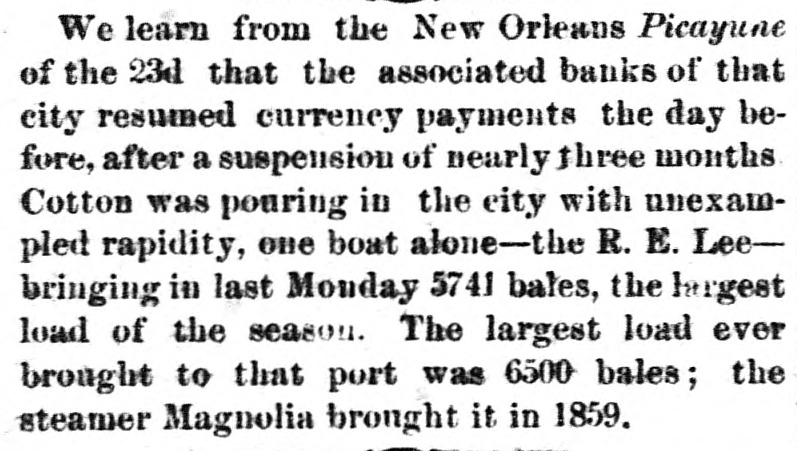
We learn from the New Orleans Picayune of the 23d that the associated banks of that city resumed currency payments the day before, after a suspension of nearly three months Cotton was pouring in the city with unexampled rapidity, one boat alone-the R. E. Leebringing in last Monday 5741 bales, the largest load of the season. The largest load ever brought to that port was 6500 bales; the steamer Magnolia brought it in 1859.


Article from The Morning Star and Catholic Messenger, December 28, 1873

Click image to open full size in new tab

Article Text

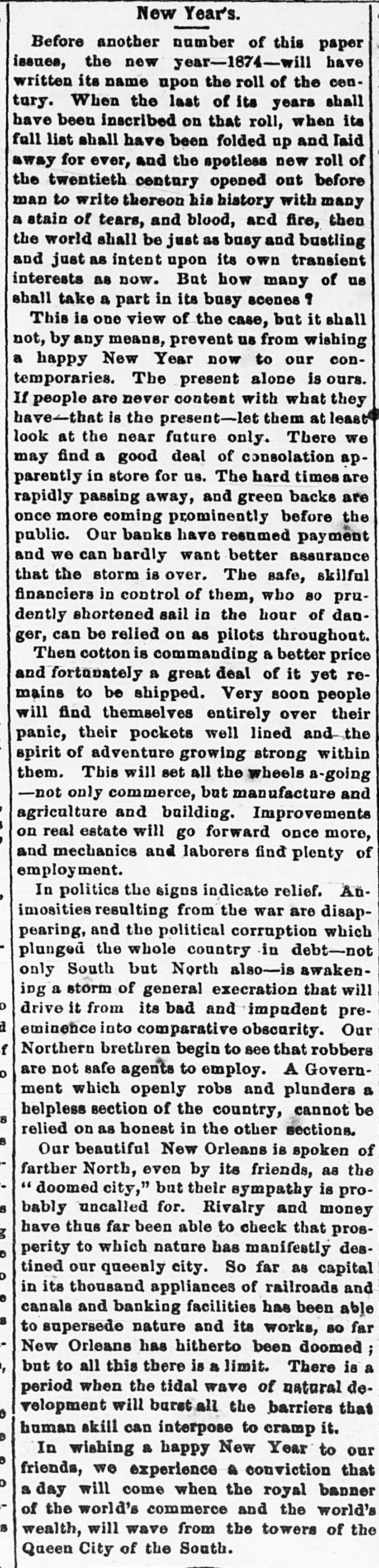
# New Year's. Before another number of this paper issues, the new year-1874-will have written its name upon the roll of the century. When the last of its years shall have been inscribed on that roll, when its full list shall have been folded up and laid away for ever, and the spotless new roll of the twentieth century opened out before man to write thereon his history with many a stain of tears, and blood, and fire, then the world shall be just as busy and bustling and just as intent upon its own transient interests as now. But how many of us shall take a part in its busy scenes ? This is one view of the case, but it shall not, by any means, prevent us from wishing a happy New Year now to our contemporaries. The present alone is ours. If people are never content with what they have that is the present-let them at least look at the near future only. There we may find a good deal of consolation apparently in store for us. The hard times are rapidly passing away, and green backs are once more coming prominently before the public. Our banks have resumed payment and we can hardly want better assurance that the storm is over. The safe, skilful financiers in control of them, who so prudently shortened sail in the hour of danger, can be relied on as pilots throughout. Then cotton is commanding a better price and fortunately a great deal of it yet remains to be shipped. Very soon people will find themselves entirely over their panic, their pockets well lined and the spirit of adventure growing strong within them. This will set all the wheels a-going -not only commerce, but manufacture and agriculture and building. Improvements on real estate will go forward once more, and mechanics and laborers find plenty of employment. In politics the signs indicate relief. Animosities resulting from the war are disappearing, and the political corruption which plunged the whole country in debt-not only South but North also-is awakening a storm of general execration that will drive it from its bad and impudent pre-eminence into comparative obscurity. Our Northern brethren begin to see that robbers are not safe agents to employ. A Government which openly robs and plunders a helpless section of the country, cannot be relied on as honest in the other sections. Our beautiful New Orleans is spoken of farther North, even by its friends, as the "doomed city," but their sympathy is probably uncalled for. Rivalry and money have thus far been able to check that prosperity to which nature has manifestly destined our queenly city. So far as capital in its thousand appliances of railroads and canals and banking facilities has been able to supersede nature and its works, so far New Orleans has hitherto been doomed; but to all this there is a limit. There is a period when the tidal wave of natural development will burst all the barriers that human skill can interpose to cramp it. In wishing a happy New Year to our friends, we experience a conviction that a day will come when the royal banner of the world's commerce and the world's wealth, will wave from the towers of the Queen City of the South.


Article from New Orleans Republican, September 1, 1874

Click image to open full size in new tab

Article Text

aging, the demand revived, and factors were enabled to recover ΒΎ @ β…žc of the previous decline. Passing over the advance during the first fortnight, and comparing the closing with the opening rates, the quotations on September 30 showed a net falling off of only ⅝ @ 1c. The improvement, however, was somewhat illusive, being partly caused by the change in the measure of value from currency to certified checks, which was equal to β…“ @ ΒΌc β…Ÿβ‚ˆ lb on the price of cotton. This change took place on September 25, when the following resolution was adopted by the Clearing House banks: "Resolved, That all deposits made hereafter shall be paid in kind, and that against previous deposits no checks exceeding $25 will be paid in currency to any one depositor on the same day." The resolution was followed by the publication of the agreement for self-protection, which was signed by nearly all the incorporated banks. The cotton movement in September had been only moderately active, the sales summing up 17,900 bales, against gross receipts of 26,732, while the stock by our running statement had increased to 22,386, and the amount unsold was 11,400. This indicates that although the demand had not been very animated the supplies were proportionately light, an actual supply of 11,400 bales, a considerable part of which was unmerchantable or held off the market for further developments, showing that the offerings had been pretty well absorbed by the demand. Buyers having adjusted their operations to the new order, October opened with a more active demand, and, although the New York panic had still a disturbing and unfavorable influence, yet, the supply being light, the previous upward tendency continued, and at the end of the first ten days factors had been enabled to establish an advance of β…œc, but on the eleventh, in response to a decline at New York, the market took an unfavorable turn, and prices receded from day to day until they closed at a net falling off of 1β…œ @ 1ΒΌc from the opening rates and a reduction of 2β…œ @ 2Β½c from the highest point. The movement at the same time had exhibited considerable activity, the month's sales amounting to


Article from The New Orleans Bulletin, January 29, 1875

Click image to open full size in new tab

Article Text

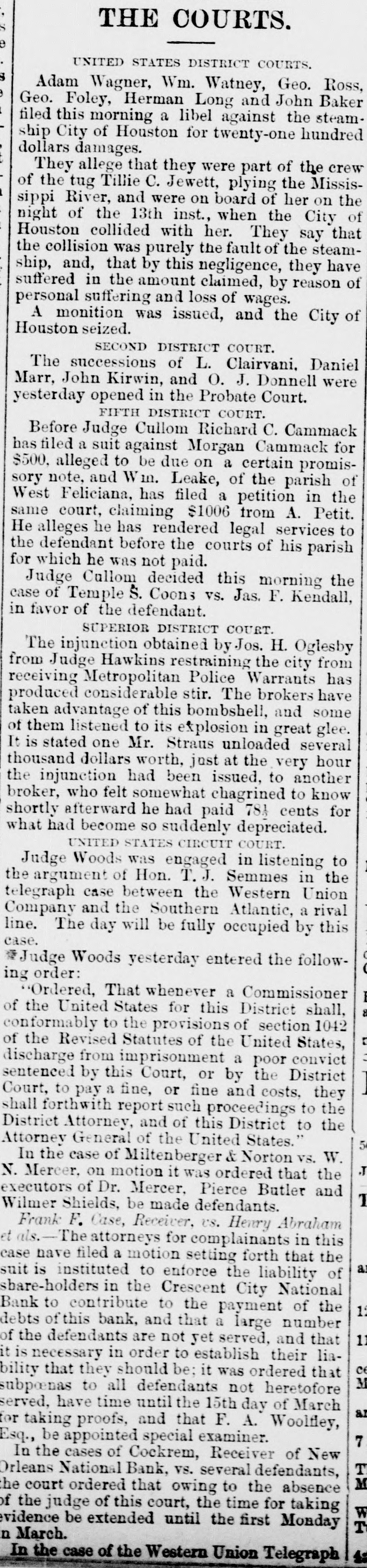
THE COURTS. UNITED STATES DISTRICT COURTS. Adam Wagner, Wm. Watney, Geo. Ross, Geo. Foley, Herman Long and John Baker filed this morning a libel against the steamship City of Houston for twenty-one hundred dollars damages. They allege that they were part of the crew of the tug Tillie C. Jewett, plying the Mississippi River, and were on board of her on the night of the 13th inst., when the City of Houston collided with her. They say that the collision was purely the fault of the steamship, and, that by this negligence, they have suffered in the amount claimed, by reason of personal suffering and loss of wages. A monition was issued, and the City of Houston seized. SECOND DISTRICT COURT. The successions of L. Clairvani, Daniel Marr, John Kirwin, and O. J. Donnell were yesterday opened in the Probate Court. FIFTH DISTRICT COURT. Before Judge Cullom Richard C. Cammack has filed a suit against Morgan Cammack for $500, alleged to be due on a certain promissory note, and Win. Leake, of the parish of West Feliciana, has filed a petition in the same court, claiming $1006 from A. Petit. He alleges he has rendered legal services to the defendant before the courts of his parish for which he was not paid. Judge Cullom decided this morning the case of Temple S. Coons vs. Jas. F. Kendall, in favor of the defendant. SUPERIOR DISTRICT COURT. The injunction obtained by Jos. H. Oglesby from Judge Hawkins restraining the city from receiving Metropolitan Police Warrants has produced considerable stir. The brokers have taken advantage of this bombshell, and some of them listened to its explosion in great glee. It is stated one Mr. Straus unloaded several thousand dollars worth, just at the very hour the injunction had been issued, to another broker, who felt somewhat chagrined to know shortly afterward he had paid 781 cents for what had become so suddenly depreciated. UNITED STATES CIRCUIT COURT. Judge Woods was engaged in listening to the argument of Hon. T. J. Semmes in the telegraph case between the Western Union Company and the Southern Atlantic, a rival line. The day will be fully occupied by this case. Judge Woods yesterday entered the following order: "Ordered, That whenever a Commissioner of the United States for this District shall, conformably to the provisions of section 1042 of the Revised Statutes of the United States, discharge from imprisonment a poor convict sentenced by this Court, or by the District Court, to pay a fine, or fine and costs, they shall forthwith report such proceedings to the District Attorney, and of this District to the Attorney General of the United States." 5 In the case of Miltenberger & Norton vs. W. N. Mercer, on motion it was ordered that the executors of Dr. Mercer. Pierce Butler and I Wilmer Shields, be made defendants. Frank F. Case, Receiver, US. Henry Abraham et attorneys for complainants in this case have filed a motion setting forth that the suit is instituted to enforce the liability of share-holders in the Crescent City National Bank to contribute to the payment of the 1: debts of this bank, and that a large number 11 of the defendants are not yet served, and that it is necessary in order to establish their liace bility that they should be; it was ordered that subpΕ“nas to all defendants not heretofore served, have time until the 15th day of March for taking proofs, and that F. A. Woolfley, Esq., be appointed special examiner. 7 In the cases of Cockrem, Receiver of New Orleans National Bank, vs. several defendants, he court ordered that owing to the absence of the judge of this court, the time for taking vidence be extended until the first Monday


Article from New Orleans Republican, June 3, 1875

Click image to open full size in new tab

Article Text

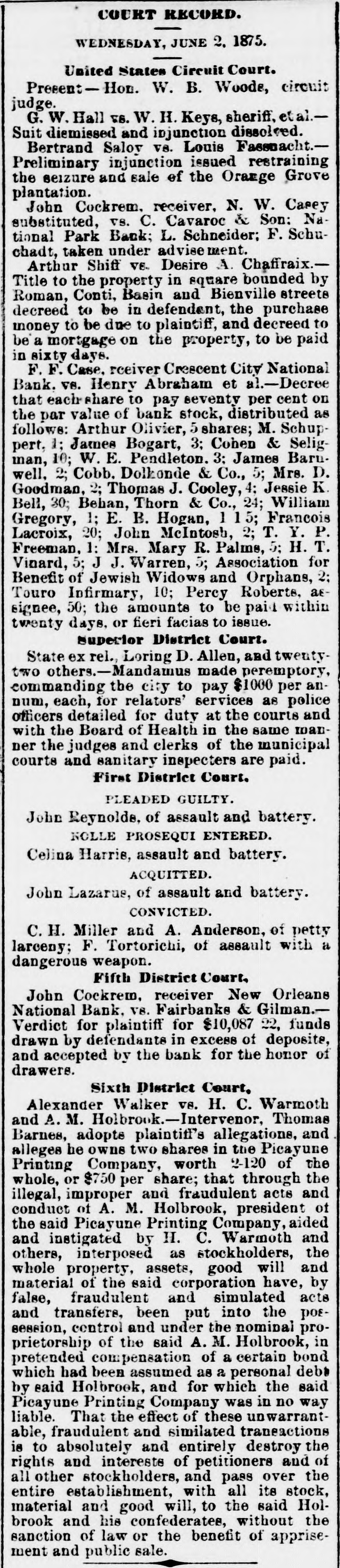
COURT RECORD. WEDNESDAY, JUNE 2. 1875. United States Circuit Court. Present Hon. W. B. Woods, circuit judge. G. W. Hall VS. W. H. Keys, sheriff, etal.Suit diemissed and injunction dissolved. Bertrand Saloy vs. Louis Fassmacht.Preliminary injunction issued restraining the seizure and sale of the Orange Grove plantation. John Cockrem. receiver, N. W. Casey substituted, vs. C. Cavaroc & Son: National Park Bank; L. Schneider: F. Schuchadt, taken under advisement. Arthur Shiff VE. Desire A. Chaffraix.Title to the property in square bounded by Roman, Conti, Basin and Bienville streets decreed to be in defendent, the purchase money to be due to plaintiff, and decreed to be'a mortgage on the property, to be paid in sixty days. F. F. Case, rceiver Crescent City National Bank. vs. Henry Abraham et al.-Decree that each share to pay seventy per cent on the par value of bank stock, distributed as follows: Arthur Olivier, 5 shares; M. Schuppert, 1; James Bogart, 3; Cohen & Seligman, 10; W. E. Pendleton. 3; James Baruwell, 2, Cobb. Dolkonde & Co., 5; Mrs. D. Goodman, 2; Thomas J. Cooley, 4: Jessie K. Bell, 30; Behan, Thorn & Co., 24; William Gregory, 1; E. B. Hogan, 1 1 5; Francois Lacroix, 20; John McIntosh, 2; T. Y. P. Freeman, 1: Mrs. Mary R. Palms, 5; H. T. Vinard, 5; J J. Warren, 5; Association for Benefit of Jewish Widows and Orphans, 2; Touro Infirmary, 10; Percy Roberts, assignee, 50; the amounts to be paid within twenty days, or fieri facias to issue. Superior District Court. State ex rel., Loring D. Allen, and twentytwo others.-Mandamus made peremptory, commanding the city to pay $1000 per annum, each, for relators' services as police officers detailed for duty at the courts and with the Board of Health in the same manner the judges and clerks of the municipal courts and sanitary inspecters are paid. First District Court. PLEADED GUILTY. John Reynolds, of assault and battery. NOLLE PROSEQUI ENTERED. Celina Harris, assault and battery. ACQUITTED. John Lazarus, of assault and battery. CONVICTED. C. H. Miller and A. Anderson, of petty larceny; F. Tortorichi, of assault with a dangerous weapon. Fifth District Court, John Cockrem. receiver New Orleans National Bank. vs. Fairbanks & Gilman.Verdict for plaintiff for $10,087 22, funds drawn by defendants in excess of deposite, and accepted by the bank for the honor of drawers. Sixth District Court, Alexander Walker vs. H. C. Warmoth and A. M. Holbrook.-Intervenor, Thomas Barnes, adopts plaintiff's allegations, and alleges he owns two shares in the Picayune Printing Company, worth 2-120 of the whole, or $750 per share; that through the illegal, improper and fraudulent acts and conduct of A. M. Holbrook, president of the said Picayune Printing Company, aided and instigated by H. C. Warmoth and others, interposed as stockholders, the whole property, assets, good will and material of the said corporation have, by false, fraudulent and simulated acts and transfers, been put into the possession, centrol and under the nominal proprietorship of the said A. M. Holbrook, in pretended compensation of a certain bond which had been assumed as a personal debt by said Holbrook, and for which the said Picayune Printing Company was in no way liable. That the effect of these unwarrantable, fraudulent and similated transactions is to absolutely and entirely destroy the rights and interests of petitioners and of all other stockholders, and pass over the entire establishment, with all its stock, material and good will to the said Hol-