Article Text
thrown out of employment, including the body of opera- tives who were most prominent in the strike of last Sum- mer, and who, it may be supposed, drew most largely on their savings to support that movement. The Atlantic Delaine Mills are controlled by Hoyt, Spragues & Co. of New-York, though not run in their name. Messrs. Sprague have shown themselves very chary of informa- tion as to the steps they have taken or propose to take in curtailing their production, and seem inclined to allow the cloud, which Rhode Island manufacturers say hangs over all interests in the State from the enormous volume of their obligations, to put on its darkest aspect.
REDUCTION OF THE PRICE OF GOODS BY BROWN & IVES.
The Lonsdale Manufacturing Company, which is con- trolled by the house of Brown & Ives, runs five mills at Lonsdale and Ashton, manufacturing villages in the valley of the Blackstone, a few miles from Providence. Here are manufactured cambrics, Lonsdale bleached shirtings, jaconets, etc., and in these five mills are 144,000 spindles and about 3,000 operatives. These mills are still running on full time and with no reduction of wages or employés. The agents state that they desire to keep with them all their operatives, some of whom have been in their employ 30 years and even more, and have as yet decided on no curtailment on account of the financial troubles. Unless matters soon mend, how- ever, they will be forced to retrench. The reduction would probably be made in the wages rather than in hours or force. The agents assert that the operatives have been getting such very high wages that they can well stand a reduction. They look, however, for an early revival of business. The Lonsdale Company this week reduced the price of their goods one cent per yard. Other manufacturers following the example have given orders to their selling agents in New-York to re- duce prices correspondingly. The agents of the Lons- dale Company say that as cotton is falling ½ of a cent per pound daily, with reduced wages they can make a fair profit at the lower rate. The reduction has not been wel- comed by their competitors, who say that they could keep up their mills at full time at the old rate, but must now curtail. Brown & Ives also control the Hope Mill, at Scituate, which makes shirtings. The mill contains 28,000 spindles and employs 350 hands. They also control the Berkeley Mill, in Cumberland, seven miles from Providence, which is a new enterprise. The mill is now running over 300 looms, and, having a capacity of 40,000 spindles, employs about 400 persons. Here are made fine goods, sixties, eighties, and one-hundreds. The Hope and Berkeley mills are running on full time, and at the latter place new looms are being frequently added. The manufacture of the class of goods made at the Berkeley is said to be new in this country. The same policy will be pursued at these two mills as at Lonsdale and Ashton. Beside these a print cloth manufactory in Blackstone, Mass., with 50,000 spindles and some 600 hands, is con- trolled by Brown & Ives. This manufactory was shut yesterday, partly for repairs, but more on account of the depression. The present intention is to resume at full time on Monday next, but action will be governed by the condition of trade.
Belonging to the Crawford-Allen estate, and now con- trolled by M. B. I. Goddard of this city, are the Allen Print Works in Providence, the print cloth mill of the Bernon Manufacturing Company at Georgiaville, R. I., the Woonsocket Company's cotton mill at Woonsocket, R. I., and the two mills of the Smithfield Manufacturing Company, one in Alleaville, R. I., the other in Dedham, Mass. Mr. Goddard also acts as agent for the Fitchville Manufacturing Company, whose mill, at Fitchville, Conn., manufactures shirtings. The Allen Print Works, which have a dozen machines with a capacity of about 15,000 pieces per week, and employ nearly 400 hands, stopped a month ago. At these, as at other print works, a stop of a fortnight twice a year, in the Spring and Autumn, for repairs and preparation for the change between light and dark goods, has been cus- tomary. The time of the Autumn closing has been Nov. 1. The panic hastened the suspension this season, and no time of resumption is yet fixed upon. The Bernon Mill, which has 603 looms, 30,000 spindles, and about 450 hands; the mill of the Woonsocket Company, with 13,000 spindles and 170 hands, and the Allenville Works of the Smithfield Manufacturing Company, with 10,200 spindles and 150 hands, all stopped on Saturday, the 11th inst. When they resume-a time as yet not fixed with certainty, but possibly Monday next-there will be some reduction, probably in time. It is thought by the representatives of these mills that a suspension of a few weeks will be lightly borne by the operatives, but longer idleness would drive many of the French Canadians of whom there is a large number employed throughout Rhode Island-to Canada for the Winter, and cause distress among them and trouble to the em- ployers to get labor in the Spring. The Fitchville Com- pany-whose new works have a capacity of 15,000, now running 12,000 spindles-has made no reduction of any kind. Two hundred hands are employed. At the Ded- ham Mill of the Smithfield Company, now running on full time, are 163 hands and 12,000 spindles.
PARTIAL SUSPENSION OF WORK IN OTHER MILLS.
The Albion Manufacturing Company at Albion, R. I., runs a mill for the manufacture of print cloths, which has 400 looms and about 22,000 spindles. It will run on full time up to Jan. 1, as it has contracts to fill up to that time. The Monville Manufacturing Company, whose new mill at Monville, R. I., is one of the largest cotton mills in the country, having a capacity for 100,000 spindles, has as yet put in but 1,200 looms, and has been employing 1,000 hands in the manufacture of print cloths, jaconets, &c. On Saturday, the 11th inst., the mill was closed, with the intention of resuming this week on half time. The Chace Mill at Washington Village, Pawtuxet, R. I., which has 4,000 spindles, was closed the same day. The Central Manufacturing Company, which has a mill at Plainfield, Conn., with 10,000 spindles, is now running on two-thirds time. The great cotton mills at Wauregan, Conn., and at Ponema, near Nor- wich-the latter ranking among the chief mills of the country, and having 72,000 spindles, and the former hav- ing 56,000 spindles-which are controlled by Providence capitalists, have been running on half time since Mon- day, the 20th instant. Their agent in this city, Edward P. Taft, says that the operatives are excellently well sit- uated to bear the reduction, being a very thrifty class, and having saved from 30 to 35 per cent of their abun- dant wages. The Warren Manufacturing Company of Warren, R. I., which has near 60,000 spindles, shut down entirely for a few days, and with the Cutler Manufac- turing Company of the same place is now running on half time. Mills in the Quinebaug Valley, in Eastern Connecticut, which are controlled by Rhode Island man- ufacturers, have almost all cut down their running time to seven hours per day for five days in the week. The owners of the large woolen mills at Woonsocket, R. I., and Waterford, Mass., are now considering the question of running only half time. None of the Rhode Island woolen mills have yet stopped entirely. The closing of a woolen mill causes so much more derangement and loss than that of a cotton mill that the woolen manufac- turers are very loth to suspend wholly, even though they cannot sell their goods. The Greene Manufacturing Company, at Norwich, R. I., which has 25,000 spindles, and makes print cloths, shirtings, and similar goods, has been running for a fortnight on three-quarters time. The Luppitt Mill, at the same place, which makes print cloths and has 7,000 spindles, will run full time to Nov. 1, when it will either stop or reduce. The Coventry Mills, at Anthony village, Coventry, R. I., with 10,000 spindles, making print cloths, will pursue the same course. Many other small mills have either reduced their running time or will do so soon.
GENERAL PROSPECTS.
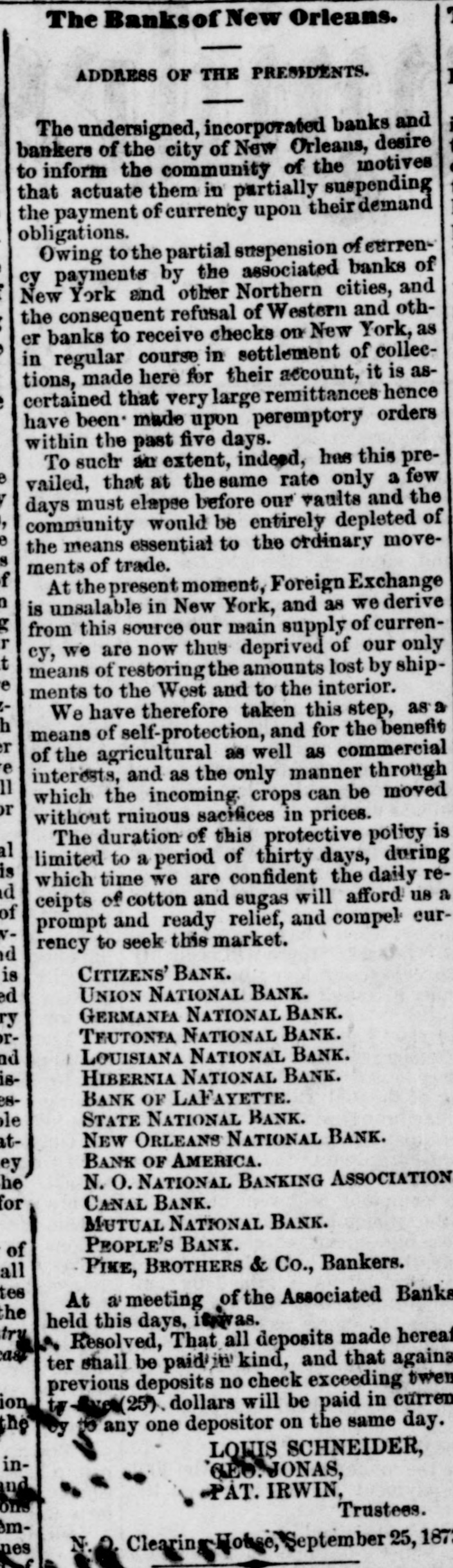
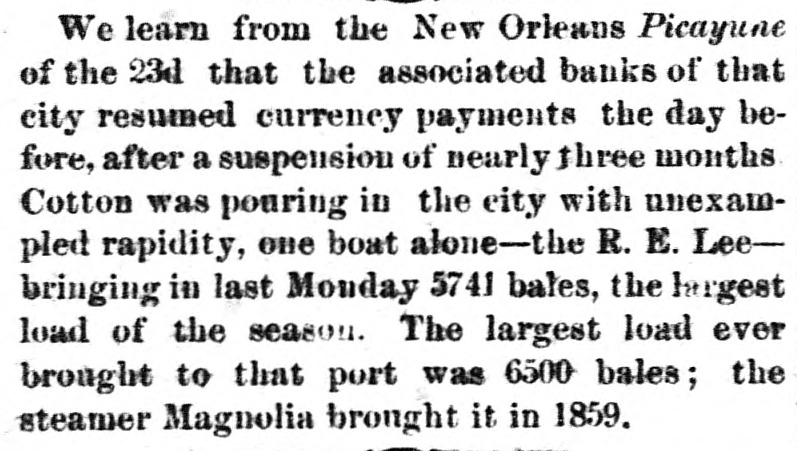
NEW-ORLEANS BANKS TO RESUME NOV. 10-A STRIKE OF COLORED LABORERS.